“The Circle” movie review

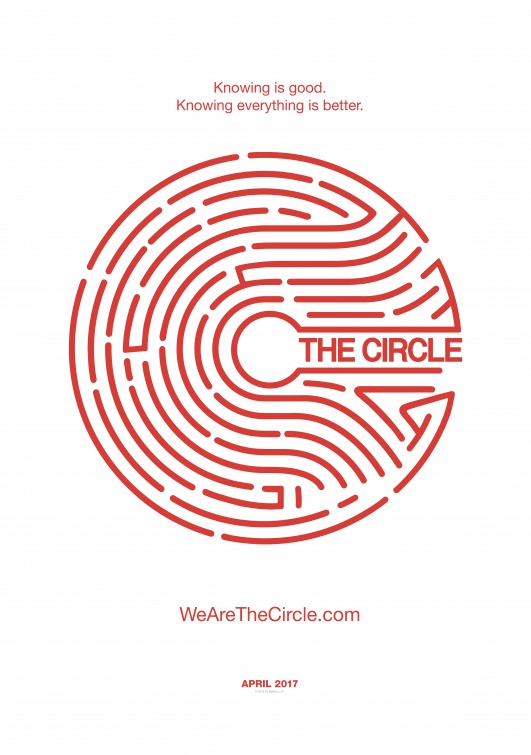
Tries for a perfect circle, but winds up more like an oval. Full of endless circular logic and irony, director James Ponsoldt’s The Circle depicts the story of a not-so-distant future, or perhaps an alternative present, in which one company dominates digital media, data gathering, and surveillance services. Based upon the four-year-old novel by author Dave Eggers, you’ll notice some stark similarities between this motion picture narrative and the smash hit TV series Black Mirror. The biggest difference between the two is that The Circle is fast-faced and poorly written whereas Black Mirror is a slow-burning but well-written anthology series. In addition to the similarities between the aforementioned, there are certainly elements of The Truman Show in this movie as well. With a powerhouse cast, brilliant composer (Danny Elfman), and excellent editing, The Circle appears to have what a blockbuster needs; however, the hollow characters, poor character development, fractured subplots, and overall diegesis hold the film back from reaching the impact that it could have had. Having taken a digital media and privacy class in graduate school, and published a few articles, this is a film that I was looking forward to in order to analyze how the social commentary or commentary on the human condition regarding reasonable expectations of privacy and big data were integrated into the plot. Sadly, the screenplay was not strong or developed significantly enough to provide big data and privacy discussions.

Mae Holland (Emma Watson) hates her job at the water company, so she is incredibly excited when her friend Annie (Karen Gillan) lands Mae an interview at The Circle, the world’s most powerful technology and social media company. Mae’s fear of unfulfilled potential impresses the recruiters at The Circle and she lands the opportunity of a lifetime. After Mae puts herself into harm’s way but rescued, thanks to The Circle’s newest surveillance and data gathering system, she is encouraged by the company founder Eamon Bailey (Tom Hanks) to take a more active role in technology development by participating in an experiment that puts Mae’s life on display for the world (in the vein of The Truman Show) to see. Once Mae turns on that camera, she has more “friends” than she ever imagined and becomes an instant online celebrity. Unfortunately, this decision will affect those closest to Mae and the negative ramifications will reach far beyond her inner circle and begin to impact humanity at large. Sometimes, people just don’t want to be found or be “social.”

For all The Circle has going for it, the weak screenplay keeps it from being the blockbuster that it so desperately wants to be. A great movie typically begins with solid writing, and that is what’s missing here. After five minutes (or so it seems) of opening title logos, perhaps that is indirect evidence that there were just too many hands in the pot, each trying to take the movie’s narrative in a different direction. Much like Frozen plays off like two different movies crudely sewn together, The Circle appears to be one movie for the first two acts, but takes an unexpected and unfulfilling turn in the third. A couple of conspicuous unanswered questions come after Mae meets TrueYou designer and founder Ty (John Boyega). He designed the platform that launched The Circle. At one point he asks Mae to meet him in a secret tunnel (where all the servers are stored) and tells her that “it’s worse than I thought.” Great opportunity to introduce intrigue, suspense, and more. The problem is that the audience is never told what Ty finds or what happens with what he found. You can remove that whole subplot and the movie remains the same. There are other subplots that are nicely introduced, but never carried out as well. Any or all of them can be removed and the film proceeds the same. Not good. If you can remove several subplots or unfulfilled turning points and the film’s diegesis remain largely untouched, then you have poor writing. The third act in and of itself leaves audiences with a hurried ending that does little to provide closure to the narrative; however, it does support the film’s circular logic and irony. Hardly satisfying.

In terms of the allegory here, The Circle is a Google-like company with Apple’s technology. Eamon Bailey is a Steve Jobs type innovator with characteristics of Mark Zuckerberg and Google’s Eric Schmidt. Thankfully, The Circle does not represent any one company, but rather combines all the most notable innovations and technological achievements of Google, Apple, Facebook, Instagram, and more into one globally dominating company. Antitrust issues are introduced early on, but again, that’s never fully developed. The movie highlights many issues faced by private citizens, governments, and digital data driven companies today; therefore, it sets the foundation for a movie that could have been thought-provoking, but the writing hinders that ability. The irony in the movie is for every digital answer to streamlining services or bolstering conveniences, a little privacy is eroded each time. Pretty soon, if one shares enough information, the idea of privacy is extinct. Privacy was central to the plot, but it just wasn’t handled in the most effective way. Concepts such as “off the grid,” self-proclaimed “celebrity,” and “calls to action” are displayed and discussed in the film, connecting this augmented reality to real-world issues each of us encounter or think about. One particularly interesting theme in the movie is deep friendship. Unfortunately, this was not fully fleshed as is the case with most of the movie; but still, it does get touched upon.

Exploring digital media and privacy is something I have written on within the last couple years. More specifically, I explore how entertainment media companies collect big data, and the privacy issues faced therein. In 2016, I published a short series of articles on the Walt Disney World Magic Bands entitled “Magical Data Collection.” You can read those articles by clicking HERE.

If you were hoping for another film like the brilliant Social Network, then you will undoubtedly be disappointed. Films such as The Circle should be memorable, but unfortunately this one is very much forgettable. Coincidentally, the movie itself is as hollow as the plot and characters.

Written by R.L. Terry

Edited by J.M. Wead

“LIFE” movie review

Chilling! In space, no one can hear you scream. Although that tagline is associated with Ridley Scott’s groundbreaking space-horror Alien, director Daniel Espinosa’s LIFE delivers an intensely dark thriller that will have you screaming and cringing from the moment life on Mars is discovered. In the same vein as AlienLIFE is a science-fiction horror that may look like Gravity and might even have the strong orchestral sounds of Interstellar, but provides audiences with an entirely different experience. Borrowing from Alien and Gravity, Sony and Columbia Pictures craft a new space-horror narrative that can sufficiently serve as a standalone film–and be great in that–but also has potential for a sequel or two. Interestingly, there are parallels to Ridley Scott’s Alien beyond the premise; LIFE also features the same number of crew members and other more subtle elements. That being said, LIFE is definitely not a knockoff Alien nor is it trying to be Ridley Scott’s critically claimed film as it does not contain the social commentary on gender, sex, and family. However, imitation is the highest form of flattery, and LIFE pays both homage to the film that likely inspired it but delivers a comprehensive science-fiction horror experience that provides ample twists, turns, and even some emotional connection along the way.

A group comprised of engineers and researchers on board the International Space Station (ISS) are on the brink of one of the most important discoveries in human civilization: life on Mars. Rory Adams (Ryan Reynolds), David Jordan (Jake Gyllenhaal), Miranda North (Rebecca Ferguson), Sho Murkami (Hiroyuki Sandana), Hugh Derry (Ariyon Baker), and Ekaterina Golovkina (Olga Dihovichnaya) represent several different counties, all working in cooperation on this groundbreaking mission. After the satellite, carrying the Martian sample, is retrieved from spiraling out of control towards the ISS is secured, the group of astronauts are faced with the crisis and task of retrieving it. After a daring retrieval, what should be a joyous discovery–something out of a scientists dreams–soon becomes a living nightmarish game of hide and seek. When the specimen from Mars begins to grow rapidly and become more and more intelligent, it stops at nothing to continue to feed the alien’s insatiable appetite and its goal to find a new home.

Initial impressions of LIFE leave you with noticing just how much like Alien it feels. It’s been nearly forty years since the Ridley Scott cinematic masterpiece, but in that time, no other science-fiction/horror film has come this close to delivering a similar (note: not as high on the cinematic totem pole as its predecessor) experience to that which first terrified audiences in 1979. One of the primary differences between Alien and LIFE is just how much closer to home this horrifying experience occurs. Whereas with the former, the alien encounter takes place hundreds of lightyears away, the latter’s narrative takes place just outside of our atmosphere on the ISS. Not that LIFE feels more intimate than Alien–it doesn’t–but the proximity of this story might add a little something more to the edge that you’re already sitting on as the horrific events unfold on the space station. Pacing is similar to Alien in that LIFE has a slow burn during the first act. To balance this slow burn or to keep audiences from thinking that it’s taking forever for the movie to really get started, the film begins with the “big event” right at the very beginning. The “big event” being the apprehension of the satellite carrying the Martian specimen. But for all it’s similarities, this movie provides a different experience that can certainly stand on its own. LIFE may have been inspired by Alien, but it is certainly not a ripoff.

I’ve been quite critical of the CGI-effects of films in more recent years, but the brilliance of the alien life form in LIFE is the degree to which it feels organic. In the beginning, the life form is little more than a single-celled organism; however, as the plot thickens, the organism begins to take a more chilling form and shape. Eventually, the alien develops a frightening grin and a mysterious-like form. One of the scariest parts of Ridley Scott’s Alien was the degree to which the Xenomorph feels so real that, even in your seat, you could feel the acidic slime and your body likely felt the excruciating pains of that iconic moment when the alien shoots out of the stomach. Part of that can be attributed to the use of pneumatics, animatronics, miniatures, and other practical effects standards. Yes, the alien life form in LIFE is computer-generated, but it also has a very real nature to it. Instead of focussing on how to make the alien as impressive as possible, it would appear that the special effects artists (whose work can be seen in the Transformers movies) focussed more on the small details that ordinarily give a CGI character away. Just like with the brilliant visual effects work in Ex Machina, the visual effects of the alien are flawless.

There is an inherent level of unpredictability in LIFE even after the unavoidable similarities to AlienLIFE plays around with the final girl trope and the killings have a strategy or method to their madness. Conspicuously missing from the characters of LIFE in a comparison to Alien is a Ripley-like character. Does the film portray strong female characters? Certainly. But LIFE keeps you guessing because the order of the deaths do not follow any predictable pattern. Do not allow yourself to fall into the trap of being predisposed to the order of the killings to be based up on star billing. Speaking of the characters, effectively managing an ensemble cast is always difficult. So often, some characters in the ensemble get lost or do not receive nearly as much development as the more obvious leaders. Not true with LIFE. True that there is not a large degree of character development all the way around, but each of the characters is treated with equal screen time and emphasis. That is, until death occurs. The excellent handling of this ensemble gives LIFE an extra dynamic that lacks in other ensemble cast films, thus helping this science-fiction horror to stand out from others that are similar in premise or plot. This movie has a “life” of its own.

2017 seems to be shaping up to be a year of excellent movies! We are just about to finish the first quarter of the year, and already there have been some great motion pictures. Furthermore, 2017 seems to be the year of the horror film because so many have made the theatrical distribution circuit. For those who love a good science-fiction thriller, you will not be disappointed with LIFE. Albeit the film may not be able to sustain the magic and horror for the entire runtime, it successfully delivers a terrifying experience for most of the film. If you don’t mind some cringeworthy moments and the dark tone of the film, then this is definitely one to see this weekend.

PS. I saw Power Rangers this week as well, and it was a delightful film! Yeah, it’s a little campy, but that’s to be expected. Definitely the best Power Rangers motion picture. All-in-all, it sufficiently pays homage to the 90s show but provides audiences with a new story. Go-go see it too!

Written by R.L. Terry

Edited by J.M. Wead

“KONG: Skull Island” movie review

“Hold onto your butts;” Warner Bros. and Legendary Entertainment’s KONG: Skull Island is full body KONG with just a hint of story. Wait. Isn’t that a line from Jurassic Park??? Sure is. And guess who delivers it? None other than Samuel L. Jackson himself–reprising his famous line from one of the most iconic films in the American cinema library. It’s rather fitting since there are many shared elements between KONG and the Jurassic Park franchise. Both take place on an island and deal with science vs. nature and pit man against ancient creatures. King Kong is no stranger to most people, considering he’s been a fixture in the cinema and theme park universes respectively for many decades. From silver screen to Universal Studios, he remains an icon to which few “monster” movies compare. Although the previous KONG films followed a very similar narrative, this newest incarnation of the king of Skull Island takes a modified route to the classic story. It shares many of the same elements or themes with its predecessors, but through the echoes of the past comes a reimagined story. Diegetically, the film certainly suffers; furthermore, it attempts to integrate social commentary on war, Captain Ahab allegory, and conservation, but none of those themes are effectively carried out. Due to the enormous “King Kong” sized cast, there lacks any real connection to any of the characters and development is certainly obscure, if any at all. Films such as this one can sometimes run into the danger of waxing nostalgic too often and forgetting that audiences want a new movie (i.e. Star Wars: the Force Awakens); and like the aforementioned, Jordan Vogt-Roberts’ KONG: Skull Island provides audiences with connections to past King Kong movies in a new approach, but ultimately crafts generic experience.

When an uncharted island shows up on U.S. satellites, Bill Randa (John Goodman) and Houston Brookes (Corey Hawkins) approach a prominent senator, seeking clearance and funding for a mapping expedition and exploration of the mysterious island resembling a skull. Begrudgingly, the senator clears Randa’s MONARCH for one last mission before the U.S. pulls out of the south Pacific following the Vietnam War pull-out. Partnering with Colonel Packard’s (Samuel L. Jackson) military troop and attaching ex-British special forces Captain Conrad (Tom Hiddleston) and photo journalist Mason Weaver (Brie Larson) to the group, the expedition lays out plans to penetrate the severe storms surrounding the island to explore the island. What the group encounters on Skull Island will give them nightmares for the rest of their respective lives. Beginning as a glorified mapping excursion, this expedition turns into a game of survival as the group makes its way across the island.

At the end of the day, this movie accomplishes what it set out to do: revive Kong, thrill people for a couple hours, and setup KONG v. Godzilla. Action-adventure films are typically not expected to contain brilliant writing, character development, and strategically placed themed and subtext. What I respect about this movie is that is unashamedly pretends not to be anything other than a larger than life adventure centered around one of cinema’s most iconic “monsters.” Clearly, there are attempts in the movie to include some deeper themes such as anti-war, nature/conservation, and even a little Moby Dick; but those themes appear to have been great thoughts that were not fully executed. That being said, there is clearly a Captain Ahab figure in the film and there are many similarities between King Kong and Moby Dick–size just being one of them. For fans of Jurassic Park you’ll appreciate not only Jackson’s “hold onto your butts” line at the beginning of the film, but also several similar scenes, camera angels, and even the helicopter entry onto the island. Lots of nostalgia, but not so much that it feels like you’ve seen it all before.

In many ways, Kong is bigger than ever, but hardly better than previous Kong films. Ironically, this same thing can be said about the former Kongfrontation attraction at Universal Studios Florida. Much like the new attraction Skull Island: Reign of Kong at Universal feels far more generic than its predecessor, today’s Kong lacks the magic and innovation that the original Kong did in 1933. Despite an attempt to successfully launch a series of “creature features,” the script and human characters certainly suffer. Little can be said about the dialog except that occasionally there are lines that move the story along instead of stating the obvious or predictable. The dialog is cumbersome and never seems to remain focussed very long. Of course, that is hard to do considering that Kong boasts an extremely large ensemble cast. At the forefront of the cast are Hiddleston, Larson, Jackson, Goodman, and Reilly’s respective characters. Of all the characters, John C. Reilly’s Hank Marlow steels the screen about as often as Kong does. One might even be able to say that this is as much a John C. Reilly film as it is a Kong movie. Part of the magic of the previous Kong films, the 1933 version to be more specific, is the setting and characters themselves. Much like the new KONG attraction at Universal took physical sets, animatronics, real fire, etc and crafted a virtual 3D experience, the special effects artists and set designers did the same thing in KONG: Skull Island. The film comes across as less Kong and more Pacific Rim. In other words: generic.

KONG: Skull Island will certainly keep you entertained the whole time as action-adventure films are supposed to do. You’ll enjoy the fight scenes and the whole “creature feature” approach this film takes. If you’re looking for moments taken right out of the previous Kong movies, then you’ll mostly be satisfied. There are few scenes taken directly from the previous movies, but there are certainly allusions and nods to classic moments. You won’t spend much time with the natives nor will you get to witness the famous Empire State Building scene, but you’ll likely enjoy the film nevertheless. Just because a film takes a reimagined approach to a classic character that ultimately plays off as generic, doesn’t mean that there isn’t anything to enjoy. For action junkies, there is plenty to grab your attention and hold it for the duration of the movie.

Written by R.L. Terry

Edited by J.M. Wead

“The LEGO Batman Movie” movie review

legobatmanNonstop antics, action, and thrills! Warner Bros. and Ratpac Dune present a movie that is equally one-hundred percent Batman whilst still completely LEGO. From the moment the opening title sequence of logos appears under the voiceover of a self-aware Batman, this brilliant animated film will take captive your attention and draw you in with a batarang of perfectly choreographed fight scenes and incredibly well timed self-reflexive humor. The LEGO Batman Movie is an entertaining combination of a contemporary story on the backdrop of Batman nostalgia. Whether you are a fan of the show from the 1960s, the Burton universe (as I am), the dark world of Nolan, or Snyder’s, you will find strategically placed references that fit exceptionally well into this LEGO universe. While the film is aimed at a younger audience, there are humor, easter eggs, and allusions to the various Batman shows and movies for adults to appreciate. Underscoring the over-the-top high concept plot, is a heartwarming story of love, family, and friends. This Batman movie pulls out all the stops as most, if not all, Batman’s villains receive screen time as well as other members of the Justice League with Batgirl and Robin. Oh yeah, the Joker IS actually in this Batman movie! With a 90% on Rotten Tomatoes and an 8.1 on IMDb, this film is sure to be a huge success this weekend.

When after a failed attempt at a takeover of Gotham by the Joker (Zach Galifianakis) and his henchmen, Batman (Will Arnett) is all too happy to accept all the credit for stopping the squad of villains. However, this time is different. The Joker and his henchmen give themselves up to the new Commissioner [Barbara] Gordon (Rosario Dawson). When the law enforcement and people of Gotham conclude that there is no longer a need for a masked vigilante, Batman finds himself having an identity crisis. Meanwhile, at a party, Bruce Wayne accidentally adopts young Richard Greyson (Michael Cera), and now is faced with the challenge of balancing his newfound role as a parent with Batman’s penchant for crime fighting. With pressures from Alfred (Ralph Fiennes) and Barbara Gordon mourning in Batman’s personal and professional lives, he must work through these challenges in order to save the city. Only this time, he may not be able to do it on his own.

What’s not to like??? The LEGO Batman Movie is one of those animated films that is perfect for (1) the whole family and groups of friends, as well as (2) legacy and new Batman fans. Just the animation and production design are positively mind blowing. With few exceptions, every design in the film from people to buildings and vehicles can be created with those iconic plastic building blocks. Much like with the previous LEGO movie, other LEGO universes get screen time as well (some of which are mentioned by name and others are implied), such as Lord of the RingsHarry PotterJurassic ParkKing Kong and more. With all the characters in the film, the focus is never shifted from Batman and Joker. There are many rabbit trails the film could have gone down, but it always stays true to the central characters. Overstimulation is another risk in a film like this one; but, for all the action sequences and ensemble casts, never once does the film feel that it is way too much to take in and enjoy. On top of the brilliant animation and design, is solid writing with excellent character development. Crafting the vision is director Chris McKay. Selecting the right director to handle all the elements of a LEGO movie is no short order. And Warner Bros and Ratpac Dune made a killer choice in McKay who brought us Robot Chicken: Star Wars: Episode III.

One of my personal favorite elements from the movie is the nostalgia meticulously and strategically woven into the plot. If you grew up watching the show from the 1960s or even reruns with your parents, you will be surprised with the echoes of the past and how they fit in perfectly with this Batman world written by Seth Grahame-Smith et al. Even the pow, bam, zap sound effect bubbles make a cameo appearance. The LEGO Batman Movie offers the best of all the Batman stories over the years. As I am not familiar with the Batman comics, I imagine that there are comic book references in the film for the enjoyment of that audience as well. Not as self-aware as Deadpool, this film does contain a hint of self-awareness, but never takes the place of the foreground action; however, it supports the main story nicely. Even the costumes are representative of many Batman universes. For the most part, Batman’s costume is rooted in the one worn by Michael Keaton in Batman and Batman Returns, but Batgirl and Robin’s costumes, respectively, are more reminiscent of the show from the 1960s. Joker is an excellent combination of the, in my opinion, definitive Joker: Jack Nicholson but hints of the more recent Jared Leto and Heath Ledger Jokers are in his costume, makeup, and behavior. We even get a more accurate representation of Harley Quinn in this film. There is quite literally something for everyone in LEGO Batman.

Looking for a great film to watch this weekend that doesn’t involve some sappy victimized Stockholm Syndrome-esque warped love story? Then head to your local theatre to catch The LEGO Batman Movie on the big screen! What better way to spend the weekend leading up to Valentine’s Day than laughing with your date??? Even if you’re spending Valentine’s Batman style–flying solo–you will still have a great time at this movie.

“Patriots Day” movie review

patriotsdayEmotionally intense–not for the faint of heart. Patriots Day is the dramatic account of the Boston Marathon Bombing and manhunt for Dzhokhar Tsarnaev and his brother Tamerlan Tsarnaev. Starring a powerhouse cast on top of extensive research, this film couldn’t come at a better time when there exists such a low general public opinion of law enforcement. Boston Police Department (BPD) shines as it shows that law enforcement officers and officials truly care about the city they are responsible for protecting. Although tragedies often are more conducive for a documentary film, writer-director Peter Berg combines the information found in a doc film with cinematic storytelling techniques to successfully construct a narrative that will rock you to the core and keep you on the edge of your seat. With the inclusion of first person, news, and surveillance footage, Patriots Day does not shy away from the visceral horror that befell the City of Boston and surrounding areas. You think you may know the story, as I did, but nothing will prepare you for coming face to face with one of the most tragic events in modern U.S. history.

Ordinarily, this is where I summarize the plot; but the plot is mostly known all too well. Fortunately, this film goes beyond the news reports and constructs a diegesis (story/narrative) around the stories of eye-witnesses, victims, the wounded, medical first responders, and law enforcement–both local and federal.

Mark Wahlberg, John Goodman, Kevin Bacon, J.K. Simmons, and the rest of the principle and supporting cast deliver outstanding portrayals of the real men and women who were instrumental in the response to and apprehension of the bombers as well as those who fell victim to the arson and shrapnel. It isn’t often that films depicting tragedies are produced this close to the events contained therein. Occasionally, there are films about tragedies that are truly better suited for a documentary; but, in order to convert it to a cinematic motion picture, a love story is added for diegetic affect. That is not the case with Patriots Day. The focus is on the BPD, FBI, and medical first response to the bombing and massive manhunt that ensued immediately after the explosions. There are certainly romantic relationships indirectly connected to the narrative, but they are mostly included to juxtapose the everyday life that everyone thought they were going to have on April 15, 2013 against the horrifying events that transpired at America’s longest running marathon, which has become such an iconic event each year.

Logistically and diegetically, there is a simple answer as to how this tragedy was so successfully translated to the silver screen so close to the day it occurred whereas other tragic events (mass shootings, bombings, aero-spacial, maritime, etc) are more conducive for and translate to a documentary better. This tragic event is a combination of (1) the explosions themselves (2) the manhunt afterwards and (3) the impressive work of law enforcement. There is more to this story than the bombing itself. Certainly the bombing was the catalyst for the events that ensured afterwards, but the real story is of the incredible actions of law enforcement and other first responders. While there seems to be a general focus in broadcast news media on the negative actions–whether perceived or otherwise–of law enforcement officers, this powerful film shows police officers in a positive light–shows them as individuals who love the city under their protection and stop at nothing to protect the innocent. This is so important in today’s climate of scrutiny of public safety officials.

The cinematography, visual effects, and production design are flawless. So incredibly realistic that you will likely feel transported from your seat into the film itself. To my surprise, the film included interviews with key figures directly involved with or affected by the Boston Marathon Bombing. It’s not uncommon to include photos with textual exposition on the lives of central figures in a historical film; but this film goes beyond telling you “where they are now” or what happened after the events in the film. It includes video footage of interviews–you get to hear from the individuals upon whom the characters were based. I could not think of a better ending to a film such as this one. Patriots Day works because it is the best of what a documentary offers with the brilliance of cinematic storytelling techniques.

For those of you who appreciate historical films depicting tragic events, then this is one that you need to watch. It is not a film to be enjoyed in the conventional sense, but one that packs a powerful message and neither glorifies nor undermines the real historic event. Such a visceral film. Rated R for adult language.

Written by R.L. Terry

Edited by J.M. Wead