“Last Flag Flying” film review

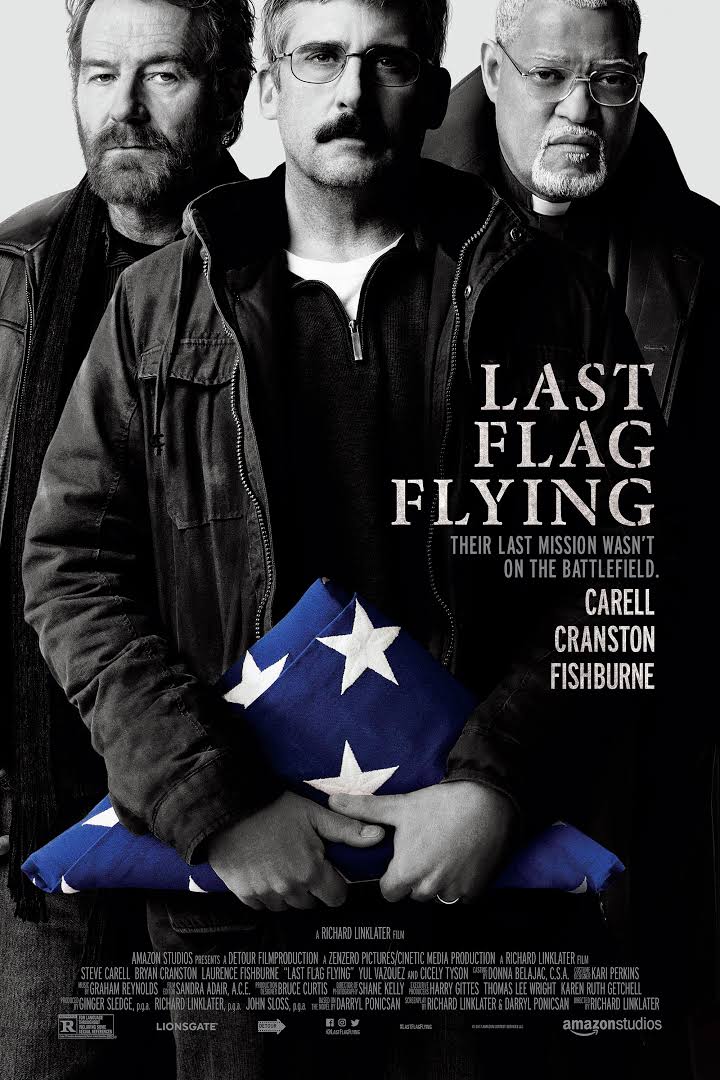
An all-star cast takes audiences on a memory journey of war, loss, friendship, and patriotism as genuine human emotions are dealt with through comedy and grief. Amazon Studios hits a homer again with the release of Last Flag Flying distributed by Lionsgate. Now in select theaters, writer-director Richard Linklater crafts an incredible motion picture that organically deals with the loss of a loved one during a time of war through the stages of grief and irreverent comedy between friends. While this film is currently flying under the radar, don’t allow that to dissuade you from watching this incredible war film. I cannot remember the last time that I saw a film that felt so genuine. Watching this film, I truly felt like a fly on the wall, watching a Vietnam vet deal with the loss of his son and reconnecting with some of the closest friends he ever had in his life. Last Flag Flying is a subgenre of war movies that places the camera at a distance from the characters and allows them to mourn and laugh on screen without interference from censors and other outsiders. While not a conventional war movie, the topic of war is found underlying many diegetic components. Dialogue driven, this film provides social commentary on patriotism, God, and friendship. Bring your listening ear to this movie because the context of the tough subject matter contains subtle yet powerful messages that highlight otherwise unstated emotions. Sometimes the best way to go through the stages of grief is to throw caution to the wind and allow humor to work its powerful remedy.

Three Vietnam war veterans reunite for a different kind of mission that forces them to deal with the present and the past. When Larry “Doc” Shepherd (Steve Carrel) arrives at the dive bar that belongs to former comrade Sal Nealson (Bryan Cranston), he asks his Marine brother to go with him without naming where. Sal drives Shepherd to a old country church now pastored by their Marine brother Richard Mueller (Laurence Fishburne). When Shepherd doesn’t touch his pale cobbler, the group realizes there is something wrong. It’s then the Shepherd reveals that his son was killed outside of Baghdad, and wants his two Marine brothers to go with him to bury his son at Arlington. Along the journey, the three former military comrades are forced to come to terms with their shared past that continues to shape their present lives by discussing tough topics such as grief, God, war, honesty, and addiction.

The sheer storytelling beauty of Last Flag Flying is found in the solid writing made evident through the excellent direction and A-list cast (and one surprising cameo that I won’t mention because it will detract from the brief but powerful screen presence). While it may appear like a somber tragedy on the surface, beneath that surface of sadness beats the heart of dark but respectful comedy that takes audiences on the memory journey right along side the characters. War movies about the loss of loved ones is not something new; but this film allows the characters to go through the stages of grief in organic ways that paints a motion picture of how human these emotions are. Human. Truly human. At times, there are no holds barred when three very different voices all converge on the same topic. You have the grieving father, a reverend, and foul-mouthed barkeep discussing everything, just as friends in real life often do. In many ways, these three former military comrades could not be any different in their present states; but at one time, they were inseparable and very much alike. While the focus of the film could have been on Shepherd’s loss or the politics of war, the focus is clearly on what makes us human and how one genuinely has to deal with loss due to war. Not that discussions of politics and religion are not found in this film–they are–but the discussions and arguments between these friends are used as tools to comment on the human condition. Because we never see combat footage, the expositional dialogue about war and politics adds incredible weight and a little mystery to the events in the film.

Before you begin to think that Linklater uses flashbacks to connect the present to the past, think again. While that would have been the easy, lazy way of accomplishing that task, he chooses to connect the present to the past through exceptional exposition between characters that prompt the audience to engage their own emotions to connect the pieces of the story together. Because we never shift between the past and present, the main story is always the main story. When constructing strong characters as we have this this film, it is the responsibility of the actors (though proper direction) to not allow the actor to get in the way of the character. Honestly, there are times that I see the individual actors eclipse the respective character, but most of the time, the audience will see the characters themselves throughout the dark comedy. The cinematography is simple, but perfect for the story within this motion picture. Linklater uses no gimmicks to tell this thought provoking story. The movie has an intimate feel to it because you can likely identify with one of the lead or supporting characters, especially when they are talking about “Disneyland” in Vietnam (you’ll just have to watch to understand why that’s in quotes). So incredibly genuine. No pretense about any of the characters in the film.

The content of this film truly reflects the tenor of the times in which we live. Topics of war, politics, and religion seem to be inundating us from all angles. It takes a special film to deal with each of those respectfully, candidly, and effectively. The trifecta of voices in this film allows the thought provoking conversations to transcend the screen and enter the minds of the audience. While working through his grief, there were times that Shepherd could have gone on an anti-military or anti-American rant, but he never speaks a negative word against anyone, though he is sometimes in immense pain. Patriotism, God, and the human condition are shown and discussed in quite unconventional and maybe even controversial ways; yet, the manner in which these topics are discussed, as it relates to Shepherd’s loss, are absolutely perfect. In a seemingly binary world where you are either a red-blooded patriot or you’re anti-American, with no room for nuance or discussion, this film provides the platform to begin to realize that we are first human before we take sides.

Although I did not care for Linklater’s Boyhood, I can honestly tell you that this film is one that you don’t want to miss. Whether you are in a military family or not, this film offers a glimpse into a world that many people have to face on a daily basis. The genuine, organic approach to the hard topics in this film allows the humanity to shine through. Not speaking for ALL veterans, but the vets that were in the screening last night had high praise for the film. And the rest of us had many positive remarks and feedback for the screener hosts.

“Murder on the Orient Express” (2017) Film Review

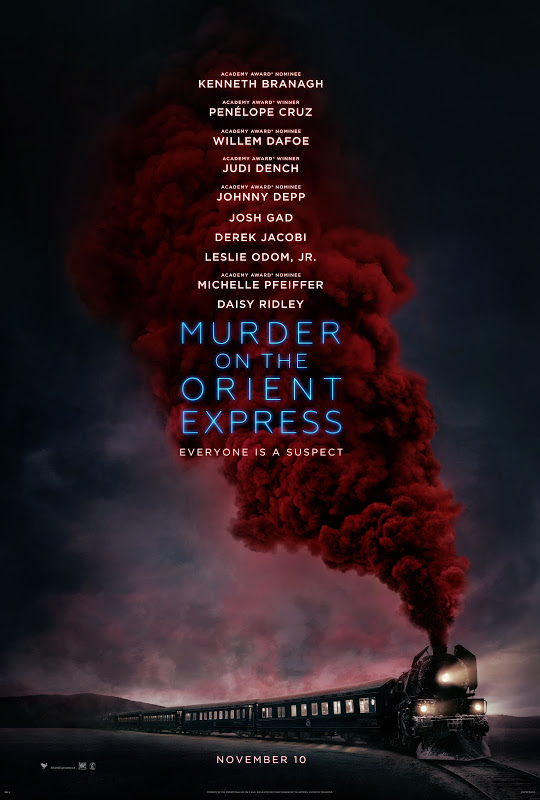
The classic Hollywood style mystery successfully pulls into the station. Grab your ticket from the box office and board the legendary Orient Express with this all-star cast. Kenneth Branagh’s adaptation of the timeless Agatha Christie novel is as bold and elaborate as Hercule Poirot’s famous mustache. Feel as though you are traveling aboard the famous transcontinental train as you attempt to put all the pieces together to solve the mystery right along with “quite possibly the greatest detective in the world.” Hollywood style movie mysteries are nearly a thing of the past, but Branagh stokes the fire in the engine of the once popular genre and conducts an exciting journey through the classic whodunit plot. The film’s namesake is a novel that has inspired so many mystery novelists, and hopefully this film inspires a new generation of filmmakers to create their own movie mysteries fit for the big screen. Because the 1974 version including a cast ranging from Ingrid Bergman to Anthony Perkins to Sean Connery has not stood the test of time as well as it was thought to have done, this cleared the tracks for Branagh’s adaptation of Christie’s most famous novel.

After he successfully solves the mystery of the theft of precious religious artifact from the Wailing Wall area of Jerusalem, Hercule Poirot (Branagh) is beseeched to head back east to solve another mystery. Over the years, Poirot has made many friends, and one of these friends is the son of the railroad tycoon who owns the opulent Orient Express. When a passenger doesn’t show, Poirot is given his seat and boards the transcontinental train bound for western Europe. Although Poirot was promised a rail journey free of crime, a nice break, and to be pampered during his travels, he finds himself solving the most peculiar of mysteries–a most gruesome murder. The victim: an unscrupulous man with many enemies. When a freak avalanche forces the Orient Express to stop on a breathtaking, precarious stretch of track, Poirot finds the time to interview each and every one of the suspects—confined to the twelve first and second-class passengers who might have had access to the victim’s cabin. When each piece of evidence opens one Pandora’s Box after another, and the web of lies and connections between the passengers grows to Poirot’s mustache proportions, Poirot faces a complex mystery that prompts him to call his very approach to crime solving into question.

Nevermind the solution to the tentpole mystery novel is one of the worst-kept secrets in British literature history, Branagh crafts a cinematic mystery full of intrigue, revenge, lies, deceit, and the central murder. The plot revolves around a seemingly perfect crime committed on a railcar with no access to the outside, and only the passengers and crew on board the suspects. But even Poirot is stumped at the who, how, and why. Whether you know the ending or not, this film provides an excellent example of a genre that harkens back to Hollywood’s golden era. There was once a time that mysteries and musicals were a staple of the industry, but times change. Still, Branagh shows audiences that the timelessness of an old fashioned whodunit cannot be overstated. Since the ending of the mystery is known by so many people, Branagh was challenged with providing the audiences with something different, something that creates a new take on a well-known story. He accomplishes this by throwing in some additional subplots, character connections, and evidence that suggests that the solution may turn other otherwise than it does in the novel. The changes he brings to the story are organic and fit in well. The end result is a fantastic film that keeps your attention from beginning to end, even for those who know–or think they know–the solution to the mystery.

From the sweeping landscape shots of the Alps to the wide variety of shots to bring the audience onto the train with the rest of the passengers, the production design is excellent. The attention to the detail and visual elegance of the story are treated with creative precision, just as the Christie plot is woven together. Production designer Jim Clay’s meticulously recreated Orient Express is truly something to behold. Unfortunately, despite Branagh’s decision to shoot on 65mm film, there are times that the train set feels almost too perfect–a little artificial–similar to The Polar Express. Although there are times that the production design is not being showcased to the degree that it should to increasingly immerse the audience into the world of Poirot, there are plenty of beautiful shots that serve as a testament to the opulence of rail travel that once was. Of the few weak areas of this film, the cinematography is the weakest because it could have been used to truly create a visually stunning film and not fall victim to surrealism. Patrick Doyle’s score complements the film by feeling like an extension of the plot itself, in time and space. The combination of big band, jazz, and orchestral music immerses the audience into this world. All the technical elements work effectively to transport you from your seat to a compartment on the legendary train.

Branagh’s screen adaptation of Christie’s characters is brilliantly entertaining and developed well. Each character represents a different type of person, a different walk of life. No two characters are alike, which makes great for interjecting some social commentary into the mystery. From a professor spouting pro-Nazi sentiments to a nurse turned missionary, you will find the characters intriguing in and of themselves, never mind how they may be connected to the victim. Alexandra Byrne’s costumes are perfect appointed extensions of the characters that wear the authentic period clothing. Each costume was designed to be as much a part of the respective character as the accents, hairstyles, and backstories. Josh Gadd proves that we can successfully play a serious role, which will prove to bolster his career, Willem Dafoe is perfect as the professor, Dench portrays the princess in only a way that she could so successfully accomplish, and the rest of the cast are all excellent. Coming in a close second to Branagh’s screen time, as the iconic inspector Poirot, is the beautifully talented Michelle Pfeiffer as the widowed heiress Mrs. Hubbard (Lauren Bacall’s character in the original). She truly showcases her talent for adding depth to the characters she plays in order to make them complex and memorable. The diverse cast of characters is incredible to watch and couldn’t have been deleted better for this highly anticipated film.

Climb aboard The Orient Express for the whodunit that started it all. Branagh’s fresh take on the classic tale would satisfy even the harshest of critics Agatha Christie herself. He treats the source material with the respect it deserve, all the while, adding in new material to craft a new experience for those tho have read the novel and/or seen the original film adaptation of this story. Do yourself a favor and don’t ask anyone whodunit, because you need to experience the solution for yourself. Perhaps you can solve it more quickly than Poirot. Don’t let the train leave the station before you pack your bags and travel back to a time when trains went full-steam ahead into adventure and intrigue.

“Thor Ragnarok” movie review

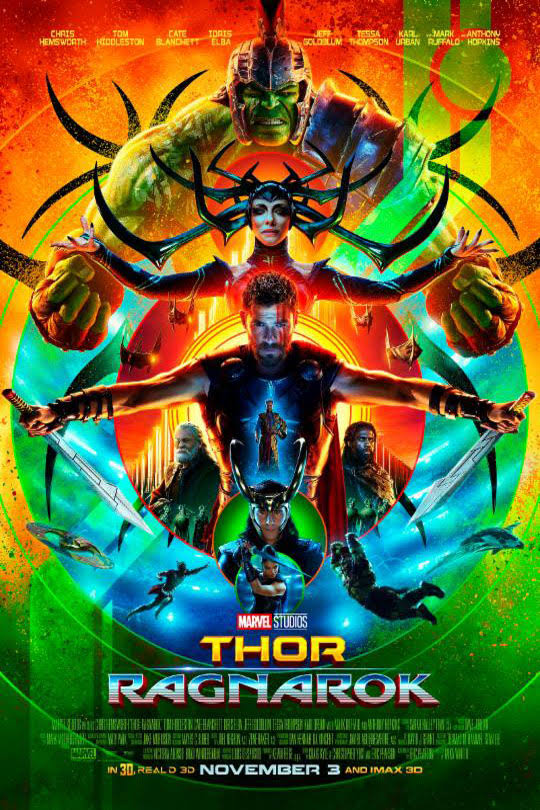
Norse mythology meets Gladiator meets 80s vintage video game in this non-stop adrenaline pumping action film. Suffice it to say, everything you’ve heard about Thor Ragnarok from your friends is true. It is an incredibly fun movie that is equally well written and directed. For anyone who follows my blog, it is no secret that I typically do not like the Disney-Marvel films (and for good reason), but the focus of this review is on THIS particular film. I state that because, honestly, I very much enjoyed this film! So, it comes from liking the structure, characters, plot etc. not just from being a fan boy, or lack thereof in this case. Not only an excellent third sequel, but this movie can easily stand on its own. Whether you have watched the other MCU (Marvel Cinematic Universe) films or not, you can rest assured that you can enjoy this superhero movie. With the way the initial trailers were cut, I thought that this was MCU’s way of jumping onto the 80s nostalgia band wagon–not so. Oh, there is definitely an 80s video game vibe about the film, but the focus is on the characters and storytelling, not the nostalgia. There is also a self-aware element of this film. Not to the extent Deadpool is self-aware, but Chris Hemsworth’s Thor has a twinkle about his eye that winks at the audience so that we know that he is aware of the corniness and ridiculousness of the characters and plot. But the magic of this film is just how well balanced the content of the film is. There were many times that the plot lended itself to falling apart, but the solid cast held the film together and provided audiences with one of the best movies in the MCU.

When Thor learns of a dark, hidden family secret, he must confront the deadliest enemy he has ever faced off with in his life. But the legendary hero encounters far more than he ever expected. The mighty Thor finds himself imprisoned on a faraway planet and forced to battle in gladiator-style games. Little does he know that the winningest challenger on the planet is his former ally The Hulk. Thor must survive the deadly gladiator-like battles in order to build his team to defeat Hela, the Asgardian goddess of death who is destroying his home world.

One of the principle themes in this film that enables this one to be more and deeper than other MCU films is just how similar it is to a conventional war picture. There are hints of courts of intrigue as well. The complex plot provides a comprehensive foundation upon which a more superficial story can be developed in order to appeal to wide audiences, with few appreciating the deeper themes and subtext. But it takes more than effective and well-developed writing to build such a solid movie, it takes multi-dimensional characters portrayed by impeccable screen talent. You’ll find all of that in Thor Ragnarok. Although his screen time is brief, Anthony Hopkins’ Odin commands the screen with confidence, wisdom, and sincerity. Few actor’s can take a few minutes of screen time and put more cinematic magic in it than Hopkins. After all, he won his Oscar for Silence of the Lambs for his collectively few minutes on screen. Joining the cast are Jurassic Park’s Jeff Goldblum and the beautiful, talented Cate Blanchette. Goldblum’s Grandmaster of Sakkar is hilarious and brilliant. As you’d expect a Goldblum character in a film like this to be: detached intellectually from that which is seen as conventional, smart-alecky; yet, he is also petty, sadistic, and relentless. Blanchette’s Hela is elegant, sadistic, and intelligent. She is perfectly able to be the comic book-esque villain she needs to be, all while bringing about a pedigreed acting to it.

All the technical elements of the film works excellently together. The most memorable of those elements is the music, for me, followed by the visual effects. I absolutely loved the nod to Willy Wonka and the Chocolate Factory during Thor’s transport to through Sakkar. This works because (1) the scene it shot and edited similarly to the boat scene in the aforementioned movie and (2) Goldblum’s Grandmaster is a Willy Wonka type. Throughout the film, there are 80s video game sound effects and a score that could fit into a nostalgic 8bit video game. However, the nods to Willy Wonka and video games do not overpower the more conventional score. Whereas the visual effects could have gone overboard and made the film play off as a video game, the video game like effects where carefully integrated in order for the film to maintain a high show quality.

The film was initially sold as a funky, colorful, comedic MCU film. And there are times that the film also encroaches upon that animated feel, but it never crosses that line–thankfully. The more serious aspects to the film balance out the slapstick moments. All of this works together to execute perfect pacing and plot/character development. Like with most MCU films, the more adventurous parts of the film are not quite adventurous enough to be an adventure film and there is typically a predictable nature about the film. I find that this film is not as predictable as previous MCU movies, but there is still that experience with this one. There is one particular part to the showdown of the film that prohibits this from falling victim to another cliche MCU ending with an epic battle, bodies flying through the air, and cities on fire, but I cannot reveal that without giving away the ending.

Looking for a fun movie to watch with your friends? Then this is a solid choice. Although the film has its diegetic flaws, the ways it succeeds outweighs the shortcomings. You also do not have to have seen the other Thor movies and really don’t even need to have seen the previous Avengers films, albeit helpful to understand some of the minor plot points. It’s definitely one that has re-watchabbility.

“Poltergeist” (1982) Retrospective Film Review

“They’re [still] here!” 35 years later, Stephen Spielberg and Tobe Hooper’s Poltergeist still terrifies audiences today. Coming off the successes of Spielberg’s Jaws & Close Encounters of the Third Kind and Hooper’s Texas Chainsaw Massacre, this powerhouse producer-director team (note: Hooper received the official director credit) crafted a horror film that became an instant classic then, and still holds up today. With Spielberg heading up the story and Hooper in the director’s chair, both cinematic geniuses combined their talent for generating material for nightmares to take the “haunted” house film sub-genre of horror to the next level. Storytelling and cinematic elements aside, another primary reason the film still haunts and intrigues audiences today is the lore of a lengendary curse attached to this film. For audiences back in 1982, and possibly still to this day, following watching the film, friends may have found themselves only venturing by an alleged haunted house on a dare. The film’s impressive ability to take the haunted house concept up to a level never seen before–in fact–it essentially created the modern haunted house genre seen in today’s horror films. In short, Poltergeist is an icon, and stands alongside films such as PsychoThe Exorcist, and The Shining. Probably the most terrifying element of all is the setting–mundane upper middle class America suburbia. No longer where “haunted” houses confided to old mansions or hotels, but could be located next door to you. That is, if your neighborhood is also built upon a burial ground.

At the end of the day, regardless of who actually directed this film, Poltergeist remains one of the strongest films in either Spielberg’s or Hooper’s canon. And the legend of a curse certainly doesn’t hurt the strong fanbase of this horror classic. Curse and directorial authorship aside (though, the latter is a valid topic for discussion), the brilliance of this film is almost self-reflexive in that it displays quite the dichotomy while commenting on the secularized versions of heaven and hell as seen in the film due to both having their due screen time. This bifurcation paves the way to read past the ghostly apparitions and (real) skeletons, to the root of what I feel Spielberg and Hooper were foreshadowing as the real threat to a traditional familial bond–that box in your living room with moving images flickering on the screen. The way the movie opens and closes are very much book ends to one another as it attempts to deal with the quandary of an inability to “choose between life and death, when [we’re] dealing with what is in between.” The foreshadow of the seemingly one-sided conversation between Carol Ann (the late Heather O’Rourke) is a great depiction of how families are today. The kids are entertaining themselves by and form connections with characters seen on the TV while mom and dad are in their own world getting lit. That is not unlike what is seen today. Now, keep in mind, televisions are not responsible for fracturing the nuclear family; but the television is often relied upon as a babysitter and becomes the object that receives the most attention to the point that some get sucked into the moving picture world. Perhaps there is a lesson here in that the television should not be the center of attention in a household.

Poltergeist has much in common with a roller coaster at a theme park, and that metaphor can can aid in explaining why a film with such a simple plot and one-dimensional characters was and still is so incredibly successful in terms of cultural references and the fan base today. Why do most people go see a horror film? Is it the complex plots and multi-dimensional characters with brilliant on screen chemistry and excellent development? Not particularly, as great as those things are AND are often found in the best horror films. The pacing of this film reminds me of the pacing of a roller coaster at a theme park because of the lift at the beginning, the plummet into danger, the feeling that it’s almost over, followed by one final plunge into the twists and turns before pulling into the station. Compared to films such as The ConjuringAmerican Psycho, and Nightmare on Elm Street (not to mention many others), the plot is somewhat nonsense; however, the film is–without argument–sensationally effective, terrifying, memorable, and the horror imagery is beautiful–filled with metaphor and familial commentary. It’s an impressive array of haunting visual effects juxtaposed against a typical American family living in the suburbs. That, and ever since this movie, static on a TV is frightening! If you can find it anywhere anymore. With all channels on 24hr programming now, I suppose that the ghosts have to find another way into our world.

The innocence of the characters is also an intriguing and atypical part of this movie that aids in the frightening imagery and nightmarish inducing apparitions. It’s atypical because the victims of death, haunting, or injury in a horror film are usually horny teenagers who are sexually promiscuous, adults who have skeletons in the closet, played God, broken the law, or just plain old sociopaths. Not true with this family. Everyone in the Freeling household are wholesome family members from the hardworking father who wants the best for his family to stay-at-home mom who loves her kids, and even the siblings who appear to get along just fine. Almost too picturesque, and ultimately a bit unrealistic. Despite the tight, healthy nuclear family, the Freelings are thrown into chaos when Carol Ann gets sucked into the world that exists between life and death behind a thin veil. That innocence helps to uncross the level of terror in the movie because it hits members of the audience that no one is safe from the reigns of evil. The fact that everything in the film happened to a normal family creates added anxiety in the minds of the audience as many go home to a similar world first depicted in the movie. Looking back, Middle American must’ve been completely shocked when a family, not unlike its own, was plunged into a world of hellish gateways, ghosts, and ghouls and other circumstances out of its control.

There is something for everyone in this film. Because it is likely that most in the audiences then and now are afraid of something in the film: unexplained physics-defying phenomena, clowns, the underside of the bed, ghosts, closets, scary trees, pools, or subdivisions. Perhaps the relatability to the characters or the scary elements of the film are what help to connect new audiences to this classic horror film. There is a wittiness about the film that reminds me of something that Alfred Hitchcock may have developed for the screen had he ventured into paranormal movies. As nightmares go, Poltergeist is thoroughly enjoyable because you know your an always wake up from it and none of the characters are permanently damages at the end of the film. Eerie, beautiful, gruesome. That’s why this film still holds up today and will continue to haunt audiences for many years to come.

“Dark Tower” movie review

A paint-by-the-numbers “epic” story with a prolific number of Stephen King references. Adapted from the Dark Tower series of novels by Stephen King, Dark Tower introduces movie audiences to one of King’s masterpiece works of literature. Unfortunately, the movie takes place in the middle of the series and fails to leave audiences wanting to see more. For the most part, it offers up little more than an enhanced SyFy Channel original movie or a one-time HBO film. With a powerhouse leading cast consisting of Idris Elba and Matthew McConaughey, it constantly feels that the actors were held back from that which we are normally accustomed. That is, not to say that there aren’t enjoyable parts of the movie–certainly seeing all the King references are fun and it is a great premise. I only wish the story and characters had been allowed to develop over the course of three films. Although there is sufficient evidence to suggest that some movies in the recent past that have been forced into a trilogy instead of a strong, concise single film, this is an example of a one-time film that truly needed the room of three films to develop and emotionally connect with audiences. There is never a dull moment in the film, nor an opportunity to become bored because the film is incredibly rushed and turning points are forced into place.

At the center of the universe stands a massively tall dark tower that keeps the bulk of evil forces at bay. Under attack by Walter (McConaughey), the last gunslinger Rolland (Elba) must destroy Walter and his following before they destroy the dark tower and wreak havoc on Keystone Earth and the other planets in the universe. Harvesting children with “the shine” from earth, to use their minds to destroy the tower, is the method employed by Walter and he has his eyes on a child whose shine is greater than any other. After Jake (Tom Taylor) evades capture by Walter’s henchmen, he finds himself on Mid World where he meets gunslinger Rolland. Under constant siege by Water, Rolland and Jake must make a arduous journey to Walter’s headquarters where he is mounting his attack against the tower. With the fate of the universe at stake, Rolland, Walter, and Jake face-off in an epic battle of good versus evil.

There is not much to dissect here. One thing is for sure–and I have not read the books–BUT, from what I know of the books, fans of the literature will not like the film because it takes what happens over the course of “King” sized novels and condenses it down to little more than a short story turned 2hr film. Not having read the books, I was not set up for disappointment. That being the case, I enjoyed the film for the most part. But it was obvious that it was incredibly rushed and there was little if any development in plot or character. No emotional investment to be found. It’s a shame; the premise of the film is fascinating and I think there is a high degree of probability that I would have enjoyed following the franchise had it been more than one film. The way the movie ends does lend itself to possible sequels, but after the very “television” feel of this one, it is going to have a hard time convincing future audiences to invest time and spend money on it. If anything, this film does prompt me to read the novels upon which it is based. One argument that could be made in the film’s defense is the same one that can be made when looking at many of the films based upon King’s works. His novels are so dense, internally driven, and detailed that is is difficult to successfully translate effectively from page to screen. Obviously, there are exceptions to this trend (i.e. the upcoming IT theatrical release).

If you are a fan of fantasy and adventure films with a hint of science-fiction, then you will likely enjoy this movie. If you love the series of books, I feel fairly confident that you will not like this adaptation. Perhaps this film will inspire a network to spearhead an epic television series. I think that is where this story will be best shown.

Written by R.L. Terry

Edited by J.M. Wead