THE DEVIL WEARS PRADA 2 movie review

A sequel about decline that unintentionally embodies it
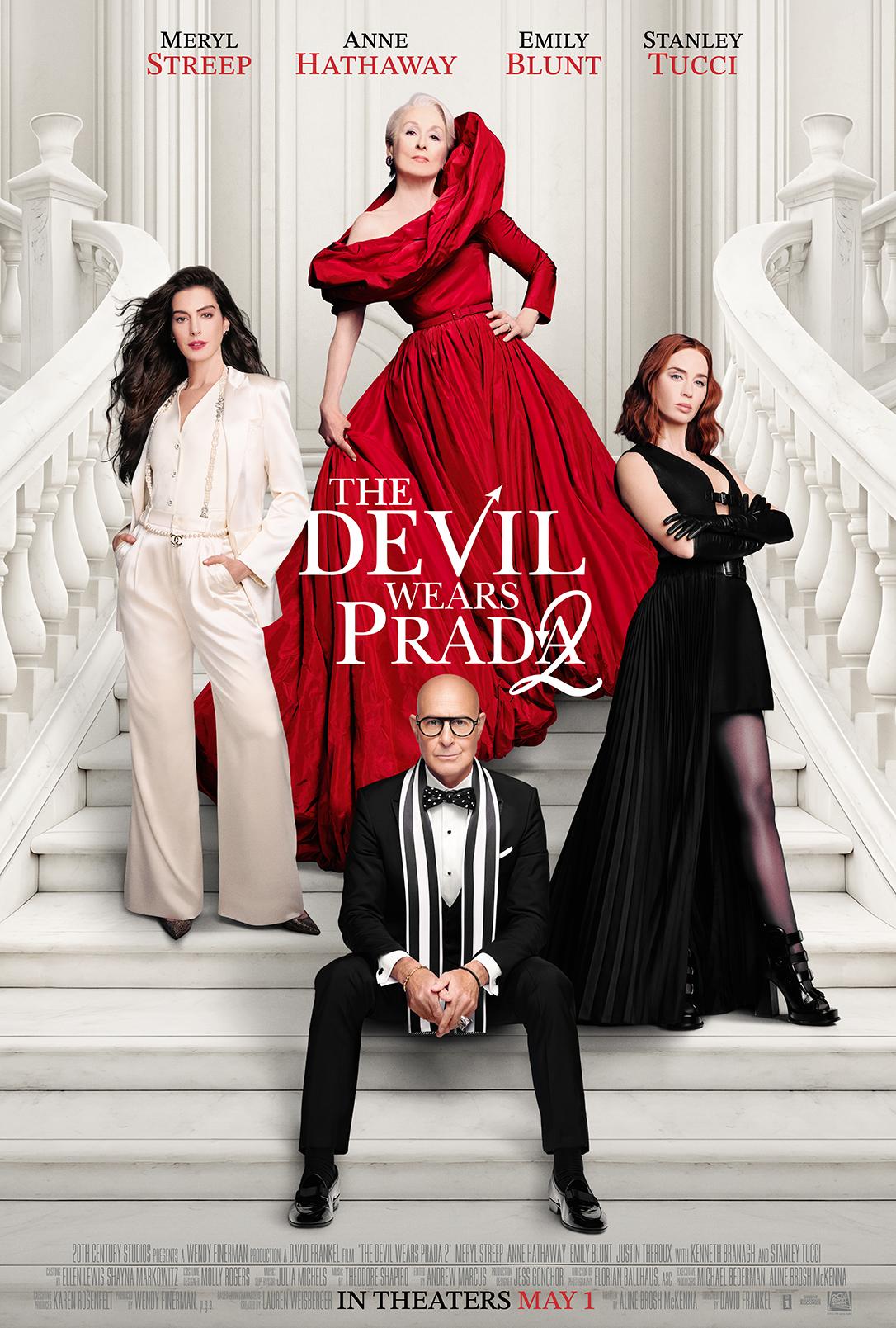
The Devil Wears Prada 2 arrives with an intriguing premise: the decline of traditional print media and the cultural erosion that follows in its wake. On paper, that is fertile dramatic territory—especially for a franchise rooted in the world of fashion magazines, where prestige once carried weight and authority. But while the film gestures toward thoughtful commentary on the changing media landscape, its ambition collapses under the weight of its own excess. The sequel’s attempt to explore the decline of traditional print journalism—and the cultural loss that represents—is buried beneath rushed subplots and thin character work. The sharp bite that defined the original is gone, replaced by interactions that feel oddly dull and listless.

About the movie: Andy Sachs (Anne Hathaway) returns to Runway as Miranda Priestly (Meryl Streep) navigates a new media landscape and Runway‘s position within it. They reconnect with another former assistant, Emily (Emily Blunt), who is now the head of a luxury brand that possesses funding which could ensure Runway‘s survival.

The irony is difficult to ignore: a movie about the fading relevance of print media ends up feeling like a diminished version of its former self. What made the original The Devil Wears Prada so compelling was not merely its fashion or its humor, but its brazen confidence. The characters were bold, unapologetic, and sharply drawn. They possessed edge—sometimes cruelty, sometimes wit—but always energy.

That energy is conspicuously absent here. The sequel lacks the chutzpah that defined the original. The characters feel like muted versions of their former selves—recognizable, but drained of vitality.

Even Miranda Priestly, once a towering figure of authority and intimidation, feels diminished. She is simply not the same Miranda. Nor is she a believable evolution of that character in an era defined by the decline of print media and the increasing irrelevance of traditional fashion magazines. Instead, she feels like a sanitized, diluted interpretation—a kind of bargain-bin version of the woman who once commanded every room she entered.

Andy, meanwhile, remains recognizable as her former self, but a shallower one—less conflicted, less driven, less interesting. Emily comes closest to recapturing her original spark, yet even she feels like a low-resolution facsimile. Nigel is perhaps the most faithful to his earlier incarnation, but he is given remarkably little to do, functioning more as a reminder of the past than as an active participant in the present.

One of the film’s most significant problems is not a lack of ideas—it is an overabundance of them. The movie attempts to comment on a wide array of contemporary issues, each of which could have sustained a compelling narrative on its own. Among them:

  • The exploitation of labor in global fashion supply chains
  • The decline of print journalism and professional writing
  • Body positivity and changing beauty standards
  • Workplace political correctness
  • The tension between art and commerce
  • The fallibility of institutions and authority figures
  • Agism

These are all worthwhile themes. But instead of selecting one or two central ideas and developing them with clarity, the film introduces them in rapid succession, only to abandon them before they gain dramatic traction. The result is a story that feels scattered and unfocused.

There is a fundamental principle of storytelling that seems to have been forgotten here:
When your story is about everything, it is ultimately about nothing.

Adding to the problem is a roster of side characters who function less as people and more as props. They appear when needed, deliver exposition, and disappear without leaving any meaningful impression. They exist to move the plot forward rather than to inhabit it.

Even the film’s musical landscape reflects this sense of creative fatigue.

The soundtrack is largely forgettable—pleasant enough in the moment, but lacking the memorable punch that defined the original film’s sonic identity. One exception, of course, is Vogue, which remains as exhilarating as ever. Its inclusion feels less like nostalgia and more like a reminder of what bold artistic expression once sounded like.

By contrast, the contributions from Lady Gaga feel surprisingly inert—polished, competent, but oddly impersonal. The songs lack the distinctive flair and theatricality audiences have come to expect from an artist of her caliber. They register less as creative statements and more as algorithmic approximations of style.

From beginning to end, The Devil Wears Prada 2 feels like a discount version of its predecessor—an imitation rather than a continuation. It tries hard to recapture the magic of the original, but its creative DNA seems shaped by the streaming era: content designed for breadth rather than depth, immediacy rather than longevity. The film moves quickly, introduces ideas rapidly, and resolves conflicts hastily—mirroring the rhythms of modern digital consumption.

In that sense, the movie unintentionally becomes a commentary on the very cultural shifts it seeks to critique.

It is a product of the moment.

And like much of contemporary media, it feels engineered for engagement rather than crafted for impact. The Devil Wears Prada 2 reminds us that sequels are not sustained by familiarity alone. They require conviction, clarity of purpose, and characters who evolve in meaningful ways. This film has ideas—many of them compelling—but acks the narrative discipline necessary to bring those ideas to life. What remains is a glossy, well-dressed production that gestures toward relevance without ever achieving it.

The original film had bite—had fire.
This one barely leaves a mark.

Ryan is the general manager for 90.7 WKGC Public Media and host of the show ReelTalk “where you can join the cinematic conversations frame by frame each week.” Additionally, he is the author of the upcoming film studies book titled Monsters, Madness, and Mayhem: Why People Love Horror. After teaching film studies for over eight years at the University of Tampa, he transitioned from the classroom to public media. He is a member of the Critics Association of Central Florida and Indie Film Critics of America. If you like this article, check out the others and FOLLOW this blog! Follow him on Twitter: RLTerry1 and LetterBoxd: RLTerry
SEND HELP (2026) horror movie review

Send Help is the rare survival thriller that understands the most dangerous thing on a deserted island isn’t nature—it’s the workplace baggage you bring with you.

Send Help plays like a postmodern riff on Misery—less interested in replicating its mechanics than in reconfiguring its psychological cruelty for a contemporary workplace horror. One can also detect traces of Survivor, the underseen Office Killer (1997), and even a one-way echo of Fatal Attraction, though Raimi’s film resists the lurid sensationalism of those predecessors in favor of something more controlled, more ideologically curious. I went into Send Help expecting one kind of movie and walked out having experienced something far more interesting—and far more satisfying. What initially presents itself as a straightforward survival thriller gradually reveals a different set of priorities: character over carnage, tension over spectacle, and psychology over shock. The turn is not a bait-and-switch so much as a recalibration, one that rewards patience and attention.

A woman (Rachel McAdams) and her overbearing boss (Dylan O’Brien) become stranded on a deserted island after a plane crash. They must overcome past grievances and work together to survive, but ultimately, it’s a battle of wills and wits to make it out alive.

Despite containing remarkably little gore, Send Help is punctuated by moments of excruciating intensity—scenes engineered to linger in the mind the way Misery’s hobbling scene does, not because of what is shown, but because of what is anticipated. Raimi understands that true discomfort is often born from restraint. Violence, when it arrives, is not gratuitous; it is precise, purposeful, and deeply unpleasant.

Where Send Help distinguishes itself most clearly is in its thematic ambition. Raimi trades his trademark splatter for commentary on workplace dynamics—particularly the lived experience of women navigating environments shaped by misogynistic men, institutional indifference, and power imbalance. The film proposes that monsters are created—that violent behavior can be traced back to environment, circumstance, and provocation. While the film makes this argument with conviction, I remain unconvinced by its absolutism. Environment can shape behavior, yes—but it does not absolve agency. Some monsters are forged by their surroundings; others choose monstrosity despite them. Under most circumstances, we remain responsible for our actions.

That tension—between explanation and excuse—is where Send Help becomes most interesting. The film is less persuasive as a moral thesis than it is as a provocation, forcing the audience to wrestle with where empathy ends and accountability begins. In that sense, the island setting becomes more than a survivalist conceit; it is a crucible. A demented Gilligan’s Island, stripped of whimsy and comfort, where rescue is uncertain and survival demands agency. The film is clear-eyed about one thing: help does not always arrive. Sometimes survival requires seizing control rather than waiting to be saved.

Visually, the setting is striking—lush, isolating, and quietly menacing. The CGI animals, however, are nearly laughable, though thankfully used sparingly enough not to derail the experience. When Raimi relies on atmosphere rather than digital intrusion, the film is at its strongest.

Excellent casting anchors the film, thoughtful writing gives the conflict weight, and the thrills feel refreshingly old-school—earned through escalation and dread rather than excess. All of it is quietly underscored by moments of dark comedy that arrive not as winks to the audience, but as pressure valves, reminding us that sometimes the most unsettling laughs are the ones that catch us off guard. McAdams’ and O’Brien’s chemistry is exceptional. They play off one another with a rhythmic precision that feels almost musical—each reaction, pause, and escalation perfectly calibrated. Their dynamic does much of the film’s heavy lifting, grounding the psychological tension in something human and volatile. One hopes this pairing is not a one-off; there is genuine electricity here worth revisiting.

There is also an unintended—but revealing—meta-text hovering around O’Brien’s presence. In a recent Entertainment Weekly article, O’Brien noted that he has been repeatedly told by agents, producers, and directors that he needs an Instagram account—that without it, he risks losing roles deemed “appropriate” for him. He has no intention of starting one. As a film scholar, I find this deeply troubling. When talent, suitability, and longevity are increasingly filtered through social media metrics rather than craft, presence, and screen intelligence, the industry risks confusing visibility with value. Send Help, perhaps inadvertently, becomes part of that conversation—raising questions about how we identify monsters, merit, and worth in systems increasingly governed by optics.

Ultimately, Send Help is not a perfect film, nor is it a subtle one. But it is a thoughtful, unsettling, and frequently compelling genre exercise—one that uses survival horror as a vehicle for interrogating power, agency, and responsibility. Raimi may be experimenting here, but the experiment is a worthwhile one. If nothing else, Send Help reminds us that the most terrifying scenarios are not those where monsters appear—but those where we are forced to decide what kind of people we are when no one is coming to save us.

Ryan is the general manager for 90.7 WKGC Public Media and host of the show ReelTalk “where you can join the cinematic conversations frame by frame each week.” Additionally, he is the author of the upcoming film studies book titled Monsters, Madness, and Mayhem: Why People Love Horror. After teaching film studies for over eight years at the University of Tampa, he transitioned from the classroom to public media. He is a member of the Critics Association of Central Florida and Indie Film Critics of America. If you like this article, check out the others and FOLLOW this blog! Follow him on Twitter: RLTerry1 and LetterBoxd: RLTerry
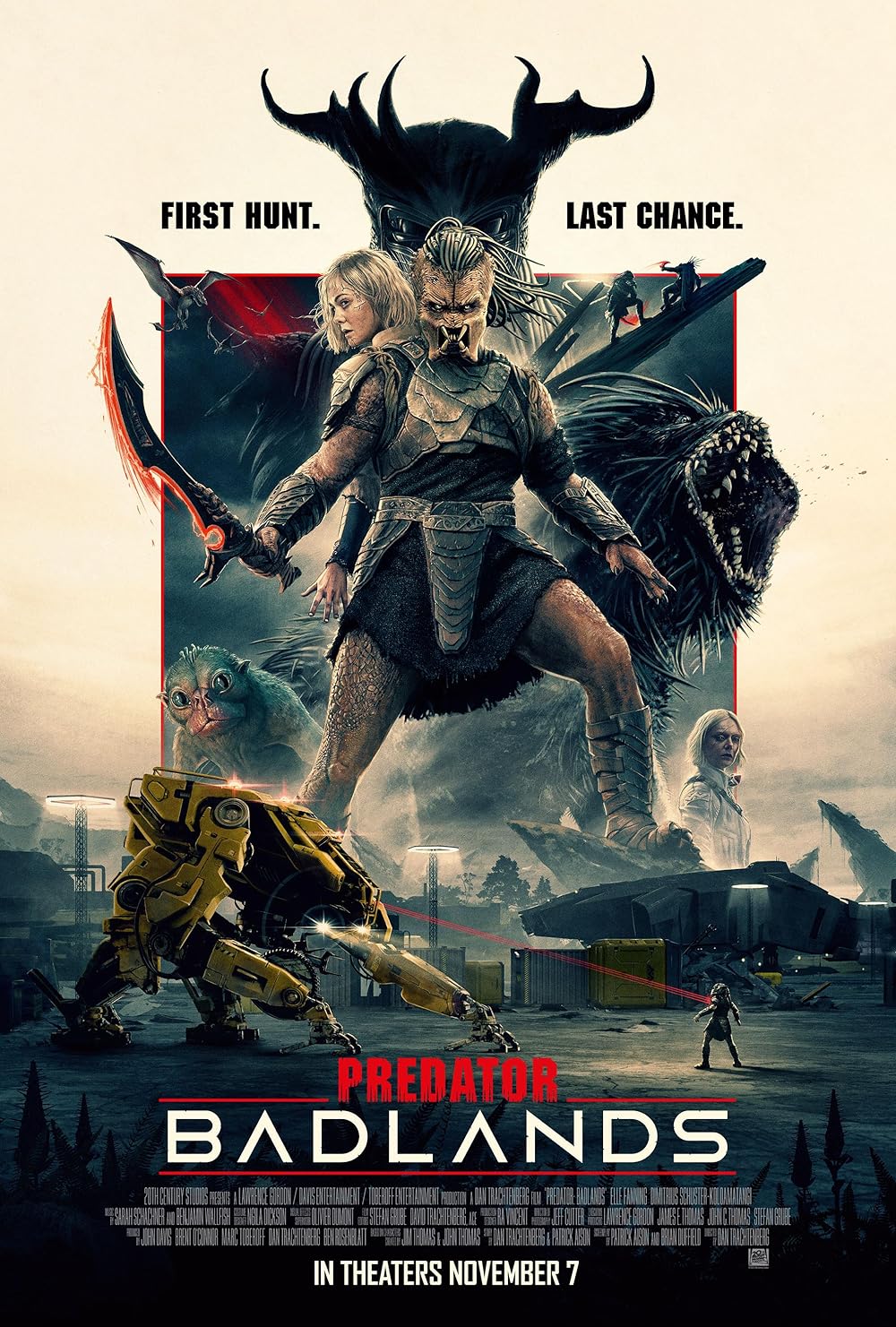
PREDATOR: BADLANDS movie review

Predator: Let’s Play. When streaming content hits the big screen.

Predator: Badlands is the equivalent of a “Let’s Play,” but with bigger explosions. The nonstop action, constant motion offer little to no substantive emotional investment. You’re an observer, not a participant—which might be fine for streaming, but it’s a strange fit for cinema. The latest in the Predator franchise plays like a two-hour sizzle reel with delusions of grandeur. It’s a glossy barrage of explosions, digital dust, and quippy one-liners that evaporate before they even hit the floor. By the time the credits roll–that’s if you haven’t fallen asleep—you’ve seen everything and felt nothing. It’s not that the film is aggressively bad—it’s that it’s aggressively empty–little more than content to pander to short attention spans with shiny movement instead of meaningful momentum.

Cast out from its clan, a Predator and an unlikely synthetic ally embark on a treacherous journey in search of the ultimate adversary.

The screenplay feels like it was written by an algorithm trained on reaction videos and Reddit threads. Every line of dialogue sounds like a placeholder; it’s as if someone said, “We’ll fix it later” or “funny line here,” and neglected to return to the page in order to fix it–before principle photography. There’s no sense of escalation, tension, or rhythm; it’s a series of flashy moments loosely stitched together, like a highlight reel of a game you didn’t play. Even the humor feels synthetic–much like the characters– punching at air instead of connecting with character or tone.

As for the characters, they exist mostly as camera targets. They are little more than digital avatars running, shooting, and shouting for reasons that never feel personal or compelling. The lead could be replaced by a different actor mid-film and you might not notice. This critic isn’t even convinced that Dek (our central Predator character) wasn’t entirely CGI, though it may have only been the facial area. “What’s my motivation?” Difficult to say–there wasn’t much upon which to build. Motivations are paper-thin, arcs nonexistent. The Predator itself, once a symbol of primal fear and unseen menace, now feels like a boss-level NPC waiting to be triggered by the next quick-time event.

Visually, Badlands has all the spectacle money can buy; but its spectacle is divorced from any meaningful purpose. The explosions are massive, the sound mix thunderous, and yet it’s as emotionally engaging as watching someone else play Call of Duty. Every frame screams “look at me!” without ever inviting you to feel something. The editing, too, is manic. And it’s not even as though the narrative demanded it; rather, the dynamic editing was most likely employed because the movie was terrified that you’d look away or down at your watch, which I did several times.

And maybe that’s the point. Predator: Badlands is far less like a movie and more like a cinematic exercise in a large scale “Let’s Play.” For those that are unfamiliar with the term, it’s a type of (usually) YouTube video of someone playing a video game and often their reactions to the game play. Think of it as a passive experience of someone else’s thrill ride. The ultimate, disconnected form of living vicariously. Don’t question anything, because it won’t take long to realize that this movie is hollow. You don’t engage; you just witness. The irony is that the film could’ve been a fascinating critique of screen-mediated experiences, but it never once stops to think.

This is just the latest in a growing trend from Disney’s genre arm: a reliance on brand nostalgia and visual polish in place of storytelling. Ever since the corporate appetite turned to IP recycling, the studio has mistaken familiarity for depth. Badlands is what happens when you try to “optimize engagement” instead of crafting a narrative, resulting in the film equivalent of clickbait dressed in billion-dollar armor.

Predator: Badlands doesn’t so much hunt its audience as it does chase its own tail. A movie that is fast, flashy, and utterly pointless; and desperately wants to go viral but forgets to be cinema. You don’t leave exhilarated; you leave wondering if you accidentally spent $15 to watch a YouTube compilation in IMAX.

Ryan is the general manager for 90.7 WKGC Public Media and host of the show ReelTalk “where you can join the cinematic conversations frame by frame each week.” Additionally, he is the author of the upcoming film studies book titled Monsters, Madness, and Mayhem: Why People Love Horror. After teaching film studies for over eight years at the University of Tampa, he transitioned from the classroom to public media. He is a member of the Critics Association of Central Florida and Indie Film Critics of America. If you like this article, check out the others and FOLLOW this blog! Follow him on Twitter: RLTerry1 and LetterBoxd: RLTerry
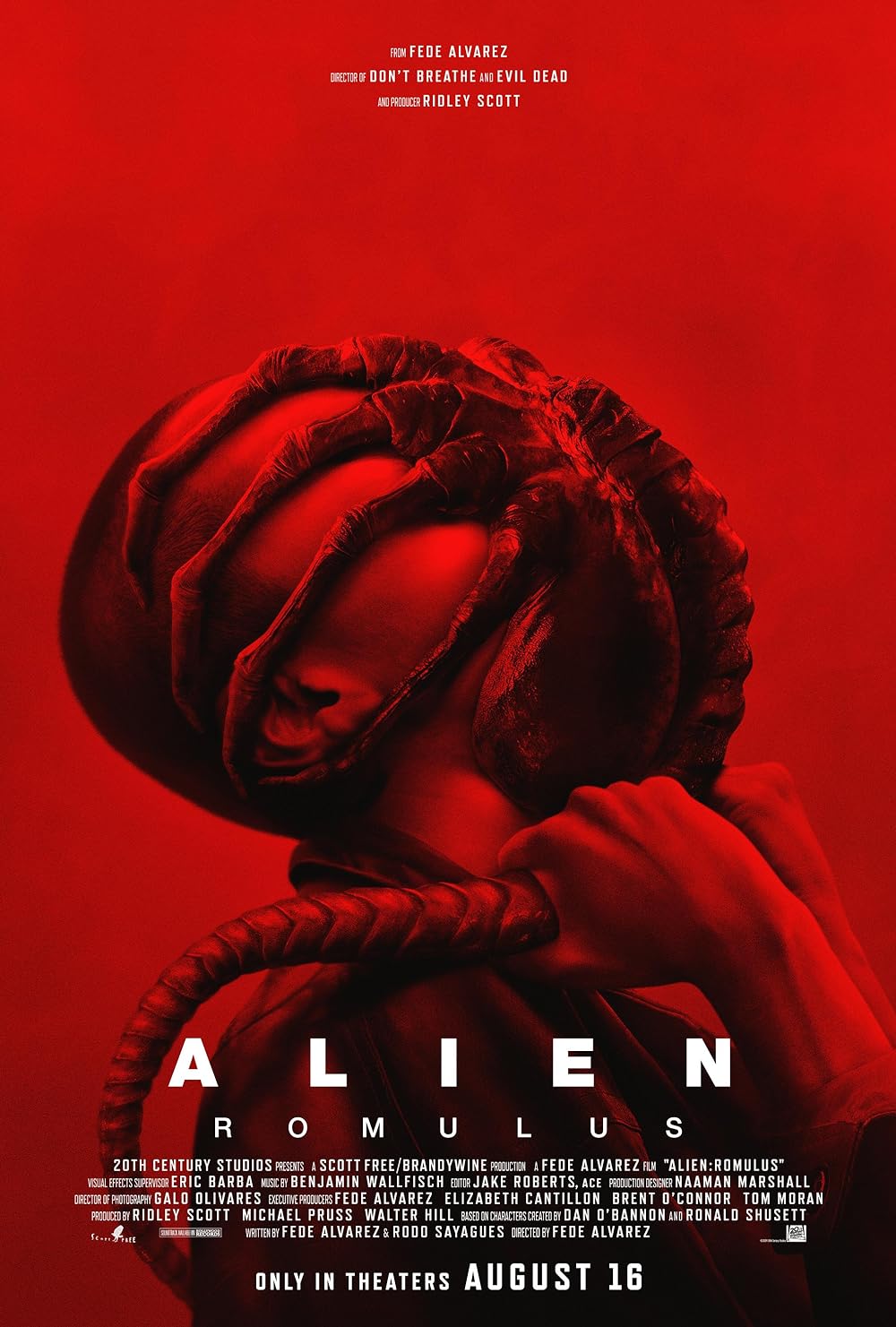
ALIEN: ROMULUS review

In space, these characters are screaming for dimension. Fede Alvarez’ Alien: Romulus is the closest in form that we have had since the masterful Alien (1979). And while the premise and plot are fairly solid, the plotting and exquisite design cannot compensate for the poorly written characters.

The most human character is a synthetic human, and he is the only character that is thoughtfully crafted. When characters struggle to connect with audiences, then the audience couldn’t care less whether they live or die–ostensibly mitigating any real stakes. The central character is mostly flawless and we never feel as though that they will be injured, much less die (I’m avoiding spoilers). The original Alien delivers incredibly well-written and developed characters that we want to survive. Alien: Romulus‘ characters–well–they should’ve all perished for lack of anything truly compelling. Additionally, this cast is way too young to be taken seriously in these roles that would be better suited for a cast that was at least 10–15 years older.

Where the film does succeed is the throwback design and feel of everything from beginning to end. Even the CG is integrated very well with the much-welcomed use of practical effects. Practical beats CG, nearly every time. Even though this movie is releasing more than forty years from the original, it feels very much connected to that iconic motion picture in form. Everything from the production design to the sounds to the music kept me from completely disengaging from the film. Alvarez has a fantastic eye for composition and atmosphere, but his screenwriting and character development are not on par with the technical achievement of the film. If you love the original Alien, then definitely see Romulus, and have fun with it. But I don’t imagine you will be rewatching this one over and over like the one that started it all. At least, it was way more meaningful than anything that released after Aliens.

Apologies for the short review of a movie that I highly anticipated. But Disney chose not to screen the film for all the critics in the CACF.

Ryan teaches Film Studies and Screenwriting at the University of Tampa and is a member of the Critics Association of Central Florida and Indie Film Critics of America. If you like this article, check out the others and FOLLOW this blog! Interested in Ryan making a guest appearance on your podcast or contributing to your website? Send him a DM on Twitter. If you’re ever in Tampa or Orlando, feel free to catch a movie with him.

Follow him on Twitter: RLTerry1 and LetterBoxd: RLTerry
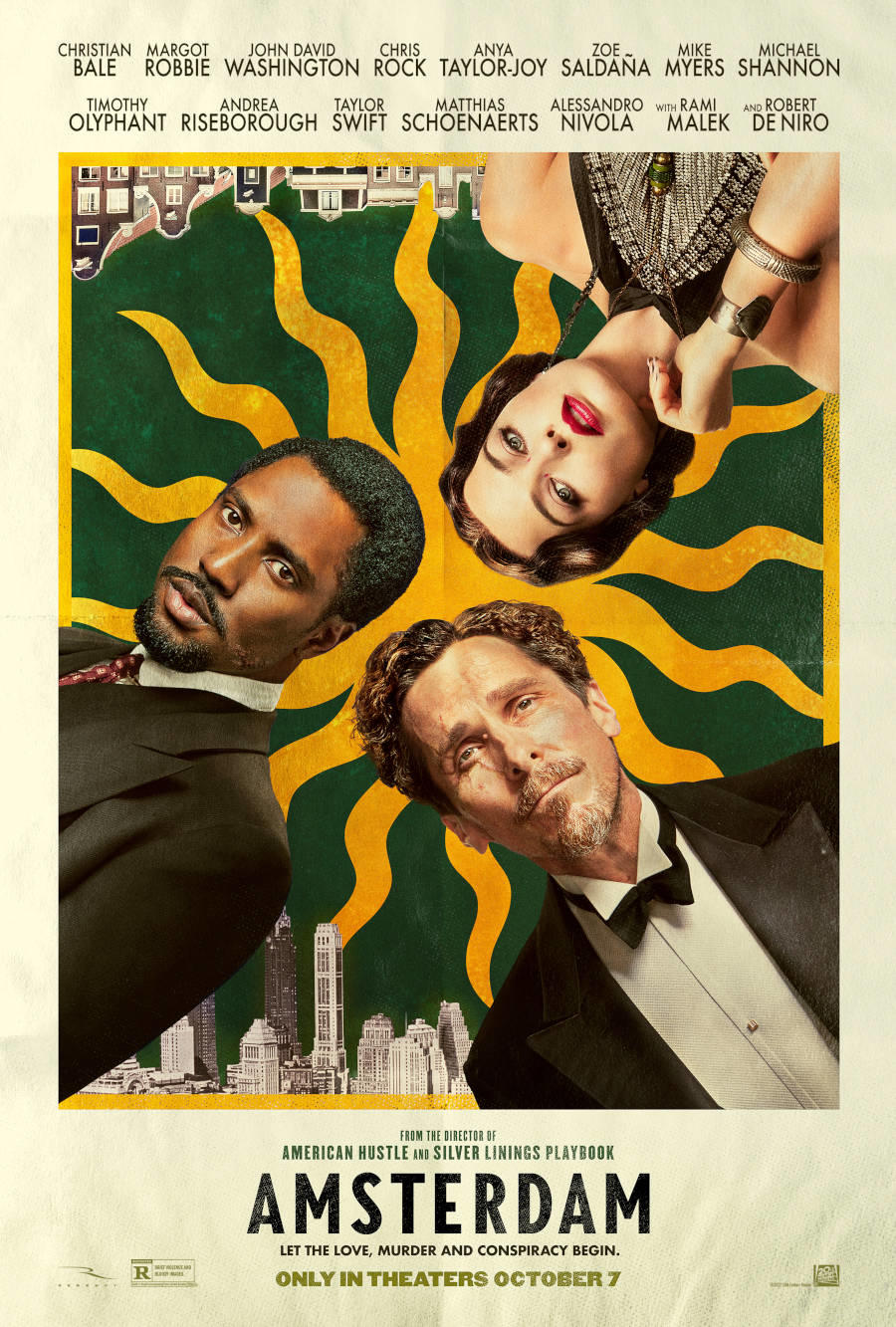
AMSTERDAM movie mini-review

There is a fascinating true story and great movie…in there…somewhere. David O. Russell’s star-studded Amsterdam is a bloated, poorly paced movie that places far more emphasis on repetitive, pedantic social commentary than it does on lean storytelling and strategic plotting. If not for the powerhouse cast, the movie would be nearly unwatchable. A litmus test I give a movie is (1) if I look at my watch and (2) if so, how often. If I am looking at the time, then I am not engrossed in the story. And I looked at my watch many times during this lengthy quasi-historical drama. Amsterdam demonstrably has little idea or security in what it wants to be. Is it a dark comedy? Is it a drama? Is it satire? All valid questions for which there is no clear answer, because it struggles to find the proper tone that best expresses its story. Although the social commentary on race relations quickly becomes redundant, it does highlight some areas of wartime history of which many, including myself, are likely unaware. Such as soldiers of color being forced to wear French uniforms–had no idea! So I am glad that this disrespectful chapter in history was highlighted for modern audiences. Clearly this movie should have been an Oscar vehicle for Russell, his cast, and crew, From beginning to end, it’s easy to read this film as a desperate attempt to win over general audiences and critics by convincing them that there is something to see here; unfortunately, what should have been an incredibly interesting mystery and untold true story suffocates under the poorly written and structured screenplay.

Ryan teaches Film Studies and Screenwriting at the University of Tampa and is a member of the Critics Association of Central Florida. If you like this article, check out the others and FOLLOW this blog! Interested in Ryan making a guest appearance on your podcast or contributing to your website? Send him a DM on Twitter. If you’re ever in Tampa or Orlando, feel free to catch a movie with him.

Follow him on Twitter: RLTerry1