PRESSURE (2026) film review

Some of history’s most consequential battles are won before the first shot is fired.
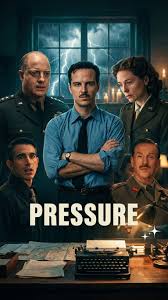
Few people associate D-Day with weather forecasting. Fewer still know the name James Stagg. Yet without his forecast, one of the most important military operations in history may have unfolded very differently.

Based on the stage play by David Haig, who also adapts his own work for the screen, Pressure transforms a little-known chapter of World War II into an engaging drama about uncertainty, responsibility, and the burden of decision-making. On paper, a film centered on meteorologists debating atmospheric conditions in the days leading up to the Normandy invasion sounds like the sort of project destined for educational television or a museum visitor center. Instead, it becomes a surprisingly compelling thriller, one driven less by combat than by anticipation.

At the center of the story is Dr. James Stagg, portrayed by Andrew Scott in a performance that quietly anchors the entire film. Stagg is tasked with delivering the weather forecast that will help determine whether General Dwight Eisenhower proceeds with the largest amphibious invasion in military history. Scott understands that the drama lies not in weather patterns themselves, but in the crushing responsibility that accompanies them. Every cloud formation, pressure system, and forecast carries potentially catastrophic consequences. His performance is restrained, thoughtful, and deeply human. Even when surrounded by military officers and strategic planners, Scott commands the audience’s attention.

One of the film’s greatest strengths is its structure. Although audiences know D-Day ultimately proceeds, Pressure still manages to generate genuine suspense. The ticking clock becomes a powerful dramatic device as military leaders await Stagg’s final recommendation. Every conversation, disagreement, and meteorological update points toward the same looming decision. Unlike many contemporary films that mistake a series of events for storytelling, Pressure understands the value of narrative momentum. Every scene serves a purpose. Every moment contributes to the mounting tension.

The film’s theatrical origins are occasionally visible, particularly in its dialogue-heavy scenes and confined settings. Yet rather than feeling limited by its stage roots, Pressure successfully expands beyond them. Haig’s screenplay retains the intimacy and character focus of a play while allowing the camera to explore a broader world. The result feels cinematic without sacrificing the strengths of the source material.

Kerry Condon provides excellent support as Kay Summersby, Eisenhower’s driver and confidante. Summersby injects welcome humor into an otherwise tense environment, but more importantly, she serves as one of the film’s most grounded voices. In rooms often dominated by military hierarchy and scientific debate, she offers practical observations and challenges assumptions with refreshing directness. Condon ensures the character never feels relegated to the sidelines.

The film’s most significant weakness comes in the form of Brendan Fraser’s portrayal of General Dwight Eisenhower. Fraser never quite settles into the role. Where Scott’s performance is measured and restrained, Fraser operates at a perpetual state of intensity. Eisenhower spends much of the film sounding as though every conversation represents the climax of a different movie. Rather than conveying the quiet burden of command, Fraser often feels as though he is performing the idea of leadership. It is not a disastrous performance, but it remains the film’s least convincing element.

When the invasion finally arrives, Pressure wisely avoids attempting to compete with films such as Saving Private Ryan or 1917. The D-Day sequences lack the spectacle and visceral emotional impact of those celebrated works, but they remain effective because they are viewed through a different lens. This is not a film about the men storming the beaches. It is a film about the people whose decisions helped determine when that assault would begin.

Watching Pressure on June 6—the anniversary of D-Day itself—felt particularly fitting. The film shines a spotlight on an overlooked participant in one of history’s defining moments and reminds us that history is often shaped not only by those who fight battles, but also by those who make the difficult decisions behind them.

It may never achieve the stature of the great World War II epics, but it succeeds admirably on its own terms. By transforming weather forecasting into compelling drama, Pressure honors an unsung hero and proves that suspense can be found in the most unlikely places.

Listen to my conversation with Brad Biewer of the CinemaSpeak Podcast on this week’s episode of ReelTalk. (Podbean, Apple, Spotify, etc).

Ryan is the morning host on WLRH Public Radio in Huntsville, AL and host of the show ReelTalk “where you can enjoy the cinematic conversations frame by frame each week.” Additionally, he is the author of the upcoming film studies book titled Monsters, Madness, and Mayhem: Why People Love Horror. After teaching film studies for over eight years at the University of Tampa, he transitioned from the classroom to public media. He is a member of the Critics Association of Central Florida and Indie Film Critics of America. If you like this article, check out the others and FOLLOW this blog! Follow him on Twitter: RLTerry1 and LetterBoxd: RLTerry
F1 THE MOVIE film review

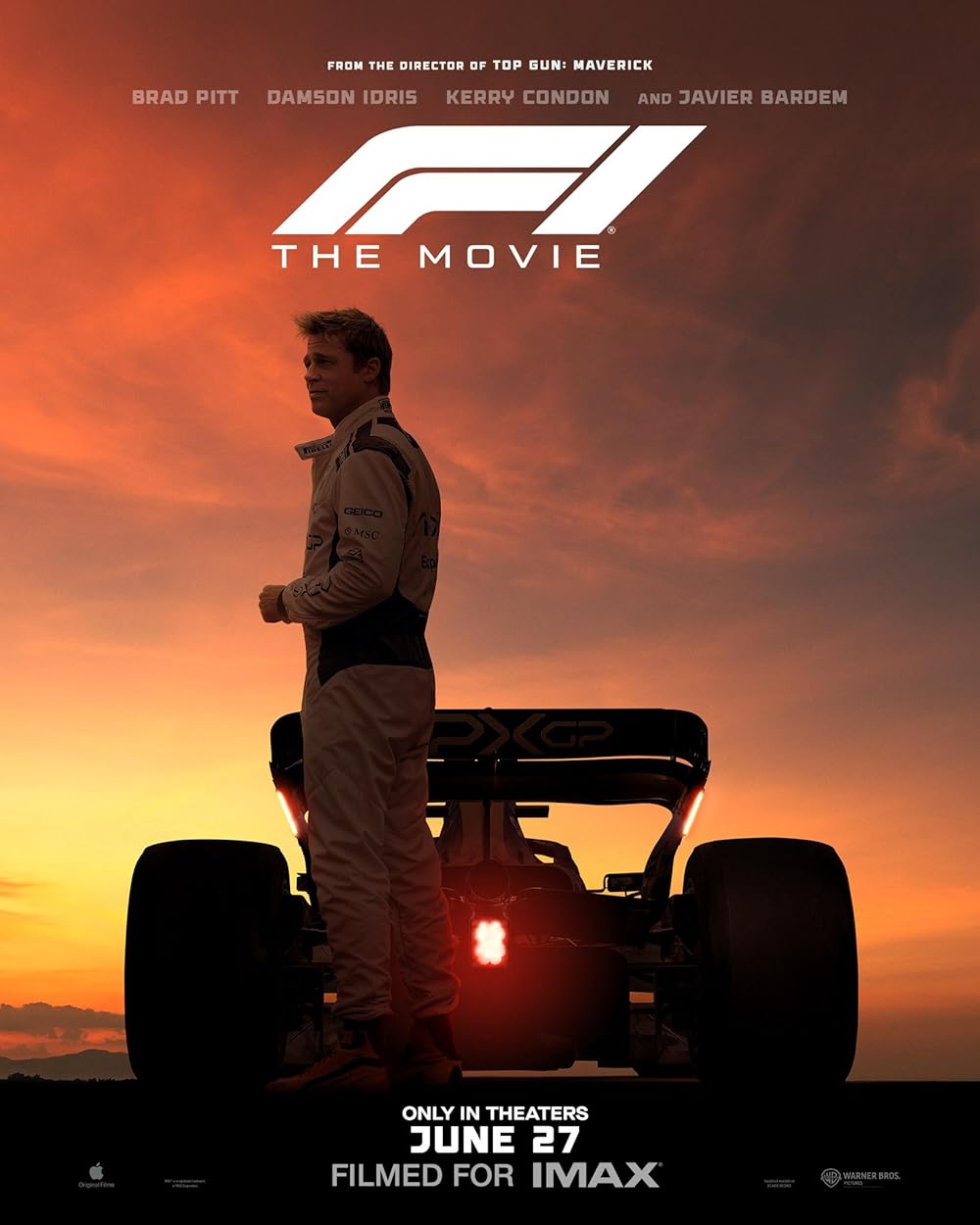
Starts on high octane, finishes on fumes. From the exhilarating technical achievement to the fantastic cast chemistry to the underdog story of redemption, it would appear that the “formula” for F1 was of sound design and execution; unfortunately, the character development is rushed and the third act simply doesn’t offer the adrenaline-pumping suspense and action as do the firsts two acts.

In the 1990s, Sonny Hayes (Brad Pitt) was Formula 1’s most promising driver until an accident on the track nearly ended his career. Thirty years later, the owner of a struggling Formula 1 team convinces Sonny to return to racing and become the best in the world. Driving alongside the team’s hotshot rookie, Sonny soon learns that the road to redemption is not something you can travel alone.

If for no other reason, see this film on the biggest screen with the highest quality sound because Joseph Kosinski’s F1 is why the BIG screen was made. From beginning to end, the cinematography and editing deserve top billing for this picture because you will feel that you are right there in the crowd or with the drivers along the Grand Prix. Even if you know little to nothing about Formula 1 racing, you will never feel lost as there are sufficient context clues and exposition to keep you along for the 200mph ride. It would have been too easy to lean into the racing sequences, but the racing punctuates the rest of the story, so each and every time you are on the track of the Grand Prix, there has been an emotional and chemical reset from the previous racing scenes. Both the sound design and cinematography are outstanding in this octane-fueled motion picture.

The score from Hans Zimmer serves as a direct extension of both action and character in F1. His energetic score blends sweeping orchestration with pulsating electronic textures that wrap audiences in the big screen story. Zimmer’s ability to craft a human story inside a mechanical world is on full display in the film. Where his brilliance as a composer is witnessed most is in the rhythmic choices scene to scene. He employs musical motifs that emulate machinery or momentum, which in a sport where every millisecond matters, Zimmer’s percussive, syncopated techniques mirror the precision and stakes of the most elite motorsport. In a film that captures a motorsport that crosses cultural boundaries–a global sport–Zimmer’s score represents a cross-section of the various regions of the world that play host to Formula 1 and seamlessly transcends cultural boundaries, creating a sort of global score that resonates with audiences from around the world.

While the plotting is sound, and serves as the foundation for a compelling story, where the film suffers is in the character development and third act. The setup in the first act informs the audience of everything needed to understand our two central characters of Sonny and Joshua (Idris) and the two vastly different worlds in which they live yet are connected by the thrill and love of racing. Of course, this thrill and love is expressed differently based upon the difference in both generation and worldview. Everything needed for a compelling character journey formula is there, but falters in the third act. Underscoring the story is social commentary on our drive (or motivation) for pursuing a passion, be that a career or by extension, a hobby. And it’s in this motivation that we witness our central characters develop over the course of the narrative conflict.

Sonny is a cynical former (generation X) Formula 1 driver, that was once heralded as the newest star on the Grand Prix circuit. In contrast, Joshua “JP” is the (generation Z) talented and charismatic driver that is obsessed with his image (with help from his press manager). Both drivers excel in talent, but are each battling their own respective demons. Sonny and JP develop over the course of the film–each man’s worldview challenged. Sonny has to grow in team spirit and JP has to grow in humility. The character arcs on which both characters are traveling begin and even develop in compelling ways, even resonating with audience members that are somewhere on the spectrum between both individuals; but, the change in both characters is too rapid when the resolution comes in the third act. JP’s scenario appears to be the perfect canvas on which to paint a portrait of what happens when we lose focus on the love of a sport and rather find ourselves lost in the celebrity of it, lost in the toxic social media swamp. Sonny’s character arc feels more complete, but even his switch from where he was to where he ended resolved itself too quickly, losing the full impact that it could have had.

Kosinski’s casting decisions result in a cast that demonstrates excellence in chemistry. There is an authenticity in the relationships and dynamics among the lead and supporting cast. Never once, did I feel that I was watching actors–rather–I felt I was watching real Formula 1 drivers, crew, and investors. I completely buy the longtime relationship between Sonny and Reuben (Bardem), even though we spend minimal time on the history of their friendship. And the clashes between Sonny and the pit crew and directors never felt rehearsed or contrived.

Even though there are shortcomings in the third act, the film remains an exhilarating experience. Movies like this is that for which the BIG screen was created–to capture larger than life stories that most audience members will never face or experience.

Ryan is the general manager for 90.7 WKGC Public Media in Panama City and host of the public radio show ReelTalk “where you can join the cinematic conversations frame by frame each week.” Additionally, he is the author of the upcoming film studies book titled Monsters, Madness, and Mayhem: Why People Love Horror. After teaching film studies for over eight years at the University of Tampa, he transitioned from the classroom to public media. He is a member of the Critics Association of Central Florida and Indie Film Critics of America. If you like this article, check out the others and FOLLOW this blog! Follow him on Twitter: RLTerry1 and LetterBoxd: RLTerry