HEART OF THE BEAST motion picture review

Exquisite, edge-of-your-seat survival thriller with genuine heart
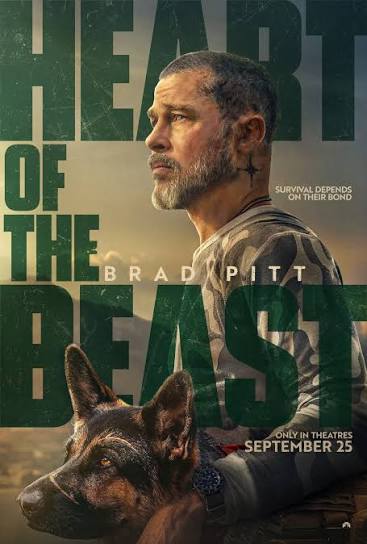
Brad Pitt and a remarkable canine co-star take audiences deep into the Alaskan wilderness in Heart of the Beast, a survival picture that understands the most dangerous terrain is not always physical. The film immediately establishes a dual struggle: surviving a landscape that is as beautiful as it is deadly while confronting the psychological wreckage left by war. That distinction is what elevates Heart of the Beast beyond the familiar survival-thriller formula. Rather than relying solely on escalating encounters with the elements, the film makes physical and emotional survival inseparable. Every external threat places additional pressure on characters already carrying wounds that cannot be bandaged, and every setback forces them to confront whether endurance alone is enough.

Pitt plays James Belmont, a retired Green Beret traveling with Odin, his former combat dog. After a devastating plane crash leaves them stranded in the mountains, the two must rely upon their training—and each other—to survive.

Director David Ayer reunites with Pitt after Fury, but this is not the survival movie I expected. Having not been particularly fond of Fury, I approached this collaboration with cautious optimism. Needless to say, Heart of the Beast completely won me over. By the time the story reached its conclusion, I was moved to tears—not because of one isolated moment, but because the film gradually draws audiences into the emotional experience of its characters until we are no longer merely observing their struggle. We are participating in it.

The external objective is clear: escape the mountains and reach safety. Beneath that action, however, is a character-driven story about James and Odin living with the lingering effects of trauma. Unlike many films that treat post-traumatic stress as a dramatic gimmick or allow it to consume a character’s identity, Heart of the Beast lets trauma emerge organically through behavior, memory, instinct, and the bond these two share.

That restraint gives the film unusual emotional authenticity. James and Odin are affected by what happened to them, but they are not defined solely by it. The story quietly argues that trauma may influence memory, fear, and behavior, but it does not erase agency. We may not control what has happened to us or how certain memories return, but we can still control how we respond.

The result is a riveting, character-driven survival picture in which the question is never simply whether its leads will make it out of the wilderness alive. The deeper question is whether they can survive what they brought into the wilderness with them.

Explaining exactly how the story develops would venture too far into spoiler territory. Suffice it to say, Heart of the Beast delivers one surprise after another. It vividly embodies the expression “two steps forward, one step back”—although for James and Odin, it frequently becomes two steps forward and three, four, or five steps back.

Pitt and his canine co-star, Uber, deliver compelling performances. When James and Odin hurt, we hurt. When they become frightened, we share their fear. Although James is a retired Green Beret, the screenplay never transforms him into an invincible action hero. He is highly trained, resourceful, resilient, and strong, but he is also vulnerable, fallible, and recognizably human. Odin is equally well developed. Anyone who has loved a dog—or another animal companion—will recognize something of their own relationship in the trust between these two characters. Uber communicates fear, loyalty, pain, and determination with extraordinary clarity, often without the film needing to underline what we are meant to feel.

The cinematography does not attempt anything particularly novel, but it captures the beauty and hostility of the Alaskan wilderness exceptionally well. The landscapes are breathtaking yet inhospitable, beautiful enough to inspire awe and cold enough to send a chill down your spine.

In lesser survival films, landscape photography can become a substitute for dramatic substance, allowing striking imagery to compensate for thin characters or a mediocre story. Not so here. The compositions and camera movements emphasize both the grandeur and hostility of the wilderness without allowing the environment to overshadow James and Odin. The mountains remain formidable, but they never become more important than the people trying to survive them.

The musical score operates with similar restraint. Beautifully composed and emotionally expressive, it provides an additional current beneath the drama without demanding attention for itself. Like the cinematography, the music serves the characters and story rather than competing with them. It feels less like accompaniment than an extension of the emotional life already present on screen.

Cameron Alexander’s tightly constructed screenplay deserves particular praise. Survival films frequently protract their ordeals, but Heart of the Beast runs under an hour and forty-five minutes, and very little of that time feels wasted. The pacing is excellent: the story never drags, yet it never feels as though it is sprinting toward its conclusion. Alexander appears to understand one of the most valuable principles of economical screenwriting: enter a scene as late as possible and leave it as soon as its dramatic purpose has been fulfilled. Nearly every scene advances character, conflict, or consequence, and each sequence points naturally toward the third act and resolution.

It is also a compelling example of the benefits of separating the writer and director roles. Ayer can concentrate on performance, atmosphere, visual storytelling, and execution, while Alexander provides the dramatic architecture beneath those choices. Their collaboration demonstrates what can happen when distinct creative disciplines complement rather than compete with one another.

As we approach the final quarter of the year and begin considering the best films of 2026, Heart of the Beast is firmly on track to make my list. It is a reminder that some of the most affecting motion pictures are those that reveal the best people can be—to one another, to the animals who depend upon us, and to ourselves—even when the world seems to be collapsing around us.

At a time when so much contemporary storytelling gravitates toward cynicism, there is something refreshing about a film that treats resilience, loyalty, compassion, and perseverance without embarrassment. More motion pictures should aspire to leave audiences feeling that the human experience, difficult as it may be, is still worth fighting for.

Heart of the Beast is equal parts exhilarating and heartwarming, delivering an emotional payoff that may send you rushing home to embrace the furry companion waiting for you. I certainly hugged my dog, Fizzgig, as soon as I returned from the cinema.

Although I am not entirely convinced a Shih Tzu would fare especially well in the Alaskan wilderness. Then again, he is a “lion dog.”

Ryan is the morning host on WLRH Public Radio in Huntsville, AL and host of the show ReelTalk “where you can enjoy the cinematic conversations frame by frame each week.” He also teaches film studies at the University of Alabama in Huntsville. Additionally, he is the author of the upcoming film studies book titled Monsters, Madness, and Mayhem: Why People Love Horror. Prior to public broadcasting, he taught film studies for over eight years at the University of Tampa. He is a member of the Critics Association of Central Florida and Indie Film Critics of America. If you like this article, check out the others and FOLLOW this blog! Follow him on Twitter: RLTerry1 and LetterBoxd: RLTerry
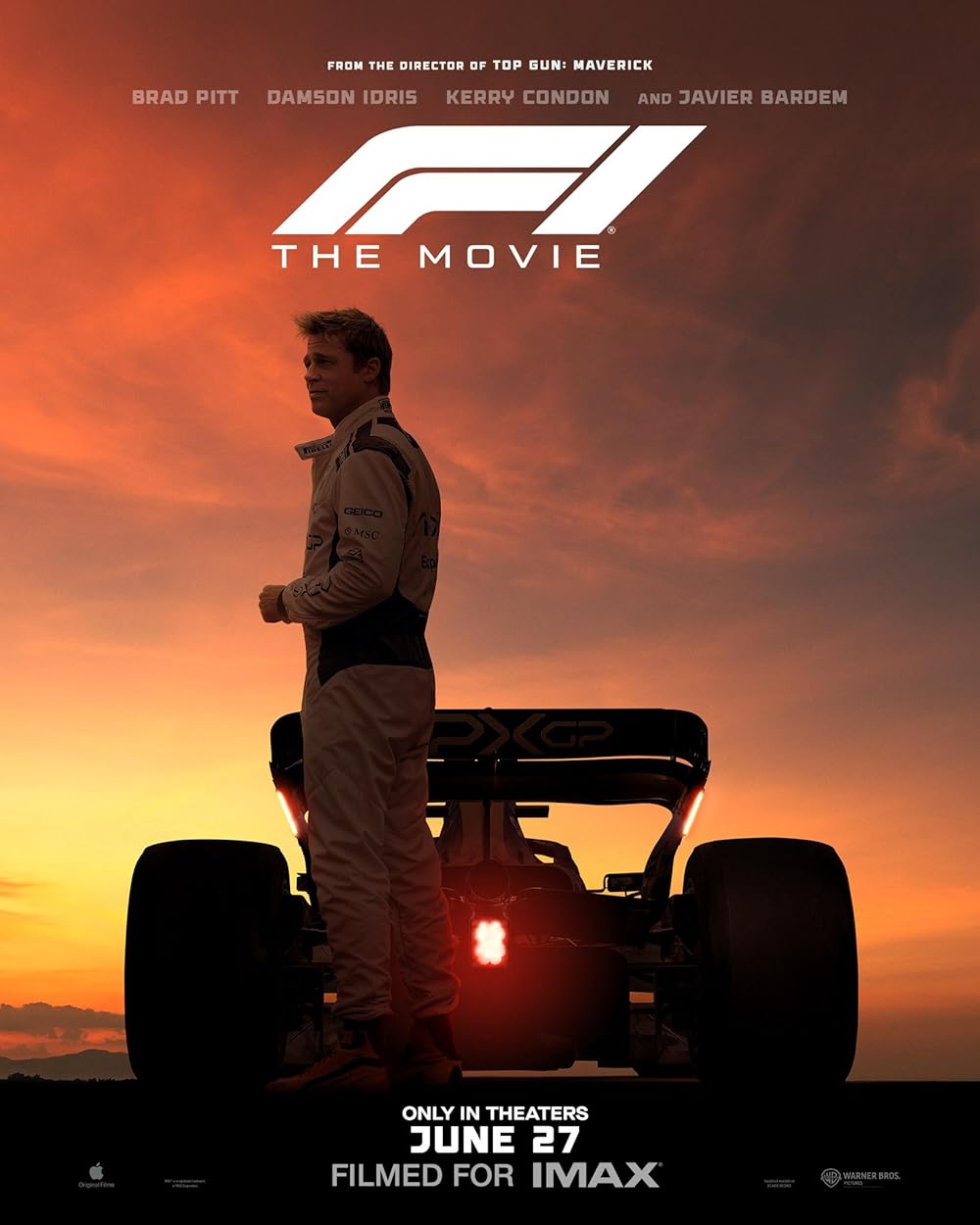
F1 THE MOVIE film review

Starts on high octane, finishes on fumes. From the exhilarating technical achievement to the fantastic cast chemistry to the underdog story of redemption, it would appear that the “formula” for F1 was of sound design and execution; unfortunately, the character development is rushed and the third act simply doesn’t offer the adrenaline-pumping suspense and action as do the firsts two acts.

In the 1990s, Sonny Hayes (Brad Pitt) was Formula 1’s most promising driver until an accident on the track nearly ended his career. Thirty years later, the owner of a struggling Formula 1 team convinces Sonny to return to racing and become the best in the world. Driving alongside the team’s hotshot rookie, Sonny soon learns that the road to redemption is not something you can travel alone.

If for no other reason, see this film on the biggest screen with the highest quality sound because Joseph Kosinski’s F1 is why the BIG screen was made. From beginning to end, the cinematography and editing deserve top billing for this picture because you will feel that you are right there in the crowd or with the drivers along the Grand Prix. Even if you know little to nothing about Formula 1 racing, you will never feel lost as there are sufficient context clues and exposition to keep you along for the 200mph ride. It would have been too easy to lean into the racing sequences, but the racing punctuates the rest of the story, so each and every time you are on the track of the Grand Prix, there has been an emotional and chemical reset from the previous racing scenes. Both the sound design and cinematography are outstanding in this octane-fueled motion picture.

The score from Hans Zimmer serves as a direct extension of both action and character in F1. His energetic score blends sweeping orchestration with pulsating electronic textures that wrap audiences in the big screen story. Zimmer’s ability to craft a human story inside a mechanical world is on full display in the film. Where his brilliance as a composer is witnessed most is in the rhythmic choices scene to scene. He employs musical motifs that emulate machinery or momentum, which in a sport where every millisecond matters, Zimmer’s percussive, syncopated techniques mirror the precision and stakes of the most elite motorsport. In a film that captures a motorsport that crosses cultural boundaries–a global sport–Zimmer’s score represents a cross-section of the various regions of the world that play host to Formula 1 and seamlessly transcends cultural boundaries, creating a sort of global score that resonates with audiences from around the world.

While the plotting is sound, and serves as the foundation for a compelling story, where the film suffers is in the character development and third act. The setup in the first act informs the audience of everything needed to understand our two central characters of Sonny and Joshua (Idris) and the two vastly different worlds in which they live yet are connected by the thrill and love of racing. Of course, this thrill and love is expressed differently based upon the difference in both generation and worldview. Everything needed for a compelling character journey formula is there, but falters in the third act. Underscoring the story is social commentary on our drive (or motivation) for pursuing a passion, be that a career or by extension, a hobby. And it’s in this motivation that we witness our central characters develop over the course of the narrative conflict.

Sonny is a cynical former (generation X) Formula 1 driver, that was once heralded as the newest star on the Grand Prix circuit. In contrast, Joshua “JP” is the (generation Z) talented and charismatic driver that is obsessed with his image (with help from his press manager). Both drivers excel in talent, but are each battling their own respective demons. Sonny and JP develop over the course of the film–each man’s worldview challenged. Sonny has to grow in team spirit and JP has to grow in humility. The character arcs on which both characters are traveling begin and even develop in compelling ways, even resonating with audience members that are somewhere on the spectrum between both individuals; but, the change in both characters is too rapid when the resolution comes in the third act. JP’s scenario appears to be the perfect canvas on which to paint a portrait of what happens when we lose focus on the love of a sport and rather find ourselves lost in the celebrity of it, lost in the toxic social media swamp. Sonny’s character arc feels more complete, but even his switch from where he was to where he ended resolved itself too quickly, losing the full impact that it could have had.

Kosinski’s casting decisions result in a cast that demonstrates excellence in chemistry. There is an authenticity in the relationships and dynamics among the lead and supporting cast. Never once, did I feel that I was watching actors–rather–I felt I was watching real Formula 1 drivers, crew, and investors. I completely buy the longtime relationship between Sonny and Reuben (Bardem), even though we spend minimal time on the history of their friendship. And the clashes between Sonny and the pit crew and directors never felt rehearsed or contrived.

Even though there are shortcomings in the third act, the film remains an exhilarating experience. Movies like this is that for which the BIG screen was created–to capture larger than life stories that most audience members will never face or experience.

Ryan is the general manager for 90.7 WKGC Public Media in Panama City and host of the public radio show ReelTalk “where you can join the cinematic conversations frame by frame each week.” Additionally, he is the author of the upcoming film studies book titled Monsters, Madness, and Mayhem: Why People Love Horror. After teaching film studies for over eight years at the University of Tampa, he transitioned from the classroom to public media. He is a member of the Critics Association of Central Florida and Indie Film Critics of America. If you like this article, check out the others and FOLLOW this blog! Follow him on Twitter: RLTerry1 and LetterBoxd: RLTerry

BABYLON (2022) film review

Whoa, that’s a lot of movie. Damien Chazelle’s decadent film of bombastic proportions is simultaneously mesmerizing and repulsive, coherent and incoherent, thoughtful and thoughtless. Suffice it to say, it’s interesting to behold. This overstuffed fever dream collage of 1920s and 1930s Hollywood is trying to tell so many stories, that it winds up not telling any of them effectively enough. There are competing A-stories (outside/action plots), each vying for to be the story about which the audience empathizes with the most. To dramatize these ideas, Chazelle assembles a mise-en-scene that’s ostensibly a combination of Singin’ in the Rain, Boogie Nights, Sunset Boulevard, and Once Upon a Time in Hollywood, with a little Caligula and Wolf of Wall Street thrown in to provocative proportions. Ultimately, what we have here is more of an exercise in montage–the assembly of a motion picture–more so than we have a clearly defined narrative. Undoubtedly, this will become a film that is shown in film studies classes in the future, and will be used for close reading discussions, much like I show Boogie Nights in my American Cinema class. There is a prolific amount of imagery to analyze, as the film follows four different Hollywood stories that all intersect one another. Just for whom was the film created? Certainly not general audiences. It is likely going to be most appreciated by Chazelle himself and with some critics and scholars (tho, not this scholar nor the majority of the critics with whom I screened this film).

Decadence, depravity, and outrageous excess lead to the rise and fall of several ambitious dreamers in 1920s Hollywood.

One thing is clear, Chazelle’s intention was to craft a boisterous love letter to the allure and power of cinema whilst negatively critiquing the Hollywood system that creates and destroys careers on a whim. Furthermore, the film seeks to provide thoughtful commentary (just how thoughtful? that is for you to decide) on the superficial, fleeting nature of fame and celebrity. Where the film excels is in the both the performative dimension and Chazelle’s direction. Unfortunately, Chazelle’s screenplay is all over the place.

While audiences may not remember the four individual story threads that make up the outside/action plot, audiences will definitely remember the prologue and final scene. Chazelle certainly captures the unbridled decadence that is probably not unlike the level of debauchery that ran rampant after the great movie people migration from Europe (mostly Germany and France) and eastern U.S. (avoiding Edison’s motion picture patent policing) after the first World War. It was certainly the wild west with a seemingly unending source of money (coupled with massive debt). To borrow from Outback’s former slogan no rules, just right, that describes the atmosphere of the greater Los Angeles area. No order, only chaos. Which is not unlike this film–lots of chaotic images and plot points.

The prologue to Babylon is truly a spectacle that words simply cannot capture accurately. That’s not to say that all of the creative decisions were plot or character-driven–I’ve said it before–that even provocative imagery can be used to further the plot or character; and therefore, that which would otherwise be evaluated as gratuitous, is actually purposeful. However, much of what goes on in the opening scenes is simply gratuitous for the sake of shocking the audience–for an extended period of runtime. I am reminded of the opening to Boogie Nights, and how at first glance it may seem gratuitous, but actually the opening scene is needed for plot and character development. It’s not so much shocking as it is crafted for a strategic purpose.

While elements of the prologue are justifiable, in the relationship to plot and character, there are many moments that are no more than prolific debauchery simply because Chazelle could. Now, what I did find most interesting–and to the point that I greatly appreciate the prologue–is that much of the deplorable chaos is underscored by the score from Fritz Lang’s masterpiece Metropolis in the Babylon scene with MechaMaria. Something Chazelle wove into the scene for the film scholars in the crowd.

Jumping to the end of the film, there is a–what amounts to a–clip show featuring iconic films from the 100+ years of cinema history we have. I get it, Chazelle is communicating to audiences that being part of filmmaking means that you’re part of something bigger than yourself, something that will live on decades and (by extension) centuries after you pass away. It’s this artform that will continually be rediscovered and influence people and cultures (good, bad, or indifferent). While it’s clearly designed to be an emotionally moving moment in the film, as indicated by the tears in the character in that scene, it comes off as lazy, derivative montage that does little more than remind the audience of better films for the rather long sequence of imagery. Instead of being a deeply, moving scene, it’s rather vapid.

The four competing A-stories depict four different (but not too dissimilar in substance) Hollywood stories. (1) an A-list star that feels the pain as he watches his star fade with changing times (2) An up and comer that is thrust into the spotlight for a brief time, just to continue to fall due to tragic flaws and a talent that simply didn’t transition to talkies (3) an immensely talented individual subject to the prejudices of the general public and Hollywood executives and (4) and an animal wrangler turned studio executive by being in the right place at the right time, but even that level of fame and success is not invincible to human error and poor judgment. Any one of these stories would have made for a great A-story, with others falling in line thereafter. But each one of them feels like it’s vying for the main outside/action story. This is where Chazelle should have worked with a screenwriter that could have taken his concepts and ideas, and fashioned them into a much better structured and plotted narrative.

Perhaps it’s a film ahead of its time, or perhaps, it truly is the Heavens Gate of 2022. Maybe it will see success on down the road like Boogie Nights and Showgirls has, but only time will tell. Presently, it’s a wild, bloated film that lacks basic storytelling.

Ryan teaches Film Studies and Screenwriting at the University of Tampa and is a member of the Critics Association of Central Florida. If you like this article, check out the others and FOLLOW this blog! Interested in Ryan making a guest appearance on your podcast or contributing to your website? Send him a DM on Twitter. If you’re ever in Tampa or Orlando, feel free to catch a movie with him.

Follow him on Twitter: RLTerry1

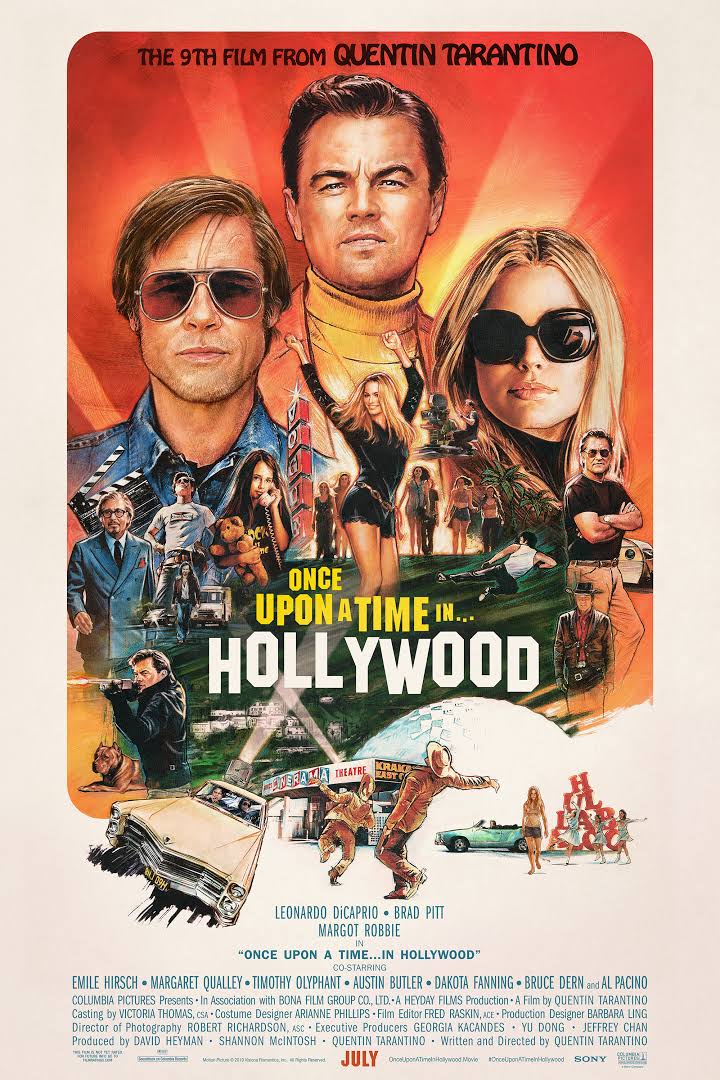
“Once Upon a Time in… Hollywood” Film Review

“The Hollywood that never was, and always will be” in this QT film that subverts expectations and delivers in spades. The ninth film from writer-director Quentin Tarantino is a brilliant historical fiction inspired by real events and people in film/television and Hollywood history. If you’ve been to Disney’s Hollywood Studios, you’ll recognize the opening quote. For the cinephile or film/TV/Hollywood history geek, this film will sweep you up in the story and setting; however, general audiences may find it difficult to connect to the otherwise fantastic story. Thankfully, the performances from the three leads DiCaprio, Pitt, and Robbie and strong supporting cast will keep you entertained for the rather lengthy runtime regardless if historic Hollywood is of interest to you or not. The characters also add a high degree of relatability, which may come of a surprise to audiences. While the film kept me engaged the entire time, I can see where more casual movie fans–even fans of QT–may find the first act sluggish. While the first two third of the film may not seem like a traditional QT film, the third act (specifically the showdown) goes full on Tarantino! If you pay particularly close attention to the view outside of the windshield of Dalton’s car, you may even notice the Alto Nido apartment building, that Joe Gillis lived in, in Sunset Boulevard. Suffice it to say, if you are up on your Hollywood history, you will find lots of Easter Eggs and references to film and television of that post studio system era. Once Upon a Time in… Hollywood represents a brilliantly entertaining homage to what is largely considered the end of the Golden Age in Hollywood.

Quentin Tarantino’s Once Upon a Time in… Hollywood visits 1969 Los Angeles, where everything is changing, as TV star Rick Dalton (Leonardo DiCaprio) and his longtime stunt double Cliff Booth (Brad Pitt) make their way around an industry they hardly recognize anymore. Concurrent to their struggle to find their place in a Hollywood that is changing so rapidly, the film also follows Sharon Tate (Margot Robbie) and Roman Polanski as the fateful night of August 8, 1969 approaches. The ninth film from the writer-director features a large ensemble cast and multiple storylines in a tribute to the final moments of Hollywood’s golden age.

I went into this film with moderately high expectations, which can be dangerous, but the film met and surpassed any preconceived notions that I had. Despite the more than 2.5hr run time, I could have easily watched it for another half hour. Compared to his other eight films, Once Upon a Time in… Hollywood is, what I would consider, to be the most accessible of his films; however, some of the magic of the film will be lost on those whom are not film/TV and Hollywood history geeks. And it’s as if QT knew this, so he wrote two incredibly entertaining fictional characters (Dalton and Booth) in this mostly historically accurate setting. Our third lead is based on the real person Sharon Tate married to then respected director Roman Polanski (Rosemary’s Baby). The three lead performances captivate the audience and keep you along for the ride as the tension increases as we approach August 8, 1969 (the night the Manson cult murdered a pregnant Tate along with four of her friends) on the quit street Cielo Drive.

For the first 2/3 of the film, you may be wondering if it’s even a QT film. And that’s because he subverts his usual approach to plot and character development, gritty violence, and non-linear storytelling is largely absent in the film. Students of QT’s work (even if you aren’t a huge fan despite respecting his cinematic work like myself) will pick up on the QT tropes and moments, but they will likely go missed by general audiences. Interestingly, everything that QT loves about old Hollywood is in this film, but never becomes the focus. Rather the setting, characters, and plot devices work to provide context, effective development of character and plot, and immersing the audience in the changing world that was Hollywood 1969. The historic events of August 8, 1969 (and other times, dates, movies referenced in the film) are an important element in the film to ground this fictional story in history; but it’s the fictional foreground of Rick Dalton and Cliff Booth that is the A-Story that moves the action plot along. Although the film does contain the character of the now infamous Roman Polanski, the focus remains on his wife, the late Sharon Tate; however, QT does an excellent job of separating the man from the art, and the pre-pedo versus post-pedo. Essentially, he is a means to an end. Horror fans will love hearing Rosemary’s Baby referenced and movie musical fans may notice the giant movie poster ad for Funny Girl outside of Columbia Pictures. 

What makes the characters of Dalton and Booth relatable to audiences is conflict, both internal and external, faced by these two men whom are aging out of and find their career tool bags are increasingly not compatible with the changing landscape of Hollywood at the time. The foreground takes us back to when the American Western genre of Film and TV was on its way out, which leaves Dalton and Booth an icon of the past. Come to think of it, they are experiencing a small degree of what Norma Desmond experienced in Sunset Boulevard. The struggle to find one’s place in the world, when the very foundation upon which you built your life and career is cracking and breaking a part, is something with which we can all identify. You can apply this to career or even romantic relationships (if you’re still single like me), you feel that no matter how hard you try or what you do to change that you cannot realize what you desire. There is a real pain that exists when looking upon a world that doesn’t want what you have to offer anymore, and you can only hang your laurels on the past for so long before it becomes a hindrance to living in the now. Booth represents a person whom experiences prejudice based upon past incidents, and hindered from being able to learn from the past and grow as a person. Both characters use alcohol as a coping mechanism, but we learn that dulling your senses to the past does not allow you to address it, learn from it, and develop a plan of action moving forward. Adapt or get left behind. Both Leo and Brad deliver outstanding performances that should catch the attention of The Academy when it comes time to nominate. There exists two layers to the performances because they are actors playing actors playing characters. Using the American Western as the conduit through which to explore a disappearing past was an excellent choice that also allowed for QT to work with a favorite genre of his. For a retrospective on the Western, check out Classic Movie Musts.

While QT has received negative criticism for his (what some have considered) underuse of Margot Robbie’s Sharon Tate, I don’t find that to be the case. Her character may not have been given a significant amount to do in the film, but she is not the central character, despite being an important part of the overall story. She portrays a real life actress and soon-to-be new mother who’s promising career was cut short by the Manson cult. When she is on screen, she truly lights it up with an infectious energy and delivers an excellent performance/portrayal in those moments. Whereas she may not have been the central character, in the scenes that we do see her, she is given important direction and reminds us that Sharon Tate was more than the late wife of Polanski or a murder victim, but was a person with dreams, friends, and a life outside of her career. For fans of Polanski’s Fearless Vampire Killers, you’ll recognize that it’s the movie that is referenced when we are given the story of how Tate came to leave Jay Sebring to become engaged to Polanski during the filming of that movie in the UK. Her story is the historical background upon which the fictional foreground of Dalton and Booth was built. Furthermore, she represents the optimistic innocence that once was before being cruelly ended. Playing around with the ideas of innocence and corruption is a running secondary theme to the primary one of the past versus present.

If you go into this movie with the expectation that it will be a quintessential QT film from start to finish, then you may be disappointed until the third act. He subverts our expectations by approaching this film in a more “Golden Era” of Hollywood way. He takes the best moves out of his playbook and integrates them into the story. Think of it as a kaleidoscope of the end of the Golden Age of Hollywood and QT’s best hits. While the film does have a slow burn through much of it (no mistaking it, it worked for me), the third act is gripping, suspenseful, and truly pays off the tension that was slowly wound through Acts I and II. Of all his films, this is probably my favorite one for fun factor and nostalgia. It doesn’t ground it self in nostalgia, but it’s a great accessory to the story. Film/TV and Hollywood history geeks will likely love this film while more casual movie fans will enjoy it well enough. It’s a film for film fans, and that’s perfectly fine!

You can catch Ryan most weeks at Studio Movie Grill Tampa, so if you’re in the area, let him know and you can join him at the cinema.

Ryan teaches screenwriting at the University of Tampa. If you like this article, check out the others and FOLLOW this blog! Interested in Ryan making a guest appearance on your podcast or contributing to your website? Send him a DM on Twitter!

Follow him!

Twitter: RLTerry1

Instagram: RL_Terry

“Allied” movie review

alliedQuite the duplicitous plot! Robert Zemeckis’ Allied released by Paramount Pictures is a thrilling tale of espionage and love. We have certainly seen a few different “spy” movies over the last couple of years; some more about espionage and others more about the drama that ensues afterwards. Fortunately, Allied feels like a genuine spy movie that actually contains espionage. The production design and costumes are a beautiful throwback to the fabulous 40s. You’ll find yourself reaching for a glass of champagne and swing dancing to Benny Goodman’s timeless big band jazz hit Sing, Sing, Sing. There is one city synonymous with WWII, espionage, and romance and you will appropriately return to that iconic city of Casablanca in Allied. This is definitely not a reimagined Casablanca but there are indirect references to that movie sprinkled throughout this new story. Films like this one require top notch talent, and both Brad Pitt and Marion Cotillard deliver outstanding performances to accompany this staple in film genres. Not limited to the love story between Pitt’s and Cotillard’s respective characters, the movie also includes some deadly shootout scenes and dangerously close encounters with the Nazis behind enemy lines.

Commander and intelligence officer Max Vatan (Pitt) is stationed in the famous city of Casablanca in French Morocco where he teams up with French resistance movement leader Marianne Beausejour (Cotillard). Impressed by her ability to so effectively blend in and create her authentic cover, Vatan soon finds himself falling in love with his partner. Following the assassination of a Nazi ambassador, Beausejour and Vatan flee to London to start their life together. Everything is going beautifully for the happy couple in their second year of marriage with a child when Vatan’s superiors confront him with the suspicion that Marianne is in fact a Nazi spy. Refusing to believe it to be true, Max must now conduct his own investigation into his wife’s history to protect the ones he loves so dearly.

I absolutely adored the look and feel of the film as it echoes the era of the Golden Age of Hollywood. Although this movie plays off a tad listless as a result of failing to elicit a strong emotional response from the audience, it is not without it outstanding elements. It benefits from solid acting and beautiful cinematography as well as some fantastic symbolism. Robert Zemeckis’ talent for visual storytelling is clearly visible in this period film. The weakness in the ability to successfully leave a lasting emotional impact on the audience is in the writing and executive producership of Steven Knight (Eastern Promises). For films that are not as much about the spectacle as they are the drama between characters and the challenges faced therein, it is vitally important that the personal/interpersonal relationships transcend the screen and directly impact the audience. All the makings were there for a deeply moving cinematic story, but it just doesn’t quite make that transition from the mostly superficial and distant.

Mirror, mirror, on the wall…(interesting fun fact: this misquoted line from Snow White is actually “magic mirror on the wall”). But, I digress. The strategic use of mirrors is an  incredible use of visual storytelling and symbolism. For those who have studied film or literary rhetoric, the mirror is a classic means of conveying duplicity (two sides, faces, etc of a character). Even without knowing that this was a spy movie, I would have been able to infer that from how the mirrors are shot and placed within the composition of the 24 frames a second. When using powerful symbolism as part of the visual story, it conveys so much more meaning in a scene than words could actually describe. Mirrors have long sense been a powerful metaphor even before moving pictures. But motion pictures allow for a greater use of the importance it plays in a cinematic story. Not limited to duplicity, mirrors can also be used as a metaphor for self-reflection. Whether talking duplicity or reflection, the mirror aids in conveying so much to the audience in this movie.

Ordinarily, I am not a fan of classic films getting remakes; however, there are always exceptions when the core or essence of the film is held in tact but the production design, direction, and cinematography are brought up to speed with contemporary cinema. If you’re a fan of WWII era films or the timelsss spy movie, then you will definitely enjoy Allied. After witnessing the significance of Casablanca in this movie, I am actually looking forward to a remake if there ever is one. Provided. That the overall look and feel of the movie is in line with classical motion picture storytelling. I could definitely see Robert Zemeckis directing a remake of Casablanca. Occasionally there are directors who can strike the balance between a classic tale told through contemporary technology, and Zemeckis definitely struck that balance in Allied.

Don’t allow the weak writing to dissuade you from watching it; there is actually a lot to enjoy in this film. After the slow burn during the first act, acts II and III are full of intrigue and suspense.