“Oh no, don’t go in that house!” “Watch out! He’s right behind you.” Some of the most memorable movies of all time are horror films, of which, some of the best and most revolutionary were made in the 1930s and 40s by the original production house of horror Universal Studios. The early horror films set the foundation upon which all other horror films would be judged. Ask anyone, and the single most famous scene in all of cinema is the famous shower scene from Hitchcock’s Psycho, widely regarded as the most pivotal horror film in all cinema history. The aforementioned scene gains a greater eerie feel upon the close of the movie when the audience realizes that Norman has little to no control over his mind and actions. There is something about horror films that beckons the audiences to find enjoyment in that which in real life would not be enjoyable—and not only see it once but repeat it over and over again. And furthermore, find the unfamiliar and grotesque fascinating to behold as what should remain hidden comes to light. The return of the repressed.
Throughout history, from the fights in the Roman Coliseum to Michael Myers’ slaying of people in Halloween, audiences have been both entertained and repeatedly drawn to stories and shows that highlight horrific acts of violence or feelings of terror and anxiety. Perhaps there is a deep seeded reason as to why millions of people find entertainment value in horror films. This question has been tackled by many psychiatrists and psychologists, each has come up with a different explanation as to “why horror?” Most notably, famed psychiatrist, Sigmund Freud provided great insight into an explanation of why people find horror films fascinating in his essay on the Uncanny.
 Although many of the conclusions drawn by Freud have been challenged over the years, he spent a great deal of time on the uncanny; and his analysis on such has helped a great deal in understanding the psychology behind horror. The word uncanny comes from the German word unheimlich, which is literally translated as something unfamiliar. However, that which is unfamiliar is not necessarily uncanny. In particular, he was interested in the return of the repressed. And, in this return of the repressed, “other” scenes, to which we do not have direct access, would reveal themselves. It is this revelation that is what Freud terms the uncanny. This theory is an explicitly aesthetic inquiry regarding what in art (or life) produces sensations of dread and horror, repulsion, and a return to such unpleasurable sensations. There are many elements or groups of elements that Freud deemed as uncanny. Each one is burdened to exceed intellectual uncertainty in order to fit the definition of uncanny as laid out by Freud.
In order to fully understand unheimlich, it is necessary to understand the antithesis of the aforementioned which is heimlich. The word Heimlich means something that belongs to the familiar, something not strange, and is friendly. Diving into a deeper reading of the word Heimlich, it can also mean something that is concealed from the conscious—not accessible by our conscious mind. Freud even goes as far as to suggest that this refers to something that is kept from sight so that others do not get to know about it. Knowing the definition of Heimlich, it is easier to understand how and why Freud chooses to use it in his evaluation of art (in which, we have literature, theatre, and cinema). According to Freud, “unheimlich is the name for everything that ought to have remained…secret and hidden, but has come into the light.” In his study on the uncanny, Freud takes on the literary imagination (this same literary analysis can and is used to analyze film) by dividing his theory up into three sections. He first defines the concept of the uncanny, then performs an examination of the context required for understanding the experience of the uncanny, and finally explores the effects of the uncanny on the psyche through literature and fiction. Some of the running themes throughout his essay are loss of eyes, castration, the double-ego, and self-reflexivity. Through the framework laid out by Freud, scholars and film critics can explore the themes in horror film as it relates to the human subconscious.
Freud explains the realm of the uncanny as the place at which aesthetics and psychoanalysis merge because it deals with a particular feeling or sensation combined with emotional impulses. The substances or manifestations of the uncanny are elements that are fearful and frightening. Proceeding with Freud’s definition of the uncanny being a class of frightening elements, plaguing the psyche, ushering an individual back to what is familiar (heimlich) and known (as opposed to what is unknown). Freud refers to the uncanny as that “which should have remained secret and hidden, but has come to the light.” Furthermore, he goes on to further describe the uncanny as the “mark of the return of the repressed.” The concept of the uncanny is a type of unwilling or mistaken exposure to something surprising, unexpected, or horrific.
Freud claims that the source of the uncanny in literature is the recurrence of something long forgotten and repressed. However, not everything that returns from the psychic depths of repression is uncanny. The mere return of repressed feelings and experiences is not sufficient for the uncanny to occur. It requires something repressed having returned but represented by an unexpected and outside the realm of reality. This is easily accomplished in literature (and by extension, movies, and plays) because fantasy is different from reality. Just because something works as uncanny in a work of literature doesn’t mean it can work in real-life as well. Within literature, if the author makes a pretense to realism, then he or she opens the door to supplying the story with the uncanny. Often times, the uncanny in literature and film is the projection of the psyche of the central character on another object or person combined with a warped view of the objective and subjective of a given situation. It’s like something within the fictional world creeps into the real world. And, this is definitely manifested within the character of Norman Bates in Psycho.
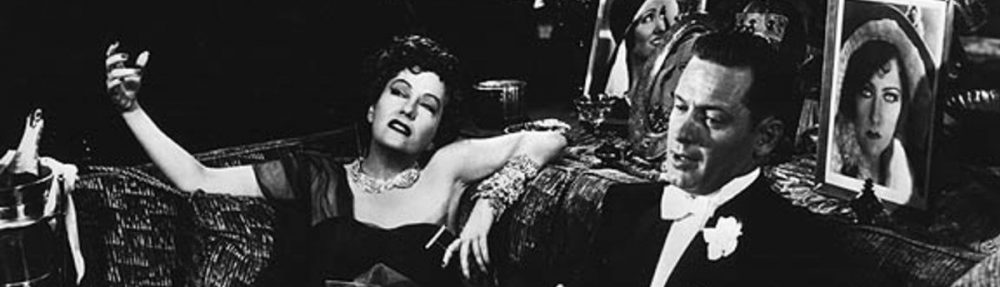
Within the horror genre, there are many different stories or narratives that exist. And, each type of horror film tells its story in different ways; however, they are all concerned with getting the same emotional response from the “people out there in the dark,” as famously stated by Norma Desmond in the timeless film noir classic Sunset Boulevard. Sometimes the audience will go on a journey into the crazed mind of a psychopathic serial killer or they may witness a supernatural monster terrorizing a small Bavarian village. In either case, Freud believes that the writers of horror are concerned with exposing the audience to “other” scenes. And, these “other” scenes are rooted in the subconscious. Freud’s psychoanalytic theory is a perfect lens through which to evaluate horror films and the effects of them.
 The character of Norman Bates became a revolutionary breakthrough in cinema and entertainment as Freud’s psychoanalytic theory gained prominence in a major motion picture. Not only using it as a character archetype but using the motion picture’s exposition, via the psychiatrist at the end of the film, as a way to explore the subconscious of Norman. Keeping inline with the pace and substantive matter of the film, Hitchcock meticulously and skillfully used the characters and dialog to frame and reveal Norman’s feelings, subconscious thoughts, and conscious behaviors despite the aforementioned being very pleasant. Although the feelings and behaviors were unpleasant, subconsciously Norman enjoyed them. And, Freud touches on this too. He refers to it as the pleasurable unpleasureable. Despite Freud’s revelations of the subconscious mind, the subconscious is not something anyone has access to or can, much less, exhibit control over its goals. Therefore, as Norman was unable to exhibit control over the actions and tendencies of his subconscious mind, he did not realize he subconsciously allowed his mother to take control over his body and turn this “normal” guy into a serial killer.
Understanding Freud’s theory of the uncanny can best be fully grasped and comprehended by applying it to a particular scene(s) in a work of horror. In this case, the actions leading up to, and including, the infamous shower scene in Alfred Hitchcock’s masterpiece Psycho will be used. Before the screeches of the violins, before the more than fifty cuts (edits) to the film, and before the audience slowly spins away from the lifeless eye of Marion Crane (Janet Leigh), Norman Bates (Anthony Perkins) shows signs of being intrigued with generating erotic feelings of arousal in his mind and body. Prior to removing the portrait of the bird from the wall of his office, Norman exhibited mostly homosexual-ish signs. He did not appear to be sexually attracted to Marion and behaved more like a new girlfriend than a potential sexual partner. However, this is all about to change.
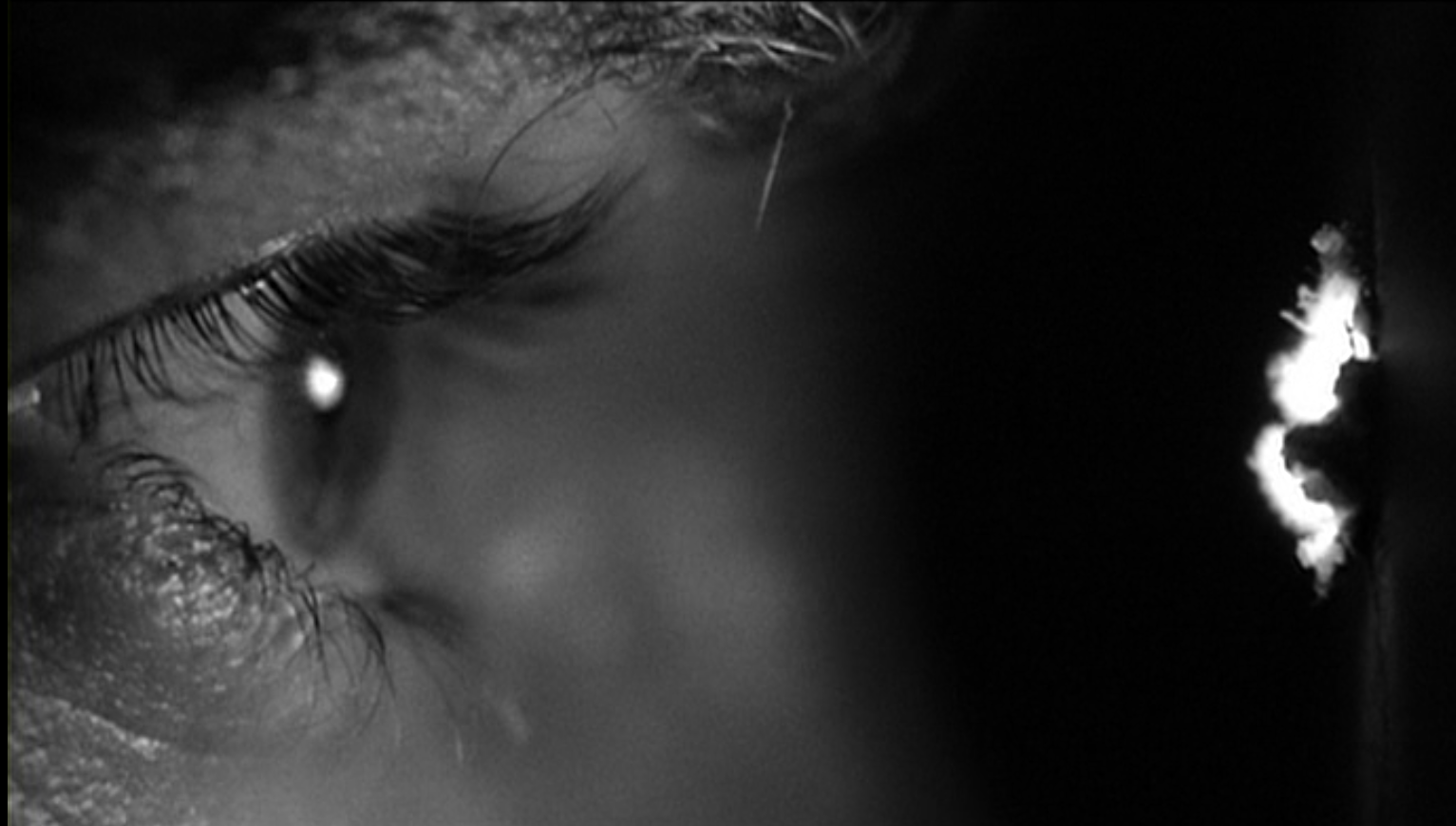
 To quickly navigate the scene prior to applying Freud’s theory of the uncanny to it, Norman bids farewell to Marion after a good dinner turns to the creepy side. Marion begins to disrobe and prepare to take a relaxing shower. Unbeknownst to her, Norman has removed a portrait of a bird from his wall and is using a peephole to gaze into her room. After spending some time on an extreme closeup of Norman’s eye, Marion puts on a robe and sits down at the desk. Norman replaces the picture on the wall and heads back to his house. Marion does some math (pertaining to the $40 thousand she stole) and then gets in the shower. Not long into the relaxing hot water, Marion is attacked by a shadowy figure resembling an old woman. She is stabbed repeatedly and left to die. We slowly spin out from Marion’s lifeless eye to close out the scene.
There is a great juxtaposition in the Norman before his peeping-tom voyeuristic actions and during (and after) his choice to peep into the bedroom on the unsuspecting Marion. It is as though there was something repressed–hidden down deep inside–Norman that unexpectedly returned to the surface of the conscious. This return then prompted him to go from exhibiting homosexual (or perhaps asexual) behaviors to clear hormone-driven heterosexual male behaviors. Although on the juvenile side, Norman clearly shows that he not only wants to be friends with Marion but to experience sexual relations with her. And, he gets his rocks off by watching her disrobe. Interestingly, the fact he is behaving similarly to a 14 or 15-year-old male plays directly to the notion that these heterosexual emotions were repressed since he was young.
But, Norman does not continue indefinitely gazing into the room of Marion; he eventually replaces the picture and heads to his house and sits. Perhaps he is in contemplation of what he wants and what he knows he cannot have. He clearly wrestles with this uncanny appearance of these feelings he is not used to experiencing. An important aspect to the uncanny is that the individual has no control over when this return of repressed unfamiliar feelings emerges. So, this isn’t something that he, in all likelihood knows how to control. So, instead of controlling it, these repressed feelings begin to take over his conscious by using pathways in the unconscious (the home of that which is uncanny).
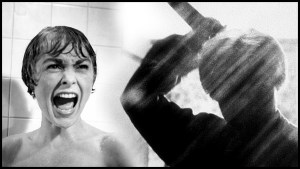 Back in the bathroom of Marion’s room, Marion steps into the shower and is soon attacked by a dark shadowy old-woman-like shadow. This shadow is Norman dressed as his mother. Since the uncanny lives in the unconscious, over which we can exhibit no control, it develops its own mechanisms of dealing with this return of the repressed. By killing the object that aroused these unconscious feelings, the unconscious is able to then return to a balance. Of course, this isn’t truly a balance because it is directly linked to socio-pathological behaviors that rely on violence to purge the emotions and drive them back to the unconscious where they belong.
Norman’s initial response, following the iconic brutal murder of Marion, was denial and projected blame onto Mother. From the time the audience is first introduced to Norman, they are presented with an individual who is timid, shy, and nervous. But, when Mother breaks through his cognitive defense mechanisms, he becomes aggressive, destructive, and volatile. As a result of this cognitive struggle between the conscious and subconscious, the presence of Mother causes pain, anguish, and both internal and external conflicts within the mind of Norman. As the psychiatrist Dr. Fred Richmond, in the movie, stated, “At times he could be both personalities, carry on conversations. At other times, the mother half took over completely. Now he was never all Norman, but he was often only mother. And because he was so pathologically jealous of her, he assumed that she was jealous of him. Therefore, if he felt a strong attraction to any other woman, the mother side of him would go wild.”
Through the psychiatrist’s psychoanalysis, rooted in Freud’s theories, the audience learns that Mother was a permanent part of his mind. After watching the movie, the audience is only ever faced with a brief moment of the pathological side of Norman. However, this brief moment is enough for the psychiatrist to conduct a preliminary evaluation of Norman’s psyche. Playing to the unheimlich of the film, umheimlich referring to what’s “uncanny” about the film (or more literally translated as unfamiliar), despite the mere glimpse into the crazy side of Norman, the audience begins to allow fear and terror to take over and imagine what he is truly like. Oddly enough, even though the audience is terrified of Norman, they also sympathize with him because of the trauma exercised on Norman from his domineering mother, thus debilitating Norman for the rest of his life.
Using Freud’s model and theory of The Uncanny to evaluate these famous scenes from Psycho, it is clear that Freud was ahead of his time and was able to explain what would drive someone to behave in such a horrific manner. By breaking it down this way, Freud actually makes Norman seem like someone that could exist in real life, and that is perhaps the most terrifying aspect to the movie. The fact that Norman could be your next-door neighbor, is enough to spark fear and horror into the lives of those who watch this masterpiece.
If you enjoyed this article, please share and SUBSCRIBE! The button is at the top of the page.
Ryan is a screenwriting professor at the University of Tampa. If you like this article, check out the others and FOLLOW this blog!
Follow him!
Twitter: RLTerry1
Instagram: RL_Terry
Thrillz (theme parks): Thrillz.co
 A spectacular journey that will have you on the edge of your seat. Ready Player One is a throwback to the classic Spielberg blockbuster films from the 70s, 80s, and 90s that many of us know, quote, and love. You’ll do far more than wax nostalgic in this film, because the focus is on the conflict at hand and not the pop culture references. Spielberg’s adaptation of the best-selling novel, written by Ernest Cline, takes on the challenge of crafting a visually compelling narrative that shows the benefits of virtual reality (VR) and gaming, juxtaposing it against the harshness of a reality following socio-economic and natural disasters in the near future. Although the story highlights the benefits of VR and shows the wonders of the imagination through the exquisitely designed scenes, there is one element seen throughout the story that transcends the illusion of Oasis (the virtual world); and that is humanity. Generosity of spirit and integrity are showcased brilliantly through the various central characters. I found myself, at the end of the movie, thinking about how much it reminds me of the magic of Willy Wonka and the Chocolate Factory. Never once, will you find an opportunity for boredom to set in. And you’ll find yourself rooting for this open source of entertainment and information to remain available to all those who want to participate, and not regulate content based upon how much someone is willing to pay.