WUTHERING HEIGHTS (2026) film review

A very lose adaptation.
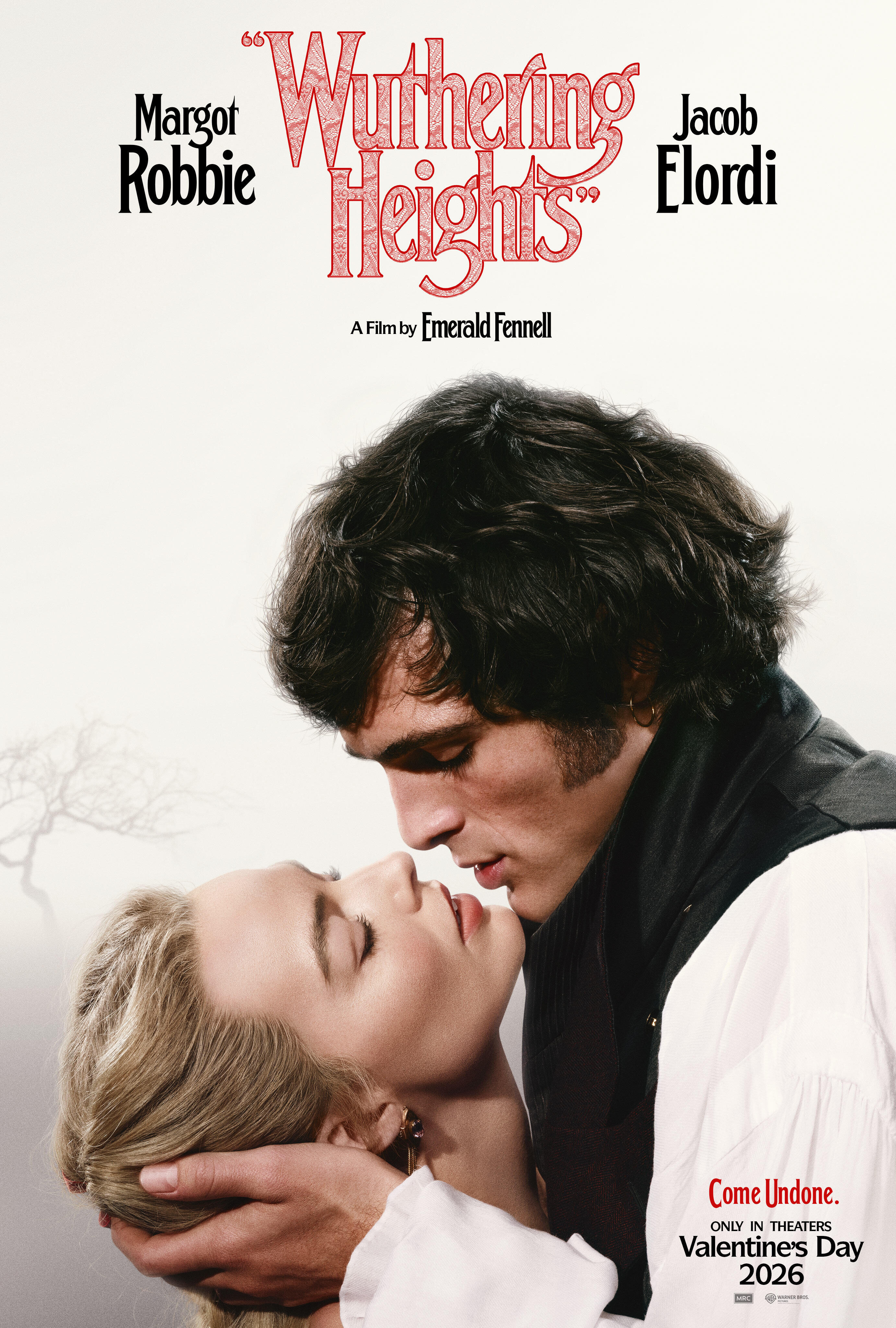
Is it a bold, thoughtful reinterpretation of a literary classic—or a grotesquely self-indulgent fever dream? Emerald Fennell’s Wuthering Heights positions itself squarely at the intersection of gothic romance and modern sensibility, daring to reimagine Emily Brontë’s tempestuous novel for contemporary audiences. The question is not whether Fennell has vision—she undeniably does—but whether that vision honors Brontë’s architecture or merely rearranges it to suit her own aesthetic impulses.

Tragedy strikes when Heathcliff falls in love with Catherine Earnshaw, a woman from a wealthy family in 18th-century England. What follows, in Brontë’s telling, is a slow-burning study of pride, cruelty, class, and decay.

Let us begin where praise is due. Emerald Fennell is undeniably a visionary director. Her eye for composition, color, texture, and environmental immersion is extraordinary. Every frame feels curated—shadow and candlelight carefully balanced, fabrics heavy with implication, the moors rendered both seductive and foreboding. The costuming and production design are exquisite, nearly flawless in execution. If one were evaluating this film purely as visual art, it would stand among the most striking adaptations of Brontë ever mounted. There is a neo-gothic confidence in its aesthetic—modern, tactile, and immersive.

Unfortunately, that same discipline is absent from the screenplay.

Fennell the director and Fennell the writer feel like two different artists. Subtlety is sacrificed in favor of blunt-force reinterpretation. When Fennell adheres closely to Brontë’s plotting, the film works. When she strays—and she strays often—the adaptation buckles under the weight of unnecessary revisionism.

The most egregious example is the character assassination of Catherine’s father. In both the novel and the 1939 William Wyler adaptation, he is a kindly, stabilizing force—the glue that holds the family together. It is only upon his death that his biological son, Hindley, descends into cruelty and degradation, transforming Heathcliff from adopted son to servant in a perverse Cinderella inversion. Fennell eliminates Hindley altogether, redistributing his vices—gambling, drunkenness, cruelty—onto the father himself, rendering him a monstrous, bigoted drunk from the outset. This is not reinterpretation; it is structural sabotage.

By corrupting the father from the beginning, the narrative loses its axis of decay. And decay is central to Wuthering Heights. The estate should mirror the relationships within it—beautiful at first, falling gradually into ruin as love curdles into vengeance. Yet Fennell presents Wuthering Heights as decrepit from the outset. If everything is already broken, there is no meaningful deterioration to witness. The symbolism collapses before it can resonate.

Isabella Linton suffers a similar flattening. In Brontë’s novel and prior adaptations, she possesses dimension, agency, and tragic complexity. Here, she is comparatively inert, stripped of the inner life that once made her more than a narrative device. Again, when Fennell stays close to Brontë, the film steadies itself. When she diverges, the narrative weakens.

Pacing further undermines the film’s impact. What could have been told effectively in an hour and forty-five minutes stretches to two hours and fifteen, with a protracted second act that tests even patient viewers. Entire opening sequences could be excised without loss, and substantial portions of the middle tightened considerably. One feels the absence of editorial restraint—the checks and balances that a separate, more disciplined screenwriter might have imposed.

And yet, there are cinematic pleasures here.

While the narrative falters, the film’s visual architecture is nothing short of extraordinary. Production design, cinematography, and costuming operate in near-perfect harmony, creating a world deeply rooted in Gothic romance yet unmistakably filtered through contemporary sensibilities. The estate’s textures—weathered wood, cold stone, candlelit interiors—create a tactile atmosphere that is immersive and deliberate. The color palette oscillates between muted earth tones and saturated bursts of crimson and shadow, suggesting emotional volatility beneath composure.

The costuming deserves particular recognition. Fennell understands silhouette and line as psychological tools. Structured bodices, layered fabrics, and stark contrasts in texture mirror emotional rigidity and suppressed desire. There is a modern sharpness in the tailoring—a recalibration that prevents the film from feeling museum-bound. This is Gothic romance rendered through a contemporary lens without collapsing into gimmickry.

The cinematography further elevates the material. Light and shadow are deployed not merely for aesthetic pleasure but for emotional suggestion. Faces emerge from darkness as though haunted by memory; candlelight flickers against stone walls like unstable devotion. Fennell’s compositional instincts are impeccable—symmetry fractured at key moments, framing that isolates characters even when they occupy the same space. Visually, this Wuthering Heights breathes.

Fennell’s restraint also deserves applause. After the provocative spectacle of Saltburn—and the social media speculation that followed—many anticipated a sexually explicit interpretation of Brontë. Instead, this adaptation is comparatively restrained. Passion is implied more often than shown. Edginess exists, yes—but it is measured, not gratuitous. Ironically, this restraint underscores her discipline as a director even while her writing falters.

Performatively, the film is strong. Robbie and Elordi deliver committed, emotionally grounded performances, leaning into the operatic intensity of the material without tipping into parody. Hong Chau, as Nelly, provides a compelling presence—observant, restrained, and quietly anchoring the emotional chaos around her. The cast frequently elevates what the script undermines.

There are even moments—brief, surprising—that are genuinely funny. Fennell understands tonal modulation, allowing dry humor to flicker through the gloom like shafts of unexpected light.

Ultimately, 2026’s Wuthering Heights is immersive and visually arresting but narratively anemic. It demonstrates how essential the collaborative checks and balances of cinema truly are. A more disciplined screenwriter paired with Fennell’s formidable directorial skill could produce something extraordinary. Instead, we are left with an adaptation that is imaginative, occasionally exhilarating—and unlikely to command a rewatch.

It is not without merit. But it mistakes alteration for insight, excess for depth, and provocation for revelation. And for a story as enduring as Brontë’s, that is a costly miscalculation.
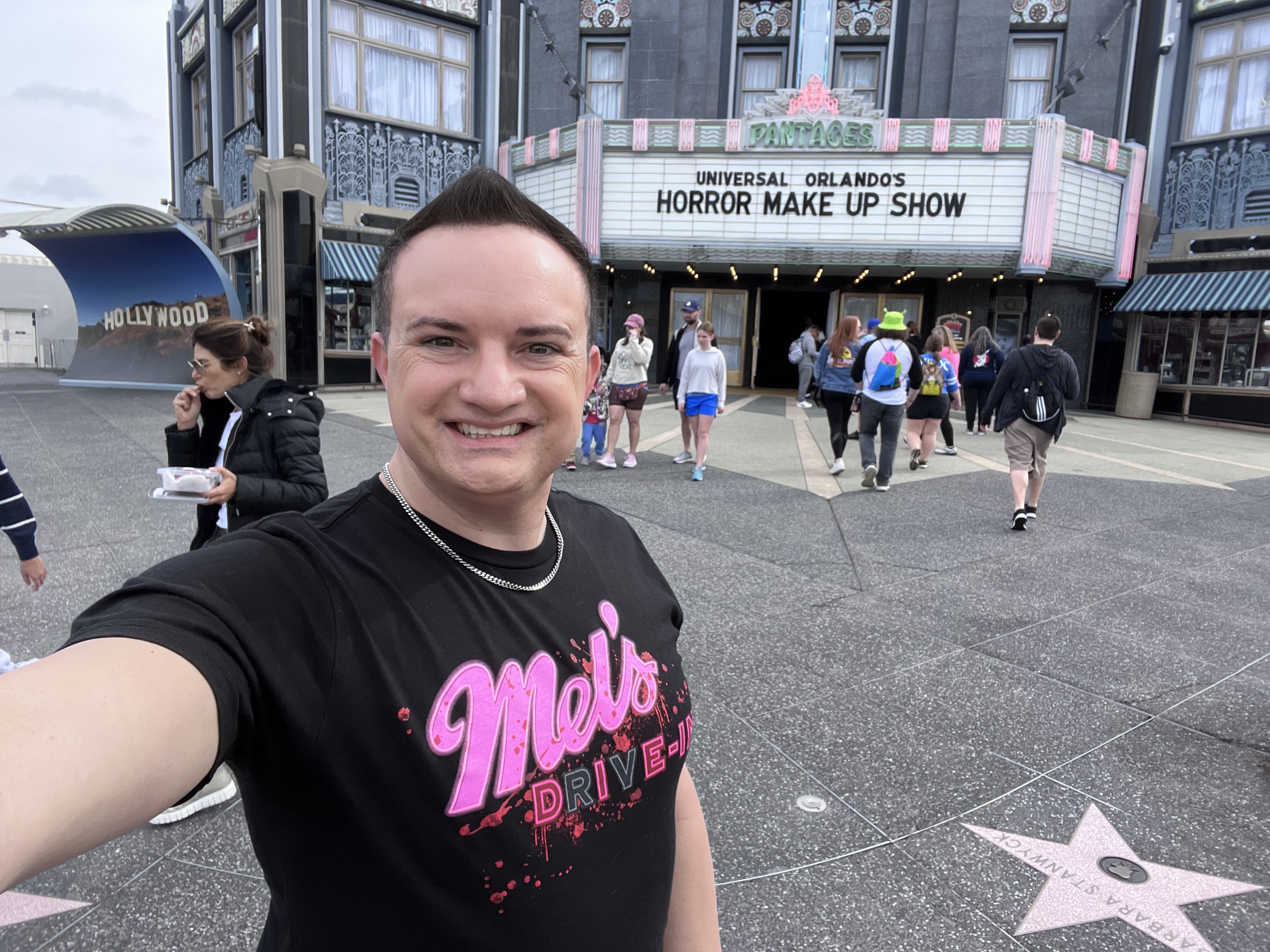
Ryan is the general manager for 90.7 WKGC Public Media and host of the show ReelTalk “where you can join the cinematic conversations frame by frame each week.” Additionally, he is the author of the upcoming film studies book titled Monsters, Madness, and Mayhem: Why People Love Horror. After teaching film studies for over eight years at the University of Tampa, he transitioned from the classroom to public media. He is a member of the Critics Association of Central Florida and Indie Film Critics of America. If you like this article, check out the others and FOLLOW this blog! Follow him on Twitter: RLTerry1 and LetterBoxd: RLTerry

BABYLON (2022) film review

Whoa, that’s a lot of movie. Damien Chazelle’s decadent film of bombastic proportions is simultaneously mesmerizing and repulsive, coherent and incoherent, thoughtful and thoughtless. Suffice it to say, it’s interesting to behold. This overstuffed fever dream collage of 1920s and 1930s Hollywood is trying to tell so many stories, that it winds up not telling any of them effectively enough. There are competing A-stories (outside/action plots), each vying for to be the story about which the audience empathizes with the most. To dramatize these ideas, Chazelle assembles a mise-en-scene that’s ostensibly a combination of Singin’ in the Rain, Boogie Nights, Sunset Boulevard, and Once Upon a Time in Hollywood, with a little Caligula and Wolf of Wall Street thrown in to provocative proportions. Ultimately, what we have here is more of an exercise in montage–the assembly of a motion picture–more so than we have a clearly defined narrative. Undoubtedly, this will become a film that is shown in film studies classes in the future, and will be used for close reading discussions, much like I show Boogie Nights in my American Cinema class. There is a prolific amount of imagery to analyze, as the film follows four different Hollywood stories that all intersect one another. Just for whom was the film created? Certainly not general audiences. It is likely going to be most appreciated by Chazelle himself and with some critics and scholars (tho, not this scholar nor the majority of the critics with whom I screened this film).

Decadence, depravity, and outrageous excess lead to the rise and fall of several ambitious dreamers in 1920s Hollywood.

One thing is clear, Chazelle’s intention was to craft a boisterous love letter to the allure and power of cinema whilst negatively critiquing the Hollywood system that creates and destroys careers on a whim. Furthermore, the film seeks to provide thoughtful commentary (just how thoughtful? that is for you to decide) on the superficial, fleeting nature of fame and celebrity. Where the film excels is in the both the performative dimension and Chazelle’s direction. Unfortunately, Chazelle’s screenplay is all over the place.

While audiences may not remember the four individual story threads that make up the outside/action plot, audiences will definitely remember the prologue and final scene. Chazelle certainly captures the unbridled decadence that is probably not unlike the level of debauchery that ran rampant after the great movie people migration from Europe (mostly Germany and France) and eastern U.S. (avoiding Edison’s motion picture patent policing) after the first World War. It was certainly the wild west with a seemingly unending source of money (coupled with massive debt). To borrow from Outback’s former slogan no rules, just right, that describes the atmosphere of the greater Los Angeles area. No order, only chaos. Which is not unlike this film–lots of chaotic images and plot points.

The prologue to Babylon is truly a spectacle that words simply cannot capture accurately. That’s not to say that all of the creative decisions were plot or character-driven–I’ve said it before–that even provocative imagery can be used to further the plot or character; and therefore, that which would otherwise be evaluated as gratuitous, is actually purposeful. However, much of what goes on in the opening scenes is simply gratuitous for the sake of shocking the audience–for an extended period of runtime. I am reminded of the opening to Boogie Nights, and how at first glance it may seem gratuitous, but actually the opening scene is needed for plot and character development. It’s not so much shocking as it is crafted for a strategic purpose.

While elements of the prologue are justifiable, in the relationship to plot and character, there are many moments that are no more than prolific debauchery simply because Chazelle could. Now, what I did find most interesting–and to the point that I greatly appreciate the prologue–is that much of the deplorable chaos is underscored by the score from Fritz Lang’s masterpiece Metropolis in the Babylon scene with MechaMaria. Something Chazelle wove into the scene for the film scholars in the crowd.

Jumping to the end of the film, there is a–what amounts to a–clip show featuring iconic films from the 100+ years of cinema history we have. I get it, Chazelle is communicating to audiences that being part of filmmaking means that you’re part of something bigger than yourself, something that will live on decades and (by extension) centuries after you pass away. It’s this artform that will continually be rediscovered and influence people and cultures (good, bad, or indifferent). While it’s clearly designed to be an emotionally moving moment in the film, as indicated by the tears in the character in that scene, it comes off as lazy, derivative montage that does little more than remind the audience of better films for the rather long sequence of imagery. Instead of being a deeply, moving scene, it’s rather vapid.

The four competing A-stories depict four different (but not too dissimilar in substance) Hollywood stories. (1) an A-list star that feels the pain as he watches his star fade with changing times (2) An up and comer that is thrust into the spotlight for a brief time, just to continue to fall due to tragic flaws and a talent that simply didn’t transition to talkies (3) an immensely talented individual subject to the prejudices of the general public and Hollywood executives and (4) and an animal wrangler turned studio executive by being in the right place at the right time, but even that level of fame and success is not invincible to human error and poor judgment. Any one of these stories would have made for a great A-story, with others falling in line thereafter. But each one of them feels like it’s vying for the main outside/action story. This is where Chazelle should have worked with a screenwriter that could have taken his concepts and ideas, and fashioned them into a much better structured and plotted narrative.

Perhaps it’s a film ahead of its time, or perhaps, it truly is the Heavens Gate of 2022. Maybe it will see success on down the road like Boogie Nights and Showgirls has, but only time will tell. Presently, it’s a wild, bloated film that lacks basic storytelling.

Ryan teaches Film Studies and Screenwriting at the University of Tampa and is a member of the Critics Association of Central Florida. If you like this article, check out the others and FOLLOW this blog! Interested in Ryan making a guest appearance on your podcast or contributing to your website? Send him a DM on Twitter. If you’re ever in Tampa or Orlando, feel free to catch a movie with him.

Follow him on Twitter: RLTerry1

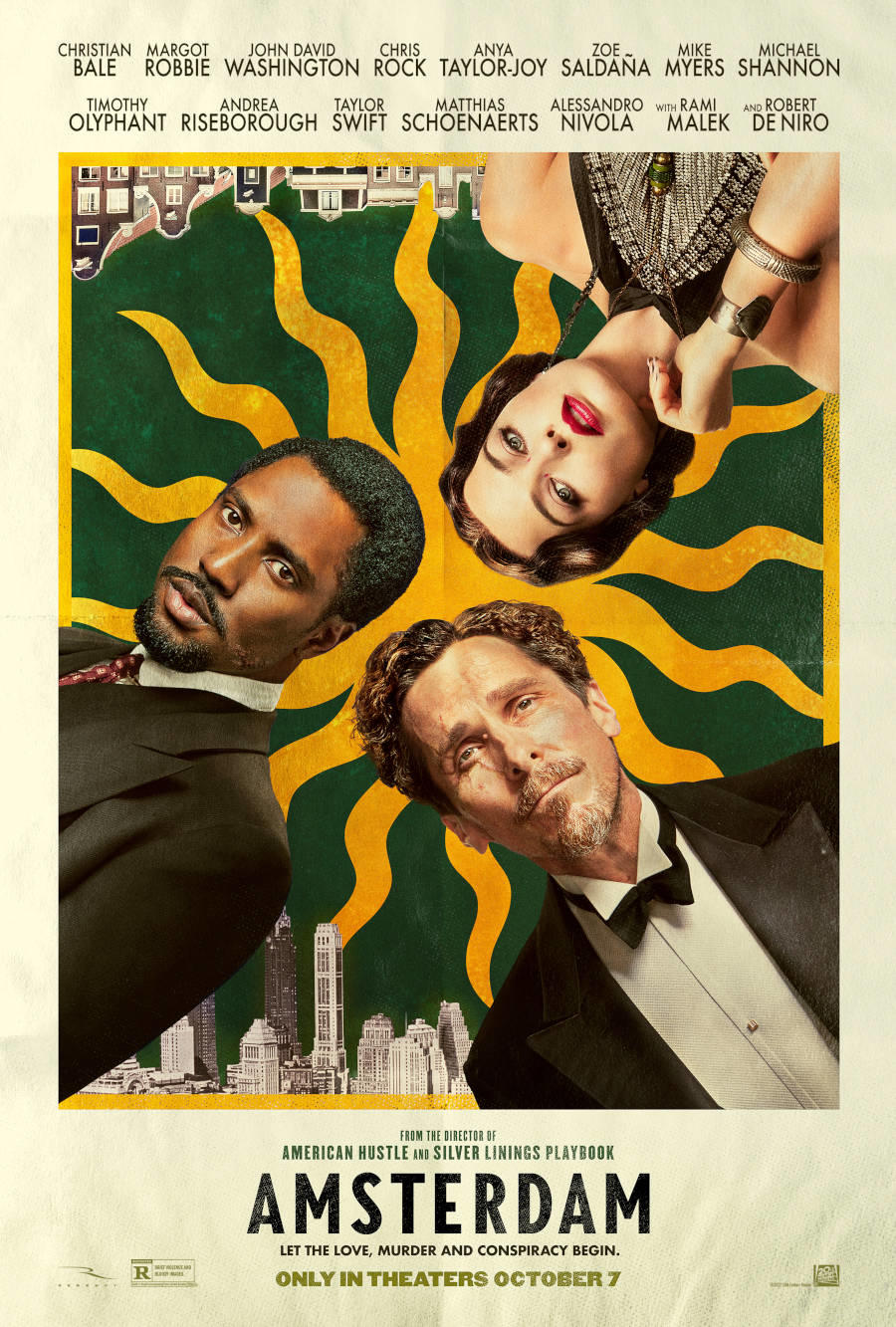
AMSTERDAM movie mini-review

There is a fascinating true story and great movie…in there…somewhere. David O. Russell’s star-studded Amsterdam is a bloated, poorly paced movie that places far more emphasis on repetitive, pedantic social commentary than it does on lean storytelling and strategic plotting. If not for the powerhouse cast, the movie would be nearly unwatchable. A litmus test I give a movie is (1) if I look at my watch and (2) if so, how often. If I am looking at the time, then I am not engrossed in the story. And I looked at my watch many times during this lengthy quasi-historical drama. Amsterdam demonstrably has little idea or security in what it wants to be. Is it a dark comedy? Is it a drama? Is it satire? All valid questions for which there is no clear answer, because it struggles to find the proper tone that best expresses its story. Although the social commentary on race relations quickly becomes redundant, it does highlight some areas of wartime history of which many, including myself, are likely unaware. Such as soldiers of color being forced to wear French uniforms–had no idea! So I am glad that this disrespectful chapter in history was highlighted for modern audiences. Clearly this movie should have been an Oscar vehicle for Russell, his cast, and crew, From beginning to end, it’s easy to read this film as a desperate attempt to win over general audiences and critics by convincing them that there is something to see here; unfortunately, what should have been an incredibly interesting mystery and untold true story suffocates under the poorly written and structured screenplay.

Ryan teaches Film Studies and Screenwriting at the University of Tampa and is a member of the Critics Association of Central Florida. If you like this article, check out the others and FOLLOW this blog! Interested in Ryan making a guest appearance on your podcast or contributing to your website? Send him a DM on Twitter. If you’re ever in Tampa or Orlando, feel free to catch a movie with him.

Follow him on Twitter: RLTerry1

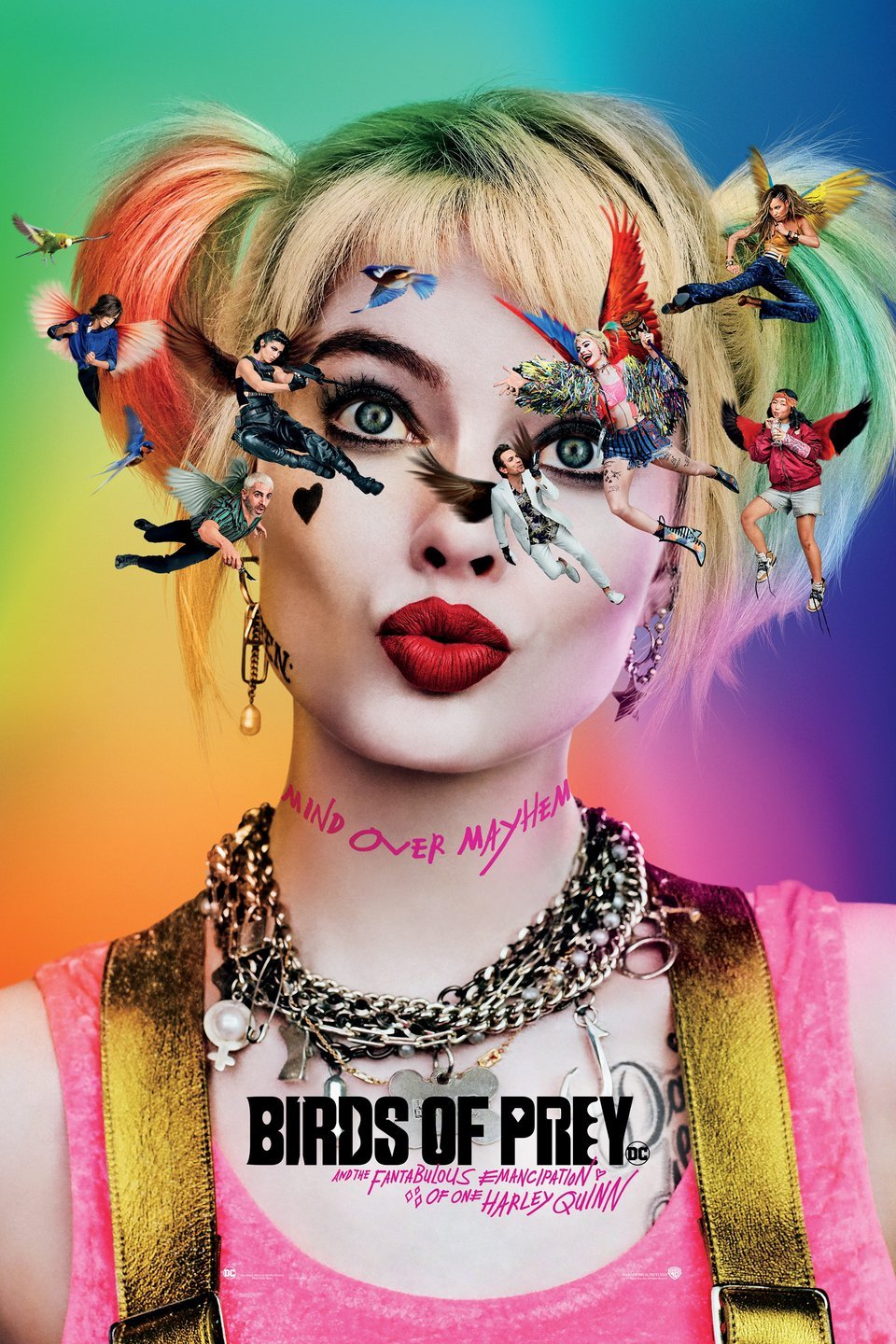
“Birds of Prey” Full Movie Review

Harley Quinn Returns. Warner Bros. and DC’s Birds of Prey: and the Fantabulous Emancipation of One Harley Quinn (from hereon out Birds of Prey, haha) is energetic, entertaining, and electrifying! Margot Robbie is a knockout! This out of this world comicbook movie is well written and directed, and even has an intimate feel in the foreground on the backdrop of outrageous, larger than life chaos. Par for the course in Gotham. Fortunately for this movie, most of the footage from the trailer was taken from the first few minutes of the movie. So, you never feel as though you’ve seen whole thing in the trailer. If Batman Returns and Deadpool had a baby, and that baby’s nanny was Kill Bill, then this is the movie that you would get! It has the brilliant camp and production design factors with the sass and action of the former two, along with the strength and determination of the latter. A winning combination, considering that Batman Returns is the best Batman movie of all time (and yes, I will die on that hill). While the trailer may make this seem like an ensemble cast for most of the movie, it really is about Harley Quinn with the other characters coming into play more significantly in the latter half of the movie. This was a strategic move by the writer and director in order for the the movie to be driven by the fallout of the breakup between Harley and Mr. J, that anti-hero anarchist spirit, and high energy optimism that defines Quinn. What we have here is a good, solid story. Yes there is the theme of female empowerment and sisterhood, but that is on the nose. The real power of this movie, and why Suicide Squad cannot even hold a candle to it, is the thoughtful story, precision plotting, and character driven conflict with plenty of reactions. Birds of Prey takes what we have grown accustomed to in comicbook movies (both DCEU and Marvel), and places it in that semitruck at the beginning of the movie, then watches as all the rules and tropes explode as the truck collides into the chemical plant! No tortured psyches, skybeams, sense of duty, or derivative action sequences here, Birds of Prey delivers explosive action and hilarious antics! All this and more awaits you in this beautiful mess of a movie.

It’s open season on Harley Quinn (Margot Robbie) when her explosive breakup with the Joker puts a big fat target on her back. Unprotected and on the run, Quinn faces the wrath of narcissistic crime boss Black Mask (Ewan McGregor), his right-hand man, Victor Zsasz (Chris Messina), and every other thug in the city. But things soon even out for Harley when she becomes unexpected allies with three deadly women — Huntress (Mary Elizabeth Winstead), Black Canary (Jurnee Smollett-Bell), and Renee Montoya (Rosie Perez)–in their respective efforts to locate the expert pickpocket Cassandra Cain (Ella Jay Basco). (IMDb summary)

If Quintin Tarantino was to direct a comicbook movie, this is precisely the kind of movie that he would write and direct. Birds of Prey director Cathy Yan and screenwriter Christina Hodson (Bumblebee) certainly seem to have channeled their love of the films of Tarantino and Waititi in the development the outstanding screenplay for Birds of Prey. It has the non-linear storytelling and violence of Tarantino paired with the tongue-in-cheekness and characterizations of Waititi. From journalist and graduate student at NYU Tisch School of the Arts to directing a major motion picture for global brands such as Warner Bros. and DC, Yan is certainly a director to watch as she continues to grow in her career. She is the kind of director that DC needs in order to develop comicbook/superhero movies that are highly engaging yet have a great deal of heart. Although I did not know the screenwriter of Bumblebee was also the writer for this movie, in retrospect, I can completely see it! Hodson knows how to craft a thoughtful story in the middle of explosive action, all the while, keeping the focus on the characters whose conflict drives the story. On the surface, this may seem like an action-driven story, but in all reality it is character driven at its core.

While some may find (and have found) the narrative exposition and nonlinear storytelling to be distracting, I find that the combination makes perfect sense for how the plot is being laid out for us; it works very well for this movie. There are similarities between the tone of Deadpool and Birds of Prey but they are different movie experiences. Each uses narrative exposition, but use that tool in different ways. Deadpool engages in breaking the fourth wall in a very Mystery Science Theatre or RiffTrax way, whereas Harley Quinn uses it in a diegetic manner. Same tool, but expressed very differently. I greatly appreciate how Quinn used this narrative device in the same way that you and I tell stories to our friends. How often have you found yourself telling recalling an event from your life and telling that story to your friends, and you get to a point at which you realize you need to preface something, and then jump back to setup that point? Probably a lot of the time! I know I certainly do. It’s like you’re so excited to get to a point in the story, but then you forget that your friends need to know what happened to setup why its important or significant. And that is precisely what Quinn is doing with her narration and what the director and writer did with the setup of the main action plot. The method that the story is laid out in front of us is a very organic way of oral storytelling. When you orally communicate a story, there is no edit button, back space, page jumps, or anything else that we use in writing to linearly tell a story (linearly being the most conventional). So yes, it is nonlinear, but otherwise it would not feel as relatable or natural.

We have both wonderfully entertaining performances and well-developed characters! The strength of this movie is built upon the characters and the conflict therein. While we do spend most of the movie with Quinn, we are methodically introduced to key characters that effect the main action plot subplot along the way. Quinn’s external goal is to retrieve the Bertinelli diamond, which is driven by her internal need for a relationship. While I won’t go into details as to how she eventually retrieves the famed diamond, as I do not want it get into spoiler territory, I will comment on her internal need for a relationship that drives the main action plot. She is longing for a relationship after Mr. J. dumps her. She feels an emptiness inside. Ironically, she desires to belong to something or someone. Ironic in that a harlequin lives to serve. What she could never have known is that she would find the sense of belonging in the relationships she forms with our supporting cast of characters that she encounters along the journey to retrieve the diamond. What she finds is NOT a romantic relationship, but a sisterhood that provides her with all the love she needs and a group to whom she can love in return. None of us (or most of us, anyway) want to be alone; we want relationships in our lives. Many find that through romantic relationships while others find it through close friendships. Sometimes both, if you’re fortunate in that way. Between her pet hyena, a pick pocket, and the newly formed group Birds of Prey, Harley Quinn’s internal need for relationship is met beautifully! It’s also this subtext that creates that intimate story amidst the backdrop of chaos.

I mentioned Batman Returns in my opening paragraph. And if you’ve seen the movie, you may be wondering why and where does Birds of Prey have elements that nod to and remind me of Tim Burton’s masterful Batman movie. Clearly, if you are wondering, then you (1) haven’t seen the greatest of all Batman movies or (2) have forgotten about the incredible art of Batman Returns. For starters, Quinn’s costume choices are very much Burton-inspired and there are several moments of dialogue that feel right out of Returns. What we love about Batman Returns is the camp factor and over-the-topness of the costuming and production design. Furthermore, there is one series of scenes in particular that are ostensibly taken right out of Returns. And this isn’t a spoiler. The production design, architecture, and set decorating in the Amusement Pier scene at the end of Birds of Prey are heavily inspired by the defunct zoo setting (Penguin’s lair) in Batman Returns. It is a fantastic combination of German expressionism and French surrealism. I absolutely love the design of the fun house and the execution of the explosive showdown! Birds of Prey strikes a perfect balance of bringing old and new fans alike together for a great comicbook inspired movie!

I highly recommend this movie to all fans of comicbook or superhero movies! Whether you are a DC or Marvel fan, or the rare DCMarvel fan, I feel strongly that you will fall in love with this movie. Although it is still incredibly fresh on my mind, and hasn’t had proper time to steep, presently I feel that it may wind up at No.3 of all-time favorite comicbook/superhero movies for me with No.1 being Batman Returns, No.2 Batman 89, and No.3 Birds of Prey.

Ryan teaches screenwriting at the University of Tampa. If you like this article, check out the others and FOLLOW this blog! Interested in Ryan making a guest appearance on your podcast or contributing to your website? Send him a DM on Twitter or email him at RLTerry1@gmail.com! You can catch Ryan most weeks at Studio Movie Grill Tampa, so if you’re in the area, feel free to catch a movie with him!

Follow him!

Twitter: RLTerry1

Instagram: RL_Terry

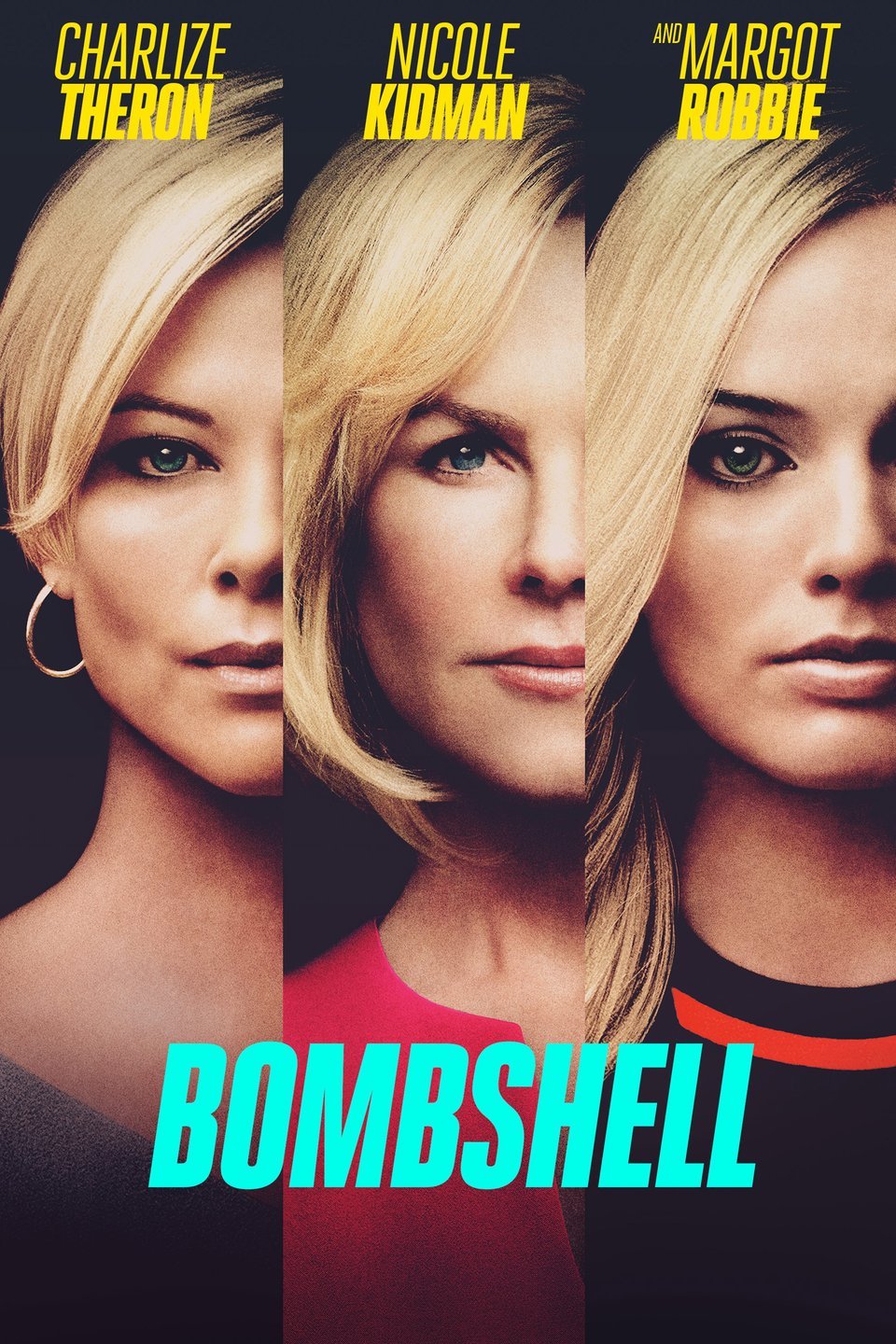
“Bombshell” Film Review

Explosive! Bombshell is a brilliantly orchestrated and riveting film that takes you behind the scenes at Fox News in the months leading up to the oust of news business mogul Roger Ailes. Follow Megyn Kelly, Gretchen Carlson, and (fictionalized) Kayla as they battle the courts of public opinion and the seemingly impenetrable fortress of Fox News to take down the repulsive Roger Ailes. I went into this film prepared for a snark-filled satire, but what I was presented with was a meticulously written and directed docudrama that struck a fantastic balance between feature news story, so to speak, and motion picture. Although the film takes itself appropriately seriously, there are plenty of moments of levity that intertwine to strike the perfect tone. Where films tackling subjects as high profile and personal as this one occasionally fall victim to creating caricatures of real people and settings. Rather than limit the film to dramatizing the legal battle and cold hard facts, it uses the fictionalized character of Kayla to explore the psycho-social cost of being the victim of sexual harassment. So this film is just as much a human story as it is a recreation of an actual event. And it’s that human component that is explored through Kayla, Megyn, and Gretchen that gives this film incredible depth. There is no pretense in this film; it’s a raw, organic approach to adapting this story from the small screen to the big screen. You even get a few surprise cameos from some some familiar anchors and other personalities. Exemplary writing and direction is coupled with a highly effective stylistic cinematography and outstanding performances by the lead and supporting cast.

Bombshell is the dramatization of the downfall of Fox News mogul Roger Ailes that chronicles a group of women as they decide to take on the mastermind of the “fair and balanced” cable news network and the toxic atmosphere he presided over at Fox News.

There have been a few films in recent years that seek to dramatize and tackle the human cost of lecherous sexual harassment and abuse of power in the work place. But this is the first one to strike the perfect balance of PSA and dramatic plot. I love the irony all throughout the film, the stark contrast between “traditional values,” and “fair and balanced” approaches and the repulsive behavior behind the scenes. Yes, Ailes might look like a pioneer for women in that he was the first to truly give women the big anchor chair, but at a scaring and traumatizing cost. He was a sadistic magician of sorts with his “look at what my right hand is doing, meanwhile my left hard is truly pulling the strings.” Much like the news network that he built (and to his credit, he was a broadcast news business genius), the surface was not a reflection of the disgusting practices to craft this “family friendly” illusion. The truly scary portrait that this film paints is not limited to Fox News, but it is likely a reflection of the business of running a “visual medium” by in large. While much of what Ailes did was direct sexual abuse and harassment, he committed a lot of indirect abuse and harassment that leaves just as traumatizing a mark upon the women he abused. Much like Hustlers posited that the entire world is a strip club where a few are dancing while the majority are paying, this film also explores the dark, seedy underbelly of “sex sells” and sex appeal.

The performances are mindblowing! How Charlize Theron completely transformed into Megyn Kelly is nearly as uncanny as Rene Zellweger’s transformation into Judy Garland in Judy. You will swear that you are watching Kelly on the big screen. Theron not only nails the look of Kelly, but the tone of voice, rhythm of speech, and body language. She is truly captivating, and showcases her phenomenal acting chops. Here’s hoping for an Oscar nom for her! Although Megyn Kelly is the central character, she is supported by Gretchen Carlson brilliantly portrayed by Nicole Kidman and fictionalized Kayla, played by Margot Robbie. In the same vein of Theron’s excellent performance, Kidman also nails Carlson down to a science. When I watched Kidman on the Fox and Friends set, I swore that it was Carlson herself. Kidman brings out the strength of character and vulnerability of Carlson. It is clear that Kidman did her homework as well as her character did. Finishing out our trifecta of women at Fox is Kayla, an entry level staff member on various shows at Fox News. She is our conduit through which we experience the extend of Ailes reprehensible behaviors behind the scenes. She represents a young eager professional that can be found in many offices. She is the “everyman,” for all intents and purposes. This role gave her so much to work with, and she was able to demonstrate the wide breadth of her acting abilities. Such a versatile actor! I also appreciate the writing of her character for giving us a normal, every day, woman of faith. One whom isn’t prudish, judgmental, or pious. Her character was likable, sex positive, and NOT homophobic. However, she also highlights how many conservatives view Fox News. And you can feel her heart break as she falls victim to Ailes, that moment she realizes and experiences that the head of Fox News is a disgusting human being.

Not only do the women shine brilliantly in this film, but John Lithgow’s Roger Ailes is fantastic! It’s hard to praise such a disgusting man, but here we have to separate the actor from the character. Lithgow is one of the most charismatic and witty actors ever, and he convinces us that he IS Ailes. I can only imagine the difficulty in portraying such a villainous person. What stands out the most in the performance, aside from the image, is how much he humanized Ailes. Showed him to self-aware of his body image and how he, much like we, rationalize negative behaviors. But it’s this human side that makes Ailed even more frightening. He successfully turns Ailes from TV business diabolical genius to mob boss. Towards the end of the film, we get an appearance by Malcolm McDowell as Rupert Murdoch himself. Such a delightful surprise to see McDowell on the big screen again. His Rupert is on point! And in his brief time on screen, he commands it strongly.

The choice of cinematography was very interesting. The movie starts out as if we are at Fox News HQ on a tour of the facility and shows. Our guide is Megyn Kelly! She simultaneously walks us through the facility and provides poignant social commentary on the image and relationships of Fox News to the world. The manner that the camera moves throughout the scenes of the film is in a documentary fashion in the scenes that are real-life recreations of the actual events. When we are in a fictionalized part of the movie, then the camera moves in a more traditional manner for scripted motion pictures. This oscillation between objective and subjective makes for a dynamic experience. Instead of a clip show of headlines and what trended in social media during this time, the film goes deeper to reveal the heart of the issue: ultimate power. Tension and suspense are built effectively as the narrative unfolds in a gripping fashion. From the creative to the technical, everything about this film works flawlessly.

Ryan teaches screenwriting at the University of Tampa. If you like this article, check out the others and FOLLOW this blog! Interested in Ryan making a guest appearance on your podcast or contributing to your website? Send him a DM on Twitter or email him at RLTerry1@gmail.com! You can catch Ryan most weeks at Studio Movie Grill Tampa, so if you’re in the area, feel free to catch a movie with him!

Follow him!

Twitter: RLTerry1

Instagram: RL_Terry