An exercise in how bored can you leave the audience before they fall asleep. Miranda July’s Kajillionaire is a thoughtful story that attempts to explore how one’s family can hold one back from healthy personal and professional development; however, the method of plot execution leaves the audience wondering why they should even care about the story. Had it not been for the compelling performances by the ensemble cast, I would’ve lost completely interest in the film. Kajillionaire desperately wants you to be engaged, but outstanding performances alone cannot keep an audience’s attention for the duration of the runtime. The film is billed as a comedy, but I never found myself laughing or even chuckling. Tonally, the film is all over the place. Had the film committed to striking a consistent tone, then perhaps the comedic elements would have stood out more instead of feeling random and forced. Clearly July set out to craft a motion picture that commented on brainwashing, neglect, and child rearing with a lack of empathy, sexual discovery, and those elements are depicted; but the film delivers a narrative that was so preoccupied with the message, that it forgot that it also needed to be even mildly entertaining. Quite frankly, the film has the personality and dimension of cardboard. Which is unfortunate, considering that the subject matter aims to be thought provoking. This film strikes me as one of those that is tailor-made made for #FilmTwitter to posit as the next great indie darling, when the story and characters are largely forgettable. What I will remember most about the film is the excellent performances delivered by the cast.
PS. I hope to be back to full reviews soon, but assisting the Florida Department of Health with COVID-19 data collection and analysis and writing for Four’s a Crowd Podcast, and of course my academic work at the University of Tampa, leaves me with limited time presently.
Ryan teaches screenwriting and American cinema at the University of Tampa. If you like this article, check out the others and FOLLOW this blog! Ryan is also the creator of the Four’s a Crowdsitcom podcast now streaming on your favorite podcatcher. Interested in Ryan making a guest appearance on your podcast or contributing to your website? Send him a DM on Twitter or email him at RLTerry1@gmail.com! If you’re ever in Tampa or Orlando, feel free to catch a movie with or meet him in the theme parks!
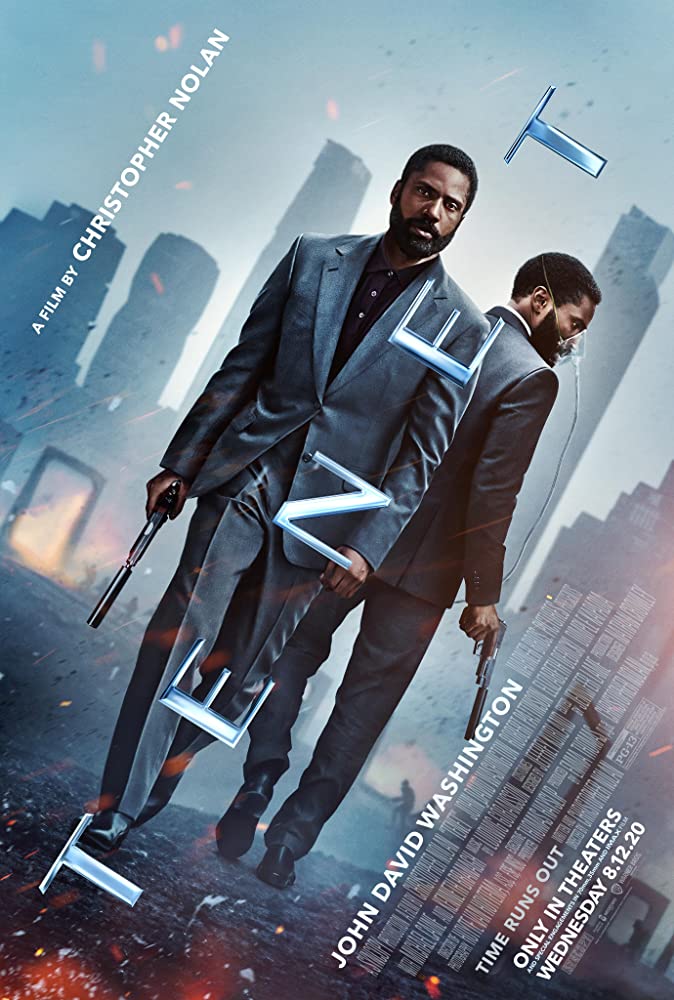
What starts out as a sleek and well executed, but still fairly standard, espionage film with some interesting sci-fi ideas, turns into a mind-blowing “time travel” action-thriller that will have you staring at the screen, mouth agape in awe. “Armed with only one word TENET, and fighting for the survival of the entire world, a Protagonist journeys through a twilight world of international espionage on a mission that will unfold in something beyond real time” (IMDb). And that is all you want or need to know going into this film.
The film is like a loop, closed in itself, similar to Nolan’s earlier film Memento but much more complex, even more complex than Inception. Previous events of the film will get re contextualized in the second half and inserts that viewers might not even have noticed start to become make sense and become important. TENET definitely warrants multiple viewings to catch all these little details, but the surface plot and the characters’ goals are kept simple so that even if not completely understanding why or how, the viewer is never lost in what is going on.
Aside from digital compositing, which is seamless, the film employs almost no computer generated effects, all action scenes are choreographed and shot practically. Unfortunately due to this age where everything you can think of is made possible computer generated effects, this might only become impressive to the viewer if he is made aware of how the effects were achieved. Fortunately, unlike some other recent productions which rely heavily on CGI, TENET will stand the test of time and may thus even become more impressive for future viewers.
The Film’s weak point is its characters. We don’t learn much about “Neil,” played by Robert Pattinson, and “The Protagonist,” played by John David Washington, aside from surface level information and they aren’t developed much until the very end of the film. Kenneth Branagh does a good job as the sometimes scenery chewing but still fairly standard villain character. The heart and soul of the movie is Elizabeth Debicki’s character “Ka,t” who is the most developed character in the film and arguably the most emotionally affected by the events of the film.
Needless to say this is not a character-driven film, instead TENET is highly plot driven but as long as viewers are aware of that they will be satisfied. If you are looking for more than your average spy action thriller but aren’t expecting a philosophical masterpiece then this is the film for you.
This article was written by our German correspondent Leon Zitz. Be sure to checkout his Instagram and YouTube pages. You can also checkout my review of his latest film Romeo Kills Juliette.
Ryan teaches screenwriting and American cinema at the University of Tampa. If you like this article, check out the others and FOLLOW this blog! Ryan is also the creator of the Four’s a Crowdsitcom podcast now streaming on your favorite podcatcher. Interested in Ryan making a guest appearance on your podcast or contributing to your website? Send him a DM on Twitter or email him at RLTerry1@gmail.com! If you’re ever in Tampa or Orlando, feel free to catch a movie with or meet him in the theme parks!
Unbridled blunt force carnage. Academy Award winner Russell Crowe’s rampage-filled Unhinged hits theatres this weekend. And if you’re in the mood for a throwback B-movie well-suited for the indoor big screen or a drive-in theatre, then hop in the driver’s seat. Unhinged is the kind of movie that is so bad yet is actually a lot of fun–the one time you will ever watch it anyway. There are really only two acts in this movie; the rushed setup with an attempt to attach some deeper meaning to the gnarly violence that starts immediately and the lengthy showdown. But you won’t care that it’s a shallow, vapid plot; you are there for three reasons (1) to see Crowe go absolutely bonkers (2) the unhinged brutal, cringy no-holds-barred violence and (3) the scarily realistic car chases through this unnamed city in this unnamed state only known as America’s Heartland. The manner in which The Man stalks Rachel (and later, her son) reminds me of the same pattern of actions we get in many horror movies. While this movie is not a genre horror movie, it is very much horror-adjacent. Moreover, this horror-adjacent movie nearly follows the same tropes as a slasher. Slasher? That’s right. And get this–I found this particularly interesting–Russell Crowe’s lumpy misogynist is credited only as The Man, and where have we seen such a vague, anonymous description of a character before? John Carpenter’s original Halloween with Michael Myers being credited as The Shape. When viewed as a horror-adjacent movie, you will likely enjoy it more. The fact that we are never told much about The Man’s motivations, makes his over-the-top kills, his look, and his barbaric behavior incredibly campy. It’s this level of camp that makes the movie serviceable, and even fun during the violence and high-impact car chases; one could say the car chases are fast and furious. Director Derrick Borte delivers a guilty pleasure action-thriller that is sure to keep you entertained for its relatively short fun time. He knows precisely what kind of movie he’s direction, and rocks it! And you now what, it looks like the director and Crowe has a fun time making this schlock fest. Even actors of Crowe’s repute need a cathartic movie every now and again.
Unhinged is a horror adjacent action-thriller that is built upon something we have all experienced–road rage. Only, this story takes everything you have ever feared about what could happen after you honk your horn to bizarrely unpredictable levels culminating in a terrifying conclusion. Rachel (Caren Pistorius) is running late taking her son to school when she meets The Man (Crowe) at a red light. When the light turns green, he sits there. After she lays on the horn a few times, races past him, and gives him that look, you now the one (as we’ve all done it), she finds herself and everyone she loves the target of a man whom, in his own words, feels invisible and is looking to leave his mark on the lives of those whom dismiss him, in deadly games of cat and mouse.
The movie starts with a stylistic montage depicting violence in the streets of America, particularly road rage. Incidentally, this movie seems to have predicted the current and recent outburst of violence in the streets, months prior. So for some, these images may hit a little too close to home. Or perhaps they will be a wakeup call for how we treat one another, because you never really know if the person standing next to you is about to go over the edge because of continued brushes with trauma. Often times, an opening montage such as this one is used to prime the pump, if you will, in order to setup social commentary or other existential critique on the events that are about to unfold. Unfortunately, this setup really goes nowhere, except to remind us that we really never know next to whom we are standing, or sitting in your car. Early on in the film, just before the deadly cat and mouse road rage game sets into full motion, The Man comments that (and I am paraphrasing), “people nowadays feel as though they should ever have to apologize to anyone for anything.” And perhaps there is a nugget of truth in that because apologies do seem to be fewer in number than they used to be. Newsflash: sometimes we are wrong or have wronged someone else, be it intentional or unintentional. So, apologies and forgiveness should be in our arsenal before grudges and rage.
Talk about bloody. This movie sets the bar ridiculously high with its opening scene of The Man obliterating his axe wife, her lover, followed by torching the house. But the bar doesn’t stop there; the ante literally keeps going up. This man displays the most extreme forms of sociopathy, and he is virtually unstoppable, just like a classic horror slasher in the vein of Michael or Jason. Perhaps he isn’t lurking in the shadows, isn’t wearing a mask, doesn’t have a trademark weapon, or doesn’t come with catchy music, but he is still a slasher! Even when he is shot, he keeps going. And is always right on the bumper of Rachel. While you will likely not care about ANY of the characters in this movie, you will enjoy the campy slasherness of The Man. Unfortunately, The Man also doesn’t give us any reason to root for him, as is the case with Michael, Freddy, or Jason. The Man is a disgusting representation of toxicity of every kind. But, he does know how to put on a show for the audience.
Word to the wise, should you encounter a vehicle sitting at an intersection when the light turns green, I wouldn’t honk your horn. If you do, then you may unleash a sociopath that will literally stop at nothing until you apologize.
Ryan teaches screenwriting and American cinema at the University of Tampa. If you like this article, check out the others and FOLLOW this blog! Interested in Ryan making a guest appearance on your podcast or contributing to your website? Send him a DM on Twitter or email him at RLTerry1@gmail.com! If you’re ever in Tampa or Orlando, feel free to catch a movie with or meet him in the theme parks!
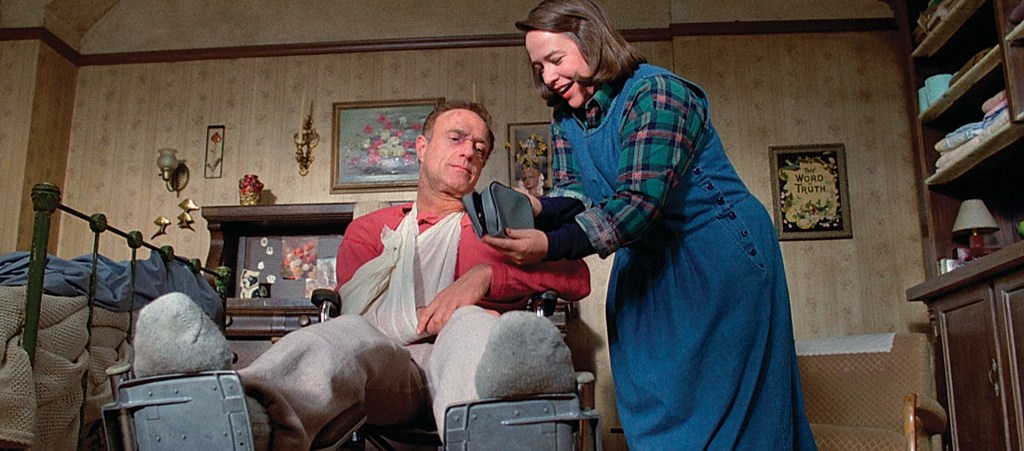
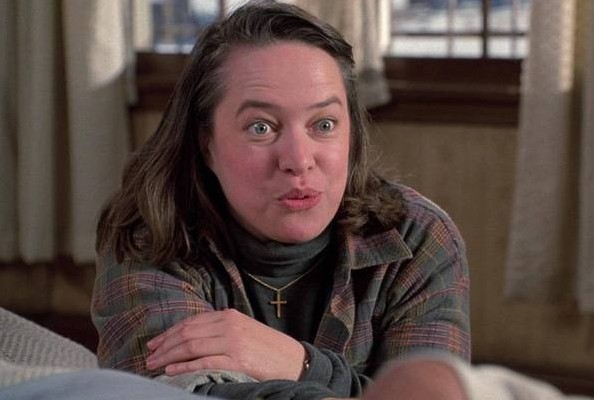
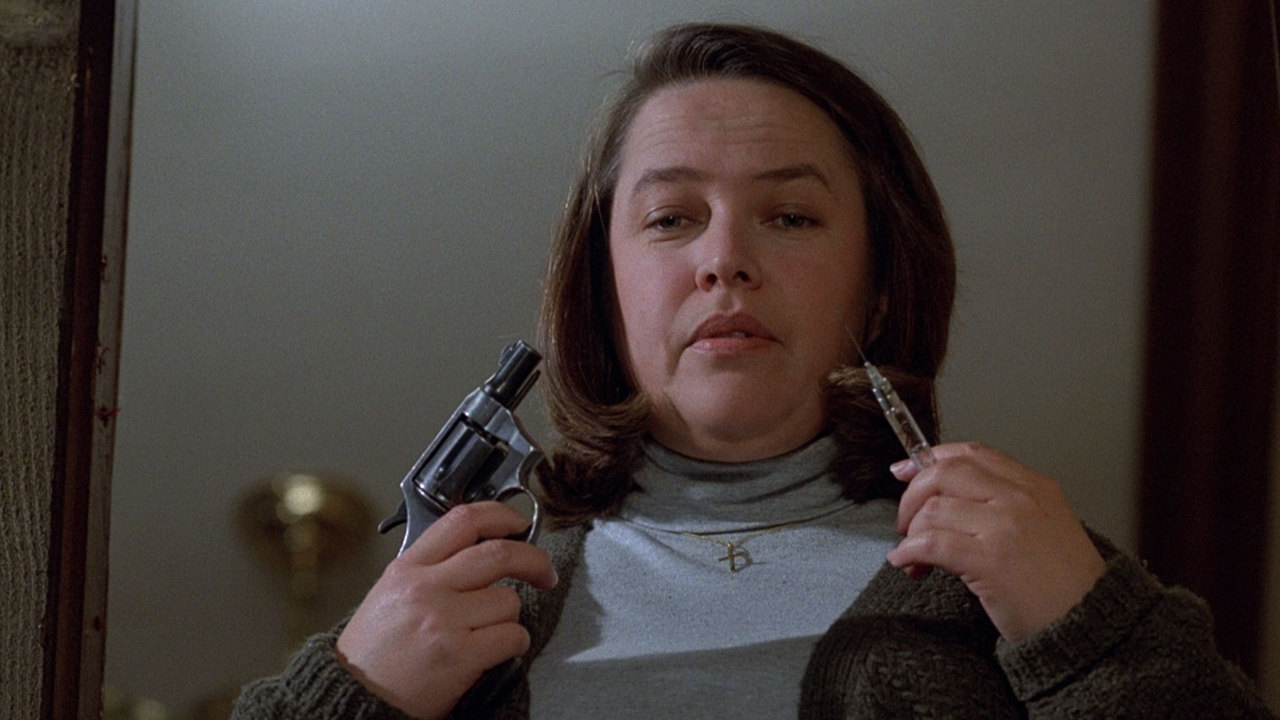
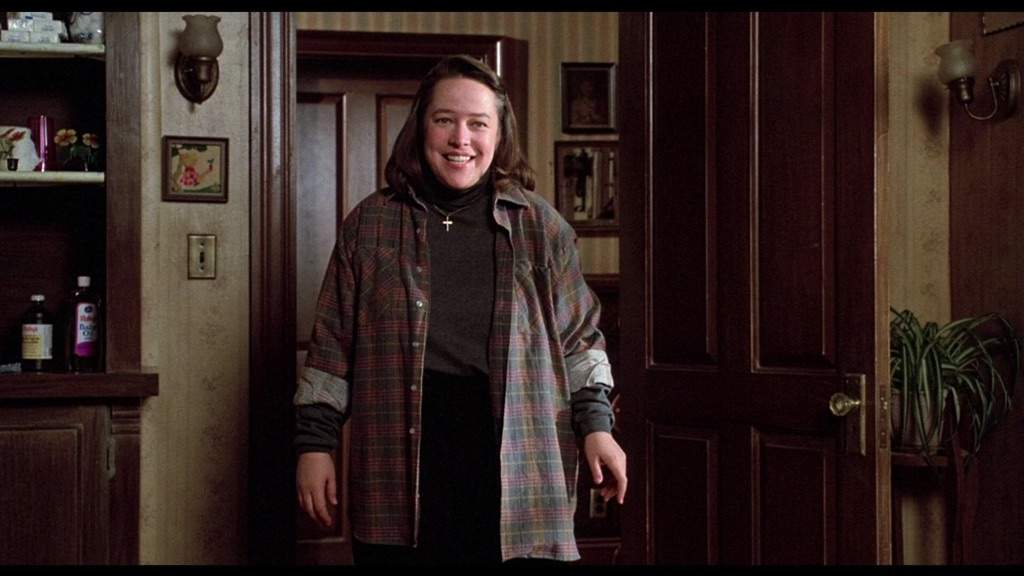
Do your ankles hurt just at the thought of this film??? Well, they should because this is one of the most unnerving horror movies of all time. In fact, each semester when I show my students the hobbling scene, they visibly cringe at that moment, and often remark that it was one of the most nightmarish scenes they’ve ever witnessed in a film. Based on the best-selling novel by Stephen King, Misery is widely regarded as one of the most terrifying psychological horror films ever. Directed by Rob Reiner, it stars then-newcomer Kathy Bates as Annie Wilkes, and playing opposite Kathy is James Caan as celebrity author Paul Sheldon. Just a quick note, the sultry Lauren Bacall also makes an appearance in this horror film as Sheldon’s agent. While this role is little more than a cameo, very few icons of the screen could’ve commanded it as beautifully as she did for those few scenes. Not only is this a brilliantly written and directed horror film, but Bates captivated us with her outstanding performance as the terrifying Annie Wilkes. In a quintessential Hitchcockian fashion, Rob Reiner crafts a phenomenal adaptation of the King novel that turns us into the prisoner of a disturbed and frightening fangirl. Annie convinced us that anyone who claims to be your No.1 fan may actually be your No.1 worst nightmare. Next time a nondescript motherly figure invites you to her picturesque cabin in Colorado, you may want to consider staying at the local Holiday Inn instead.
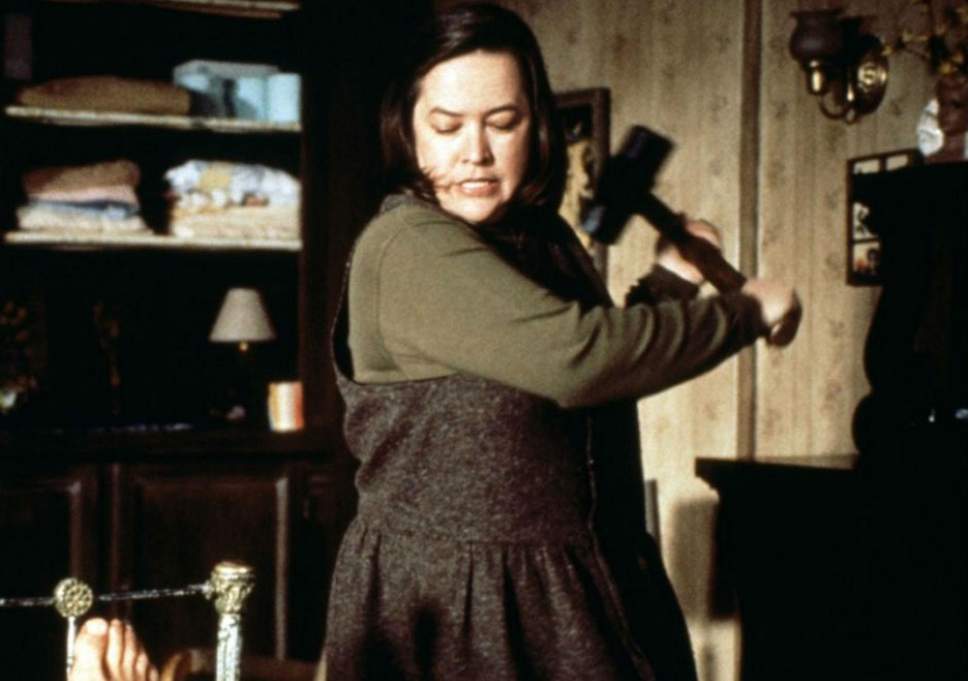
Clearly, Reiner studied Alfred Hitchcock’s methods for shooting a thriller. Evidence of this tone is witnessed in the framing, character blocking, and lingering shots. In fact, I argue that if you were to replace Reiner’s name with Hitchcock’s, it would be easy to convince (non cinephile’s) that it was in fact directed by the Master of Suspense. Reiner provides audiences with one of the most iconic horror films from the 90s that holds up incredibly well. Even with the typewriter, the sheer terror that Caan’s character of Paul Sheldon felt as he was kept prisoner by his sadistic No.1 fan Annie Wilkes (Bates). One of the biggest differences between the book and movie is the famous and painful hobbling scene. The book depicts Annie chopping off one of Paul’s feet versus the crippling of the ankles in the movie. I feel this was a good choice because the sledgehammer scene is far more painful than the former. I mean, every time I see a sledgehammer, I am reminded of this scene even to this day. Misery takes a minimalistic approach to the American horror film at a time that it was about being bigger and better. This approach was contrary to the trends of the day in that it felt far more intimate than other horror film contemporaries. As such, Reiner’s Misery is also largely takes place in one location (only flanked by quick moments in others). The combination of truly appalling, gut wrenching, darkly humorous, and sadistically amusing nature of this film enables it to hold up incredibly well and boasts one of the single most horrific scenes in horror cinema history.
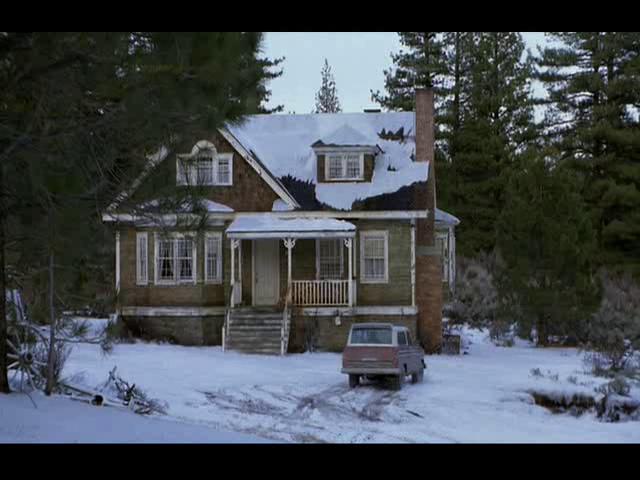
Talk about a character with incredible depth! Annie Wilkes is one of those exemplary characters in horror that provides ample opportunity to apply critical lenses to analyze her psychology and sociology. Clearly she displays signs of psychopathy, but there is so much more to her character. And those layers are what makes her one of the most terrifying characters in horror film history. On the surface, she is a monster-like human; but beneath that sociopathic behavior, she is clearly suffering from severe mental disorders brought on by past trauma. Collectively, we can surmise that Annie’s past traumas left her feeling that everyone and everything is out to get her. Therefore, she runs a countryside farm in mountainous Colorado away from everyone. Her only interaction with outsiders is when she has to run to town to pickup food and supplies. In addition to her mental disorders, she also displays signs of agoraphobia. Although some of her mental disorders have direct impact on her violent nature, other disorders are largely indirectly responsible, such as her likely obsessive compulsive disorder (OCD). Evidence supporting this can be seen in her immaculately clean and organized house. Her OCD contributes significantly to her obsession with Paul Sheldon. The only joy in her life comes from the romance novels that she reads–a vicarious way to experience a full life–namely the Misery series by Paul Sheldon. Essentially, she is the perfect storm of psychological and emotional disorders all wrapped up in a an unassuming citizen of a small Colorado town. She could very well be your neighbor or one of your social media followers. Perhaps she is YOUR No.1 fan.
Although screenwriter William Goldman adds in a subplot of the town’s sheriff investigating the disappearance of Paul Sheldon, which works very well for the film even though it was not in the novel, the story is about two characters (representing two sides of the same coin) trapped in a room together, locked in a psycho-social battle of wills. Ostensibly, this story features two characters whom represent the creative mind of Stephen King during his real addiction to alcohol. I mention this real-life time of darkness in King’s life, not to glorify it because it helped inspire one of his greatest novels turned film, but it helps us to understand the depth and power of the story and characters. Both Sheldon and Wilkes have incredible chemistry because they represent real life villains in the life of King. King’s real battle between his healthy mind and drug-induced state parallels Paul Sheldon’s battle for freedom with Annie Wilkes standing in his way. In a most brilliant fashion, the sadistic former nurse Annie is the manifestation of how controlling a drug addiction can be–how it makes the user a prisoner of one’s own mind and body. This subplot is strategically woven into the main action plot then delivered through the character development and character-driven scenes in the story.
Annie is not completely evil. Early on, she shows us that she cares about victims as she could not have known that it was Paul Sheldon that she was rescuing from the car crash. Being his No.1 fan, as soon as she saw him, she knew precisely who he was and therefore her obsessive nature takes over. There is a moment that encapsulates one of the film’s themes that is often overlooked. Prior to caring for Paul, Annie takes his attache full of manuscripts and tucks it under her arm thus symbolizing that Paul’s work is more important than Paul’s life. But that doesn’t confirm her psychopathic nature. Even upon the more formal introduction of Annie, she shows us that she cares about Paul’s recovery as she crudely splints his broken legs. Why not take him to the hospital? Well, because she is his No.1 fan and no one can take care of him the way she can. She goes on to shower Paul with accolades. Claims to have read his Misery novels several times, even committing them to memory. Furthermore, she closely identifies with Misery Chastain (the series’ central character), so cares deeply what happens to her. Albeit being hospitalized in a stranger’s private residence is a little disconcerting, Paul grows to trust and even like Annie. He trusts her so much that he allows her to read the unpublished manuscript for the final Misery novel. And this is where things take a turn for the worse, Paul’s hospital is about to turn into a prison ran by the sinister warden from hell.
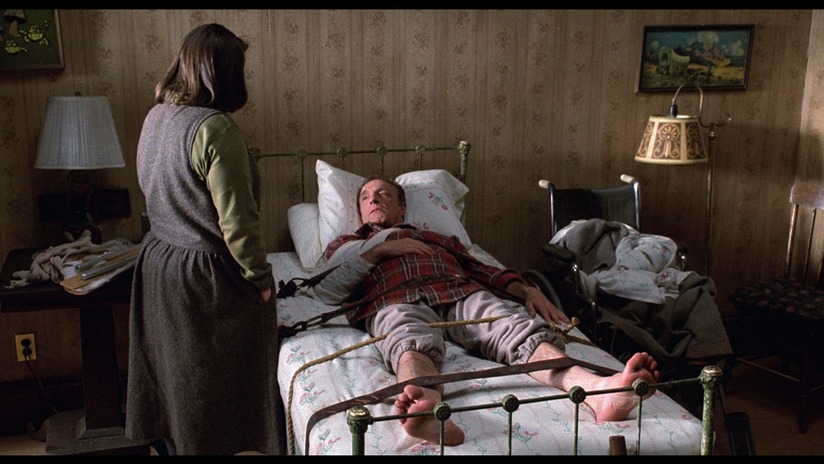
The plot of Misery works on multiple levels to generate the fear that it elicits from audiences. It’s a combination of exploring the effects of isolation on the mind and body, depicting various interpretations of captivity, and the overwhelming sense of dread that cruel intentions are lurking in the background of everything. And it’s not abstract feelings of isolation that Paul experiences, but he is literally isolated from the world due to being snowed in and downed phone lines. Despite being just outside of town, he may as well be on the moon. Without phone lines, Paul is cut off from anyone that is not Annie. Not only is Paul a prisoner of Annie’s house and his room (and eventually the bed specifically), but he is a psychological prisoner as well. He only has Annie to talk to, and he has to play her game or risk her violent mania. Failing to play her game, the role she would have him play, has grave consequences. And those grave consequences give way to the ominous sense of impending cruelty. Even before Annie completely loses it, Paul sees through the cracks in her homespun veneer, and what he sees terrifies him. I absolutely love Annie’s long drawn out monologue about the Kimberly Mines before she hobbles Paul. Paired with the creepy rendition of Moonlight Serenade, this scene plays out with methodic brilliance. The suspense of what is to come will make even the bravest crumble under the fear.
During Annie’s rage over the offensive swearing in the unpublished manuscript, she spills the hot soup on Paul and we begin to see the signs of her mania, twisted morals, paranoia, and negative effects of OCD. Obviously, we learn more about her psychopathy as the scenes unfold, but in retrospect, we witness the signs in big bold letters from this moment on. But she doesn’t continually behave in such a neurotic manner. She oscillates back and forth. This oscillation is an important aspect to her character because it drives up the tension and suspense because we don’t know when or where to expect her dangerous behavior. There are moments that we anticipate a violent outburst, but then she fools us by not delivering. By the same token, there are moments that we don’t expect it, and she terrifies us. The character trait of Annie’s that makes her one of the most terrifying in the Blockbuster of horror is her lack of feeling. Everything she does, she rationalizes without regard for quality of life or humankind. The very definition of sociopath.
The psycho-social disorders affecting the behavior and psychology of Annie are never confirmed, and don’t need to be. We don’t need to know precisely why or what causes Annie to behave the way she does. Because if we fully understood her, she would cease to be as nightmare-inducing as she is. It’s important that Annie Wilkes remain a type of Boogeyman. However, we can gather from the film that she suffers from a form schizotypal personality disorder, OCD (which I’ve mentioned), and meets most of the criteria of borderline personality disorder. A trifecta of disorders that creates the monster that we encounter in the film. She copes with these disorders by executing numerous defensive mechanisms including denial, projection, rationalization, regression, fantasy, and more. Whereas we often talk about her psychopathy and sociopathy, we often neglect to recognize her highly intelligent mind. Too bad her intelligence isn’t matched by empathy and and human kindness. Her intellect is observed through how she anticipates Paul’s movements and knowing when he’s been out of his room. And an intelligent villain is the most dangerous and unpredictable of all.
Aside from her disorders, unpredictable behavior, and lack of empathy, attributes that can be found in other horror villains, she stands out because she is a women. It’s her feminism that enables her to stand out against similar villains such as Norman Bates, Jack Torrance, Buffalo Bill and others. When we typically think of female characters or women in general (and I realize I am over-generalizing), we think of someone whom is kind, hospitable, nurturing, passive, and empathetic. Annie subverts those notions in so many ways, many of which have been outlined in this analysis. She makes Joan Crawford from Mommy Dearest look like Mrs. Brady. As out of control as Annie behaves, she is very much in control. She IS the one holding all the cards and calling the shots in this prison. While other characters (male or female) with similar disorders or backgrounds that parallel Annie’s have lost their minds, Annie knows precisely what she is doing, and is supremely strategic when she does it. We may be cheering when Paul finally kills her with the typewriter, in brilliant ironic fashion, but she is an incredibly strong female character who can hold her own, backs down to no one.
Not only is Misery one of the top psychological horror films ever made, but Annie is a noteworthy female character in the horror genre. While the final girls get most of the attention when we talk Women in Horror, it’s important to not forget that horror has given us terrifying women as well. Whereas so often the most interesting villains (or characters of opposition) get to be played by men, this film would not be as powerful is the roles were gender swapped. The fact that this psychopath is a women makes her all the more disturbing. She crafts such overwhelming sense of dread that is more frightening because we aren’t used to female characters as the main villains. Kathy Bates was a perfect choice for this role, and she has gone on to play all kinds of roles but the horror community gets extra excited when she plays a horror role. While horror doesn’t often win awards at the Oscars, Kathy Bates won the Academy Award for an actress in a leading role for her work in Misery.
Ryan teaches Film Studies and Screenwriting at the University of Tampa. If you like this article, check out the others and FOLLOW this blog! Interested in Ryan making a guest appearance on your podcast or contributing to your website? Send him a DM on Twitter or email him at RLTerry1@gmail.com! If you’re ever in Tampa or Orlando, feel free to catch a movie with him.
German writer-director Leon Zitz is back with his newest short film, which reinterprets the classic story of Romeo and Juliette through a post-modern lens that places Romeo and Juliette in a hopeless, dismal society from which Romeo and Juliette are desperately desiring to escape. Zitz has demonstrated his penchant for auteur filmmaking through his previous shorts Bus Stop, The Applicant, and Time’s Up. His cinematic approach often delivers a stylistically “indie” aesthetic similar to many A24 films. Unfortunately, like with many auteur indie filmmakers, the character development and plot often suffer. While the plot is weak and asks far too much of the audience, the strength of this short is in the cinematography and production design. There are many wonderful shots and sequences in this film; furthermore, Zitz showcases an innate talent for capturing the emotion of a scene. From the lighting to the camera angles, Zitz beautifully demonstrates how to create that cinematic look and feel. Each and every frame is intentionally crafted to deliver a particular mood. Story-wise, this rendition, of the most famous and tragic love story of all time, follows two star-crossed lovers in their will to escape their gritty, grim. depressing hometown. When Juliette unintentionally reveals a secret about Romeo, she seals her fate. Perhaps Romeo Kills Juliette falls short in writing, but it benefits from strong technical elements and overall aesthetic appeal. The potential of this reimagination of Romeo and Juliette is held back by lack of exposition and coherent plotting. Even when I encounter an aspiring filmmaker that shows weakness in an area or two (in this case, screenwriting), I do my best to focus on and highlight what they do well. And Zitz consistently demonstrates a love for the art of motion pictures in terms of the visual appeal. There is a refreshing, unfiltered organic nature to each and every frame in his work. So, show this aspiring filmmaker some love by watching his short today.
Ryan teaches screenwriting and American cinema at the University of Tampa. If you like this article, check out the others and FOLLOW this blog! Interested in Ryan making a guest appearance on your podcast or contributing to your website? Send him a DM on Twitter or email him at RLTerry1@gmail.com! If you’re ever in Tampa or Orlando, feel free to catch a movie with or meet him in the theme parks!