
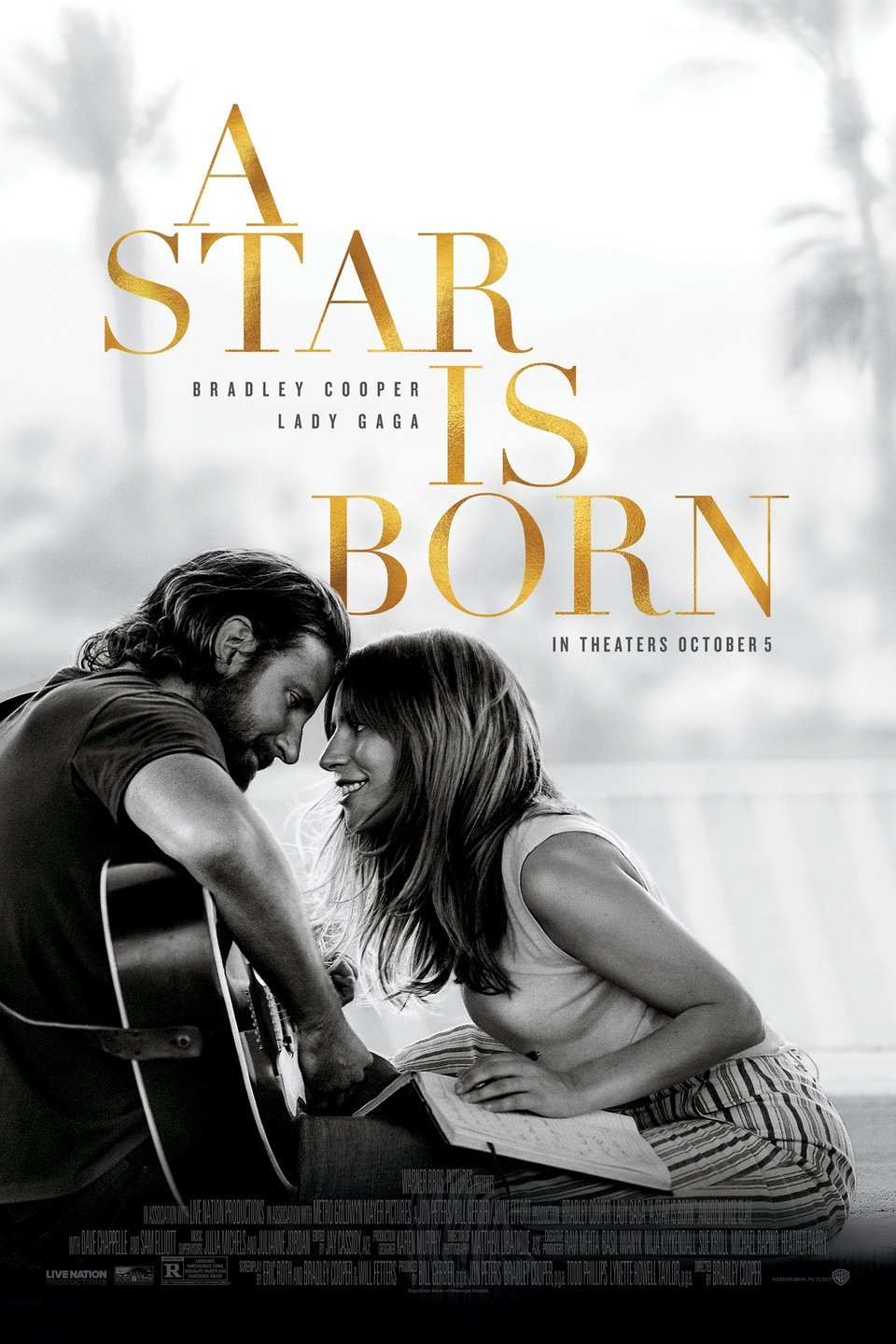
“A Star is Born” (2018) Full Film Review

This “ageless and evergreen” movie musical will move your very soul from “the shallow” to the deep. Bradley Cooper’s A Star is Born is the fourth version of this story, and the strongest of the group. Now, the Streisand version will always have special place in my heart because I’m a lifelong Streisand fan. But other than Streisand herself, the rest of the film is largely forgettable. However, Cooper’s A Star is Born is a mind-blowingly, unapologetic movie musical that delivers a genuine authenticity rarely seen in movie musicals. With all the hype that this film received out of the Venice Film Festival and others during September, there is often the question that IF the film lives up to the hype? The short answer is YES. Fixing some of the plot holes in the Streisand version and providing more comprehensive character development, the screenplay co-written by Cooper harnesses the power of a simple plot with complex characters dealing with the positive and negative affects of stardom on two different people caught in a “bad romance.” With two charismatic performers with outstanding vocals and music plus a gripping story that will have you hooked from the first bar to the last, A Star is Born is an etherial cinematic experience equivalent to that of a shooting star. A star that will shoot its way to the Oscars next year.

Loving the bottle as much as he loves the stage, alt-country rockstar Jackson Maine (Cooper) wonders into a drag bar where he arrives just in time to see the performance of Ally (Gaga). Blown away by her incredible vocals, Maine finds her in the dressing room to introduce himself. Maine is taken back by her street smarts and homespun humility, but sees an undiscovered star. Although Ally has all but given up on her dream, Maine is determined to coax her out onto the stage Determined to provide Ally with the stage she needs to showcase her uncanny ability to create magic with her voice, a magic that has profound, authentic meaning behind it, Maine invites her to join him at a gig. When she refuses the invitation, Maine sends his chauffeur to follow her until she gives in. And gives in, she does. Already smitten with Ally, Maine falls madly in love with her after their voices make incredible music together. Soon, Ally’s career takes off like a shooting star, while Maine deals with his inner demons. Just like careers have ups and downs, so does the relationship between Ally and Jackson Maine.

As a star rises, a comet falls. While the basic plot of this, and the other versions of A Star is Born are similar in nature, this one feels the most cinematic. Cooper’s screenplay takes what the previous versions did well, and then improves where the others did not perform as well. With three previous ones to analyze, Cooper certainly had plenty of source material to pour over. What I appreciate most about this version is the foreshadowing and poetry that provide a rich subtext. One of the most important parts of plot development in a screenplay is the strategic placement and execution of emotional beats. Much in the same way the original songs in the movie drive those emotional beats home, the screenplay follows in suit. Although I will argue that the first half of the movie is stronger than the second half, the story is a powerful one that shies not away from depicting real issues that celebrities, especially in the music industry, face. There is an unapologetic approach to both sides of the stage. The beginning scenes pack a powerful punch. And I was completely sold on Ally’s ability to delicately balance toughness against vulnerability. Jackson Maines character development is gritty and believable. Fortunately, after the 1976 (Streisand) version shifted the focus from Hollywood to the music industry, that shift provided the foundation upon which 2018’s A Star is Born is built. For all this story has going for it, paving the way to a likely Oscar nomination, Cooper is unable to sustain the energy from the first act all the way through the rest of the movie. While the first and third acts are strong (especially the first), the second act lacks the charm and energy of the first but does effectively lead us into the showdown and realization. Whereas the pacing looses footing a little in the middle, there is no mistaking that this is a phenomenal retelling of a classic plot for a new generation, complete with humiliation, redemption, heartbreak, and love.

The cinematography is incredibly strong. While not heavily stylized in a particular manner like other filmmakers, who’s direction is part of that filmmaker’s identity, the cinematography in this film incorporated a variety of approaches from wide shots of real concerts to intimate closeups that work seamlessly together in order to provide the film with an outstanding and comprehensive visual appeal. One of the elements of the cinematography that stood out to me the most was just how natural and relaxed the camera movement felt. There were plenty of moments that I forgot the camera was there because it felt that I was present–in those moments–witnessing the plot unfold. While some directors may have felt the need to approach most of this movie as a music video (instead of a musical), Cooper allows the camera to linger in a moment to drive the emotion of that moment home. During the musical performances, there is certainly a music video feel to it, but it never takes you out of the story, at large. From beginning to end, the cinematography flows naturally across the movie.

Cooper and Lady Gaga’s respective performances are incredible. They will certainly wow you from beginning to end. Not surprising after watching the movie last night, Cooper delivers a command performance that is sure to land him a Best Actor nomination. He looks and sounds like an alt-country rockstar. I had no idea that he could sing! At no point does it ever feel like he’s acting. Such power in subtlety. It’s the little things he does that serves as evidence of his commitment to character and never acting like a Jackson Maine type but legitimately becomes Maine with all his problems with addiction to drugs and alcohol. Because the subject of celebrity addictions leading to untimely deaths has been in the news a lot, this was a great opportunity for Cooper to comment on this issue by depicting how tragic it is, and the affects on others.

Whether you are a fan of Lady Gaga or not, there is no doubt that her acting and vocal performance will leave you speechless. Of course, being speechless never stopped me. Without breaking character or forcing her real-world persona and fandom into the diegesis of the film, there is a nod to her status as a queer icon. One of the early scenes in the film features her at a drag show. This scene fits into the story perfectly, and successfully sets up some of the subtext and commentary later on in the film regarding how the music industry (and Hollywood to an extent) package female performers. The character of Ally allows fans of Gaga to explore a different side to her through most of the film. During the second act, there are moments that remind us of what makes Gaga so popular–very similar to her real-world celebrity self–but these moments never detract from the more organic, intimate ones. Although Ally’s quest for stardom does play out a little cliche as it points us back to the real-world Lady Gaga, Ally’s character finds herself back to her true self at the end of the film. As a side note, I love the nods to the the 1976 one by way of Ally talking about how her nose was considered too big by talent scouts. A brilliant nod to Streisand’s trademark nose.

With a very strong start, mediocre middle, and relatively strong recovery, Bradley Cooper’s A Star is Born is a don’t miss film! If you were worried that the film was not going to live up to the hype of the festivals, no need to worry any longer. From what I have gathered from other critics, members of #FilmTwitter and the #PodernFamily (podcasters), there appears to be an agreement (mostly anyway) that this film is an outstanding work that will be one to watch for this upcoming awards season. Perhaps it won’t be the next Silence of the Lambs and take the Big 5 Oscars, but it will likely still do very well.

Ryan is a screenwriting professor at the University of Tampa. If you like this article, check out the others and FOLLOW this blog!

Follow him!

Twitter: RLTerry1

Instagram: RL_Terry

Thrillz (theme parks): Thrillz.co

“A Simple Favor” full movie review

Sleek, stylish, sexy! The best “lifetime movie” ever. Either the marketing of this film was the most misleading or the most brilliant! And yes, I truly believe that lifetime movie is a legit subgenre of suspense. Dark comedy meets neo-noir in this fantastic movie. It’s twisted and fun! Thrilling and comedic, Paul Feig’s film engages in a delicate balancing act that required extreme precision to ensure that the film not make any movement, miss a beat, or gloss over a turning point that could have would up disastrous. Much in the same way Feig’s Spy struck brilliant balance between comedy and serious spy movie, he proves that he has the ability to replicate the approach. Gives me hope for the highly anticipated Spy sequel that rumor has is happening. But we will have to wait and see if that rumor comes to fruition. Containing solid performances from Blake Lively and Anna Kendrick, the film also comments on the mind games woman and mothers play with one another. In fact, A Simple Favor delivers some unconventional yet thought-provoking commentary on motherhood and parenting. For all the commentary in the film, it never tries to be preachy or dogmatic about how women and mothers should behave or treat one another. Various parenting styles are played around with in hilarious ways. While the plot may seem like a satire or parody of Gone Girl, there is enough that is different that is certainly feels like a unique movie. There is nothing accidental about how all the elements came together to give us a fantastic movie; everything is intentionally executed with extreme care in order to deliver a lifetime movie that is suspenseful and, at times, slapstick funny.

Be careful when you fulfill a simple favor from a friend. Stephanie (Anna Kendrick) is a simple mom who’s extremely active in his son’s school and runs a successful “mommy” vlog. Emily is the director of public relations for a major fashion brand and is never active in her son’s school. Through a series of unpredictable events, Stephanie and Emily become best friends, even though on the surface, they couldn’t be any different from one another. One day, Emily asks Stephanie for a “simple favor” to pick her son up from school because of a work emergency. It soon becomes clear that Emily is not coming home. And Emily then begins a investigation into the disappearance of her friend. After the cops get involved, the mystery takes a turn for the bizarre, and Emily must find out what happened to her friend and mother Emily.

Immediately, the opening stylistic credit sequence informs me that this is not going to be a typical murder-mystery movie. The title sequence reminds me of the same one Feig used for Spy. Amidst the angular single color designs are images of women’s fashion. One of the takeaways from the trailer was the amazing costume design and fashion in the film. Setting the tone for a sexy thriller is successfully accomplished in using this imagery. It’s a throwback to the style of the 1960s spy movies that featured women in killer attire that was absolutely perfect in every way. Much like in television, movies have largely moved away from artistic opening title sequences. What I love about a creative opening title sequence is that it can set the tone for the rest of the movie. Think of it as the cover art or preface of a book. Since this movie is based on a book, I like how the opening title sequence seems to be a manifestation of the cover or opening of the book. From the opening title sequence effectively communicating the tone of what we are about to watch, the opening scenes of the film inform us precisely who Stephanie and Emily are. Stephanie is almost a caricature of an enthusiastic crazed Martha Stewart mom juxtaposed against Emily’s high-fashioned, corporate power cynical mom who still loved her kid. Conflict should derive from character interactions even before the plot creates conflict, and this film gives us two characters that provide exceptional and comedic conflict right at the beginning. The characters draw you into the story. It is obvious that the characters were developed first.

Before we even talk about the commentary on motherhood, there is a lot to explore in the respective personalities of Emily and Stephanie. Each personality and worldview is incredibly unique. What isn’t unique between the leading ladies is the fact that they are both incredibly intense individuals. Stephanie pours her tenacity into her vlog and being a “perfect mom” whereas Emily pours her energy into her career and keeping everyone who wants to gets close to her at bay. While Stephanie is enamored with Emily, she misses some indicators that there is something not quite right with Emily. But because of her desire to be friends with Emily, Stephanie chooses to overlook Emily’s bizarre behavior. Behavior that would drive the rest of us away such as being taken advantaged of, belittling, patronizing, just to name a few. There is a scene in which Emily snaps at Stephanie for taking a candid picture with an attitude that could cut glass. There is something Emily admires about Stephanie too. Stephanie’s constant positivity and genuine authenticity. Qualities that Emily does not have. And Stephanie admires the hyper-sexualization of Emily. In many ways, what makes them different, actually complements one another. Yin and Yang.

Beyond the mystery of A Simple Favor, which I won’t explore because it would spoil the plot, there is a subtext of commentary on motherhood. Both are mothers, yet one of them is clearly the femme fatal. The film sets Emily up as the femme fatal from the moment she steps out of her Porsche in the killer suit and devilish stiletto heels, topped with a fedora directly out of a film noir. Stephanie is the poster-child overachieving mom with her volunteering, smart mom outfits, and baking. Each is essentially an extreme of their respective type of mom. The unconventional intimacy between Emily and Stephanie allows Feig to have the support for the dramatic shifts and turning points in the plot. Whether you may be a dedicated stay-at-home mom (which, can be a full-time job–let’s be honest) or a jet-setting corporate work-life balance mom, the pressures of motherhood (or more broadly parenting for all the fathers out there) can bring out the worst in someone. While day spas, laughter, makeovers, or a glass of wine on a balcony may be perfectly fine most of the time to provide relief from the stresses of parenthood, sometimes a mom (or dad) needs something a bit more engaging, tawdry, hair-let-down, steamy, and intriguing. Something that provides some much-needed disorder to keep things interesting. And that is precisely what happens in A Simple Favor. Instead of taking either extreme position from which to be a parent, perhaps the best answer lies somewhere in the middle. Don’t forget that even overachievers need to let their hair down.

If you enjoyed Gone Girl and Spy, then you will undoubtedly enjoy this brilliant thriller that is both suspenseful and funny. Paul Feig is proving that he can consistently walk that fine line between comedy and thriller or comedy and suspense in order to deliver films that take themselves seriously as both a comedy and a more serious work. Furthermore, Feig proves that he can provide an excellent platform for charismatic female actors to showcase the range of their talent. A Simple Favor delivers a plot that is simple yet contains many intricate pieces and surprise reveals. You will be completely engaged the whole time.

Ryan is a screenwriting professor at the University of Tampa. If you like this article, check out the others and FOLLOW this blog!

Follow him!

Twitter: RLTerry1

Instagram: RL_Terry

Thrillz (theme parks): Thrillz.co

“The House with a Clock in its Walls” full movie review

Whimsical and terrifying. A departure for the maestro of gory horror movies, Eli Roth’s foray into children’s horror-lite cinema is a hit! The House with a Clock in its Walls is the film adaptation of the 1973 novel, by the same name, written by John Bellairs. While there is a childlike wonder about the film, Roth’s trademark stylistic direction is clearly seen in brief glimpses into the movie’s much darker and disturbing moments. Already a rumored house for next year’s Halloween Horror Nights at Universal Studios Hollywood and Florida, this film provides many opportunities to adapt the house and its inhabitants into a fantastic haunted house maze. Jack Black and Cate Blanchett are incredibly entertaining, and offer an incredible banter that will leave you wanting a friendship like the one shared by these two characters. Our leading young star Owen Vaccaro is less interesting to watch and displays terrible crying skills; however, he does deliver a performance that shows he has potential to grow as a child actor. Although the movie largely takes place within the victorian mansion, it never feels limiting or redundantly boring. Eli Roth’s expertise for visual storytelling makes every room just an interesting as the previous one. For a children’s horror movie (what I’m calling horror lite), it has some scares and twisted moments that are actually terrifying if you stop to think about it. Roth takes this PG movie as close to a PG-13 movie without ever crossing that line. Never evoking strong emotion, you will still find moments that you will laugh and jump!

When Lewis’ parents are killed in a tragic accident, his estranged uncle Jonathan (Black) send for him to move to his mansion in Michigan as he is the only family Lewis has. After Jonathan uncouthly picks him up on the bus, Lewis begins to wonder what he’s gotten himself into. Nothing could have prepared him for what he was about to encounter in the mysterious mansion. In very little time, Lewis learns that his uncle and their intelligent, feisty neighbor Mrs. Zimmerman (Blanchett) are practitioners of of the magical arts, to the highest degree! With his eyes now opened to the fascinating world of magic, Lewis expresses an interest to learn magic himself. Struggling to make friends in his new school and neighborhood, Lewis tries to impress the student council president by raising the dead; but unbeknownst to him, Lewis unleashes an evil warlock who seeks to bring an end to humanity. It’s a race against the mysterious, hidden clock within the walls of the mansion to stop the warlock from destroying the world and all its inhabitants.

A perfect way to introduce kids to horror films, Eli Roth’s The House with a Clock in its Walls strikes a perfect balance between maintaining a kid-friendly plot while strategically including terrifying imagery. Although I watched Alfred Hitchcock Presents and The Twilight Zone with my mom growing up, it would be a while before I truly found that I absolutely loved horror films. Fortunately, kids of the 90s had more options for gateway horror than kids today. When I was a kid, I had Nickelodeon’s Are You Afraid of the Dark? and Goosebumps to introduce me to horror. Sadly, there do not seem to be nearly as many options for today’s kids to discover a love of horror early on. Mainly, that’s because filmmakers are more concerned with creating horror movies and TV shows for teens and adults due to  the increased gory, sexual, and disturbing content. Thankfully, one of the masters of horror took it upon himself to channel his 10yo self in order to adapt his penchant for popular, cult classic horror to provide a great experience for kids. And Roth did a superb job! Perhaps Roth does not bring his trademark torture porn and queasy horror to the screen in this children’s movie, but he does apply that same ability to scare us to the macabre puppets, man-eating topiaries, and demonic hand licking. That tongue was soooo Roth. Love it.

The production design is brilliant! Instead of relying upon digitally conjured terrifying or whimsical effects, this film largely delivers practical effects against the backdrop of a tangible set. That’s not saying that there isn’t CGI in the film, there is quite a lot. But it never takes me out of the world that Roth created for the screen. As I am not knowledgeable in architectural design, I am not sure if the setting is more Baroque or Victorian, but it’s gorgeous! The setting was quite immersive for a children’s movie, and gives the film a sense of dimension that is so often lost in 21st century movies. Editors and graphics designers are so preoccupied with whether or not they can achieve the effect that they don’t stop to think it is will detract from the believability of the setting and set-builds.

With Roth directing, this film benefits from its emotional beats, turning points, and moments of shock and terror being placed and executed with precision. Whereas a gateway children’s horror film cannot have much, if any, true body horror, it can include imagery that lends itself to more conventional horror such as evil Jack-o-lanterns, clown puppets, and ventriloquist dolls. Think of this film as introducing young audiences to those same tropes, that adults love about horror films, but in innocuous ways that may be just above a kid’s head but close enough that it may ignite an interest in horror films. Sometimes Roth’s more horrific elements of this film are witnessed as lurking in the shadows. Sort of a nod to his legacy but everything is still masquerading around as a family-friendly horror movie. In addition to talking about the horror and magical elements of the film, the plot is pretty simple and is ostensibly about the true sprit of family. Although each of our three main characters could, in many ways, not be any more different from one another, they all have a love of magic, education, and loyalty. Furthermore, each of them has suffered the loss of loved ones that leaves an empty hole in their respective hearts. Through these common interests, Jonathan, Mrs. Zimmerman, and Lewis form a bond that enables them to form a new family. If there is something conspicusoly missing from the plot, it is more of an exploration of post WWII trauma.

If you’re looking for a family-friendly gateway horror movie to watch, then definitely check this one out. The House with a Clock in its Walls proves that there is a need for more TV and film programming that is suitable for younger audiences who want a good thrill just like you and me. One thing is for sure, this film sill undoubtedly prompt young audiences to open their minds to the amazing world of horror movies, or perhaps scare them away.

Ryan is a screenwriting professor at the University of Tampa. If you like this article, check out the others and FOLLOW this blog!

Follow him!

Twitter: RLTerry1

Instagram: RL_Terry

Thrillz (theme parks): Thrillz.co

Alfred Hitchcock: the First Director to Brand Himself (Part 1)

More than an instantly recognizable silhouette. Before the idea of a director branding him or herself became as common a goal as it is today, Alfred Hitchcock pioneered the very concept of a director developing a brand that would instantly be recognizable by millions. Not only was Hitch the Master of Suspense, and still is, but he was also a master of marketing. Unknown to many, Hitchcock worked in sales and marketing before he became one of, if not the, most recognizable name in cinematic history. Between his experience in marketing and with silent filmmaking, he was a master of captivating visual storytelling way before his most well known works of cinema. I teach media and screenwriting at the University of Tampa, and I’ve often told my students that writing a compelling, memorable, effective thirty-second commercial can be more difficult than writing a two-hour film. I realize that illustration overly simplifies the respective concepts; however, the idea is that if you can proficiently tell an intriguing or impactful story in thirty-seconds, then you can proficiently write a two-hour movie. Taking what worked well in advertising and marketing, and adapting it to a cinematic diegetic structure, Hitchcock was able to capitalize on his penchant for visual storytelling and ability to prompt desired physiological and emotional responses from the audience. The American Marketing Association defines a brand as “a name, term, design, symbol, or any other feature that identifies one seller’s good or service as distinct from those of other sellers.” The fact that Hitch’s name and silhouette have instant meaning, definition attached to them, is evidence enough that he was a master of branding.

Prior to understanding just how Hitchcock became the first director to brand himself, it is paramount to understand how a brand–more specifically brand recognition–comes to exist in the first place. A simplistic method of understanding what defines a brand takes the form of a relationship between an image (or idea) and the individual. Relationship is key. There is an emotion attached to the relationship between the image and the products or services that it represents; moreover, this relationship is not without a practical component such as cozy fur-lined boots or an automobile with consistent impeccable quality. By extension, the relationship between an individual and a brand can create a sense of importance, safety, or class. Once a relationship is formed, then the individual experiences both physiological and emotional reactions to the sight or sound of the image or idea. Think of that feeling you get when you see the Disney castle or hear “Wish Upon a Star.” Or perhaps, imagine how you feel or react when you see a BMW or wear a Rolex. These are iconic brands that mean something to many individuals. The mere exposure to the sight, sound, or message will prompt a comprehensive response within the mind and body. As the maxim goes, “imitation is the highest form of flattery;” therefore a quality, successful product or service will be copied but never fully replicated because there is always a secret ingredient that makes the original unique. In addition to the aforementioned, when an image or idea becomes a recognizable brand, then there is a power endowed upon that image that gives that company (that owns the image, product, or service) a kind of soft power that cannot easily be quantified but it’s quite real and figuratively measurable.

Not unlike Rolex, BMW, and Disney, Alfred Hitchcock was and is also a brand–and a powerful one at that. He was the first director to become a brand; and since then, others have tried to brand themselves as well. Some with success and others with defeat. One of the keys to Hitchcock’s ability to combine the words of marketing and filmmaking in order to not only develop a reputation but become a brand, Hitchcock recognized early in his career (especially after coming to the United States) the importance of promoting himself–his actual image–in conjunction with the promotion of a particular film. He demonstrated a clearly intentional desire to ensure that his name was at the forefront of the conscious of the American public. When a particular director, who consistently delivers quality or groundbreaking films, links the outstanding performance of the films with his or her image, then the mere sight of or name of that director carries priceless value. Following the breakup of the studio system over the late 1940s through the 50s, there arose an increased opportunity for to claim authorship of a motion picture. Prior to the decentralization of Hollywood, most movies were completely packaged by the Studio/distribution company, with the director playing a minor role. With the new opportunities to connect a motion picture to the director during marketing, it paved the way for directors to advance their own careers as well as the success of the movie. As studio authorship decreased, individual (director or producer) authorship increased!

According to Janet Staiger in her essay Creating the Brand: the Hitchcock Touch, she outlines four significant criterion that apply to image or brand as it relates to showbusiness. (1) the character persona that is created by selection of performances in film, tv, web media, etc (2) the performer (acting ability) in those mediums (3) the worker/laborer that develops from what is learned about the individual’s professional life in respect to business dealings and (4) the private persona that derives from the individual’s off-camera personal life. Whereas these criteria are more aligned with an actor or actress, these elements can be applied, by extension, to understanding Hitchcock as a brand. Hitchcock’s character can be seen through his genre selection–the types of films that a director authors. Think of his genre selection as the equivalent of the types of characters an actor or actress chooses to play. We recognize the performer element in Hitchcock’s consistent ability to direct the motion pictures with incredible precision and innovate programming for then-new mediums like television. Hitch’s worker/laborer attribute is found in what we know about his behind-the-scenes work on set and in the business offices. Most famously is his near-departure from Paramount when he went to make Psycho, for which they earmarked zero funding. He self-financed the iconic film and used his Alfred Hitchcock Presents crew. Passion, determination, and commitment witnessed. In terms of his private persona, Hitch was famously a practical joker and a family man. In fact, his daughter appeared in multiple episodes of Presents. All these elements together combine to create Hitchcock’s image.

But there is more to branding oneself than crafting an figurative or metaphysical image. There is the physical image that is recognized by the naked eye. After injecting himself into film social circles comprised of well-established directors, screenwriters, and even critics and journalists, he had a well-known name. And even though a name can carry power, it needs a tangible representation. Although one may assess that Hitchcock came up with that trademark minimalistic nine stroke silhouette, the inspiration came from a series of director sketches that appeared in The Motion Picture Studio journal in 1923. There, we have a group of then and now famous directors with Hitch appearing sideways with his famous belly out and hands in his pockets. By the 1930, Hitchcock was being heralded as a master of suspense. And that description of Hitch’s work continued until the moniker stuck in perpetuity.

In addition to the soon-to-be-moniker, film magazines took notice of his notable weight. By the late 1930s, it is said that Hitch already weighed in excess of 300lbs. As the maxim goes, “there is no bad publicity,” and that can definitely be witnessed in how Hitch’s brand continued to develop during his early days in America. The constant articles about his weight, the unprecedented success of his films, his cameos in those films, and sketched of Hitch, all those elements together created Hitch’s image. You can very much liken the evolution of the Hitchcock figurative image and physical logo to the evolution of Walt Disney’s image and either the Mickey ears or castle logo. Whereas the content of the motion pictures that both produced/directed respectively are quite different, they share one important element in common. They both injected themselves into the production and marketing of their work as much as possible. Although Walt Disney made himself into a brand (most solidly after Snow White), it was Hitchcock who was the pioneer in the very idea of a director creating his (or her) recognizable brand. In many ways, Walt follow Hitch’s direction to make his brand. But where did the famous nine stroke sketch come from? Well, according to author Robert Kapsis in his book Hitchcock: the Making of a Reputation, he drew the sketch himself in 1927 for the purpose of making it into a gift for his friends and colleagues. He created a wooden jigsaw puzzle with the iconic image an placed it in a small linen bag. I cannot think of anything more Hitchcock. This parallels how Hitch injected himself into his cinematic work both in the story itself, as a cameo, and in the marketing of his films.

Hitchcock knew that to create a brand–as everything he has accomplished for this result has been completely intentional–he needed to make a connection between his films and himself, and then himself to his name, and his name to the abstract profile. Then when someone sees the logo, they are immediately predisposed to feeling a certain way about Hitch and his films. It’s a bi-directional highway, so to speak.

Part 2

Ryan is a screenwriting professor at the University of Tampa. If you like this article, check out the others and FOLLOW this blog!

Follow him!

Twitter: RLTerry1

Instagram: RL_Terry

Thrillz (theme parks): Thrillz.co

“The Nun” Horror Movie Review

Well, it’s not the worst horror movie ever. Universes are popping up everywhere, and why should The Conjuring not follow in suit? Based on the real-life paranormal work of Ed and Lorraine Warren, there is certainly enough material from which to build a universe; but if this is a universe and the movies are planets, then perhaps The Nun will go by way of Pluto. Sometimes it’s included, sometimes it’s not. One may even go so far as to say that The Nun is truly unholy–an unholy hot mess of a movie. That’s not to say that it isn’t fun to watch. Like with horror movies, in general, it is a fun watch with a large group of people all reacting at the same time. While recent horror films focus on creating an atmosphere of dread and developing characters that the audience cares about, and then crafting twisted moments of terror such as A Quiet Place or Hereditary, this movie follows bad horror movie tropes that may aid in getting you to jump here and there, but ultimately fail at delivering anything truly scary or horrific. With German expressionism being at the very roots of the American horror film, as seen in NosferatuPhantom of the Opera, and DraculaThe Nun seems like such a missed opportunity to produce a terrifying gothic horror movie.

When a nun at a cloistered abby in the hills of Romania is discovered as having committed suicide by hanging, the Vatican calls upon the service of Father Burke (Birchir) to investigate the occurrence to determine if there is any unholy work at play. Under the advisement of the Vatican, Father Burke is asked to work with Irene, a young nun from a Catholic school because she has the gift of visions that may aid in their mission. Although Irene has yet to take her final vows, she agrees to accompany Father Burke to Romania to uncover why one of her sisters would commit suicide. Father Burke and Sister Irene soon discover that a most unholy spirit lives within the castle, and that the abby’s convent of nuns were protecting the world against a malevolent demon who must be sent back to the depths of hell.

Like many of you, I too was initially optimistic for this origin story as the glimpses of The Nun in the Conjuring movies are terrifying. Partly, these glimpses are creepy because we see very little of the nun. The demon nun suffers from some of the same problems that are witnessed in the Insidious movies. When the demon was shadowed, barely visible–but just enough to frighten you–he was scary; but then he turns into Darth Maul and loses that level of fright he had through most of the first movie. Simply stated, we saw too much of him. To the point that he almost became a parody of his former self. Likewise, the nun’s exaggerated features, yellow eyes, and jagged teeth quickly transition from scary to almost funny. Funny in that it felt campy or over the top. Director Corin Hardy obviously does not know the power of subtlety. Diegetically, the plot of The Nun plays out as incredibly predictable. The nun or another ghoulish apparition appears right when and where you expect it to happen. No surprises here. In an era that arthouse horror is attracting mainstream audiences–and making bank at the box office–it’s quite upsetting that a movie that had the setting and characters for arthouse horror decided to go the “paint by the numbers” route instead of joining other trailblazers.

A grossly underused setting. The movie begins in candle-lit hallways in a medieval castle in the foggy hills of Romania. Visually, the movie appeared to be setting up a story and setting that would have that beautifully dark gothic feel and look; however, it quickly turns into another generic haunted house movie. We begin with an incredibly effective foreboding atmosphere complete with everything you want to see in a gothic horror film, then scrap it for unimaginative rooms and cheap exploitation. Gothic horror films possessed an ability to depict terrifying stories with minimal dialogue. Dialogue was an extension of the plot; it did not force the plot. The Nun had all the right elements for a frightening horror film but failed to deliver the Conjuring universe movie we wanted or expected. It’s like, you can buy all the ingredients to make an exquisitely delicious dish you had at a French restaurant; but if you do not know or choose to ignore the proper amounts and order of the ingredients, then your dish will most likely fail to meet your expectations. Moreover, there were many moments that felt gimmicky, felt forced.

With such an amazing setting, the german expressionistic and gothic roots should have ben channeled more effectively. Whether you are familiar with the term or not, you are likely familiar with what it looks like–especially if you are a horror junkie like myself. The antithesis of French impressionism (art displaying authentic life), German expressionism sought to reflect real life but through metaphor, allegory, and symbolism. An indirect representation of observations of real-life. Expressionism allows the filmmaker to visually explore themes such as death, life, sex, institutions, religion, and more. The beauty is its ability to provide social commentary without being overt. Examples of German expressionism can be found in older films such as Nosferatu and The Cabinet, Dr. Caligari, mid-century films like Psycho and The Exorcist, but also found in newer films such as Batman Returns and Crimson Peak. Mostly associated with film noir, german expressionism is foundational to the looks and feel of horror films as well. Visually, German expressionism is characterized by exaggerated architecture, shadows, twisted landscapes, and sharp edges. The very look of it is creepy. German expressionism takes many visual queues from gothic architecture. It’s that gothic looks and feel that was mostly ignored in the setting and actions of The Nun even though it was a perfect candidate for it.

This movie will undoubtedly do well at the box office over the next couple of weekends as even “ehh” horror is bankable. Before I allow myself to get too discouraged, I look to how the sequel to Annabelle was fantastic after the first installment was a let down. If Annabelle Creation can improve upon its predecessor, then the forthcoming Nun sequel can do the same thing under the right direction with the right screenplay.