HEART EYES horror movie review

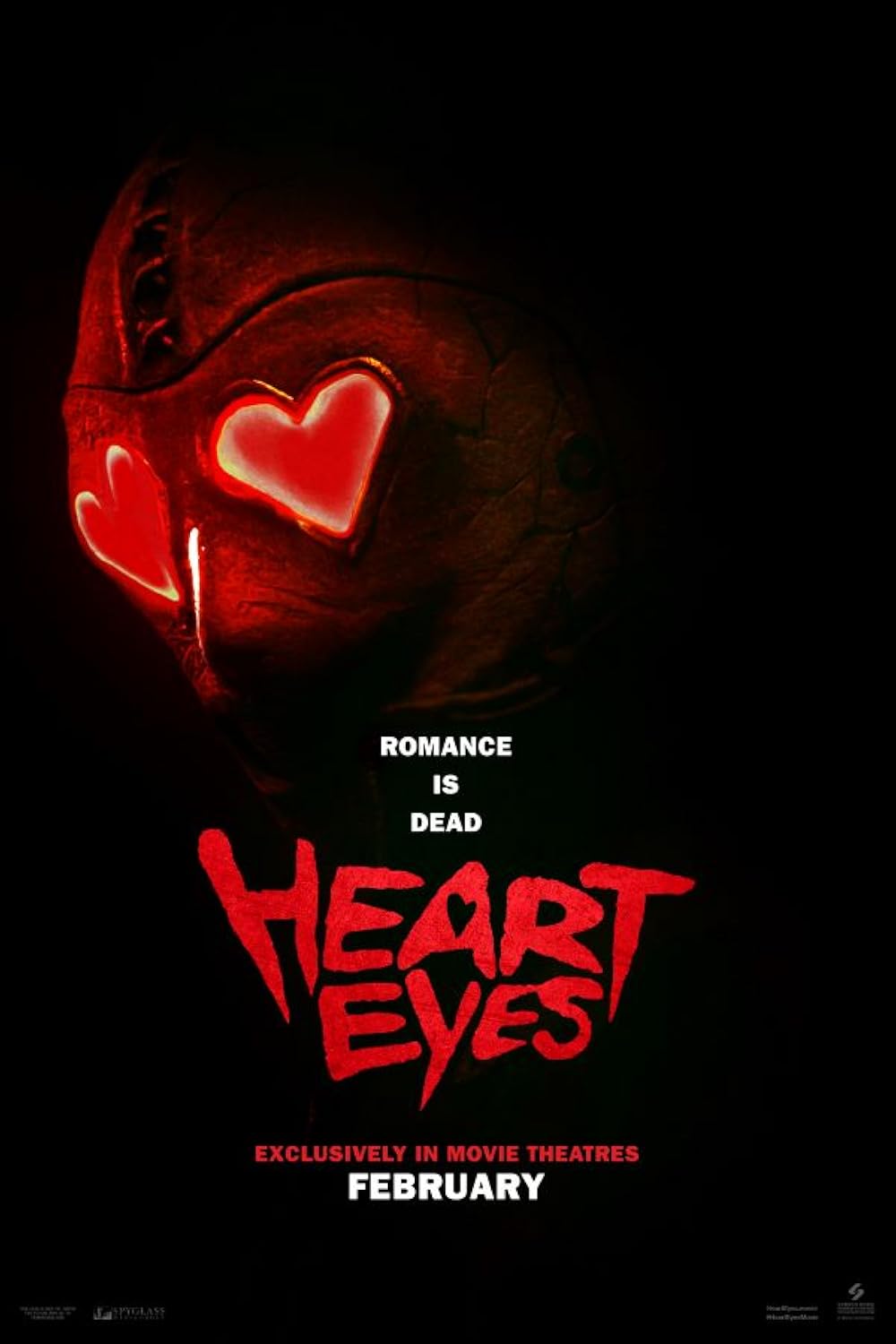
Slashtastic! Heart Eyes is the don’t miss holiday horror movie this Valentine’s season. Whether you’re a romantic or a cynic, there is something in here for everyone. The blend of romance and horror will, like Cupid’s arrow, find its way to the heart of slasher fans. Move over Coal Miner to make room for a new killer on the Valentine’s scene. Directed by CollegeHumor’s Josh Ruben and written by Christopher Landon (Happy Death Day), Michael Kennedy (Freaky), and Phillip Murphy (Hitman’s Wife’s Bodyguard), Heart Eyes seamlessly blends cliches from both romcoms and slashers, resulting in a movie that is sure to find its way onto rewatch lists every Valentine’s Day.

A masked maniac with glowing, red heart-shaped eyes returns every Valentine’s Day to terrorize unsuspecting couples.

The screenwriting is efficient and effective, and wastes no time in drawing audiences into this properly paced story. The kills are over-the-top–almost campy–and the romanic comedy bits are cheesy–in all the best ways possible. But this movie isn’t just about thrills and kills, because the central characters are surprisingly well-developed, and you’ll be rooting for their survival. So sure, some of the plot beats are formulaic, but this is a formula that has worked for over four decades, and demonstrates that genre movies have a timeless quality–a charm–about them that keeps us coming back for more screams.

Much like we saw with 2023’s Thanksgiving, Heart Eyes does the slasher right. Not only does it check off all the boxes for a classically written slasher, it also checks off boxes for a romantic comedy. Perhaps the movie leans more into its horror genes than it does its romcom genes, but it still strikes a well balanced genetic sequence for your entertainment pleasure. Starting with a classic romantic comedy opening, but as soon as it steeps for just the right amount of time, then upending it with a campy and gruesome slasher sequence, informs audiences precisely that for which they are in store for the rest of the movie. It sets the tone right up front, so you’re willing to buy everything else the movie throws at you.

The plotting is both sound as does the slasher reveal right. Yes, in hind sight you can make the observations that Heart Eyes took from this or that slasher, but that’s the beauty–it follows the formula but still keeps it engaging. Never once did I feel that it failed to keep my interest–even when I called the identity of HEK. I liked that this movie felt like classic slasher. We get it all: a big event that kicks everything into gear, a central character with a well-defined external goal driven by an internal need, and a character of opposition. This movie benefits from solid screenwriting and a director that seeks to entertain first and underscores the superstructure with thoughtful material for conversations about romance and relationships in the subtext. The stakes are high: survival! And throughout the movie, the stakes are raised, reminding us that no one is safe and even our final girl can be injured or killed.

Both of our central characters are well-developed. Olivia Holt’s Ally and Mason Gooding’s Jay are relatable and compelling. Are the characters particularly deep? No. But are they sufficiently developed to give these slasher characters human dimension? Yes. Both are strong and vulnerable. Furthermore, Ally feels like an “everyman” that is thrown into a situation in way over her head, but the setup is quite believable. I also like comedic irony in that she works for a jewelry company but has grown disillusioned by romance after being dumped by her boyfriend. Perhaps you work for a company that advocates for or sells something of which you are now cynical. Alternatively, Jay may come off overly optimistic and idealistic, but through that, we also learn that he as fears and vulnerabilities too. My point is, the principle players in this slasher are written with dimension, so you are rooting for their survival.

The most memorable slashers have a trademark mask, weapon, or sometimes both, which is the case with the Heart Eyes Killer (HEK). I’ve no doubt that HEK will find a place amongst the pantheon of slasher icons. After a long time of no new entries into that circle, we had John Carver added in 2023 and now HEK. Heart Eyes is a horror movie made by slasher fans for slasher fans, and its refreshing to see that the horror staple is still alive and well. Through movies like Thanksgiving and Heart Eyes, modern audiences are reminded that genre movies can be just as entertaining or thoughtful as the arthouse movies that are slowly becoming the mainstream. Funny–the movies that used to be the mainstream (i.e. slashers) are slowly finding their way into the arthouse cinemas, while the prestige pictures that used to be confined to the arthouse cinemas are slowly becoming the new mainstream.

Thematically, the movie explores disillusionment in and with romance. From an opening scene that underscores the realization that images captured by a camera are not always reflexive of reality to the cynicism that can grow out of broken relationships to accepting that an idyllic romance may just be possible, it’s all in this movie. Through the apparatus of the slasher, the writers and director are able to explore love and romance in a variety of ways that are rather poignant.

If your idea of a Valentine’s date is dinner followed by a scary movie, then this movie fits the bill! It works as both. Happy Valentine’s Day!

Ryan is the general manager for 90.7 WKGC Public Media in Panama City and host of the public radio show ReelTalk about all things cinema. Additionally, he is the author of the upcoming film studies book titled Monsters, Madness, and Mayhem: Why People Love Horror. After teaching film studies for over eight years at the University of Tampa, he transitioned from the classroom to public media. He is a member of the Critics Association of Central Florida and Indie Film Critics of America. If you like this article, check out the others and FOLLOW this blog! Follow him on Twitter: RLTerry1 and LetterBoxd: RLTerry
COMPANION horror movie review

A wild, albeit predictable ride. New Line Cinema’s Companion, written and directed by Drew Hancock, is an entertaining cautionary tale on how ultimate control, ultimately corrupts. Moreover, the film provides a thoughtful critique on the (in this case) deadly consequences of attempting to exert that desire for ultimate control over an individual, thus rendering mute their unique individuality. The film also paints a provocative portrait of the relationship between humanity and artificial intelligence (and androids) by establishing a seemingly controlled environment that then devolves into one of chaos. This progression reflects the overarching theme of attempts at ultimate control by underscoring the illusion of the ability to exert ultimate control over the human spirit, even if that “humanity” is housed within an artificial intelligence. Hancock’s screenplay is lean and mean, and nicely balances the horror elements with both lighthearted and dark comedy. Even though many of the plot beats were predictable, the movie still succeeded in remaining engaging and fun–just goes to show that there is a beauty to genre movies.

A weekend getaway turns bloody and violent when a subservient android that’s built for human companionship goes haywire.

Hancock’s film effectively blends elements of horror and comedy to explore contemporary anxieties surrounding individualism, artificial intelligence, and the ethical implications of control for the purposes of subjugation. Audiences are challenged by the plot and characters to reflect on the moral responsibilities involved in the creation and control of artificial-sentient beings. By prompting the audience to consider the consequences, the film is positing questions concerning the very nature of humanity and the desire and limits of control. Furthermore, the film demonstrates that when given seemingly ultimate control, that primal desires for ultimate control surface, thus reminding us that we have to learn to be generous, kindly, and altruistic because we are naturally born rather selfish and self-centered. Ultimate control, ultimately corrupts. Without reasonable checks and balances, the results of absolute control can be negative and quite possibly even deadly to the human spirit.

As artificial intelligence increases in human-like problem solving and expression, we have to ask ourselves how far will be go to both create and control artificial intelligence as it slowly approaches android-like technology. Will androids be controlled like a typical robot or mindless automaton or will they be granted sentient status like Data on Star Trek: the Next Generation‘s critically acclaimed episode “The Measure of a Man”? Without derailing from my review of Companion too much, I am reminded of this outstanding Trek episode that actually does a much better job of addressing topics of autonomy and control than Hancock’s film. The episode critiques the idea that beings created for a (even at one time, pre-determined) purpose (especially artificial ones) can be controlled or owned. Data’s ability to choose his own destiny is at stake. Captain Picard argues, in the trial that is convened to determine Data’s humanity, that intelligence, self-awareness, and consciousness make someone a sentient individual, not merely their biological nature.

Where I feel that Hancock’s film falls short is in its social commentary is the limitations it places on itself in its expression of the themes with which it underscores the plotting and characters. For the greatest impact, it should have been more consistent in the exploration of ultimate control over a seemingly sentient individual. Instead of crafting a film that could be more broadly applied, Hancock’s story falls into the trap of being too focuses on a overly generalized stereotype of particular individuals versus crafting a narrative that was more broadly concerning itself with depicting robbing sentient beings of their individualistic humanity–their free will. The sharpest criticism is clearly aimed at one particular character (and the demographic they represent). But eventually the idea of control over an individual snares another group. And for a moment, there was hope that Hancock was extending his critique to be more inclusive, but it returns to being focused on the original demographic group. This extension would have been a reminder that anyone can find themselves drawn to how far one can push the limits of control over a lover, friend, or other platonic, professional, or romantic relationship. It’s a trait that runs through everyone, and we have to learn to control our innate selfish and self-centered behaviors with which we are born.

While I have some reservations in the consistency and accuracy of theming in the film, Companion remains a solid horror films that serves as a reminder of the consequences of exerting ultimate control over an individual. The pacing, plotting, character development, and technical elements work together very well to keep the audience entertained on this wild ride.

Ryan is the general manager for 90.7 WKGC Public Media in Panama City and host of the public radio show ReelTalk about all things cinema. Additionally, he is the author of the upcoming film studies book titled Monsters, Madness, and Mayhem: Why People Love Horror. After teaching film studies for over eight years at the University of Tampa, he transitioned from the classroom to public media. He is a member of the Critics Association of Central Florida and Indie Film Critics of America. If you like this article, check out the others and FOLLOW this blog! Follow him on Twitter: RLTerry1 and LetterBoxd: RLTerry
PRESENCE horror film review

It’s, well, interesting. As soon as I saw that David Koepp was the screenwriter, I was instantly intrigued. While I’m hit or miss with Soderbergh, I’m generally hit with Koepp. But, I find this film’s apparatus to be more interesting than the story itself. While Presence is ostensibly a ghost story, it derives much of its intrigue–not from its narrative–but from its formal and technological apparatus. Soderbergh, known for his experimental approach to filmmaking, employs an innovative first-person perspective; however, this stylistic choice, coupled with Soderbergh’s meticulous control over framing, lighting, and movement and Koepp’s minimalist screenplay, resulted in elevating the film’s formal qualities above its forgettable plot and one-dimensional characters.

In short, the film is about a family that moves into a suburban house and becomes convinced they’re not alone.

The film unfolds through the perspective of an unseen spectral presence, effectively turning the camera into an active participant rather than a passive observer. This shift from traditional storytelling to experiential cinema foregrounds the act of seeing and being seen, inviting viewers to consider their own complicity in the voyeuristic aspects of horror. The film’s reliance on long takes and fluid camerawork creates an unsettling sense of omnipresence, emphasizing the medium’s ability to manipulate space and perception.

While Koepp’s screenplay is serviceable in its exploration of haunted house tropes, it often feels secondary to the film’s preoccupation with its own form. Koepp’s screenwriting is characterized by minimalistic dialogue and a structure devoid of conventional plotting. Rather than relying on his penchant for exposition-heavy scripts, Koepp wrote a screenplay that relied primarily on subtext and visual cues, thus inviting the audience to experience the story through mood versus visually-driven stimuli. The film’s thees such as literal and metaphoric isolation, family dysfunction, and the effects of trauma, feel much more like scaffolding for Soderbergh’s technical experimentation than an actual story. Koepp’s unconventional screenplay paired with Soderbergh’s experimental filmmaking results in a film wherein the mechanics of cinema take precedence over traditional storytelling.

Ultimately, Presence is most compelling when considered as an exercise in film form rather than a compelling story itself. The filmmaking apparatus generates a more profound engagement than its plot and characters, which hurts the potential this film had given its pedigree of talent. Soderbergh and Koepp crafted a film that is less about a haunted house and more about reimagining the voyeuristic capabilities of cinema itself. By leveraging cutting-edge camera systems and post-production techniques, Soderbergh set out to blur the line between observer and observed, in an attempt to create an uncanny sense of intimacy and detachment, but it failed to stick with this critic long after the credits rolled.

Ryan is the general manager for 90.7 WKGC Public Media in Panama City and host of the public radio show ReelTalk about all things cinema. Additionally, he is the author of the upcoming film studies book titled Monsters, Madness, and Mayhem: Why People Love Horror. After teaching film studies for over eight years at the University of Tampa, he transitioned from the classroom to public media. He is a member of the Critics Association of Central Florida and Indie Film Critics of America. If you like this article, check out the others and FOLLOW this blog! Follow him on Twitter: RLTerry1 and LetterBoxd: RLTerry

THE BEST CHRISTMAS PAGEANT EVER movie review

A heartwarming reminder of the importance of community. The movie also delivers a thoughtful critique of misplaced values. Based on the beloved 1971 children’s novel by Barbara Robinson, this big screen adaptation is a solid way to kick off the holiday season with a Christmas movie that is sure to fall into the annual movie rotations for many. Although the screenwriting demonstrably lacks refinement, there is still much to like about the movie. After a rocky first act, the movie finds its tone, despite the rough dialogue and poor pacing. Over all, it is an enjoyable movie that I will likely watch again before the Christmas season is over.

The Herdmans are six siblings who have a reputation for being the worst kids in the world. However, when they take over the local church Christmas pageant, they just might teach a shocked community the true meaning of Christmas.

Tonally, this movie falls somewhere between A Charlie Brown Christmas and A Christmas Story. While this movie may not have the same degree of memorable scenes that will find their way into the cultural zeitgeist, there are moments of hilarity and thoughtful poignancy. The movie shies not away from spotlighting the various prejudices and classism that permeate every town, particularly small towns and even amongst the imperfect people that makeup a church, but also uses the various social dynamics, at play, in the film to show how we can change for the better–after all, this is a redemption story. But it’s not a redemption story in the way we have seen in the past, with characters like Scrooge; rather, this is a redemption story about characters that talk the talk, but struggle to walk the walk. Moreover, this redemption story also follows those that are angry with the world and take out that anger and resentment on those around them. All around, this movie is full of imperfect people across the spectrum that need a wakeup call.

The movie works best when it leans into naturalism, but occasionally falters or feels uneven when it tries to strike a balance between typical faith-based movies and more mainstream ones. Some of the characters and conflicts feel like relatable albeit exaggerated versions of real life, while others feel incredibly forced and unnatural. From what I can remember, the Herdmans are more–how shall I say–earthy and raw in the book than in this film adaptation. And while we get glimpses of this, it would’ve been nice to have witnessed more of their behavioral aberrations to drive home how different they were perceived to be from their community. It’s here where we witness that Dallas Jenkins may be a better producer than director.

Bringing her trademark blend of strength, vulnerability, and sense of humor is Judy Greer as Grace, our house mom that unwittingly takes on the biggest event in her small town. All around, the principle cast is solid with a few standout performances. Some of those standout performances are from Knylee Heiman as the manic and terrifying Gladys, Beatrice Schneider as the crass Imogene, and Lorelei Olivia Mote as the self-centered diva Alice. The characters that work best are those that demonstrate stylistic differences compared to the rest of the cast. In other words, it’s the character actors that stand out in this film–and for good reason–they are both funny and act as an exaggerated reflection of real life people. We each know of people in our own lives that feel like these move people. I feel that if more characters were given something to do by the screenplay or director, that the performative dimension would’ve been above average.

Thematically, the movie reminds us that family and community traditions (particularly at Christmastime) are an important part of the human experience; however, the movie continues the conversation by its provocative reminder that traditions devoid of love and flexibility can become a trap or even a monster. It’s not the tradition itself that is important; it’s the love and community building that is most important. The tradition is merely a vessel through which we can extend love to one another. Just like Charlie Brown and his friends are reminded that Christmas is about the birth of baby King in a nondescript manger in a lowly town and, by extension, the radical changes He will bring to the world through His birth, life, death, and resurrection, the townsfolk in Emmanuel (the town in the movie) are reminded that Jesus was born for everyone, including the Herdmans, “the worst kids in the world.” And that we should care more about one another than we do keeping traditions the same simply for the sake of tradition.

After watching the movie, I am inspired to go back a reread the book. I remember reading it as a kid, and I imagine perhaps other kids of the 70s, 80s, and 90s remember reading the book as well.

Ryan taught Film Studies and Screenwriting at the University of Tampa for over eight years and has a book releasing next year titled Monsters, Madness, and Mayhem: Why People Love Horror. Recently, he has taken over 90.7 WKGC NPR in Panama City, and will be launching a film talk show soon. Additionally, he is a member of the Critics Association of Central Florida and Indie Film Critics of America. If you like this article, check out the others and FOLLOW this blog! Follow him on Twitter: RLTerry1 and LetterBoxd: RLTerry
CLUE: LIVE ON STAGE play review

“I. Am. Your singing telegram (POW!)” here to tell you that you do not want to miss the hilarious hijinks of CLUE: Live on Stage! It successfully channels the film whilst crafting a new experience. And yes, all the iconic, quotable lines and slapstick moments are in the show!! It’s a laugh out loud riot that will uplift the human spirit!

Playing the Straz Center in Tampa now through June 2nd.

Designed for fans of the cult classic, complete with all the camp, but can still be appreciated by all! This stage adaptation of the beloved star-studded film owes its success to the playwriting that retained the soul and memorable moments of the film yet injected new dialogue, scenes, comedic irony, and physical comedy that together craft a familiar yet fresh experience. From the moment the play opens with the original theme music, you know that you will be in for an uplifting time at the theatre. Some stage adaptations of films neglect to include so much of what makes their respective film source beloved, such as the score, quotable lines, or slapstick humor; not true with CLUE. This is one of the best stage adaptations of a film that I have ever witnessed.

One of the subtle strengths of the playwriting is the inclusion of some meta humor such as characters carrying around the original board game detective notepads and even the game board. Other elements that elevate the meta humor of the play include musical cues and slight fourth wall breaking as if to nod to the audience that “we know you know.” The stage design is fantastic! Every inch of space is used efficiently and effectively to achieve the feeling of a vast mansion on a single stage. Furthermore, the design retains that beautifully gothic atmosphere that we associate with the iconic board game and campy film.

With such great cast/character chemistry in the film, I was curious if this adaptation would be able to capture even half of the magic. It pleases me to report that the cast’s chemistry is fantastic! And while they certainly recreate notable moments from the film, each of them puts their own spin on the expression of those moments. From “Let us out, let us out; let us in, let us in” to “Fla, fla, flames, flames on the side of my face” to “I. Am. Your singing telegram,” all those memorable moments are part of the stage production!

And if you were curious if the multiple endings from the film are included, that they are! But, the solution(s) are different than the film, so don’t think that you have it figured out. Even this faithful adaptation throws curve balls that will keep you on the edge of your seat.

I had such an incredibly enjoyable time with this play, and I know you will too. CLUE: Live on Stage is currently touring the country, so look for a showing near you! CLUE is playing the Straz Center in Tampa now through June 2nd, but checkout the CLUE website for when it will be touring in your area.

Ryan teaches Film Studies and Screenwriting at the University of Tampa and is a member of the Critics Association of Central Florida and Indie Film Critics of America. If you like this article, check out the others and FOLLOW this blog! Interested in Ryan making a guest appearance on your podcast or contributing to your website? Send him a DM on Twitter. If you’re ever in Tampa or Orlando, feel free to catch a movie with him.

Follow him on Twitter: RLTerry1 and LetterBoxd: RLTerry