
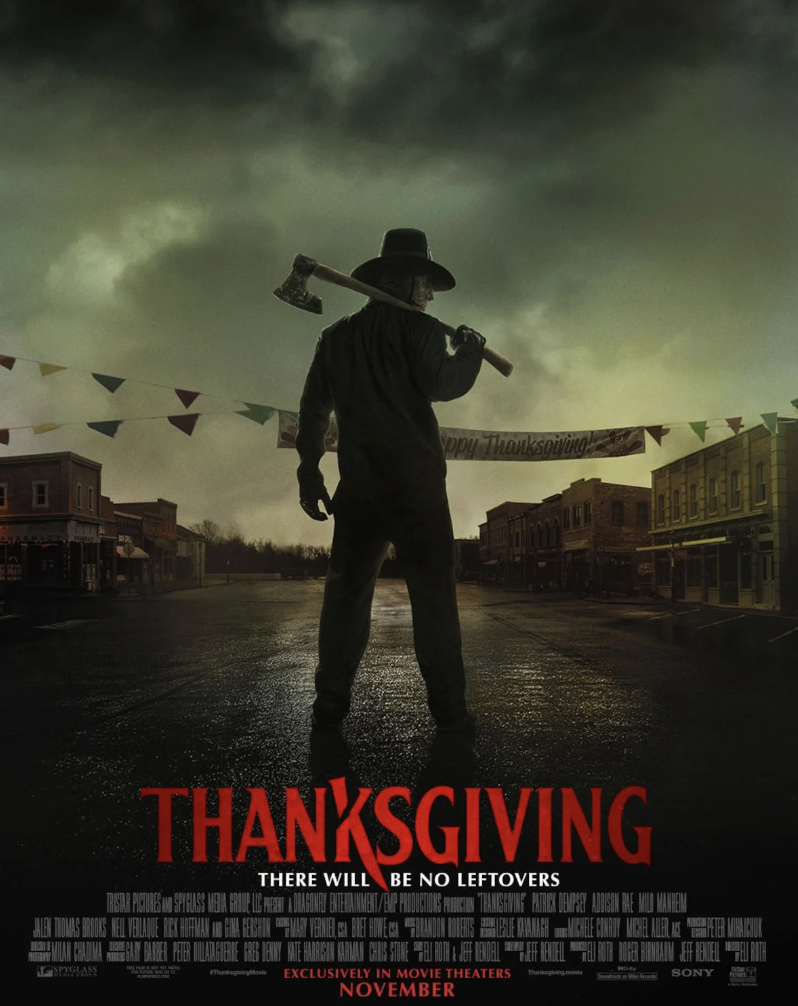
THANKSGIVING (2023) horror movie review

I know what you did last Thanksgiving! Eli Roth’s Thanksgiving is IKWYDLS meets Jaws with a dash of Scream in a scathing critique of toxic, insatiable consumerism that is destined to be an instant holiday horror fave! Complete with great kills and stuffed with laughs, it’s a highly entertaining slasher!

An axe-wielding maniac terrorizes residents of Plymouth, Mass., after a Black Friday riot ends in tragedy. Picking off victims one by one, the seemingly random revenge killings soon become part of a larger, sinister plan.

The slasher has a formula, and Eli Roth is serving it up in heaping helpings that simultaneously check all the boxes for the horror stable yet find ways of seasoning it with style and flare. While some non-slasher fans may get hung up on all the nods to classic slashers, it’s how Roth uses the homages and references that express his original recipe for this future holiday horror classic. Beyond the cleverness of the screenplay, Eli Roth has crafted a horror movie that is entertaining from the first course to dessert. It’s a sheer blast that demonstrates the art of identifying the balance between comedy and horror. Even though it isn’t a horror-comedy per se, it is a horror movie that takes the story seriously but punctuates it with laughter to form a fantastic roller coaster of a ride.

For the most part, Thanksgiving has remained the only major U.S. holiday largely untouched by the horror genre. In fact, I can only think of the absurd Thankskilling (2007) and its even worse sequel (2012). There are endless holiday horror examples for Halloween, but we also have Valentines Day (My Bloody Valentine), St. Patrick’s Day (Leprechaun), Easter (Night of the Lepus), Independence Day (IKWYDLS and Jaws), Christmas (Black Christmas, Silent Night, Deadly Night, Krampus), another exhaustive list), but Thanksgiving has been a rather conspicuous absence from that holiday horror library. Not anymore! This movie has it all, turkey dinner with all the trimmings, including blood and guts, some male-sploitation abs, and an axe-wielding masked killer.

From The House with a Clock in its Walls to Green Inferno, Roth’s horror library is stratified from the whimsy to the horrific. And on that spectrum, I’d place Thanksgiving somewhere around the middle, which is right where it needs to be. It’s neither too dark nor does it play it too safe, and it has a healthy level of intentional camp. Despite being set in our present day, it has the soul of a 90s slasher in the vein of IKWYDLS. The holiday theming works to the movie’s advantage because it provides both opportunities to provide commentary on our society and integrate some subversive whimsical elements as well.

Audiences are queued into the type of horror movie they are about to watch at the very beginning. Simply stated, the first act of Thanksgiving is incredibly effective at setting the tone and thesis for the movie. While he may not be going for scares in the conventional sense, he is going for some–and what I characterize as–more deeply troubling scares. His critique of toxic consumerism (as represented by Black Friday monsters–uhh-I mean, shoppers) is simply scathing, and oh so effective! Even before the killer shows up, there is bloody mayhem at the hands of the people of Plymouth themselves. And it’s not just the physical harm befalling the shoppers, but the emotional and psychological suffering is spotlighted.

We witness a mob outside of a (not Walmart) store that is all clamoring for door buster sale items and behaving inexcusably. Perhaps Roth is exaggerating for illustrative purposes, but it’s honestly not that far removed from how awful, greedy, and thankless shoppers are often times, especially on Black Friday. If everyday people can cause this kind of harm, that liminal space between killer and victim begins to blur. And that is more terrifying than any masked slasher. Eli Roth challenges audiences to ask themselves to what extent will they devolve in order to get 50% off a waffle iron.

The movie additionally spotlights the disruption to family time around the Thanksgiving table by greedy corporations that insist on starting Black Friday sales on Thursday night and the horrendous, deplorable behavior by the consumers that feed these corporations with their insatiable, selfish behavior. Roth isn’t trying to scare people, in the conventional sense, with his holiday horror offering, but rather scare them into behaving like human beings and remembering to be grateful for what we have instead of being greedy and selfish with time and resources. After watching this movie, you may think twice before supporting a store on Thanksgiving Day; moreover, you may find yourself behaving more civilly during the Black Friday sales.

All the kills are over-the-top and creative, typically underscored with dark humor, which removes them from reality. The comedy is very much character-driven, with some slapstick sprinkled throughout. It’s primarily a cozy (throwback-style) slasher with a side of gore, so the gore will be a little more intense than in a classic 80s or 90s slasher, but because of its punctuated nature, it is not nearly as gnarly or grotesque as in say Roth’s Hostile. Suffice it to say, Roth thankfully leans far more into the slasher subgenre than he does the torture porn subgenre.

Thanksgiving is a well-written and directed holiday slasher that delivers a clever story, thoughtful plotting, and fun characters. I can totally see the John Carver mask becoming one that you may very well see on Halloween along with Ghostface, Jason, Michael and the rest.
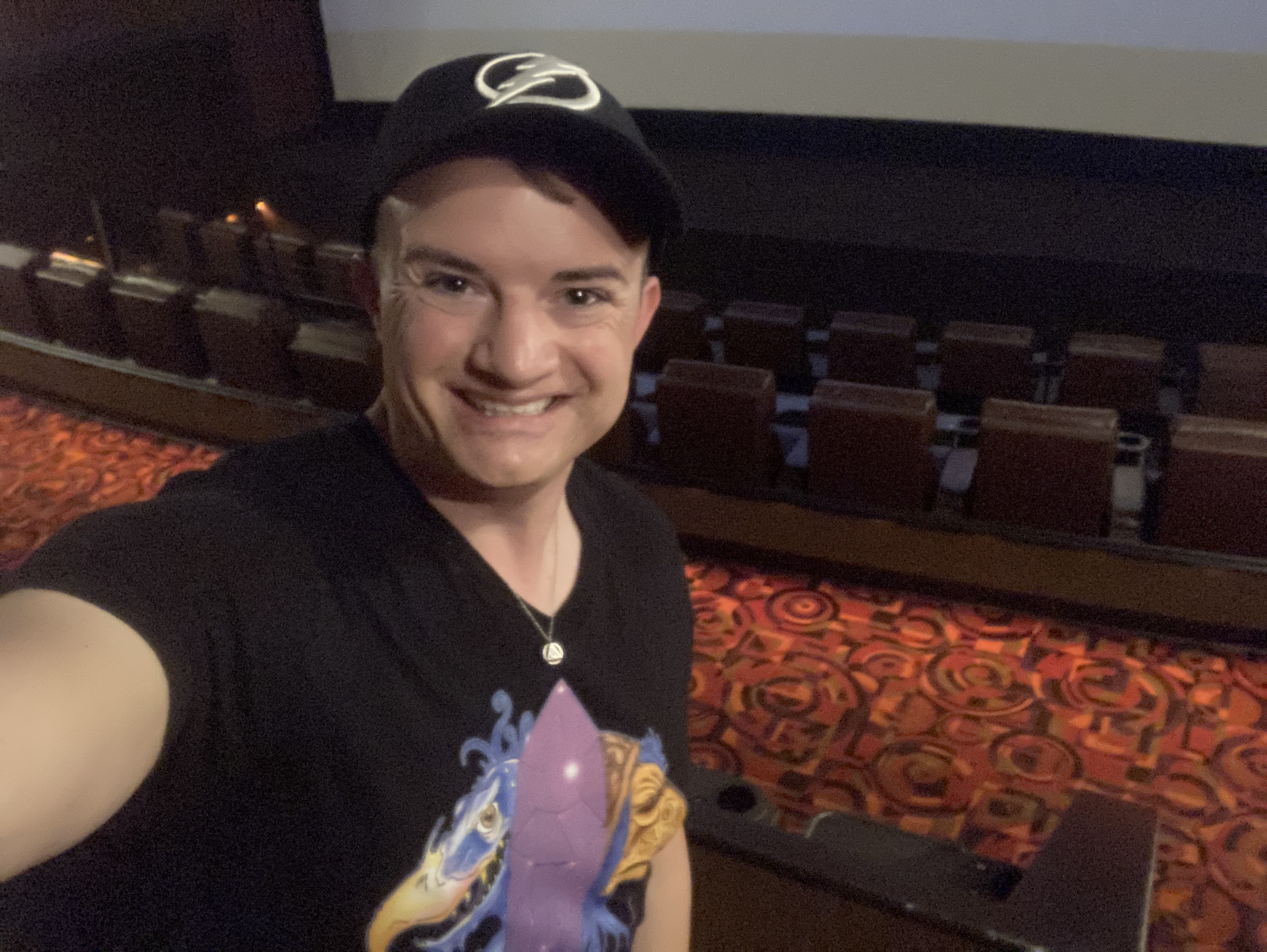
Ryan teaches Film Studies and Screenwriting at the University of Tampa and is a member of the Critics Association of Central Florida and Indie Film Critics of America. If you like this article, check out the others and FOLLOW this blog! Interested in Ryan making a guest appearance on your podcast or contributing to your website? Send him a DM on Twitter. If you’re ever in Tampa or Orlando, feel free to catch a movie with him.
Follow him on Twitter: RLTerry1 and LetterBoxd: RLTerry

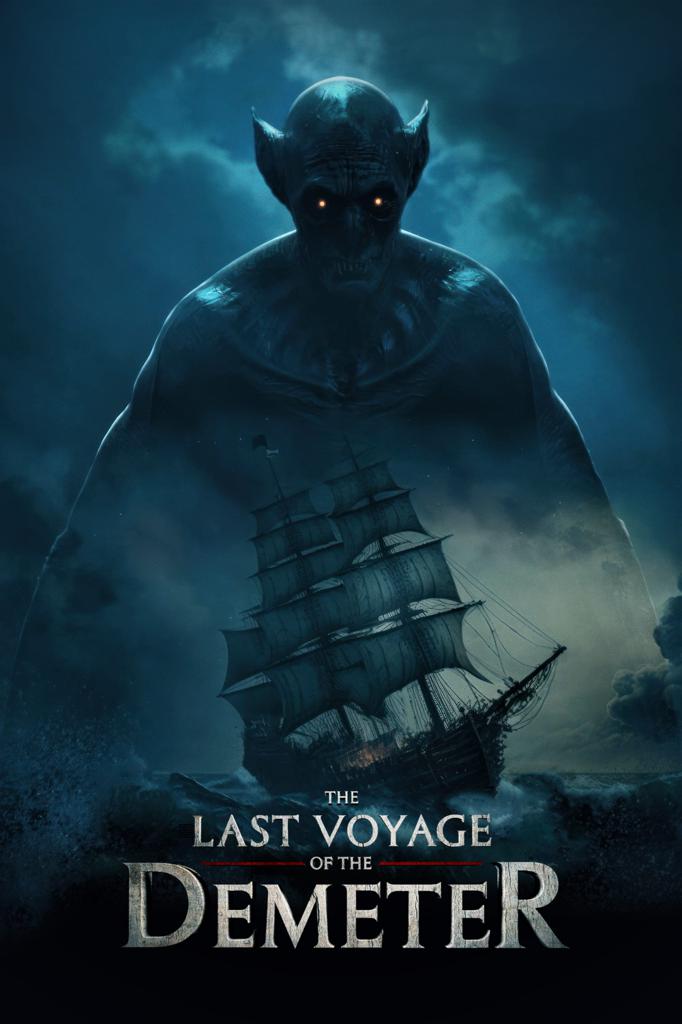
THE LAST VOYAGE OF THE DEMETER horror movie review

Fangtastic! Universal meets Hammer horror in a gothic tale that explores what may have happened on the domed Demeter carrying one thirsty passenger. While seemingly most contemporary horror movies take place in the real world, The Last Voyage of the Demeter transports us back in time to a fantastical world full of sailing vessels, ominous castles, and terrifying folklore. More than a backdrop on which the story unfolds, the atmosphere and sets are characters in and of themselves. If the gothic setting wasn’t enough, the score will certainly wrap you in the nightmare of this movie. If you love classic horror, this is right up your alley as it’s in the same ‘vein’ as such foundational early to mid 20th century horror motions pictures including Nosferatu and Dracula and even late 20th century horror pictures like the original Alien. While it remains to be seen if this is Universal’s second attempt at the defunct Dark Universe, between this movie and the Universal Monsters last at Epic Universe theme park (still under construction), the manner in which this movie ends certainly lends credence to an attempt to revive the dead Dark Universe.

After accepting mysterious cargo from an anonymous customer, the crew of The Demeter experience horrific events aboard the doomed sailing vessel as it makes it way from the harbors beneath the Carpathian Mountains to London.

Neither Bram Stoker, F.W. Murnau, nor Carl Laemmle included much information on the doomed voyage of the Demeter after it left the harbor beneath the Carpathian Mountains. All we know is that mysterious cargo (which we know is the coffin and/or dirt belonging to Count Dracula/Orlak) is dropped off and only the ghost of a ship arrives in London. And that’s the beauty of this movie, the filmmakers only needed to begin and end in the right places. Therefore, everything that unfolds on the ship is pure speculation and imagination. When adapting an existing IP, this is how it should be done. And while this is the best example in recent years of how to find new stories within an existing IP, Disney did something similar with Rogue One, which is my favorite in the Disney Wars movie universe.

We already know The Demeter and crew aboard are doomed, so the charm or terror in this movie isn’t what’s ultimately going to happen–rather–how is it going to happen. And director André Øvredal and writer Bragi Schut Jr. do an excellent job at making the events captivating and even surprising. No one is safe on the sailing cargo vessel, and I do mean no one. Our storytellers craft a narrative that is completely inspired by the past writings and movies yet it takes the story of Dracula to new levels, most of which I appreciate, though there are some elements of the story that I feel are not in line with established vampire lore.

Without getting into spoilers, it’s difficult to discuss what I would like to bring to to the discourse; however, I’d be remiss if I didn’t convey that there is a character we know from nearly all iterations of Dracule or Nosferatu that appears to be setup, but it’s never delivered. Without knowing the direction Universal is going with this movie, I must say that this was a missed opportunity to organically bring this character into what appears to be a relaunch of the Dark Universe.

Both Universal and Hammer horror are being channeled in this newest Dracula movie! You have the gothic stylings of early Universal horror coupled with the amped violence of Hammer horror. Working together, this two distinctly stylistic expressions of horror are used effectively in the crafting of the aesthetic and tone of this movie. Further evidence of the inspiration taken from early Universal and Hammer horror can be witnessed in the haunted house upon the sea concept. I am also reminded of Alien when I think of the setting, the claustrophobia, and the no escape dynamics of this movie. In Alien, it was a Xenomorph in space where “no one can hear you scream,” except we are in a sailing vessel at sea where no one can hear you scream.

As a huge horror fan, especially of the classics, I am eager to see where this movie takes Universal horror. Usually, I am not a fan of starting a franchise (when it is intentionally started), but this movie demonstrates that Universal may have learned its lesson from the failed launch of the last Dark Universe. I definitely see potential in this return to classic Universal monsters, and am along for the ride.

Ryan teaches Film Studies and Screenwriting at the University of Tampa and is a member of the Critics Association of Central Florida and Indie Film Critics of America. If you like this article, check out the others and FOLLOW this blog! Interested in Ryan making a guest appearance on your podcast or contributing to your website? Send him a DM on Twitter. If you’re ever in Tampa or Orlando, feel free to catch a movie with him.
Follow him on Twitter: RLTerry1 and LetterBoxd: RLTerry

SHAZAM! FURY OF THE GODS movie review

Sufficiently entertaining. SHAZAM! Fury of the Gods starts and ends well, but the middle wanders aimlessly with the only goal to inflate runtime. After the explosive first act, the second act mostly serves as filler material to augment the narrative by making it about twenty to thirty minutes longer than it needed to be. Fortunately, the third act delivers a climatic showdown, which greatly aids in the audience experience. But the movie struggles narratively between the inciting incident (at the beginning) and the showdown at the end. Clearly, there was a good superhero movie in there, but it gets lost during the meandering developmental stage. To the movie’s credit, though, it’s the enthusiastic cast that ultimately saves the audience from complete disengagement. This is especially true with Helen Mirren and Lucy Liu, playing our villains, and Jack Dylan Grazer in his well-played comedic relief. While it’s not terribly memorable superhero movie, neither is it a bad movie.

Bestowed with the powers of the gods, Billy Batson and his fellow foster kids are still learning how to juggle teenage life with their adult superhero alter egos. When a vengeful trio of ancient gods arrives on Earth in search of the magic stolen from them long ago, Shazam and his allies get thrust into a battle for their superpowers, their lives, and the fate of the world.

If you have not seen the trailer, DON’T. While I have not seen the trailer myself, I’ve read that the BIG cameo at the end of the movie is spoiled. So, do yourself a favor and do NOT watch the trailer. As I stated in the beginning, it is sufficiently entertaining; moreover, I honestly enjoyed myself more than I thought I would for a movie aimed at kids and young teens. When I say aimed at kids and young teens, I do not use that as a pejorative or as a tool to belittle the movie. In fact, I am glad to see that there is a superhero movie that is aimed at kids. Seems like the majority of superhero movies nowadays are inappropriate for developing minds. It pleases me that we have a movie here that is suitable for the whole family.

Ryan teaches Film Studies and Screenwriting at the University of Tampa and is a member of the Critics Association of Central Florida and Indie Film Critics of America. If you like this article, check out the others and FOLLOW this blog! Interested in Ryan making a guest appearance on your podcast or contributing to your website? Send him a DM on Twitter. If you’re ever in Tampa or Orlando, feel free to catch a movie with him.

Follow him on Twitter: RLTerry1 and LetterBoxd: RLTerry

KNOCK AT THE CABIN movie review

Knock on a different cabin. M.Night Shyamalan’s latest horror film Knock at the Cabin attempts to explore thoughtful themes but the storytelling is clunky due to the poor plotting and contrived character development. Moreover, this is a case wherein film form is employed as a tool to compensate for underdeveloped meaning and story structure. Where the film excels is in the characters and casting. Yes, the character development is contrived, but I appreciate Shyamalan’s character mix. In particular, it’s a refreshing mix because the fact the parents are a same-sex couple doesn’t factor heavily into the plot nor become a sermon, like it so often does. It simply is and that’s it. Furthermore, the casting of not only the central parental couple, but all of the characters shines because of the realistic representation of everyman. Bautista is provided a platform to portray a much different character than he has in the past, which is fantastic to witness! He is given an conduit through which he can more freely exercise his acting chops. Visually, the film is striking; there is an emotive dimension to the montage of the motion picture and the cinematography. Again, the film form is outstanding! Unfortunately, the screenplay is lacking the same degree of thought that was found in the technical approach to crafting this film.

While vacationing at a remote cabin in the woods, a young girl and her parents are taken hostage by four armed strangers who demand they make an unthinkable choice to avert the apocalypse. Confused, scared and with limited access to the outside world, the family must decide what they believe before all is lost.

Knock at the Cabin excels in montage and cinematography because of how the eye of the camera oscillates between subjective and objective placement, much in the same way our own eye (and mind’s eye) operates in real life. Treating the camera as our own eyes allows Shyamalan a brilliant opportunity to bring the audience into the narrative. Unfortunately, this is hampered by the clunky storytelling. However, because of the stylistic choices for camera placement and scene framing, the film is successful in delivering an unsettling mood and suspense with the camera (in a Hitchcockian manner). Furthermore, the film proves to be exemplary in the area of montage (or dramatic film assembly) demonstrated by the stylistic choices that provide the film with steady pacing and guiding our focus from character to character or scene to scene. While the story may be lacking refinement, the editing crafts a visual narrative that is lean and mean.

Struggling narratively, the film fails to sufficiently provide thoughtful critique (or commentary) on any area on which it concerns itself. I don’t mean to sound vague, but to discuss the themes, symbolism, or commentary would require me to divulge spoilers. What I can say, without getting into spoilers, is that there is an attempt to critique: preconceived opinions or judgments of people, willful disbelief in the face of evidence, and toxic ideologies. I appreciate what Shyamalan set out to accomplish; it’s clear that this film was supposed to be a vessel to foster conversations about the themes and subtext, but no single area of theme or subtext was setup or developed adequately. We receive glimpses in the dots Shyamalan attempted to connect, but they are glimpses at best. Flashbacks are used as a tool to provide clarity on present conflicts, but that (often abused) storytelling tool is wielded ineffectively and wastefully.

Ryan teaches Film Studies and Screenwriting at the University of Tampa and is a member of the Critics Association of Central Florida and Indie Film Critics of America. If you like this article, check out the others and FOLLOW this blog! Interested in Ryan making a guest appearance on your podcast or contributing to your website? Send him a DM on Twitter. If you’re ever in Tampa or Orlando, feel free to catch a movie with him.

Follow him on Twitter: RLTerry1 and LetterBoxd: RLTerry

BABYLON (2022) film review

Whoa, that’s a lot of movie. Damien Chazelle’s decadent film of bombastic proportions is simultaneously mesmerizing and repulsive, coherent and incoherent, thoughtful and thoughtless. Suffice it to say, it’s interesting to behold. This overstuffed fever dream collage of 1920s and 1930s Hollywood is trying to tell so many stories, that it winds up not telling any of them effectively enough. There are competing A-stories (outside/action plots), each vying for to be the story about which the audience empathizes with the most. To dramatize these ideas, Chazelle assembles a mise-en-scene that’s ostensibly a combination of Singin’ in the Rain, Boogie Nights, Sunset Boulevard, and Once Upon a Time in Hollywood, with a little Caligula and Wolf of Wall Street thrown in to provocative proportions. Ultimately, what we have here is more of an exercise in montage–the assembly of a motion picture–more so than we have a clearly defined narrative. Undoubtedly, this will become a film that is shown in film studies classes in the future, and will be used for close reading discussions, much like I show Boogie Nights in my American Cinema class. There is a prolific amount of imagery to analyze, as the film follows four different Hollywood stories that all intersect one another. Just for whom was the film created? Certainly not general audiences. It is likely going to be most appreciated by Chazelle himself and with some critics and scholars (tho, not this scholar nor the majority of the critics with whom I screened this film).

Decadence, depravity, and outrageous excess lead to the rise and fall of several ambitious dreamers in 1920s Hollywood.

One thing is clear, Chazelle’s intention was to craft a boisterous love letter to the allure and power of cinema whilst negatively critiquing the Hollywood system that creates and destroys careers on a whim. Furthermore, the film seeks to provide thoughtful commentary (just how thoughtful? that is for you to decide) on the superficial, fleeting nature of fame and celebrity. Where the film excels is in the both the performative dimension and Chazelle’s direction. Unfortunately, Chazelle’s screenplay is all over the place.

While audiences may not remember the four individual story threads that make up the outside/action plot, audiences will definitely remember the prologue and final scene. Chazelle certainly captures the unbridled decadence that is probably not unlike the level of debauchery that ran rampant after the great movie people migration from Europe (mostly Germany and France) and eastern U.S. (avoiding Edison’s motion picture patent policing) after the first World War. It was certainly the wild west with a seemingly unending source of money (coupled with massive debt). To borrow from Outback’s former slogan no rules, just right, that describes the atmosphere of the greater Los Angeles area. No order, only chaos. Which is not unlike this film–lots of chaotic images and plot points.

The prologue to Babylon is truly a spectacle that words simply cannot capture accurately. That’s not to say that all of the creative decisions were plot or character-driven–I’ve said it before–that even provocative imagery can be used to further the plot or character; and therefore, that which would otherwise be evaluated as gratuitous, is actually purposeful. However, much of what goes on in the opening scenes is simply gratuitous for the sake of shocking the audience–for an extended period of runtime. I am reminded of the opening to Boogie Nights, and how at first glance it may seem gratuitous, but actually the opening scene is needed for plot and character development. It’s not so much shocking as it is crafted for a strategic purpose.

While elements of the prologue are justifiable, in the relationship to plot and character, there are many moments that are no more than prolific debauchery simply because Chazelle could. Now, what I did find most interesting–and to the point that I greatly appreciate the prologue–is that much of the deplorable chaos is underscored by the score from Fritz Lang’s masterpiece Metropolis in the Babylon scene with MechaMaria. Something Chazelle wove into the scene for the film scholars in the crowd.

Jumping to the end of the film, there is a–what amounts to a–clip show featuring iconic films from the 100+ years of cinema history we have. I get it, Chazelle is communicating to audiences that being part of filmmaking means that you’re part of something bigger than yourself, something that will live on decades and (by extension) centuries after you pass away. It’s this artform that will continually be rediscovered and influence people and cultures (good, bad, or indifferent). While it’s clearly designed to be an emotionally moving moment in the film, as indicated by the tears in the character in that scene, it comes off as lazy, derivative montage that does little more than remind the audience of better films for the rather long sequence of imagery. Instead of being a deeply, moving scene, it’s rather vapid.

The four competing A-stories depict four different (but not too dissimilar in substance) Hollywood stories. (1) an A-list star that feels the pain as he watches his star fade with changing times (2) An up and comer that is thrust into the spotlight for a brief time, just to continue to fall due to tragic flaws and a talent that simply didn’t transition to talkies (3) an immensely talented individual subject to the prejudices of the general public and Hollywood executives and (4) and an animal wrangler turned studio executive by being in the right place at the right time, but even that level of fame and success is not invincible to human error and poor judgment. Any one of these stories would have made for a great A-story, with others falling in line thereafter. But each one of them feels like it’s vying for the main outside/action story. This is where Chazelle should have worked with a screenwriter that could have taken his concepts and ideas, and fashioned them into a much better structured and plotted narrative.

Perhaps it’s a film ahead of its time, or perhaps, it truly is the Heavens Gate of 2022. Maybe it will see success on down the road like Boogie Nights and Showgirls has, but only time will tell. Presently, it’s a wild, bloated film that lacks basic storytelling.

Ryan teaches Film Studies and Screenwriting at the University of Tampa and is a member of the Critics Association of Central Florida. If you like this article, check out the others and FOLLOW this blog! Interested in Ryan making a guest appearance on your podcast or contributing to your website? Send him a DM on Twitter. If you’re ever in Tampa or Orlando, feel free to catch a movie with him.

Follow him on Twitter: RLTerry1