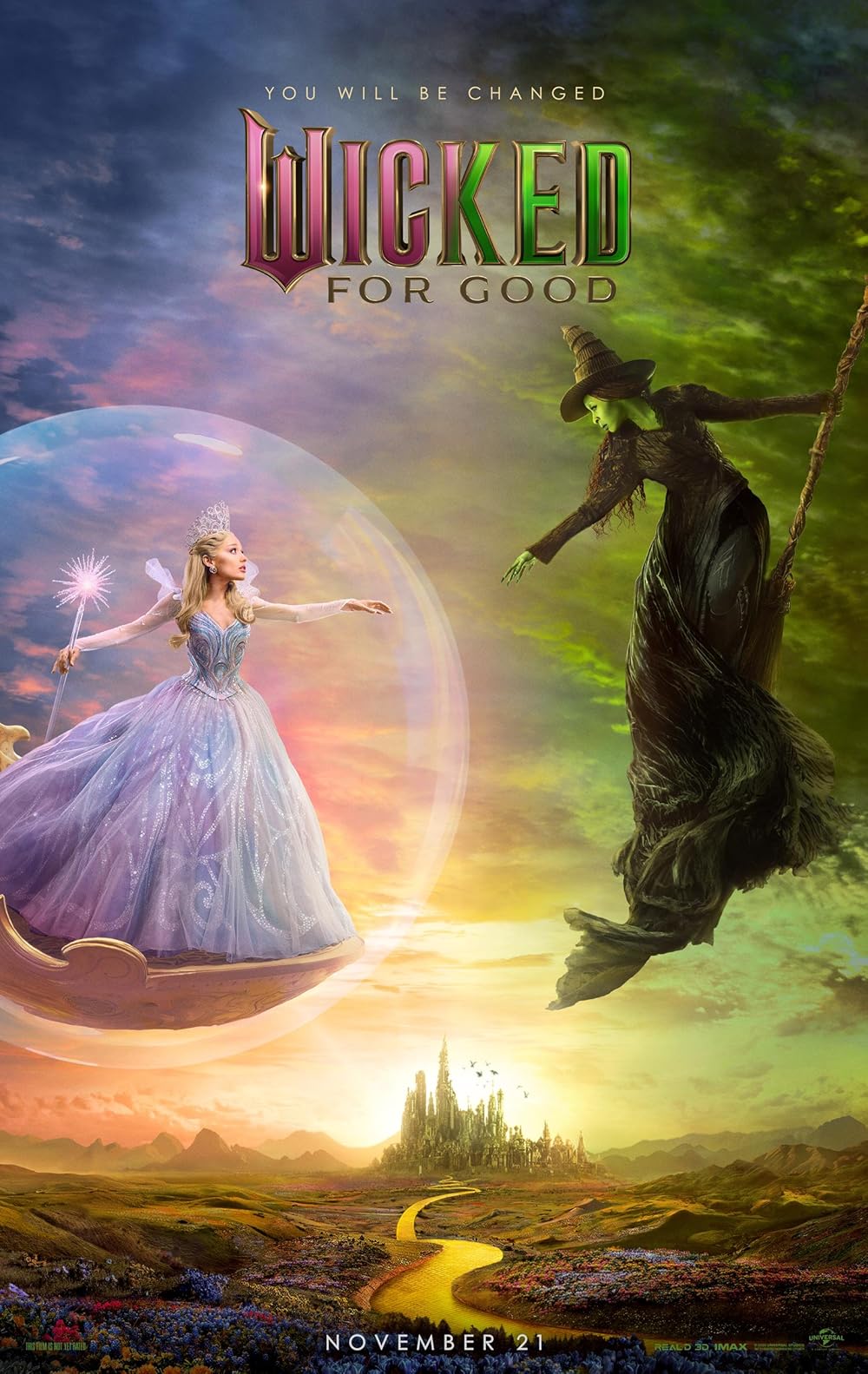
WICKED: FOR GOOD movie musical review

Some movies soar on broomsticks; this one never quite gets off the ground.

Wicked: For Good arrives with sky-high expectations, a beloved Broadway pedigree, and a cinematic world forever shaped by the 1939 Wizard of Oz. And while the heart for the material is undeniably present—director Jon M. Chu’s affection radiates through nearly every frame—the execution is fraught with problems that prevent the film from casting the spell it so eagerly attempts. It’s a movie overloaded with spectacle yet starved of narrative discipline, regrettably proving that sometimes a production can have all the right ingredients and still mix the potion incorrectly. There’s no question Jon M. Chu loves this material—his enthusiasm is evident. But passion alone isn’t enough. The film desperately needed stronger producing and organizational forces to ground the project, refine its pacing, and balance its emotional register. Instead, we get a production that feels at once over-managed and under-shaped.

Now demonized as the Wicked Witch of the West, Elphaba lives in exile in the Ozian forest, while Glinda resides at the palace in Emerald City, reveling in the perks of fame and popularity. As an angry mob rises against the Wicked Witch, she’ll need to reunite with Glinda to transform herself, and all of Oz, for good.

The most glaring issue in this movie is the pacing. This story never needed to be two movies. One Broadway show, one complete screen adaptation—simple math. Instead, Wicked and Wicked: For Good, collectively, feel like a single narrative forcibly stretched and compressed simultaneously. Scenes either end abruptly or linger with self-importance, giving the whole film a stop-and-start rhythm that betrays any emotional momentum. Moments that should breathe are suffocated, while others that should be tightened sprawl endlessly. Narratively, the film leans heavily on contrivances rather than character and plot development. Plot turns feel telegraphed or unearned, creating a sense that events are happening because the script demands it—not because the characters have earned the journey. Emotional beats are pushed rather than developed; the film tugs at heartstrings it hasn’t taken the time to weave. Many sequences feel manipulative instead of meaningful, leaving the viewer aware of the strings being pulled rather than swept up in the melody.

The film maintains the emotional equivalent of flooring the accelerator from beginning to end. Everything is heightened, everything is urgent, everything is presented at maximum volume. Without quieter resets, the story becomes exhausting rather than exhilarating. The lack of modulation leaves little room for nuance, making even potentially impactful moments blur together into one extended crescendo.

And then there’s the Oz problem itself–it was bad enough in the first movie, but this one amplifies all the flaws in this picture. From the opening Universal logo and Wicked title card, both stylized to resemble their 1930s counterparts, it’s clear the film wants to position itself adjacent to the classic Wizard of Oz. (And yes, I am aware that the Broadway show is based on books and not the 1939 classic, but this is a screen adaptation that is going to by default be connected spiritually and literally to the events, imagery, and characterizations of the original movie, but I digress). Whenever Wicked intersects with that iconic imagery, the visual and narrative disconnect is jarring. Tonally, textually, and aesthetically, nothing matches. Two of the most egregious examples are the Wicked Witch of the West’s castle, a location fundamentally misaligned with its 1939 counterpart in both history and design, and Glinda’s bubble. Hello??? She is clearly a magical being and travels by a magical bubble. To rob her of those elements is to rob her original characterization. For a film so eager to evoke some level of nostalgia, its disregard for consistency with cinema’s most beloved fantasy feels baffling.

The editing is among the film’s most distracting flaws—awkwardly timed transitions, uneven scene construction, and moments that feel spliced for convenience rather than cohesion. The cinematography dazzles with color and movement but contributes little to storytelling. It’s all flash, no narrative substance: beautiful images that ultimately amount to little more than digital confetti. And we cannot talk editing without addressing teh cringe CGI–the kind of digital spectacle that feels less like movie magic and more like a rough animatic accidentally exported at full resolution. Emerald City looks less like a tangible place and more like a high-end screensaver—everything polished to a rubbery sheen, with no texture, grit, or atmospheric depth. Characters often appear detached from their surroundings, as if composited into a digital diorama rather than inhabiting a lived-in world. Instead of mixing practical sets with digital enhancements, the film leans heavily on full-CG environments and even characters, resulting in octane-fueled and intimate moments feeling artificial. It’s like looking upon a world of fantasy that feels more like a giant animated backdrop with actors placed within versus a world that feels tangible.

Not even the presence of Michelle Yeoh is enough to elevate the film’s sense of class or gravitas. Although, it’s hard to blame her, given that she’s phoning in a performance built on scraps of narrative substance. In this second installment, her character is little more than an ornament of prestige, offering neither meaningful development nor any real impact on the story. Jeff Goldblum, likewise, delivers a surprisingly muted turn, coasting on his trademark charisma without ever fully engaging. When two performers known for commanding the screen seem this disengaged, it speaks less to their abilities and more to a film that gives them virtually nothing with which to work.

Wicked: For Good reaches for greatness but ultimately fails to stick the landing. It’s a film overflowing with heart yet undercut by structural missteps, contrived plotting, mismatched continuity, and a visual approach that prizes spectacle over substance. For a story about defying gravity, it’s ironic that this adaptation never quite lifts off the ground.

Ryan is the general manager for 90.7 WKGC Public Media and host of the show ReelTalk “where you can join the cinematic conversations frame by frame each week.” Additionally, he is the author of the upcoming film studies book titled Monsters, Madness, and Mayhem: Why People Love Horror. After teaching film studies for over eight years at the University of Tampa, he transitioned from the classroom to public media. He is a member of the Critics Association of Central Florida and Indie Film Critics of America. If you like this article, check out the others and FOLLOW this blog! Follow him on Twitter: RLTerry1 and LetterBoxd: RLTerry
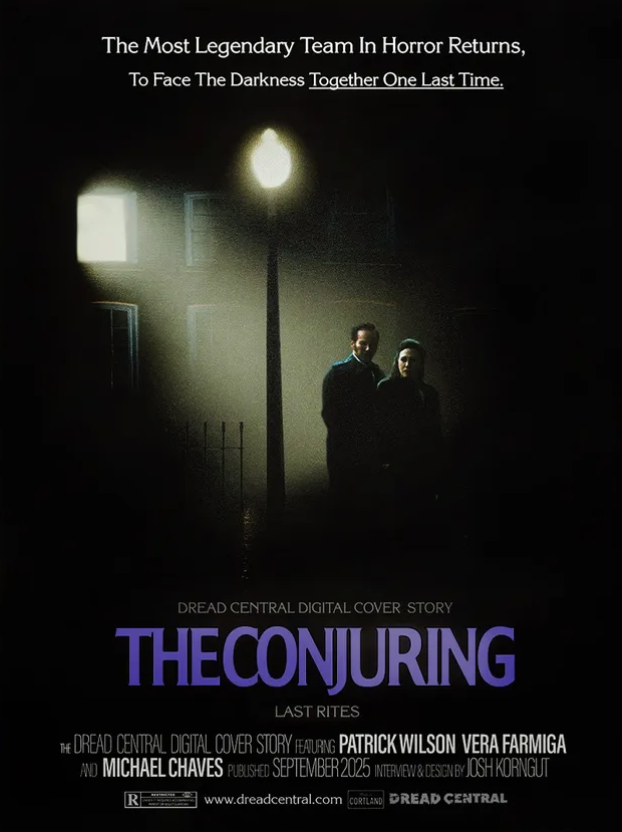
THE CONJURING: LAST RITES horror film review

The screenplay should be exercised of the demons plaguing the narrative. While The Conjuring: Last Rites offers initial intrigue and a moderately compelling performative dimension, what substance the story had was undercut by a proliferation of monstrous encounters.

In 1986, paranormal investigators Ed and Lorraine Warren travel to Pennsylvania to vanquish a demon from a family’s home. This case would prove to be their last.

At its outset, the film suggests a promising return to the roots of this dozen-year-old horror franchise that began in 2013, hinting at a chilling and intimate confrontation with the supernatural. The mood is suitably dark, and the premise—while familiar—has just enough mystery to draw the viewer in for what would appear to be tapping into its desire to be in the same vein as The Exorcist. For a time, it even teases the prospect of a measured, atmospheric entry into the Warrens’ saga. Unfortunately, the promise of the first act quickly gives way to a chaotic barrage of hollow frights and set-piece monsters that smother any narrative tension the film might have cultivated.

The greatest asset in the film is, without question, the lead casting of (returning) Patrick Wilson and Vera Farmiga and the addition of Mia Tomlinson as daughter Judy Warren and Ben Hardy as her fiancé Tony. Farmiga and Wilson remain the heart of the franchise–they are the soul reason this franchise continued for as long as it did. Their impeccable chemistry continues to play a vital role in lending credibility and weight to this story and the others in the franchise that would otherwise struggles to stay grounded. Combining Farmiga and Wilson with Tomlinson and Hardy, their collective performances carry an emotional authenticity that suggests a deeper, more resonant film lurking beneath the surface–too bad it was largely kept beneath the surface of the picture. Additionally, the supporting players, too, offer moderately compelling turns, doing what they can with material that rarely allows for nuance.

Where Last Rites falters most egregiously is in its writing—particularly in the second and third acts. What begins with threads of intrigue quickly unravels into a tangle of formulaic plot beats, ill-defined stakes, and a near-total abandonment of narrative discipline. The dialogue oscillates between expositional over-explaining and perfunctory banter, never achieving the kind of earnestness that made earlier entries memorable. By the climax, the story feels more like a theme park attraction than a descent into the occult. (Speaking of which, The Conjuring-verse would make for a fantastic Halloween Horror Nights House if an agreement between New Line Cinema and Universal Parks and Resorts could ever be reached).

Equally troubling is the film’s shallow and often misguided treatment of spiritual warfare. While The Conjuring-verse has historically dabbled in theological and metaphysical ideas, this installment offers only a cursory exploration—at times bordering on ignorance. Themes of faith, redemption, and evil are reduced to ornamental set dressing rather than being woven meaningfully into the narrative. Fundamental tenets of spiritual warfare are neglected: Scripture teaches that “demons tremble at His name” and that they cannot force a person, calling on the Lord, to take their own life or that of another—tempt, yes; coerce, no. This misunderstanding undercuts the stakes, turning spiritual conflict into spectacle rather than a profound struggle. Even William Friedkin’s The Exorcist handled these dimensions with reverence and gravity, whereas here they are clumsily exploited for empty shocks.

From a film craft perspective, the overreliance on CGI monsters is perhaps the final nail in the coffin for this horror franchise and universe. Where practical effects could have imbued the film with texture, tangibility, and dread, we are instead subjected to a parade of vapid, weightless apparitions. Without giving way to spoilers too much, there is a scene in which Lorraine is staring in to a sink that overflows with blood–CGI blood. If Kubrick could pull off the bloody elevator scene in The Shining then this movie could have used practical effects for this scene. I am not suggesting that practical effects alone would have “saved” the soul of this movies, but an increase in the degree to which practical and mechanical effects were integrated into the narrative certainly would’ve helped the movie feel more tangible. The jump scares—frequent and rarely earned—feel like mechanical interruptions rather than organic outgrowths of fear. It is horror by checklist, and it shows. By the time we arrive at the third act, nearly every scene or sequence has a series of jump scares that are predictable at best and lazy at worst. More character-driven moments and dramatic conflict would’ve been a great tool for emotional resets and plot/character development.

In the end, The Conjuring: Last Rites is neither the triumphant sendoff nor the atmospheric chiller it aspires to be. It is a film at war with its own instincts: part haunted house, part monster mash, and ultimately, part missed opportunity. All that said, it’s not a bad movie–it’s better than many of the other installments. But a franchise that needed to end with an Annabelle: Creation would up ending with an Annabelle.

Ryan is the general manager for 90.7 WKGC Public Media in Panama City and host of the public radio show ReelTalk “where you can join the cinematic conversations frame by frame each week.” Additionally, he is the author of the upcoming film studies book titled Monsters, Madness, and Mayhem: Why People Love Horror. After teaching film studies for over eight years at the University of Tampa, he transitioned from the classroom to public media. He is a member of the Critics Association of Central Florida and Indie Film Critics of America. If you like this article, check out the others and FOLLOW this blog! Follow him on Twitter: RLTerry1 and LetterBoxd: RLTerry
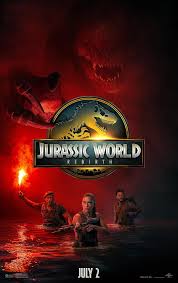
JURASSIC WORLD: REBIRTH movie review

Possesses dino DNA, but missing strands and sequences, leaving an uneven and forgettable movie. Jurassic World: Rebirth begins with an intriguing enough premise, but the characters are poorly written, which is then amplified by way of a subplot that only serves to clutter the story. After a rough first two acts–except for a thrilling and fantastically written T-Rex chase scene (that was part of Crichton’s original novel and script for Jurassic Park)–the third act is surprisingly exciting and suspenseful, and at times terrifying.

Zora Bennett (Scarlet Johansson) leads a team of skilled operatives to the most dangerous place on Earth, an island research facility for Jurassic World. Their mission is to secure genetic material from dinosaurs whose DNA can provide life-saving benefits to mankind. As the top-secret expedition becomes more and more risky, they soon make a sinister, shocking discovery that’s been hidden from the world for decades.

Perhaps Koepp’s screenwriting works best when the original version of a script is written by the novel’s author (which, I know wasn’t possible for this movie in more ways than one), and he then crafts the original version to be more effective for the screen. To put it simply, no one knows what is going on or when/where they are. Harsh? Not really, when the movie opens with lazy exposition through on screen text describing an event that happened 17 years ago…keep that in mind, 17 years (placing it in line with Jurassic World not Jurassic Park). But then the characters talk about the research and development facility as if it was connected to the original park–not possible. Even popcorn movies should adhere to the logic of their own world building. It’s as if no one thought about the events that unfold in this movie, and how they relate to the previous movies. Kind of basic storytelling logic.

There are many elements of this movie that fail to make any logical sense (and again, that is the logic setup by the movie itself) or are setup, and never developed or connected to any motivation or stakes. To go into them, would take too much time.

Aside from logic problems, the movie is plagued by poorly written characters, an extraneous, shoehorned subplot, and weak first and second acts (with one exception in the second act that was thrilling). While I appreciate the minimalistic cast of characters compared to the cast of characters in all the Jurassic World movies, there are two competing groups that are pretty much independent of one another and could have each been in their own movie altogether. Yet, somehow, they are sloppily fused together in this movie. For argument’s sake, we’ll call them the Mercenaries and the Family. The Mercenaries and their outside/action plot are fine–I’d even go so far as to say ‘that’ story is sufficiently interesting. The Family and their plot felt extraneous and ultimately of little importance to anything that happened. It’s as if there were two different movie ideas (1) centered on the Harvesters and (2) the Family. And I think either by itself would have made for a better movie than putting them together. These decisions left the movie feeling muddled and crowded.

There is a T-Rex sequence in the second act that is fantastic! It very much harkens back to the sci-fi horror-adjacency of the original movie. Of course it helps that Crichton’s original Jurassic Park novel and screenplay thereof contained a similar sequence. Fun fact: this sequence in the novel and original Crichton screenplay served as the inspiration for Jurassic Park: The Ride at Universal Studios parks. It plays out wonderfully in this movie, like a short film in and of itself, because it’s setup well, developed strategically, and resolved thrillingly.

Even though there are a couple of characters that are almost fun or compelling to watch (almost), the rest are more disposable than a red solo cup at a frat party. You’ll find yourself rooting for the dinosaurs to win. Of all the characters, there is one particularly so annoying and deplorably behaved, that you’ll want the first dinosaur you see to pick him off, (and question why on earth his girlfriend would be with him and why the dad would let the boyfriend walk all over him–answer, bad writing). Other characters are one-dimensional or the casting choice never sells the character. All around, there are many character and casting problems, resulting in a movie wherein you’ll hope the next dino attack happens soon–and preferably ends with one less character.

Where the movie “finds a way” to leave you on a high note, is in the third act. Despite the slapdash screenwriting throughout the first and second acts, the third act is wildly entertaining and even at times, terrifying! It almost compensates for the first hour and forty-five minutes. The (weird) dinos are “monsters” again, and the various chase sequences each offer something different (even though one is a recreation of the Kitchen Scene from the original movie). The stakes are raised and the level of terror leaps off the screen. So often, movies start well and fail to stick the landing; with this one, it fails to stick the launch but definitely sticks the landing.

SUffice it to say, if you took the first two acts from The Lost World: Jurassic Park, and paired them with the third act from Jurassic World: Rebirth, then you’d actually have a pretty good, memorable movie.

As an OG Jurassic Park fan (and Lost World apologist, except for the third act), I hate having to write reviews such as this one for a franchise installment. But, the more I thought about this movie, the more stupid it became. I suppose it’ll make for a fun enough 4th of July weekend watch, but doesn’t do much beyond that.

Perhaps, these movies will “find a way” back to greatness one day–doubtful as it seems.

Ryan is the general manager for 90.7 WKGC Public Media in Panama City and host of the public radio show ReelTalk “where you can join the cinematic conversations frame by frame each week.” Additionally, he is the author of the upcoming film studies book titled Monsters, Madness, and Mayhem: Why People Love Horror. After teaching film studies for over eight years at the University of Tampa, he transitioned from the classroom to public media. He is a member of the Critics Association of Central Florida and Indie Film Critics of America. If you like this article, check out the others and FOLLOW this blog! Follow him on Twitter: RLTerry1 and LetterBoxd: RLTerry
DANGEROUS ANIMALS (2025) horror movie mini review

Sufficiently fun. Dangerous Animals is the kind of horror movie that is sufficiently fun and entertaining once, but not a movie that commands a rewatch. The premise is fantastic: a serial killer that kidnaps young tourists (usually young women) and feeds them to sharks as he uses a old VHS camcorder to capture the victim’s demise. Dangerous Animals takes inspiration from other movies such as Shark Night (2011), Cabin by the Lake. and even The Silence of the Lambs. Between truncated first and third acts, is a protracted second act that foils any suspense, tension, or proper pacing setup in the first act. Performatively, the film is quite good; had it not been for the compelling and entertaining performances, the movie would’ve fallen quite flat for me. Like with many indie films, the cinematography and editing outclass the screenwriting. The evidence of thoughtful directing is there, but its potential is hampered by the poorly paced and structured screenplay. This feels like a short film idea that was augmented to fit a feature length runtime. Without giving it away, there is a particular scene about a third of the way through the movie that is straight-up an homage to an iconic scene from Silence of the Lambs, which I really appreciated. Releasing on the 6th of June, if you enjoy shark and/or horror movies, then its worth checking out. But like I said, for me, as sufficiently entertaining as it was, it isn’t one that I am going to rewatch anytime soon.

Ryan is the general manager for 90.7 WKGC Public Media in Panama City and host of the public radio show ReelTalk about all things cinema. Additionally, he is the author of the upcoming film studies book titled Monsters, Madness, and Mayhem: Why People Love Horror. After teaching film studies for over eight years at the University of Tampa, he transitioned from the classroom to public media. He is a member of the Critics Association of Central Florida and Indie Film Critics of America. If you like this article, check out the others and FOLLOW this blog! Follow him on Twitter: RLTerry1 and LetterBoxd: RLTerry
THE WILD ROBOT movie review

Wildly heartfelt and uplifting! Universal and DreamWorks Animation’s The Wild Robot is among the best films of the year, period. Director Chris Sanders delivers a truly compelling and smartly written fish-out-of-water story about found family and being more than the sum of our parts–or programming. Easily on track to make my Top 10 Films of the Year list. Based on the book by the same name, DreamWorks Animation hits a homerun with this outstanding animated motion picture that will challenge you, thrill you, and tug at your heartstrings.

Shipwrecked on a deserted island, a robot named Roz must learn to adapt to its new surroundings. Building relationships with the native animals, Roz soon develops a parental bond with an orphaned gosling.

I’ll admit it up front, I cried. It really is such a beautiful animated motion picture that likely rocketed its way into my best films of the year list. Not since The Iron Giant have we had an animated motion picture with such gravitas. While I still feel that 2016’s Kubo and the Two Strings remains the best animated motion picture in the last ten years, I must say that The Wild Robot is solidly my No.2 pick. The strength of this picture is in the compelling story, relatable characters, and efficient plotting (sometimes a little too efficient). My only real negative criticism of the film is the pacing in the first act; while refreshingly lean, some scenes and sequences needed a little more room to develop and breathe. Even though The Wild Robot shares little in common with The Iron Giant‘s plot, it shares Iron Giant‘s heart and soul.

Fish-out-of-water premises have been a staple of cinema for nearly as long as films have been around. So the real challenge for writers and directors is to find original ways of expressing these foundational ideas. And what is precisely what we have in this film. There are actually three fish-out-of-water narratives within the film, and the film is better for them because each of these layers adds personal and interpersonal complexities to character relationships with the world in which they finds themselves and amongst each other. The films provides thoughtful commentary on what it is like to both be in a world that is unfamiliar and have unfamiliar tasks thrust upon oneself.

Furthermore, this film depicts the importance of adapting to one’s environment and overcoming obstacles, even those that are innate. I also appreciate what the film has to say about self-determination and taking personal responsibility for one’s circumstances and one’s mistakes. Fish-out-of-water stories are some of the most relatable, because we have all been placed in an unfamiliar environment, and know how that can feel. It’s a terrifying prospect to be dropped into a world that is alien to us, and the film does not shy away from the challenges, joys, and even the tragedies that can befall us.

Another narrative area of strength in the film is challenging us not to quickly pass judgment on that fish-out-of-water when they find themselves in your world. Or to presume that one’s past behavior is always an indication of how that person (or animal, as it were) will always behave. Yes, past behavior can indicate predisposition to moral and ethical aberrations, but that does not mean that redemption is not to be considered a possibility. I love how the film paints a portrait that we can change, if we have the will and support to do so. It rarely comes naturally, we have to work at it. We have to work at overcoming natural behaviors that may not be constructive and ultimately selfish. We are more than the sum of our parts–or our programming.

To a lesser extent, there is come social commentary on the relationships between the work place and the employee and even cultures that decry the individual in exchange for group think. Without getting into spoilers, the film depicts imagery of how some, if not many, companies treat and feel about their employees. How a company does not view the employee as an individual; rather, as a means to an end, just another cog in the machine that will be disciplined for any individuality or unique expression. But not before the company assimilates the knowledge of that employee, particularly those that do think outside the box. Difference will not be tolerated. That is the feeling of many companies and even governmental systems. The film challenges these ideas by showing cooperation between diverse groups, even groups that are naturally enemies. Furthermore, the film demonstrates how differences can be overcome or even set to the side in order to serve, protect, and survive.

Lastly I’d be remiss not to touch on the global idea of the film, which is the concept of found family. Throughout the entire film there are images of the important role one’s found family fills in life. Found family is that family-like unit that may not be blood-related, but very much fill the same role as a more traditional family in one’s life. It’s a group of friends that have a relationship that goes beyond typical friendship, and includes family-like dynamics. Sometimes these are formed because someone feels rejected or neglected by their real family, and find family with a close group of friends. Other times, and I’d venture say most of the time, a found family can be formed out of the significant distance between you and your family of origin. So when in a new place because of school, work, or even military transfer, it’s important to form a strong bond with friends (or a friend’s family) to fill that important role even when separated from one’s family of origin. We are creatures that have an innate need for connection and companionship.

I cannot recommend The Wild Robot enough! Don’t miss seeing this incredible animated motion picture on the big screen.

Ryan teaches Film Studies and Screenwriting at the University of Tampa and is a member of the Critics Association of Central Florida and Indie Film Critics of America. If you like this article, check out the others and FOLLOW this blog! Interested in Ryan making a guest appearance on your podcast or contributing to your website? Send him a DM on Twitter. If you’re ever in Tampa or Orlando, feel free to catch a movie with him.

Follow him on Twitter: RLTerry1 and LetterBoxd: RLTerry