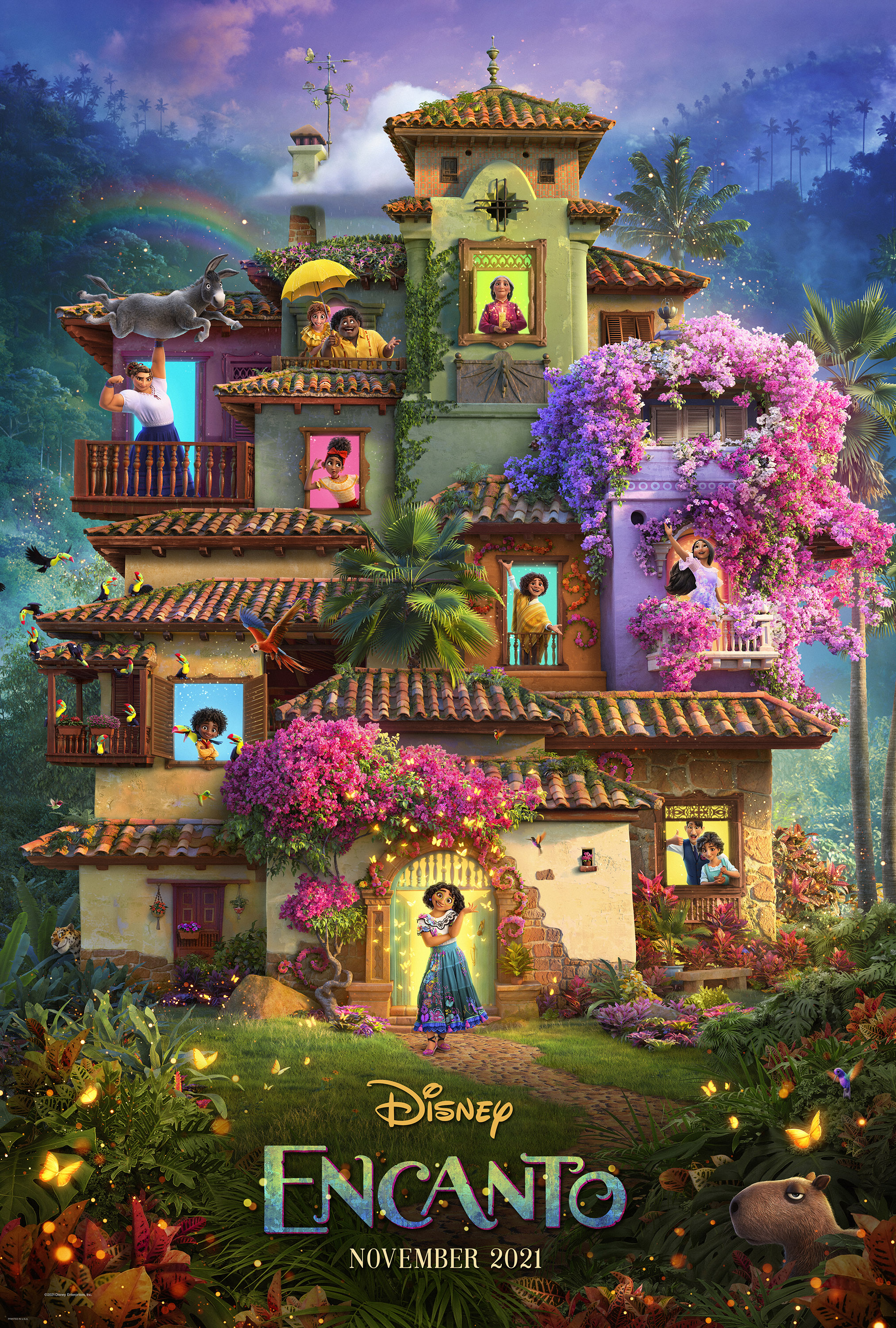
Formulaic and predictable. For all its magic, cheerful colors, and spicy music,ENCANTO is a bland animated motion picture that is ironically devoid of Disney magic. While the characters and performative dimension of the mise-en-scene are paint-by-numbers in the Disneysphere, the biggest star of this film is the gorgeous set and production design! On a more philosophical level, Encanto can be read as a post-modern deconstruction of a meritocratic society in exchange for an ideological utopia built upon the foundation of socialism. Accompanied by musical numbers that do little more than service the plot, Encanto reminds me of an animated motion picture better suited for Disney+ than a theatrical run. Even with songs by Lin-Manuel Miranda, the (billed as) 60th Walt Disney Animation picture fells more like it’s the product of an assembly line operated by a committee of non-player-characters rather than the imaginative culmination of writers whom care. Ironically, it ostensibly becomes the very societal expectations and perfection, which its pedantic and overt message is preaching against. There is little to no gravitas to the conflict, there is lacking a true character of opposition, and the central character is nearly unrelatable because she achieves everything she wants without any measurable loss. Without meaningful conflict, there is no drama.
The Madrigals are an extraordinary family who live hidden in the mountains of Colombia in a charmed place called the Encanto. The magic of the Encanto has blessed every child in the family with a unique gift — every child except Mirabel. However, she soon may be the Madrigals last hope when she discovers that the magic surrounding the Encanto is now in danger.
The central character in Encanto is Mirabel, and in her magical family, she is the only one without a gift. Mirabel’s grandmother Abuela is the formidable matriarch and leader of her influential family in the secluded town of Encanto, where she lives with her family in the magical Madrigal compound named La Casita. La Casita is a house with a mind of its own, right out of the silent French cinema classic The Electric Hotel (1908). After Abuela lost her husband during a pillaging and burning by (what is most likely) colonial soldiers, her great sadness and loss manifested itself into a magical candle that created Encanto and the mountains that shield it from the outside world. And while Mirabel doesn’t have any special gifts, the rest of her siblings and cousins do. And Abuela is immensely proud of each and eery one of her kids, while she tolerates Mirabel. Mirabel’s mother can heal people with her cooking (but why doesn’t she heal Mirabel’s visual acuity???), while her father can (hmm…guess he doesn’t have an ability either, but he’s obviously well-adjusted). Isabella and Louisa, Mirabel’s sisters, have the powers of flower conjuration and super strength respectively. Her aunt is a regular Storm (X-Men) because she can control the weather. One of her (poorly written and under-developed) cousins has super hearing, and another cousin can shape-shift because he is still discovering his identity (eye roll). Family Madrigal is made up of a bunch of self-congratulatory manic overachievers whose supernatural superiority is a neurotic group symptom of general unhappiness.
After a crisis besets the family and they lose their powers, it’s up to Mirabel to save the family, which equates to saving Encanto. Mirabel’s quest is to learn the secret of a long-lost cousin’s vision that placed Mirabel in the middle of the prophesied crisis. Skipping to the predictable end, the only way that the crisis can be solved is by completely destroying La Casita and rebuilding with a new foundation, which is philosophically, a manifestation of Encanto and Madrigal traditions, values, and beliefs. And instead of a foundation build upon individual contributions, Family Madrigal is now a community build upon the foundation of familial socialism, in which there are no individuals, just the group. Essentially, the entire structure of La Casita and Family madrigal had to be completely destroyed and rebuilt to accommodate Mirabel’s lack of a gift. Wonder if she even though to learn a new skill? Develop a talent? Which she has, she sings and dances beautifully. Perhaps Mirabel saw her world as unfair, but with a little critical thinking, perhaps she could’ve developed a method that didn’t require the dismantling of her entire world to rebuild it according to her standards. If everyone is the same with no regard for knowledge, skills, or abilities, then where is the incentive to learn, develop, and improve one’s self and society??? In the end, it’s the post-modern theory that favors the loss of the individual in exchange for a group identity that ultimately wins in the town of Encanto.
Flavorless and unsatisfying as this animated movie is, it did manage to execute some things well. Like the production and set design, for examples. The writing may be bland, but the design is spicy! You will be delighted at the bright colors, geometric shapes, and at times fever dream sequences. None of the songs are particularly memorable (hmm, kind of like this movie), but they are fun while they are on screen and the music will undoubtedly put you in the mood to grab a bite to eat at your local Colombian restaurant. Since this is the first Disney animated movie to take place in Columbia, I would’ve appreciated learning more about Colombian culture. Philosophically, this movie is incredibly problematic. But it is colorful and fun for an hour and a half, so you can best enjoy it as background noise while your focus is elsewhere.
Ryan teaches American and World Cinema at the University of Tampa. If you like this article, check out the others and FOLLOW this blog! Interested in Ryan making a guest appearance on your podcast or contributing to your website? Send him a DM on Twitter or email him at RLTerry1@gmail.com! If you’re ever in Tampa or Orlando, feel free to catch a movie with him.
An ambitious departure from the previous paint-by-numbers MCU films, but while it will attempt to distract you with impressive visuals (other than the Deviants), it’s a soulless film with a convoluted plot full of neo-liberal woke-pandering. Chloe Zhao’s The ETERNALS is the result of a writer/director concerning themselves far more with satisfying the rubric of check-boxes associated with toxic woke culture than telling a thoughtful or entertaining story. This is MARVEL Studios’ movie to demonstrate, through superficial virtue signaling, that they are onboard the Woke Express. Perhaps the idea of this movie sounded innovative in the echo-chamber meetings, but the execution leaves much to be desired. Diegetically, the prolific world building, MCU connectivity, and character development this movie needed to do, even the more than 2.5hr runtime isn’t sufficient, and ultimately feels like a DCEU-style rush job. Between the chaotic plotting, bad CG (those Deviants look like something right off the SyFy Channel), cosplay uniforms, dialogue lacking in any subtext, and the gross neglect for any nuance to the storytelling whatsoever, this movie is the product of an assortment of post-modern critical theories and not the imagination of a filmmaker. Clearly Zhao has an eye for cinematic composition, but her skills as a storyteller are not nearly as fine-tuned–certainly not for such a gargantuan superhero spectacle.
The Eternals, a race of immortal beings with superhuman powers who have secretly lived on Earth for thousands of years, reunite to battle the evil Deviants.
Dramatize don’t tell. This is the No.1 principle I teach in my film studies and screenwriting classes. And this important convention is broken at the very beginning of The Eternals. Very few movies have demonstrated that scrolling text in a prologue can pay off dramatically (i.e. Star Wars). It works in Star Wars because that is how the world was first introduced to the mammoth intellectual property, therefore, it becomes part of its branding (and is missed when it doesn’t happen). Moreover, there was no frame of reference prior to A New Hope; and since we were being plunged into the middle of the action, it was necessary to preface the story that was about to unfold. Audiences aren’t being introduced to the MCU–they’ve been in the MCU ostensibly since Paramount’s Iron Man. Therefore, this demonstrates a lazy approach to providing exposition that could have otherwise been integrated more thoughtfully into the main action story. Furthermore, this lack of dramatic exposition is problematic, not only at the beginning, but throughout the movie.
If there was a social media campaign or outcry about it in the last few years, you will find that box checked off in this movie. As I watched this movie (in IMAX, btw), I couldn’t help but envision a rubric, not unlike the kind many professors use for grading papers. Personally, I don’t use a rubric in my classes because satisfying requirements in that fashion does not tell me how you can apply what you learn in class to your topic; but rather, that you know the bare minimum you need to do in order to get the point(s). Think of it as a typical test. A typical test only demonstrates to the professor how much you can remember NOT how much you know or your level of wisdom (the application of knowledge). It’s as if Zhao held meetings with MARVEL Studios executives and staff to outline every woke box that needed to be checked in this progressive movie. I won’t go into all the examples because that would take up a paragraph in and of itself, but if there has been a push for representation, then you will find it here. And all those characters in one place means that most are not developed sufficiently and feel more like one-dimensional tokens than characters crafted by a writer who cares. That’s the problem here. Increased representation across the spectrum of humanity in cinema is very important, but not when it comes at the expense of the integrity of the characters themselves.
One of the hottest topics of discussion to come out of this movie is the inclusion of a PG-13 sex scene, which is long overdue in a cinematic universe such as this one, which is filled with HOT male and female characters in form-fitting uniforms. More than demonstrating to audiences that the MCU movies have grown up with their initial audience of teens and 20-somethings, this scene is important because it shows that these immortal beings have some humanity in them. Superheroes and supervillains are often not thought of as human, and even though we learn that these immortal beings aren’t exactly human, they do take on many characteristics of humans, and this scene is a refreshing reminder that superheroes have erotic passions just like the rest of us. There is a vulnerability about them.
Because of all the piping that is being laid in this movie (enough for at least two or three movies), the story feels incredibly rushed. It reminded of how the DCEU tried to complete with MARVEL, years after MARVEL had been in the MCU. The result was hurried world building. It took MARVEL years to build the MCU, but the DCEU tried to accomplish the same in a year or two. We have five stories here (1) its creation myth and early Mesopotamia (2) the time in Babylonian Empire (3) the time in the Aztec Empire (4) the Greco-Roman Empire, and (5) the present-day story. Each of these is incredibly important to the main action plot of The Eternals, and yet these otherwise rich settings are reduced to flashback fodder. There are easily three thoughtful movies that could have come out of the five aforementioned stories. The result is a single plot that cannot possibly accomplish everything that it needs to in order to effectively tell the story and do it justice. I’m still not entirely sure why the Deviants were attacking the Eternals; oh it was sort of explained, but like with much of the rest of the film, it wasn’t thoughtfully developed either.
If you are familiar with Middle Eastern or Greek mythology, you will enjoy the integration of some of the mythological stories with which you are likely familiar. From the Epic of Gilgamesh to Ikaros to Athena, you will learn that it’s the Eternals that inspired these stories. While we may never know precisely what inspired these stories in real life, they were likely inspired by real individuals, much like legends and lore are to this day. So, knowing that these powerful, immortal beings have been secretly living on earth makes since, and can be appreciated both through a historic lens and through the backstory of the main action plot of the movie.
There are two end-credit scenes, each setting up a new characters. I won’t spoil it (but don’t look at the IMDb either). One scene in at the beginning of the credits and the other is a post-credit scene.
Ryan teaches American and World Cinema at the University of Tampa. If you like this article, check out the others and FOLLOW this blog! Interested in Ryan making a guest appearance on your podcast or contributing to your website? Send him a DM on Twitter or email him at RLTerry1@gmail.com! If you’re ever in Tampa or Orlando, feel free to catch a movie with him.
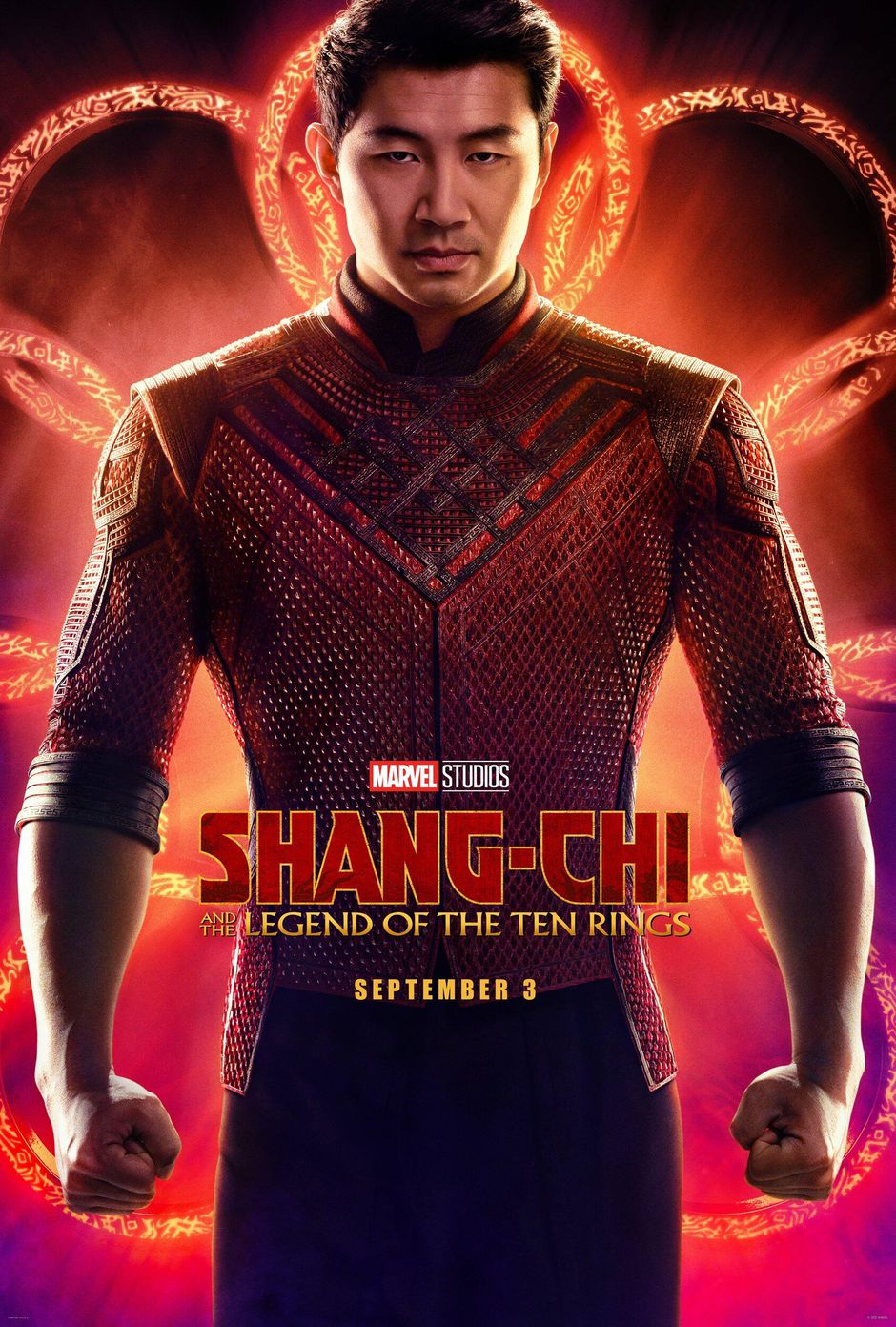
An action-packed reimagination of the classic kung-fu movie that is equally enjoyable as a stand-alone movie or MCU world-building installment that is best experienced on the BIG SCREEN. It’s no secret that I can take or leave the MCU, same with the DCEU. I’ll be up front and say that I like a select few superhero movies (Batman Returns, 89,Wonder Woman, all the X-Men movies), Batman Returns being my favorite (and I still argue the best comic book movie ever); however, all that said, I thoroughly enjoyed Shang-Chi! From beginning to end, it’s filled with explosive action and properly seasoned with moments of hilarity. Whether you are watching it because you are a Pavlovian MCU fan boy or girl that simply salivates over anything Marvel (or Disney) or you are seeking to be entertained in a cinematic escape for a couple of hours, then this film fits the bill.
Even though there are some cliche extreme wide landscape shots at the beginning that are working hard to convince you that the best place for the movie is on the BIG SCREEN, that’s not why you want to experience it in that ideal environment. You want to experience it on the BIG SCREEN because of the big action moments, mind-blowing fight choreography, intimate character-development scenes, and laughter and cheers from the audience!
Shang-Chi: and the Legend of the Ten Rings boasts a great cast that includes a key supporting role played by the indelible Michelle Yeoh. Our lead Shaun/Shang-Chi is played by the handsome Simu-Liu and his best friend played by the popular Awkwafina. These actors are supported by a well-written screenplay that not only delivers plenty of adrenaline-pumping sequences, one-liners and zingers (mainly from Awkwafina), but never loses focus on the external goal and internal needs. Simple plots with complex characters make some of the best movies!
While there are times that the mystical elements of the movie do seem a bit over-the-top, even for a superhero movie, the superpowers (be they derived from nature or from a weapon), don’t cross the threshold between suspension of disbelief and utter ridiculousness. The movie lays out the rules of its worlds in the first act, so you are willing to accept whatever is thrown at you. Writing tip: you can get away with nearly anything if you properly set it up. We learn everything we need to follow the story at the beginning of the movie.
If you’re seeking to be entertained by a solid high-concept movie, then you don’t want to miss seeing Shang-Chi and the Legend of the Ten Rings on the BIG SCREEN. Seriously, you can go into it the movie, not being that familiar with the preceding MCU movies, and still be able to thoroughly enjoy your time. If you are an MCU geek and love all the nods, Easter eggs, and world-building details, then you will also be happily satisfied. I hope this movie is an indication of the types of movies we are to witness in the next stage(s) of the MCU.
Ryan teaches American and World Cinema at the University of Tampa. If you like this article, check out the others and FOLLOW this blog! Interested in Ryan making a guest appearance on your podcast or contributing to your website? Send him a DM on Twitter or email him at RLTerry1@gmail.com! If you’re ever in Tampa or Orlando, feel free to catch a movie with or meet him in the theme parks!
While the official announcement was unaccompanied with fanfare, the overturning of the landmark ruling in “U.S. v Paramount Pictures, Inc., et al” (1948) on Friday, August 7, 2020 marks a turning point in the business of modern cinema. Also known as The Paramount Decision and The Hollywood Antitrust Case, this ruling marked the end of Hollywood’s Golden Age and the decline of the Studio System that upheld it. What exactly does this mean for the business moving forward? Short answer: nobody knows, and anyone claiming to know what IS going to happen is incredibly presumptuous. However, by looking at the history of the 1948 ruling and the current events surrounding the August 7th ruling, we can explore this watershed moment in the film business, both past and present. Furthermore, we can extrapolate from past precedent what may happen or even could happen today. One thing is certain, we are in rapidly ranging and even uncertain times due to the direct and indirect impacts of the response to COVID-19. Although the federal court began reevaluating this case in late 2019, it is undeniable that the impact of the response to the effects of the virus may have played a latent role in the final decision. From a massive increase in streaming content options to premium paid video-on-demand (PVOD) to continued (at the time of this writing) delays in returning “big ticket” first-run movies to theatrical exhibition, there are many factors at play here. Not to mention questions such as “if I am an indie filmmaker, will I be able to get my movies in theatrical chains,” “does this mean that Amazon or Apple will buy up struggling chains like AMC,” or “if I am a screenwriter, will I still be able to submit my screenplays to studios if they are completely vertically integrated?” Perhaps this exploration of the past, present, and future of the film business in light of the overturn of the Paramount Decision won’t be able to provide definitive answers, but it will provide historical, empirical, and observational evidences to suggest what may or could happen moving forward.
In short, the Paramount Decision (1948) was a landmark case in which the US Government forced the eight major/minor studio players to end the practice of block booking, divest themselves of their respective theatre chains (sell them off), and modify the practice of long-term employee contracts (although, this practice would continue until the 1960s). This marked the beginning of the end of the Studio System, AKA Hollywood’s decentralization. But before we can even begin to understand the significance of the August 7, 2020 decision that overturned the landmark ruling, we have to jump in the wayback machine and head to Hollywood’s Golden Age (recently seen on Ryan Murphy’s Hollywood, a 2020 limited-run series on Netflix).
What was the studio system anyway? It was the arrangement of film production and distribution dominated by a small number of studios in Hollywood. Historically, the term refers to the practice of large motion picture studios, between the 1920s-60s, of producing movies primarily on their own backlots with creative personnel often under long-term contracts, and which dominated exhibition through the vertical integration of company-owned movie theatres. Block booking was also a common practice at this time. This process forced theatres to accept a block of movies from a studio. If an independent theatre wanted to show Movie A, then the studio would require the theatre to also accept and show Movies B, C, D, and E too.
Years before the U.S. Supreme Court ruled against the once powerful Paramount Pictures, the biggest studio in Hollywood at the time, there were constant legal and ethical issues plaguing the storied studio system that produced some of the most foundational films in cinema history. Back during the height of the studio system, there were eight principle players: the Big Five and the Little Three. The Big Five was comprised of: Paramount, MGM, Warner Bros., 20th Century Fox, and RKO; the Little Three included Universal, Columbia, and United Artists. You may (1) recognize some of those names today and (2) notice that there is a famous studio conspicuously missing. The latter is due to Walt Disney Studios being in its infancy during this time. Ironically, it would become nearly completely vertically integrated in the 20th and 21st centuries, minus owning a chain of movie theatres. In a manner of speaking the Walt Disney Company operates in a very similar fashion to that of its older brothers and sisters.
When I took a tour of Paramount Pictures back in 2015, I asked how many full-time staff worked on the lot. And the tour guide responded with 30-40 people. That’s right, only 30-40 people at the time. While that number may have fluctuated in the last five years, it leads me into one of the practices that came to a close when the Studio System fell. Prior to the Paramount Decision and the development of professional unions, studios held movie stars, directors, writers, and others to longterm contracts (with few, if any, options). Contracts were so tightly managed, that studios would loan stars to other studios, for example Paramount may choose to loan out Mae West to M-G-M in exchange for Judy Garland. The on screen talent wasn’t the only area treated as a commodity, virtually every role in front or or behind the camera was under contract to a studio, including directors and writers.
While this looks like an infringement upon civil liberties through our 2020 eyes, and there are many reasons it should, there was something positive regarding employment during the Studio System: job security. When you worked for the studio, you worked for the studio and made all its pictures. Meaning, you knew you had regular employment until your contract was satisfied, you quit, or were fired. Employees didn’t have to worry about when and where the next gig was; employees went to work, Monday through Friday if you will, just like other working professionals. Furthermore, this centralized human resources system also made it possible to apply for vacant positions as a director, writer, craftsman, or any other position. There were also a great number of formal apprenticeships for those who were trying to break into the system. Sounds great, right? Well, yes and no. Yes, for reasons of streamlining the hiring process and providing stable employment in the field; and no, because the studio (that also likely controlled movie theatres) would not produce or distribute your picture unless you worked for the studio. It was a closed corporate system, so independents were largely kept out of it. From submitting screenplays to theatrical distribution, aspiring filmmakers either had to join the corporate ranks of the studio system or exhibit their pictures in small independent movie houses, IF they could even get the film developed and edited.
Even before the 1948 decision, the studio system and studio-theatre relationships were under attack, but the studios were able to find loop-holes and political alliances in order to avoid the breakup of the vertical integration that was expensive to maintain but highly lucrative. As the movie studios regrouped for continued legal battles in the court system and Justice Department, media mogul Howard Hughes of storied RKO Pictures made the decision to sell off his movie theatres. When The Justice Department made it clear that there were to be no more deals between the government and the movie studios, Paramount sold its movies theaters in an attempt to buy into television. However, after the legacy studio’s continued involvement in all the antitrust cases leading to the final decision in 1948, the government did not permit Paramount to maintain any semblance of a monopoly in the frontier of television.The battle to keep the studio system was finally over. In the end, the Paramount case influenced the growth of television because, among other reasons, RKO and other studios sold their film libraries to television stations to offset the losses from the Paramount Decision. The studios also released actors from those longterm contracts, and many became television stars.
Although there are many side-effects and tangential reasons why the studio system (1) was lucrative and (2) hard to dismantle, there is one root reason from which everything else radiated: control. Everything gets back to control. Control of movie stars, control of writers and directors, control of the distribution and exhibition process. With all this control, the Studio System was able to craft its own narrative and success story. While the system was lucrative, it also racked up a lot of debt. Debt that came from borrowing from banks, exorbitant movie star salaries, and fighting legal battles. Even though the system had a lot of problems, it still gave us some of the best movies of all time, motion pictures that are larger than life, and those that typified the Golden Age of Hollywood. However, this system also protected its own when scrutiny or accusations arose, which is reprehensible. The Hollywood Studio System was truly its own self-contained world that outsiders were only let into through the movies and publicity.
The film business landscape looks much different than it was during and just after the Golden Age of Hollywood. But over time, we have seen a migration back towards the ol’ system of doing things. The most recent examples of borderline antitrust infringement are Disney’s acquisition of 20th Century Fox, AT&T’s acquisition of Warner Bros. Pictures, and Comcast’s acquisition of NBC-Universal. What makes the latter two particularly interesting cases is the simple fact that both AT&T and Comcast own and operate the literal hardware in the ground and air that brings you your connection to the internet. One could read this as a form of distribution. The Disney example is more or less one of reducing the ability to equitably compete for audience dollars and the ability to create jobs. You can read more on the Disney-Fox deal in my article Out-Foxed. While block booking and price-fixing are still illegal, the overturn of the Paramount Decision does create a greater pathway to acquiring movie theatres and the ability to be more greatly vertically integrated than was possible since 1948. Interestingly, movie studios have been legally able to buy movie theatres since 1948, but because of the scrutiny and bureaucratic red tape that would come with it, it was not a practice except in the case of Disney purchasing the historic El Capitan theatre and Netflix purchasing the iconic Grauman’s Egyptian Theatre (sister theatre to the world-famous Grauman’s Chinese Theatre). Disney uses the El Capitan for most of its own premieres, but the movie theatre also shows a variety of other programming. But with this overturning, Disney could choose to only show its movies in the El Capitan, likewise with Netflix and the Egyptian Theatre.
But, so what if Netflix and Disney want to exclusively exhibit their own films in their movie palaces? And you’re right, those two locations do not significantly make a difference in the grand scheme of things; but, what this represents is a microcosm of what could happen more nationally. And that’s why many of us are fascinated by this ruling; we are both anxious and eager to see what happens in this new frontier. Maybe nothing, maybe something. But film academics have a duty to analyze the situation to inform the public of the possible outcomes.
At the time of writing this article, Disney has made no claim regarding any real interest in purchasing the struggling AMC movie theatre chain nor Regal (owned by CineWorld). That said, there is more to explore that isn’t quite as in the face of the public as purchasing theatre chains. While control is the root cause for the machine that was the studio system, the reason the government went after the big studios was in-part because the studios made it nearly impossible for independent filmmakers to get their films into theatres or land distribution deals. If the studio did not produce your film, then it would not distribute it. The inequitable competition field led the US Government to bring about the landmark antitrust case. Lack of competition or lack of an opportunity to compete is what many independent producers, directors, and other creative and technical personnel fear most moving forward. It is highly unlikely that anything major is going to happen overnight; however, the studios now have the latitude, or horizontal if you will, to test the boundaries of their vertical integration and ability to strong-arm the marketplace. Suffice it to say, the studios will be “testing the fences for weaknesses, systematically…they remember” (Robert Muldoon, Jurassic Park).
While Disney may not be presently interested in purchasing a movie theatre chain (according to the August earnings call), the three companies to watch out for are: AT&T, Amazon, and Apple. The AAA threat. Interestingly, AT&T is no stranger to monopolies or even oligopolies (like a monopoly, but when a market is controlled by a few big companies instead of one). Without going into too much detail on the U.S. v American Telephone and Telegraph (AT&T) case, the antitrust case was brought against the telecom giant, owner and operator of Bell Systems. Bell Systems held a monopoly over American and Canadian phone systems, a monopoly that was held since the dawn of the telephone. The end result of the 1982 ruling brought about the breakup of the Bell Systems company into seven regional “Bell” markets. From this breakup we got seven telecom companies, each operating a particular geographic region. Interestingly, four out of the seven companies are now back under the control of AT&T. The remaining three former Bell markets are owned by Verizon and CenturyLink.
If we use the AT&T case study as a parallel model for understanding studios and the film business, we can posit ideas of what may happen in light of the recent overturn. The AT&T model bares many similarities to the Studio System model. We have a monopoly (or oligopoly) that was broken up by the US Government. Then there was a time of division; but slowly those once divested companies were bought up by the big company again, and in AT&T’s case, the original company. Full circle. What’s funny is that this parallel case study involves one of the likely players in this post-Paramount Decision world. By using the AT&T model, reason stands that a big company or two (maybe three) can and will buy up smaller companies to have a larger footprint, thus reducing competition. It happened the telephone world, it can happen in the film world. After being broken up, AT&T made many smart, seemingly benign moves in order to essentially become a phoenix that is greater than it was before its empire was broken up.
What does this mean for studios and movie theatres? It simply means that it is very likely that a major company with deep pockets will purchase movie theatre chains. Simple as that. We have seen this before in the AT&T case study. But it won’t be Disney, Universal, or even Netflix buying the theatres, it will be AT&T, Amazon, Apple, or and/or Sony. Inarguably, the first three are some of the largest, wealthiest, and most influential companies in the world, with the latter having an incredibly diversified portfolio that includes technology and more; what better way to showcase your audiovisual technology than in movie theatres??? Each of these companies has the assets necessary to acquire AMC, CineWorld (Regal), Cobb, and even Cinemark. Interestingly, AT&T, Amazon, Apple, and Sony all have investments in film and tv production. AT&T owns WarnerMedia et al., Amazon operates Amazon Studios, Apple creates original content for Apple TV+, and Sony operates Sony Entertainment et al. It is unlikely that the US Government would permit any of these companies to buy up more than one of the major movie theatre chains, but we could easily see each of the four major movie theatre players getting bought up by corporate conglomerates. While there isn’t evidence to suggest that these four corporate giants would force audiences to go to one of their theatres to see one of their movies, it is entirely possible that those corporate giants would offer additional programming (maybe certain movies primarily released on streaming services) at their company owned movie theatres. Between original and licensed/distributed content, these movie theates, tied to media conglomerates that have major studio investments, may pack the theatres with so many movies that independent filmmakers will have to see alternate means of securing distribution, be that through streaming services, independent movie theatres, or or smaller specialized chains like Studio Movie Grill and Alamo Draft House, both of which are known for catering to cinephiles, including horror fans.
In a manner of speaking, what we are looking at here is a post-modern Studio System. You’d once again have the BIG FIVE (AT&T, Apple, Amazon, Disney, and Comcast) and the LITTLE THREE (Sony, Viacom/Paramount, and Netflix). These eight companies would control the media landscape. And there will be just enough competition that it avoids any antitrust lawsuits (until it doesn’t; that’s how this goes, if you haven’t figured it out), until history repeats itself again. This new studio system will flourish for decades, but then something will happen and the government will step in and break up the companies again, most likely resulting in selling of movie theatre chains or even more sobering, movie theatres become a shadow of their former selves. It is unlikely that movie theatres will completely go away, but their purpose and role in show business may be relegated to little more than a novelty. These studios may reimagine the movie star star system, film/tv/production related unions could lose their power because of the increasing number of employees (not contractors) at movie studios, and/or there could even be more theme parks as a means to generate quick revenue to funnel back into the studio model, much like Disney and Universal Parks and Resorts do for their parent companies. Lots of job creation may happen, but these will lack in the creative latitude that many filmmakers crave.
For many independent filmmakers, the fear of the fallout from the overturn of the Paramount Decision is reduced opportunities to secure distribution deals. But it’s not only the production talent that is concerned. Writers could be greatly impacted; because, in a more heavily vertically integrated system, writers will have far fewer outlets for purchasing or licensure of their screenplays. Disney is a good example of this. Disney rarely purchases screenplays from screenwriters; their common practice is to use in-house screenwriters or commission a writer to pen a screenplay. So, if you are not IN the Disney studio system, then your chances of selling or optioning your screenplay are minimal. Since Disney owns 20th Century Fox, then this same practice carries over into that branch as well. That said, Searchlight Pictures is still a production and distribution company to which independent filmmakers and screenwriters can submit work for purchase, licensing, etc. While Disney is the easy example here, this same practice could be said of any major studio.
More vertical integration means larger companies in a world that is shrinking. This shrinking world could mean trouble for the aspiring filmmaker or screenwriter because of the lack of opportunities to make the transition from page to set to distribution. While this new world may make it more difficult for a screenwriter to sell a screenplay to a studio that is vertically integrated, the director will also face new challenges. Independent filmmakers will have to get their films bought or licensed by a major company in order to get the exposure needed to be able to develop a substantive career. Netflix has a history of being friendly to independent filmmakers (although it has more and more original programming), so an advantage to getting Netflix to buy or option your movie is that you may just be able to screen it at the Egyptian Theatre, which would greatly aid in qualifying for the Oscars or Golden Globes.
While independent filmmakers may face increasing odds against them for theatrical distribution, this post-modern Studio System could create thousands of jobs in the industry. But you will create what the studio wants you to create, which may not necessarily be the stories that you want to tell. And amidst this possible creation of jobs may be a world with far less opportunity for equitable competition for that golden statue and audience eyes.
Ryan teaches film studies and screenwriting at the University of Tampa. If you like this article, check out the others and FOLLOW this blog! Interested in Ryan making a guest appearance on your podcast or contributing to your website? Send him a DM on Twitter or email him at RLTerry1@gmail.com! If you’re ever in Tampa or Orlando, feel free to catch a movie with or meet him in the theme parks!
You are going to catch feels! Disney-Pixar’s Onward is a powerful animated motion picture that will take you on an exciting and emotionally charged journey. There is such a tremendous beauty in the simple storytelling that explores familial relationships through the conduit of a fantastical quest. Onward reminds me of a classic Spielberg-like coming-of-age action-adventure movie with heart. Interestingly, I am reminded of many DreamWorks movies, including How to Train Your Dragon, in the overall look of the movie. It’s almost as if Pixar saw what DreamWorks was doing right, and in a very Apple way, set out to do it better. Onward is what you get when you take the visual design and themes of DreamWorks movies and pair them with a quintessential Pixar story. Much like Coco provided us with a compelling story that would forever change how we view family tradition and history, this movie explores the relationship between brothers on their quest to bring their dad back from the dead for one day. In a day and age in which relationships between brothers or sons and fathers seem to be largely absent from themes in movies, this is a refreshing look at these relationships in a positive, healthy light. While this is an animated motion picture, it is every bit pure cinema as a live-action counterpart. The great Cecil B. DeMille stated, “the greatest art in the world is the art of storytelling,” and Onward is a great story for the whole family! You will encounter joy and warmth in the plot and characters as you set forward and press onward in your adventure along with Ian and Barley. Unlike a typical action-adventure movie, this one does take a little while to get up to speed. But once that second act kicks into gear, you will experience a thrilling good time that will have you laughing and crying in true Pixar fashion.
Two teenage elf brothers, Ian (Tom Holland) and Barley (Chris Pratt) Lightfoot, go on a journey to discover if there is still a little magic left out there, after receiving a mysterious gift from their mother on Ian’s birthday, in order to spend one last day with their father, who died when Barley was little and before Ian was born (IMDb).
Not your usual fantasy movie! While Onward starts out with a voiceover narration providing exposition against the backdrop of a fantastical world of elves, wizards, mythological creatures and more, the prologue lays out the historical piping to provide important context for the modern story that is about to unfold. We are told that the world was once full of magic, but over time, the industrial revolution and invention of technology took the place of magic. Eventually the world simply forgot about its very existence. I love this setup, because it’s a mirror of our own world in which technology has radically altered how we interact with the world around us and even each other. When we rewrite or forget the past, it has a profound impact upon our present and future. I appreciate how this film highlights the importance of not forgetting the past, not forgetting where we came from. Looking to the past, even recent past, can help to shift our focus from ourselves to others. Sometimes we can even find a whole new appreciation of the present by stepping back and realizing the indirect meaning behind actions that have impacted our growth and development. One can even read this as a commentary on art versus commercialization. For the sake of cost and simplicity, much that was once crafted is now churned out on an assembly line. We forget the importance of personal investment of time and energy into everyday elements. Perhaps we can even liken this to film versus digital. Many different ways of reading this analogy!
I often comment in my screenwriting class at the University of Tampa that some of the best movies out there have simple plots and complex characters. For a visualization of what that looks like, think of that little black dress or classic black suit that lives in many of our closets. Those simple outfits can be accessorized in so many different ways to make a lasting statement or impression. There is a beauty in the simplicity. Same with the story in Onward. At its core, this movie is about a quest to find the long lost Phoenix stone in order to bring Ian and Barley’s dad back to life for one day. But along the way, our two central characters encounter conflict after conflict that reveals to us the various layers of our characters. We learn so much about their history, goals, needs, and more in how they each uniquely respond to the same obstacles. Lasting conflict can often be achieved by giving two characters the same goal, but they each have vastly different methods for achieving the goal. This concept is played out over and over again throughout the movie, and it works incredibly well! I also appreciate this movie for just how funny it is! Honestly, this is probably one of Pixar’s funniest movies in a long time! All the action and emotional elements of the Onward are superbly satisfying and work completely in sync, just like all the section of a symphony playing in perfect harmony!
Each and every obstacle that creates conflict between our two brothers moves the story forward; never once do we reach a point in the plot in which we are spinning our figurative wheels. Representing a microcosm of a larger plot structure, each and every scene in a movie is made up of a setup, conflict, and resolution. And the resolution (be it negative or positive) points to the next scene, and the following scene does the very same. Every scene is a piece of the track that points to the end of the movie. With a tight script, Onward is consistently moving us forward to the showdown and realization of this movie. What makes the conflict we witness in the movie all the more relatable is just how common, everyday much of it is. We may be in a world of fantasy, but the problems experienced by the brothers are the same as the ones we experience in real life. Most of us with siblings don’t always get along–certainly in our growing up years, it can be that way–but this movie is a testament to the importance of connecting and appreciating our siblings for what they teach us and how they impact our lives even when we don’t realize it. For those whom may have lost a parent, often times, you can find your parent in the life of your sibling and vice versa. Loving parents leave a legacy in their children.
Visually, the movie is stunning! I love just how “not” Pixar it looks. Ever since Pixar started striving for quasi photorealism, I’ve not been as impressed with the animation. For example, I prefer the look of Toy Story 3 to Toy Story 4. The production design and animation in Onward reminds me of much of what DreamWorks has produced over the years in terms of themes and design. Perhaps DreamWorks will see Onward and think to themselves, “gee, they took a page from our playbook and did it better.” The plot is tighter, the comedy is better developed, and the characters more fleshed out. Essentially, this movie indirectly highlights what is missing in many DreamWorks movies, and that is stronger screenplays. Onward delivers an animation design that is rich with everything that you want to see in a world of fantasy! So many fantastical creatures that feel right at home within their world. And this world feels incredibly believable. In many ways, it looks just like our world in which the modern can be right up next to the ancient, where sometimes historical buildings are at risk for being torn down to make way for something new. Looking across the landscape, you will be delighted at the attention paid to effective world building and the little things that make such a difference.
Don’t think of this as Pixar’s throwaway movie, as some have, this is an outstanding animated motion picture that delivers an engaging adventure paired with an emotional roller coaster that will have you laughing and crying.
Ryan teaches screenwriting at the University of Tampa. If you like this article, check out the others and FOLLOW this blog! Interested in Ryan making a guest appearance on your podcast or contributing to your website? Send him a DM on Twitter or email him at RLTerry1@gmail.com! If you’re ever in the Tampa area, feel free to catch a movie with him!





 R.L. Terry ReelView