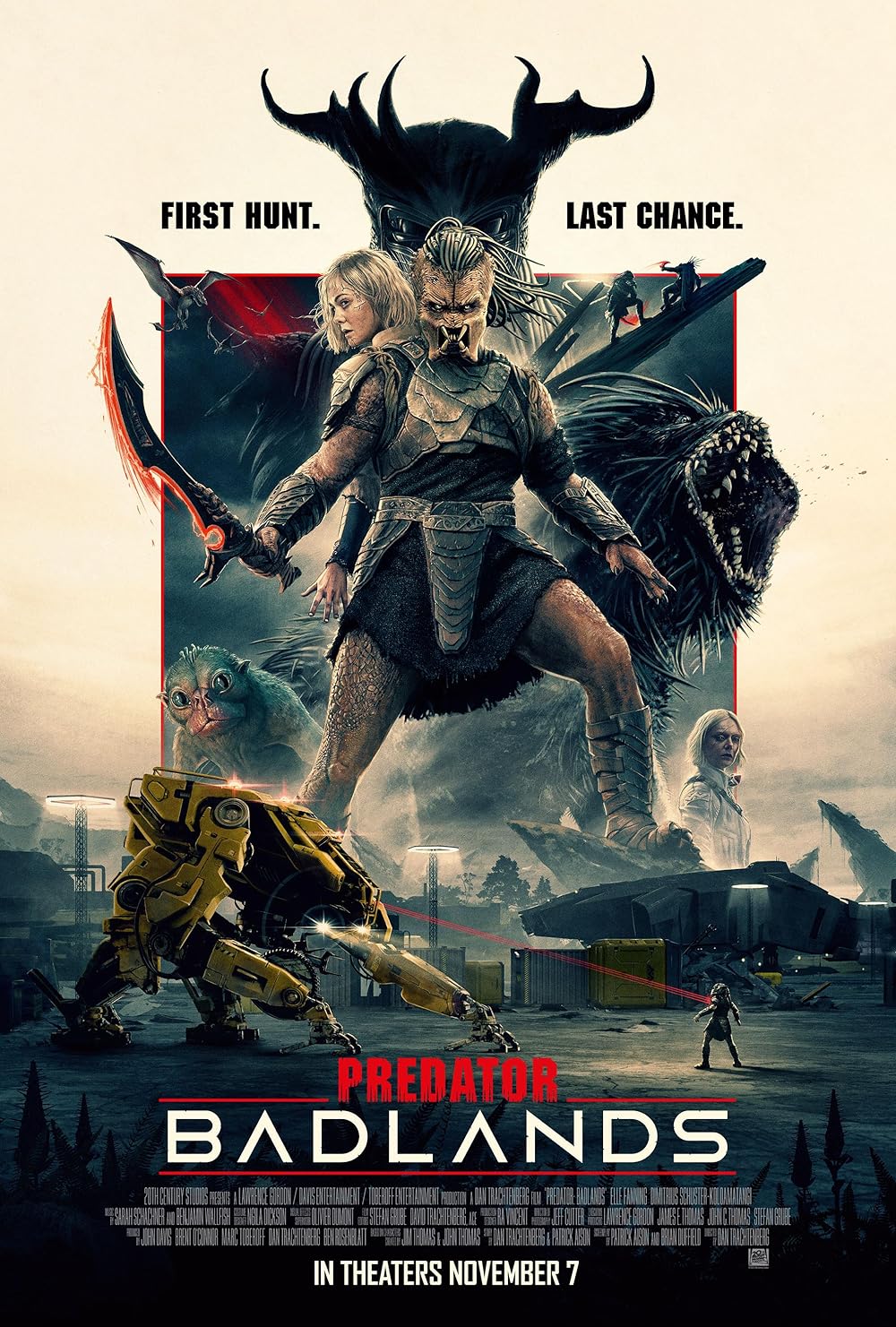
PREDATOR: BADLANDS movie review

Predator: Let’s Play. When streaming content hits the big screen.

Predator: Badlands is the equivalent of a “Let’s Play,” but with bigger explosions. The nonstop action, constant motion offer little to no substantive emotional investment. You’re an observer, not a participant—which might be fine for streaming, but it’s a strange fit for cinema. The latest in the Predator franchise plays like a two-hour sizzle reel with delusions of grandeur. It’s a glossy barrage of explosions, digital dust, and quippy one-liners that evaporate before they even hit the floor. By the time the credits roll–that’s if you haven’t fallen asleep—you’ve seen everything and felt nothing. It’s not that the film is aggressively bad—it’s that it’s aggressively empty–little more than content to pander to short attention spans with shiny movement instead of meaningful momentum.

Cast out from its clan, a Predator and an unlikely synthetic ally embark on a treacherous journey in search of the ultimate adversary.

The screenplay feels like it was written by an algorithm trained on reaction videos and Reddit threads. Every line of dialogue sounds like a placeholder; it’s as if someone said, “We’ll fix it later” or “funny line here,” and neglected to return to the page in order to fix it–before principle photography. There’s no sense of escalation, tension, or rhythm; it’s a series of flashy moments loosely stitched together, like a highlight reel of a game you didn’t play. Even the humor feels synthetic–much like the characters– punching at air instead of connecting with character or tone.

As for the characters, they exist mostly as camera targets. They are little more than digital avatars running, shooting, and shouting for reasons that never feel personal or compelling. The lead could be replaced by a different actor mid-film and you might not notice. This critic isn’t even convinced that Dek (our central Predator character) wasn’t entirely CGI, though it may have only been the facial area. “What’s my motivation?” Difficult to say–there wasn’t much upon which to build. Motivations are paper-thin, arcs nonexistent. The Predator itself, once a symbol of primal fear and unseen menace, now feels like a boss-level NPC waiting to be triggered by the next quick-time event.

Visually, Badlands has all the spectacle money can buy; but its spectacle is divorced from any meaningful purpose. The explosions are massive, the sound mix thunderous, and yet it’s as emotionally engaging as watching someone else play Call of Duty. Every frame screams “look at me!” without ever inviting you to feel something. The editing, too, is manic. And it’s not even as though the narrative demanded it; rather, the dynamic editing was most likely employed because the movie was terrified that you’d look away or down at your watch, which I did several times.

And maybe that’s the point. Predator: Badlands is far less like a movie and more like a cinematic exercise in a large scale “Let’s Play.” For those that are unfamiliar with the term, it’s a type of (usually) YouTube video of someone playing a video game and often their reactions to the game play. Think of it as a passive experience of someone else’s thrill ride. The ultimate, disconnected form of living vicariously. Don’t question anything, because it won’t take long to realize that this movie is hollow. You don’t engage; you just witness. The irony is that the film could’ve been a fascinating critique of screen-mediated experiences, but it never once stops to think.

This is just the latest in a growing trend from Disney’s genre arm: a reliance on brand nostalgia and visual polish in place of storytelling. Ever since the corporate appetite turned to IP recycling, the studio has mistaken familiarity for depth. Badlands is what happens when you try to “optimize engagement” instead of crafting a narrative, resulting in the film equivalent of clickbait dressed in billion-dollar armor.

Predator: Badlands doesn’t so much hunt its audience as it does chase its own tail. A movie that is fast, flashy, and utterly pointless; and desperately wants to go viral but forgets to be cinema. You don’t leave exhilarated; you leave wondering if you accidentally spent $15 to watch a YouTube compilation in IMAX.

Ryan is the general manager for 90.7 WKGC Public Media and host of the show ReelTalk “where you can join the cinematic conversations frame by frame each week.” Additionally, he is the author of the upcoming film studies book titled Monsters, Madness, and Mayhem: Why People Love Horror. After teaching film studies for over eight years at the University of Tampa, he transitioned from the classroom to public media. He is a member of the Critics Association of Central Florida and Indie Film Critics of America. If you like this article, check out the others and FOLLOW this blog! Follow him on Twitter: RLTerry1 and LetterBoxd: RLTerry
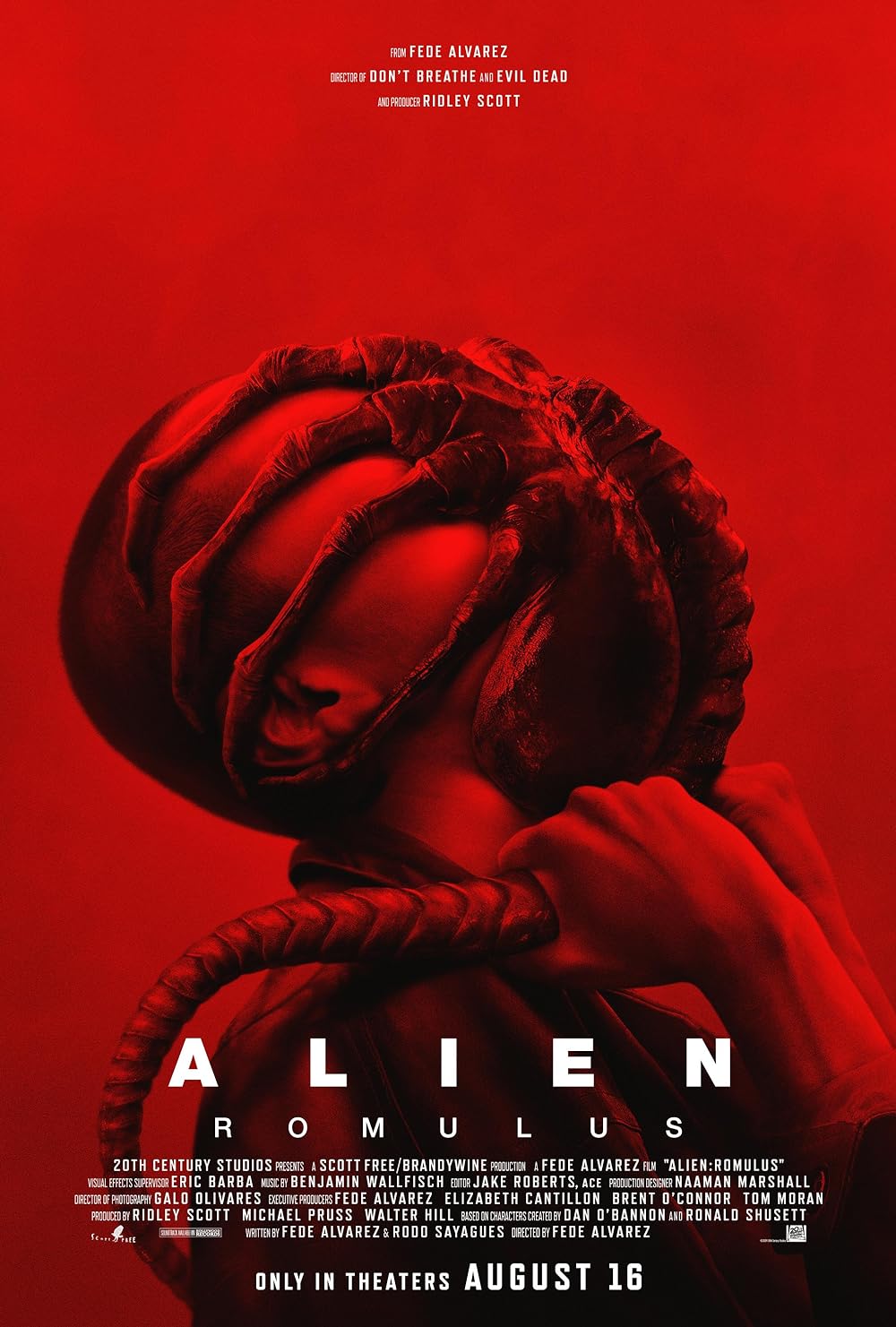
ALIEN: ROMULUS review

In space, these characters are screaming for dimension. Fede Alvarez’ Alien: Romulus is the closest in form that we have had since the masterful Alien (1979). And while the premise and plot are fairly solid, the plotting and exquisite design cannot compensate for the poorly written characters.

The most human character is a synthetic human, and he is the only character that is thoughtfully crafted. When characters struggle to connect with audiences, then the audience couldn’t care less whether they live or die–ostensibly mitigating any real stakes. The central character is mostly flawless and we never feel as though that they will be injured, much less die (I’m avoiding spoilers). The original Alien delivers incredibly well-written and developed characters that we want to survive. Alien: Romulus‘ characters–well–they should’ve all perished for lack of anything truly compelling. Additionally, this cast is way too young to be taken seriously in these roles that would be better suited for a cast that was at least 10–15 years older.

Where the film does succeed is the throwback design and feel of everything from beginning to end. Even the CG is integrated very well with the much-welcomed use of practical effects. Practical beats CG, nearly every time. Even though this movie is releasing more than forty years from the original, it feels very much connected to that iconic motion picture in form. Everything from the production design to the sounds to the music kept me from completely disengaging from the film. Alvarez has a fantastic eye for composition and atmosphere, but his screenwriting and character development are not on par with the technical achievement of the film. If you love the original Alien, then definitely see Romulus, and have fun with it. But I don’t imagine you will be rewatching this one over and over like the one that started it all. At least, it was way more meaningful than anything that released after Aliens.

Apologies for the short review of a movie that I highly anticipated. But Disney chose not to screen the film for all the critics in the CACF.

Ryan teaches Film Studies and Screenwriting at the University of Tampa and is a member of the Critics Association of Central Florida and Indie Film Critics of America. If you like this article, check out the others and FOLLOW this blog! Interested in Ryan making a guest appearance on your podcast or contributing to your website? Send him a DM on Twitter. If you’re ever in Tampa or Orlando, feel free to catch a movie with him.

Follow him on Twitter: RLTerry1 and LetterBoxd: RLTerry
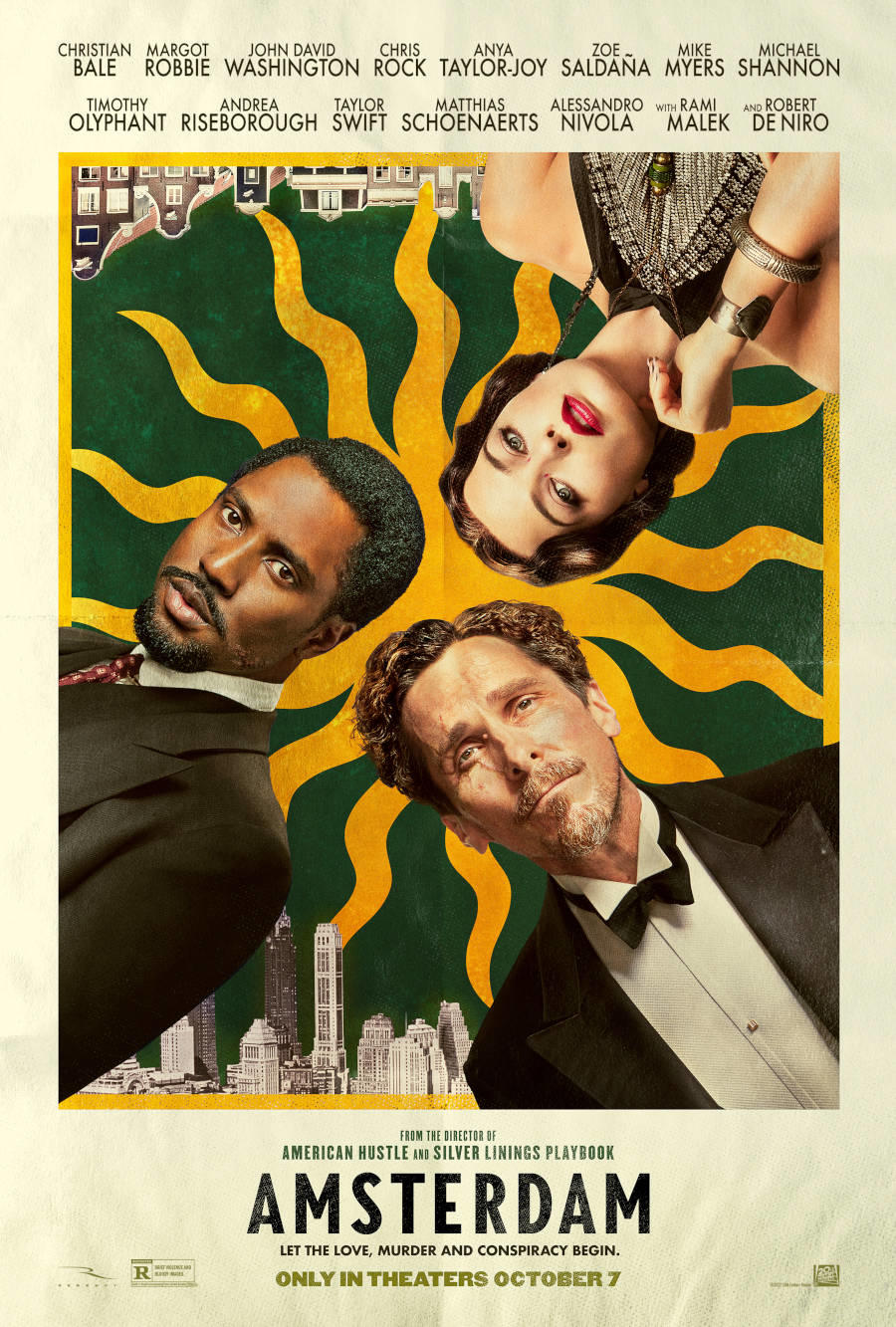
AMSTERDAM movie mini-review

There is a fascinating true story and great movie…in there…somewhere. David O. Russell’s star-studded Amsterdam is a bloated, poorly paced movie that places far more emphasis on repetitive, pedantic social commentary than it does on lean storytelling and strategic plotting. If not for the powerhouse cast, the movie would be nearly unwatchable. A litmus test I give a movie is (1) if I look at my watch and (2) if so, how often. If I am looking at the time, then I am not engrossed in the story. And I looked at my watch many times during this lengthy quasi-historical drama. Amsterdam demonstrably has little idea or security in what it wants to be. Is it a dark comedy? Is it a drama? Is it satire? All valid questions for which there is no clear answer, because it struggles to find the proper tone that best expresses its story. Although the social commentary on race relations quickly becomes redundant, it does highlight some areas of wartime history of which many, including myself, are likely unaware. Such as soldiers of color being forced to wear French uniforms–had no idea! So I am glad that this disrespectful chapter in history was highlighted for modern audiences. Clearly this movie should have been an Oscar vehicle for Russell, his cast, and crew, From beginning to end, it’s easy to read this film as a desperate attempt to win over general audiences and critics by convincing them that there is something to see here; unfortunately, what should have been an incredibly interesting mystery and untold true story suffocates under the poorly written and structured screenplay.

Ryan teaches Film Studies and Screenwriting at the University of Tampa and is a member of the Critics Association of Central Florida. If you like this article, check out the others and FOLLOW this blog! Interested in Ryan making a guest appearance on your podcast or contributing to your website? Send him a DM on Twitter. If you’re ever in Tampa or Orlando, feel free to catch a movie with him.

Follow him on Twitter: RLTerry1

BARBARIAN horror film review

Outstanding! Each and every layer of this masterful horror film is crafted with care and precision. Barbarian strikes an uncanny balance of unsettling terror juxtaposed against clever irony and humor. Writer-director Zach Cregger delivers the best horror film so far this year, and among the strongest in recent years. Not only does the film boast exceptional shot composition, the screenplay is sleek and no scene goes wasted. The fine-tuned plot mapping and story structure provide a solid foundation upon which the thoughtful story is told. I heard some in the audience make statements related to the observation that this film is largely flying under the radar, but I posit that is a good thing. While I had only seen the trailer for this film in passing, I’m glad that I didn’t know more about the premise (aside from the AirBnb setup) because it may have detracted from the visceral experience of a film that has the soul of an arthouse motion picture but the high concept of a more commercial feature. If you see it before your friends, DO NOT spoil any of the twists or turns as this film should be appreciated for the emotional and physiological roller coaster that it is. My advice is go in as blind as possible. Oh, if modern horror films had already promoted you to question ever visiting Detroit, this film will convince you to avoid the motor city.

A young woman (Tess) discovers the rental home she booked is already occupied by a stranger (Keith). Against her better judgment, she decides to spend the night but soon discovers there’s a lot more to fear than just an unexpected house guest.

Simple plot, complex characters. The recipe for a great film! But don’t let the high concept outside-action story lull you into a state of projecting predictability upon the story. Just when you feel that you may have it figured out, Cregger throws you for a loop–a loop that was setup earlier in the film unbeknownst to you. Zach Cregger has demonstrably studied masters of suspense and horror such as Hitchcock, Argento, and Craven because he took the best parts of Psycho, Suspiria, and The Hills Have Eyes to create his original expression of tried and true tentpoles of horror. In an age wherein most features are remakes of previous motion pictures, this film serves as a reminder that there are fresh ideas out there to be expressed on the silver screen. And not just original ideas, but well-written stories with solid plotting that don’t leave you wondering what you just watched. Accessibility should never be thought of as lacking meaningful substance for those that want to read the film more closely.

Whereas I won’t venture too far into the story progression, I do want to comment on the opening scene(s) because it reminded me of Suspiria. What’s funny, is that I was wearing my Suspiria t-shirt last night to the screening. I liken the opening of Barbarian to Suspiria because of the central character driving in the rain to a house whereat there is no room for her accompanied by an ominous score. Even though the score isn’t as iconic as Goblin’s score in the Argento masterpiece, the score was an extension of the increasing tension at the opening of the film. And who should finally answer the door to this rather quaint, Instagram-worthy house in the middle of a neighborhood long-condemned, but a Norman Bates-like character. The opening and entire first act setup everything that is to follow.

Georgina Campbell, who plays our central character of Tess, and Bill Skarsgard, who plays Keith, demonstrate excellent on-screen chemistry. Later on in the film when we meet actor AJ Gilbride, played by Justin Long, he complements the fantastic character dynamics and mix. Speaking of Long, there is a clever nod to Jeepers Creepers that you’ll just have to watch the film to find out. Often times, it’s horror films with small casts and intimate settings that deliver the best thrills. Because a writer can spend time on developing central and supporting characters and making sure that every scene has a beginning, middle, and end, and that every scene sets up the scene to follow. Even in a film with figurative and literal layers to the story, each scene should teach us more about the individual characters and further develop plot beats in a manner that does not make the story more convoluted, but slowly reveal the end, one layer at a time.

While I find this film to be overwhelmingly smartly executed, there are a couple of ideas that I find to be problematic, and furthering stigma and misrepresentation instead of using the opportunity to provide a more constructive depiction or argument. Of the two observations I made, I can really only touch on one of them without getting into character or plot spoilers.

When Tess discovers that there is something seriously wrong in the idyllic suburban cottage, she eventually receives a response by the police, after waiting some time. On one hand, I appreciate the setup to and this scene itself because it shows how dangerous is it for cities to reduce the public safety workforce (call it what you will), but where I find the scene problematic is that both police officers dismiss Tess’ concerns even though she is demonstrably in distress. In an era wherein a large number of media portray law enforcement in an unfair, misrepresentative light, this could have been an opportunity to show that the police could very well have been skeptical, but chose to act upon Tess’ claims. This would’ve made for a more constructive, accurate scene versus what we got. This doesn’t mean the police should have found concrete evidence or were instrumental in saving the day, but it would have helped to combat the dangerous ideology that law enforcement is irresponsible.

Deserving of a rewatch, this film is one you don’t want to miss seeing on the big screen! Not only does this film standout compared to the horror films we’ve had this year, but it is one of the best-written films of the year, period. I hope that Cregger’s next feature is as thoughtfully written and directed as this one.

Ryan teaches Film Studies and Screenwriting at the University of Tampa and is a member of the Critics Association of Central Florida. If you like this article, check out the others and FOLLOW this blog! Interested in Ryan making a guest appearance on your podcast or contributing to your website? Send him a DM on Twitter. If you’re ever in Tampa or Orlando, feel free to catch a movie with him.

Follow him on Twitter: RLTerry1

THE KING’S MAN movie review

Highly entertaining! This film can be read as a commentary on the necessities and atrocities of war and the emotional cost of freedom. After the disappointing sequel to the outstanding Kingsman: the Secret Service, I was unsure what to expect from this prequel-sequel. So often, prequels simply do not capture the magic of the original. While the original is still the best in this franchise, this prequel taking us back to the origins of the secret agency operating at the most extreme discretion, will keep you engaged as it parallels world history leading up to World War I. The movie is well-paced and structured, and will keep your eyes and ears glued to the screen for the duration of the movie that surprisingly exceeds two hours; you will not feel like you’ve sat there for over two hours. Teaching World Cinema, I spend a lot of time each semester discussing the historical events that helped to shape the content therein and direction of cinema, so I was particularly interested in how closely this film would follow the Russian Revolution and the preamble to the Third Reich in Germany. Even though this film is not intended to recreate all the actual events that plunged the Western world into World War I, there are quite a number of nods and references to major turning points in the revolutions and wars. Most notably in this film, is the subplot of Rasputin and the Romanov family. Ralph Fiennes’ role as the Duke of Oxford (founder of Kingsman) finds a nice balance between serious and campy. Tonally, the original still strikes the best balance, but this one is certainly aiming for that balance between serious espionage movie and camp; perhaps the landing is a little bumpy, but never does it detract away from the experience. If you enjoy spy movies that are exciting and take place within real world history, then you will undoubtedly enjoy this film!

One man must race against time to stop history’s worst tyrants and criminal masterminds as they get together to plot a war that could wipe out millions of people and destroy humanity.

Decades prior to the events of the original, Kingsman was formed, but only after the Western world was plunged into World War I, inclusive of the Russian Revolution and preamble to the Third Reich. While we know from history that there wasn’t an organization of villains who’s goal was to overthrow democracy and monarchy in exchange for socialism and totalitarianism, the film does a good job of applying some fiction to the real historical events. In terms of history, the months leading up to the Russian Revolution provide the bulk of the historic context. Yes, that means the infamous Rasputin plays a major role in the film. And the film plays it close to history, because unlike the Rasputin we get in Anastasia, this one isn’t a sorcerer; however, it does hint at him possessing some dark magic (but that mythos is grounded in reality). The real life Rasputin was a dark priest, alchemist, healer, and advisor to Tsar Nicholas Romanov II, the last emperor of Russia. One prominent historical theory suggests that the British Secret Service was involved in Rasputin’s assassination, and this film leans into that theory in order to motivate the founding of Kingsman. For a while, I thought that the legend of Anastasia (which lasted about 90 years) was going to factor into this movie, which would give rise to a plot point in its sequel. But sadly, I don’t think we will be searching for Anastasia in the next movie (if there is one, which there probably will be).

What I appreciate most about this film is the commentary on the atrocities and necessities of war and the emotional cost of victory. This isn’t really a spoiler because it happens in the first few minutes of the film, but we open on the death of the Duke of Oxford’s (Fiennes) wife, and it’s this death that radically alters his opinions on getting involved in war and fighting for your country. Moreover, his radical ideological shift was exhibited through his rearing of his son, whom he (over)protected and kept from entering into military service. Understandably, the Duke did not want to lose his son on the war front, in the same way he lost his wife and son’s mother. Without spoiling the plot, the Duke goes through a redemption arc and through various conflict, his pacifist ideology is challenged, and he must decide what he’s going to do about it, as the world is crumbling around him. Sometimes, war is necessary to fight for what is right. But even the most justified wars come as a cost. That cost may be emotional, psychological, or relational; yet, the cost is worth it because it may have saved tens of thousands or even millions of lives in the long run. The King’s Man challenges our views on war, by placing us in the family units and in the trenches along No Man’s Land (and no, Wonder Woman does not show up). Some things in life are truly worth fighting for, and fights are not always going to be debates on a stage. Furthermore, if you’re a parent, perhaps you will be challenged to be the kind of man or women your child would be.

You’ll want to add The King’s Man to your list of movies to watch in cinemas over Christmas! You get a little of everything: some classic espionage, a World War I film, and commentary that is applicable to our own lives.

Ryan teaches American and World Cinema at the University of Tampa. If you like this article, check out the others and FOLLOW this blog! Interested in Ryan making a guest appearance on your podcast or contributing to your website? Send him a DM on Twitter or email him at RLTerry1@gmail.com! If you’re ever in Tampa or Orlando, feel free to catch a movie with him.

Follow him on Twitter: RLTerry1