THE BRIDE! (2026) movie review

There’s a good movie somewhere inside The Bride!—perhaps several.
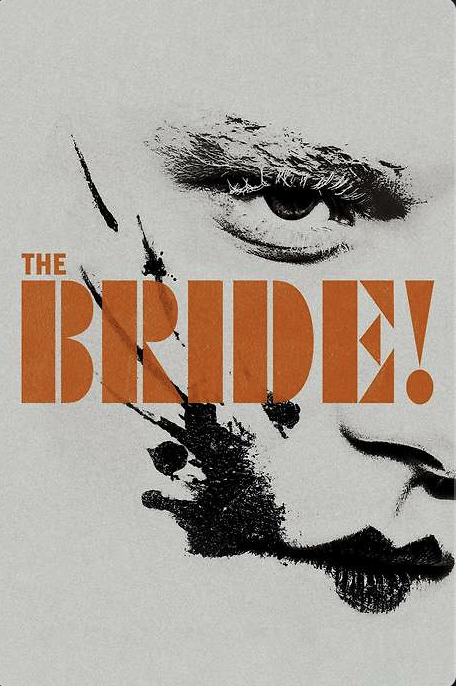
There’s a good movie somewhere inside The Bride!—perhaps several. The irony is that the film itself feels as Frankensteined together as the titular creation at its center. Maggie Gyllenhaal’s ambitious reinterpretation of Mary Shelley’s Frankenstein and James Whale’s immortal Bride of Frankenstein (1935) clearly springs from a place of imaginative vision. The problem is not the ideas. The problem is that too many of them are stitched together without the narrative cohesion necessary to bring the creature fully to life. What emerges is a fascinating but uneven cinematic experiment: a film whose strongest parts often struggle against the whole.

In 1930s Chicago, groundbreaking scientist Dr. Euphronious (Annette Bening) brings a murdered young woman Ida (Jessie Buckley) back to life to be a companion for Frankenstein’s monster (Christian Bale). What happens next is beyond what either of them could ever have imagined.

There is little doubt that Gyllenhaal set out to craft an imaginative and thought-provoking reexamination of Frankenstein mythology. The ambition is evident in nearly every frame. Yet the screenplay and editing lack the discipline required to shape that ambition into something structurally coherent. In an ironic parallel to Frankenstein’s own creation, the film is assembled from intriguing narrative parts—each compelling in isolation—but collectively they never quite form a unified organism. Any one of those narrative threads might have served as a more stable foundation than the combination presented here.

It is possible that The Bride! may one day find a second life as a cult curiosity. Cinema history is filled with examples of films—The Rocky Horror Picture Show and even Showgirls—that were initially met with confusion before later audiences embraced their eccentricities. But both of those films possessed an essential ingredient that this one struggles to sustain: entertainment. Each of them understood its own satirical target and leaned confidently into the theatricality of its premise. The Bride! gestures toward satire but never fully commits to it. The result is a tonal tug-of-war between melodrama and camp. Had the film embraced the latter more confidently, the experience might have been far more exhilarating. Intentional camp signals to the audience that the filmmakers are in on the joke; here, the film often takes its own eccentricities too seriously.

Narratively, the film wanders. Yet the performative dimension proves far sturdier. Jessie Buckley and Christian Bale share a compelling chemistry that anchors the film whenever the plot threatens to drift. Annette Bening brings welcome gravitas to her doctor, while Penélope Cruz’s detective—though played with conviction—is underserved by a character that ultimately has too little to do. Indeed, the performances are what keep the audience invested when the narrative itself begins to lose its footing.

Visually, however, Gyllenhaal demonstrates undeniable directorial confidence. Her eye for composition yields moments of striking cinematic beauty. The cinematography and production design elegantly bridge old and new interpretations of the mad scientist mythos. Laboratories glow with stylized menace while the broader world of the film evokes both classical Hollywood romanticism and contemporary visual flair. Particularly during the musical interludes, lighting and camera movement become expressive tools rather than mere ornamentation.

One of the film’s most charming creative flourishes lies in its affectionate nods to classic romantic melodramas and golden-age song-and-dance spectacles. Busby Berkeley’s Footlight Parade, Gold Diggers of 1933, and other Warner Bros. musical traditions echo throughout the film, not merely as nostalgic references but as narrative devices that illuminate the emotional worlds of the characters. The moments when Frank (Bale), Ida (Buckley), and the camera operator drift into choreographed reverie feel as though they have stepped directly off a 1930s soundstage. In these sequences, the film’s imagination briefly achieves the synthesis the rest of the narrative seeks.

Yet structurally the film remains overburdened. Elements of Romeo and Juliet, Bonnie and Clyde, and The Bride of Frankenstein all compete for narrative dominance, while the shadow of Mary Shelley herself looms as an interpretive framework. Any one of these inspirations could have produced a compelling through-line with traces of the others woven in. Instead, the film attempts to juggle all of them simultaneously. The result is a narrative compass that spins without settling on a clear direction.

This imbalance points toward a broader issue increasingly visible in contemporary cinema: the challenge of the writer-director auteur. Gyllenhaal clearly possesses a strong visual sensibility and a director’s instinct for atmosphere and composition. But here the screenplay does not display the same level of discipline as the filmmaking. The modern industry often encourages directors to function simultaneously as writers and producers, yet history demonstrates that some of the greatest films emerge from collaboration rather than singular authorship. There are exceptional writer-directors—but they remain the exception rather than the rule. In this case, Gyllenhaal’s imaginative vision might have benefited enormously from the partnership of a dedicated screenwriter capable of translating those ideas into a tighter narrative structure.

None of this diminishes the ambition behind The Bride!. The film is imaginative, visually striking, and intermittently electrifying. It simply struggles to unify its many inspirations into a cohesive whole. With a stronger narrative foundation, Gyllenhaal’s directorial instincts might have produced something truly extraordinary.

Instead, we are left with a fascinating creature assembled from promising parts—alive, perhaps, but never quite fully formed. And like Frankenstein’s creation itself, the result inspires equal parts admiration and frustration.

Ryan is the general manager for 90.7 WKGC Public Media and host of the show ReelTalk “where you can join the cinematic conversations frame by frame each week.” Additionally, he is the author of the upcoming film studies book titled Monsters, Madness, and Mayhem: Why People Love Horror. After teaching film studies for over eight years at the University of Tampa, he transitioned from the classroom to public media. He is a member of the Critics Association of Central Florida and Indie Film Critics of America. If you like this article, check out the others and FOLLOW this blog! Follow him on Twitter: RLTerry1 and LetterBoxd: RLTerry
SCREAM 7 horror movie review

There is a difference between resurrecting a franchise and reviving its pulse. Scream 7 understands that distinction.

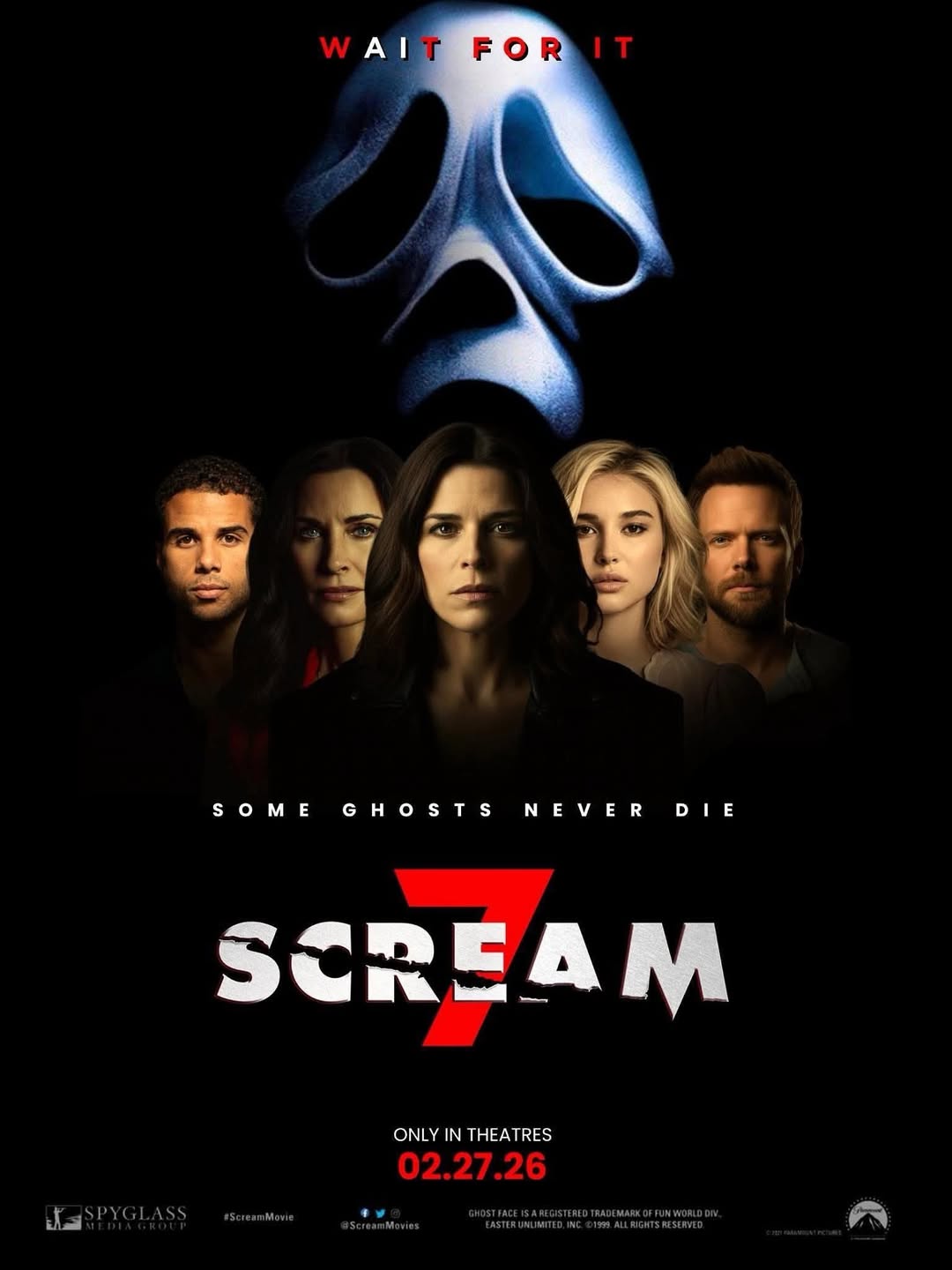
There is a difference between resurrecting a franchise and reviving its pulse. Scream 7 understands that distinction. This seventh installment aligns far more closely with Scream 2–4—with the 1996 original remaining peerless—than with the tonal divergence of entries five and six. It is not an attempt to eclipse the original nor to extend the reboot-era mythology. Instead, it is a recalibration: a deliberate return to the structural mechanics and tonal balance that once defined the series—brutal yet playful, self-aware yet grounded, meta without collapsing into parody. It restores the rudimentary whodunit spine, re-centers the franchise’s emotional trinity, and reasserts consequence in a narrative space that had begun to flirt with immunity. It may not reinvent the mask, but it remembers how to make it frightening—and fun—again.

The premise is straightforward: a new Ghostface emerges in the quiet Indiana town where Sidney Prescott has built a life beyond trauma. When her daughter becomes the next target, Sidney is pulled back into the cycle she has spent decades surviving. The simplicity is intentional. This is not a mythology-expanding installment. It is a structural restoration.

When I wrote about the original Scream in 2020, I emphasized how Wes Craven and Kevin Williamson fused satire and sincerity—how the film functioned simultaneously as genre critique and legitimately tense mystery. And in reflecting on Scream 4, I argued that the franchise’s survival depended on maintaining that balance between irony and genuine stakes. Scream 7 understands that lineage. It does not reinvent the formula; it reasserts it.

The humor is sharper than in the previous two entries, and the dialogue once again flirts with meta-awareness without dissolving into self-congratulation. More importantly, the whodunit framework returns to prominence. Scream has always been more mystery than massacre—a slasher disguised as a parlor game. Here, suspicion lingers. Motives matter. The audience is invited to participate again rather than merely observe. That interactive quality—so essential to the original—has been restored.

The kills are similarly recalibrated. They are decisive, occasionally shocking, and refreshingly unwilling to protect characters based on audience expectation. Supporting players are bloodied. Familiar faces are not insulated by nostalgia. The film reinstates a fundamental rule: no one is safe. In doing so, it restores tension that had softened in recent installments.

At the center of this recalibration is the reaffirmation of the franchise’s trinity: Sidney Prescott, Gale Weathers, and a classically-derived Ghostface presence that evokes the psychological intimacy of earlier entries. Strip Scream to its essentials and it has always revolved around those pillars. When they are foregrounded, the franchise regains coherence.

If Scream 4 was the franchise’s first major recalibration, Scream 7 feels like its long-delayed mirror. The fourth installment ushered Scream into the digital revolution—interrogating self-made celebrity, the commodification of trauma, and the toxic symbiosis between violence and visibility. It marked the franchise’s pivot from analog to digital, from landline terror to algorithmic notoriety.

Scream 7, by contrast, gestures toward cultural correction. In a late-2020s climate increasingly skeptical of hyper-digital performativity and increasingly nostalgic for tactile authenticity, this installment feels almost deliberately analog in spirit. The satire is restrained. The violence has weight. The mystery mechanics are foregrounded. If Scream 4 bridged the franchise into the digital age, Scream 7 gently guides it back toward its roots. Both are recalibrations—but pulling in opposite technological directions.

It would be naïve to ignore the production context that shaped this film. Melissa Barrera’s departure following her public political statements altered the series’ trajectory and necessitated a creative reset, with Kevin Williamson returning to write and direct. Freedom of speech is foundational—but not without professional consequence within corporate filmmaking. The result is a film structurally distinct from what entries five and six were building toward.

More concerning than the controversy itself is the critical climate surrounding the film’s release. Its unusually low Rotten Tomatoes score reads less like a measured assessment of craft and more like a referendum on production politics. Evaluated on narrative mechanics, tonal discipline, and franchise coherence, Scream 7 is far from a failure. It is focused, structurally sound, and far more aligned with the franchise’s DNA than its aggregate score suggests.

This return to form may also be more culturally resonant than some critics assume. There is a growing appetite—particularly among younger audiences—for analog aesthetics and classical genre storytelling. Eli Roth’s Thanksgiving proved that an original slasher can thrive in the 2020s. Scream 7 demonstrates that a legacy slasher can endure by remembering what made it compelling in the first place.

In retrospect, Scream 7 may not be the boldest chapter in the franchise—but it may prove to be one of the most necessary. It restores the mystery spine. It reinstates consequence. It reminds us that Ghostface works best when the blade cuts both ways—satire and sincerity, humor and horror. The original remains untouchable. But longevity in horror does not come from constant reinvention. It comes from understanding when to sharpen the knife rather than redesign it.

And sometimes, survival is less about evolution than about reclaiming your identity.

Ryan is the general manager for 90.7 WKGC Public Media and host of the show ReelTalk “where you can join the cinematic conversations frame by frame each week.” Additionally, he is the author of the upcoming film studies book titled Monsters, Madness, and Mayhem: Why People Love Horror. After teaching film studies for over eight years at the University of Tampa, he transitioned from the classroom to public media. He is a member of the Critics Association of Central Florida and Indie Film Critics of America. If you like this article, check out the others and FOLLOW this blog! Follow him on Twitter: RLTerry1 and LetterBoxd: RLTerry
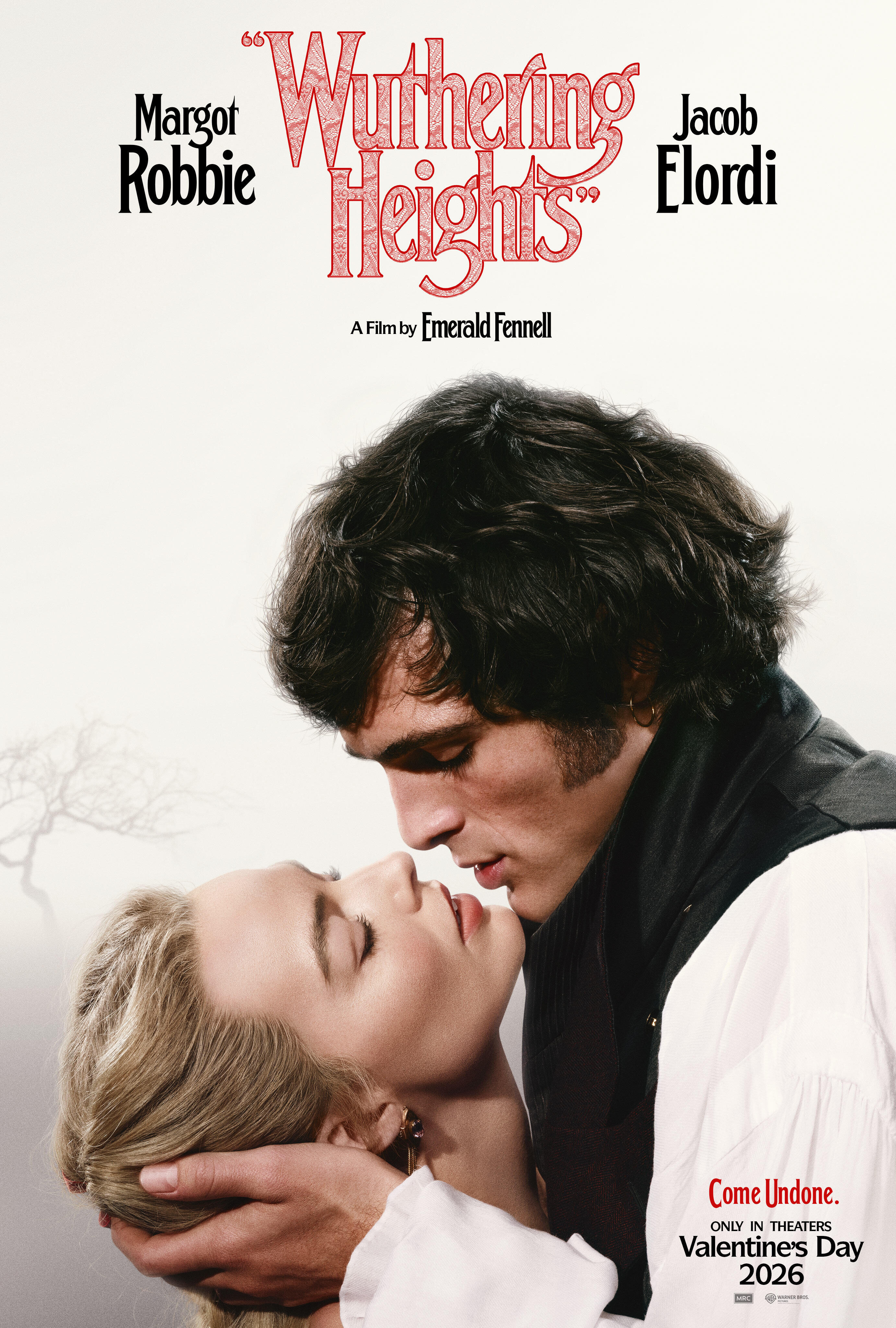
WUTHERING HEIGHTS (2026) film review

A very lose adaptation.

Is it a bold, thoughtful reinterpretation of a literary classic—or a grotesquely self-indulgent fever dream? Emerald Fennell’s Wuthering Heights positions itself squarely at the intersection of gothic romance and modern sensibility, daring to reimagine Emily Brontë’s tempestuous novel for contemporary audiences. The question is not whether Fennell has vision—she undeniably does—but whether that vision honors Brontë’s architecture or merely rearranges it to suit her own aesthetic impulses.

Tragedy strikes when Heathcliff falls in love with Catherine Earnshaw, a woman from a wealthy family in 18th-century England. What follows, in Brontë’s telling, is a slow-burning study of pride, cruelty, class, and decay.

Let us begin where praise is due. Emerald Fennell is undeniably a visionary director. Her eye for composition, color, texture, and environmental immersion is extraordinary. Every frame feels curated—shadow and candlelight carefully balanced, fabrics heavy with implication, the moors rendered both seductive and foreboding. The costuming and production design are exquisite, nearly flawless in execution. If one were evaluating this film purely as visual art, it would stand among the most striking adaptations of Brontë ever mounted. There is a neo-gothic confidence in its aesthetic—modern, tactile, and immersive.

Unfortunately, that same discipline is absent from the screenplay.

Fennell the director and Fennell the writer feel like two different artists. Subtlety is sacrificed in favor of blunt-force reinterpretation. When Fennell adheres closely to Brontë’s plotting, the film works. When she strays—and she strays often—the adaptation buckles under the weight of unnecessary revisionism.

The most egregious example is the character assassination of Catherine’s father. In both the novel and the 1939 William Wyler adaptation, he is a kindly, stabilizing force—the glue that holds the family together. It is only upon his death that his biological son, Hindley, descends into cruelty and degradation, transforming Heathcliff from adopted son to servant in a perverse Cinderella inversion. Fennell eliminates Hindley altogether, redistributing his vices—gambling, drunkenness, cruelty—onto the father himself, rendering him a monstrous, bigoted drunk from the outset. This is not reinterpretation; it is structural sabotage.

By corrupting the father from the beginning, the narrative loses its axis of decay. And decay is central to Wuthering Heights. The estate should mirror the relationships within it—beautiful at first, falling gradually into ruin as love curdles into vengeance. Yet Fennell presents Wuthering Heights as decrepit from the outset. If everything is already broken, there is no meaningful deterioration to witness. The symbolism collapses before it can resonate.

Isabella Linton suffers a similar flattening. In Brontë’s novel and prior adaptations, she possesses dimension, agency, and tragic complexity. Here, she is comparatively inert, stripped of the inner life that once made her more than a narrative device. Again, when Fennell stays close to Brontë, the film steadies itself. When she diverges, the narrative weakens.

Pacing further undermines the film’s impact. What could have been told effectively in an hour and forty-five minutes stretches to two hours and fifteen, with a protracted second act that tests even patient viewers. Entire opening sequences could be excised without loss, and substantial portions of the middle tightened considerably. One feels the absence of editorial restraint—the checks and balances that a separate, more disciplined screenwriter might have imposed.

And yet, there are cinematic pleasures here.

While the narrative falters, the film’s visual architecture is nothing short of extraordinary. Production design, cinematography, and costuming operate in near-perfect harmony, creating a world deeply rooted in Gothic romance yet unmistakably filtered through contemporary sensibilities. The estate’s textures—weathered wood, cold stone, candlelit interiors—create a tactile atmosphere that is immersive and deliberate. The color palette oscillates between muted earth tones and saturated bursts of crimson and shadow, suggesting emotional volatility beneath composure.

The costuming deserves particular recognition. Fennell understands silhouette and line as psychological tools. Structured bodices, layered fabrics, and stark contrasts in texture mirror emotional rigidity and suppressed desire. There is a modern sharpness in the tailoring—a recalibration that prevents the film from feeling museum-bound. This is Gothic romance rendered through a contemporary lens without collapsing into gimmickry.

The cinematography further elevates the material. Light and shadow are deployed not merely for aesthetic pleasure but for emotional suggestion. Faces emerge from darkness as though haunted by memory; candlelight flickers against stone walls like unstable devotion. Fennell’s compositional instincts are impeccable—symmetry fractured at key moments, framing that isolates characters even when they occupy the same space. Visually, this Wuthering Heights breathes.

Fennell’s restraint also deserves applause. After the provocative spectacle of Saltburn—and the social media speculation that followed—many anticipated a sexually explicit interpretation of Brontë. Instead, this adaptation is comparatively restrained. Passion is implied more often than shown. Edginess exists, yes—but it is measured, not gratuitous. Ironically, this restraint underscores her discipline as a director even while her writing falters.

Performatively, the film is strong. Robbie and Elordi deliver committed, emotionally grounded performances, leaning into the operatic intensity of the material without tipping into parody. Hong Chau, as Nelly, provides a compelling presence—observant, restrained, and quietly anchoring the emotional chaos around her. The cast frequently elevates what the script undermines.

There are even moments—brief, surprising—that are genuinely funny. Fennell understands tonal modulation, allowing dry humor to flicker through the gloom like shafts of unexpected light.

Ultimately, 2026’s Wuthering Heights is immersive and visually arresting but narratively anemic. It demonstrates how essential the collaborative checks and balances of cinema truly are. A more disciplined screenwriter paired with Fennell’s formidable directorial skill could produce something extraordinary. Instead, we are left with an adaptation that is imaginative, occasionally exhilarating—and unlikely to command a rewatch.

It is not without merit. But it mistakes alteration for insight, excess for depth, and provocation for revelation. And for a story as enduring as Brontë’s, that is a costly miscalculation.

Ryan is the general manager for 90.7 WKGC Public Media and host of the show ReelTalk “where you can join the cinematic conversations frame by frame each week.” Additionally, he is the author of the upcoming film studies book titled Monsters, Madness, and Mayhem: Why People Love Horror. After teaching film studies for over eight years at the University of Tampa, he transitioned from the classroom to public media. He is a member of the Critics Association of Central Florida and Indie Film Critics of America. If you like this article, check out the others and FOLLOW this blog! Follow him on Twitter: RLTerry1 and LetterBoxd: RLTerry
SEND HELP (2026) horror movie review

Send Help is the rare survival thriller that understands the most dangerous thing on a deserted island isn’t nature—it’s the workplace baggage you bring with you.

Send Help plays like a postmodern riff on Misery—less interested in replicating its mechanics than in reconfiguring its psychological cruelty for a contemporary workplace horror. One can also detect traces of Survivor, the underseen Office Killer (1997), and even a one-way echo of Fatal Attraction, though Raimi’s film resists the lurid sensationalism of those predecessors in favor of something more controlled, more ideologically curious. I went into Send Help expecting one kind of movie and walked out having experienced something far more interesting—and far more satisfying. What initially presents itself as a straightforward survival thriller gradually reveals a different set of priorities: character over carnage, tension over spectacle, and psychology over shock. The turn is not a bait-and-switch so much as a recalibration, one that rewards patience and attention.

A woman (Rachel McAdams) and her overbearing boss (Dylan O’Brien) become stranded on a deserted island after a plane crash. They must overcome past grievances and work together to survive, but ultimately, it’s a battle of wills and wits to make it out alive.

Despite containing remarkably little gore, Send Help is punctuated by moments of excruciating intensity—scenes engineered to linger in the mind the way Misery’s hobbling scene does, not because of what is shown, but because of what is anticipated. Raimi understands that true discomfort is often born from restraint. Violence, when it arrives, is not gratuitous; it is precise, purposeful, and deeply unpleasant.

Where Send Help distinguishes itself most clearly is in its thematic ambition. Raimi trades his trademark splatter for commentary on workplace dynamics—particularly the lived experience of women navigating environments shaped by misogynistic men, institutional indifference, and power imbalance. The film proposes that monsters are created—that violent behavior can be traced back to environment, circumstance, and provocation. While the film makes this argument with conviction, I remain unconvinced by its absolutism. Environment can shape behavior, yes—but it does not absolve agency. Some monsters are forged by their surroundings; others choose monstrosity despite them. Under most circumstances, we remain responsible for our actions.

That tension—between explanation and excuse—is where Send Help becomes most interesting. The film is less persuasive as a moral thesis than it is as a provocation, forcing the audience to wrestle with where empathy ends and accountability begins. In that sense, the island setting becomes more than a survivalist conceit; it is a crucible. A demented Gilligan’s Island, stripped of whimsy and comfort, where rescue is uncertain and survival demands agency. The film is clear-eyed about one thing: help does not always arrive. Sometimes survival requires seizing control rather than waiting to be saved.

Visually, the setting is striking—lush, isolating, and quietly menacing. The CGI animals, however, are nearly laughable, though thankfully used sparingly enough not to derail the experience. When Raimi relies on atmosphere rather than digital intrusion, the film is at its strongest.

Excellent casting anchors the film, thoughtful writing gives the conflict weight, and the thrills feel refreshingly old-school—earned through escalation and dread rather than excess. All of it is quietly underscored by moments of dark comedy that arrive not as winks to the audience, but as pressure valves, reminding us that sometimes the most unsettling laughs are the ones that catch us off guard. McAdams’ and O’Brien’s chemistry is exceptional. They play off one another with a rhythmic precision that feels almost musical—each reaction, pause, and escalation perfectly calibrated. Their dynamic does much of the film’s heavy lifting, grounding the psychological tension in something human and volatile. One hopes this pairing is not a one-off; there is genuine electricity here worth revisiting.

There is also an unintended—but revealing—meta-text hovering around O’Brien’s presence. In a recent Entertainment Weekly article, O’Brien noted that he has been repeatedly told by agents, producers, and directors that he needs an Instagram account—that without it, he risks losing roles deemed “appropriate” for him. He has no intention of starting one. As a film scholar, I find this deeply troubling. When talent, suitability, and longevity are increasingly filtered through social media metrics rather than craft, presence, and screen intelligence, the industry risks confusing visibility with value. Send Help, perhaps inadvertently, becomes part of that conversation—raising questions about how we identify monsters, merit, and worth in systems increasingly governed by optics.

Ultimately, Send Help is not a perfect film, nor is it a subtle one. But it is a thoughtful, unsettling, and frequently compelling genre exercise—one that uses survival horror as a vehicle for interrogating power, agency, and responsibility. Raimi may be experimenting here, but the experiment is a worthwhile one. If nothing else, Send Help reminds us that the most terrifying scenarios are not those where monsters appear—but those where we are forced to decide what kind of people we are when no one is coming to save us.

Ryan is the general manager for 90.7 WKGC Public Media and host of the show ReelTalk “where you can join the cinematic conversations frame by frame each week.” Additionally, he is the author of the upcoming film studies book titled Monsters, Madness, and Mayhem: Why People Love Horror. After teaching film studies for over eight years at the University of Tampa, he transitioned from the classroom to public media. He is a member of the Critics Association of Central Florida and Indie Film Critics of America. If you like this article, check out the others and FOLLOW this blog! Follow him on Twitter: RLTerry1 and LetterBoxd: RLTerry
NETWORK 50th Anniversary Review

When satire ceases being satire–we’re living inside it.

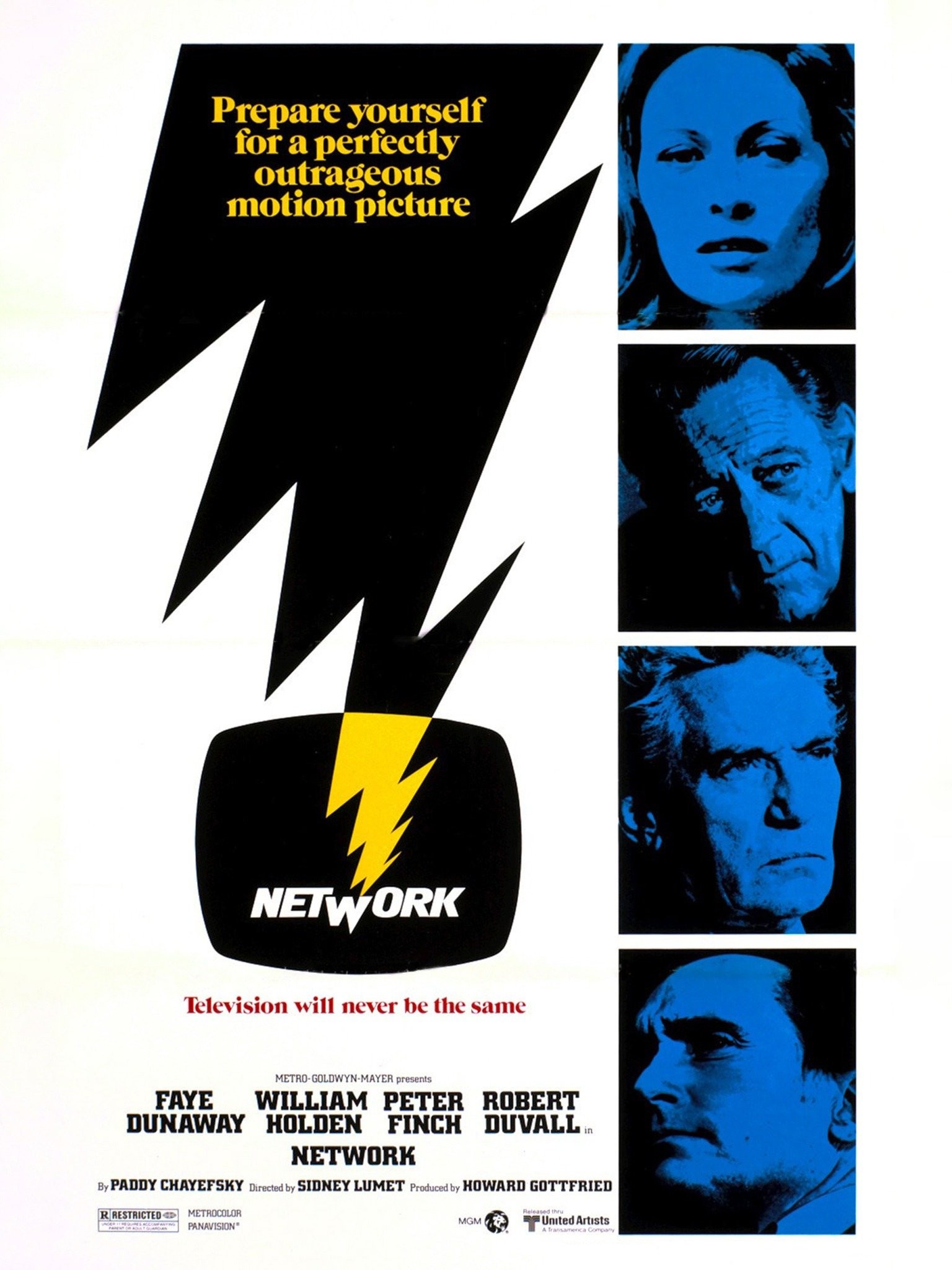
There are films that feel timely, films that feel dated, and then there is Network—a work so disturbingly elastic that it seems to recalibrate its relevance with each passing decade. What Sidney Lumet’s incendiary masterpiece offered in 1976 as provocation now functions as diagnosis. Network ceased being satire the moment we began living inside it. And at fifty years on, it is no longer prophetic so much as instructional—a grim field manual for the media ecosystem we willingly built.

On its surface, Network is a scathing critique of television news and the corrosive marriage between journalism and entertainment. But that reading now feels almost quaint. Today, the film operates as a far more expansive lens—one through which we can examine social media’s performative outrage, the collapse of editorial integrity, the rise of influencers over actors, and “content” replacing cinema as both commodity and aspiration. The film’s possibilities for interpretation are not merely endless; they are inescapable.

You can listen to the NETWORK episode of ReelTalk, which serves as a great companion piece to this article through your favorite podcast service. For your convenience, I’ve included some links that may work for you.

When I survey the contemporary media landscape—where outrage is currency, truth is malleable, and spectacle supplants substance—I often find myself echoing Howard Beale’s immortal lament: “I’m as mad as hell, and I’m not going to take this anymore.” The tragedy, of course, is that Beale’s righteous fury is swiftly commodified, packaged, and sold back to the public. In Network, that process is the warning. In 2026, it is the business model.

What Network ultimately offers is not just a critique of television news, but an elegy for every so-called Golden Age of legacy media—journalism, cinema, and serialized television alike. Watching it now, I am reminded of Norma Desmond’s aching declaration in Sunset Boulevard: “I am big. It’s the pictures that got small.” Substitute “pictures” for platforms, algorithms, and engagement metrics, and the lament lands with devastating clarity. In my view, social media and streaming have not merely disrupted cinema and television; they have delivered a mortal wound—one from which craft, patience, and collective cultural experience may never fully recover.

Network endures first and foremost because it is built on one of the most ferocious screenplays ever put to film. Paddy Chayefsky’s Oscar-winning script is not merely well-written; it is weaponized language—monologues that cut like scalpels, dialogue that oscillates between blistering satire and operatic tragedy, and ideas so densely packed they continue to unfold decades later. This is writing that trusts intelligence, that dares to be verbose, ideological, and confrontational in a way modern studio cinema rarely permits. Chayefsky understood that words—spoken with conviction—could be more explosive than spectacle, and he built Network accordingly.

What makes the screenplay extraordinary is its refusal to choose a single target. It indicts television news, corporate capitalism, religious fervor, political apathy, and audience complicity with equal venom. The famous “mad as hell” speech is not a populist rallying cry so much as a trap—an emotional release engineered to be monetized, emptied of meaning, and repackaged as programming. Chayefsky was not predicting outrage culture; he was anatomizing it. In an era where dialogue is often sanded down to algorithm-friendly soundbites, Network feels almost alien in its literary ambition—proof that cinema once trusted language to carry weight, risk, and consequence.

Sidney Lumet’s direction is the perfect counterbalance: disciplined, precise, and deliberately unflashy. Lumet stages the film like a moral courtroom drama, allowing performances and ideas to occupy the foreground while the camera observes with quiet authority. His restraint is crucial. Rather than amplifying the satire through stylistic excess, Lumet grounds the absurdity in realism—office spaces feel oppressive, boardrooms feel sterile, and television studios feel eerily sacred. The effect is chilling: the madness is not heightened by cinematic flourish; it emerges organically from systems that feel frighteningly familiar.

Together, Chayefsky and Lumet create a film that feels less like a movie and more like a controlled detonation. There is no indulgence, no wasted motion, no attempt to soften the blow. In contrast to today’s cinema—often drowned in visual noise, diluted themes, and studio-mandated ambiguity—Network stands as a reminder of what happens when writing and direction operate with absolute clarity of purpose. It is fearless, articulate, and devastatingly focused. And perhaps most damning of all: it proves that cinema once had the courage to tell audiences the truth, even when that truth was deeply uncomfortable.

Yet if Network endures as forcefully as it does, it is not solely because of its prescience. It endures because it is performed with astonishing precision and gravitas by one of the greatest ensembles ever assembled. Peter Finch’s Howard Beale remains one of cinema’s most unforgettable figures—a man whose breakdown is mistaken for authenticity, whose humanity is exploited until nothing remains. Finch’s posthumous Academy Award win feels less like recognition than inevitability.

William Holden, meanwhile, brings a weary, world-worn melancholy to Max Schumacher that resonates deeply with his earlier turn as Joe Gillis in Sunset Boulevard. Both characters are men who recognize the rot of the system even as they remain complicit within it—observers with just enough moral clarity to feel shame, but not enough power to stop the machine. Holden’s quiet resignation here serves as the film’s conscience, a reminder of what professionalism and restraint once meant.

And then there is Faye Dunaway, delivering a tour de force for the ages—one of those rare performances that does not merely dominate a film, but defines an era of acting. Her Diana Christensen is ambition incarnate: ice-cold, ferociously intelligent, and utterly unencumbered by empathy. Dunaway doesn’t soften the character or seek audience approval; she weaponizes Diana’s ruthlessness, allowing her to move through the film with the predatory calm of someone who understands power not as responsibility, but as leverage. The performance is so precise and so unflinching that it almost feels inhuman, as though Diana has already evolved into the algorithmic logic the film warns us about—ratings as morality, attention as currency, and human cost as an acceptable casualty.

It is no accident that Dunaway earned the Academy Award for Best Actress for this role. The Oscar was not simply recognition of a great performance; it was an acknowledgment of something rarer—a character so vividly realized that she became a cultural archetype. Diana Christensen is not just a television executive; she is the prototype for the modern media operator, the spiritual ancestor of today’s content strategists, brand architects, and engagement-obsessed executives. Dunaway plays her with surgical control, her clipped delivery and laser-focused gaze conveying a woman who has replaced conscience with metrics long before such thinking became normalized.

In the broader context of film history, Dunaway’s work in Network cements her status as one of the greatest actresses of all time—very much in the lineage of Bette Davis and Joan Crawford, yet operating outside the classical Golden Age of Hollywood. Like them, Dunaway possessed an unapologetic intensity, a willingness to embrace unlikable women, and a commanding screen presence that bent films around her gravitational pull. But unlike Davis or Crawford, her era offered fewer guardrails and less mythmaking; Dunaway emerged during a transitional moment in American cinema, when performances could be raw, confrontational, and morally untidy.

That makes her Diana Christensen all the more extraordinary. It is not a performance cushioned by studio glamour or softened by melodrama—it is sharp, modern, and terrifyingly plausible. Decades later, Dunaway’s Oscar-winning turn feels less like a relic of 1970s cinema and more like a warning label we ignored.

The supporting cast—Beatrice Straight, Ned Beatty, Robert Duvall—forms a devastating chorus, each representing a different facet of institutional decay. Straight’s Oscar-winning performance, in particular, remains one of the most remarkable achievements in Academy history. The fact that Straight’s Academy Award for Best Supporting Actress was won with comparatively limited screen time only underscores the magnitude of her presence. Every line, every glance carries weight. Gravitas is not measured in minutes.

It is impossible to discuss Network without reckoning with its unprecedented—and now unthinkable—Oscar performance. The film received ten Academy Award nominations, including Best Picture, Best Director, and an astonishing four acting nominations across all performance categories. Even more remarkable: Network won three of the four acting awards—Peter Finch (Best Actor), Faye Dunaway (Best Actress), and Beatrice Straight (Best Supporting Actress)—with Finch’s win occurring posthumously. That trifecta remains a singular achievement in Oscar history.

What makes this feat so haunting in retrospect is not merely its rarity, but what it represents: a time when the Academy rewarded performance-driven cinema rooted in language, ideas, and moral urgency. These were not roles engineered for “Oscar moments” clipped for social media circulation. They were fully realized characters inhabiting a screenplay that demanded intelligence, restraint, and theatrical rigor. Even Beatrice Straight’s win—earned with fewer than six minutes of screen time—speaks to an era when gravitas mattered more than exposure, and emotional truth outweighed narrative gymnastics.

Contrast that with the modern awards landscape, where performances are often subsumed by brand visibility, platform allegiance, and campaign machinery. Today’s Oscars frequently feel less like a celebration of cinema than a referendum on cultural relevance as defined by streaming metrics and algorithmic reach. In that context, Network’s acting sweep feels not merely impressive, but elegiac—another artifact from a period when cinema trusted adults to speak, listen, and think.

This is where Network dovetails uncomfortably with my broader reflections on the erosion of cinematic prestige and journalistic integrity. The film arrived at a moment when studios still believed movies could challenge audiences, when networks still pretended journalism was a public service, and when awards bodies still recognized craft over content. That ecosystem no longer exists.

Today, companies like Netflix and Disney—titans of scale and convenience—have played outsized roles in flattening the cultural landscape. Netflix’s content-first philosophy has blurred the line between cinema and disposable product, prioritizing volume over vision and treating storytelling as a data problem to be optimized rather than an art form to be refined. Disney, meanwhile, has transformed legacy filmmaking into brand maintenance, where risk is minimized, mythmaking is franchised, and even news-adjacent programming is filtered through spectacle and marketability.

In that environment, Network feels almost confrontational. It reminds us that journalism once aspired to truth rather than virality, that cinema once valued language over noise, and that performances once carried weight beyond their runtime. The film’s Oscar dominance is not simply a historical footnote—it is a marker of how far the industry has drifted from rewarding seriousness, substance, and moral clarity.

Ultimately, Network foresaw where we were headed with terrifying clarity. But perhaps its greatest sorrow is that it did not imagine how eagerly we would embrace that future. Our media landscape has not merely changed; it has lost its soul. Journalism has become performance. Cinema has become content. And authenticity—once a virtue—has been repurposed as branding. Half a century later, Network stands as both benchmark and indictment. It is proof that cinema once mattered enough to scare the powerful—and a reminder that somewhere along the way, we stopped demanding that it do so.

Ryan is the general manager for 90.7 WKGC Public Media and host of the show ReelTalk “where you can join the cinematic conversations frame by frame each week.” Additionally, he is the author of the upcoming film studies book titled Monsters, Madness, and Mayhem: Why People Love Horror. After teaching film studies for over eight years at the University of Tampa, he transitioned from the classroom to public media. He is a member of the Critics Association of Central Florida and Indie Film Critics of America. If you like this article, check out the others and FOLLOW this blog! Follow him on Twitter: RLTerry1 and LetterBoxd: RLTerry