PREDATOR: BADLANDS movie review

Predator: Let’s Play. When streaming content hits the big screen.
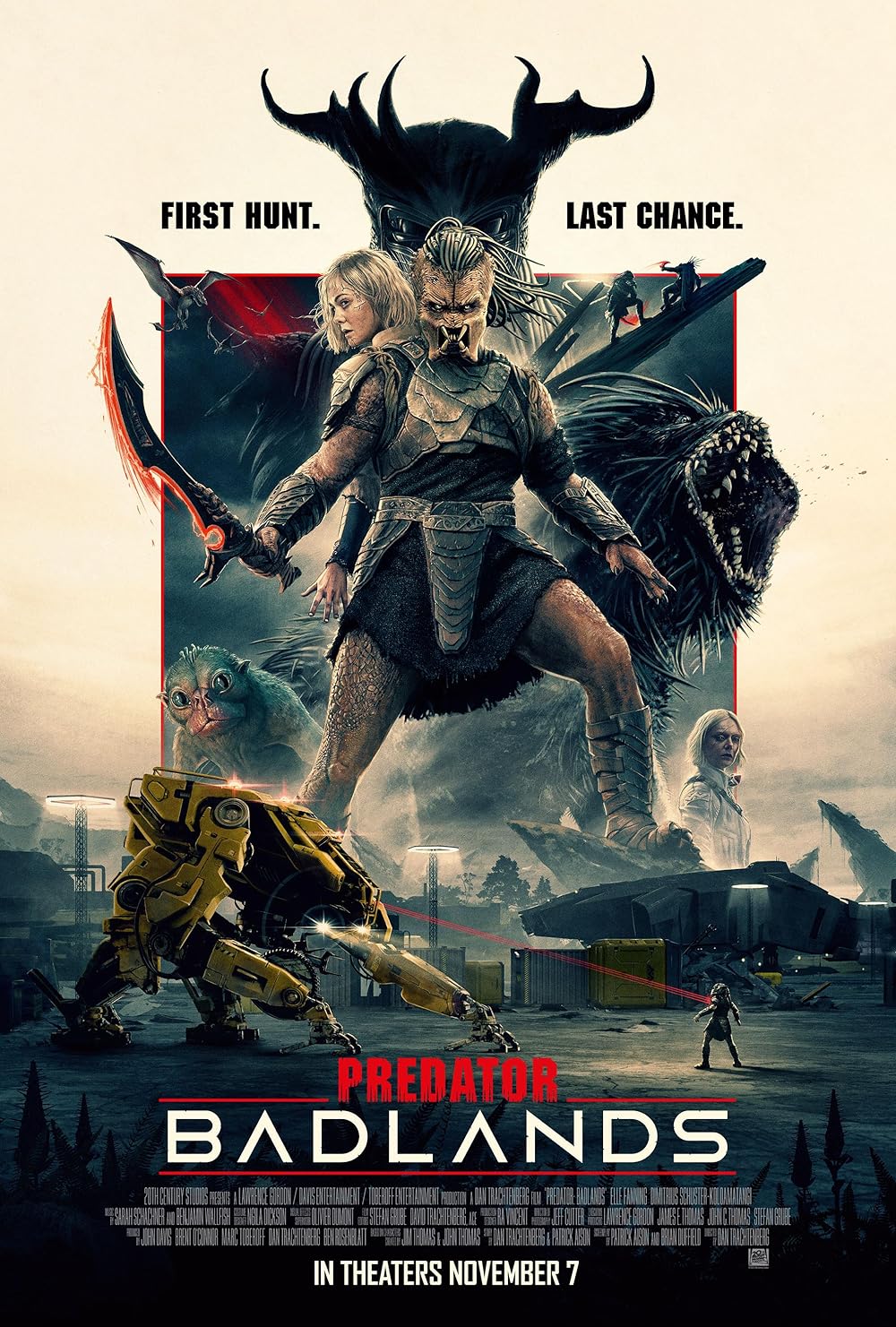
Predator: Badlands is the equivalent of a “Let’s Play,” but with bigger explosions. The nonstop action, constant motion offer little to no substantive emotional investment. You’re an observer, not a participant—which might be fine for streaming, but it’s a strange fit for cinema. The latest in the Predator franchise plays like a two-hour sizzle reel with delusions of grandeur. It’s a glossy barrage of explosions, digital dust, and quippy one-liners that evaporate before they even hit the floor. By the time the credits roll–that’s if you haven’t fallen asleep—you’ve seen everything and felt nothing. It’s not that the film is aggressively bad—it’s that it’s aggressively empty–little more than content to pander to short attention spans with shiny movement instead of meaningful momentum.

Cast out from its clan, a Predator and an unlikely synthetic ally embark on a treacherous journey in search of the ultimate adversary.

The screenplay feels like it was written by an algorithm trained on reaction videos and Reddit threads. Every line of dialogue sounds like a placeholder; it’s as if someone said, “We’ll fix it later” or “funny line here,” and neglected to return to the page in order to fix it–before principle photography. There’s no sense of escalation, tension, or rhythm; it’s a series of flashy moments loosely stitched together, like a highlight reel of a game you didn’t play. Even the humor feels synthetic–much like the characters– punching at air instead of connecting with character or tone.

As for the characters, they exist mostly as camera targets. They are little more than digital avatars running, shooting, and shouting for reasons that never feel personal or compelling. The lead could be replaced by a different actor mid-film and you might not notice. This critic isn’t even convinced that Dek (our central Predator character) wasn’t entirely CGI, though it may have only been the facial area. “What’s my motivation?” Difficult to say–there wasn’t much upon which to build. Motivations are paper-thin, arcs nonexistent. The Predator itself, once a symbol of primal fear and unseen menace, now feels like a boss-level NPC waiting to be triggered by the next quick-time event.

Visually, Badlands has all the spectacle money can buy; but its spectacle is divorced from any meaningful purpose. The explosions are massive, the sound mix thunderous, and yet it’s as emotionally engaging as watching someone else play Call of Duty. Every frame screams “look at me!” without ever inviting you to feel something. The editing, too, is manic. And it’s not even as though the narrative demanded it; rather, the dynamic editing was most likely employed because the movie was terrified that you’d look away or down at your watch, which I did several times.

And maybe that’s the point. Predator: Badlands is far less like a movie and more like a cinematic exercise in a large scale “Let’s Play.” For those that are unfamiliar with the term, it’s a type of (usually) YouTube video of someone playing a video game and often their reactions to the game play. Think of it as a passive experience of someone else’s thrill ride. The ultimate, disconnected form of living vicariously. Don’t question anything, because it won’t take long to realize that this movie is hollow. You don’t engage; you just witness. The irony is that the film could’ve been a fascinating critique of screen-mediated experiences, but it never once stops to think.

This is just the latest in a growing trend from Disney’s genre arm: a reliance on brand nostalgia and visual polish in place of storytelling. Ever since the corporate appetite turned to IP recycling, the studio has mistaken familiarity for depth. Badlands is what happens when you try to “optimize engagement” instead of crafting a narrative, resulting in the film equivalent of clickbait dressed in billion-dollar armor.

Predator: Badlands doesn’t so much hunt its audience as it does chase its own tail. A movie that is fast, flashy, and utterly pointless; and desperately wants to go viral but forgets to be cinema. You don’t leave exhilarated; you leave wondering if you accidentally spent $15 to watch a YouTube compilation in IMAX.
Ryan is the general manager for 90.7 WKGC Public Media and host of the show ReelTalk “where you can join the cinematic conversations frame by frame each week.” Additionally, he is the author of the upcoming film studies book titled Monsters, Madness, and Mayhem: Why People Love Horror. After teaching film studies for over eight years at the University of Tampa, he transitioned from the classroom to public media. He is a member of the Critics Association of Central Florida and Indie Film Critics of America. If you like this article, check out the others and FOLLOW this blog! Follow him on Twitter: RLTerry1 and LetterBoxd: RLTerry
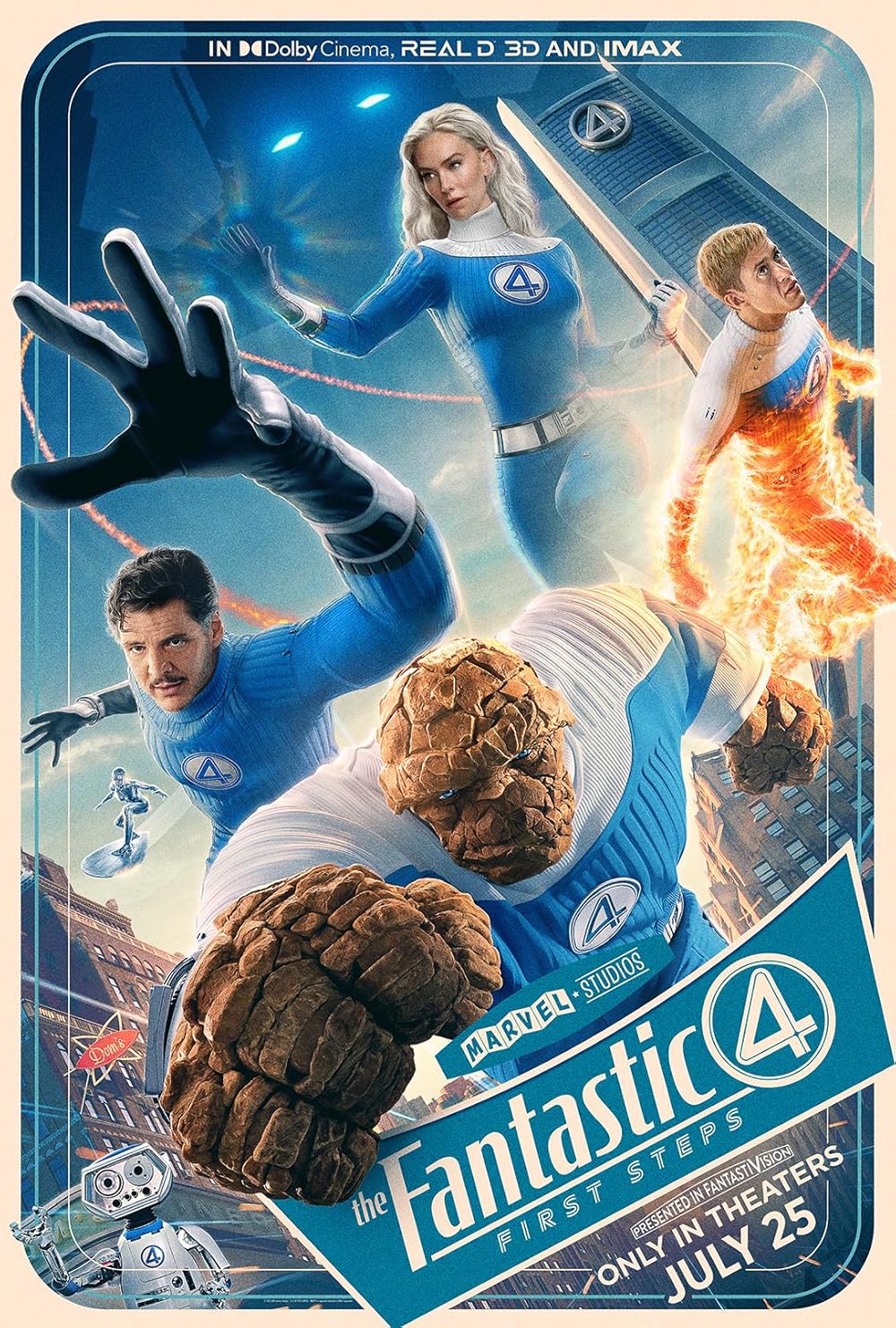
THE FANTASTIC FOUR: FIRST STEPS movie review

Fantastic? Let’s not get ahead of ourselves. Somewhere, Doctor Doom is laughing—because the real villain here is the script. The Fantastic Four: First Steps is a superhero movie that boasts an eye-catching retrofuturistic aesthetic and the welcome return of a classically evil villain, but it stumbles narratively with a lopsided screenplay, fragmented character dynamics, and a superfluous Silver Surfer who’s more prop than presence. With a protracted first act, truncated second act, and anticlimactic third, the swing the screenplay makes results in a foul ball–not a complete miss. Ultimately, it feels like a blueprint more than a building—an origin story more concerned with establishing than enthralling. It may offer the glimmer of potential, but that potential is still waiting for a film that knows how to make the most of these characters and each other. For a franchise reboot that proudly wears its Jet Age design language on its sleeve—from sleek, chrome-laced laboratories to wardrobe choices evocative of a Tomorrowland dreamscape—it’s ironic that the narrative propulsion of First Steps feels so grounded.

Mister Fantastic, Invisible Woman, Human Torch, and the Thing face must defend the Earth against the evil Galactus and his henchman Silver Surfer.

One of Fantastic Four: First Steps‘ undeniable triumphs is its commitment to a bold, 1960s retrofuturistic aesthetic that feels lovingly ripped from the pages of a Silver Age comic book or the Saturday morning cartoons of yesteryear. From the clean, curved architecture to the brightly colored jumpsuits and analog-style gadgetry, the film creates a world brimming with mid-century optimism—where science gleams, and adventure is just a rocket launch away. It’s visually delightful, evoking a kind of lost future that’s both nostalgic and fresh. However, the illusion occasionally falters due to jarring technological inconsistencies—most notably, the inexplicable presence of flying police cars in a world where most other vehicles appear rooted in vintage combustion-era design. And, I’d be remiss not to mention the futuristic pregnancy test that doesn’t jive with the world around it. These moments by no means sink the aesthetic, but they do momentarily snap the viewer out of the carefully constructed retro bubble.

Had the screenplay been better developed, then it may have been a “fantastic” superhero movie. The first act overstays its welcome by devoting undue time to setup that borders on exposition overload. By the time the plot remembers to move forward, the second act breezes by in a montage-like sequence of conflicts and discoveries, depriving the audience of organic development. Then, just as stakes are positioned to crescendo, the third act fumbles its own climax—settling for a resolution that feels more contractual than cathartic. While I appreciate the under two-hour runtime, I would not be surprised if there are entire scenes and sequences left on the cutting room floor.

But the most glaring issue isn’t pacing—it’s people. Or rather, the lack of connection between them. The titular quartet never quite gels. Chemistry between Reed, Sue, Johnny, and Ben is virtually nonexistent, with interactions that feel less like family dynamics and more like coworkers meeting on a Monday morning Zoom call. Attempts at humor or sentimentality fall flat, not because the lines are poorly written (though many are), but because the actors rarely feel like they’re occupying the same emotional wavelength. Pescall and Kirby have solid chemistry, and separately Quinn and Moss-Bachrach have fantastic comedic chemistry; but collectively, Marvel’s first family is lacking in sufficient chemistry. However, compared to previous cinematic attempts, seeking to adapt the Fantastic 4 for the big screen, this one is the strongest attempt.

Silver Surfer’s inclusion is more puzzling than pivotal. A character of mythic stature reduced here to a glorified Uber driver with a shiny board. She floats in and out of scenes with little impact on the plot, contributing neither urgency nor depth. Her presence suggests a franchise desperate to expand its cosmic CV but unsure of how to weave her meaningfully into the narrative tapestry. In fact, Silver Surfer could be removed from the story, and pretty much everything plat out much in the same way. No mistaking it, there IS an interesting backstory there, but it was barely tapped and even less developed. I am not suggesting Silver Surfer needs a movie or TV series, but a few more minutes of development in this movie, wouldn’t have hurt anything.

I did enjoy the refreshing return of a classic villain in Galactus. So often, modern cinema and television go to great lengths to demonstrate how villains are merely misunderstood or solely formed by societal factors–not Galactus. He’s neither misunderstood nor sympathetic. Just evil. In an era where antagonists are often softened by tragic backstories or moral ambiguity, the choice to lean into a classically malevolent foe is surprisingly refreshing. The character brings weight and threat to the film, standing as a stark reminder that sometimes the best villains are the ones who like being bad.

To the movie’s credit, audiences can watch it without having to know much about the Fantastic 4 and there is little need to watch any preceding movies or TV series. That said, I’ve been told that there are TV series and movies that will help to better understand or appreciate certain elements–but not required. When it’s all said and done, The Fantastic Four: the First Steps is sufficiently enjoyable and doesn’t overstay its welcome. Feels like a late summer movie, and there’s nothing innately wrong with that.

Ryan is the general manager for 90.7 WKGC Public Media in Panama City and host of the public radio show ReelTalk “where you can join the cinematic conversations frame by frame each week.” Additionally, he is the author of the upcoming film studies book titled Monsters, Madness, and Mayhem: Why People Love Horror. After teaching film studies for over eight years at the University of Tampa, he transitioned from the classroom to public media. He is a member of the Critics Association of Central Florida and Indie Film Critics of America. If you like this article, check out the others and FOLLOW this blog! Follow him on Twitter: RLTerry1 and LetterBoxd: RLTerry
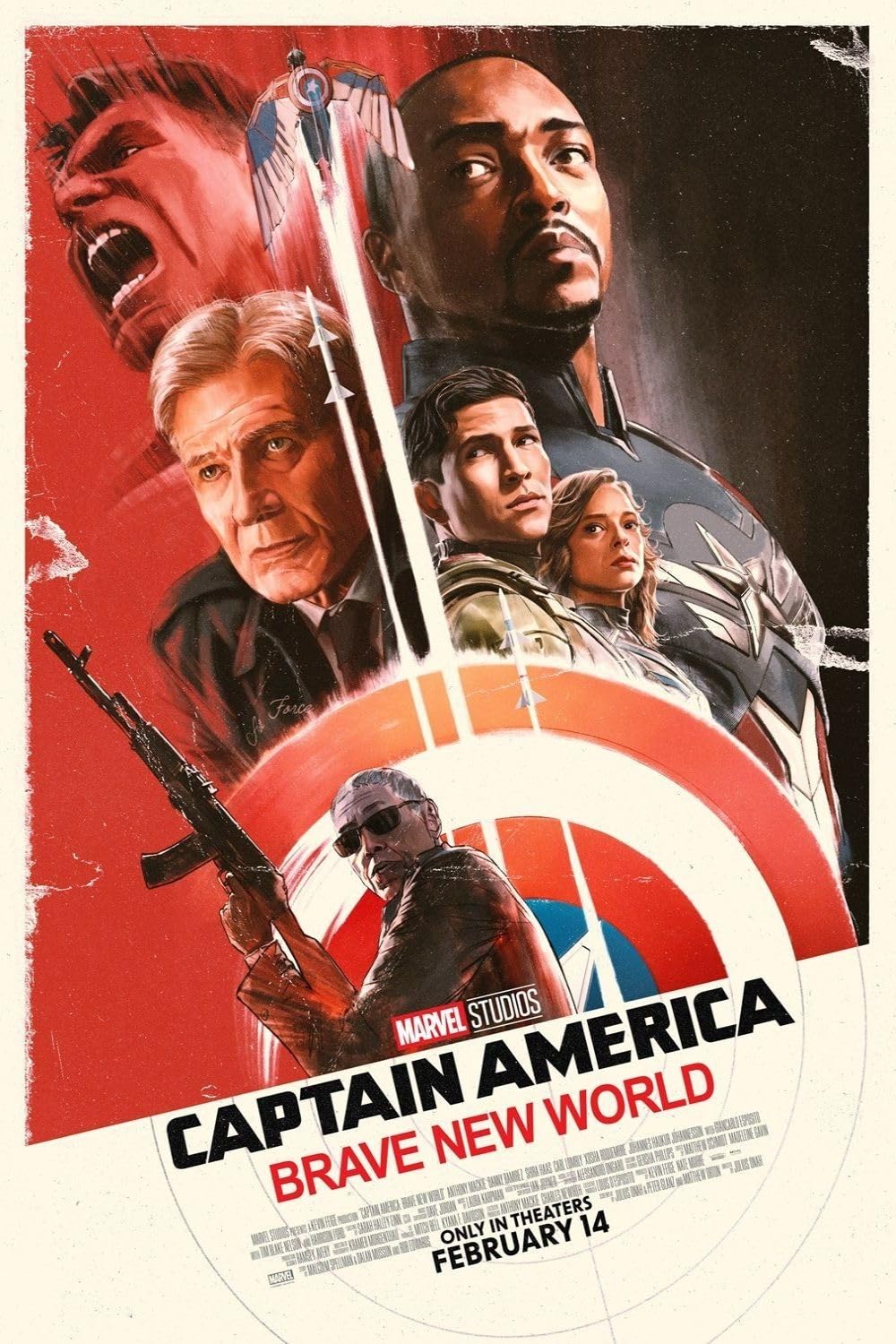
CAPTAIN AMERICA: BRAVE NEW WORLD movie review

Disney+: the Movie. The latest installment in the MCU feels like a Disney+ episode or show idea that was artificially inflated into a feature film. Captain America: Brave New World neither has the intrigue of an espionage thriller nor the excitement of a superhero movie. The plotting unfolds in a manner reminiscent of a serialized television series, evidenced by disjointed scenes that could very well function as individual episodes respectively. The movie is also plagued with gross levels of slapdash, uninspiring CGI that take an already vapid story and reinforce the one-dimensional delivery. From beginning to end, the pacing issues are evidenced by the diegetic momentum that ramps up then fizzles repeatedly causing any modicum of suspense or urgency to diminish as soon as it forms, resulting in a mitigation any potential of a cinematic spectacular.

Sam finds himself in the middle of an international incident after meeting with President Thaddeus Ross. He must soon discover the reason behind a nefarious global plot before the true mastermind has the entire world seeing red.

Captain America: Brave New World exemplifies the trend of blurring the lines between television and cinema. The long and short of it is: the significant influence the MCU TV shows have had upon the theatrical releases. This observation is two-fold (1) screenwriting and (2) technical achievement. While the former is the more significant problem, the latter is the easiest to identify. Specifically, the movie’s color grading, shot composition, and digital effects are nearly indistinguishable from MCU streaming series on Disney+. Unfortunately, this blurring of the lines between cinema and television results in a lack of the grandeur typically associated with MCU theatrical releases.

The latter could be more forgivable is the former was of a higher caliber. While writer Rob Edwards has certainly demonstrated his gift for screenwriting in previous Disney films (the Academy Award nominated Treasure Planet, being one), the other two writers have primarily worked in Disney+ television–and it shows–in spades. The plotting, pacing, character development (or lack thereof, as it were) is straight out of Disney+. The lack of urgency and stakes are also problematic, as well as the near absence of the “fun” factor. I will be the first to acknowledge that I don’t typically care for comic book or superhero movies; that said, even I will admit that the the first two phases of the MCU were (mostly, anyway) fun popcorn movies. Not the case with this latest installment. If the movie wasn’t going to be fun, then it should’ve been intriguing or spellbinding–not the case either. It’s pretty average all the way around.

I will forever be a champion for practical effects–even practical effects that are supplemented with CGI. But this movie screams TV-budget CGI the whole time. This is particularly true in the rather anticlimactic showdown. You cannot replace the way real light bounces off real objects into the camera lens, and this movie demonstrates the danger in relying heavily on CGI in an attempt to wow the audience. The strength of a picture should be in the plotting, subtext, and character development–not in the CGI. Since the movie was not going to lean into the fun factor, the CGI should’ve been dialed way back.

Even though it was wonderful to see Harrison Ford on the big screen again, he appeared to have been experience little fun while making this movie; furthermore, the performance was pretty well phoned in. Likewise, Anthony Mackie was not himself as Sam. This Sam was greatly lacking in charisma and wit. While his performance may not have been as phoned-in as Ford’s, there was still a flatness to the performative dimension. Danny Ramirez, however, did appear to be having fun on this movie, and I would’ve liked to have seen him given more to do in order to draw me into the story.

Captain America: Brave New World struggles to distinguish itself as a cinematic experience, with its disjoined plot, production quality, and lack of meaningful character development, resulting in a movie that appears to have far more in common with a Disney+ television series than with a feature motion picture.

Ryan is the general manager for 90.7 WKGC Public Media in Panama City and host of the public radio show ReelTalk about all things cinema. Additionally, he is the author of the upcoming film studies book titled Monsters, Madness, and Mayhem: Why People Love Horror. After teaching film studies for over eight years at the University of Tampa, he transitioned from the classroom to public media. He is a member of the Critics Association of Central Florida and Indie Film Critics of America. If you like this article, check out the others and FOLLOW this blog! Follow him on Twitter: RLTerry1 and LetterBoxd: RLTerry
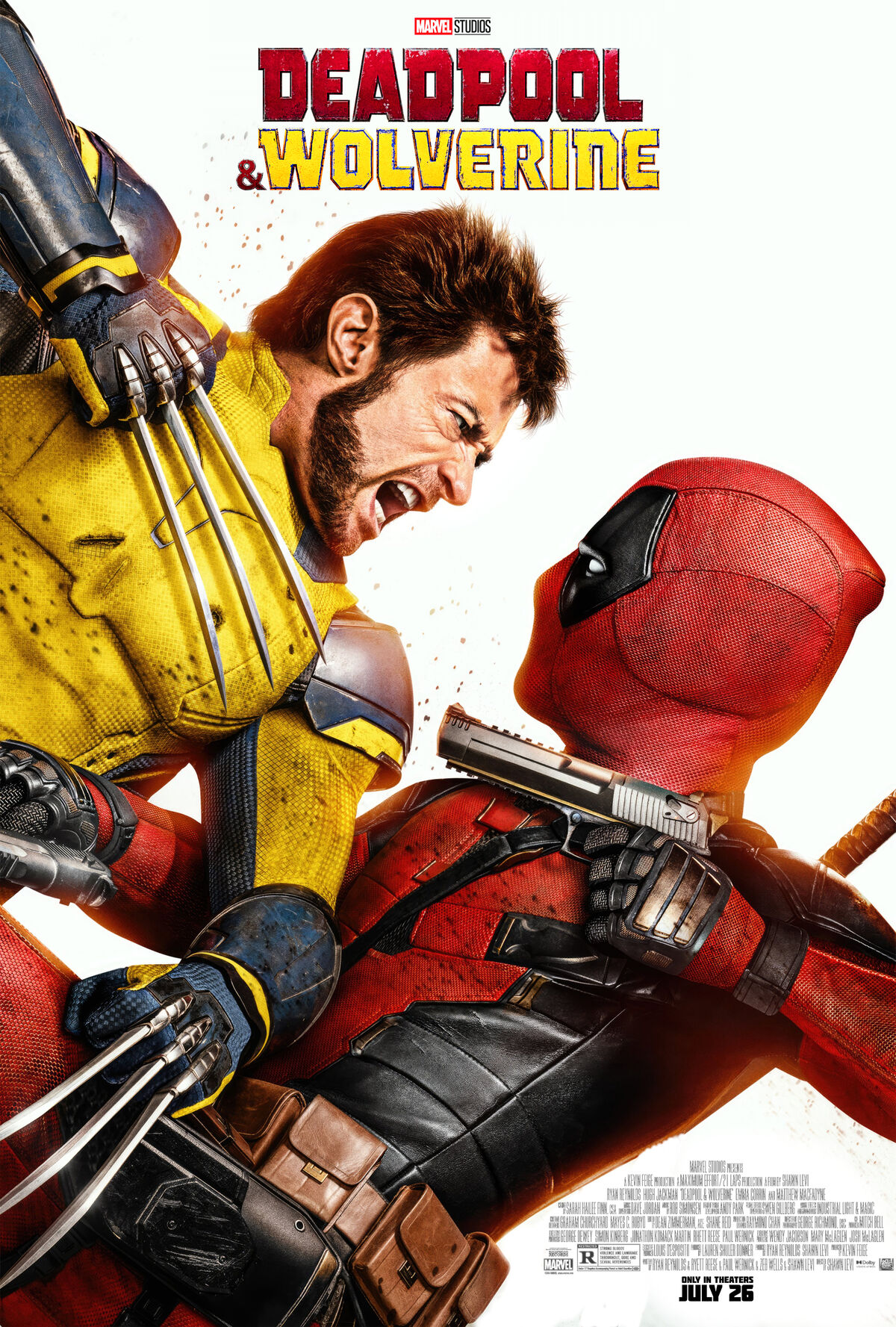
DEADPOOL & WOLVERINE movie review

Exhausting. Deadpool & Wolverine is a step down from its predecessors in terms of quality and cleverness of storytelling. While clearly intended to be a movie that reinvigorates the MCU, the screenwriting is both pandering and derivative. While effective in smaller doses, the hyper-meta humor is overplayed to the point of being obnoxious. Moreover, there are many gags that are recurring to the point of boredom. While expertly choreographed, shot, and edited, the endless barrage of fight sequences overstays its welcome. In terms of the premise, the whole multiverse idea that has been integrated into so many superhero movies (both MCU and DCEU) is overplayed. Had the movie been closer to 90-100 minutes, then perhaps the pacing would’ve been better and the Deadpool jokes, satire, and gags would not have felt overplayed, but the 2+ hours runtime works against the full potential of the narrative. If you can’t get enough of the Deadpool schtick, then you’ll undoubtedly like this movie. But if you were hoping for something as clever as the first two Deadpool movies, then you may be as disappointed as was I.

When the multiverse is threatened by a powerful Omega class mutant, Deadpool’s services are retained to protect the multiverse from complete collapse. In order to defeat this new deadly enemy, Deadpool teams up with the Wolverine, whom is recovering from psychological injuries.

Because of the movie’s setup, I had hoped that Deadpool and Wolverine’s goal would have been to eliminate all timelines except the sacred timeline (I guess that’s supposed to be the real/our world), putting an end to the multiverse, but that wasn’t the motivation or goal. So, I suppose that means the multiverse theory will continue steamrolling through this and other franchises. The whole multiverse theory needs to die. At this point, it is way past its half-life and rather limiting on the stories that can be told. Sounds counterintuitive, right? For how could a multiverse limit the stories that can be told? Simple. Everything is connected in a codependent sort of way. In a cinematic (including television counterparts) multiverse, no story, character, or plot is truly independent of the other; therefore, a filmmaker is unable to craft an original story; for any story involving the characters in a multiverse, has to fit in with the rest of the multiverse.

In a manner of speaking, a multiverse actually mitigates freedom of expression and variety of storytelling. When filmmakers return to crafting original expressions of stories and plots for comic book characters, then the quality of comic book movies may agin reach the levels of the Burton-verse. To this day, Batman 89 and Batman Returns are still the two best examples of superhero/comic book movies with X-Men the Animated Series being the best example of a superhero/CBM television series.

Fortunately, Hugh Jackman’s Wolverine’s gritty, no nonsense personality helps to balance out Ryan Reynolds’ manic Deadpool. While I have many reservations with this movie, I cannot deny the great chemistry between the two of them. Jackman’s X-Men the Animated Series inspired Wolverine was my favorite part of the whole movie. Partly because I grew up with X-Men TAS and have enjoyed the X-Men 97 series. Seeing that yellow and blue suit filled me with such happiness. Additionally, there are other nods to X-Men TAS and the Fox X-Men movies, including a particular surprise cameo that I know my friend Shawn of the Solving for X podcast will immensely enjoy! (If you’re an X-Men fan, then you should add this podcast to your lineup). What I liked most about this movie was the X-Men dynamic. Even though I have my reservations, I am curious how this newest iteration of cinematic X-Men will be adapted for the big screen. It is my hope that it will have the quality of storytelling of X-Men TAS that successfully addressed difficult topics in the real world both creatively and accessibly, all while bringing everyone to the table. Just as Professor X dreamed humans and mutants could engage in meaningful discourse one day.

Breaking the fourth wall and meta-humor can be effective tools for both humor and plot/character development; however, recurring pot shots and real-world references detract from the cleverness of the humor, and can ultimately take the viewer out of the movie. More so than the previous installments in the Deadpool franchise, this one is particularly packed with, what I am calling, hyper-meta humor. Hyper in that it’s so over the top and repetitive that it loses its charm quickly and grows stale. Most movies serve as a means of escape from the dullness, harshness, or complexities of reality; this is certainly true of superhero/comic book movies–or rather, was. I don’t know about you, but I don’t go into most movies hoping to be reminded of reality. Unless of course, for example, it’s based on a true story or a melodrama that is intended to evoke a real-world emotive response. So many of the jokes in Deadpool & Wolverine take me out of the movie, especially one recurring pot shot, that I won’t mention, that is borderline disrespectful of an historic Hollywood institution.

Despite most of the movie, in my opinion, to be lacking in genuine, clever humor, I manages to at least laugh here and there. The problem with a movie built entirely on the humor of middle school boys is that the move is ironically inappropriate for that same age group. When the first Deadpool released (by 20th Century Fox), they did the responsible thing by reminding parents that, even though this was a superhero movie, that its intended audience was 17+. I’ve yet to see an effort on Disney/Marvel’s part to remind potential audiences that this movie is rated R, and not appropriate for younger audiences due to the sexual innuendoes and language. Violence wise, other than the increased amount of blood, it’s on par with many PG-13 movies. When Deadpool hit the scene, he was different from that of most other superhero characters at that point, and his schtick was refreshingly funny; now, with the increased amount of middle school base humor in many comic book movies (mainly the MCU), it’s no longer refreshing and now borderline obnoxious. If I had to select one word that best describes Deadpool & Wolverine it would be obnoxious.

Ryan teaches Film Studies and Screenwriting at the University of Tampa and is a member of the Critics Association of Central Florida and Indie Film Critics of America. If you like this article, check out the others and FOLLOW this blog! Interested in Ryan making a guest appearance on your podcast or contributing to your website? Send him a DM on Twitter. If you’re ever in Tampa or Orlando, feel free to catch a movie with him.

Follow him on Twitter: RLTerry1 and LetterBoxd: RLTerry

INSIDE OUT 2 movie review

An entertaining and thoughtful exploration of the complexities of the human condition. And one of the best hockey movies ever! Disney-Pixar’s Inside Out 2, the highly anticipated followup to 2015’s Inside Out, builds upon the original to deliver a far better movie! At best, I find the original mediocre, so I was not anticipating to like the sequel. I was wrong. I had such a great time with this movie because it’s full of many laugh out loud moments. And not just that. But this movie delivers much stronger plotting and character development compared to the first movie and that which has been released by Disney/Pixar in the last several years. I find myself sending most of what Disney releases to the penalty box anymore these days, but not so with Inside Out 2. Perhaps this movie demonstrates a return to simple plots with complex characters that strike the right balance between humor and insight. Much better than its predecessor, this movie truly personifies the emotional complexities we develop as we get older. While our central character of Riley may be a 13 year-old girl, the lessons we learn from the movie are relevant for teens and adults alike. Between the thoughtfulness of storytelling the moments of hilarity, and the commentary on human emotion, this is a fantastic movie.

Joy, Sadness, Anger, Fear and Disgust have been running a successful operation by all accounts. However, when Anxiety shows up, they aren’t sure how to feel. Meanwhile, Riley is faed with the challenges of transitioning to high school and the desire to secure a place on the hockey team.

Inside Out 2 excels where Inside Out failed to deliver. Everything that transpires in this movie feels authentic, feels like an organic cause and effect sequence of events. Whereas in the first movie, clearly there was an overt attempt to elicit emotionally manipulative responses from the audience. The challenges Riles faces when learning her closest friends are going to a different high school and the desire to (1) land a spot on the high school hockey team and (2) build relationships that she can lean on when entering the world of high school, all feel close enough to reality to be believable yet there is still a whimsy about them. Where many movies fail these days is in proper plotting and pacing. Inside Out 2 satisfies both, and does so very well. We have a clearly defined central character with a clearly defined external goal motived by a clearly defined internal need, both of which are met with a character(s) of opposition. Yes, there is an emotional journey, which we have in the first one, but this one defines a measurable, external goal that Riley will either achieve or fail to achieve, thus raising the stakes.

One of the biggest changes between the first movie and this one is the degree to which humor is integrated into the story to balance out the more emotionally challenging moments. In fact, there are truly some laugh out loud comedic bits that I think adults will find even funnier than kids and teens. I won’t reveal any of those to you because I want you to experience them for yourselves, but there is a recurring gag that delivers every time. And the honesty about the emotions we all have and when they develop is also responsible for some of the humor. There is a refreshing candor about the expression and personification of emotions in the movie that makes the movie accessible for anyone, no matter where they are on their emotional journey.

This film also reminds us of the complexities of the human condition. There are so many areas of life that are not clear cut, black and white, right and wrong, and as such, these grey areas make life challenging. While the movie may not formalize this concept, as it is designed to be most accessible by kids and teens, one of the theses in the film posits that as we grow up, our ability to discern and reason are increasingly important as there are times we are faced with decisions that demonstrate no clear right or wrong direction, but both will have their own respective sets of consequences, both good and bad. The journey on which Riley and her emotions find themselves teaches them that both positive and negative experiences, successes and failures, and that which we regret are all needed to form our personality and value system.

Inside Out 2 is entertaining and thoughtful! Should you choose to watch it, I’m confident that you will find it as enjoyable as did I.

Ryan teaches Film Studies and Screenwriting at the University of Tampa and is a member of the Critics Association of Central Florida and Indie Film Critics of America. If you like this article, check out the others and FOLLOW this blog! Interested in Ryan making a guest appearance on your podcast or contributing to your website? Send him a DM on Twitter. If you’re ever in Tampa or Orlando, feel free to catch a movie with him.

Follow him on Twitter: RLTerry1 and LetterBoxd: RLTerry