INSIDE OUT 2 movie review

An entertaining and thoughtful exploration of the complexities of the human condition. And one of the best hockey movies ever! Disney-Pixar’s Inside Out 2, the highly anticipated followup to 2015’s Inside Out, builds upon the original to deliver a far better movie! At best, I find the original mediocre, so I was not anticipating to like the sequel. I was wrong. I had such a great time with this movie because it’s full of many laugh out loud moments. And not just that. But this movie delivers much stronger plotting and character development compared to the first movie and that which has been released by Disney/Pixar in the last several years. I find myself sending most of what Disney releases to the penalty box anymore these days, but not so with Inside Out 2. Perhaps this movie demonstrates a return to simple plots with complex characters that strike the right balance between humor and insight. Much better than its predecessor, this movie truly personifies the emotional complexities we develop as we get older. While our central character of Riley may be a 13 year-old girl, the lessons we learn from the movie are relevant for teens and adults alike. Between the thoughtfulness of storytelling the moments of hilarity, and the commentary on human emotion, this is a fantastic movie.

Joy, Sadness, Anger, Fear and Disgust have been running a successful operation by all accounts. However, when Anxiety shows up, they aren’t sure how to feel. Meanwhile, Riley is faed with the challenges of transitioning to high school and the desire to secure a place on the hockey team.

Inside Out 2 excels where Inside Out failed to deliver. Everything that transpires in this movie feels authentic, feels like an organic cause and effect sequence of events. Whereas in the first movie, clearly there was an overt attempt to elicit emotionally manipulative responses from the audience. The challenges Riles faces when learning her closest friends are going to a different high school and the desire to (1) land a spot on the high school hockey team and (2) build relationships that she can lean on when entering the world of high school, all feel close enough to reality to be believable yet there is still a whimsy about them. Where many movies fail these days is in proper plotting and pacing. Inside Out 2 satisfies both, and does so very well. We have a clearly defined central character with a clearly defined external goal motived by a clearly defined internal need, both of which are met with a character(s) of opposition. Yes, there is an emotional journey, which we have in the first one, but this one defines a measurable, external goal that Riley will either achieve or fail to achieve, thus raising the stakes.

One of the biggest changes between the first movie and this one is the degree to which humor is integrated into the story to balance out the more emotionally challenging moments. In fact, there are truly some laugh out loud comedic bits that I think adults will find even funnier than kids and teens. I won’t reveal any of those to you because I want you to experience them for yourselves, but there is a recurring gag that delivers every time. And the honesty about the emotions we all have and when they develop is also responsible for some of the humor. There is a refreshing candor about the expression and personification of emotions in the movie that makes the movie accessible for anyone, no matter where they are on their emotional journey.

This film also reminds us of the complexities of the human condition. There are so many areas of life that are not clear cut, black and white, right and wrong, and as such, these grey areas make life challenging. While the movie may not formalize this concept, as it is designed to be most accessible by kids and teens, one of the theses in the film posits that as we grow up, our ability to discern and reason are increasingly important as there are times we are faced with decisions that demonstrate no clear right or wrong direction, but both will have their own respective sets of consequences, both good and bad. The journey on which Riley and her emotions find themselves teaches them that both positive and negative experiences, successes and failures, and that which we regret are all needed to form our personality and value system.

Inside Out 2 is entertaining and thoughtful! Should you choose to watch it, I’m confident that you will find it as enjoyable as did I.
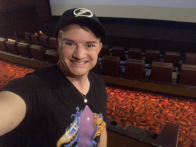
Ryan teaches Film Studies and Screenwriting at the University of Tampa and is a member of the Critics Association of Central Florida and Indie Film Critics of America. If you like this article, check out the others and FOLLOW this blog! Interested in Ryan making a guest appearance on your podcast or contributing to your website? Send him a DM on Twitter. If you’re ever in Tampa or Orlando, feel free to catch a movie with him.
Follow him on Twitter: RLTerry1 and LetterBoxd: RLTerry

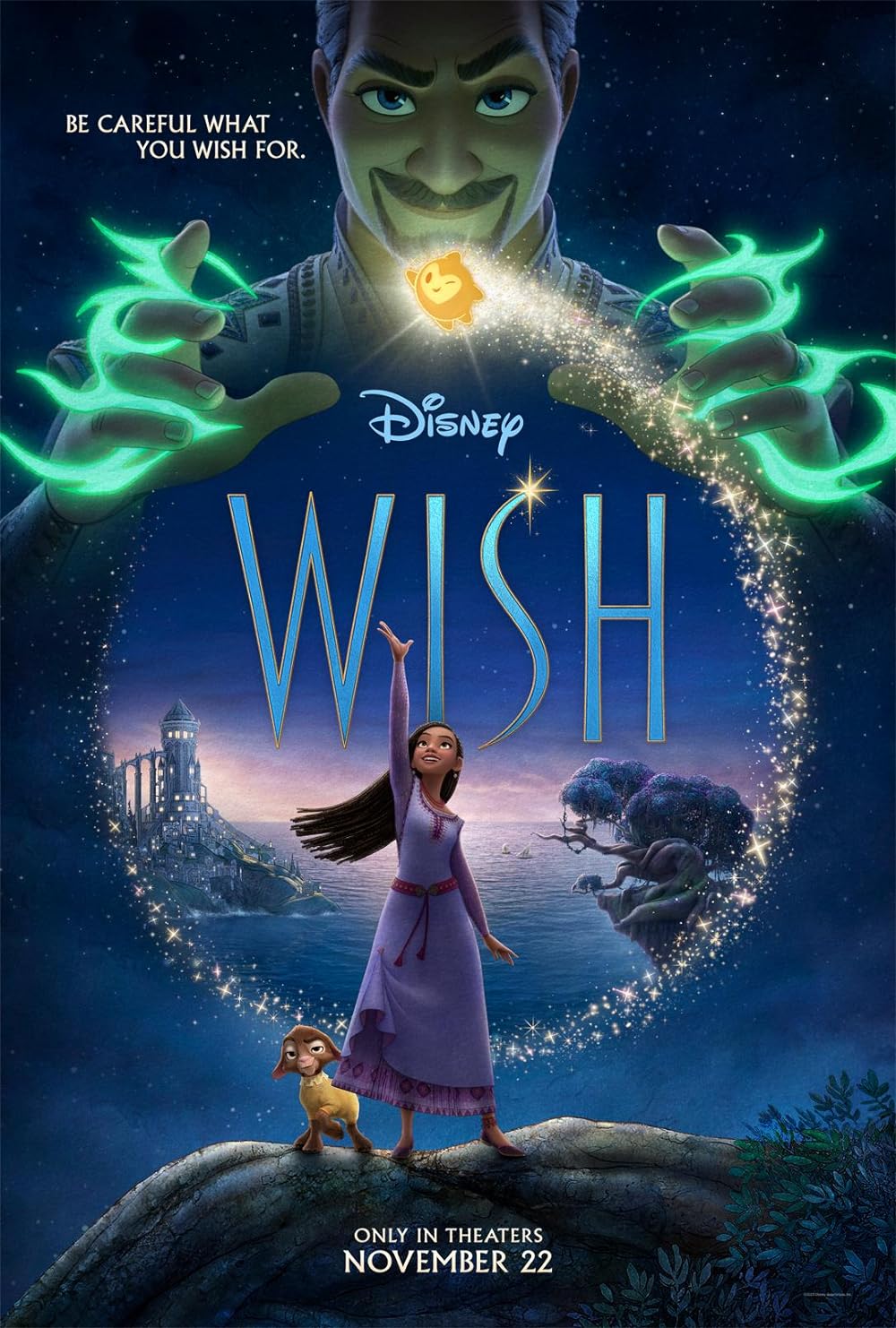
Disney’s WISH movie review

Disney should’ve wished upon a star for a better screenplay. But hey, at least we have an actual villain again! Wish attempts to be a return to the classic Disney animated feature form, but it fails to recapture the magic. Still, there are glimpses of that former Disney magic that are encouraging, and perhaps it’s a sign of what is to come in the next few years. And I am talking about the hand-drawn inspired matte-like backgrounds. Unfortunately, the CG cast and foreground elements detract from the magic of that classic Disney animation. Suffice it to say, the dichotomy of animation styles is distracting. Wish doesn’t have so much a story idea problem as it does a plotting and story execution problem, which plagues this movie. Moreover, what the movie lacks in thoughtful plotting, it strives to make up for in the musical numbers–forgettable as they may be. Most likely, the movie won’t be remembered for its story per se, but rather for the setups for future animated classic remakes as Wish is the origin story for the Disney wishing star. To that end, there are a couple of hidden Mickeys and moderately subtle nods to other Disney characters; and these nods are tastefully handled until they are not–and incredibly overt to the point of being obnoxious.

Young Asha makes a wish so powerful that it’s answered by a cosmic force, a little ball of boundless energy called Star. With Star’s help, Asha must save her kingdom from King Magnifico and prove that when the will of one courageous human connects with the magic of the stars, wondrous things can happen.

Even though I have many reservations in the execution of this movie, I admire it for the originality in creating an origin story for THE Disney wishing star, which we first witness in Disney’s Pinocchio. And the rest is history. This same star guides Peter Pan to Never Never Land, Cinderella wishes upon it, and so many more characters. To the screenwriters’ credit, the idea for Wish is a refreshing turn from the direction Disney movies (live action and animated) have been going for years now. All the building blocks for a great story and plot are there, but it’s as if the builders of the story didn’t follow the architect’s plans as closely as they should have. Suffice it to say: great idea, poorly executed. The result is rushed character and plot development.

Something that Wish does mostly well: it represents the return of the classically-inspired Disney villain. And while Magnifico can’t hold a candle to Ursula, Maleficent, the Horned King, or even Yzma (my personal favorite Disney villain), he does fill the vacancy that has been present since after The Princess and the Frog (2009) and Tangled (2010). For thirteen years, we’ve needed a villain, and Magnifico has shown us why. Nevermind that he isn’t nearly as memorable as the aforementioned villains, but he demonstrates why it’s important for a movie to have a villain. Yes, I am aware that (1) it’s more accurately described as a character of opposition and (2) the villain needn’t be the bad guy. But, I digress.

We love villains that we love to hate, or villains that are the flip side of the coin to our central character. In fact the best villains have many of the same attributes as our hero, and maybe even some of the same goals, but their methods of achieving these warped goals are twisted. At its most basic level, a well-written movie has a central character, that central character has an external goal motivated by an internal need, and there is a character standing between the central character and his or her goal.

The plotting may be weak, but the subtext and theming are quite strong! The movie provides commentary on ideas such as socialism, censorship, and authoritarianism. Unfortunately, I cannot get into all the supporting material without venturing into spoiler territory, but I want to spotlight the commentary, because it works well. The movie clearly demonstrates that the censorship of ideas can lead to a loss of uniqueness and individuality. And even the ability to learn and grow as unique individuals. This parallels the tyrannical banning of books in our public schools being experienced by some states in our country, including the one from which I write this review. One thing that the history of the world has taught us is that anytime mass censorship (often government or other large institution-based) is exerted upon a people, the society becomes a prison for those that live in it. They, in essence, become entrapped in Plato’s Cave allegory.

It’s difficult to get into all the details of how the movie provides a negative critique on socialism, but this theme can be read in the dark side of lofty promises of government-provided housing, occupational, food, and other resources. For there is a cost–and a great one at that. In the movie, this cost is expressed through wishes and Magnifico’s reign over the Kingdom of Rosas. Even though all the characters were enjoying the freely available resources of Rosas, in the end, they realize that nanny-like state took away individualism and freedom of choice. In a movie landscape that is ever-so-more-regularly advocating the advantages of socialism, this movie is a testament to “be care what you wish for” because everything in life does come at a cost. For the Kingdom of Rosas, it was wishes, for you, it maybe something entirely different but no less important to your individuality and freedom of choice.

Lastly, I want to touch on the magic of those hand-drawn-inspired backgrounds. There are so many scenes in which the background looks straight-up like a matte painting, and I love it! I wish the entire movie looked hand-drawn; it wouldn’t fix the story execution or screenwriting issues, but it would have given the movie a more magical, almost tangible quality. Hand-drawn animation (and I will include stop-motion animation in this critique) has real dimension. With stop-motion animation, the dimension is in the objects and the lighting thereof; with hand-drawn animation, the magic is in the imperfections and motion.

Specifically looking at Golden Age through The Black Cauldron, the hand-drawn animation had literal depth because of Walt’s patented multiplane camera. Artists would draw onto glass panes, layer and space them, and the camera would shoot the linear image, giving the two-dimensional image depth of field. The hand-drawn-inspired backgrounds of Wish are encouraging because this may be a sign of what is to come for Disney animation. Unfortunately, the magic gets lost in this movie because of the distracting dichotomy of animation styles. It’s removes the characters from the background, from the world in which they live, and you never quite buy these characters are part of the setting.

Perhaps Wish suffers from story execution problems, but there is hope that Disney animation may be making a turn for the better.

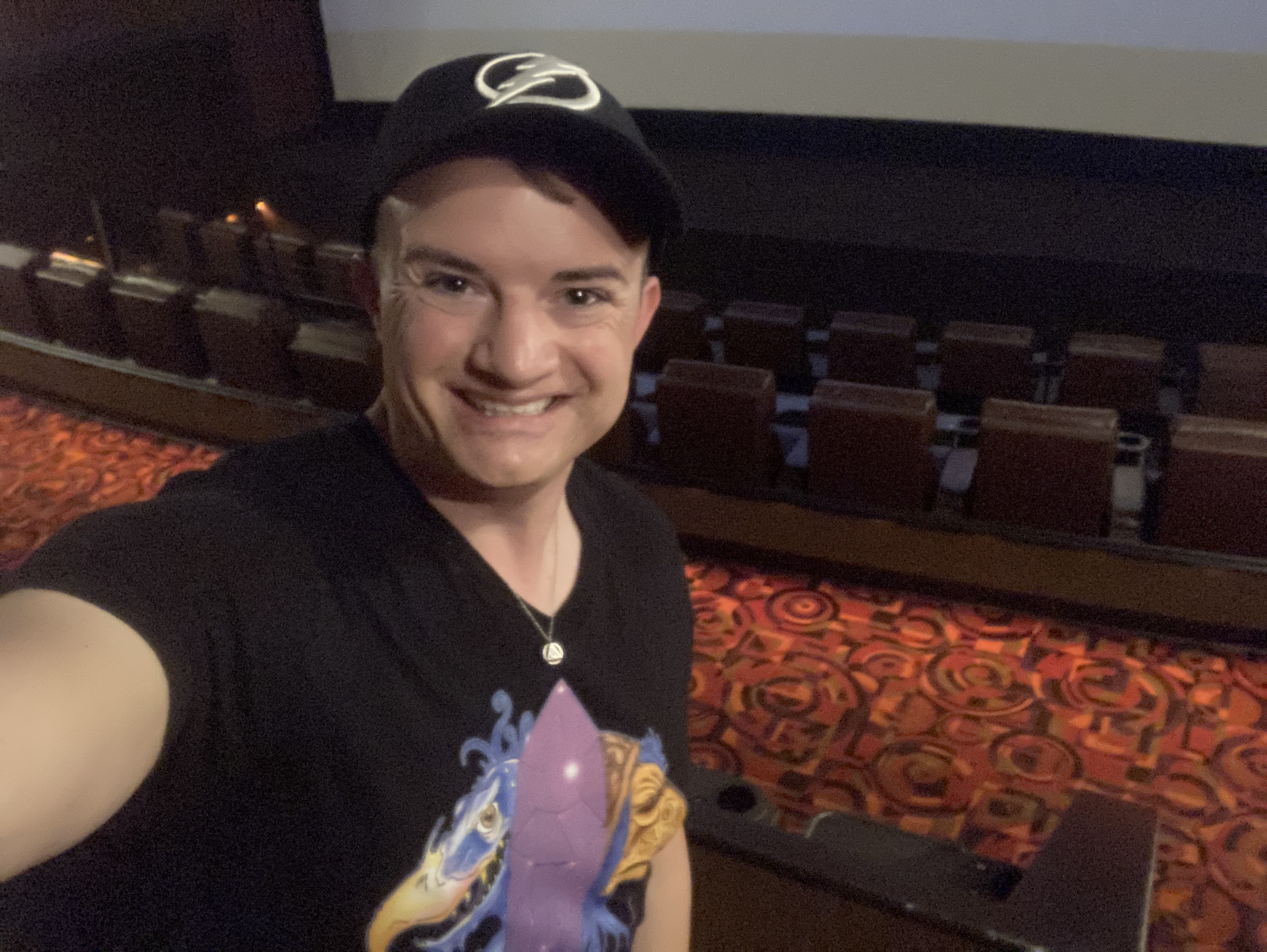
Ryan teaches Film Studies and Screenwriting at the University of Tampa and is a member of the Critics Association of Central Florida and Indie Film Critics of America. If you like this article, check out the others and FOLLOW this blog! Interested in Ryan making a guest appearance on your podcast or contributing to your website? Send him a DM on Twitter. If you’re ever in Tampa or Orlando, feel free to catch a movie with him.
Follow him on Twitter: RLTerry1 and LetterBoxd: RLTerry

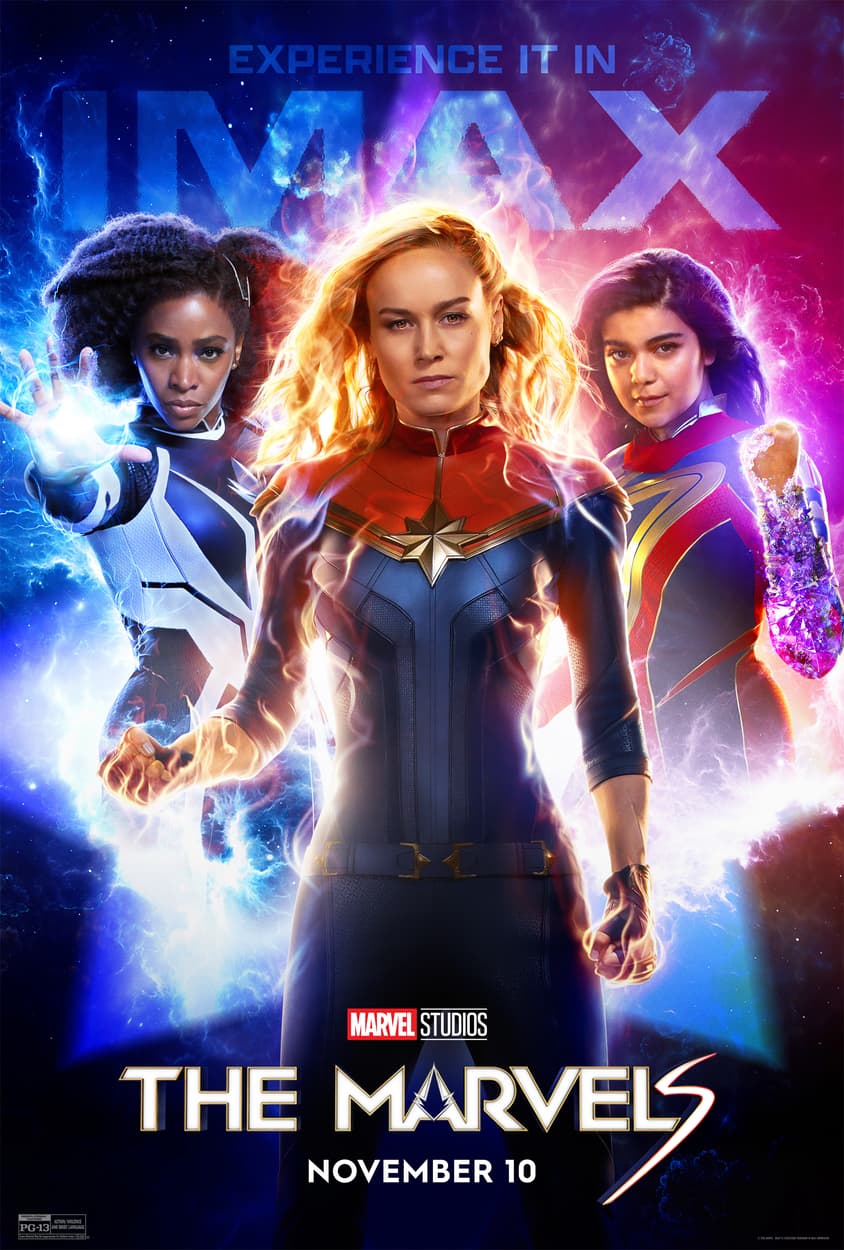
THE MARVELS movie review

by Amanda Firestone, Guest Contributor and Film Professor

I don’t know about you, but I’m burned out on superhero movies. By the time we got to Infinity War (2018) and Endgame (2019), I wasn’t sure I could sit through another CGI-explosion, epic battle fight fest. And I didn’t – until Wakanda Forever hit the screen (2022). While I loved seeing Shuri become Black Panther, that same drained feeling returned after two hours and forty-one minutes in the theater seat. Leaving the cinema, I complained to my spouse that superhero filmmakers squeeze in fight after fight, sacrificing tight storytelling. For what? I’m not sure.

Like Wakanda Forever, the draw for me to see The Marvels is the woman-led cast. When I look at the MCU lineup, I can’t help but notice that men’s stories are prioritized, particularly in Phases One and Two. While women characters are important to the teams or the general narratives, they frequently are outnumbered by their men counterparts. The Marvels unfailingly centers audiences on Carol Danvers, Monica Rambeau, and Kamala Khan. While the ever-present Nick Fury provides support, the three heroes strategize together to defeat their common enemy, Dar-Benn, who is also a woman.

In many ways, the joy of the film is the simplicity. It brings together three characters who initially have some friction. They build trust and confidence in their team, and then they fight the baddie. For my taste, Nia DaCosta understood the assignment; the movie is one hour and forty-five minutes long, and that means the pacing is solid without so many of those masturbatory fight scenes that bog down other Marvel films.

Another way that The Marvels avoids bloat is by bypassing frequent rehashing of MCU information. When I was leaving the theater, the critic behind me complained that he didn’t know what was going on because the film didn’t take the time to explain all of the backstories for the Marvels. He hadn’t seen their respective origin stories. We all know the MCU is sprawling, and very few fans are die-hard completists. The film spent the first 15-20 minutes introducing each character and situating her in her world. It was sufficient to say, “hey, this one’s a loner superhero; this one’s a teenaged superhero with a fangirl crush on the loner; this one’s a scientist superhero who has family drama with the loner.” For people who see The Marvels as their intro to the MCU, they have Captain Marvel, Ms. Marvel, and WandaVision to seek out if they want to add more layers to their knowledge. But, those other sources are not necessary to understand the heart of the movie – build a team and fight the baddie.

Speaking of villains, another success for this movie is Dar-Benn, a Kree Accuser who becomes emperor after the destruction of the Supreme Intelligence. The sun that her planet orbits is dying and as a result, so is the planet. Dar-Benn is a ruler on a mission to save her people – at any cost. While her methods are brutal, there’s a lot of empathy to be had for her, which makes her conflicts with The Marvels more interesting on an emotional level, particularly as we head to the final showdown.

I felt so much joy watching this film. Yes, there was some fanservice in the picture (one of the most dangerous creatures in the universe features prominently), and as a Marvel fan it’s nice to see those call backs. More than that, it was just an all-around great popcorn flick. There was a great balance of levity, seriousness, and intensity. I cared about the characters, and that’s especially true for the newcomers like Dar-Benn. It’s well-worth the cost of the ticket and the time.

Assessment 4.5/5 stars

Dr. Amanda Firestone is an Associate Teaching Professor at the University of Tampa where she teaches film and media studies classes including Women in Film. She is the co-editor of Resist and Persist: Essays on Social Revolution in 21st Century Narratives, Harry Potter and Convergence Culture: Essays on Fandom and the Expanding Potterverse, and The Last Midnight: Essays on Apocalyptic Narratives in Millennial Media

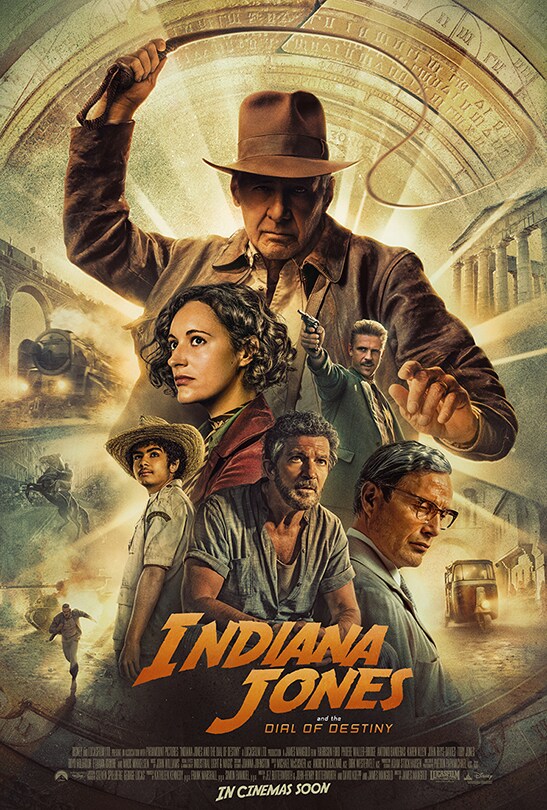
INDIANA JONES: AND THE DIAL OF DESTINY movie review

And the dial of mediocrity. While the movie’s charm lies in the classical action-adventure premise and tone, Harrison Ford’s final performance as the titular adventurous scholar ends with a forgettable movie devoid of the humor, tension, scale and scope of the first three Indiana Jones movies. Moreover, the screenplay suffers from poor pacing and lack of character-building. However, it’d be unfair to characterize the movie as being completely uninteresting. In fact, Indiana Jones: and the Dial of Destiny is a fun enough throwback movie for the whole family to enjoy.

Daredevil archaeologist Indiana Jones races against time to retrieve a legendary dial that can change the course of history. Accompanied by his goddaughter, he soon finds himself squaring off against Jürgen Voller, a former Nazi who works for NASA.

The James Mangold helmed fifth and final installment in the Indiana Jones franchise is neither bad nor good enough to be memorable. Moreover, neither does the movie deliver in setting nor technical achievement.

Speaking of technical achievement, any overly negative reports of the de-aging of Ford, in the protracted prologue, are greatly exaggerated, nor does the CGI in the rest of the movie feel obtuse or too overt. On the contrary, I was greatly concerned for the exchange of practical effects for CGI on the levels of being distracting. While I noticed here and there, it wasn’t what I would characterize as highly conspicuous.

Gone is the grand scale and scope of the first three Indiana Jones movies in exchange for a world that feels as if it could fit in a space the size of Guam. For an action-adventure movie, it struggles to deliver on either. If we boil it down to its storytelling DNA, does it check off the basic requirements of an action-adventure movie? Sure. I won’t take that away from the movie. But does it excel at any one of those elements? Aside from remaining clean enough for the whole family to enjoy, no, it does not. While it is certainly a better story than Crystal Skull, unfortunately, Crystal Skull is more memorable than this installment (albeit, for all the wrong reasons). Dial of Destiny certainly feels way closer to the first three Jones movies than Crystal Skull ever will. It is of the same DNA, but not expressed nearly as thoughtfully or charismatically as the original trilogy.

As I’ve stated countless times before, (except for rare occasions) when a movie’s writer (or editor) and director are the same person(s), then there fails to be a sufficient check and balance system narratively. Mangold has shown that he is capable of both, I cite Logan, but that was perhaps the exception while Dial is the rule. There is a good story in this movie, but nothing was executed by storytellers that truly cared. I was shocked to see David Koepp’s name attached to this movie, because he took Michael Crichton’s original Jurassic Park screenplay and shaped it into the masterful story we’ve been enjoying for three decades. Crichton provided the novel and screenplay bones and circulatory system, but Koepp crafted the muscle and skin. Dial of Destiny does not feel like a Koepp screenplay, but perhaps Mangold flexed his directorial muscles too much and Koepp’s genius was lost.

Oh, as an aside, no Helena, that’s just called stealing. Perhaps go back to school and take an economics class. Come to think of it, that would have been a funny Jones line in the movie. And the movie was in desperate need of comedic relief.

The movie opens with plundering Nazis, in classic Jones fashion, and we are introduced to a 30, 40-something Dr. Henry Jones Jr. The prologue (which makes up most of Act I) delivers all the trappings of a classic Indiana Jones movie, but it goes on, and on, and on for nearly a half-hour. And it wouldn’t’ be so bad if this half-an-hour significantly impacted events in Acts II and III, but it ultimately sets up very little. Is it a fun and somewhat exciting method for returning audiences to the 1930s and 40s world of Indiana Jones, definitely. But does it fail to justify its protracted sequence of events? Also yes. The movie’s pacing would have beeb greatly helped by cutting the prologue down to 10–15-minutes. Think: opening of Indiana Jones: and the Last Crusade. I’ve a feeling that’s what Mangold was going for in this movie.

There is one plot device that this prologue does foreshadow, and if you think it’s never going to go there, guess again. I’ll leave it at that to avoid spoilers.

I’d be remiss not to comment on the charm of the movie. While it may suffer from many problems that hold it back from reaching beyond mediocrity, there is no doubt that it delivers the throwback premise and tone we love about these classical action-adventure movies. I just wish it had more action and adventure in the storytelling mix. I appreciate the movie for remaining true to form (in its most simplistic form, but form nevertheless), and not increasing adult visual content or language in order to be perceived as with it. Increased adult content is not the mark of a franchise maturing over time, in fact, it’s a cheap gimmick that devalues. There are certainly times and places for it, but an Indiana Jones. movie was not it. So it can be praised for keeping the content, tone, and form of classical action-adventure alive–on life support–but alive.

Not sure why Disney is releasing this for the week of July the 4th, because it works much better as a Father’s Day movie.

Ryan teaches Film Studies and Screenwriting at the University of Tampa and is a member of the Critics Association of Central Florida and Indie Film Critics of America. If you like this article, check out the others and FOLLOW this blog! Interested in Ryan making a guest appearance on your podcast or contributing to your website? Send him a DM on Twitter. If you’re ever in Tampa or Orlando, feel free to catch a movie with him.

Follow him on Twitter: RLTerry1 and LetterBoxd: RLTerry

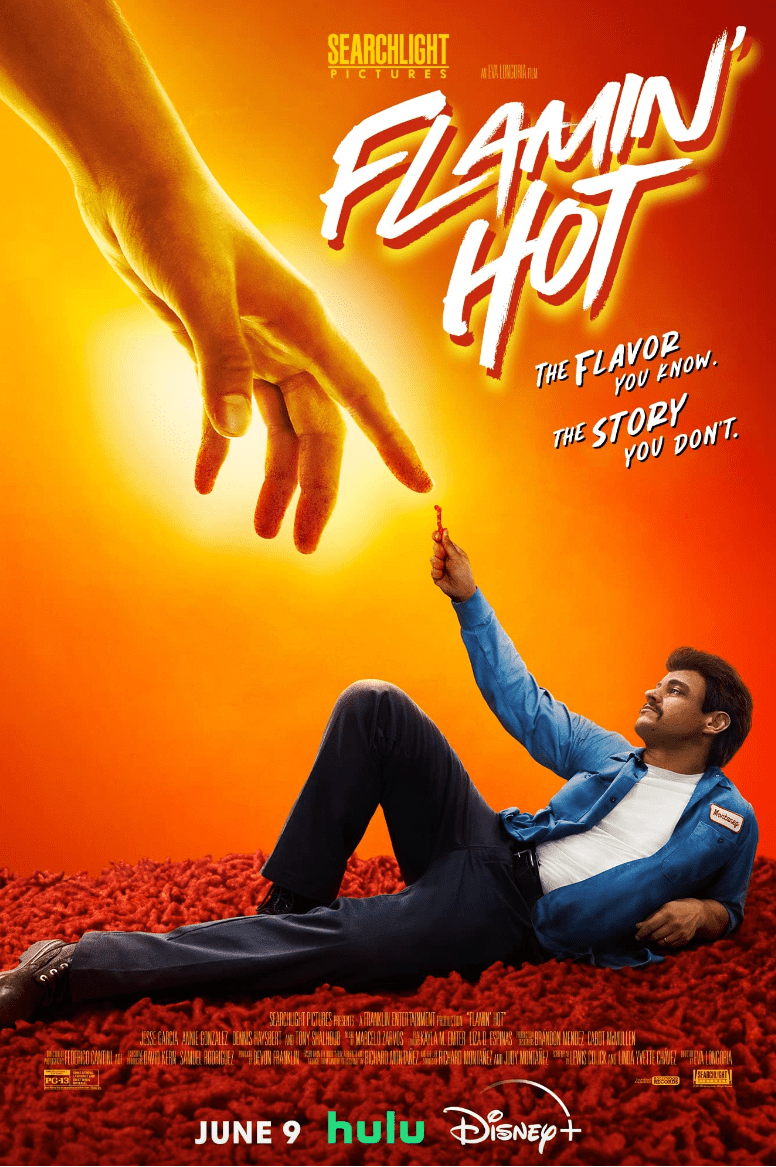
FLAMIN’ HOT movie mini review

Uplifting! Flamin’ Hot is a thoroughly enjoyable, motivational biopic that captivates audiences with the compelling story of Richard Montañez, the man who invented Flamin’ Hot Cheetos (and other Flamin’ Hot line items) and ostensibly saved his Southern California FritoLay plant from closure in the 90s. Directed by Eva Longoria and written by Lewis Colick and Linda Yvette Chávez, this movie delivers a more compelling story than AIR; however, Flamin Hot does not deliver as highly in the performative dimension. This is a movie for anyone that has ever felt like an underdog. Richard’s inspirational story serves as evidence that prayer, determination, resiliency, and refusal to allow one’s origin to determine one’s personal and professional destination, truly do work! Although the movie is tonally upbeat and even funny, it still affords intimate character moments. Structurally, the movie is well-paced and never hangs out in any scene longer than it needs. And it’s incredibly interesting! Just like AIR so successfully made the origin of a shoe captivating, the same can be said for Flamin’ Hot Cheetos.

If you’re seeking a picture that is inspirational, lean, and funny, then checkout Flamin’ Hot on Hulu and Disney+ starting June 9th.

Ryan teaches Film Studies and Screenwriting at the University of Tampa and is a member of the Critics Association of Central Florida and Indie Film Critics of America. If you like this article, check out the others and FOLLOW this blog! Interested in Ryan making a guest appearance on your podcast or contributing to your website? Send him a DM on Twitter. If you’re ever in Tampa or Orlando, feel free to catch a movie with him.
Follow him on Twitter: RLTerry1 and LetterBoxd: RLTerry