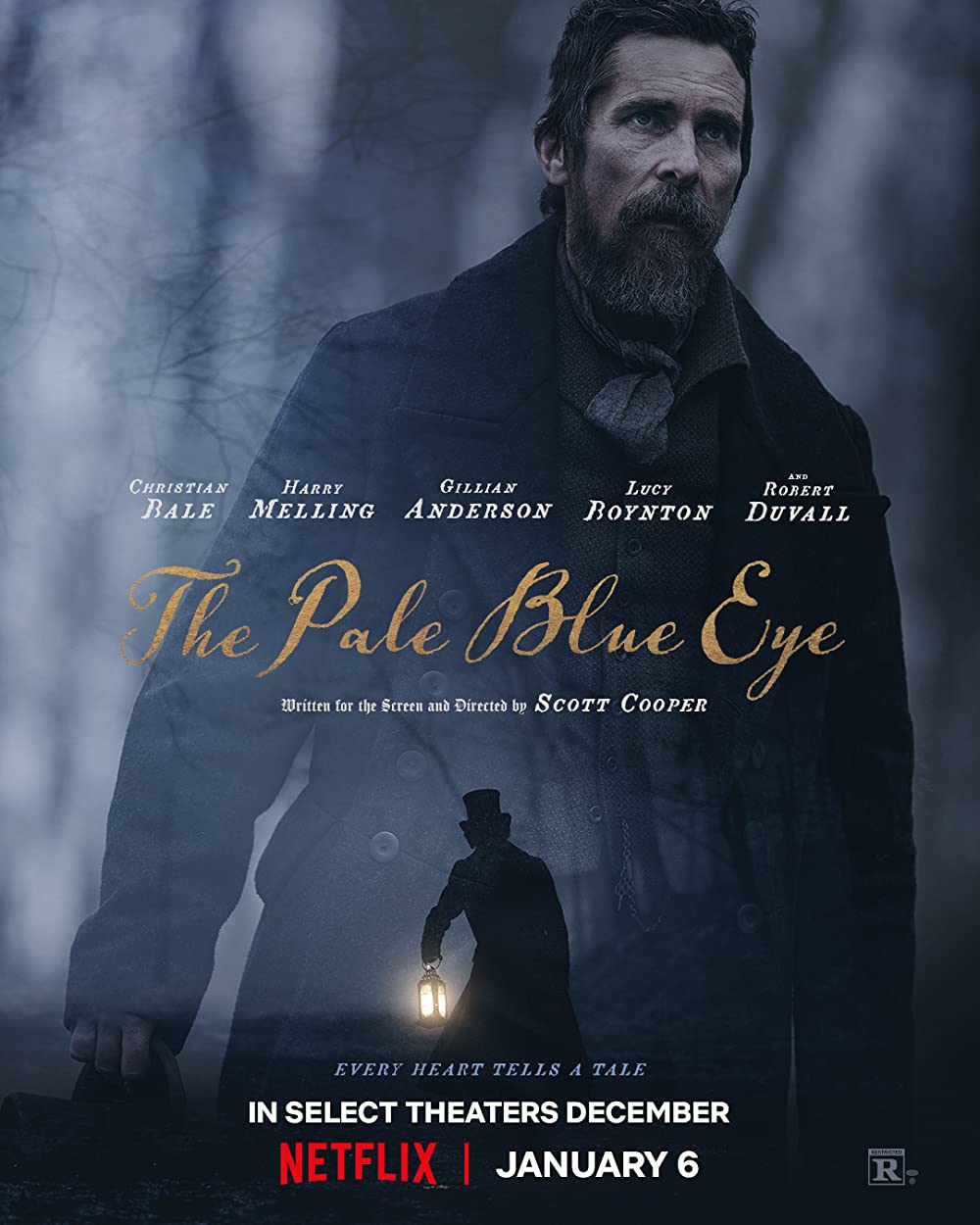
THE PALE BLUE EYE period mystery review

The unsettling atmosphere will transport, while the macabre mystery intrigues. Scott Cooper’s The Pale Blue Eye is both a period murder-mystery drama and serves as an imaginative origin story for Edgar Allan Poe. With skeletons in every character’s closet, the enigma of a mystery will beckon audiences to solve the mystery along with Christian Bale’s character. Based on the novel by the same name, the film adaptation is in the same vein as The Cursed from earlier this year and Antlers from last year. Both of which are among my favorites of the last two years. So, if you liked either of those films, you will mostly likely enjoy this one as well. In addition to the aforementioned, the film also reminds me a little of Tim Burton’s Sleepy Hollow (1999). Unlike the film’s to which I have likened this one, The Pale Blue Eye is heavier on mystery than it is horror. While Edgar Allan Poe’s short stories and poems have been the inspiration for hundreds of films, and his writing itself, foundational in the development of the American Horror Film (expressionism+surrealism+Freud+Poe), this is one of few films that feature Poe himself–or rather–a fictionalized version of the towering literary figure. What I appreciate about this imaginative origin story is showing a different side to Poe–a side that is actually funny and quirky. Because this is a mystery, I am unable to discuss details as that could spoil important plot points. But it’s important to note that this film’s mise-en-scene strikes a balance between one that is concerned with atmosphere and proper plotting. So often, films that are heavy on atmosphere are lacking in the story-structure department, but not this one. Despite the runtime of 2-hours, no scene ever lingers too long. If you enjoy period murder-mysteries, then you’ll undoubtedly enjoy this film. The Pale Blue Eye hits cinemas on December 23rd and Netflix on January 6th.

Ryan teaches Film Studies and Screenwriting at the University of Tampa and is a member of the Critics Association of Central Florida. If you like this article, check out the others and FOLLOW this blog! Interested in Ryan making a guest appearance on your podcast or contributing to your website? Send him a DM on Twitter. If you’re ever in Tampa or Orlando, feel free to catch a movie with him.

Follow him on Twitter: RLTerry1

BABYLON (2022) film review

Whoa, that’s a lot of movie. Damien Chazelle’s decadent film of bombastic proportions is simultaneously mesmerizing and repulsive, coherent and incoherent, thoughtful and thoughtless. Suffice it to say, it’s interesting to behold. This overstuffed fever dream collage of 1920s and 1930s Hollywood is trying to tell so many stories, that it winds up not telling any of them effectively enough. There are competing A-stories (outside/action plots), each vying for to be the story about which the audience empathizes with the most. To dramatize these ideas, Chazelle assembles a mise-en-scene that’s ostensibly a combination of Singin’ in the Rain, Boogie Nights, Sunset Boulevard, and Once Upon a Time in Hollywood, with a little Caligula and Wolf of Wall Street thrown in to provocative proportions. Ultimately, what we have here is more of an exercise in montage–the assembly of a motion picture–more so than we have a clearly defined narrative. Undoubtedly, this will become a film that is shown in film studies classes in the future, and will be used for close reading discussions, much like I show Boogie Nights in my American Cinema class. There is a prolific amount of imagery to analyze, as the film follows four different Hollywood stories that all intersect one another. Just for whom was the film created? Certainly not general audiences. It is likely going to be most appreciated by Chazelle himself and with some critics and scholars (tho, not this scholar nor the majority of the critics with whom I screened this film).

Decadence, depravity, and outrageous excess lead to the rise and fall of several ambitious dreamers in 1920s Hollywood.

One thing is clear, Chazelle’s intention was to craft a boisterous love letter to the allure and power of cinema whilst negatively critiquing the Hollywood system that creates and destroys careers on a whim. Furthermore, the film seeks to provide thoughtful commentary (just how thoughtful? that is for you to decide) on the superficial, fleeting nature of fame and celebrity. Where the film excels is in the both the performative dimension and Chazelle’s direction. Unfortunately, Chazelle’s screenplay is all over the place.

While audiences may not remember the four individual story threads that make up the outside/action plot, audiences will definitely remember the prologue and final scene. Chazelle certainly captures the unbridled decadence that is probably not unlike the level of debauchery that ran rampant after the great movie people migration from Europe (mostly Germany and France) and eastern U.S. (avoiding Edison’s motion picture patent policing) after the first World War. It was certainly the wild west with a seemingly unending source of money (coupled with massive debt). To borrow from Outback’s former slogan no rules, just right, that describes the atmosphere of the greater Los Angeles area. No order, only chaos. Which is not unlike this film–lots of chaotic images and plot points.

The prologue to Babylon is truly a spectacle that words simply cannot capture accurately. That’s not to say that all of the creative decisions were plot or character-driven–I’ve said it before–that even provocative imagery can be used to further the plot or character; and therefore, that which would otherwise be evaluated as gratuitous, is actually purposeful. However, much of what goes on in the opening scenes is simply gratuitous for the sake of shocking the audience–for an extended period of runtime. I am reminded of the opening to Boogie Nights, and how at first glance it may seem gratuitous, but actually the opening scene is needed for plot and character development. It’s not so much shocking as it is crafted for a strategic purpose.

While elements of the prologue are justifiable, in the relationship to plot and character, there are many moments that are no more than prolific debauchery simply because Chazelle could. Now, what I did find most interesting–and to the point that I greatly appreciate the prologue–is that much of the deplorable chaos is underscored by the score from Fritz Lang’s masterpiece Metropolis in the Babylon scene with MechaMaria. Something Chazelle wove into the scene for the film scholars in the crowd.

Jumping to the end of the film, there is a–what amounts to a–clip show featuring iconic films from the 100+ years of cinema history we have. I get it, Chazelle is communicating to audiences that being part of filmmaking means that you’re part of something bigger than yourself, something that will live on decades and (by extension) centuries after you pass away. It’s this artform that will continually be rediscovered and influence people and cultures (good, bad, or indifferent). While it’s clearly designed to be an emotionally moving moment in the film, as indicated by the tears in the character in that scene, it comes off as lazy, derivative montage that does little more than remind the audience of better films for the rather long sequence of imagery. Instead of being a deeply, moving scene, it’s rather vapid.

The four competing A-stories depict four different (but not too dissimilar in substance) Hollywood stories. (1) an A-list star that feels the pain as he watches his star fade with changing times (2) An up and comer that is thrust into the spotlight for a brief time, just to continue to fall due to tragic flaws and a talent that simply didn’t transition to talkies (3) an immensely talented individual subject to the prejudices of the general public and Hollywood executives and (4) and an animal wrangler turned studio executive by being in the right place at the right time, but even that level of fame and success is not invincible to human error and poor judgment. Any one of these stories would have made for a great A-story, with others falling in line thereafter. But each one of them feels like it’s vying for the main outside/action story. This is where Chazelle should have worked with a screenwriter that could have taken his concepts and ideas, and fashioned them into a much better structured and plotted narrative.

Perhaps it’s a film ahead of its time, or perhaps, it truly is the Heavens Gate of 2022. Maybe it will see success on down the road like Boogie Nights and Showgirls has, but only time will tell. Presently, it’s a wild, bloated film that lacks basic storytelling.

Ryan teaches Film Studies and Screenwriting at the University of Tampa and is a member of the Critics Association of Central Florida. If you like this article, check out the others and FOLLOW this blog! Interested in Ryan making a guest appearance on your podcast or contributing to your website? Send him a DM on Twitter. If you’re ever in Tampa or Orlando, feel free to catch a movie with him.

Follow him on Twitter: RLTerry1
EMPIRE OF LIGHT film review

Underwhelming. Sam Mendes’ Empire of Light tries to be too many things, and winds up being none of them sufficiently enough. Furthermore, it’s a story out of time that would have played better had it come out 30-40 years ago. Moreover, it’s poorly paced, and Olivia Coleman’s Oscar-reaching performance is simply not enough to save this film that so desperately desires your affection. Is it a story about the challenges of a mixed race couple in the 1980s? Is it a story about the love and healing nature of cinema? Is it a story commenting on and challenging ageism in romance? Or, is it a story about trauma and mental illness? It’s all of those subjects–and–none of those. None of them effectively enough, anyway.

A romance develops in a beautiful old cinema on the south coast of England in the 1980s.

In an age in which mixed-race couples are increasingly common, movies about the healing power of cinema have been done–and much better (ie Cinema Paradiso), and films about mental illness are common, the story that needed to be the central focus was the one on ageism in dating. And yet, that subplot takes the furthest backseat to the others. Empire of Light never lands on any one outside/action story paired with an inside/emotional story. Neither does Coleman’s character effectively go though a growth arc–she is largely the same at the end of the movie as she is at the beginning–save the healing power of cinema (which isn’t her chief struggle).

This film stands as another example of a director with an idea(s) that should have worked with a screenwriter, because any screenwriter with his/her weight in salt would’ve cautioned Mendes against the plethora of subplots and inner-needs. A closer look at this film suggests that Mendes desired to create this generation’s Cinema Paradiso, but the movie simply doesn’t deliver on that theme or subplot. Like with all the other themes and motifs, the narrative feels desperately forced. I’ll leave you with this: where the film does excel.

Empire of Light ‘shines’ best through the brilliant eye of director of photography Roger Deakins. It’s because of his incredible talent that the film looks as gorgeous as it does. Furthermore, the setting and production design shine brilliantly. I wish that the outside/action story included the renovation of the older auditoriums and ballroom. Would’ve made for a fantastic manifestation of one of the inside/emotional stories.

Ryan teaches Film Studies and Screenwriting at the University of Tampa and is a member of the Critics Association of Central Florida. If you like this article, check out the others and FOLLOW this blog! Interested in Ryan making a guest appearance on your podcast or contributing to your website? Send him a DM on Twitter. If you’re ever in Tampa or Orlando, feel free to catch a movie with him.

Follow him on Twitter: RLTerry1

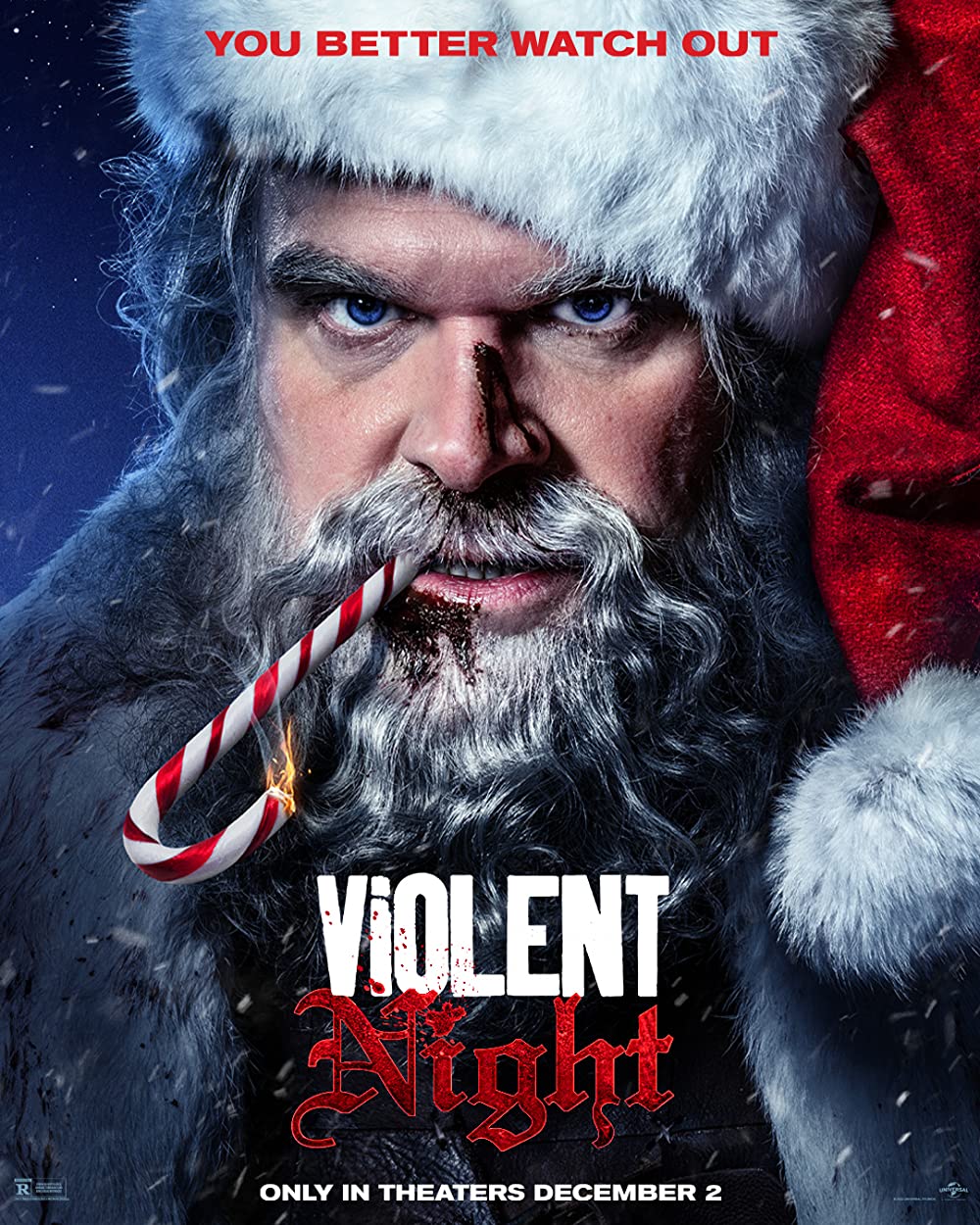
VIOLENT NIGHT Christmas movie review

Highly entertaining and hilarious! Better watch out burglars, Santa’s coming to town. Universal Pictures’ Violent Night hits theatres this week. And you don’t want to miss this fantastically fun horror-adjacent Christmas action movie, which is equal parts Die Hard and Home Alone with some Krampus thrown in for good measure–and it that still has plenty of Christmas spirit! Not since Krampus have we had such unconventional Christmas movie in cinemas. Not quite unsettling enough to be a horror movie, but gorier than a typical action movie, Violent Night sits comfortably in the middle (but a little closer to action). One of the things that makes both Gremlins and Krampus work so well is that the violence is played for laughs, and audiences will find that to also be true in this movie. Even though the violence is prolific, it is schlocky and even campy, at times. Despite the creative, gory kills and pulse-pounding action sequences, Violent Night takes times to impart valuable lessons in family, hope, and even redemption. It simultaneously acknowledges how hard the holidays can be on folks that have become disillusioned with Christmas and yet manages to show the importance of never losing hope in the magic of Christmastime. Even though we may not know how it works; it’s important not to allow cynicism of this world to overpower the optimism of hope the holidays bring. With a solid screenplay, effective direction, and entertaining kills, Violent Night is an instant modern classic that is sure to find its way onto annual watch-lists every December.

An elite team of mercenaries breaks into the Lightstone family compound on Christmas Eve, taking everyone hostage inside. However, they aren’t prepared for a surprise combatant: Santa Claus is on the grounds, and he’s about to show why this Nick is no saint.

I often remark that some of the best movies are those with a simple plot and complex character, and that is what we have here! On the surface, it may be a horror-adjacent heist movie, but beneath the creative kills and campy characters lies a movie that has a lot to say about the various feelings about Christmas (and the holidays in general).

Before you dismiss this movie as just a schlockfest, there is discernible depth to this story that will resonate with audiences of all walks of life and opinions on the magic of Christmas. The commentary on the Christmas season is witnessed in the characters, specifically Santa, Trudy, and Scrooge. By extension, other manifestations of holiday feelings are expressed through the rest of the cast of Lightstones and mercenaries. Santa has become a Christmas cynic himself, because of the rampant entitlement and greed of the world, Trudy holds true to the magic of Christmas despite the negative stressors of her family, and Scrooge represents the idea that Christmas is nonsensical and worthless. All real feelings. Furthermore, the film does not shy away from discussing the gross consumerism that is so often, yet unfortunately, at the forefront of Christmas.

A growing trend for films that aim to be character studies is to neglect the plot. Not true with Violent Night! Again, the surface is a gory action movie, but at its core, it is a character study on reactions to Christmas. Even character studies need to have a well-structured plot, because the outside/action story is a visualization of the inside/emotional story. We get both in this fantastically fun movie! Santa must reconcile his purpose with the state of the world, Trudy must reconcile her belief in the magic of Christmas within her dysfunctional family, and Scrooge (more specifically pre-Christmas Eve Scrooge) gets his just desserts for reining terror. Moreover, I appreciate how the movie provides thoughtful commentary on some of the worst people–and I am not talking about the mercenaries (tho they are deplorable people), but the Lighthouse family members represent people we know from our own lives.

Much like Krampus (but far more violent and a little less scary), Violent Night is a cautionary tale on the dangers of selfishness, greed, and toxic celebrity-ism. We’ve all been Santa, Trudy, or one of the other characters in the movie. Don’t miss the schlock, hijinks, and heart of the action-packed Violent Night this Christmas season.

Ryan teaches Film Studies and Screenwriting at the University of Tampa and is a member of the Critics Association of Central Florida. If you like this article, check out the others and FOLLOW this blog! Interested in Ryan making a guest appearance on your podcast or contributing to your website? Send him a DM on Twitter. If you’re ever in Tampa or Orlando, feel free to catch a movie with him.

Follow him on Twitter: RLTerry1

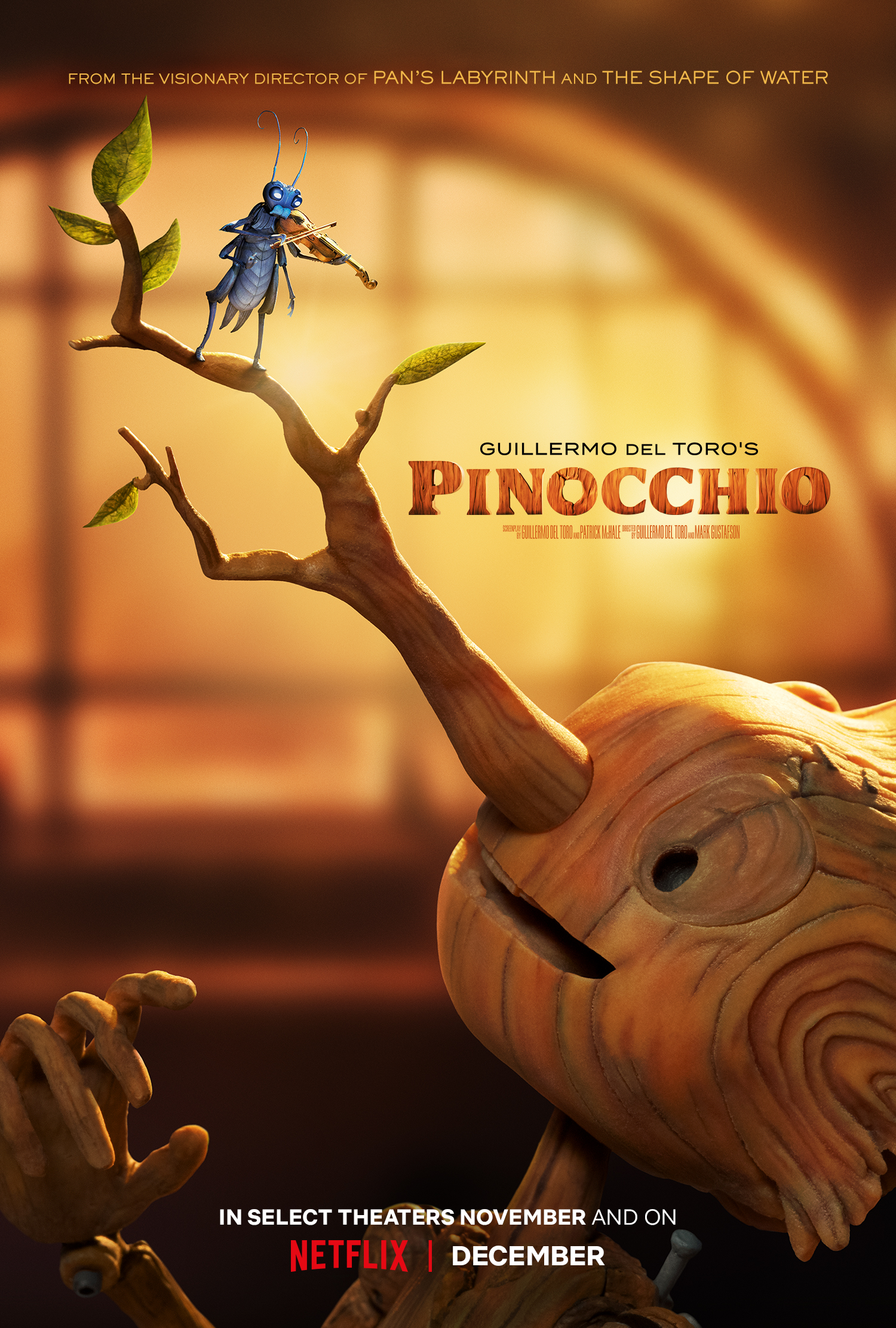
GUILLERMO DEL TORO’S PINOCCHIO motion picture review

Positively avant-garde! Easily among the best pictures of the year, period. Guillermo del Toro’s Pinocchio is a brilliant stop-motion picture that will stir the hearts and minds of any audience! In many ways it’s reminiscent of 80s dark fantasies such as The NeverEnding Story and The Dark Crystal. Which should come as no surprise that del Toro worked in collaboration with the Jim Henson Company. Audience will be completely transported to the post-World War I Italian world that del Toto meticulously recreates, complete with the fascist movement, which underscores much of the film. Not since Kubo and the Two Strings have we had such a gorgeous, imaginative animated feature film–a film that was robbed of its deserved and earned Beast Animated Film Oscar (no, Zootopia is in no universe a superior film). Let’s hope that the Mouse doesn’t rob Pinocchio of it’s well-deserved Academy Award for Best Animated Feature.

The story may seem familiar: A father’s wish magically brings a wooden boy to life in Italy, giving him a chance to care for the child. But you’ve never seen Pinocchio like this before!

Before you dismiss Del Toro’s Pinocchio as another soulless, cash-grab remake, this much more macabre version of the titular puppet’s story delivers immense depth and dimension. Not only of technical achievement, but of theme, plot, and character development. This animated film proves that animation isn’t only for kids, because this film is far more thoughtfully crafted than most live action films this ear. And yes, I agree with recent comments from Quintin Tarrantino that we are experiencing one of the worst eras of cinema in history. No doubt this is true. However, this year has seen some real winners such as Top Gun: Maverick and now Pinocchio. Suffice it to say, this is not your kid’s Pinocchio. And, although there are important life lessons in the film, it goes to places, both figuratively and literally, that may not be appropriate for kinds under 12 years of age. While Pinocchio is in its limited theatrical run, see it on the BIG screen!

While there are certainly plot beats which are shared by the original 19th century story, the 1940 Disney adaptation, the wretched Robert Zemeckis’ remake earlier this year, and countless stage adaptations (funnily enough, I saw the operetta Pinocchio this week as well), Guillermo del Toro’s Pinocchio takes on a life of its own. It isn’t often that the filmmaker added a possessive to the film title. Whereas it’s commonplace for Disney to add Disney’s… to literally everything, it’s uncommon for director’s or producers to add a possessive to the film’s title. Notable exceptions include Tim Burton’s Nightmare Before Christmas (directed by Henry Selick), Bram Stoker’s Dracula (directed by Francis Ford Coppola), and now Guillermo del Toro’s Pinocchio. This possessive form of title is often employed to signify (1) the filmmaker’s confidence in his or her work of motion picture art and (2) to separate it from all other versions of the same story (and/or title). Moreover, this often indicates to audiences that they are about to witness the work of a true auteur (not the case when we see Disney’s…–that’s just plain branding).

Is it del Toro’s arrogance or an ego trip that prompts such chutzpah in this film’s title? Not at all. Del Toro has been working on this passion project for over 15 years. Before you feel that’s an exaggeration, let the finished motion picture be the demonstrable evidence of meticulous work frame-by-frame in this nearly two-hour film. Images are most often captured at 25-frames-per-second, so to achieve the fluid motion del Toro has, you just do that math. Del Toro crafted intricate animation captured by a camera that is repeatedly started and stopped over the course of day, weeks, years. Each mouth, arm ear, eye, literally any object that has movement, is moves a little at a time, frame-by-frame. Not only does del Toro’s craftsmanship translate to beautiful, seamless movement by the characters and environment in the film, he successfully captures the visual and emotional miracles that can only be accomplished through stop motion animation. There’s a reason why we go back to the Rankin & Bass Christmas classics every year; there is immense simplicity and beauty in stop-motion animation. Why? Same reason why practical effects will always be superior to (overt) CGI effects–depth, dimension, the way real light bounces off objects and into the camera lens.

Even though the film is quite dark from the moment the atrocities of war are witnessed, it is not without its levity and uplifting scenes. To get into a central theme of the film involving stages of grief (which makes it unique compared to other iterations), would mean venturing too far into spoilers, which I would like to avoid, and with that theme, there are many scenes that force the audience to confront what many fear most. Because of this theme, one might think the film is somber most of of the time, and fortunately, this is not true. There are plenty of moments that break up the sadness to inject a healthy dose of laughter. And more often than not, we have Sebastian J. Cricket to thank for that! (I’m sure the “J” is a playful jab at Disney). DelToro’s sardonic, raconteur cricket always has the perfect witty remark or anecdote to provide insight into a given plot point or emotional beat. Because of Sebastian J. Cricket’s running commentary and moral/ethical guidance, the audience is willing to go on this emotional roller coaster. The moment of levity allow for an emotional and psychological reset to face the darker moments.

Outside of the imagery of the stages of grief, there are other fascinating areas of social commentary in the film as well. I love how del Toro moves the real boy imagery, how it’s traditionally interpreted: wood vs. flesh, to one that posits ideas of what it means to be a real man. These arguments are mostly seen in the Mussolini’s youth armies scenes. In the world of fascist Italy, to be a real man meant taking up the arms and creeds of Mussolini’s Italy to fight the allied forces. Pinocchio must decide what it means to be a real man. Another area that is interesting is the relationship between Geppetto and the village (Catholic) Church. While there may be various ways of interpreting this imagery and these scenes, which are bookends for the film, I feel it is best interpreted as Geppetto never compromising on his faith in God even though the Catholic Church, at that time in Italy, was being infiltrated by Mussolini’s fascist ideals (cleverly disguised to sway some in the faith community).

Lastly, we cannot talk about this film without highlighting the moving score and outstanding original songs. While Pinocchio is not a musical, it has several original songs that will move audiences! Not only does this film boast exquisite animation, but it delivers outstanding original music and lyrics as well. Audiences will find both diegetic and non-diegetic musical numbers in the film. This combination works incredibly well to wrap audiences in the mesmerizing story!

Even though Guillermo del Toro’s Pinocchio is coming to Netflix in December, look to see if it’s playing at theatre near you for the full experience!

Ryan teaches Film Studies and Screenwriting at the University of Tampa and is a member of the Critics Association of Central Florida. If you like this article, check out the others and FOLLOW this blog! Interested in Ryan making a guest appearance on your podcast or contributing to your website? Send him a DM on Twitter. If you’re ever in Tampa or Orlando, feel free to catch a movie with him.

Follow him on Twitter: RLTerry1