R.L. Terry ReelView

A Scholarly Approach to Cinema and More

R.L. Terry ReelView

“Red Sparrow” film review

Intense. Riveting. Spine-tingling, A masterful spy thriller crafted in a classical fashion with sex appeal. Red Sparrow will harness your full attention from the opening. Directed by Francis Lawrence, this spy movie is the level of excitement that 2015’s Bridge of Spies wished it was. Whereas many espionage movies fail to develop a plot that keeps you guessing from beginning to end–allowing you to feel like a covert operative or detective–this film delivers a mesmerizing story filled with intriguing characters and close calls. In many ways, this film contains elements that could be likened to a Hitchcockian suspense thriller with influences from Billy Wilder and David Fincher. Jennifer Lawrence displays an uncanny performance that truly shows the versatility of the Oscar-winning actress. With tensions rising between the US and Russia in real life, this films comes at a perfect time because we may find ourselves in a cold war that’s reminiscent of the latter part of the 20th century. Not for those who are weak in the stomach, this film contains cringy visceral horror that will get under your skin. Without the need to rely on science-fiction gadgetry to carry the story, this film provides well-developed characters and an intriguing plot that’s filled with twists and turns.

Prima Bolshoi Ballet ballerina Dominika Egorova (Jennifer Lawrence) is faced with a bleak and uncertain future following a severe career-ending injury while on stage performing. Her high-ranking uncle persuades her to attend Sparrow School: an institution that trains seductive spies in order to pry information from targets by using extreme sensuality. Sparrows turn their minds and bodies into weapons for the state. Being determined to remain special, Dominika completes the sadistic training more quickly than the other students and is recruited for a covert assignment to track and report on an American CIA operative (Joel Edgerton) who Russia feels will lead them to the mole within their own ranks.

The beautiful opening of Red Sparrow is abruptly ended when Dominika suffers a horrific injury that instantly ends her ballet career. This acutely intense moment will cut you directly to the bone–you will undoubtedly wince or cringe, feel the break in your own legs. This is but a taste of what is to come throughout the movie. In an exquisite fashion, the gorgeous dance at the opening is juxtaposed against the alleged drug deal gone bad. Paralleling one another, the event that unfolds concurrently enable the plot to get a quickly paced fantastic start out the gate. Unfortunately, this excellent start does lead into a slower paced latter half of Act I. However, there is important background information that is revealed during Act I that foreshadows and sets up the remainder of the turning points in the plot. You will also notice the use of the color red in many places during the movie. Analyzing the shades of, and placement of the crimson hue has the potential to generate conversations between cinephiles.

The color red is not the only symbol in the movie that can be analyzed; there is a theme of your body belonging to the state. Essentially, this can be read as a commentary on celebrity. As a prima ballerina, Dominika’s body was weaponized for the stage and figuratively belonged to the Bolshoi and by extension to the public. Much in the same way her Sparrow weaponized body literally belongs to The State. It’s her body, but the Bolshoi and The State determine her career. But she is determined to not allow herself to become a commodity that can be abandoned, traded, or punished. This can be said about conventional celebrities and the public. In a manner of speaking, the public decides whether or not you are worth seeing on screen and how you should behave. Back during the days of the Studio System, this was a big problem because the Studio controlled your image, who you dated, slept with, when/if you had kids, your marriage, and more. There was mass exploitation in that system, and one of the reasons why it was ended. The empowering message of rebelling against The State, who is determined to own you and your body, can be witnessed through the covert actions of Dominika.

In the grand Hitchcockian fashion, there is a lot of suspense that increases tension but does not always provide a release. Though Hitch would have handled the level and pacing of the suspense more perfectly, you can read his famous bomb theory in Red Sparrow. Hitchcock knew how to take a two-dimensional situation and find a third-dimensional approach to impress the audiences and hold firm their attention. And to the film’s credit, there are a few times that the level of suspense coupled with the symphonic score channels Hitch. Unlike many spy movies that rely too heavily on a love story, the film brilliantly leaves you wondering whether or not Lawrence and Edgerton are in love or rather it is a facade employed in order to extract vital information for their respective allegiances. The level of romance and eroticism is just enough to add the sex-appeal to the relationship without the movie becoming about the romance between two individuals who serve two opposing countries.

Not for the faint of heart, there are some incredibly intense moments in the film that might make you queasy in the stomach. But the movie chooses to place more emphasis on the action, plot, and characters more so than that which threatens your eye. It’s certainly a new breed of spy movie, but it’s one that is incredibly interesting and will hold your attention for the more than 2hr runtime.

Oscars 90 | The 2018 Annual Academy Award Nominations

It’s that time of year again! The Academy of Motion Picture Arts and Sciences has announced the nominees for the 2018 Oscars, now celebrating its 90th year. Here are my picks for each category! The Academy may vote for these or another nominee, but I just wanted to post the ones I would like to see win this year. For a complete listing of nominees, please visit VARIETY! I am pretty happy with this year’s list of nominees, there are only a few films, collectively, that I thought were overlooked in their respective category. Fortunately, I have seen most of the films on this list! If I have not seen the movies in a category, I have listed all the nominees. Who do you hope wins this year?!?

Best Picture: “The Shape of Water”

Lead Actor: Gary Oldman, “Darkest Hour”

Lead Actress: Margot Robbie, “I, Tonya”

Supporting Actor: Christopher Plummer, “All the Money in the World”

Supporting Actress: Allison Janney, “I, Tonya”

Director: “The Shape of Water,” Guillermo del Toro

Animated Feature: “Coco,” Lee Unkrich, Darla K. Anderson

Animated Short: I have not seen any of these, so here is the list for you to decide

“Dear Basketball,” Glen Keane, Kobe Bryant
“Garden Party,” Victor Caire, Gabriel Grapperon
“Lou,” Dave Mullins, Dana Murray
“Negative Space,” Max Porter, Ru Kuwahata
“Revolting Rhymes,” Jakob Schuh, Jan Lachauer

Adapted Screenplay: “Logan,” Scott Frank & James Mangold and Michael Green

Original Screenplay: “The Shape of Water,” Guillermo del Toro, Vanessa Taylor

Cinematography:  “The Shape of Water,” Dan Laustsen

Best Documentary Feature: I have not seen these films, so here is the full list

Best Documentary Short Subject: I have not seen these films, so here is the full list

“Edith+Eddie,” Laura Checkoway, Thomas Lee Wright
“Heaven is a Traffic Jam on the 405,” Frank Stiefel
“Heroin(e),” Elaine McMillion Sheldon, Kerrin Sheldon
“Knife Skills,” Thomas Lennon
“Traffic Stop,” Kate Davis, David Heilbroner

Best Live Action Short Film: I have not seen these films, so here is the full list

“DeKalb Elementary,” Reed Van Dyk
“The Eleven O’Clock,” Derin Seale, Josh Lawson
“My Nephew Emmett,” Kevin Wilson, Jr.
“The Silent Child,” Chris Overton, Rachel Shenton
“Watu Wote/All of Us,” Katja Benrath, Tobias Rosen

Best Foreign Language Film: “The Square” (Sweden)

Film Editing: “The Shape of Water,” Sidney Wolinsky

Sound Editing: “Dunkirk,” Alex Gibson, Richard King

Sound Mixing: “Dunkirk,” Mark Weingarten, Gregg Landaker, Gary A. Rizzo

Production Design: “The Shape of Water,” Paul D. Austerberry, Jeffrey A. Melvin, Shane Vieau

Original Score: “The Shape of Water,” Alexandre Desplat

Original Song: “This Is Me” from “The Greatest Showman,” Benj Pasek, Justin Paul

Makeup and Hair: “Darkest Hour,” Kazuhiro Tsuji, David Malinowski, Lucy Sibbick

Costume Design: “Beauty and the Beast,” Jacqueline Durran

Visual Effects: “Blade Runner 2049,” John Nelson, Paul Lambert, Richard R. Hoover, Gerd Nefzer

Lin Shaye and Liam Neeson | January Box Office Gold

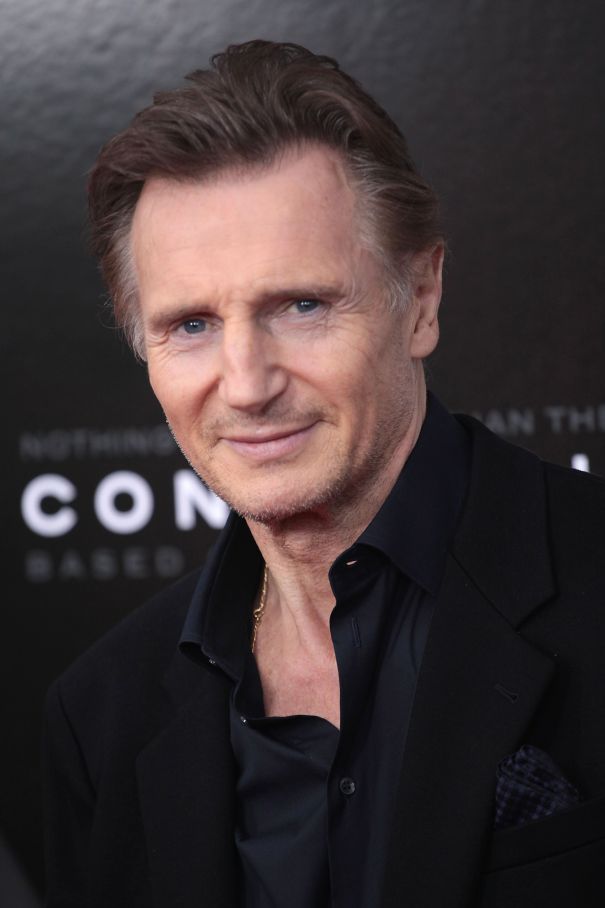
Both Insidious and The Commuter are gems in the graveyard that is typically true “January” release films. I say true because films like The Shape of WaterI Tonya, and The Post are wide-released in January but were originally released on a limited run during the Holidays in order to qualify for The Oscars. For those who follow cinema closely, it’s no surprise that months like January and September are typically referred to as movie graveyard because that is ordinarily where movies go to die that cannot stand up to Spring, Summer, Fall, or Holiday release times. However, the last couple of years have seen some very strong films in January/February. Last year’s examples are Get OutLogan, and A Cure for Wellness. Last week’s Insidious: the Last Key and this week’s The Commuter are very much paint-by-the-numbers horror/action films respectively; but the cast–in particular, the leads–makes these films fun and even exciting to watch. From background actress to leading horror queen, Lin Shaye truly makes the Insidious films ones to be experienced on the big screen. Her flair for paranormal/supernatural films is uncanny, and take mediocre horror movies and transform them into movies you don’t want to wait until it comes to VOD. Likewise, Liam Neeson wowed audiences with his trademark character with a “particular set of skills” in the Taken movies, and has since played similar characters in other films. When you see his name, you expect that character-type and often times you get it! The Commuter may be a cliche action-thriller, but Neeson makes the film one that is a non-stop ride, one you don’t’ wanna miss when it leaves the station.

But why do both Shaye and Neeson draw the audiences the way they do? By all accounts, movies like the Insidious and Taken franchises or some iteration of the aforementioned are filled with horror and action tropes that seldom provide a truly new experience for audiences. However, their movies generally do very well at the box office and are consistently thrilling to watch. Placing Neeson in an action thriller or Shaye in a supernatural horror is essentially a guaranteed box office success for audiences and investors. In a manner of speaking, what we are dealing with here are legitimate movie stars. Truth be told, 21st-century cinema does not see movie stars in the same way that the early and mid 20th century did. In early days of cinema, films were built on the back of the studio system stars. It was a Betty Hutton film, a Humphrey Bogart movie, a William Holden picture, a Bette Davis film, etc. I’d argue that Tom Cruise is the closest to a contemporary era movie star in the traditional sense that we have. But by extension, you can apply the same attributes to Liam Neeson and  Lin Shaye by the cache that they bring to their films–they are a box office draw. Just their respective names are enough to invigorate audiences and generate ticket sales. At the end of the day, that’s when you know you have a true movie star. The name alone is enough to excite audiences and drive ticket sales.

Both actors are equally talented in their respective ways. The level of talent, entertainment, and thrill is consistent. You are never disappointed in their performances. If you remove/replace either of them in Insidious: the Last Key or The Commuter, the movies would likely not play out nearly half as well as they presently do. I’m not knocking the writing, directing, scores, editing, or cinematography, I am stating that the films are nothing remarkable in and of themselves; however, Shaye and Neeson bring a powerful screen presence with them that take the mediocre horror and action films to transform them into a cinematic experience that is incredibly enjoyable.

“KONG: Skull Island” movie review

“Hold onto your butts;” Warner Bros. and Legendary Entertainment’s KONG: Skull Island is full body KONG with just a hint of story. Wait. Isn’t that a line from Jurassic Park??? Sure is. And guess who delivers it? None other than Samuel L. Jackson himself–reprising his famous line from one of the most iconic films in the American cinema library. It’s rather fitting since there are many shared elements between KONG and the Jurassic Park franchise. Both take place on an island and deal with science vs. nature and pit man against ancient creatures. King Kong is no stranger to most people, considering he’s been a fixture in the cinema and theme park universes respectively for many decades. From silver screen to Universal Studios, he remains an icon to which few “monster” movies compare. Although the previous KONG films followed a very similar narrative, this newest incarnation of the king of Skull Island takes a modified route to the classic story. It shares many of the same elements or themes with its predecessors, but through the echoes of the past comes a reimagined story. Diegetically, the film certainly suffers; furthermore, it attempts to integrate social commentary on war, Captain Ahab allegory, and conservation, but none of those themes are effectively carried out. Due to the enormous “King Kong” sized cast, there lacks any real connection to any of the characters and development is certainly obscure, if any at all. Films such as this one can sometimes run into the danger of waxing nostalgic too often and forgetting that audiences want a new movie (i.e. Star Wars: the Force Awakens); and like the aforementioned, Jordan Vogt-Roberts’ KONG: Skull Island provides audiences with connections to past King Kong movies in a new approach, but ultimately crafts generic experience.

When an uncharted island shows up on U.S. satellites, Bill Randa (John Goodman) and Houston Brookes (Corey Hawkins) approach a prominent senator, seeking clearance and funding for a mapping expedition and exploration of the mysterious island resembling a skull. Begrudgingly, the senator clears Randa’s MONARCH for one last mission before the U.S. pulls out of the south Pacific following the Vietnam War pull-out. Partnering with Colonel Packard’s (Samuel L. Jackson) military troop and attaching ex-British special forces Captain Conrad (Tom Hiddleston) and photo journalist Mason Weaver (Brie Larson) to the group, the expedition lays out plans to penetrate the severe storms surrounding the island to explore the island. What the group encounters on Skull Island will give them nightmares for the rest of their respective lives. Beginning as a glorified mapping excursion, this expedition turns into a game of survival as the group makes its way across the island.

At the end of the day, this movie accomplishes what it set out to do: revive Kong, thrill people for a couple hours, and setup KONG v. Godzilla. Action-adventure films are typically not expected to contain brilliant writing, character development, and strategically placed themed and subtext. What I respect about this movie is that is unashamedly pretends not to be anything other than a larger than life adventure centered around one of cinema’s most iconic “monsters.” Clearly, there are attempts in the movie to include some deeper themes such as anti-war, nature/conservation, and even a little Moby Dick; but those themes appear to have been great thoughts that were not fully executed. That being said, there is clearly a Captain Ahab figure in the film and there are many similarities between King Kong and Moby Dick–size just being one of them. For fans of Jurassic Park you’ll appreciate not only Jackson’s “hold onto your butts” line at the beginning of the film, but also several similar scenes, camera angels, and even the helicopter entry onto the island. Lots of nostalgia, but not so much that it feels like you’ve seen it all before.

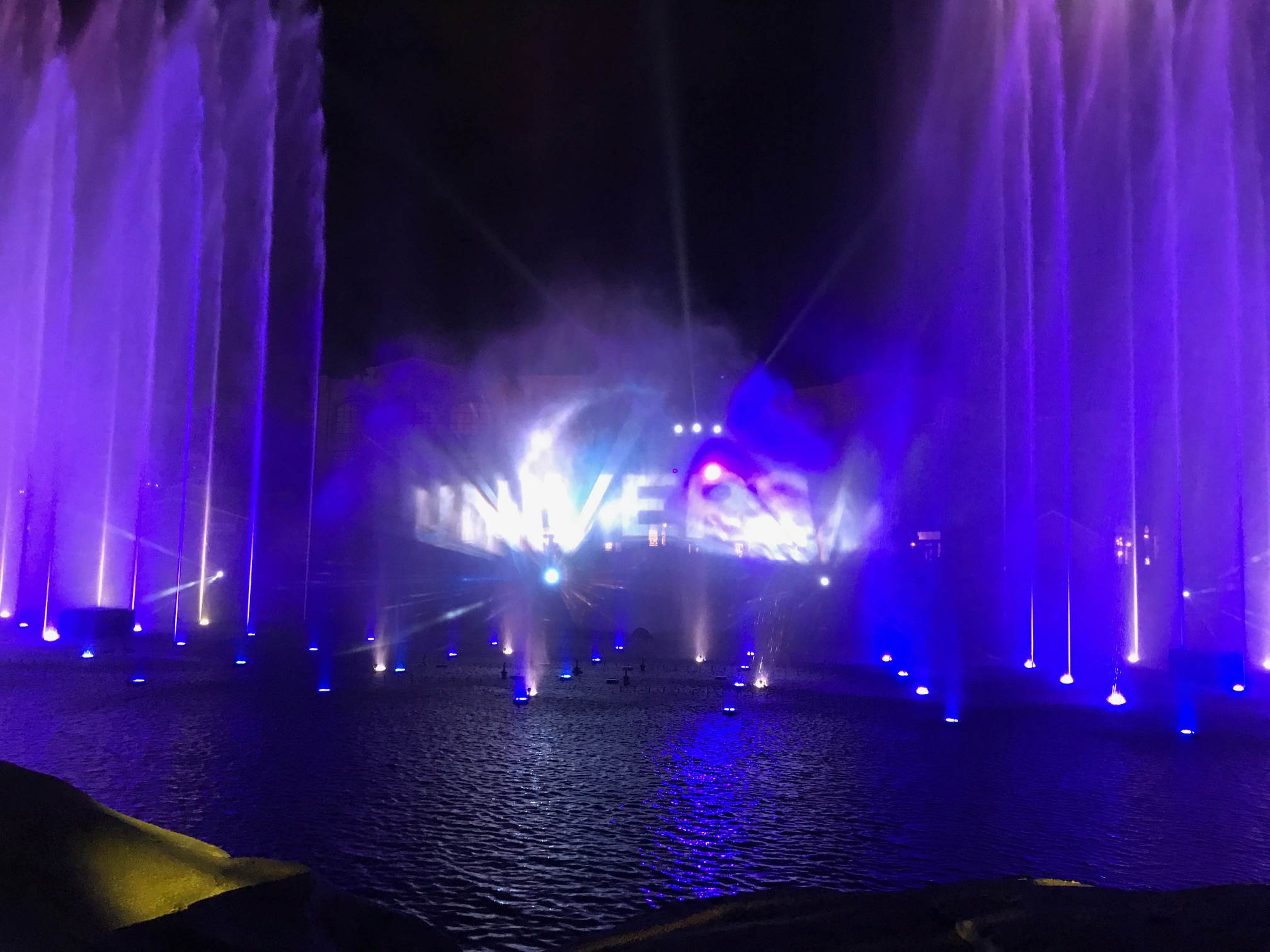
In many ways, Kong is bigger than ever, but hardly better than previous Kong films. Ironically, this same thing can be said about the former Kongfrontation attraction at Universal Studios Florida. Much like the new attraction Skull Island: Reign of Kong at Universal feels far more generic than its predecessor, today’s Kong lacks the magic and innovation that the original Kong did in 1933. Despite an attempt to successfully launch a series of “creature features,” the script and human characters certainly suffer. Little can be said about the dialog except that occasionally there are lines that move the story along instead of stating the obvious or predictable. The dialog is cumbersome and never seems to remain focussed very long. Of course, that is hard to do considering that Kong boasts an extremely large ensemble cast. At the forefront of the cast are Hiddleston, Larson, Jackson, Goodman, and Reilly’s respective characters. Of all the characters, John C. Reilly’s Hank Marlow steels the screen about as often as Kong does. One might even be able to say that this is as much a John C. Reilly film as it is a Kong movie. Part of the magic of the previous Kong films, the 1933 version to be more specific, is the setting and characters themselves. Much like the new KONG attraction at Universal took physical sets, animatronics, real fire, etc and crafted a virtual 3D experience, the special effects artists and set designers did the same thing in KONG: Skull Island. The film comes across as less Kong and more Pacific Rim. In other words: generic.

KONG: Skull Island will certainly keep you entertained the whole time as action-adventure films are supposed to do. You’ll enjoy the fight scenes and the whole “creature feature” approach this film takes. If you’re looking for moments taken right out of the previous Kong movies, then you’ll mostly be satisfied. There are few scenes taken directly from the previous movies, but there are certainly allusions and nods to classic moments. You won’t spend much time with the natives nor will you get to witness the famous Empire State Building scene, but you’ll likely enjoy the film nevertheless. Just because a film takes a reimagined approach to a classic character that ultimately plays off as generic, doesn’t mean that there isn’t anything to enjoy. For action junkies, there is plenty to grab your attention and hold it for the duration of the movie.

Written by R.L. Terry

Edited by J.M. Wead

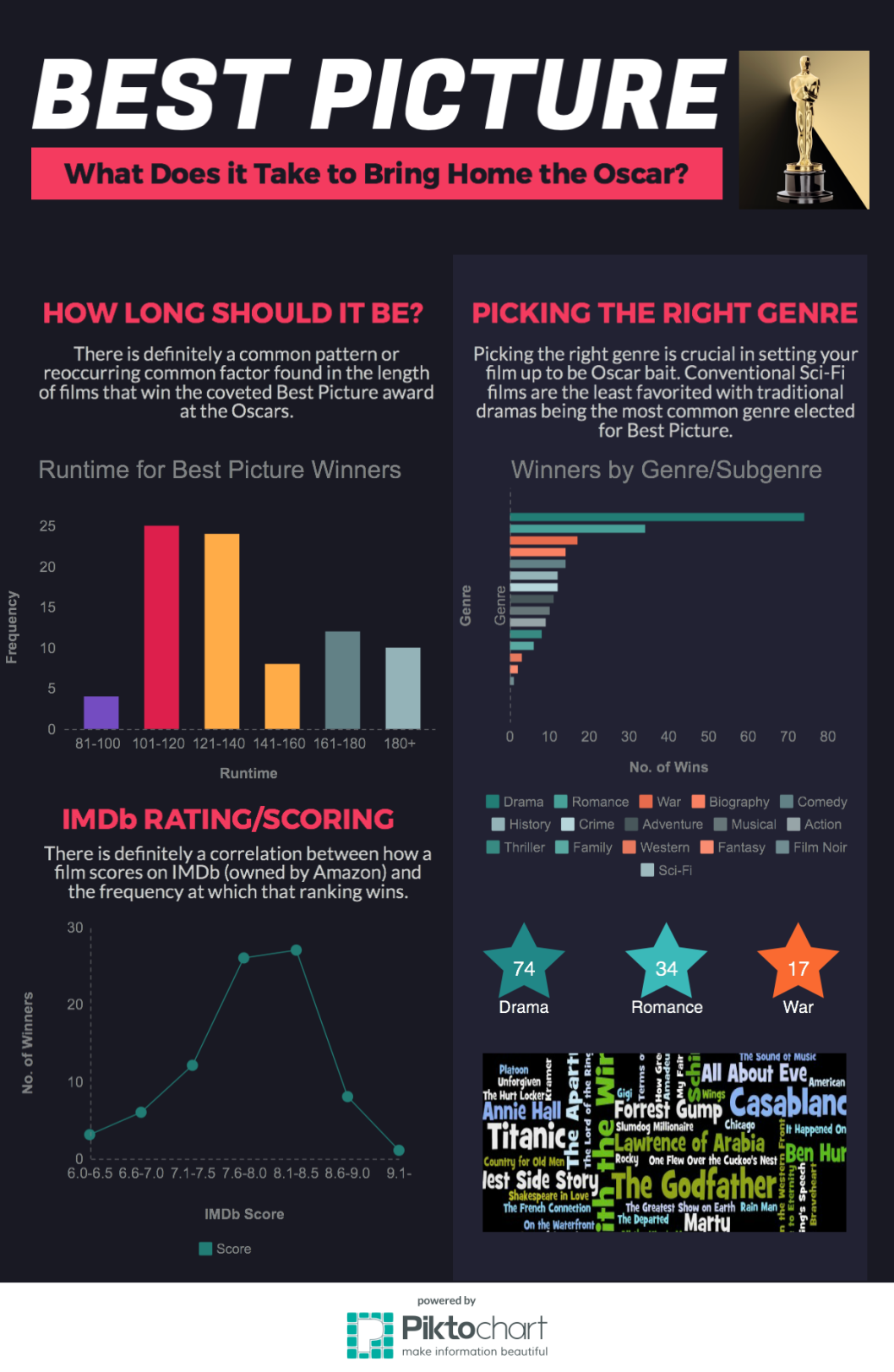
Best Picture: What Does it Take to Bring Home the Oscar?

oscar_criteriaI created this infographic using Piktochart for the Media Writing class I teach at the University of Tampa. This infograph outlines some of the correlating criteria in respect to the films that win the Best Picture Oscar at the Academy Awards.