THE ODYSSEY film review

Magnificent moments in search of an epic story.

When audiences leave The Odyssey, they’ll likely be talking about the Trojan Horse, the Cyclops, the sea monsters, and the breathtaking images Christopher Nolan has conjured for the largest screens imaginable. And rightly so. Few filmmakers working today possess Nolan’s ability to stage spectacle on such an astonishing scale. Yet for all its technical brilliance and jaw-dropping visual achievement, The Odyssey left me admiring its individual moments and technical achievement far more than the story connecting them.

About the film: Odysseus (Matt Damon) embarks on a dangerous voyage back to Ithaca following the Trojan War, encountering treacherous creatures like the Cyclops Polyphemus, Sirens, and the gates of Hades.

While few filmmakers have demonstrated the talent and skill to craft motion pictures on the scale and scope of Nolan’s, many have been able to create motion picture offerings truly deserving of the big screen treatment. But, cinema has become so enamored with spectacle that audiences increasingly mistake scale for storytelling. The two are not synonymous. A breathtaking image may inspire awe, but without dramatic architecture it struggles to resonate beyond the moment it appears on screen.

This is the central irony of Christopher Nolan’s The Odyssey. Adapting the foundational epic of Western storytelling—a tale whose dramatic framework has influenced literature and cinema for nearly three millennia—Nolan delivers some of the most astonishing imagery ever projected onto a movie screen while simultaneously diminishing the very narrative mechanics that made Homer’s poem endure.

Nolan has long challenged conventional storytelling, but innovation alone neither elevates nor diminishes a work of art. The irony here is especially striking because The Odyssey originates from the civilization that gave us many of the dramatic principles still underpinning Western storytelling. Homer didn’t simply tell an adventure; he created the definitive mythic journey—a narrative whose emotional power comes from watching Odysseus endure one impossible trial after another as he struggles home.

Nolan’s adaptation rarely allows that journey to accumulate. Instead, the film drifts between spectacular episodes much as Odysseus himself drifts across the sea. Each sequence is magnificent in isolation, but the nonlinear structure continually interrupts the dramatic momentum needed for the voyage to feel emotionally cumulative.

For viewers already familiar with Homer’s epic, reconstructing the chronology isn’t especially difficult. For those encountering The Odyssey for the first time, however, the film provides surprisingly little connective tissue or narrative context. Rather than deepening the myth, the fragmented structure often obscures it. As odd as it may sound, the 1990s Wishbone adaptation arguably communicates the story’s emotional architecture more effectively.

Some have dismissed my criticism by suggesting I simply dislike nonlinear storytelling. The opposite is true. Some of my favorite films—including Mulholland Drive, Rashomon, Arrival, Pulp Fiction, Memento, and The Godfather Part II—all abandon linear chronology. What unites those films is that their structures reveal character, reinforce theme, or place the audience inside a unique perspective that chronological storytelling could not achieve. Their nonlinear construction enriches the drama.

Here, Nolan primarily uses a nonlinear structure to reorganize the plot.

That distinction matters, because the result is a film whose storytelling often feels less powerful than its individual scenes. Fortunately, those scenes are truly extraordinary.

One observation from fellow critic Sean Boelman has lingered with me since seeing the film. Sean—who admired The Odyssey far more than I did—suggested that Nolan’s nonlinear structure feels reminiscent of oral storytelling. The more I’ve reflected on that idea, the more I think he’s right. There is a quality to the film that resembles hearing an ancient bard recount Odysseus’ adventures, jumping from one episode to another as memory and emphasis dictate rather than strict chronology.

Where we ultimately diverge is whether that approach serves the medium of cinema. Oral storytelling and visual storytelling are not identical languages. What works around a fire or in the halls of ancient Greece does not necessarily produce the strongest dramatic experience on a movie screen. Cinema possesses tools that oral tradition never could: editing, visual composition, performance, and dramatic pacing that build cumulative emotional momentum. By adopting the rhythms of oral storytelling, Nolan creates an undeniably fascinating interpretation of Homer’s epic, but one that, for me, sacrifices too much of the dramatic architecture that gives the journey its emotional force.

This is what makes The Odyssey such a fascinating film to evaluate. Rarely have I encountered a movie in which spectacle and dramatic architecture diverge so dramatically. As a visual achievement, Nolan’s film ranks among the most impressive epics of the modern era. As a piece of dramatic storytelling, I found it considerably less satisfying.

The Trojan Horse sequence is among the most awe-inspiring moments Nolan has ever filmed. Every set, every landscape, every battle possesses a mythological grandeur rarely seen in modern filmmaking. Watching The Odyssey, I found myself imagining what audiences must have experienced seeing Metropolis or The Ten Commandments for the first time. Those films redefined cinematic scale for their generations. Nolan’s achievement feels similarly monumental.

Which is why The Odyssey absolutely deserves to be seen on the biggest screen available. Whether that’s 70mm IMAX or another premium format matters far less than simply experiencing its overwhelming visual and sonic presentation in a theater. A larger screen won’t solve the screenplay’s structural shortcomings, but it will allow viewers to fully appreciate one of the most ambitious technical achievements of recent years.

Matt Damon anchors the film with quiet confidence, delivering perhaps the strongest performance of the ensemble. He fully inhabits Odysseus, carrying both the physical burden of the journey and the emotional weariness of a man desperate to return home. The remainder of the cast performs capably without leaving much of a lasting impression. Tom Holland never entirely escapes echoes of Peter Parker, Anne Hathaway provides the elegance and composure we’ve come to expect, and Robert Pattinson is surprisingly underutilized. There are no poor performances—only few that linger after the credits.

Ultimately, I suspect The Odyssey will be remembered as one of the year’s biggest cinematic events, and deservedly so. Nolan has once again reminded audiences why epic filmmaking belongs in theaters, where stories of mythic scale can be experienced communally rather than consumed individually at home.

I only wish the storytelling had matched the magnificence of the filmmaking.

For all its extraordinary craftsmanship, The Odyssey left me marveling at its images more than feeling the weight of Odysseus’ journey. In the end, Nolan delivers an unforgettable cinematic experience, but not, for me, an unforgettable telling of Homer’s timeless epic.

Ryan is the morning host on WLRH Public Radio in Huntsville, AL and host of the show  ReelTalk  “where you can enjoy the cinematic conversations frame by frame each week.” Additionally, he is the author of the upcoming film studies book titled Monsters, Madness, and Mayhem: Why People Love Horror. After teaching film studies for over eight years at the University of Tampa, he transitioned from the classroom to public media. He is a member of the Critics Association of Central Florida and Indie Film Critics of America. If you like this article, check out the others and FOLLOW this blog! Follow him on Twitter: RLTerry1 and LetterBoxd: RLTerry
OPPENHEIMER film review

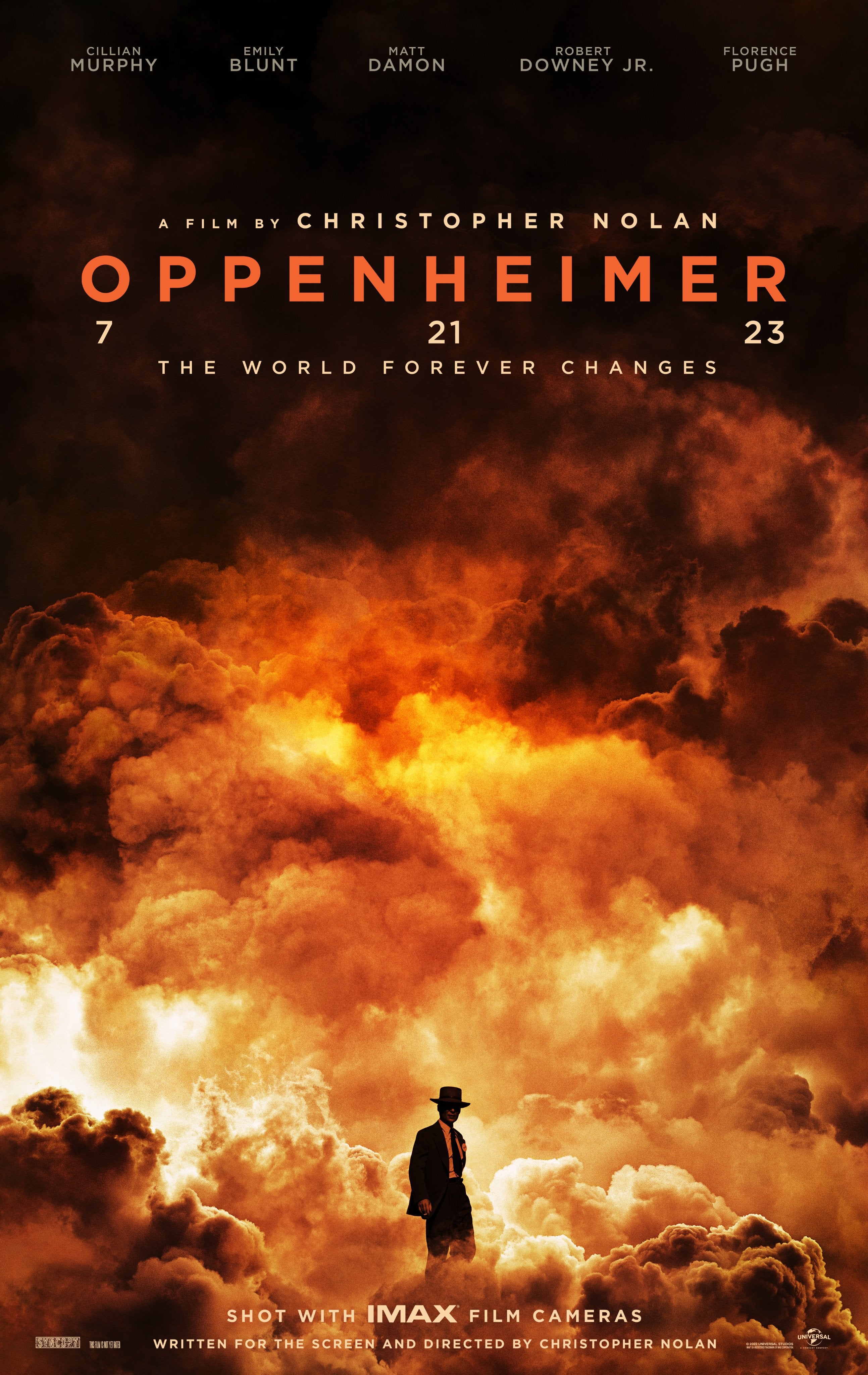
Sensational! Christopher Nolan’s highly anticipated cinematic spectacular Oppenheimer is an extraordinary motion picture that delivers a story as explosive as the subject matter. Not since Nolan’s earlier work on pictures such as Memento and The Prestige have I enjoyed both the form and function of his stylistic brand of filmmaking. Although the film chronicles the development, use of, and subsequent scientific and sociological affects of the A-Bomb, the story it really about the rise and fall of J. Robert Oppenheimer. Moreover, the subtext of the story is one that carries with it such commentary as the true cost of notoriety and serving one’s country and the destructive nature of unsubstantiated witch hunts. It’s a character-driven story more than it is a plot-driven story about the creation of the A-Bomb.

Oppenheimer is the story of American scientist J. Robert Oppenheimer and his role in the development of the atomic bomb. The film explores how one man’s brilliance, hubris, and relentless drive changed the nature of war forever, led to the deaths of hundreds of thousands of people and unleashed mass hysteria, and how, subsequently, the same man’s attempts to end one World War began a Cold War that would last for nearly fifty years.

While I have some reservations in the structural integrity of Nolan’s plotting in this film, which no strangers to my blog should know since that is often where I am hardest on films, his plotting and characterization hasn’t been this strong since Memento and The Prestige.

It should come of no surprise that Nolan’s latest motion picture excels in technical achievement. And I am not mentioning that to in anyway detract from that achievement; but, I mention that because had the film simply been an exercise in pushing the boundaries of filmmaking, then it would be another intentionally avant-garde vanity project. Which, it is not. Oppenheimer excels in both form and function; it shows care for both how the motion picture is montaged and presented and for the function of both plot and character.

With few exceptions, whether the plotting of a film is linear or non-linear, the plot should still follow foundational storytelling conventions to achieve the full impact it desires. Contrary to a postmodernist view of rules of art, just because one breaks the rules does not mean that a work of art or endeavor is somehow more substantive or meaningful in value. Nolan strikes a fantastic balance between form and function in this picture to completely transport audiences to the world of Los Alamos, NM in the mid-20th century.

Not since Dario Argento’s masterpiece Suspiria have I witnessed a motion picture employ the use of lighting, color (or lack thereof), and score to such a fantastical and effective level. These visual and auditory elements combine to immerse audiences in both the narrative and emotive dimensions of Oppenheimer’s story. Never overshadowing the story, but working in tandem with it, the visual and audible elements of the mise-en-scene craft a picture that simultaneously feels part of our world and yet somehow other worldly. Moreover, the story of Oppenheimer is told through both subjective and objective camera placement. In less experienced hands, this could have proven to be disastrous, but Nolan demonstrates his command of the screen in the uncanny combination of both.

One of the most stylistic montage and editing devices used is the black and white (more accurately described as grayscale) imagery for a specific timeline. And it would appear to my observation that it is indeed grayscale stock film–not desaturated in post-production. This observation is in part gleaned by way of the effects of lighting on the film stock. From a story organization perspective, this use of grayscale film stock helps in understanding the part of the non-linear timeline in which we find ourselves.

Where Nolan often struggles is in character authenticity. More times than not, the characters in his films are often lacking in believability, relatability, and vulnerability. Not that his characters are generally flawless, but they have demonstrated a lack in that which makes us most human. Each and every character in this film feels incredibly human–true to life. Whether or not the film is an accurate representation of the real-life counterparts, is not something on which I can comment. But, the characters, as presented, are relatable and feel authentic within their world. On the topic of characters, Nolan also injects humor into this film, which isn’t characteristic of his past films; and that use of humor helps to provide tension relief as an emotional reset between dramatic beats or scenes.

The central theme in the film is the true cost of notoriety and serving one’s country. And this is expressed primarily through Oppenheimer’s relationship with the development of the A-Bomb, but supplemented by his interactions with Albert Einstein, and therein Einstein’s relationship with his Theory of Relativity and success as the greatest scientific mind of all time. Or, as Oppenheimer puts it, “the greatest scientific mind of his day.” The story has to be seen to truly felt, but Oppenheimer spotlights how when one’s usefulness is seen as exhausted or no longer relevant to one’s country, that one is disposable.

We not only witness this in the film, but in real life as well. To this day, there are those that fought for their country that are not treated with the dignity and respect they both earned and deserve. The film paints a rather negative portrait of federal government operations as it relates to international and domestic policies. Suffice it to say, after Oppenheimer delivered the A-Bomb, he was soon thereafter cast aside as his (objectively reasonable) opposition to further development of weapons of mass destruction began to influence policy decisions. And this rise and fall story isn’t relatable to merely the government, but can be said of any company or organization that hails one as a visionary one minute, but after the project is realized, the same company or organization moves on. Fame is fleeting.

While many brilliant scientists were undoubtedly envious of Oppenheimer’s commercial success (except for Einstein, whom was a soothsayer of sorts), perhaps the rise and fall of Oppenheimer serves as a reminder that there are many whom have had notoriety forced upon them, but the oft infamy that follows can create a figurative prison out of which there is no escape.

Another observation I make, into the film’s themes and motifs, is the depiction of communism vs capitalism. Unfortunately, the loudest on social media do not likely have an accurate interpretation of what communism and capitalism are. And without getting into details, suffice it to say, the film does not accurately portray either communism or capitalism. So, I worry that many will watch the movie and begin to make connections and associations that are not accurate. On the topic, I’ll leave you with this: destructive ideologies that devalue individuality, based in universal truth and logic, in exchange for group identity based on emotions and impossible utopias is still an enemy of the people today.

This film is not to be missed on the biggest screen AND on 70mm film. Seeing a picture on film is truly magical. The depth lighting and shadow and richness of the color spectrum will always be expressed the best on celluloid. A chemical reaction beats 0s and 1s any day. Oh, and there is no reported use of CGI in this motion picture.

Ryan teaches Film Studies and Screenwriting at the University of Tampa and is a member of the Critics Association of Central Florida and Indie Film Critics of America. If you like this article, check out the others and FOLLOW this blog! Interested in Ryan making a guest appearance on your podcast or contributing to your website? Send him a DM on Twitter. If you’re ever in Tampa or Orlando, feel free to catch a movie with him.

Follow him on Twitter: RLTerry1 and LetterBoxd: RLTerry
“TENET” Film Review

By Leon Zitz

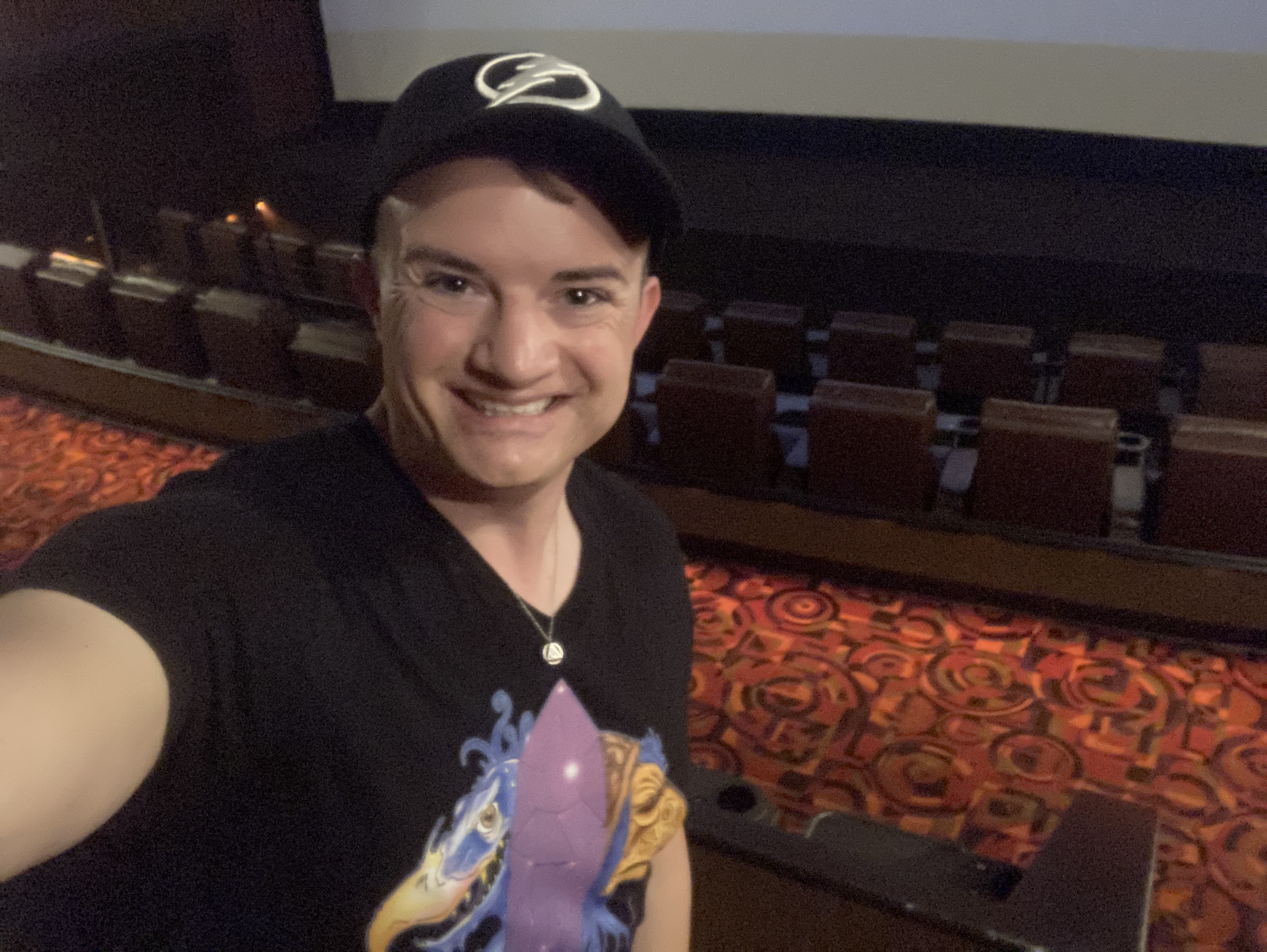
What starts out as a sleek and well executed, but still fairly standard, espionage film with some interesting sci-fi ideas, turns into a mind-blowing “time travel” action-thriller that will have you staring at the screen, mouth agape in awe. “Armed with only one word TENET, and fighting for the survival of the entire world, a Protagonist journeys through a twilight world of international espionage on a mission that will unfold in something beyond real time” (IMDb). And that is all you want or need to know going into this film.

The film is like a loop, closed in itself, similar to Nolan’s earlier film Memento but much more complex, even more complex than Inception. Previous events of the film will get re contextualized in the second half and inserts that viewers might not even have noticed start to become make sense and become important. TENET definitely warrants multiple viewings to catch all these little details, but the surface plot and the characters’ goals are kept simple so that even if not completely understanding why or how, the viewer is never lost in what is going on.

Aside from digital compositing, which is seamless, the film employs almost no computer generated effects, all action scenes are choreographed and shot practically. Unfortunately due to this age where everything you can think of is made possible computer generated effects, this might only become impressive to the viewer if he is made aware of how the effects were achieved. Fortunately, unlike some other recent productions which rely heavily on CGI, TENET will stand the test of time and may thus even become more impressive for future viewers.

The Film’s weak point is its characters. We don’t learn much about “Neil,” played by Robert Pattinson, and “The Protagonist,” played by John David Washington, aside from surface level information and they aren’t developed much until the very end of the film. Kenneth Branagh does a good job as the sometimes scenery chewing but still fairly standard villain character. The heart and soul of the movie is Elizabeth Debicki’s character “Ka,t” who is the most developed character in the film and arguably the most emotionally affected by the events of the film.

Needless to say this is not a character-driven film, instead TENET is highly plot driven but as long as viewers are aware of that they will be satisfied. If you are looking for more than your average spy action thriller but aren’t expecting a philosophical masterpiece then this is the film for you.

This article was written by our German correspondent Leon Zitz. Be sure to checkout his Instagram and YouTube pages. You can also checkout my review of his latest film Romeo Kills Juliette.

Ryan teaches screenwriting and American cinema at the University of Tampa. If you like this article, check out the others and FOLLOW this blog! Ryan is also the creator of the Four’s a Crowd sitcom podcast now streaming on your favorite podcatcher. Interested in Ryan making a guest appearance on your podcast or contributing to your website? Send him a DM on Twitter or email him at RLTerry1@gmail.com! If you’re ever in Tampa or Orlando, feel free to catch a movie with or meet him in the theme parks!

Follow him on Twitter: RLTerry1

“Dunkirk” film review

Journalism meets cinematic visual storytelling. Christopher Nolan’s war epic Dunkirk provides audiences with a different kind of war movie experience. Different in that the narrative is nonlinear and highly experimental. From a technical perspective, the film is flawless. The cinematography, sound design, and score all work together to create an immersive experience in which that fourth wall is nearly removed. One of my friends that I saw the film with last night described it as being a fly on the wall within each timeline. With little dialog, the focus is on the various groups of the army, air force, and civilians. The stylistic film reminds me of photo/video journalism. Dunkirk demonstrates that an emotionally satisfying experience can be delivered without conventional storytelling. In many ways Norma Desmond would be proud of Nolan’s film because “[he] didn’t need dialog, [he] had faces.” Dunkirk invites audiences in for a rare glimpse into the reality of war, and the reality of not only the armed forces but the civilian assistance that truly made the difference and just why this particular war story is so remarkable. Be sure to brush up on your knowledge of the events of Dunkirk before watching the film. You’re definitely going to need to have a base of knowledge of the theatre before becoming the proverbial fly on the wall.

Instead of a plot synopsis, here is what Wikipedia has as a summary of the history of Dunkirk Evacuation. This is definitely going to be helpful prior to watching the film.

During the Second World War (1939–1945), in the May 1940 Battle of France, the British Expeditionary Force (BEF) in France aiding the French, was cut off from the rest of the French Army by the German advance. Encircled by the Germans they retreated to the area around the port of Dunkirk. For years, it was assumed that Adolf Hitler ordered the German Army to stop the attack, favouring bombardment by the Luftwaffe. However, according to the Official War Diary of Army Group A, its commander, Generaloberst Gerd von Rundstedt, ordered the halt. Hitler merely validated the order several hours after the fact. This lull in the action gave the British a few days to evacuate by sea and fortify defences. Winston Churchill, the British Prime Minister, ordered any ship or boat available, large or small, to collect the stranded soldiers. 338,226 men (including 123,000 French soldiers) were evacuated – the miracle of Dunkirk, as Churchill called it. It took over 900 vessels to evacuate the Allied forces and although over two-thirds of those rescued embarked via the harbour, almost 100,000 were taken off the beaches. More than 40,000 vehicles as well as massive amounts of other military equipment and supplies were left behind, their value being less than that of trained fighting men. The British evacuation of Dunkirk through the English Channel was codenamed Operation Dynamo. Forty thousand Allied soldiers (some who carried on fighting after the official evacuation) were captured or forced to make their own way home through a variety of routes including via neutral Spain.

If you are approaching Dunkirk from a desire to see a Saving Private Ryan, then you may want to rethink going to see this film. With little convention in the storytelling, this film puts you on the beach, in the air, or on the sea alongside the civilians, pilots, soldiers, and officers. The focus is not on the characters, special effects, or the bloody atrocities of war, but focussed on highlighting a significant event in WWII history that has largely gone unknown except for those in France and the UK. You are very much like a journalist who is capturing the imagery with your camera. It’s a snapshot of war, not necessarily the story of war. War history buffs, this IS a film for you!