Sinister Summer: “Jaws” Retrospective Horror Film Review

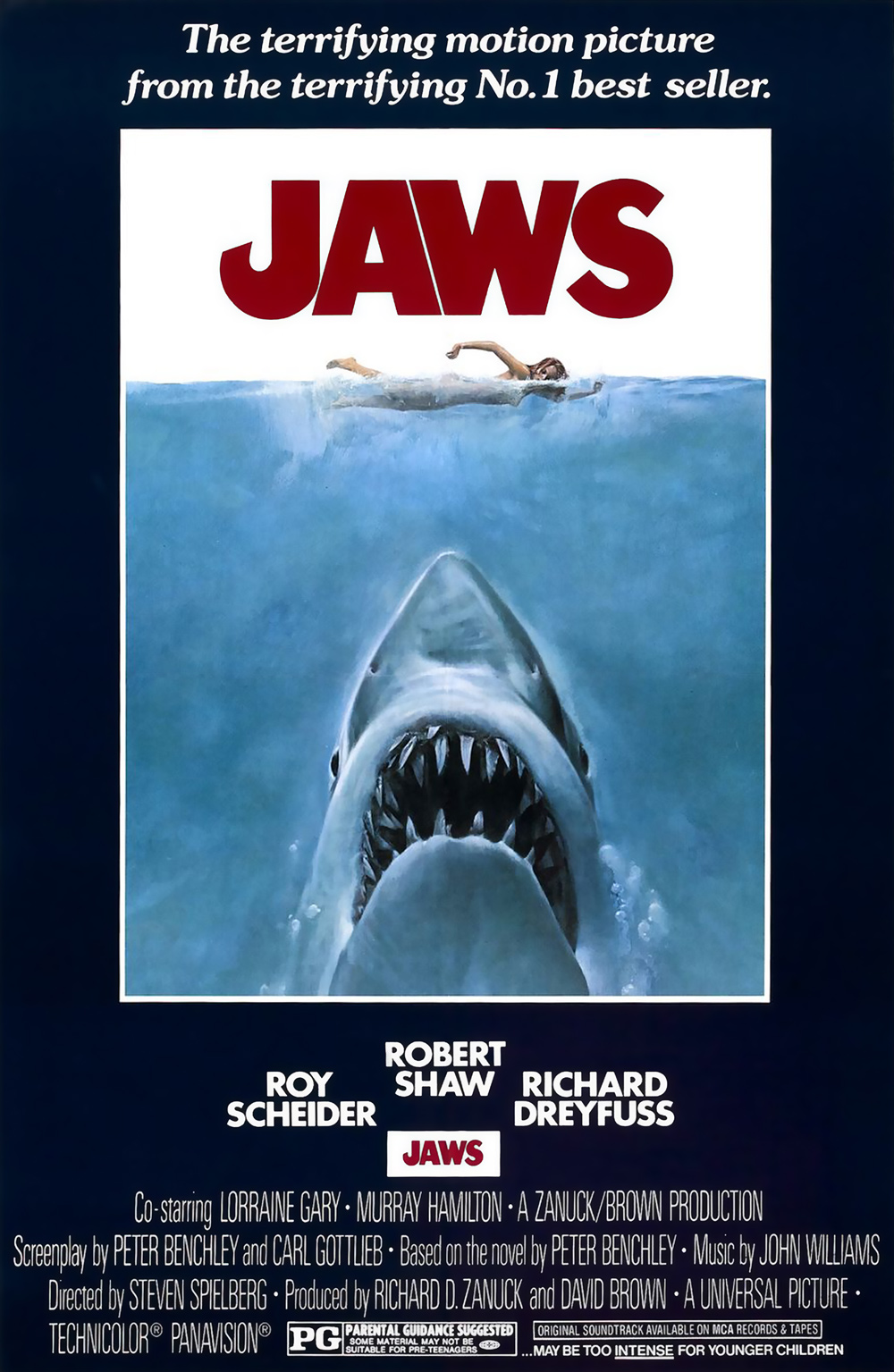
The original blockbuster! With The Meg opening tonight, the next article in my Sinister Summer series is a retrospective on Jaws (1975). And, we still “need a bigger boat” after all these years. Beginning with the iconic minimalistic score by John Williams, Steven Spielberg’s Jaws is still keeping people out of the water more than forty years later. Beyond the film, you can still face off with the most famous shark in cinema history at Universal Studios Hollywood. A favorite for folks to watch on July 4th each year (as I do), this film became the standard for the modern horror creature feature. And at only four minutes on screen, Bruce (Jaws’ nickname), successfully terrified audiences then and continues to frighten beachgoers today. For all intents and purposes, this iconic film set the bar for and essentially created this subgenre of horror movies featuring man-eating monsters from the natural world that exist in places where we typically find joy and relaxation. The ocean, theme parks, rivers, lakes–these innocent places become the setting for unimaginable terror.

If you are old enough to have watched it in theatres in 1975 or fortunate enough to have attended the special 40th Anniversary screenings back in 2015, then you can attest to the film’s evergreen ability to scare you out of your wits. When I watched it on the big screen in 2015, the auditorium was filled nearly to capacity with kids, teenagers, and adults. To see this iconic film on the big screen was truly a memorable experience. Especially so around where I live, since the gulf beaches are just down the road. The atmosphere was incredibly fun. All of these fans, most of which had likely seen Jaws before, were gathered together to relive the terrifying experience of a man-eating shark terrorizing a small New England town during the July 4th holiday season. But why would so many people pay to see a film that they had seen at no additional cost on TV or watched on DVD/BluRay?

Much in the same way Alfred Hitchcock’s Psycho is often credited, and rightly so, for being the first modern horror film and forerunner to the classic slasher; likewise, Spielberg’s adaptation of Peter Benchley’s novel Jaws is credited as the first modern creature feature horror film and forerunner to the blockbuster (or event movie). I am not negating King Kong, Creature from the Black Lagoon, or other predecessors; it’s important to take note of the word modern. Aside from excellent, visionary direction, both Psycho and Jaws have three important elements in common (1) powerhouse cast (2) strategic suspense and (3) a brilliant, oft-parodied, burned in your mind musical score.

It probably seems like you were born with John William’s two-note Jaws theme in your head, much like Bernard Hermann’s Psycho screeches. The terrifying suspense of Jaws comes in the form of a PG movie. That’s right, Jaws is rated PG. But this film delivers a bigger and more memorable punch than any gory torture porn horror film ever could. The groundbreaking structure of both these legendary films are the prototypes from which their respective branches of horror films are derived. They are the blueprint, if you will, for suspense and horror. The manner in which the suspense is drawn out for most of the movie assists in the ability to enjoy it over and over again, without it ever feeling like a B movie. The drawn out suspense engages you emotionally and psychologically. The feeling of dread lingers and lingers. In fact, you don’t truly see Bruce until the third act of the film when he jumps out of the water in an attempt to bite off the arm of Chief Brody. This intentional drawing out of suspense makes the delivery of that moment pack a powerful punch, an assault on the eyes and mind. Both Psycho and Jaws benefit from an excellent cast. The respective casts could not have been any better. Interestingly, in order to not allow the cast to overpower the story or shark, Spielberg didn’t choose actors with an instant command presence. But they displayed a strong presence nevertheless. It never feels as if they are acting, but truly become the characters they are portraying. The relatability of the characters is partly due to the screenplays, but it takes phenomenal actors to successfully bring these characters to life. Spielberg would repeat this same successful approach to creating blockbusters E.T. the Extra Terrestrial and Jurassic Park.

For more on suspense, checkout this video featuring Hitchcock himself.
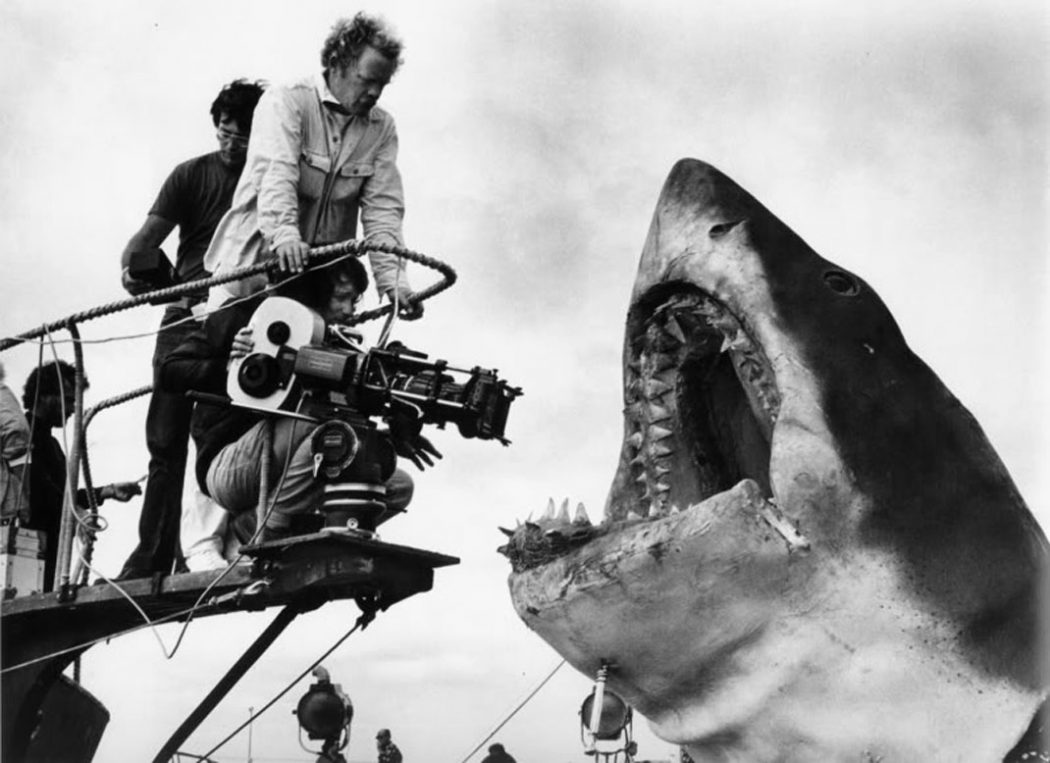
When Jaws is referred to as the original blockbuster, it’s not simply due to being the first film to break the $100mil box office sales mark, toppling the records previously set and held by The Exorcist and The Godfather. That is a valid observation, but is ultimately incidental. Reasoning behind this thriller’s ability to create the concept of a blockbuster movie is the fact Jaws was seen as an event not to be missed. Looking back at the original crowds of 1975, you’d think the movie was a one-night-only big event. Hence the term blockbuster. The common adjective attributed to big summer movies literally derives from the fact that queues for the box office wrapped around city blocks. It busted the block, so to speak. And the rest is history! Coupled with the summer release date and ticket sales, the allure of Jaws generated levels of enthusiasm and interest never seen before. The film took in so much money at its opening, that it nearly made up the entire production budget by the end of the first week. Furthermore, distribution and marketing companies began to use Jaws as a model for future marketing efforts in order to attempt to generate another blockbuster effect. After Jaws in 1975, the next big blockbuster would be George Lucas’ Star Wars IV: A New Hope in 1977. All these factors contribute to the iconic status of Jaws in terms of its contribution to film business.
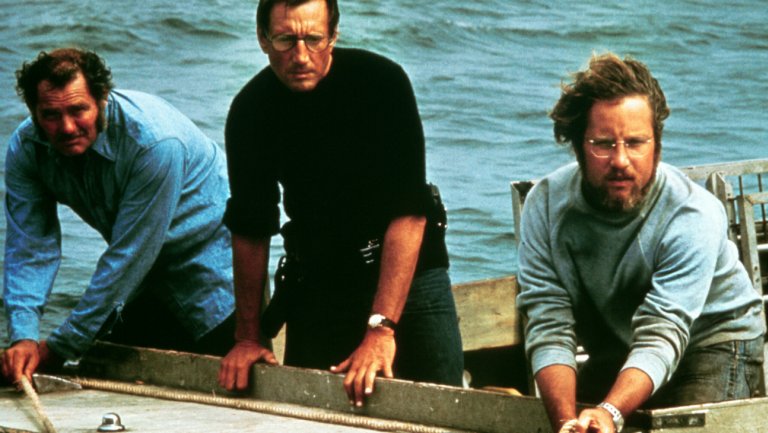
Instead of building a thriller on shock value, disturbing imagery, or jump scares, author Peter Benchley’s screenplay for Jaws focussed on crafting a cinematic atmosphere that had an intimate, claustrophobic feel built upon well-crafted drama through character development and conflict, at the center of which is a little heart. Different from contemporary creature features, Jaws picks off swimmers in the single digits and those attacks all happen at a single beach on a small island off the coast of Massachusetts. And instead of an entire agency hunting down the man-killer shark, three unlikely men are forcibly thrown together in order to track down and eliminate the terror from the waters off Amity Island. Keeping the principle cast and environment small, enabled the drama to perform strongly. Big things do come in small packages. Coupled with the strong performances from the entire leading cast, this brilliant combination of cinematic elements works together to give us some of the most memorable lines, scenes, and cinematography in movie history. Furthermore, real people swept up into an impossible situation and foolish decisions enable the audience to identify with the characters and the setting in ways that make the terror feel all the more real and close to home–or the beach.

While Bruce is often thought to be the villain of Jaws–and no mistaking it, he is definitely an antagonist–I argue that the true opposition to the goal in the plot is Amity’s mayor. If we accept the goal is to apprehend or kill the man-eating shark, then Vaughn serves as opposing that action. Perhaps you’ve never though of the true villain of Jaws being Mayor Larry Vaughn. A close analysis of the plot reveals that Jaws (Bruce) functions more as a catalyst for the principle conflict between Chief Brody and Vaughn. Other than the death at the beginning of the film, the Mayor is indirectly responsible for the remaining deaths. After all, it’s due to his utter complacency, negligence, and classic greed that led to the other deaths. For most of the film, we spend far more time with Chief Brody’s continued conflict dealing with the social pressures, desires, and ill-fated decisions of his boss than we do with shark attacks. Mayor Vaughn fails to acknowledge the sheer gravity of the dangerous situation, and close Amity’s beaches in order to keep his citizens safe. In effect, he fed them to the shark. Seems like a villainous action to me. Bruce was being a shark, Vaughn was the villain.

Often the central character’s development hinges on the direct and indirect conflict with the opposition to the goal of the plot. In this scenario, Mayor Vaughn stands between Brody and Bruce. The moments in which Brody demonstrates measurable growth in his character arc are when he attempts to stand up to the Mayor showcasing a contrast between public safety and a combination of politics and economics. Unfortunately, we never witness Brody truly standing up to the Mayor to enact measurable change per se; however, it isn’t needed because we witness several moments of Brody shouldering the responsibility of protecting the citizens of Amity as a civil servant. By contrast, Vaughn is more preoccupied with a warped view of  civic responsibility that places more importance on increasing the bottom line of the local businesses than public safety. He rationalizes his position opposing the advice of Brody by engaging in classic psychological defense mechanisms such as denial, displacement, and projection. Vaughn’s actions throughout the film depict an elected leader with misplaced priorities in order to better his own career.
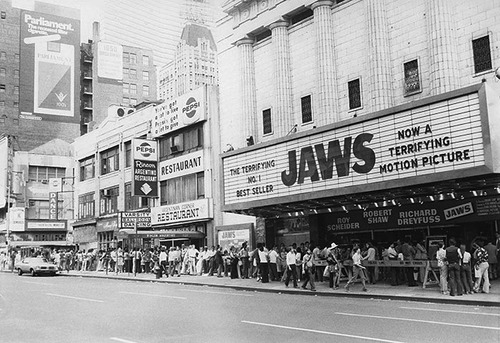
The success of Jaws and reasons why it continues to stand the test of time has more to do with the beauty in simplicity and strategic marketing than Spielberg’s filmmaking. Don’t get me wrong, Spielberg is an excellent storyteller and directed many of our favorite films such as this one, Jurassic ParkE.T.Poltergeist (with Tobe Hooper), and more, but it’s the strong screenplay and innovative marketing efforts that give Jaws the chutzpah it has. Jaws quite literally changed the way studios market “blockbuster” films. Prior to Jaws‘ release, the only films to get wide, general releases were B-movies and exploitation films, but Universal Pictures took the chance at cramming Jaws into as many screens as possible, and it paid off in spades! Jaws wasn’t the first film to book theatres in this was, but it was the first to be well-received by by critics and fans. The film was an instant success!
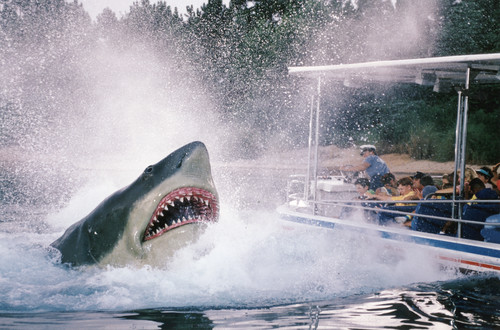
Even if you trust the statistics that you are more likely to be injured or die in a car accident than be attacked by a shark, Jaws still leaves you wondering what may lurk in the depths of the ocean, and by extension lakes and rivers (thanks in part to Animal Planet’s River Monsters). There is a lingering feeling, even if in the back of your mind, that a man-eating shark could live in our oceans. That is the power of this film and why it has continued to pervade popular culture for more than 40 years. Its influence on popular culture is certainly not limited to the dozens or imitations such as Lake PlacidPiranha, Deep Blue Sea, or parodies like Sharknado, but it serves as the inspiration for Discovery Channel’s Shark Week, the Monster Jam monster truck Megalodon, theme park attractions, and the music is often used in unrelated TV shows and movies. Lines, imagery, music, and characters are permanently embedded in the psyche of the general public.

“Jurassic Park” (1993), Sci-Fi Horror NOT Action-Adventure

In honor of Jurassic Park‘s 25th Anniversary, I want to revisit why the film works so incredibly well, and never gets old. Just like Dr. Alan Grant states at the beginning of the film, “raptors have far more in common with present day birds than they do with reptiles,” that same analogy can be drawn with the original Jurassic Park and its proximity to horror compared to action-adventure. Borrowing from Dr. Grant, the original Jurassic Park has far more in common with scifi-horror than it does with action-adventure, hence why it has held up over the years and continues to be a favorite film for many cinephiles and fans alike. While all the sequels, including Jurassic World are far more action-adventure than the original, Jurassic Park can be likened to Ridley Scott’s Alien. The latter is a quintessential space scifi-horror with action-adventure sequels just like the former. And like Jurassic Park, the original Alien is considered far superior to that of the sequels. But why is this? There are many reasons from script to director to cinematography; but at the end of the day, it’s the fact that both these critically acclaimed and admired films have their respective roots in the American horror film and not action-adventure movies. More so than any other genre, horror is (1) uniquely American and (2) the most time tested, given it can trace its roots back to the 1890s and was perfected by Universal Pictures in the 1920s and 30s.

So what separates Jurassic Park from the sequels? Both have life-threatening dinosaurs, both have action, both have adventure, etc. But, only the original carries with it social commentary, rich subtext, and well-developed themes told through a brilliant combination of horrific frights and believable sciences taking place within a world of fiction grounded in reality. Furthermore, the focus in both Jurassic Park and Alien is largely on the drama between the characters and the oppositional forces in the film. The sequels in both franchises place far less emphasis on well-developed conflict and drama, and instead sacrifice those golden elements of cinematic storytelling for high-concept CGI-filled adventure movies with lots of dinosaurs or aliens. The proliferation of gimmicks and effects is often used to hide a weak story. Fortunately, Jurassic Park provides audiences with a strong plot told through exceptional cinematic storytelling.

Jurassic Park‘s screenplay benefitted from being penned by the award-winning author Michael Crichton who also wrote the novel by the same name. Often times, when the author of the novel also writes the screenplay, the screenplay forms a stronger foundation upon which the technical elements can be build. A more recent example of a brilliant screenplay adaptation of a novel is Gone Girl, the author of the novel was the screenwriter. Although a screenplay is visually driven whereas a novel is internally driven, when a novelist with a penchant for visual storytelling writes the screenplay for the movie adaptation, the screenplay tends to contain better developed characters, strong subtext, effective conflict, and excellent dialogue. Crichton created incredibly memorable characters who each spoke with their own voice. Casting the right actors to portray the characters is obviously important–and the cast for Jurassic Park is exemplary–but even before the actor steps into the character’s shoes, the character has to be created. Each character in Jurassic Park possesses unique traits, strengths, weaknesses, dialect, and behaviors. Instead of the conflict being arbitrary, the conflict develops through the interpersonal relationships between the characters and the relationship between the characters and the opposition–human and nature.

I was in elementary school when the movie hit theatres in the summer of 1993; and although under 13, my parents allowed me to go see the movie. It was my first PG-13 film, and what an experience! Not unlike Dr. Grant’s reaction to his first encounter with a dinosaur in the film, my reaction to Spielberg’s masterpiece was eyes-wide-open, mouth gaping wide, and racing endorphins. And then comes the macabre contrast in Acts II and III. “Ooo, ahh–that’s how it begins, and then there’s running and screaming” (Dr. Ian Malcolm, The Lost World). Aptly stated. The opening scene hooks the audience with a disaster, but does not reveal much about the dinosaur in the secured transport–brilliant. Because this scene did not show a dinosaur, the audience’s curiosity is pricked which creates an eagerness to see a dinosaur and a degree of nervousness or apprehension accompanying that curiosity. We wanted to see more. If you’re familiar with Hitchcock’s bomb theory, he states “you must never let the bomb go off.” More than simply shock audiences with the death of that employee at the beginning of the movie, this scene serves as information more than a glimpse at that which would be horrific in real life. This delay of seeing a dinosaur forces the audiences to pay more attention to the characters, dialogue, and conflict than looking for the next dino. Furthermore, the delay in seeing a dinosaur, perfectly setup audiences for the grand reveal on the way from the helipad to the Visitors Center. Interestingly, if you add up all the screen time that dinosaurs receive in the film, you’ll find that they are only on screen for about 20-minutes. Just like Hitchcock transferred the terror from the screen into the minds of the audience after the Psycho “shower scene,” Crichton and Spielberg did the same with Jurassic Park.

It’s the soft introduction to the man-made dinosaurs that makes the horror of the dinosaurs feel so much more intense later on in the film–and make you scream! In terms of the type of science-fiction horror film Jurassic Park could be classified as, it shares many commonalities with man vs nature and man vs technology horror films. Crichton is known for his believable science within his works of fiction. It is obvious that genetics and paleontology were researched enough to use real, hard science to inspire a fictional science that feels just out of reach of the current trends in the science, technology, and engineering fields. Pair that with horror, and you have a solid cinematic film. The brilliance of horror films is how they can creatively comment on or provide a different perfective on a anthropological or psychological observation; moreover, it can be helpful when exploring philosophical questions. And these topics are visually explored through the movie and externalize the themes. One area that separates popcorn action-adventure movies from horror films is the cultural significance of the subtext and themes. Typically, action adventure movies do not carry with them social commentary nor significantly pull on our emotions and tap into our most primal fears. Jurassic Park contains all of this. There is something about horror films that beckons the audiences to find enjoyment in, that which in real life, would not be enjoyable—and not only see it once, but repeat it. And furthermore, find the unfamiliar and grotesque fascinating to behold as what should remain hidden comes to light. Certainly the dinosaurs in the movie should have remained “extinct,” but were brought back to life and engaged in violence in which we find enjoyment. 

Some of the themes found in Jurassic Park that are told through the visceral horror and tense dramatic moments are: man vs nature, foolishness and folly, greed, wisdom vs knowledge, man vs technology, and parenting. Why don’t the Jurassic films have the chache that the original does? You try to find to find rich themes such as these in the subsequent films. They don’t exist. Why? Because it is far more difficult to explore what it means to be human and social constructs in a scifi action movie than in scifi horror. An action movie would be ill-equipped to tackle questions of a philosophical nature because the focus is largely on the action itself and not necessarily the characters, and almost never the subtext and theme. For an action film to delve into that which causes the film to take on an intellectual nature, it would lose the attention of those who simply want a good popcorn movie. Don’t get me wrong, there are excellent action-adventure movies that contribute to the world of cinema in exceptional ways. Indiana Jones Raiders, Doom, and Last Crusade do that. Obviously, the inability to reconcile nature’s resistance to control is one of the most important themes of Jurassic Park. Dr. Ian Malcolm tells the group that “life finds a way,” and it immediately becomes the film’s mantra (and a quotable line), true in every demonstrable, measurable way; the dinosaurs survive outside their design and engineering, the lost children survive with the help of a kid-averted paleontologist who discovers his parental side, humanity survives despite meddling in the natural order of things by playing God because that’s what we do–we survive. Every character in the film either understands or is reminded of this–some of them, by force when it’s too late–through the course of events.

Jurassic Park uses horror film techniques in a brilliant fashion to force its audience into considering the larger philosophical questions mentioned in the previous paragraph. It reinforces those questions with clever parallels: Dr Grant’s way of paleontology is about to go “extinct” due to the rise of computer technology (the line “don’t you mean extinct” came from a comment behind-the-scenes regarding CGI encroaching upon animatronics, puppetry, and special effects); the power of the natural world is exponentially magnified when the park’s technology failure is combined with a disastrous tropical storm; money causes literally every ill in the film, even when it is being used for supposedly admirable purposes; and “you were so pre-occupied with whether or not you could, you didn’t stop to think if you should.” The inability to reconcile nature’s resistance to control is one of the most important themes of the film, of course. Ian Malcolm tells the group that “life finds a way,” and it abruptly becomes the tale’s rallying cry, true in every conceivable way; the dinosaurs survive outside their engineering, the lost children survive with the help of a paleontologist who discovers his paternal side, humanity survives despite its meddling because it’s what we do. Every character in the film either understands this, or is made to by the course of events.

Beyond exploring themes, it’s the intent of the film that determines whether is a thriller (suspense) or horror film. The films speak for themselves. If the intent is to horrify, then it’s a horror film; if the intent is to thrill, then it is a thriller. In all fairness, Jurassic Park is borderline; but it’s the level of shock, fear, and dread that may just be enough to tip the scale toward horror instead of thriller, and certainly evidence enough to prove that it is NOT simply a dark action-adventure movie. Much like Stanley Kubrick’s The Shining and Scott’s Alien, Spielberg’s Jurassic Park is also an intellectual film. Whereas an action-adventure movie would have provided audiences with a few minutes collectively of some surface-level chit-chat above ethics in order to technically give the film a theme, Jurassic Park provides audiences with an entire film about ethics that will have them talking about the various dilemmas and challenges facing the characters throughout the film. It’s brilliant! And quite the rarity these days. The hand of Spielberg’s penchant for horror (Jaws and Poltergeist) is seen in Jurassic Park from requesting that Crichton rewrite the original screenplay to be more cinematic and less internally driven because Spielberg desired to take the novel and adapt it to screen as a Jaws on land. If his intent was to make a sequel to Jaws, then we have to conclude that his intention was to horrify audiences in some measurable amount.

With a film as dynamic as Jurassic Park, it may be nearly impossible to prove that it is a horror film at its roots; but, the body of information provided in this article help to support the thesis that it is a horror film based upon the intention, conflict, themes, and visceral terror. “Well, there is it.”

You can catch Ryan most weeks at Studio Movie Grill Tampa, so if you’re in the area, let him know and you can join him at the cinema.

Ryan teaches screenwriting at the University of Tampa. If you like this article, check out the others and FOLLOW this blog! Interested in Ryan making a guest appearance on your podcast or contributing to your website? Send him a DM on Twitter!

Follow him!

Twitter: RLTerry1

Instagram: RL_Terry

“Split” movie review

splitIntensely captivating! M. Night Shyamalan stages a successful return to the horror-thriller genre in the brilliantly intriguing motion picture Split. When Universal Pictures, arguably the king of the American horror film, Blumhouse Productions, and Shyamalan combine their respective visual storytelling skills, the result is a dynamic thriller full of outstanding twists and turns. Shyamalan, long known for surprise or bizarre endings, provides audiences with the biggest surprise of all: he is back, and it’s a completely satisfying cinematic experience! Beginning with 2015’s The Visit, Shyamalan has been working on a comeback; and Split is the final evidence needed to support his successful return to the silver screen. James McAvoy delivers an outstanding performance–or should I say performances–every minute of the film. Although the concept of building a suspense-thriller around a character with dissociative identify disorder (DID), formerly known as multiple personality disorder, is not a new one–after all Norman Bates is the most iconic example. M. Night Shyamalan puts his own spin on the character-type by adding his special blend of what can only be referred to as “shyamalan-ness.” You’ll definitely want to see it again in order to catch everything that you missed the first time.

A film that many psych majors will find fascinating! While the mental divisions of those with dissociative identity disorder have long fascinated and eluded science, it is believed that some can also manifest unique physical attributes for each personality, a cognitive and physiological prism within a single being. Though Kevin (McAvoy) has evidenced 23 personalities to his trusted psychiatrist, Dr. Fletcher (Betty Buckley), there remains one still submerged who is set to materialize and dominate all the others. Compelled to abduct three teenage girls led by the willful, observant Casey (Anya Taylor-Joy), Kevin reaches a war for survival among all of those contained within him – as well as everyone around him – as the walls between his compartments shatter apart. (IMDb).

Just when you think the movie is going one direction, it throws you for an unpredictable loop. Split provides audiences with the same level of captivation as M. Night delivered in Signs or even in The Visit. Very much character-driven, this film could have easily taken a turn for the campy or par-for-the-course approach to a central character with DID; but Shyamalan proves that a familiar premise can be crafted into a whole new experience. After the incredible success of 1999’s The Sixth Sense, audiences everywhere set the bar for Shyamalan quite high–in fact he was prematurely compared to a 21st century Alfred Hitchcock. While it is highly unlikely that any director will reach the iconic status of Hitchcock, Shyamalan was seen as a director who would provide a similar experience to that which earned Hitchcock the moniker the master of suspense. Evidence of his admiration of Hitchcock can be been in the title sequence of Split. It bares a striking resemblance to the opening title sequence from Psycho. 

However, the danger in prematurely setting expectations too high is that you may likely be setting yourself up for disappointment. And that is precisely what happened with Shyamalan. From killer plants to invisible supernatural entities, he began to lose the cache he earned in the early 2000s. M. Night would spend years disappointing audiences to the point that he became a joke–a parody–perfect material for Family Guy. Then just when all hope for Shyamalan to regain the admiration of movie patrons–especially those who enjoy horror/suspense/thrillers–he gives us The Visit in 2015. That film was the glimmer of hope he needed to begin to rebuild his status as a thriller/suspense/horror filmmaker. And with the incredibly satisfying Split, M. Night Shyamalan is BACK!

Films like Psycho and Split only work as well as their respective director and cast–primarily the villain. Obviously, Psycho stands up to the test of time and will forever be a favorite of many cinephiles and a testament to the power of visual storytelling, Split had to be a new experience while still channeling the director that Shyamalan admires and patterns himself after. The success of Split rested upon the performance of McAvoy as Kevin (and the 23 others with a 24th on the horizon). McAvoy’s performance in this film is quite possibly the best of his career. Each identity is clearly seen as individuals. From his facial expressions to his gait to the manner in which he carries himself, every identity is unique in voice and appearance. Even in the middle of a conversation, one identity goes away while another surfaces into “the light.” Although there are only a few identities that have prominence in the diegesis, the others give audiences just enough nuance to register them as having a presence in the subconscious of Kevin.

For all the excellence in cinematic storytelling Split has to offer, there is no denying that it may be controversial in that it uses DID to construct a “beast.” There are already members of the mental-illness community who have expressed disdain for the subject matter and context of the film. However, prematurely dismissing this film as offensive to those suffering from cognitive disorders would be ill-conceived. After screening the film, it is clear that the focus is not on DID itself (or any other cognitive disorder that Kevin may have), nor is Kevin crafted to be an unredeemable monster; but, this film uses DID and the character of Casey (one of the young ladies who is captured at the beginning of the film) as tools through which to explore childhood trauma, abuse, and coping mechanisms. Isn’t that what films do? Push the envelop in an effort to provide a different perspective on an issue, problem, or circumstance? Horror is often concerned with “other” scenes–revealing that which should remain hidden–and Shyamalan does precisely that in Split.

If you enjoy horror, suspense, or thriller films, then you are definitely going to enjoy Split. There is so much to take in, that you may want to watch it again in order to catch everything that you may have missed the first time. Even if you are skeptical or think the content may be offensive to the mental-illness community, you may be surprised that there is a lot that can be gleaned from the narrative. With brilliant performances, excellent writing, and outstanding direction, Split should be on your radar of films to watch this weekend.

Written by R.L. Terry

Edited by J.M. Wead

DCA’s Hollywood Tower Hotel Under New Management

TOT_DCA_GGThe recent news of the Guardians of the Galaxy makeover of the iconic Tower of Terror (TOT) ride at Disney’s California Adventure has many, if not most, fans of the attraction up in arms. Apparently, it was not being guarded too well. Suffice it to say, those of us who spend a great deal of time in the parks (for me, it’s the Florida parks mostly), we are accustomed to seeing iconic attractions go by way of Jaws: the Ride. That does not mean that one ever gets used to or accepts it; but the fact is that the theme parks have to evolve in order to keep up with those who bring in the most revenue (kids and teenagers, because of their parents or grandparents). Of course, some evolutions are better left in AutoCad. With the Walt Disney Company unable to integrate the Marvel IP into the Florida parks to any significant extent (in terms of attractions), it seems the only choice is to overhaul the Disneyland Resort (DLR) near Los Angeles…

At first, many theme park enthusiast must be wondering why??? However, exploring this recent news from a critical perspective reveals that it is a business decision, plain and simple. As I have written many times, theme parks are glorified arms of revenue–a business line item–that are designed to be cash cows, instant revenue. Most likely, the DLR company conducted surveys and focus groups concerning a proposed idea to refit the Twilight Zone Tower of Terror with Guardians of the Galaxy. Although it is expected that some attractions have to be removed or retrofitted, there are certain attractions–especially in the Disney Parks–that should not be touched. The Disney Parks more so than the Universal Parks rely upon nostalgia. In many ways, this modification of the TOT at DCA is sacrilegious to the original theme of the parks and will upset many people. With the massive refurbishment of TOT, this leaves park regulars and future tourists wondering what iconic attraction is next. If TOT is not safe, then is any attraction safe from elimination??? But, is retheming an attraction always met with disdain? Certainly not. When the 20,000 Leagues Under the Sea attraction at Disneyland Park received its Finding Nemo refurbishment, it was generally met with excitement and praise. That is probably because the soul of the attraction was left in tact. By extension, it could be said that retheming Mission: Space at EPCOT with a Guardians of the Galaxy makeover would actually be welcomed and appreciated as that attraction is getting dated and simply does not see even half the guest numbers that it once did. But should Spaceship Earth get rethemed to a Marvel IP? Definitely not. There are attractions that need to be rethemed or reimagined every couple of decades or so, and then there are those which are best left alone for all to appreciate over the years. But how to know the difference? That’s the question.

Many theme park researchers and fans alike never thought that ToT would become extinct; that is until the rumors began floating around in the last year or so. Much like Universal Studios Florida, Disneyland Resort suffers from lack of room for expansion. Yes, I am aware the Universal has acquired more land recently; but for argument sake, it is important to be able to compare the two. One reason why Universal needed to retheme and replace entire attractions is because it did not have the luxury of expansion until recently. So, the only way to integrate new offerings into the parks was to replace existing ones. Much in the same vein, DLR is also landlocked; and in order to integrate new offerings, it too has little choice but to replace or retheme existing attractions or lands. Accepting the fact that DLR has limited room for geographic expansion, leaves only one alternative: continue to modify the park every 15-20 years or so. The largest source of revenue for theme parks are kids and teenagers. Not that young and older adults do not add large numbers; but the families with kids and teens are the ones who bring in the most revenue due to multiple family members needing multi-day tickets and potentially several nights in a hotel. For every one or two people going to the park alone or together, there is likely one or two families or groups of 4-6 or even more who are also going. Think of it as a 1:4 ratio (and that is probably conservative). Much like Disney’s Hollywood Studios is almost losing its identity with and connection to the magic of filmmaking, with the massive addition of Star Wars and Toy Story Lands, DCA looks like it is also shedding its story of California and Hollywood and dawning the dominant theme of Marvel and Cars. Yes, the parks are integrating movies but not in the same way that the parks were originally designed.

Why is losing its original identity an important part of the equation on whether something is considered a legacy attraction or not? Because once the identity of old Hollywood or the magic of filmmaking is stripped away, then what was once seen as iconic or legacy no longer has that image or appeal. If DCA no longer represents Old Hollywood, gold rush California, or beachside amusements, then the Hollywood Tower Hotel no longer seems relevant. Although many people recognize the Twilight Zone music, it is safe to say that most kids and teens do not know what the Twilight Zone is or was. They don’t know that it was a groundbreaking anthology series in TV’s earlier days. So, if those who are not driving the most revenue into the parks do not understand the significance or nostalgia of the Twilight Zone, if they do not see the park as representing Old Hollywood or filmmaking, and if they have never seen the Tower of Terror movie, then that attraction becomes a prime target for a complete overhaul or massive refurbishment. Essentially, it is like a member of a royal family getting striped of his or her title under a new monarchy. Simply stated, it is apparent that the Twilight Zone Tower of Terror no longer qualifies as a legacy attraction at DLR.

We can analyze this decision all day long and arrive at a litany of conclusions or rationale for why this was or was not a good decision; but the fact of the matter is, unless things change, the ToT at DCA is going to become a Guardians of the Galaxy attraction. In my personal opinion as a theme park enthusiast and long-time fan, I am saddened to see this attraction get replaced by a newly acquired IP; but, the analyst in me can understand why the company is making that decision. Looks as if the Tower of Terror left it “guard” down. Perhaps the new theme will be a success! However, that success comes at the cost of an opening day attraction that many will miss.

Reimagining Halloween in the Parks this Year: the Mind of Horror v. the Eye of Terror

After taking break from posting last week, as it was a holiday, I am happy to provide you with another stimulating article once again on the themed entertainment industry! All week long, I have been thinking about what to write this week. I’ve covered some of the recently opened or previews of attractions and theme parks opening soon; but, I thought that I would take a slightly different approach this week. Over the last year, the United States and other countries have been experiencing a rise in violence. Whether that violence has (1) always been there, but because of the great mediation of society (a proliferation of media capturing devices and distribution outlets), we simply see it more often or (2) if there truly is a signifiant rise in mass violence compared to past decades, is not what I am here to discuss. I would, however, like to discuss the upcoming Halloween events in the parks this year, and specifically, how they might have to adapt or change as a result of the recent mass shootings.

HHN2016Already, Universal Orlando has alluded to the fact that it may be revisiting some of its offerings for this year’s Halloween Horror Nights (HHN), and it would not surprise me if Busch Gardens Tampa Bay makes a similar decision with Howl-O-Scream (HOS), as both parks primarily draw from the Central Florida area and of course tourists still flock to the parks for the annual celebration of the macabre. The recent massacre at the Pulse Night Club will undoubtedly have an affect upon the planning and logistics of primarily HHN followed by HOS to a lesser extent. Since the horror film, and by extension the haunted house attraction (or scare zone) are both grounded in the same anthropological (inclusive of sociology) and psychological theories, there is definitely an opportunity to explore this area of themed entertainment. As Disney’s Mickey’s Not So Scary Halloween Party and SeaWorld’s Spook-tacular do not include glorified violence or death, I will not spend time analyzing how those events may change, because they are mostly benign. Suffice it to say, there will likely be some changes coming to HHN and HOS this year. What are those changes? Well, I am not prevued to those decisions; but can extrapolate from logic and theory what may happen in light of recent events in Orlando and beyond. It is important to note that both Universal Orlando and Busch Gardens Tampa Bay mostly likely have to revisit some of the scare zones or houses this year but not implement changes that may have a negative affect upon drawing from guests outside the Central Florida area. Striking a balance between curtailing some of the violence in respect to those who died and still satisfying those who were not emotionally or psychologically impacted is the key.

HOS2016The events certainly still have to feel like Halloween but perhaps reimagining some of the offerings will aid in finding that delicate balance. It is entirely possible that many who have enjoyed going to HHN and HOS in the past may back off this year in an effort not to come face-to-face with violence as it has greatly impacted many people. Here’s an interesting question: does horror have to be violent? Yes and no. Some of the greatest horror movies of all time are not terribly violent at all, but the eye witnessing violent acts certainly creates terror in the minds and bodies of the audience (or park guest). Alfred Hitchcock once said, “there is no greater threat than an unopened door.” This is indicative of the master of suspense’s ability to generate the fear of something or someone that may not even be a threat. There is another Hitchcock quote (or, at least I believe it’s Hitch) to the effect of “greater is the fear that’s in the mind than on the screen” (if you know of this exact quote, please let me know). That being said, likewise, seeing Freddy, Jason, Leatherface, or Michael is equally terrifying because of the trademark violence they have displayed on the screen over the years. It is important to year-round or seasonally operating Halloween-themed attractions to include both the physical and psychological/emotional aspects of horror in order for the guests to have a dynamic and full experience facing that which terrifies them and from which guests would otherwise run away.

unheimlichThroughout history, from the fights in the Roman Coliseum to Michael Myers’ slaying of people in Halloween, audiences have been both entertained and repeatedly drawn to stories and shows that highlight horrific acts of violence or feelings of terror and anxiety. Perhaps there is a deep seeded reason as to why millions of people find entertainment value in horror films. This question has been tackled by many psychiatrists and psychologists, each has come up with a different explanation as to “why horror?” Most notably, famed psychiatrist Sigmund Freud provided great insight into an explanation of why people find horror films fascinating in his essay on the Uncanny.  In his study on the uncanny, Freud takes on the literary imagination (this same literary analysis can and is used to analyze film and themed entertainment) by dividing his theory up into three sections. He first defines the concept of the uncanny, then performs an examination of the context required for understanding the experience of the uncanny, and finally explores the affects of the uncanny on the psyche through literature and fiction. Some of the running themes throughout his essay are loss of eyes, castration, the double-ego, and self-reflexivity. Through the framework laid out by Freud, scholars and film critics can explore the themes in horror film as it relates to the human subconscious; and for purposes of our discussion, the horror attraction.

Freud explains the realm of the uncanny as the place at which aesthetics and psychoanalysis merge, because it deals with a particular feeling or sensation combined with emotional impulses. The substances or manifestations of the uncanny are elements that are fearful and frightening. Proceeding with Freud’s definition of the uncanny being a class of frightening elements, plaguing the psyche, ushering an individual back to what is familiar (heimlich) and known (as opposed to what is unknown). Freud refers to the uncanny as that “which should have remained secret and hidden, but has come to the light.” Furthermore, he goes on to further describe the uncanny as the “mark of the return of the repressed.” The concept of the uncanny is a type of unwilling or mistaken exposure to something surprising, unexpected, or horrific. Freud claims that the source of the uncanny in literature is the recurrence of something long forgotten and repressed. However, not everything that returns from the psychic depths of repression is uncanny. The mere return of repressed feelings and experiences is not sufficient for the uncanny to occur. It requires something repressed having returned but represented by an unexpected and outside the realm of reality. This is easily accomplished in literature (and by extension, movies, theme park attractions, and plays) because fantasy is different from reality.

Just because something works as uncanny in a work of literature doesn’t mean it can work in real-life as well. During times of tragedy felt by an entire group of people or nation, the same concepts which work in literature and film may not work as well, for a period of time anyway, in themed entertainment. Within literature, if the author makes a pretense to realism, then he or she opens the door to supplying the story with the uncanny. Often times, the uncanny in literature and film is the projection of the psyche of the central character on another object or person combined with a warped view of the objective and subjective of a given situation. It’s like something within the fictional world creeps into the real world. Within the horror genre, there are many different stories or narratives that exist. And, each type of horror film tells its story in different ways; however, they are all concerned with getting the same emotional response from the “people out there in the dark,” as famously stated by Norma Desmond in the timeless film noir classic Sunset Blvd. Sometimes the audience will go on a journey into the crazed mind of a psychopathic serial killer or they may witness a supernatural monster terrorizing a small Bavarian village. In either case, Freud believes that the writers of horror, and by extension themed entertainment designers, are concerned with exposing the audience to “other” scenes. And, these “other” scenes are rooted in the subconscious.

eyeofhorrorMoreover, Carol Clover also provides insight into the fascination with the horror theme park attraction. After all, horror films and theme park attractions are mostly concerned with what you actually see. Horror attractions, much like their movie counterparts, are visual stories that are translated into experiential narratives. The Halloween themed attractions in the parks have to include different eyes. The three principle types of eyes used in horror attractions are the assaultive gaze (active, penetrating), reactive gaze (passive, penetrated, the most common in horror storytelling), and repeated gaze (masochism for characters and spectators alike). This is one reason why extreme closeups (ECU) of the eye are popular in horror films turned attractions. The eye is extremely symbolic in narratives driven by fear. The design of horror attractions and films is extremely fascinating because of the convergence of visual storytelling and engineering. It’s more than blood, gore, screams, and knives; there is almost a poetry behind it. A brilliantly insightful quote from Clover is, “Inasmuch as the vision of the subjective camera calls attention to what it cannot see–to dark corners and recesses of its vision … and what might be … just off-frame–it gives rise to the sense not of mastery but of vulnerability.” At the end of the day, both HHN and HOS highlight our vulnerability and prey on our fears of that which assaults the eye and should remain hidden.

corridorBut what about HHN and HOS this year? Looking to the past, and how Universal Orlando handled mass violence in society that had a profound impact on a group or whole culture of people may help shed light on what might be expected this year. During HHN XI (2001), Universal Creative pulled Eddie, the chainsaw wielding maniac with a complex and fascinating backstory, from the lineup after the attacks on 9/11/2001. It was decided that the mood of the United States was such that it would have been in poor taste to include such a violent icon in the theming. In addition to the removal of the HHN icon, most signs of blood, gore, and the glorification of violence were removed–even names of characters and zones were modified. Because of the recent deaths of nearly 50 people (some of whom were connected to the parks as employees, bloggers, or past performers), we might witness a similar reimagination of events at Halloween Horror Nights and Howl-O-Scream this season. Hopefully, I have been able to open a discussion on how things could be reimagined at the annual Halloween events this year. An attraction can be equally terrifying even if there is no violence to be seen. However, the inclusion of cliche horror film violence is an integral part of the modern Halloween attraction experience. Even Carol Clover explores the importance of men, women, and chainsaws in horror storytelling. Perhaps the creative engineers and designers at the parks will look beyond what has typically been a staple of these events and embrace other avenues of terror that will still prompt screams. In all likelihood, we will probably see the dial turned back on the knives and guns during HHN and HOS but that certainly does not mean that the attractions will be any less terrifying. It’s entirely possible that the mind of horror will outweigh the eye of terror in the theming, planning, and design of HHN and HOS this year.