“Red Sparrow” film review

Intense. Riveting. Spine-tingling, A masterful spy thriller crafted in a classical fashion with sex appeal. Red Sparrow will harness your full attention from the opening. Directed by Francis Lawrence, this spy movie is the level of excitement that 2015’s Bridge of Spies wished it was. Whereas many espionage movies fail to develop a plot that keeps you guessing from beginning to end–allowing you to feel like a covert operative or detective–this film delivers a mesmerizing story filled with intriguing characters and close calls. In many ways, this film contains elements that could be likened to a Hitchcockian suspense thriller with influences from Billy Wilder and David Fincher. Jennifer Lawrence displays an uncanny performance that truly shows the versatility of the Oscar-winning actress. With tensions rising between the US and Russia in real life, this films comes at a perfect time because we may find ourselves in a cold war that’s reminiscent of the latter part of the 20th century. Not for those who are weak in the stomach, this film contains cringy visceral horror that will get under your skin. Without the need to rely on science-fiction gadgetry to carry the story, this film provides well-developed characters and an intriguing plot that’s filled with twists and turns.

Prima Bolshoi Ballet ballerina Dominika Egorova (Jennifer Lawrence) is faced with a bleak and uncertain future following a severe career-ending injury while on stage performing. Her high-ranking uncle persuades her to attend Sparrow School: an institution that trains seductive spies in order to pry information from targets by using extreme sensuality. Sparrows turn their minds and bodies into weapons for the state. Being determined to remain special, Dominika completes the sadistic training more quickly than the other students and is recruited for a covert assignment to track and report on an American CIA operative (Joel Edgerton) who Russia feels will lead them to the mole within their own ranks.

The beautiful opening of Red Sparrow is abruptly ended when Dominika suffers a horrific injury that instantly ends her ballet career. This acutely intense moment will cut you directly to the bone–you will undoubtedly wince or cringe, feel the break in your own legs. This is but a taste of what is to come throughout the movie. In an exquisite fashion, the gorgeous dance at the opening is juxtaposed against the alleged drug deal gone bad. Paralleling one another, the event that unfolds concurrently enable the plot to get a quickly paced fantastic start out the gate. Unfortunately, this excellent start does lead into a slower paced latter half of Act I. However, there is important background information that is revealed during Act I that foreshadows and sets up the remainder of the turning points in the plot. You will also notice the use of the color red in many places during the movie. Analyzing the shades of, and placement of the crimson hue has the potential to generate conversations between cinephiles.

The color red is not the only symbol in the movie that can be analyzed; there is a theme of your body belonging to the state. Essentially, this can be read as a commentary on celebrity. As a prima ballerina, Dominika’s body was weaponized for the stage and figuratively belonged to the Bolshoi and by extension to the public. Much in the same way her Sparrow weaponized body literally belongs to The State. It’s her body, but the Bolshoi and The State determine her career. But she is determined to not allow herself to become a commodity that can be abandoned, traded, or punished. This can be said about conventional celebrities and the public. In a manner of speaking, the public decides whether or not you are worth seeing on screen and how you should behave. Back during the days of the Studio System, this was a big problem because the Studio controlled your image, who you dated, slept with, when/if you had kids, your marriage, and more. There was mass exploitation in that system, and one of the reasons why it was ended. The empowering message of rebelling against The State, who is determined to own you and your body, can be witnessed through the covert actions of Dominika.

In the grand Hitchcockian fashion, there is a lot of suspense that increases tension but does not always provide a release. Though Hitch would have handled the level and pacing of the suspense more perfectly, you can read his famous bomb theory in Red Sparrow. Hitchcock knew how to take a two-dimensional situation and find a third-dimensional approach to impress the audiences and hold firm their attention. And to the film’s credit, there are a few times that the level of suspense coupled with the symphonic score channels Hitch. Unlike many spy movies that rely too heavily on a love story, the film brilliantly leaves you wondering whether or not Lawrence and Edgerton are in love or rather it is a facade employed in order to extract vital information for their respective allegiances. The level of romance and eroticism is just enough to add the sex-appeal to the relationship without the movie becoming about the romance between two individuals who serve two opposing countries.

Not for the faint of heart, there are some incredibly intense moments in the film that might make you queasy in the stomach. But the movie chooses to place more emphasis on the action, plot, and characters more so than that which threatens your eye. It’s certainly a new breed of spy movie, but it’s one that is incredibly interesting and will hold your attention for the more than 2hr runtime.
“Annihilation” film review

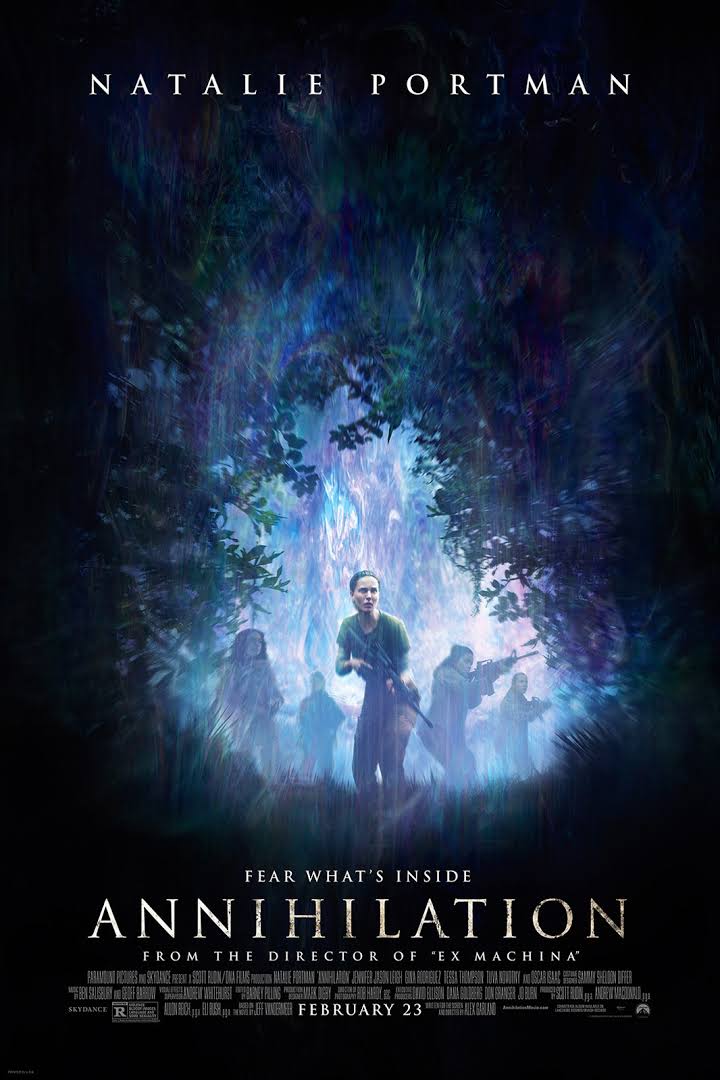
Outstanding craftsmanship that provides a trippy, surrealist experience! It’s been a long time since I’ve seen a horror science-fiction film like this one–one that harkens back to the manner in which Stanley Kubrick terrified audiences with his cinematic masterpieces. The brilliance of this film is the visually disturbing storytelling that’s built upon metaphysical and philosophical queries as well as Freud’s uncanny. Written and directed by Alex Garland (Ex Machina) and based upon the Southern Reach book series by Jeff VanderMeer, Annihilation boasts an all-female lead cast that takes the audience on a gripping, nail-biting adventure into the unknown that is frocked with wonder and tragedy. Falling in line with extraterrestrial films, this one exists somewhere between Alien and Arrival with influences from Kubrick and even Salvador Dali. Don’t wait for it to be released on Netflix internationally to avoid watching it at your local cinema; this IS a film best viewed, experienced, and enjoyed on the BIG screen–and not the 65in in your living room. For those who look for and appreciate science-fiction and/or horror films that explore psycho-social and institutional themes, then this is truly a film for you. Cognitively engaging and physiologically disturbing, Annihilation is a turbulent, horrific adventure.

After a mysterious meteor-like object strikes a lighthouse in Area X (most likely the swamplands of northwestern Florida), an increasingly growing membrane-like phenomenon is slowly swallowing up the land around it. When several paramilitary and scientific expeditions do not return from exploring the anomaly, biology professor Lena Kane (Natalie Portman) is aggressively recruited to work on the next team of scientists to track, report, analyze and potentially rescue former teams from what’s being called “the shimmer.” Professor Kane and her team have no idea that they will be facing their worst nightmares inside the shimmer as they explore this unknown world filled with dangerous opposition from the creatures that live within and the psychosis-like tension between the team members themselves.

Definitely not a film for the general masses. And you know what??? That is perfectly fine. In fact, that’s why this film works so incredibly well as an avant-garde-like science-fiction horror film. Had it directed for the masses, the film would not be nearly as stimulating psychologically and physiologically. Much like Garland did with the Oscar-winning Ex Machina, he crafts a world based on the best-selling series that takes the audience on a disturbing journey into the macabre, which juxtaposes the physical and metaphysical dimensions. Garland’s Annihilation is a masterful cinematic work that combines excellent writing with exceptional imagery and stunning practical effects. If Dali were alive today, this is the kind of film that he would have wanted to work on because there is such a heavy surrealist approach to the production design and visual effects. But this film is so much more than just the cinematic beauty of the motion picture. There are philosophical questions that one may ask oneself that create an added dimension of engagement that further immerses the audience into the world of the film.

Much like with Ex Machina, Garland shows an obsession with the need to see and see through when observing an unknown entity that may or may not be sentient. Paralleling how he set up the glass wall between Caleb and Ava (the AI) in the compound/lab designed by Nathan (Oscar Isaac, who is also in Annihilation), Garland sets up the interrogation room in which we are first introduced to Lena while she is being interviewed by the team in hazmat suits. I love the play on perspectives, vantage points if you will in both movies. That fluctuation between a filtered and unfiltered view of the phenomenon under observation offers much depth to the storytelling. In Annihilation, we are initially introduced to the shimmer, and world within, through sensors, readouts, and other “filters” but then we are thrust into the horrifying flora, fauna, and animal life without any type of protective boundary. Freud refers to the revealing of that which should remain hidden or the return of the repressed (which we literally get to witness in this film) as that which is uncanny (click for article). Just as our characters are constantly searching for clarity, you will find yourself paying close attention to the unknown to gain an unhindered understanding of what you are witnessing.

Not your average science-fiction horror film, this one will truly get under your skin–much like The Shimmer invades the bodies of those who choose to enter the dark twisted, refracted world of that which lies beyond our senses. Truly terrifying, this film is one for those who love a sci-fi horror that will prompt you to contemplate the themes and subtext of the movie. One of the quandaries that face the characters, and by extension, the audience is the idea of self-destruction versus suicide–the physiological versus the psychological components. For those who may worry that the film is “too intellectual,” the story is told in such a way that it not only appeals to film critics, academics, or horror aficionados but can be enjoyed by those who like a good, disturbing scare. The fact that there is the “intellectual” dimension to the film adds to the experience for those who appreciate that element in visual storytelling.

“Black Panther” movie review

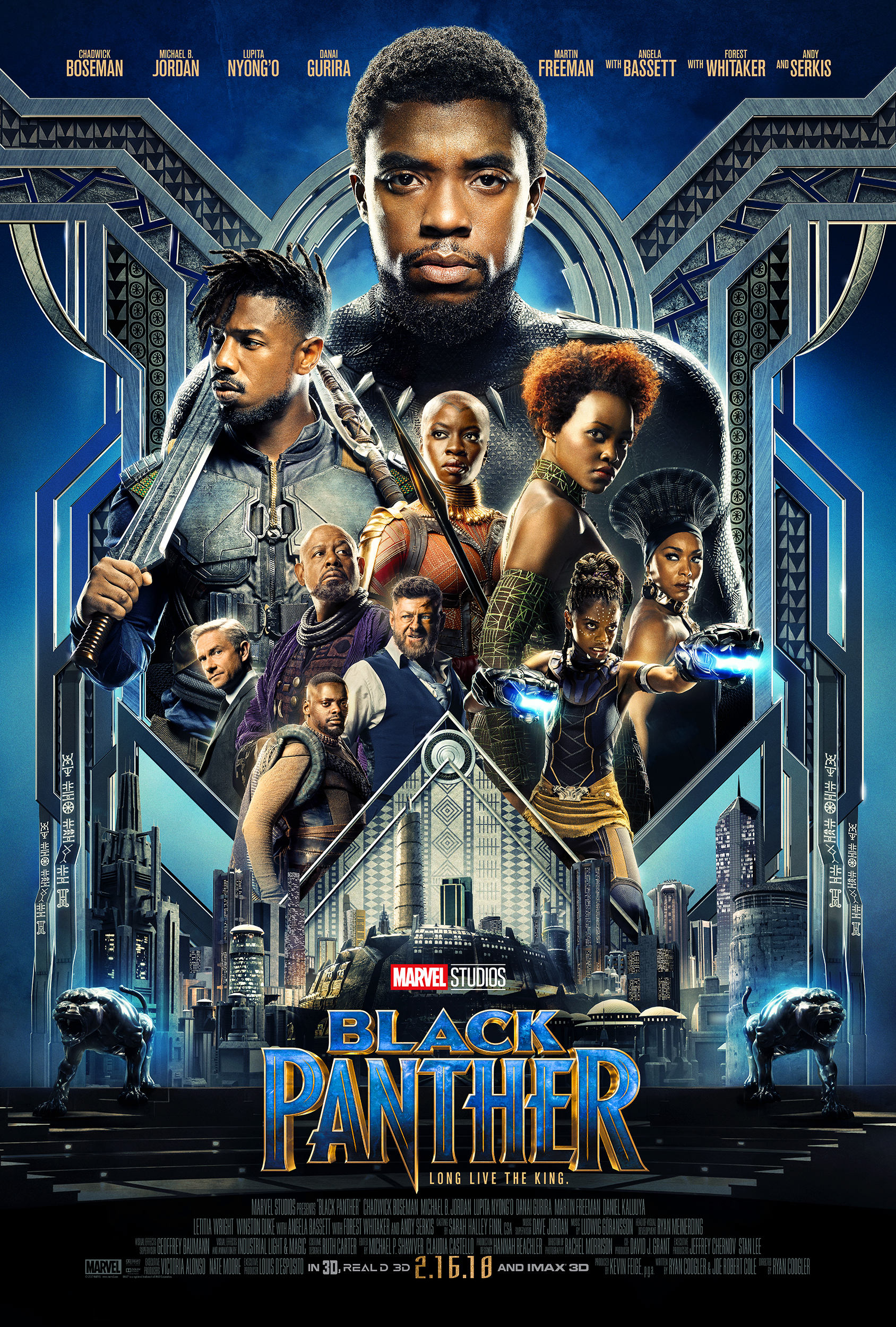
A groundbreaking new perspective on the typical high concept superhero movie. Marvel’s Black Panther directed by Ryan Coogler is the type of movie that began with the desire to make a bold statement and then a narrative was built around the message. If you’ve heard it’s unlike any superhero movie you’ve seen before, then you’ve heard correctly. One of the things I’ve always appreciated about the Marvel universe (and DC by the same token) is the diversity of the characters. There are characters from a variety of backgrounds, creeds, cultures, ethnicities, etc that are represented in the characters. However, just because the characters were there does not mean they received reasonable screentime (or page time in comics). Up to this point, X-Men’s Storm (my favorite Marvel character) seems to be the only black character who receives comparable screen and page time to that of her white male or female counterparts. In a world that should teach us that our universe is a diverse place, filled with incredible people from a variety of backgrounds and origins, the representation of black heroes lagged behind. The beauty of Black Panther is not that is was simply created to finally give a predominantly black cast in a superhero universe the spotlight, the beauty is that the movie has something to teach everyone. There is a particularly strong message for young black boys and girls that their mythology is as fascinating as the Greeks and Romans, and that they can achieve greatness through teamwork, education, and loyalty.

Chadwick Boseman plays King T’Challa, of Wakanda, the fictional African nation housing secret sci-fi technology, who must step up and embrace the weighty responsibility of his birthright after the assassination of his father. When T’Challa returns home Wakanda to take his rightful place as king, a powerful enemy suddenly reappears and challenges T’Challa’s claim to the throne — and as Black Panther — T’Challa gets tested when he’s drawn into a conflict that puts the fate of Wakanda and the entire world at risk. Faced with treachery and danger, the young king must rally his allies and release the full power of Black Panther to defeat his foes and secure the safety of his people. (IMDb)

Although there is a lot of technology in Wakanda (and by extension, in the film), the focus is not on gadgetry or superpowers but on how T’Challa can be a better king than his father who made a poor judgment call that ultimately cost him his life and put the land of Wakanda at risk of rape, pillage, and plunder. That is a message that resonates with everyone–we all want to strive to be better as we go through life. Perhaps we are trying to be better than we were as kids or maybe you are trying to be a better parent than yours were. Whatever the case, we can all place ourselves in T’Challe’s boots. There is also a powerful message regarding how isolation can be detrimental to society at large. Not that the film is advocating the loss of sovereignty–Wakanda is highly sovereign–but there is the message that a country with so much to offer should return some of that to the world in order to help create a better society, more opportunities for growth, and the sharing knowledge that can heal and protect.

The cast is incredible! So many talented performers who truly bring their respective characters to life. My only negative critique regarding the cast is the underused Michael B Jordan as the main opposition character. His charisma shines brightly on screen! But sadly, he does not get much screen time. He is the type of opposition character that you love to see, but unfortunately, you don’t get that much time with him. Although many may be quick to liken Black Panther to Captain America—and for good reason, both shoot straight and almost piously righteous–there is a big difference between the two–and it’s a good one. Black Panther is humanized by his endearing relationship with his brilliant sister Shuri portrayed by the delightful Letitia Wright. Honestly, she was my favorite character in the entire movie. Every moment she was on screen was outstanding. She was the only one who wasn’t bruting–always positive–and has the BEST lines. Just her character alone is enough to give the movie rewatchabiity. On the topic of dialogue, I would like to have seen a powerful monologue that embodied the message of the film and evoked strong emotion. There are emotional parts, but I think an acute moment would have done the film well.

The film opens with a beautiful long tracking shot of exquisite editing that has a mystical feel to it. The opening alone is enough to hook your attention for the remainder of the narrative. No surprise here that all the technical elements were exemplary. There were only a few times that the visual effects felt artificial. For all the action movie tropes in the film, it plays as more of a character-driven story than action-driven. And that’s the brilliance of Black Panther. Simple plot, complex characters–that’s what I tell my screenwriting students at the University of Tampa.

Intensely riveting, Black Panther is clearly a standout Marvel film distinguished from the others in the MCU. All the elements that give it the fresh take on the superhero movie genre work to its advantage. You’ll certainly be left with a lasting impression.

Star Wars and Nintendo: Battle of the Parks

The big question is which will be the bigger draw??? Although it first debuts in Tokyo for the 2020 Summer Olympics, Universal Studios Japan’s Super Nintendo World is one of the most highly anticipated theme park expansions, rivaled only by Star Wars: Galaxy’s Edge (Star Wars Land) at Disney parks in the US debuting next year! Two enormous intellectual properties (IPs) that will undoubtedly drive up guest attendance by exponential amounts. But which will prove to be the more popular expansion? Arguably, both lands will significantly impact the attendance of, character meet-and-greets in, and merchandise of the parks. The competition is heating up between Universal and Disney parks and resorts–reminds me of the US and Russian space race of the mid-1900s. While there is no doubt that both lands will be major successes, therein lies a question of which one will prove to be more popular. Not that it truly matters in the grand scheme of things, but it’s one of those things that is interesting to talk about and synthesize some research.

After the opening of both Wizarding World of Harry Potter (WWoHP) lands at Universal Studios Florida (and subsequently the Hollywood expansion), it was no surprise that Disney World was running to catch up, hence the opening of Pandora: the World of Avatar. As amazingly beautiful and detailed as Pandora is, it has not managed to draw the continued crowds and fandom that the WWoHP has been doing since 2010. According to the website Touring Plans, the increase from 2015 to 2017 attendance at Animal Kingdom rose marginally on the average whereas the Miami Herald reports that the increase at Universal Orlando during this same time period was more significant, and the forthcoming TEA Connect and AECOM reports are predicted to show greater growth at Universal than Disney World. Suffice it to say, the fanbase for Harry Potter far exceeds that of Avatar; however, the great battle for the crowds is currently between Star Wars: Galaxy’s Edge combined with Toy Story Land and Super Nintendo World with further Harry Potter/Fantastic Beasts developments in the worksTo understand which is likely to out-perform the other, one has to delve into the individual fanbases and economic impact of both properties primarily in question–Star Wars and Nintendo.

Unfortunately, there is little to no empirical way to quantify the number of fans either property has because of all the variables. Furthermore, movie ticket DVD/BluRay/VOD sales cannot be weighed against video game console and interactive media (video games) sales to determine fanbase size because it would not be an equitable means of measurement. Understanding the fanbase is crucial to predicting which property will be the bigger draw, which will have the biggest economic impact on its respective park. At the end of the day, both expansions are winners. Both will prove to provide vast positive affects upon the parks. Still, the friendly competition gives rise to the question which will be the bigger success. While the number of fans cannot be realistically quantified, the amount of revenue generated by Star Wars and Nintendo CAN be quantified, and that is precisely what Statista does. According to Statista (and the more than 18K sources from which the company compiles the information), Star Wars has generated $7.5B in revenue compared to Nintendo‘s $75B. What??? Yes, that’s right. Nintendo exceeds Star Wars in revenue 10x. While Nintendo may far exceed Star Wars in revenue generation, it’s important to note that Star Wars is the leading movie franchise in terms of merchandise sales. Yes, more than Harry Potter (and I’m house Ravenclaw). And merchandise sales is a HUGE component of theme park operations and sales.

Since park guests base their visit on more than just a single land, the presence of Toy Story Land at Disney World and Wizarding World of Harry Potter should also be taken into account when determining whether Disney World or Universal Orlando will see the bigger boost to attendance and increase in revenue. Arguably, Harry Potter (inclusive of Fantastic Beasts) is the bigger franchise family based on book sales, ticket sales, current theme park attractions, etc. Therefore, Star Wars land has to be big enough to not only compete against Nintendo World but also Harry Potter. One of the biggest advantages that Star Wars has over Nintendo and Harry Potter is merchandise sales and collections. Star Wars has exponentially more memorabilia and collectors than Nintendo, mostly because of the success of the films and the fact that Star Wars predates Nintendo by several years. But I imagine that Universal will continue to rely upon WWoHP for the bulk of the merchandise sales at the park since it can compete with Star Wars Land on that playing field. Analyzing the fandom of Nintendo is a little more difficult than that of Star Wars because Star Wars is the big umbrella under which all the movies, video games, and merchandise fall. Fans identify themselves as a Star Wars fan, whereas the fans of Nintendo’s product line are more prone to identify with a particular game franchise (Mario, Pokemon, Zelda, etc) more so than identifying with Nintendo proper. All evidence points to both brands being strong, viable candidates that will provide a close competition.

Both Star Wars and Nintendo are worldwide phenomena–no question. Combine Star Wars with Toy Story and conversely Nintendo with Harry Potter, and you have two powerhouse destinations for theme park fans. With the recent expansions at Universal Studios Florida and Hollywood, Disney World/Disneyland needs to ramp up their game–go into hyperspeed. Star Wars: Galaxy’s Edge pulls into space dock in 2019 just in time for episode IX. We are still a few years away from a domestic Super Nintendo World, and do not know much about it; however, we do have an idea of what to expect at the Universal Studios Tokyo and can by extension apply that knowledge to Universal Orlando. From what we know so far, Star Wars land will be a completely immersive environment that will essentially transport park guests to a “galaxy far far away.” If the WWoHP is the best example of the successful translation from book to screen to theme park for a world of fantasy, then Star Wars land will be on par with the best.

An interesting element to think about is the future of both Star Wars and Nintendo. It’s old news at this point that the most recent Star Wars movie The Last Jedi was not popular with longtime fans–new fans, yes–longtime fans, no. Nintendo is successfully holding onto both the old and new fans because the video games and consoles continue to appeal to those who had an NES as a kid or just bought last year’s Switch. Even legacy properties are holding onto what made them popular, but incorporating trends in interactive media (the term now often used to define that which was formerly video games). Mario Builder is an example of the aforementioned concept. If Star Wars continues to lose its longtime fans, abandons them for the new fans, then the new land may not fair as well as Nintendo World. Fantastic Beasts and Where to Find Them was a new generation Harry Potter movie that largely appealed to BOTH the old and newer fans. Therefore, it could be said that Universal Orlando’s most popular themed lands may have a longer life than Star Wars if the movies keep dropping the older fans. Just something to think about.

The Battle of the Parks is hot, and will just keep getting hotter! Fortunately, healthy competition breeds innovation, so whether or not Universal or Disney has the better new land expansions, the real winner in this battle is the consumer! Both parks will greatly benefit from the expansions and only time will be able to tell which one wins this race to be the best.

Are the Slow Times a Thing of the Past?

Remember when there were some select weekends each year, like clockwork, that the central Florida theme parks were slow? Yeah, well so do those who run the parks. Over the last few years, there have been a number of new specialty events from A Celebration of Harry Potter to RunDisney, Food & Wine Festivals and more to fill those used-to-be slow weekends. Prior to the addition of many of these events, January and February were typically slow, same with August and September. Even Busch Gardens and SeaWorld have cashed in on eliminating the slow times that locals counted on to enjoy the parks without the bulk of tourists. Fortunately for locals, Super Bowl Sunday (after 3pm anyway), Mothers Day, and Labor Day are still the slowest three days (on average) but that may change in the future too. Moreover, while these events bring in thousands that would otherwise have waited until Springtime, Summer, or the Holidays to visit the parks, these events have a downside too. Think local. The annual passholders that, by in large, provide the regular cash flow that is typically unaffected by the economy, find that it’s getting more and more difficult to enjoy the parks without the constant heavy crowds.

Just a few years ago, there was an ebb and flow to the park attendance. Waves of tourists would come in usually over the Summer months, followed by the holidays at Thanksgiving and Christmastime, then the Spring Break weeks of March and April. When you live, say within an hour or two of the parks, you pick the weekends or weeks (if you work weekends) that don’t fall within those times. Or, perhaps you used to. With the increase in the number of RunDisney events, special celebrations, and festivals, there is far less of an ebb and flow–now it’s constantly busy. If we look at this as a mathematical equation, then perhaps we can develop a solution that not only provides the specialty/seasonal events aimed mostly at tourists but also integrate some local-centric events too. What you do to one side of the equals mark, do to the other side. The yin and yang.

A solution to the increasing issue with locals losing the times that used to be slow could be adding more annual passholder exclusive events. Universal has done this before, but it greatly limited the number of passholders that could take advantage of it, and the slots filled up nearly as quickly as the RunDisney events. An easy event to offer annual passholders at the theme parks to show how much the parks appreciate the dedication (and the money on a regular basis) is a time that the park is closed to day-ticket holders. Even twice a year. And for the parks not to place a cap on the number of annual passholders that could attend. No special musical guests, special merchandise, nor special shows need to be added. Just keep the park operating as normal but close at an early time to day guests, and remain open for six hours for annual passholders.

Disney could close Magic Kingdom to day guests at 7 as it usually does for the other hard ticketed events, Universal Studios and Islands of Adventure could close at 5 as with other events, and Busch Gardens & SeaWorld could close at 6 as they do for special events. Then keep the parks open for the next six hours. Showing appreciation for annual passholders in this fashion will reaffirm to those who are thinking of canceling to renew their passes. Furthermore, it will also compensate for the lack of slow times that used to exist–the times that passholders counted on. Furthermore, passholders of all socio-economic classes could enjoy the exclusive operating hours because many hard ticketed events are out of the price range for those who already spend a large sum of income on passes, food, and the occasional stay-cation at a resort. Moreover, with some parks, there has been a mitigation of passholder appreciation. Overall, Universal, Busch Gardens, and SeaWorld show regular appreciation through events, “bucks” for in-park purchases, BOGO ticket offers, and more; however, there is a selection of parks that feel buttons are an adequate form of appreciation beyond complementary park admission. A’chem.

With the disappearing slow times, if the theme parks show appreciation to passholders by having the parks open only exclusively for passholders–even if just 6hrs on a Friday or Saturday–then passholders would feel that there are still a few times a year (collectively between the parks) that they can enjoy them without the wall-to-wall crowds and 60+ min waits in queue for an attraction.