NOW YOU SEE ME: NOW YOU DON’T movie review

The real magic is in how this movie made it past opening night.
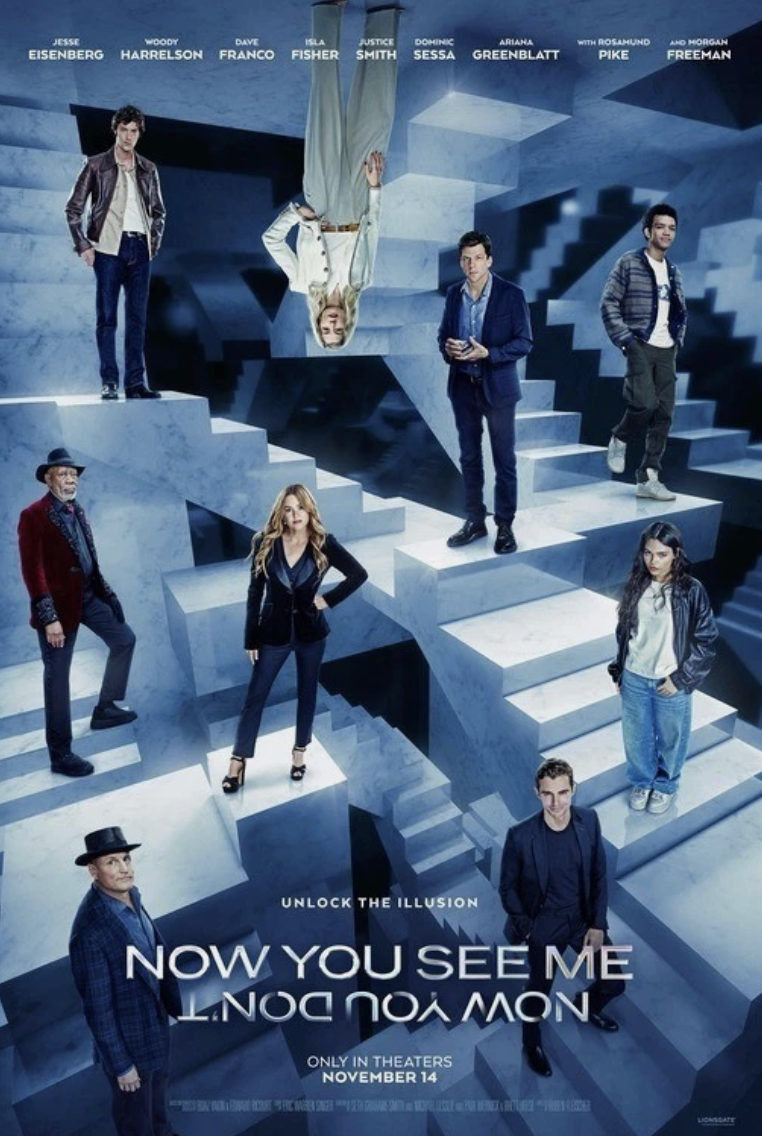
“He was an illusionist…he wasn’t a very good illusionist.” Although that comedic line is delivered by Madeline Kahn in CLUE (1985), it seems rather fitting for the tertiary installment in the Now You See Me series. Now You See Me: Now You Don’t is a cinematic magic trick without magic—an illusion performed with all the spectacle of a streaming-original and none of the wonder that made the first film such a delightful surprise. What should have been a clever caper wrapped in misdirection, sleight of hand, and showmanship instead plays like an inflated pilot episode for a franchise desperate to convince us it still has something up its sleeve.

The Four Horsemen and a new generation of illusionists try to bring down a worldwide criminal network.

Let’s begin with the one element that is genuinely spellbinding: the château sequence of scenes. The production design on display here is fantastic—one of the best production designs of the year. Every room, corridor, and shadow-drenched chamber seems crafted with the meticulous eye of an artisan. Sadly, aside from the technical achievement, this setting is little more than a backdrop to the action within its labyrinthine corridors. In another movie, this location could have been a character unto itself; here, it’s little more than an exceptionally beautiful stage for an otherwise uninspired performance. Still, credit where is due: the château alone might be the only reason this movie deserves to be seen anywhere larger than a laptop screen.

The returning cast—those legacy performers who anchored the earlier installments—slip back into their roles with charm and chemistry. Harrelson always delivers an entertaining performance–ever since his days on Cheers. The rapport between the legacy cast is believable–a once-close group of friends that hasn’t seen one another in a decade, even if the screenplay material underserves them. And yes, Morgan Freeman’s cameo is a genuine delight, a sprinkle of prestige the film desperately needed. But not even Freeman can pull a rabbit out of this hat.

Unfortunately, the three new teenage cast members derail what little fun the film attempts to muster. Obnoxious, self-righteous, and utterly allergic to accountability, they embody the worst tendencies of modern franchise youthification. The film props them up as the only ones who can “fix the world,” all while they display a profound lack of understanding of that very world’s complexities. It’s a toxic ideological cocktail—one part hubris, one part naïveté, shaken vigorously and served without nuance. Their presence doesn’t invigorate the franchise; it infantilizes it.

An overview of the plotting reveals that Now You Don’t contains more holes and narrative gaps than those the O.J. jury was willing to ignore. Motivations shift without cause, twists are telegraphed from miles away, and the screenplay is so preoccupied with its social commentary that it forgets to construct a believable story around it. The message—about the wealthy exploiting the poor—is noble in theory but executed with such superficiality that it borders on parody. It’s activism-by-template, the cinematic equivalent of most “thoughts and prayers” tweets.

Worse, the film contains no meaningful tension. It coasts on comic-book logic without embracing the fun of comic-book storytelling. Stakes evaporate. Consequences vanish. Nearly every set piece feels contrived rather than orchestrated. Magic, by its nature, requires misdirection, timing, and a suspension of disbelief; this film offers none of those. What should have been a thrilling high-wire act is instead a leisurely stroll with training wheels–or perhaps a trite-cycle of a movie.

Now You See Me: Now You Don’t is a movie that wants to dazzle but barely flickers. It lacks cinematic gravitas, emotional investment, and narrative cohesion. And much like a forgettable card trick, it should ultimately disappear from cinemas—preferably before anyone attempts to resurrect this franchise again. It’s time to vanish.
Ryan is the general manager for 90.7 WKGC Public Media and host of the show ReelTalk “where you can join the cinematic conversations frame by frame each week.” Additionally, he is the author of the upcoming film studies book titled Monsters, Madness, and Mayhem: Why People Love Horror. After teaching film studies for over eight years at the University of Tampa, he transitioned from the classroom to public media. He is a member of the Critics Association of Central Florida and Indie Film Critics of America. If you like this article, check out the others and FOLLOW this blog! Follow him on Twitter: RLTerry1 and LetterBoxd: RLTerry
PREDATOR: BADLANDS movie review

Predator: Let’s Play. When streaming content hits the big screen.

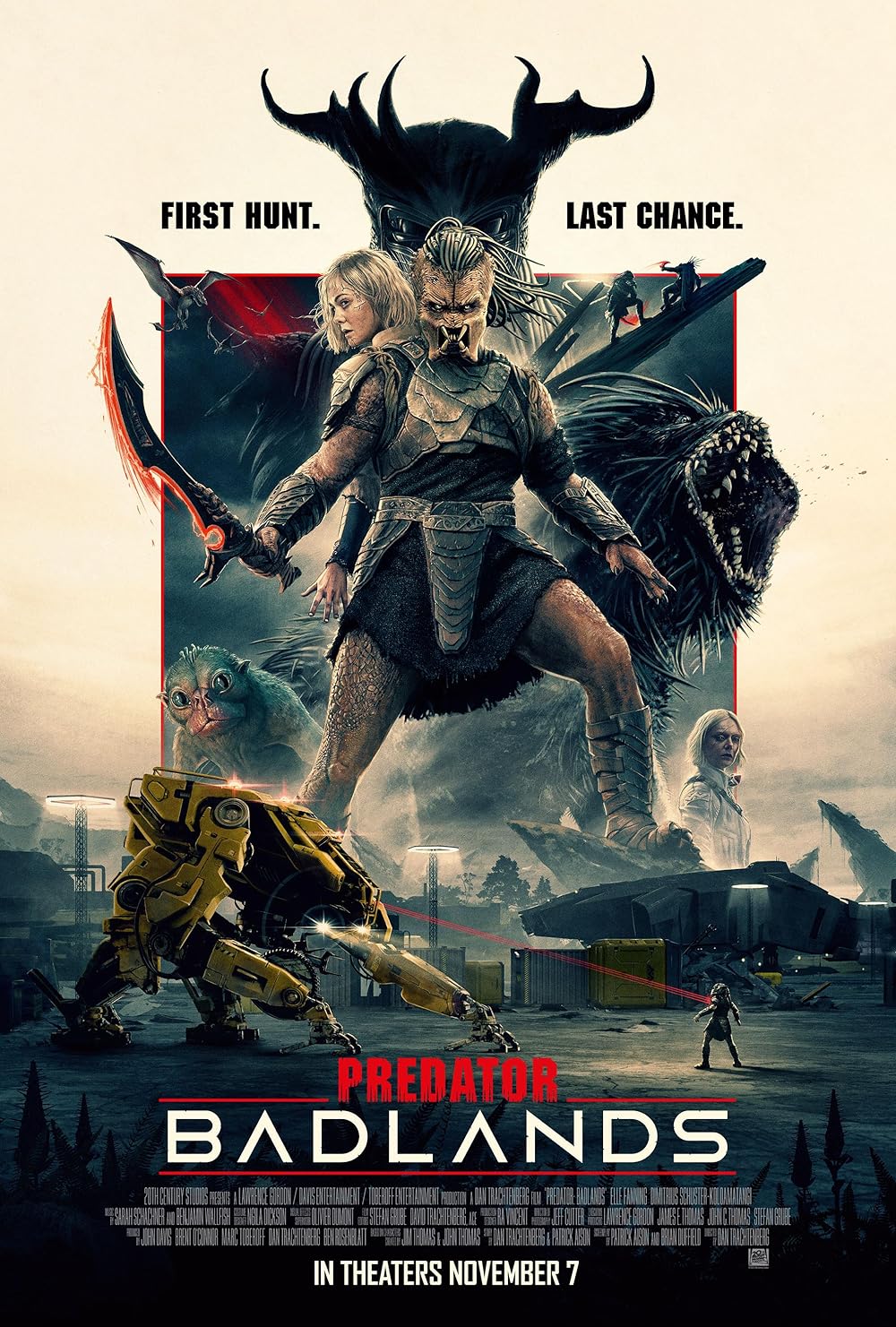
Predator: Badlands is the equivalent of a “Let’s Play,” but with bigger explosions. The nonstop action, constant motion offer little to no substantive emotional investment. You’re an observer, not a participant—which might be fine for streaming, but it’s a strange fit for cinema. The latest in the Predator franchise plays like a two-hour sizzle reel with delusions of grandeur. It’s a glossy barrage of explosions, digital dust, and quippy one-liners that evaporate before they even hit the floor. By the time the credits roll–that’s if you haven’t fallen asleep—you’ve seen everything and felt nothing. It’s not that the film is aggressively bad—it’s that it’s aggressively empty–little more than content to pander to short attention spans with shiny movement instead of meaningful momentum.

Cast out from its clan, a Predator and an unlikely synthetic ally embark on a treacherous journey in search of the ultimate adversary.

The screenplay feels like it was written by an algorithm trained on reaction videos and Reddit threads. Every line of dialogue sounds like a placeholder; it’s as if someone said, “We’ll fix it later” or “funny line here,” and neglected to return to the page in order to fix it–before principle photography. There’s no sense of escalation, tension, or rhythm; it’s a series of flashy moments loosely stitched together, like a highlight reel of a game you didn’t play. Even the humor feels synthetic–much like the characters– punching at air instead of connecting with character or tone.

As for the characters, they exist mostly as camera targets. They are little more than digital avatars running, shooting, and shouting for reasons that never feel personal or compelling. The lead could be replaced by a different actor mid-film and you might not notice. This critic isn’t even convinced that Dek (our central Predator character) wasn’t entirely CGI, though it may have only been the facial area. “What’s my motivation?” Difficult to say–there wasn’t much upon which to build. Motivations are paper-thin, arcs nonexistent. The Predator itself, once a symbol of primal fear and unseen menace, now feels like a boss-level NPC waiting to be triggered by the next quick-time event.

Visually, Badlands has all the spectacle money can buy; but its spectacle is divorced from any meaningful purpose. The explosions are massive, the sound mix thunderous, and yet it’s as emotionally engaging as watching someone else play Call of Duty. Every frame screams “look at me!” without ever inviting you to feel something. The editing, too, is manic. And it’s not even as though the narrative demanded it; rather, the dynamic editing was most likely employed because the movie was terrified that you’d look away or down at your watch, which I did several times.

And maybe that’s the point. Predator: Badlands is far less like a movie and more like a cinematic exercise in a large scale “Let’s Play.” For those that are unfamiliar with the term, it’s a type of (usually) YouTube video of someone playing a video game and often their reactions to the game play. Think of it as a passive experience of someone else’s thrill ride. The ultimate, disconnected form of living vicariously. Don’t question anything, because it won’t take long to realize that this movie is hollow. You don’t engage; you just witness. The irony is that the film could’ve been a fascinating critique of screen-mediated experiences, but it never once stops to think.

This is just the latest in a growing trend from Disney’s genre arm: a reliance on brand nostalgia and visual polish in place of storytelling. Ever since the corporate appetite turned to IP recycling, the studio has mistaken familiarity for depth. Badlands is what happens when you try to “optimize engagement” instead of crafting a narrative, resulting in the film equivalent of clickbait dressed in billion-dollar armor.

Predator: Badlands doesn’t so much hunt its audience as it does chase its own tail. A movie that is fast, flashy, and utterly pointless; and desperately wants to go viral but forgets to be cinema. You don’t leave exhilarated; you leave wondering if you accidentally spent $15 to watch a YouTube compilation in IMAX.

Ryan is the general manager for 90.7 WKGC Public Media and host of the show ReelTalk “where you can join the cinematic conversations frame by frame each week.” Additionally, he is the author of the upcoming film studies book titled Monsters, Madness, and Mayhem: Why People Love Horror. After teaching film studies for over eight years at the University of Tampa, he transitioned from the classroom to public media. He is a member of the Critics Association of Central Florida and Indie Film Critics of America. If you like this article, check out the others and FOLLOW this blog! Follow him on Twitter: RLTerry1 and LetterBoxd: RLTerry
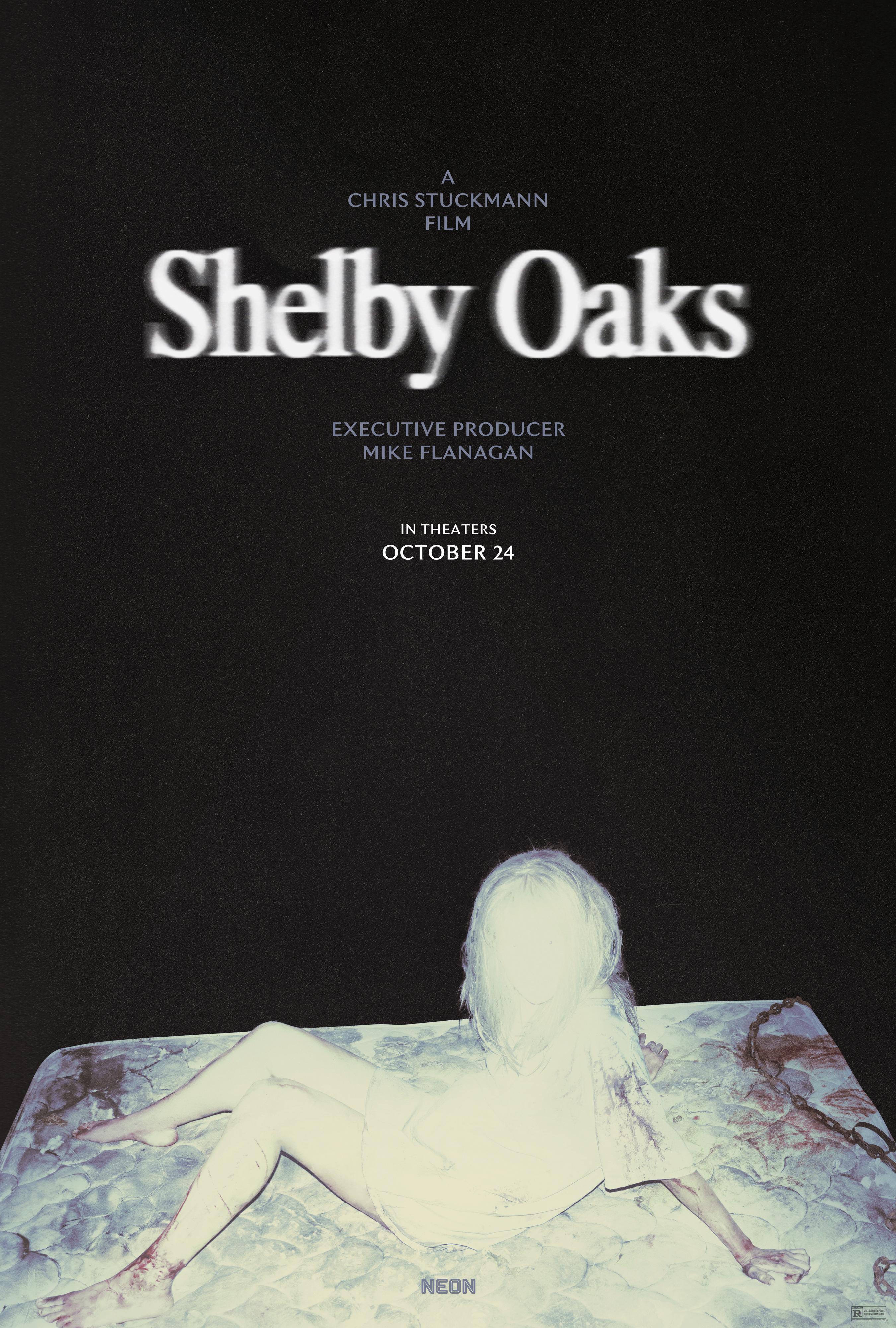
SHELBY OAKS horror movie review

A cautionary tale of when YouTubers confuse content with cinema.

Chris Stuckmann’s Shelby Oaks arrives with all the makings of a breakthrough: (1) it’s one of the most successful Kickstarter-funded indie films ever, and (2) it’s directed by one of YouTube’s most popular influencer-critics. In fact, I’ve used some of his videos in my own classroom—good material: informative, engaging, and accessible for budding cinephiles. But therein lies the rub: informative and engaging does not a motion picture make. The premise, though, is undeniably intriguing—a reimagining of familiar horror tropes with contemporary urgency. Stuckmann delivers a film that has the bones of something potent—think The Blair Witch Project meets Rosemary’s Baby: paranoia, obsession, and the horror of the unseen, all wrapped in a missing-person mystery and topped with a bow of supernatural dread.

Shelby Oaks is about Mia’s search for her long-lost sister and paranormal investigator Riley becomes an obsession when she realizes an event from her past may have opened the door to something far more sinister than she could have ever imagined.

Like many contemporary filmmakers–particularly those that got their start on YouTube–Shelby Oaks excels in technical achievement and marketing. The cinematography is confident and atmospheric, drenched in moody lighting that evokes gothic horror. There is little doubt that Stuckmann clearly understands shot composition, pacing within the frame, even editing in-camera and the importance of visual tone. All the technical elements are quite impressive for a debut feature. And if all a motion picture was–was the visual elements–it’d be easy to admire. But it isn’t. Even Hitchcock knew that. Which is why Hitch never wrote his own screenplays–he generated the idea, even outlined entire scenes and sequences–but he knew that he needed to work with a screenwriter, that understood the material, in order to fully realize his movie idea for the screen. What is greatly lacking in contemporary cinema is an understanding of what makes a great story–plot structure, mechanics, and the emotional substructure.

But Shelby Oaks falters where too many YouTube-born filmmakers stumble—storytelling. Shelby Oaks has a great idea for a movie, but not a fully realized narrative. At its core, the narrative never builds sufficient momentum. Why? Simple–because there’s no real opposition. “Evil,” in the abstract, isn’t conflict. Opposition must manifest into something tangible between the character and his or her external goal, whether that’s a person, a system, or her own inner demons. For all the supernatural activity in the film, there never truly emerges a character of opposition. The result is a macabre mystery that depicts scenes and sequences wherein Mia’s pursuit unfolds, but without the benefit of a tangible sense of escalation or even revelation. Shelby Oaks is more of a proof of concept rather than a complete story.

Stuckmann, for all his film knowledge, seems more comfortable replicating tone and texture than constructing narrative architecture. His background in reviewing movies gives him an eye for what looks right—but not yet the discipline to shape what feels right. He understands what sells, what gets views, and even genre conventions. But sadly, none of the characters, including Mia, possess real dimension or agency. She and the rest of the characters are vehicles for mood rather than emotional engagement.

What works on YouTube—enthusiasm, charisma, and technical dissection—doesn’t automatically translate to cinema. His channel reveals a deep love of horror and a commendable understanding of its visual language, yet Shelby Oaks exposes the gap between appreciating a genre and authoring it. The film lacks what isn’t needed in (and can even get in the way of) YouTube content: storytelling mechanics, structure, and the discipline of narrative design. It’s one thing to analyze story beats; it’s another to build them, to shape character arcs, rhythm, and tension through the grammar of storytelling rather than the syntax of spectacle. Often, YouTube videos have great hooks, but they lack the narrative substance behind the hook.

What’s most frustrating is how close Shelby Oaks comes to working. The concept is rich, and the craftsmanship is undeniably strong. Stuckmann clearly loves cinema, and there’s passion behind every frame. But cinema isn’t content creation—it’s storytelling. And storytelling requires more than aesthetic confidence; it demands structure, development, and resolution.

The YouTube garden is flourishing with emerging directors, cinematographers, and editors—talented creators who’ve mastered the language of cameras, lighting, and cutting for attention. But what it’s not producing are writers. The art—and science—of writing seems to be withering in the age of influencer cinema. Many creators know how to make something look good but not why it should matter. Storytelling requires patience, discipline, and a willingness to think beyond the thumbnail and algorithm. In a culture where speed and spectacle drive engagement, screenwriting—the slow, deliberate architecture of character, conflict, and change—feels almost antiquated. And yet, it remains the soul of cinema. Without writers, we get films that resemble content: sleek, competent, and hollow.

Shelby Oaks stands as a cautionary tale of when YouTubers confuse content with cinema. Furthermore, this movie is an example of the hollowness of contemporary cinema, how cinema is feeling more and more disposable as the months and years pass the silver screen. The tools are there, the ambition is there, but without mastery of story, all that remains are haunting images in search of a heartbeat.

Ryan is the general manager for 90.7 WKGC Public Media in Panama City and host of the public radio show ReelTalk “where you can join the cinematic conversations frame by frame each week.” Additionally, he is the author of the upcoming film studies book titled Monsters, Madness, and Mayhem: Why People Love Horror. After teaching film studies for over eight years at the University of Tampa, he transitioned from the classroom to public media. He is a member of the Critics Association of Central Florida and Indie Film Critics of America. If you like this article, check out the others and FOLLOW this blog! Follow him on Twitter: RLTerry1 and LetterBoxd: RLTerry
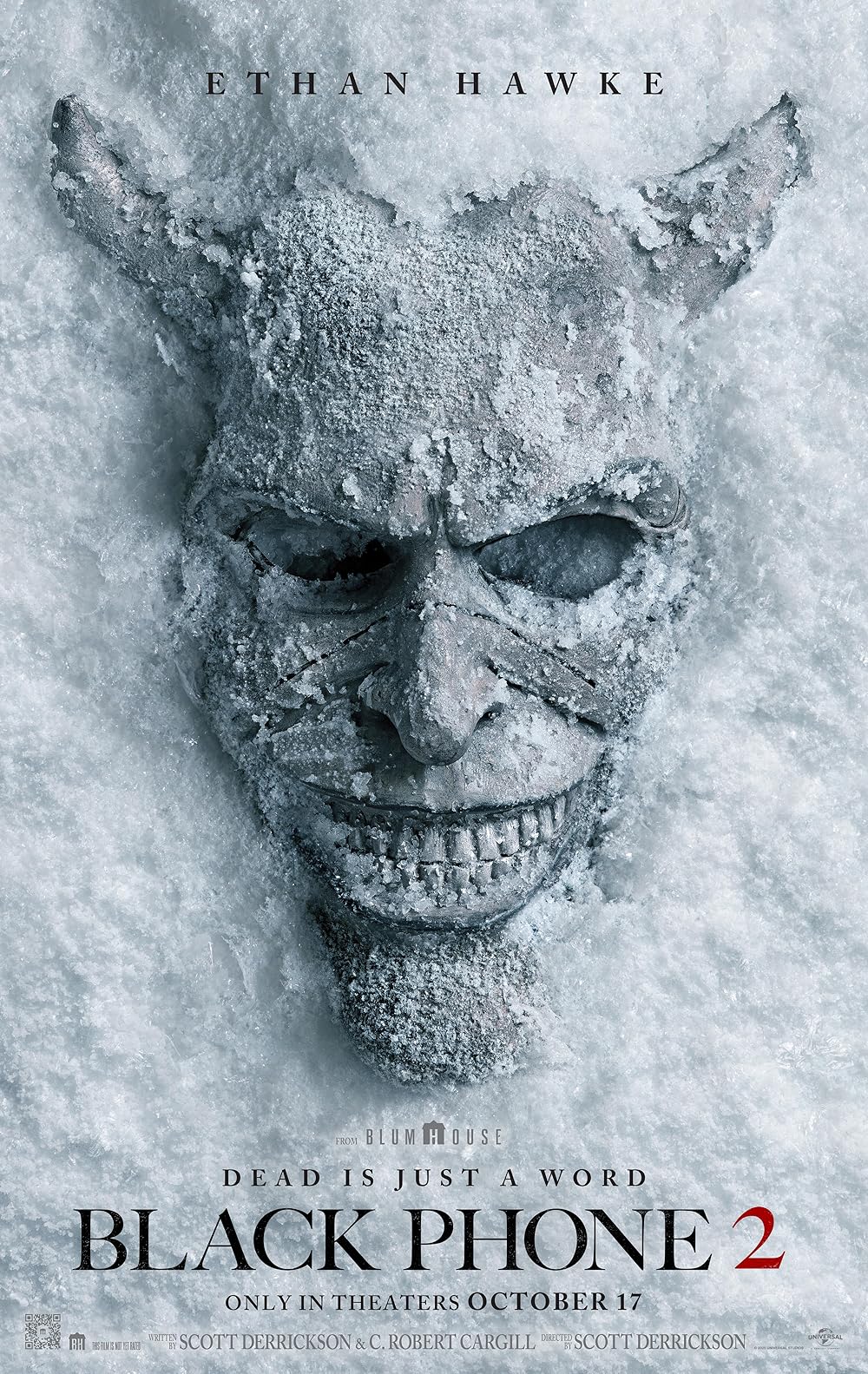
BLACK PHONE 2 horror movie review

Don’t answer the call—best to let go to voicemail.

Atmospheric but empty. Black Phone 2 may ring with eerie potential, but what you’ll hear on the other end is mostly static. You just as soon use a telegraph service to form a connection between the big screen and audience than the calls this movie desperately makes. Derrickson demonstrates that he can certainly direct the heck out of a horror movie, but it might be time for someone else to write the next call–or at the very least, he should perhaps stop hiring his friend as a writing partner. While the film succeeds in delivering a chilling, oppressive atmosphere, reminding us that Derrickson remains one of horror’s more visually articulate directors, it also reinforces the unfortunate truth that he’s a far better director than writer. What we have here is another casualty of the writer-director syndrome; which is to suggest that one can be a stylistic filmmaker or even auteur without need to wear both hats. Some filmmakers are better directors, some better writers–and that’s okay! While Black Phone 2 begins with promise, it quickly devolves into a frustrating exercise in squandered ideas, tonal inconsistency, and narrative disarray.

Bad dreams haunt 15-year-old Gwen as she receives calls from the black phone and sees disturbing visions of three boys being stalked at a winter camp. Accompanied by her brother, Finn, they head to the camp to solve the mystery, only to confront the Grabber — a killer who’s grown even more powerful in death.

The film ambitiously sets out to expand upon the supernatural mythology introduced in the 2022 original. Derrickson clearly wants to explore the dream world as a deeper psychological battleground—echoing the meta-horror energy of A Nightmare on Elm Street III: Dream Warriors. But instead of capturing that sequel’s inspired creativity and emotional cohesion, Black Phone 2 feels more like a discount version of a superior brand. The screenplay introduces a fascinating set of “rules” for how this dream realm operates, only to immediately ignore or contradict them, leaving the audience confused rather than intrigued. Internal logic is sacrificed for jump scares and contrived character beats that go nowhere.

And speaking of characters—if you can call them that—most are little more than human wallpaper. Half the ensemble feels like a collection of movie people consisting of broadly sketched types that serve a single plot function before fading into irrelevance. Others border on offensive caricature, perpetuating inaccurate and disparaging stereotypes. For all intents and purposes, about three-and-a-half characters can be removed from the movie, and the story play out much the same. Why that half-character? Because, they do help develop the plot in a measurable way–albeit a modicum of development. When a film’s supporting cast functions more like furniture versus people, no amount of spooky atmosphere can save it. The best written and developed character was Demián Bichir’s Armando.

Still, there are moments, scenes, and even entire sequences that remind us of Derrickson’s undeniable craftsmanship. His camera captures dread beautifully; his sense of timing and space within the frame conjures genuine unease. There are glimpses of a haunting, emotionally resonant movie buried somewhere beneath the fractured structure and incoherent script. Unfortunately, those glimpses are fleeting. And that’s the great tragedy here—not just for Black Phone 2, but for a growing trend in contemporary filmmaking: the writer-director who insists on doing it all, in the name of authorship.

Once upon a time, filmmakers understood that collaboration was the lifeblood of cinema. Directors directed. Writers wrote. And when both crafts worked in harmony, we got films that not only looked great but meant something. Somewhere along the line, “auteur” became synonymous with “solo act,” and too many directors convinced themselves that to have a voice, they had to pen the script too. The result? Movies that look immaculate but feel hollow—visual symphonies built on shaky foundations.

Derrickson is a perfect example (another is Jordan Peele). As a director, his command of tone and atmosphere is nearly peerless; his work in horror often hums with intelligence and mood. But Black Phone 2 exposes the limits of his pen. The foundation for a compelling story is here—the bones of something rich and psychologically resonant—but the film never benefits from a writer who truly cares about character, motivation, or thematic depth. It’s as though Derrickson fell so in love with his own concept and craft that he forgot to ask whether the story itself deserved that devotion.

A gifted director needn’t be the writer to be an auteur. In fact, some of the greatest auteurs—Hitchcock, Spielberg, even Fincher–are those who know the value of letting a skilled screenwriter shape the clay before they bring it to life. Black Phone 2 might have been a haunting triumph had Derrickson trusted someone else, other than his friend, to write the words for the world he so clearly knows how to visualize. Instead, we’re left with a reminder that even the most talented filmmaker can’t build a cathedral on a cracked foundation.

By the time the credits roll, Black Phone 2 feels like a series of individually thoughtful scenes strung together by a story that never quite finds its pulse. It’s a patchwork of ideas that might have worked—had they been developed, connected, or earned. The result is a film that looks and sounds like a horror movie, but never feels like one worth the cost of time.

Ryan is the general manager for 90.7 WKGC Public Media in Panama City and host of the public radio show ReelTalk “where you can join the cinematic conversations frame by frame each week.” Additionally, he is the author of the upcoming film studies book titled Monsters, Madness, and Mayhem: Why People Love Horror. After teaching film studies for over eight years at the University of Tampa, he transitioned from the classroom to public media. He is a member of the Critics Association of Central Florida and Indie Film Critics of America. If you like this article, check out the others and FOLLOW this blog! Follow him on Twitter: RLTerry1 and LetterBoxd: RLTerry

WHEN CINEMA SANG: TOP TEN MOVIE SONGS OF THE 1980s

When we look back at the films of the 1980s, it’s impossible to separate the images on screen from the songs that scored them. This was the decade when movie music didn’t just underscore the action—it defined it. A single track could embody the spirit of a film while simultaneously capturing the mood of an entire generation. And remarkably, so many of those songs remain with us today. They’re still streamed on playlists, still belted out at karaoke, still instantly recognizable from their opening chords. The 1980s gave us movie songs that became cultural landmarks, and in many ways, they’ve never stopped playing.

Among the long arc of cinema history, the 1980s stand out as the high-water mark of the movie song. This was the era when a soundtrack single could leap to the top of the charts overnight, transforming into a cultural event in its own right. Whether it was an infectious pop hook or a soaring power ballad, these songs weren’t just background music; they were stitched into the fabric of the films and the culture itself. Think of the triumphant synth-drenched pulse of Flashdance…What a Feeling, the high-octane rush of Danger Zone, or the emotional catharsis of Wind Beneath My Wings. The decade leaned into the marriage of sound and image with unapologetic boldness, and in doing so created songs as enduring as the films they came from—sometimes even more so.

Why have they endured? Partly because they articulated universal experiences—ambition, risk, heartbreak, friendship—in melodies and lyrics that were at once sincere and unforgettable. The 1980s were an era of spectacle, melodrama, and unabashed emotion, and the songs mirrored that ethos. They became sonic shorthand for youth, energy, rebellion, and joy. In an age when MTV amplified every movie track into a visual pop event, these songs weren’t merely incidental—they were emotional anchors, marketing juggernauts, and narrative engines. Nothing’s Gonna Stop Us Now carried Mannequin’s optimism beyond the multiplex and into wedding halls. Dolly Parton’s 9 to 5 gave voice to working-class frustration while climbing the radio charts. And Don’t You (Forget About Me) is now inseparable from Judd Nelson’s raised fist in The Breakfast Club. These weren’t just songs in movies; they became shorthand for the decade’s imagination.

Why don’t we have these same kind of songs today? There’s been a cultural shift–most noticeably in the 2020s, but has its roots in the mid to late 1990s. By the 1990s and 2000s, the conditions that made such songs possible began to fade. Pop soundtracks increasingly licensed pre-existing hits rather than commissioning originals. Franchise filmmaking turned toward instrumental scores and brand cohesion rather than big, show-stopping anthems. And as music videos lost their central cultural role, so too did the symbiotic relationship between cinema and pop radio. The cultural machine that once elevated a movie song into a generational anthem simply no longer works the same way.

Reflecting upon more recent years, much of 2020s pop and movie music is created in a climate of deep cynicism and fragmentation. Songs today are often crafted for algorithms, for virality on TikTok, or as ironic counterpoints in film soundtracks rather than as emotional anchors. Other songs carry with them a tone of anger or polarization. Audiences, steeped in skepticism toward institutions, media, and even each other, tend to reward irony, detachment, or knowing self-parody over the kind of unguarded sincerity that defined the 80s. A song that earnestly belts out its hopes risks being labeled “cheesy” or “dated,” whereas in the 1980s, that very boldness was the point.

One of the most striking contrasts between the 1980s and the 2020s is the sense of permanence. The movies and music of the 1980s were made with a boldness that seemed intent on lasting—on making an impression that would outlive the decade itself. By contrast, much of today’s popular culture, both in film and in music, feels designed for rapid consumption rather than long-term resonance–its largely disposable.

Songs today are often crafted not for endurance but rather for algorithms—engineered to spike on streaming platforms, go viral on TikTok, or capture a brief window of attention on curated playlists. In that sense, music has become increasingly functional: it serves a moment, a meme, a mood, but rarely aspires to the kind of cultural monumentality that defined the best of the 1980s. The hooks are short, the structures lean toward repetition, and the lifespan of a hit can sometimes be measured in weeks rather than years. The same phenomenon is evident in today’s movies. Franchise blockbusters dominate the box office, but their cultural imprint often fades once the next installment arrives. Films are built as nodes in larger intellectual property ecosystems, not as singular artistic statements. Just as contemporary songs often feel interchangeable—quickly eclipsed by the next release—so too do many films function as disposable content, part of a cycle of endless consumption rather than enduring cultural landmarks.

By comparison, the movies and songs of the 1980s embraced scale and spectacle not just for immediate impact but for legacy. A hit song wasn’t simply filler for a soundtrack; it was an anthem meant to outlive its film, designed to thrive on the radio, MTV, and in the cultural memory. Similarly, films were often built as self-contained phenomena: E.T., Top Gun, Back to the Future—movies that carried an aura of event cinema and refused to feel like disposable installments. This is not to say that contemporary culture lacks quality (although that appears to be increasingly true, in the opinion of this scholar and critic), but rather that its structures encourage disposability. With so much “content” (the use of content versus film or music is intentional) being produced at such speed, both music and movies are often designed to capture attention briefly rather than to linger. The result is a cultural landscape that feels ephemeral, where few works are positioned to endure in the way that 1980s soundtracks and films continue to do.

Suffice it to say, the movie songs of the1980s sought to define a generation; today, music and movies often just try to define a moment.

It appears all too clear that in the 1980s, movies weren’t just stories we watched; they were songs we sang, dances we learned, and emotions we carried. It wasn’t simply a golden age of movie music—this era was the last time cinema’s soundtrack felt like the heartbeat of the culture. In our present times, wherein pop culture often reflects uncertainty and disillusionment, the 1980s (extending into the 1990s) stand as the last great era when music from movies felt larger than life, confident enough to aim for forever. Moreover, these songs transcend generations by speaking directly to universal desires—love, empowerment, joy, escape—modern songs often feel locked, chained to their cultural moment or fixated on a particular socio-political lament.

The 1980s–when cinema sang! What the 1970s did for cinematic scores, the 1980s did for music that wrapped us in the cinematic experience.

This week, on my show ReelTalk on WKGC Public Media, I sat down with returning guest and friend of the show music professor Dr. Steven DiBlasi to countdown our Top Ten Movie Songs of the 1980s. Our respective lists both aligned and diverged, covering the wide spectrum of great, memorable movie songs. This is where I am going to direct you to listen to the show (approx 1hr) to avoid spoilers, but if you’re more of a reader than a listener, then you can find our ranked lists below.

Listen

Top Ten Movie Songs of the 1980s

Mine (Ryan’s)

Dr. DiBlasi’s

  • 10. Stir It Up (Beverly Hills Cop)
  • 9. Trust (Batman)
  • 8. Danger Zone (Top Gun)
  • 7. Wind Beneath My Wings (Beaches)
  • 6. Nothing’s Gonna Stop Us Now (Mannequin)
  • 5. 9 to 5 (9 to 5)
  • 4. Goonies R Good Enough (The Goonies)
  • 3. Maniac (Flashdance)
  • 2. NeverEnding Story (The NeverEnding Story)
  • 1. Flashdance…What a Feeling (Flashdance)
  • 10. In Your Eyes (Say Anything)
  • 9. The Heat is On (Beverly Hills Cop)
  • 8. Don’t You Forget About Me (The Breakfast Club)
  • 7. Footloose (Footloose)
  • 6. Fight the Power (Do the Right Thing)
  • 5. Take My Breath Away (Top Gun)
  • 4. Purple Rain (Purple Rain)
  • 3. Eye of the Tiger (Rocky)
  • 2. The Power of Love (Back to the Future)
  • 1. Ghostbusters (Ghostbusters)

Ryan is the general manager for 90.7 WKGC Public Media and host of the public radio show ReelTalk “where you can join the cinematic conversations frame by frame each week.” Additionally, he is the author of the upcoming film studies book titled Monsters, Madness, and Mayhem: Why People Love Horror. After teaching film studies for over eight years at the University of Tampa, he transitioned from the classroom to public media. He is a member of the Critics Association of Central Florida and Indie Film Critics of America. If you like this article, check out the others and FOLLOW this blog! Follow him on Twitter: RLTerry1 and LetterBoxd: RLTerry