
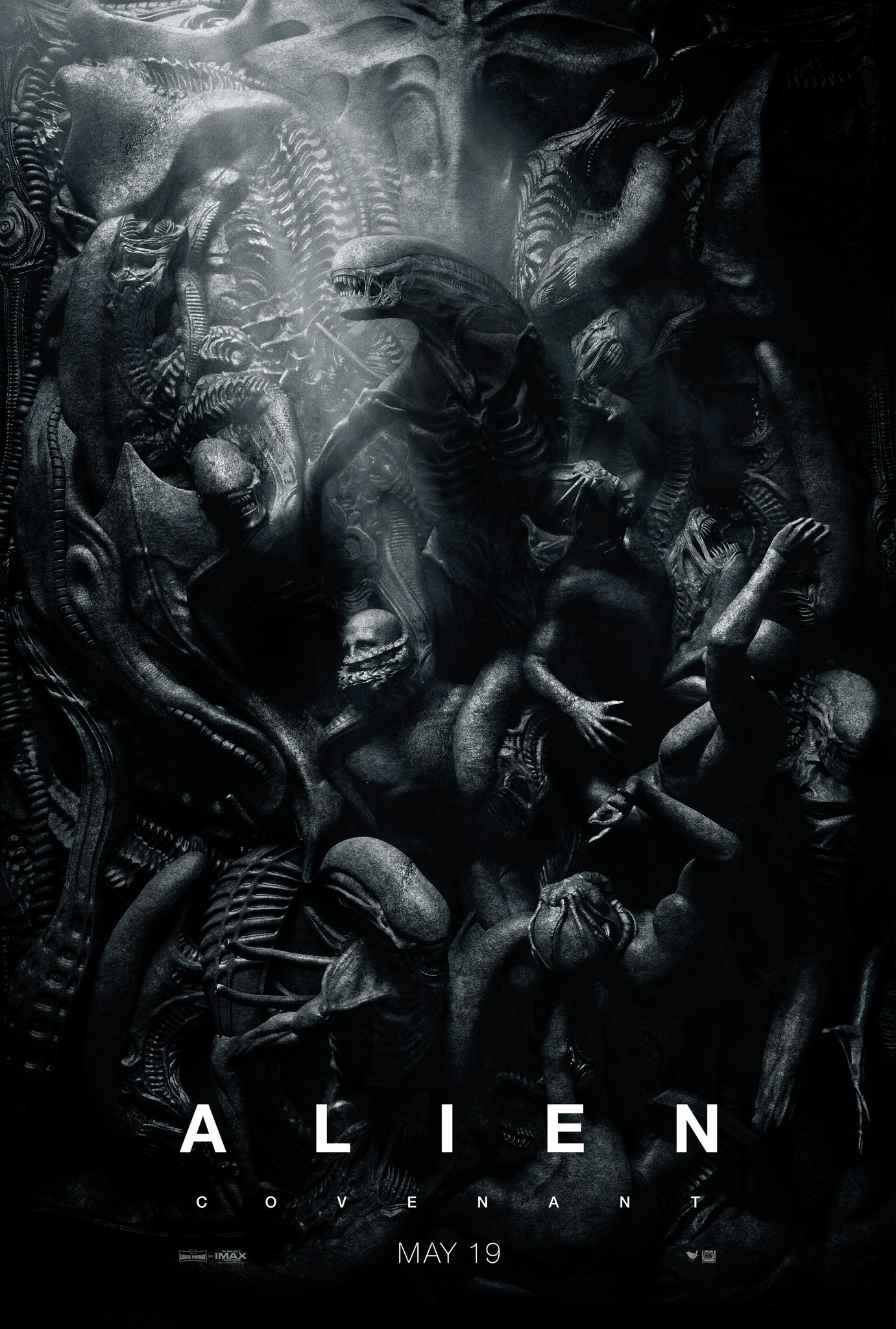
“Alien: Covenant” movie review

Alien: Covenant returns to its roots in horror. In 1979, Ridley Scott convinced audiences around the world that “in space, no one can hear you scream.” And the newest film in the line of prequels leading up to the terrifying events aboard the Nostromo, attempts to make up for the rejection of 2012’s Prometheus as a true prequel to Alien. Fortunately for fans of the franchise, Alien: Covenant is mostly successful at delivering what audiences loved about the original and missed in the subsequent Cameron and Fincher movies–the trademark horror of the xenomorph and facegrabbers. Starting off like Prometheus and finishing more like the original Alien, the newest film in the nearly 40-year-old franchise will have you screaming, cringing, and completely immersed in blood-curdling terror. That is, until you realize that only some questions from Prometheus are answered, and all new questions about events in this movie are generated and left unanswered. That appears to be Ridley Scott’s Achilles heal: always leaving more questions unanswered than providing closure or exposition, thus prohibiting the movie from being as great as it certainly had the potential to be. With one more film between this current installment and 1979’s Alien, perhaps there will be far fewer unanswered questions and provide the history for which fans are looking.

On a colonization mission, the complement of the Covenant is traveling into deep space towards a new planet that earth’s humans hope to make a new home. After encountering some severe spacial turbulence enroute to the destination, the crew of the Covenant intercept a transmission from an uncharted planet that, according to the sensors, appears to be a complete paradise. After some deliberation, it’s decided to head for this new planet. Most of the time, when something is too good to be true, it usually is. Led by the new captain Oram (Crudup) and first officer Daniels (Waterson). After an attack from an alien species, the crew is rescued by David (Fassbender), a synthetic android-like human, who is the only remaining survivor of the Prometheus expedition from some years earlier. Unbeknonst to the crew and scientists of the Covenant, they are about to come face to face with the most terrifying nightmare imaginable–make that–an unimaginable fight for survival when paradise turns to hell.

One of the first technical elements that fans of Alien will notice is the opening title sequence. It is reminiscent of the manner in which the opening credits and title of the original were revealed in the emptiness of space on screen. I appreciated this homage to the original because it set me up to prepare for an Alien movie and not a second Prometheus. Perhaps that does not seem important to non-fans; but to make a long story short, while Scott was in the conceptual phase of a sequel to Prometheus (prequel to Alien), he was told by the studio that audiences didn’t want another Prometheus–they wanted Ridley Scott’s Alien. And now the rest is history. In order to best understand the flaws of Alien: Covenant it’s necessary to understand the similar flaws of Prometheus. One of the many diegetic and technical problems with Prometheus was the fact that there was little direct connection to Alien and it felt like a whole new franchise and not an extension of the original. This lack of connection is best represented by the number of unanswered questions dwarfing the answered ones. Essentially, audiences only learned about David’s origin and, to a lesser extent, why that particular planet. But enough about Prometheus, we are here to talk Alien: Covenant.

Although vastly improved, Covenant also leaves audiences with many unanswered questions; albeit, it is successful at making up for many of the diegetic flaws of the preceding film. To get into the questions would reveal too much about the film and perhaps hint at some spoilers, so I won’t go into specifics. But enough about the flaws of this otherwise exciting and well-produced film–just know that the writing is weak but hopefully will be better in the next installment. The most impressive elements of the movie are related to the cinematography, editing, and visual effects. From the sweeping landscape shots to intimate closeups of the xenomorph and its victims, Covenant is absolutely visually stunning. There is even a mild romantic encounter between David and a member of the Covenant crew that was shot incredibly well and strategically placed in the narrative. Where the story is weak, Scott makes up for in creating an impressive cinematic experience for long-time and new fans alike. There are even shot sequences that are taken directly out of Alien. Often times, I am extremely critical of computer-generated effects and characters versus practical effects and animatronics–and for good reason–nothing can replace the way real light bounces off real objects and is really captured by the glass lenses on a camera. Furthermore, it’s rare that a character react in genuine fear to an object, villain, or murderous alien that is not really present on set. However, the combination of CGI and practical effects in Covenant is breathtaking and convincingly real. You will almost feel the facegrabber latching onto you and the xenomorph’s wet acid-breath on your skin.

Aside from the unanswered questions still residing in the minds of those who have seen the film, Covenant fails to live up to Alien in another rather conspicuous way. For everything that this film did right and make up for (in respect to Prometheus), it lacked any memorable crew members–more specifically–this film differs from Alien by not developing Dani(els) to be the strong female character that she had the potential to be. Dani could have been Covenant‘s answer to Sigourney Weaver’s Ripley in Alien. One of the diegetic elements that is most talked about and is often the topic of horror film humanities classes is the breaking of gender roles and heteronormative expectations by Ripley in Alien. Perhaps that is why Alien is almost avant-garde in the cinematic experience whereas Covenant is impressive but does not typify the art of cinematic storytelling nor contributes to groundbreaking character-types. Beyond strong female lead, the film simply fails to leave the audience with any one memorable character period. No one will be talking about any one particular character years from now. Both the unanswered questions and the lack of memorable significant characters can be traced by to one root cause: flawed writing.

If you loved the original Alien, then you will mostly enjoy Alien: Covenant. The experience is equally terrifying as it is beautiful. Whether you have seen Prometheus or not will not affect your enjoyment factor in this film. If you have seen Prometheus, then I would suggest watching the Ridley Scott short film The Crossing because it ties Prometheus to Alien: Covenant. Think of it as an extended prologue. This short film helps audiences to make the connection between the two films in hopes that it does answer some otherwise unexplained circumstances and events. After watching this film, I have an urge to rewatch the original in order to begin making those direct connections between this one and Alien. With one more film to release to finalize the events between Prometheus and Alien, I am eager to have my remaining questions answered. Bottom line: Alien: Covenant demonstrates Scott’s newfound commitment to return audiences to the space horror that makes the original so iconic.
“Gifted” movie review

A cute paint-by-the-numbers heartwarming drama. Although Gifted may be in the vein of a Hallmark Original, it doesn’t shy away from nor sanitize the real problems faced by adults and children. Fresh off the Spider-Man series, director Marc Webb switches gears from superhero action movie to family drama. However, this drama stands out from its counterparts due to the organic feel of the dialog and in how it follows a blockbuster formula. Webb is certainly not new to directing cinematic dramas; he directed the wildly popular 500 Days of Summer which has a cult following in and of itself. Diegetic contrast can easily be drawn between Gifted and 500 Days of Summer in the simple fact that the former is chronologically out of order–but it can easily be said that the movie would not have the artistic or emotional impact that it did if it were told in order–whereas the latter is traditional in linear storytelling. If it were not for Chris Evans and Octavia Spencer’s billing in the film, this one would likely go by the wayside. Over the course of a director or writer’s career (although not limited to those roles), there are occasionally films that provide audiences with a glimpse into a director getting in tough with his or her roots, and this is one of those. More polished and comprehensive than a typical Hallmark movie, Gifted is satisfying enough but does not leave a lasting impact.

Faced with raising his niece Mary (McKenna Grace) after the untimely death of his sister, Frank Adler (Chris Evans) lives a modest, hardworking life in a small coastal town in Florida. Mary is no ordinary child; she is a mathematics prodigy. Against the advice of friend and neighbor Roberta (Octavia Spencer), Frank enrolls Mary in a typical elementary school. When Mary’s unparalleled, brilliant mathematical skills come  to the attention of Mary’s teacher Bonnie (Jenny Slate) and principal, her school encourages Frank to enroll her in an exclusive school for cognitively gifted children. With a deep desire for Mary to have a normal, fun childhood, Frank declines the full-scholarship. News of Mary’s ability and the scholarship soon reach Frank’s mom Evelyn (Lindsay Duncan), a genius in her own right. After failing to reason with her son, Evelyn takes him to court in order to secure parental rights. Throughout the custody battle, skeletons come out of the closet and the reasons for Frank’s decisions become clear.

Paralleling the brilliance of Mary’s cognitive abilities, a trait that runs through the entire family, the most notable element that stands out in Gifted is the casting. Child actors playing characters who are atypically outstanding in a particular field can come across as precocious, if not just plain annoying. Whether a kid genius, musical savant, or prima ballerina, attributing adult-like qualities to a child can create a character that comes across as out of touch with the majority of the audience. Not so with McKenna Grace. With her wide eyes, missing front teeth, and refreshing spontaneity, she provides audiences with a relatable character who just happens to be brilliant. This relatablity can be attributed to her down-home charm and humble demeanor. When he’s not saving the world, Captain America is raising his niece in a non-discript small coastal town outside of the bustling Tampa-St. Pete metropolitan area. While many actors become type casted after bringing an iconic character to life, Evans is working to prevent this by appearing in lead roles that are in stark contrast to his work in the Marvel Cinematic Universe. Sporting a perpetual scruffy beard, love for the outdoors, and a boyish-fatherly charm, Evans demonstrates his ability to successfully transfer his acting prowess to other genres in cinema outside of his famous Captain America.

Supporting the two leads are Spencer’s Roberta and Duncan’s Evelyn who are interestingly mirror characters in that they are the antithesis of one another. Although her screen time is limited, Roberta’s appearances are strategic and greatly support the emotional pull of the movie. Wise beyond her likely formal education, Roberta cares nearly as much about Mary’s well-being as does her father-figure uncle. Spencer’s charisma is easily seen in this chief supporting role and I cannot think of another female actor who could have done this role justice as well as Spencer did. The character of Evelyn is an interesting one to evaluate. On one hand, she is a monster of a grandmother who wants to control her granddaughter and protect the family’s academic legacy; but for fear of smothering her like she did her own daughter, tries to be as loving and concerned as she can. Although at first I thought that this was a role better suited for Jessica Lange, I do not feel that Lange could have captured the vibrant love that Evelyn has for her family–tough love maybe–but sincere love for and desire for her children to be successful. Evelyn is both an enlightened academic and tough-loving mother and grandmother.

Gifted does its best to be a tear-jerker, but it never quite hits that emotional peak. There were times that I was close to tearing up, but there was just a little something extra missing that prevented the tears from rolling down my face. The plot of this film was as structured, precise, and predictable as a chalk equation on a blackboard, but it still has a charm that will assist it in beckoning patrons to watch it at the cinema when it hits select theaters this week with a wide release predicted in the near future.

Written by R.L. Terry

Written by J.M. Wead

“LIFE” movie review

Chilling! In space, no one can hear you scream. Although that tagline is associated with Ridley Scott’s groundbreaking space-horror Alien, director Daniel Espinosa’s LIFE delivers an intensely dark thriller that will have you screaming and cringing from the moment life on Mars is discovered. In the same vein as AlienLIFE is a science-fiction horror that may look like Gravity and might even have the strong orchestral sounds of Interstellar, but provides audiences with an entirely different experience. Borrowing from Alien and Gravity, Sony and Columbia Pictures craft a new space-horror narrative that can sufficiently serve as a standalone film–and be great in that–but also has potential for a sequel or two. Interestingly, there are parallels to Ridley Scott’s Alien beyond the premise; LIFE also features the same number of crew members and other more subtle elements. That being said, LIFE is definitely not a knockoff Alien nor is it trying to be Ridley Scott’s critically claimed film as it does not contain the social commentary on gender, sex, and family. However, imitation is the highest form of flattery, and LIFE pays both homage to the film that likely inspired it but delivers a comprehensive science-fiction horror experience that provides ample twists, turns, and even some emotional connection along the way.

A group comprised of engineers and researchers on board the International Space Station (ISS) are on the brink of one of the most important discoveries in human civilization: life on Mars. Rory Adams (Ryan Reynolds), David Jordan (Jake Gyllenhaal), Miranda North (Rebecca Ferguson), Sho Murkami (Hiroyuki Sandana), Hugh Derry (Ariyon Baker), and Ekaterina Golovkina (Olga Dihovichnaya) represent several different counties, all working in cooperation on this groundbreaking mission. After the satellite, carrying the Martian sample, is retrieved from spiraling out of control towards the ISS is secured, the group of astronauts are faced with the crisis and task of retrieving it. After a daring retrieval, what should be a joyous discovery–something out of a scientists dreams–soon becomes a living nightmarish game of hide and seek. When the specimen from Mars begins to grow rapidly and become more and more intelligent, it stops at nothing to continue to feed the alien’s insatiable appetite and its goal to find a new home.

Initial impressions of LIFE leave you with noticing just how much like Alien it feels. It’s been nearly forty years since the Ridley Scott cinematic masterpiece, but in that time, no other science-fiction/horror film has come this close to delivering a similar (note: not as high on the cinematic totem pole as its predecessor) experience to that which first terrified audiences in 1979. One of the primary differences between Alien and LIFE is just how much closer to home this horrifying experience occurs. Whereas with the former, the alien encounter takes place hundreds of lightyears away, the latter’s narrative takes place just outside of our atmosphere on the ISS. Not that LIFE feels more intimate than Alien–it doesn’t–but the proximity of this story might add a little something more to the edge that you’re already sitting on as the horrific events unfold on the space station. Pacing is similar to Alien in that LIFE has a slow burn during the first act. To balance this slow burn or to keep audiences from thinking that it’s taking forever for the movie to really get started, the film begins with the “big event” right at the very beginning. The “big event” being the apprehension of the satellite carrying the Martian specimen. But for all it’s similarities, this movie provides a different experience that can certainly stand on its own. LIFE may have been inspired by Alien, but it is certainly not a ripoff.

I’ve been quite critical of the CGI-effects of films in more recent years, but the brilliance of the alien life form in LIFE is the degree to which it feels organic. In the beginning, the life form is little more than a single-celled organism; however, as the plot thickens, the organism begins to take a more chilling form and shape. Eventually, the alien develops a frightening grin and a mysterious-like form. One of the scariest parts of Ridley Scott’s Alien was the degree to which the Xenomorph feels so real that, even in your seat, you could feel the acidic slime and your body likely felt the excruciating pains of that iconic moment when the alien shoots out of the stomach. Part of that can be attributed to the use of pneumatics, animatronics, miniatures, and other practical effects standards. Yes, the alien life form in LIFE is computer-generated, but it also has a very real nature to it. Instead of focussing on how to make the alien as impressive as possible, it would appear that the special effects artists (whose work can be seen in the Transformers movies) focussed more on the small details that ordinarily give a CGI character away. Just like with the brilliant visual effects work in Ex Machina, the visual effects of the alien are flawless.

There is an inherent level of unpredictability in LIFE even after the unavoidable similarities to AlienLIFE plays around with the final girl trope and the killings have a strategy or method to their madness. Conspicuously missing from the characters of LIFE in a comparison to Alien is a Ripley-like character. Does the film portray strong female characters? Certainly. But LIFE keeps you guessing because the order of the deaths do not follow any predictable pattern. Do not allow yourself to fall into the trap of being predisposed to the order of the killings to be based up on star billing. Speaking of the characters, effectively managing an ensemble cast is always difficult. So often, some characters in the ensemble get lost or do not receive nearly as much development as the more obvious leaders. Not true with LIFE. True that there is not a large degree of character development all the way around, but each of the characters is treated with equal screen time and emphasis. That is, until death occurs. The excellent handling of this ensemble gives LIFE an extra dynamic that lacks in other ensemble cast films, thus helping this science-fiction horror to stand out from others that are similar in premise or plot. This movie has a “life” of its own.

2017 seems to be shaping up to be a year of excellent movies! We are just about to finish the first quarter of the year, and already there have been some great motion pictures. Furthermore, 2017 seems to be the year of the horror film because so many have made the theatrical distribution circuit. For those who love a good science-fiction thriller, you will not be disappointed with LIFE. Albeit the film may not be able to sustain the magic and horror for the entire runtime, it successfully delivers a terrifying experience for most of the film. If you don’t mind some cringeworthy moments and the dark tone of the film, then this is definitely one to see this weekend.

PS. I saw Power Rangers this week as well, and it was a delightful film! Yeah, it’s a little campy, but that’s to be expected. Definitely the best Power Rangers motion picture. All-in-all, it sufficiently pays homage to the 90s show but provides audiences with a new story. Go-go see it too!

Written by R.L. Terry

Edited by J.M. Wead

Disney’s “Beauty and the Beast” (2017) movie review

Prepare yourself for “a tale as old as time” that is ultimately better told through its animated counterpart. Director Bill Condon’s live-action remake of Beauty and the Beast, the first animated film nominated for Best Picture at the (1992) Academy Awards, is an extravagant display of visual effects and digital imagery necessary to animate a live-action motion picture. Essentially, he took an animated movie, made it live-action, just to make it animated again. Sure, this new version of the “song as old as rhyme” can certainly stand on its own and is demonstrably well-directed, but 2017’s Beauty and the Beast largely comes across as unnecessary. In terms of the storytelling (or diegesis), the film’s effort to nearly shot-for-shot translate the most memorable parts of the film from animation to live-action pays off nicely! It’s when the film tries to be different that it falls short in its delivery. There are sufficient moments that beautifully recreate that which caused you to fall in love with this movie more than two decades ago; although, with this version, you may find yourself exhausted and over-stimulated by the constant waves of computer-animated figures in a live-action world. Oh yeah, you’ll likely miss hearing the legendary Angela Lansbury as the iconic Mrs. Potts. The film does its very best to justify its existence, but begs the question whether or not this was the movie for which you were waiting.

Belle (Emma Watson) is a young lady with a longing for adventure and a great big imagination, but she lives in a rather provincial French town. But, Belle is about to get more adventure than even she, in her wildest imagination could have dreamt. For through a series of strange circumstances, she finds herself trapped inside a dark foreboding castle, surrounded by a very odd collection of characters. It’s in this castle that she finds her father who she feared injured or dead imprisoned by a Beast (Dan Stevens). Against her father’s wishes, she reluctantly exchanges herself for her father’s release. After the Beast sets him free, Belle is to remain a permanent resident of the castle. Fearing the worst, Belle’s father seeks the help of the misogynistic village heartthrob Gaston (Luke Evans) and his band of goofs and thugs to rescue her. During this time, however, Belle begins to feel “something there that wasn’t there before” as she learns more about the Beast of the castle.

Can this film stand on its own? Sure. There is no question in that. Moreover, is it enjoyable and magical? That, it is. But when most of the campaign, leading up to the highly anticipated release, was primarily built upon how similar the live-action film would be to its animated counterpart, therein a problem arises. Because most people going into the movie will have seen the animated version, Broadway show, or even the show at Disney’s Hollywood Studios (which, in full disclosure, is a show that I worked when I was a Cast Member at Walt Disney World), you are predisposed to looking for and eagerly awaiting the nostalgic references and memories. And there is nothing wrong with that. In fact, I was looking forward to reliving the experience of when I first saw the animated movie. For the most part, if you are like me, then you will be pleased with the live-action translation–truly. However, it’s when the live-action version departs from or adds in material not found or referenced in the animated classic that you may be disappointed or simply ask “why?” You may find yourself wondering why was a live-action remake even necessary?

One of the most memorable elements of Disney’s Beauty and the Beast (1991) is the music! Still to this day, millions of people love hearing the classic music and lyrics by Alan Menken and Howard Ashman. Both the Beauty and the Beast and Be Our Guest can be heard as part of other shows at Walt Disney World and of course are included in the stage show at Hollywood Studios. Fortunately, the most iconic songs from the animated version are largely untouched; however, with a couple of the songs, there are breaks for diegetic dancing, fighting, or other material that essentially interrupts the organic flow of the music from the buildup to the climax and denouement. Again, the question “why” will likely pop into your head. We are introduced to a few new songs, and in and of themselves, are beautiful! Every note and lyric has that Disney magic that many of us have come to expect and appreciate. Unfortunately, the songs just don’t fit in with the original numbers in terms of pacing, lyrics, and score. Furthermore, here’s something quite interesting and odd: the song [To Be] Human Again was written for but deleted when it originally hit theatres in 1991. It was, however, added back in for the Broadway show and in the 2010 (and Diamond Edition) re-release of the movie. Although it was seen as important enough to include in the Broadway show and add back into the animated version, it is conspicuously missing from the live-action remake.

With the exception of Emma Thompson replacing the legendary Angela Lansbury, the cast was well-selected and demonstrated excellent chemistry between one another. Although Emma Watson is not a singer by trade, she was able to capture a Belle-like essence in her delivery of the various songs throughout the film. There was something uniquely organic in her voice that is seldom captured by other Disney “princesses” (note: Belle is not a princess). I greatly appreciate the dynamic range of characters that Watson has demonstrated that she can play over the years. Dan Stevens wows audiences with his vocal prowess especially in his solo number as we transition from the second to third acts. I appreciate how he stuck a fantastic balance between his human and beast sides respectively. Luke Evans was a perfect choice for Gaston, and his vocal talent matches his muscles–big, bold, and flawless. The rest of the cast, which includes some A-list talent itself, was ideally suited for the enchanted objects in the castle and the village.

Okay, now for the white elephant in the room: Josh Gad’s Lefou. Unless you have been completely disconnected from social media and the news, you’ve undoubtedly heard or read about the first ever Disney “gay moment” in this film. Suffice it to say, the whole thing has been blown way out of proportion. In fact, more attention is likely being paid to Lefou now than had the story never grown to the size of Gaston’s ego. For the most part, the subtext and subtitles of Lefou’s are largely just that–subtle–unless you are looking for them. But, in doing that, you may miss some of the more important and impressive parts of the movie. Moreover, there is nothing in Lefou’s actions that come across as offensive or obnoxious. Before audiences begin accusing Disney of pushing their ideals on those eager to attend this film, it is likely that the entertainment and media giant is simply delivering what audiences already expect or want. As a film and media professor, I can tell you that by in large, media simply delivers what audiences and investors are telling them to produce–not the other way around. Looking back at the animated film, it is pretty obvious that Lefou has a thing for Gaston anyway. Although most of the hints at his sexual orientation are more-or-less winks or nods at the audience (winks or nods that you have to be looking for), there is a moment that is a trifle more obvious at the end of the film. Diegetically, there is nothing bizarre about Lefou’s behavior and it suits his character well.

Prepare to be whisked away to an enchanted castle in a remote part of France. So remote is this province in France, that most everyone speaks with a British accent. Bill Condon’s film will take you back to when you first saw this magical tale of falling in love with someone based upon what’s on the inside and not allowing a beastly outward appearance to detract from the gentle soul. Relive the music that you may still listen to in the car or eagerly look forward to when visiting the Disney Parks and Resorts. Ultimately, this film may not capture the magic of the original for you, but there is a lot to enjoy! Looking for a great date movie this weekend, then this is definitely it! Hopefully a side effect of this film may remind producers and audiences that some stories are better suited for an animated motion picture.

Written by R.L. Terry

Edited by J.M. Wead

“KONG: Skull Island” movie review

“Hold onto your butts;” Warner Bros. and Legendary Entertainment’s KONG: Skull Island is full body KONG with just a hint of story. Wait. Isn’t that a line from Jurassic Park??? Sure is. And guess who delivers it? None other than Samuel L. Jackson himself–reprising his famous line from one of the most iconic films in the American cinema library. It’s rather fitting since there are many shared elements between KONG and the Jurassic Park franchise. Both take place on an island and deal with science vs. nature and pit man against ancient creatures. King Kong is no stranger to most people, considering he’s been a fixture in the cinema and theme park universes respectively for many decades. From silver screen to Universal Studios, he remains an icon to which few “monster” movies compare. Although the previous KONG films followed a very similar narrative, this newest incarnation of the king of Skull Island takes a modified route to the classic story. It shares many of the same elements or themes with its predecessors, but through the echoes of the past comes a reimagined story. Diegetically, the film certainly suffers; furthermore, it attempts to integrate social commentary on war, Captain Ahab allegory, and conservation, but none of those themes are effectively carried out. Due to the enormous “King Kong” sized cast, there lacks any real connection to any of the characters and development is certainly obscure, if any at all. Films such as this one can sometimes run into the danger of waxing nostalgic too often and forgetting that audiences want a new movie (i.e. Star Wars: the Force Awakens); and like the aforementioned, Jordan Vogt-Roberts’ KONG: Skull Island provides audiences with connections to past King Kong movies in a new approach, but ultimately crafts generic experience.

When an uncharted island shows up on U.S. satellites, Bill Randa (John Goodman) and Houston Brookes (Corey Hawkins) approach a prominent senator, seeking clearance and funding for a mapping expedition and exploration of the mysterious island resembling a skull. Begrudgingly, the senator clears Randa’s MONARCH for one last mission before the U.S. pulls out of the south Pacific following the Vietnam War pull-out. Partnering with Colonel Packard’s (Samuel L. Jackson) military troop and attaching ex-British special forces Captain Conrad (Tom Hiddleston) and photo journalist Mason Weaver (Brie Larson) to the group, the expedition lays out plans to penetrate the severe storms surrounding the island to explore the island. What the group encounters on Skull Island will give them nightmares for the rest of their respective lives. Beginning as a glorified mapping excursion, this expedition turns into a game of survival as the group makes its way across the island.

At the end of the day, this movie accomplishes what it set out to do: revive Kong, thrill people for a couple hours, and setup KONG v. Godzilla. Action-adventure films are typically not expected to contain brilliant writing, character development, and strategically placed themed and subtext. What I respect about this movie is that is unashamedly pretends not to be anything other than a larger than life adventure centered around one of cinema’s most iconic “monsters.” Clearly, there are attempts in the movie to include some deeper themes such as anti-war, nature/conservation, and even a little Moby Dick; but those themes appear to have been great thoughts that were not fully executed. That being said, there is clearly a Captain Ahab figure in the film and there are many similarities between King Kong and Moby Dick–size just being one of them. For fans of Jurassic Park you’ll appreciate not only Jackson’s “hold onto your butts” line at the beginning of the film, but also several similar scenes, camera angels, and even the helicopter entry onto the island. Lots of nostalgia, but not so much that it feels like you’ve seen it all before.

In many ways, Kong is bigger than ever, but hardly better than previous Kong films. Ironically, this same thing can be said about the former Kongfrontation attraction at Universal Studios Florida. Much like the new attraction Skull Island: Reign of Kong at Universal feels far more generic than its predecessor, today’s Kong lacks the magic and innovation that the original Kong did in 1933. Despite an attempt to successfully launch a series of “creature features,” the script and human characters certainly suffer. Little can be said about the dialog except that occasionally there are lines that move the story along instead of stating the obvious or predictable. The dialog is cumbersome and never seems to remain focussed very long. Of course, that is hard to do considering that Kong boasts an extremely large ensemble cast. At the forefront of the cast are Hiddleston, Larson, Jackson, Goodman, and Reilly’s respective characters. Of all the characters, John C. Reilly’s Hank Marlow steels the screen about as often as Kong does. One might even be able to say that this is as much a John C. Reilly film as it is a Kong movie. Part of the magic of the previous Kong films, the 1933 version to be more specific, is the setting and characters themselves. Much like the new KONG attraction at Universal took physical sets, animatronics, real fire, etc and crafted a virtual 3D experience, the special effects artists and set designers did the same thing in KONG: Skull Island. The film comes across as less Kong and more Pacific Rim. In other words: generic.

KONG: Skull Island will certainly keep you entertained the whole time as action-adventure films are supposed to do. You’ll enjoy the fight scenes and the whole “creature feature” approach this film takes. If you’re looking for moments taken right out of the previous Kong movies, then you’ll mostly be satisfied. There are few scenes taken directly from the previous movies, but there are certainly allusions and nods to classic moments. You won’t spend much time with the natives nor will you get to witness the famous Empire State Building scene, but you’ll likely enjoy the film nevertheless. Just because a film takes a reimagined approach to a classic character that ultimately plays off as generic, doesn’t mean that there isn’t anything to enjoy. For action junkies, there is plenty to grab your attention and hold it for the duration of the movie.

Written by R.L. Terry

Edited by J.M. Wead