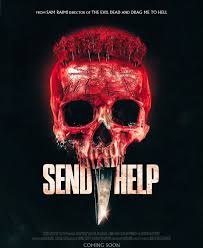
Send Help is the rare survival thriller that understands the most dangerous thing on a deserted island isn’t nature—it’s the workplace baggage you bring with you.
Send Help plays like a postmodern riff on Misery—less interested in replicating its mechanics than in reconfiguring its psychological cruelty for a contemporary workplace horror. One can also detect traces of Survivor, the underseen Office Killer (1997), and even a one-way echo of Fatal Attraction, though Raimi’s film resists the lurid sensationalism of those predecessors in favor of something more controlled, more ideologically curious. I went into Send Help expecting one kind of movie and walked out having experienced something far more interesting—and far more satisfying. What initially presents itself as a straightforward survival thriller gradually reveals a different set of priorities: character over carnage, tension over spectacle, and psychology over shock. The turn is not a bait-and-switch so much as a recalibration, one that rewards patience and attention.
A woman (Rachel McAdams) and her overbearing boss (Dylan O’Brien) become stranded on a deserted island after a plane crash. They must overcome past grievances and work together to survive, but ultimately, it’s a battle of wills and wits to make it out alive.
Despite containing remarkably little gore, Send Help is punctuated by moments of excruciating intensity—scenes engineered to linger in the mind the way Misery’s hobbling scene does, not because of what is shown, but because of what is anticipated. Raimi understands that true discomfort is often born from restraint. Violence, when it arrives, is not gratuitous; it is precise, purposeful, and deeply unpleasant.
Where Send Help distinguishes itself most clearly is in its thematic ambition. Raimi trades his trademark splatter for commentary on workplace dynamics—particularly the lived experience of women navigating environments shaped by misogynistic men, institutional indifference, and power imbalance. The film proposes that monsters are created—that violent behavior can be traced back to environment, circumstance, and provocation. While the film makes this argument with conviction, I remain unconvinced by its absolutism. Environment can shape behavior, yes—but it does not absolve agency. Some monsters are forged by their surroundings; others choose monstrosity despite them. Under most circumstances, we remain responsible for our actions.
That tension—between explanation and excuse—is where Send Help becomes most interesting. The film is less persuasive as a moral thesis than it is as a provocation, forcing the audience to wrestle with where empathy ends and accountability begins. In that sense, the island setting becomes more than a survivalist conceit; it is a crucible. A demented Gilligan’s Island, stripped of whimsy and comfort, where rescue is uncertain and survival demands agency. The film is clear-eyed about one thing: help does not always arrive. Sometimes survival requires seizing control rather than waiting to be saved.
Visually, the setting is striking—lush, isolating, and quietly menacing. The CGI animals, however, are nearly laughable, though thankfully used sparingly enough not to derail the experience. When Raimi relies on atmosphere rather than digital intrusion, the film is at its strongest.
Excellent casting anchors the film, thoughtful writing gives the conflict weight, and the thrills feel refreshingly old-school—earned through escalation and dread rather than excess. All of it is quietly underscored by moments of dark comedy that arrive not as winks to the audience, but as pressure valves, reminding us that sometimes the most unsettling laughs are the ones that catch us off guard. McAdams’ and O’Brien’s chemistry is exceptional. They play off one another with a rhythmic precision that feels almost musical—each reaction, pause, and escalation perfectly calibrated. Their dynamic does much of the film’s heavy lifting, grounding the psychological tension in something human and volatile. One hopes this pairing is not a one-off; there is genuine electricity here worth revisiting.
There is also an unintended—but revealing—meta-text hovering around O’Brien’s presence. In a recent Entertainment Weekly article, O’Brien noted that he has been repeatedly told by agents, producers, and directors that he needs an Instagram account—that without it, he risks losing roles deemed “appropriate” for him. He has no intention of starting one. As a film scholar, I find this deeply troubling. When talent, suitability, and longevity are increasingly filtered through social media metrics rather than craft, presence, and screen intelligence, the industry risks confusing visibility with value. Send Help, perhaps inadvertently, becomes part of that conversation—raising questions about how we identify monsters, merit, and worth in systems increasingly governed by optics.
Ultimately, Send Help is not a perfect film, nor is it a subtle one. But it is a thoughtful, unsettling, and frequently compelling genre exercise—one that uses survival horror as a vehicle for interrogating power, agency, and responsibility. Raimi may be experimenting here, but the experiment is a worthwhile one. If nothing else, Send Help reminds us that the most terrifying scenarios are not those where monsters appear—but those where we are forced to decide what kind of people we are when no one is coming to save us.
Ryan is the general manager for 90.7 WKGC Public Media and host of the show ReelTalk “where you can join the cinematic conversations frame by frame each week.” Additionally, he is the author of the upcoming film studies book titled Monsters, Madness, and Mayhem: Why People Love Horror. After teaching film studies for over eight years at the University of Tampa, he transitioned from the classroom to public media. He is a member of the Critics Association of Central Florida and Indie Film Critics of America. If you like this article, check out the others and FOLLOW this blog! Follow him on Twitter: RLTerry1 and LetterBoxd: RLTerry
When satire ceases being satire–we’re living inside it.
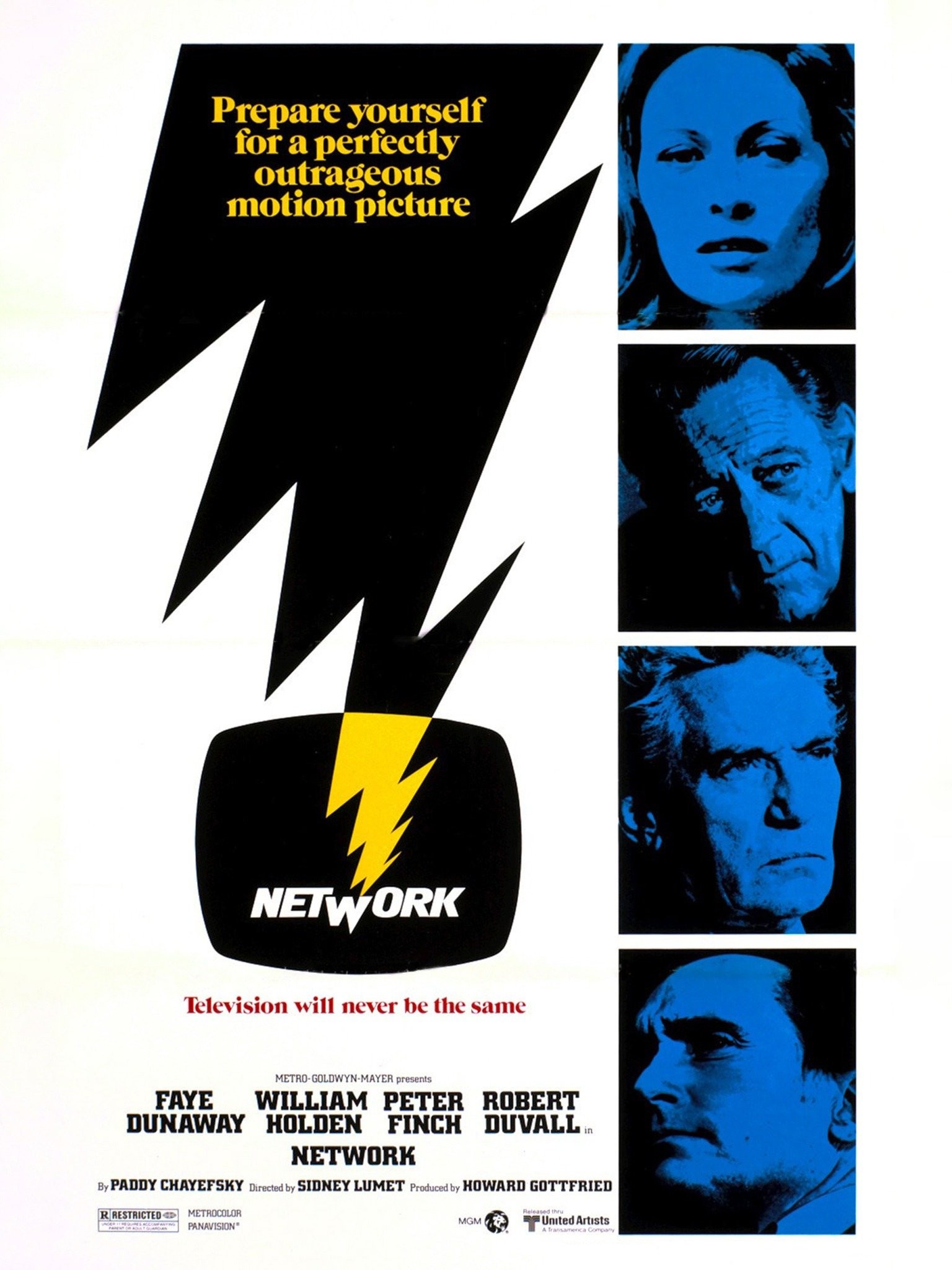
There are films that feel timely, films that feel dated, and then there is Network—a work so disturbingly elastic that it seems to recalibrate its relevance with each passing decade. What Sidney Lumet’s incendiary masterpiece offered in 1976 as provocation now functions as diagnosis. Network ceased being satire the moment we began living inside it. And at fifty years on, it is no longer prophetic so much as instructional—a grim field manual for the media ecosystem we willingly built.
On its surface, Network is a scathing critique of television news and the corrosive marriage between journalism and entertainment. But that reading now feels almost quaint. Today, the film operates as a far more expansive lens—one through which we can examine social media’s performative outrage, the collapse of editorial integrity, the rise of influencers over actors, and “content” replacing cinema as both commodity and aspiration. The film’s possibilities for interpretation are not merely endless; they are inescapable.
You can listen to the NETWORK episode of ReelTalk, which serves as a great companion piece to this article through your favorite podcast service. For your convenience, I’ve included some links that may work for you.
When I survey the contemporary media landscape—where outrage is currency, truth is malleable, and spectacle supplants substance—I often find myself echoing Howard Beale’s immortal lament: “I’m as mad as hell, and I’m not going to take this anymore.” The tragedy, of course, is that Beale’s righteous fury is swiftly commodified, packaged, and sold back to the public. In Network, that process is the warning. In 2026, it is the business model.
What Network ultimately offers is not just a critique of television news, but an elegy for every so-called Golden Age of legacy media—journalism, cinema, and serialized television alike. Watching it now, I am reminded of Norma Desmond’s aching declaration in Sunset Boulevard: “I am big. It’s the pictures that got small.” Substitute “pictures” for platforms, algorithms, and engagement metrics, and the lament lands with devastating clarity. In my view, social media and streaming have not merely disrupted cinema and television; they have delivered a mortal wound—one from which craft, patience, and collective cultural experience may never fully recover.
Network endures first and foremost because it is built on one of the most ferocious screenplays ever put to film. Paddy Chayefsky’s Oscar-winning script is not merely well-written; it is weaponized language—monologues that cut like scalpels, dialogue that oscillates between blistering satire and operatic tragedy, and ideas so densely packed they continue to unfold decades later. This is writing that trusts intelligence, that dares to be verbose, ideological, and confrontational in a way modern studio cinema rarely permits. Chayefsky understood that words—spoken with conviction—could be more explosive than spectacle, and he built Network accordingly.
What makes the screenplay extraordinary is its refusal to choose a single target. It indicts television news, corporate capitalism, religious fervor, political apathy, and audience complicity with equal venom. The famous “mad as hell” speech is not a populist rallying cry so much as a trap—an emotional release engineered to be monetized, emptied of meaning, and repackaged as programming. Chayefsky was not predicting outrage culture; he was anatomizing it. In an era where dialogue is often sanded down to algorithm-friendly soundbites, Network feels almost alien in its literary ambition—proof that cinema once trusted language to carry weight, risk, and consequence.
Sidney Lumet’s direction is the perfect counterbalance: disciplined, precise, and deliberately unflashy. Lumet stages the film like a moral courtroom drama, allowing performances and ideas to occupy the foreground while the camera observes with quiet authority. His restraint is crucial. Rather than amplifying the satire through stylistic excess, Lumet grounds the absurdity in realism—office spaces feel oppressive, boardrooms feel sterile, and television studios feel eerily sacred. The effect is chilling: the madness is not heightened by cinematic flourish; it emerges organically from systems that feel frighteningly familiar.
Together, Chayefsky and Lumet create a film that feels less like a movie and more like a controlled detonation. There is no indulgence, no wasted motion, no attempt to soften the blow. In contrast to today’s cinema—often drowned in visual noise, diluted themes, and studio-mandated ambiguity—Network stands as a reminder of what happens when writing and direction operate with absolute clarity of purpose. It is fearless, articulate, and devastatingly focused. And perhaps most damning of all: it proves that cinema once had the courage to tell audiences the truth, even when that truth was deeply uncomfortable.
Yet if Network endures as forcefully as it does, it is not solely because of its prescience. It endures because it is performed with astonishing precision and gravitas by one of the greatest ensembles ever assembled. Peter Finch’s Howard Beale remains one of cinema’s most unforgettable figures—a man whose breakdown is mistaken for authenticity, whose humanity is exploited until nothing remains. Finch’s posthumous Academy Award win feels less like recognition than inevitability.
William Holden, meanwhile, brings a weary, world-worn melancholy to Max Schumacher that resonates deeply with his earlier turn as Joe Gillis in Sunset Boulevard. Both characters are men who recognize the rot of the system even as they remain complicit within it—observers with just enough moral clarity to feel shame, but not enough power to stop the machine. Holden’s quiet resignation here serves as the film’s conscience, a reminder of what professionalism and restraint once meant.
And then there is Faye Dunaway, delivering a tour de force for the ages—one of those rare performances that does not merely dominate a film, but defines an era of acting. Her Diana Christensen is ambition incarnate: ice-cold, ferociously intelligent, and utterly unencumbered by empathy. Dunaway doesn’t soften the character or seek audience approval; she weaponizes Diana’s ruthlessness, allowing her to move through the film with the predatory calm of someone who understands power not as responsibility, but as leverage. The performance is so precise and so unflinching that it almost feels inhuman, as though Diana has already evolved into the algorithmic logic the film warns us about—ratings as morality, attention as currency, and human cost as an acceptable casualty.
It is no accident that Dunaway earned the Academy Award for Best Actress for this role. The Oscar was not simply recognition of a great performance; it was an acknowledgment of something rarer—a character so vividly realized that she became a cultural archetype. Diana Christensen is not just a television executive; she is the prototype for the modern media operator, the spiritual ancestor of today’s content strategists, brand architects, and engagement-obsessed executives. Dunaway plays her with surgical control, her clipped delivery and laser-focused gaze conveying a woman who has replaced conscience with metrics long before such thinking became normalized.
In the broader context of film history, Dunaway’s work in Network cements her status as one of the greatest actresses of all time—very much in the lineage of Bette Davis and Joan Crawford, yet operating outside the classical Golden Age of Hollywood. Like them, Dunaway possessed an unapologetic intensity, a willingness to embrace unlikable women, and a commanding screen presence that bent films around her gravitational pull. But unlike Davis or Crawford, her era offered fewer guardrails and less mythmaking; Dunaway emerged during a transitional moment in American cinema, when performances could be raw, confrontational, and morally untidy.
That makes her Diana Christensen all the more extraordinary. It is not a performance cushioned by studio glamour or softened by melodrama—it is sharp, modern, and terrifyingly plausible. Decades later, Dunaway’s Oscar-winning turn feels less like a relic of 1970s cinema and more like a warning label we ignored.
The supporting cast—Beatrice Straight, Ned Beatty, Robert Duvall—forms a devastating chorus, each representing a different facet of institutional decay. Straight’s Oscar-winning performance, in particular, remains one of the most remarkable achievements in Academy history. The fact that Straight’s Academy Award for Best Supporting Actress was won with comparatively limited screen time only underscores the magnitude of her presence. Every line, every glance carries weight. Gravitas is not measured in minutes.
It is impossible to discuss Network without reckoning with its unprecedented—and now unthinkable—Oscar performance. The film received ten Academy Award nominations, including Best Picture, Best Director, and an astonishing four acting nominations across all performance categories. Even more remarkable: Network won three of the four acting awards—Peter Finch (Best Actor), Faye Dunaway (Best Actress), and Beatrice Straight (Best Supporting Actress)—with Finch’s win occurring posthumously. That trifecta remains a singular achievement in Oscar history.
What makes this feat so haunting in retrospect is not merely its rarity, but what it represents: a time when the Academy rewarded performance-driven cinema rooted in language, ideas, and moral urgency. These were not roles engineered for “Oscar moments” clipped for social media circulation. They were fully realized characters inhabiting a screenplay that demanded intelligence, restraint, and theatrical rigor. Even Beatrice Straight’s win—earned with fewer than six minutes of screen time—speaks to an era when gravitas mattered more than exposure, and emotional truth outweighed narrative gymnastics.
Contrast that with the modern awards landscape, where performances are often subsumed by brand visibility, platform allegiance, and campaign machinery. Today’s Oscars frequently feel less like a celebration of cinema than a referendum on cultural relevance as defined by streaming metrics and algorithmic reach. In that context, Network’s acting sweep feels not merely impressive, but elegiac—another artifact from a period when cinema trusted adults to speak, listen, and think.
This is where Network dovetails uncomfortably with my broader reflections on the erosion of cinematic prestige and journalistic integrity. The film arrived at a moment when studios still believed movies could challenge audiences, when networks still pretended journalism was a public service, and when awards bodies still recognized craft over content. That ecosystem no longer exists.
Today, companies like Netflix and Disney—titans of scale and convenience—have played outsized roles in flattening the cultural landscape. Netflix’s content-first philosophy has blurred the line between cinema and disposable product, prioritizing volume over vision and treating storytelling as a data problem to be optimized rather than an art form to be refined. Disney, meanwhile, has transformed legacy filmmaking into brand maintenance, where risk is minimized, mythmaking is franchised, and even news-adjacent programming is filtered through spectacle and marketability.
In that environment, Network feels almost confrontational. It reminds us that journalism once aspired to truth rather than virality, that cinema once valued language over noise, and that performances once carried weight beyond their runtime. The film’s Oscar dominance is not simply a historical footnote—it is a marker of how far the industry has drifted from rewarding seriousness, substance, and moral clarity.
Ultimately, Network foresaw where we were headed with terrifying clarity. But perhaps its greatest sorrow is that it did not imagine how eagerly we would embrace that future. Our media landscape has not merely changed; it has lost its soul. Journalism has become performance. Cinema has become content. And authenticity—once a virtue—has been repurposed as branding. Half a century later, Network stands as both benchmark and indictment. It is proof that cinema once mattered enough to scare the powerful—and a reminder that somewhere along the way, we stopped demanding that it do so.
Ryan is the general manager for 90.7 WKGC Public Media and host of the show ReelTalk “where you can join the cinematic conversations frame by frame each week.” Additionally, he is the author of the upcoming film studies book titled Monsters, Madness, and Mayhem: Why People Love Horror. After teaching film studies for over eight years at the University of Tampa, he transitioned from the classroom to public media. He is a member of the Critics Association of Central Florida and Indie Film Critics of America. If you like this article, check out the others and FOLLOW this blog! Follow him on Twitter: RLTerry1 and LetterBoxd: RLTerry
From the Big Screen to the Smallest: The Oscars and the Final Lament for Cinema
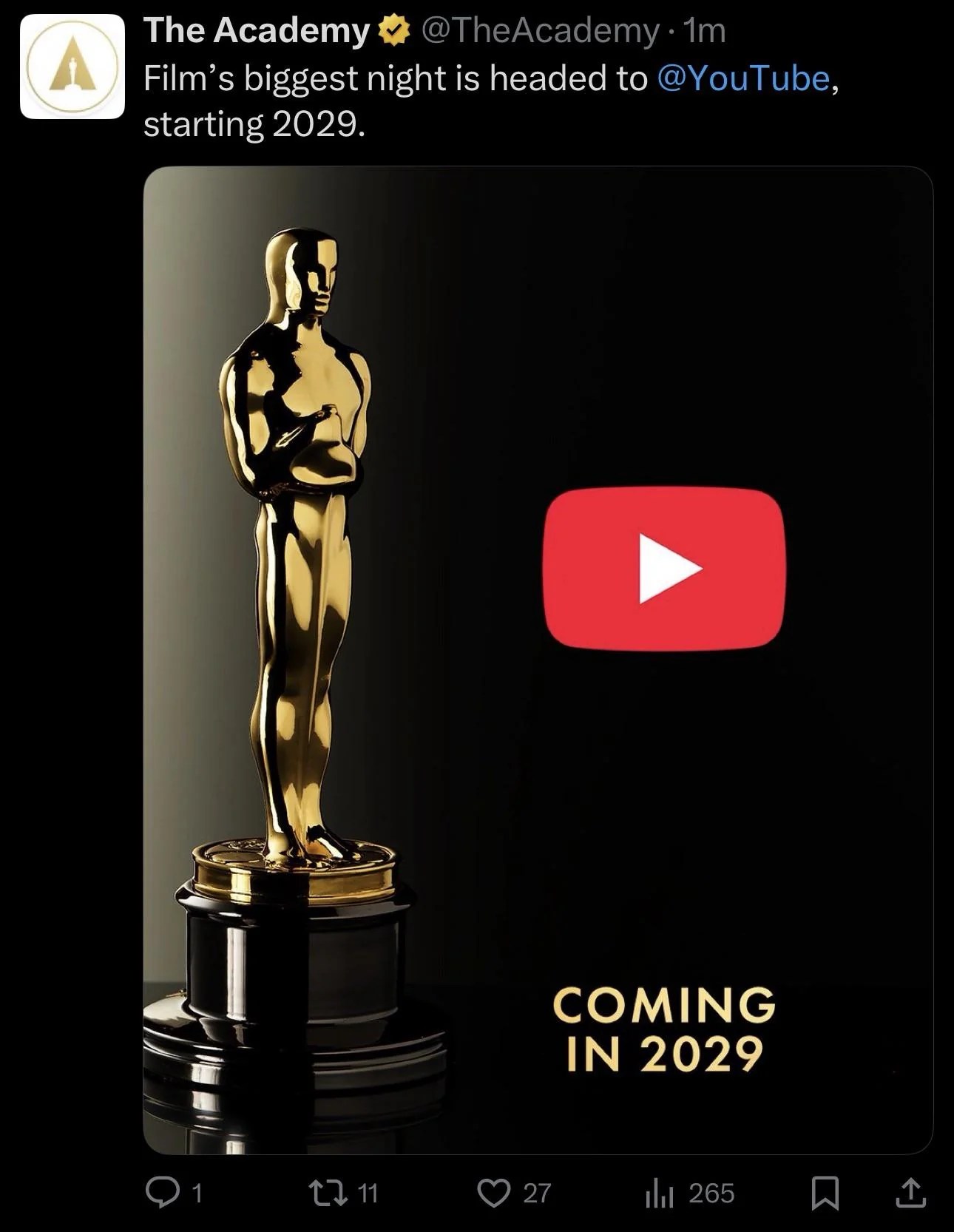
In 1929, the Academy Awards were born alongside the consolidation of cinema as the defining art form of the twentieth century. The Oscars did not merely honor motion pictures; they sanctified the big screen as a cathedral of light where stories were projected larger than life, and where audiences gathered together in reverent silence to be transformed. Nearly a century later, the announcement that the Oscars will move to YouTube in 2029 feels less like an adaptation and more like a capitulation. It’s a moment of inflection that reads, unmistakably, as a eulogy.
Anyone who has followed my work on Twitter or my blog for any length of time knows that I effectively gave up on the Oscars years ago. Even so, this announcement demands cultural analysis and reflection on its deeper implications. One needn’t be a devoted viewer of the ceremony to recognize the ongoing erosion of cinema itself; disengagement does not preclude clear sight, and distance often sharpens it.
There is a morbid irony in a ceremony created to celebrate cinema’s grand scale choosing to live on the smallest screen possible. The Oscars migrating to YouTube is not simply a platform change; it is a symbolic reversal of values. The institution that once affirmed spectacle, patience, and collective experience now aligns itself with the very medium that played a decisive role in cinema’s metaphoric death—fragmented attention, algorithmic taste-making, and content flattened into disposable scrolls. What was once king has voluntarily donned the motley of the court jester.
For decades, the Oscars functioned as a kind of cultural mass. Even when ratings declined, the ceremony retained its claim to seriousness. It insisted—sometimes stubbornly—that movies mattered, that craft mattered, that the labor of hundreds could still culminate in something worthy of ritual. To move this rite to YouTube is to concede that cinema no longer warrants ceremony at all. It is now content, indistinguishable from reaction videos, vlogs, and monetized outrage. The awards will play not to the gods of light and shadow, but to the lowest common denominator of engagement.
This decision cannot be disentangled from the broader arc traced in the manuscript on which I am presently writing Are You Still Watching? Solving the Case of the Death of Cinema, which is my followup book to Monsters, Madness, and Mayhem: Why People Love Horror releasing in October 2026. The internet did not merely change distribution; it reprogrammed desire. It replaced anticipation with immediacy, reverence with irony, and stars with personalities. The movie star—once a distant, luminous figure whose very remoteness fueled myth—has been rendered obsolete by constant access (except for you Tom Cruise–you are the last remaining movie star in the classical sense). When everyone is visible at all times, no one can remain larger than life. In this sense, the internet did not just kill the movie star; it dismantled the conditions required for stardom to exist.
The Golden Era understood something we have since forgotten: limitation creates meaning. The big screen mattered because it was rare. The theatrical experience mattered because it demanded surrender—of time, of attention, of comfort. The Oscars mattered because they crowned achievements that could not be reduced to metrics. Box office was discussed, but it did not dictate value. Craft, risk, and ambition still held currency. One cannot imagine the architects of Hollywood—those who built studios, nurtured stars, and believed in cinema as a national dream—viewing this moment without despair. The roll call of names etched into Oscar history now echoes like a rebuke.
The move to YouTube completes a long erosion. First came the shrinking theatrical window, then the dominance of streaming, then the rebranding of films as “content.” Each step was defended as pragmatic, inevitable, even democratic. Yet inevitability is often the language of surrender. By placing the Oscars on YouTube, the Academy signals that it no longer believes cinema deserves its own stage—literal or metaphorical. It accepts, finally, that movies are just another tile in the feed.
What makes this moment especially tragic is that it arrives cloaked in the rhetoric of accessibility. YouTube promises reach, youth, relevance. But to what end and at what cost? Cinema was never meant to be optimized for virality. Its power lay in duration, in immersion, in the audacity to ask audiences to sit still and feel deeply. An awards show on YouTube does not elevate cinema to the digital age; it drags cinema down to the logic of the internet, where attention is fleeting and meaning is provisional. That which is required by the desired algorithm will be that which dictates the ceremony and pageantry thereof.
And yet, this lament is not without pride. There was a time when this industry truly was an industry of dreams. When the Oscars crowned films that expanded the language of the medium. When a win could alter a career not through branding, but through trust—trust that audiences would follow artists into challenging territory. That history cannot be erased by an algorithm, even if it can be buried beneath one.
If the Oscars moving to YouTube does not signal the death of cinema, it is difficult to imagine what would. It is the final nail not because it kills something vibrant, but because it seals a coffin long prepared. What remains will continue to exist—films will still be made, awards will still be handed out—but the animating belief that cinema is a singular, communal art form has been surrendered.
The tragedy is not that the Oscars will stream on YouTube. The tragedy is that, in doing so, they admit they no longer know what they are mourning.
This loss of self-knowledge did not arrive overnight. Long before the platform shift, the ceremony began to erode its own authority through an increasing embrace of socio-political posturing by hosts and award recipients alike. What was once a night dedicated, however imperfectly, to the celebration of films, performances, and craft gradually transformed into a sequence of soapboxes. The Oscars mistook moral exhibitionism for relevance, and in doing so alienated a broad public that tuned in not for lectures, but for an affirmation that movies themselves still mattered.
This is not an argument against artists holding convictions, nor a denial that cinema has always intersected with politics. Rather, it is an indictment of a ceremony that lost the discipline to distinguish between art and advocacy. When acceptance speeches routinely overshadowed the work being honored, the implicit message was clear: the films were secondary. Viewers responded accordingly. Ratings declined not merely because of streaming competition, but because the ceremony no longer respected its own premise. Had hosts and winners remained anchored in the films—celebrating storytelling, performance, direction, and the collaborative miracle of production—the Oscars might have retained their standing as a cultural commons rather than a partisan spectacle.
In surrendering the focus on cinema itself, the Academy weakened the very case for its continued relevance.
Progress is often invoked as an unqualified good, but history suggests it is more accurately understood as an exchange—one that invariably involves loss. Sometimes that “loss” isn’t’ felt immediately, but there is inevitably some mild, moderate, or signifiant loss somewhere. Every cultural advance carries a cost, and the measure of true progress lies in whether what is gained outweighs what is surrendered. In the case of the Oscars, the pursuit of modernity, relevance, and moral signaling came at the expense of gravitas, neutrality, and shared cultural meaning. What was gained—momentary applause within narrow circles, fleeting relevance in the news cycle—proved insufficient compensation for what was lost: broad public trust, ceremonial dignity, and the sense that this night belonged to everyone who loved movies, not just those who spoke the loudest.
When institutions confuse change with improvement, they often wake to find that they have survived only in form, not in spirit.
Taken together, the Oscars decline follows a macabre logic—a ceremony founded to exalt scale, craft, and collective experience gradually surrendered its authority by de-centering movies themselves—first through moral grandstanding, then through technological appeasement, and finally through full assimilation into the internet’s attention economy. Each step was justified as necessary, inclusive, or inevitable. Yet the cumulative effect was corrosive. The Oscars did not lose relevance because audiences abandoned cinema; audiences abandoned the ceremony because it no longer stood for cinema as something distinct, demanding, and worthy of reverence.
What remains is a hollowed-out ritual, stripped of its gravitational pull, migrating to YouTube not as a bold reinvention but as an admission of defeat. The move completes the journey from cathedral to feed, from shared cultural moment to algorithmic afterthought. It confirms that the Academy has chosen survival at the cost of meaning—and in doing so, has preserved the shell of the institution while relinquishing its soul.
Gloria Swanson’s Norma Desmond, reflecting on the industry’s changing fortunes, once delivered an epitaph that now feels uncomfortably prophetic: “I am big. It’s the pictures that got small.” A century after the birth of the Oscars, her words resonate with renewed clarity. Cinema did not shrink because audiences demanded less; it shrank because its stewards accepted less.
The Oscars’ migration to the smallest screen is not progress; it’s the final confirmation that something vast, communal, and luminous has been allowed to diminish, and that what replaced it was not worth the cost. A ceremony that no longer centered movies should not be surprised when audiences stopped gathering to watch it. The move to YouTube, then, feels less like a sudden betrayal and more like the logical endpoint of a long retreat: from celebration to commentary, from reverence to rhetoric, from a shared night at the movies to just another argument in the feed.
Ryan is the general manager for 90.7 WKGC Public Media and host of the show ReelTalk “where you can join the cinematic conversations frame by frame each week.” Additionally, he is the author of the upcoming film studies book titled Monsters, Madness, and Mayhem: Why People Love Horror. After teaching film studies for over eight years at the University of Tampa, he transitioned from the classroom to public media. He is a member of the Critics Association of Central Florida and Indie Film Critics of America. If you like this article, check out the others and FOLLOW this blog! Follow him on Twitter: RLTerry1 and LetterBoxd: RLTerry
40 Years Later, It’s Still One of the Smartest Comedies Ever Made From One of the Dumbest Possible Premises.
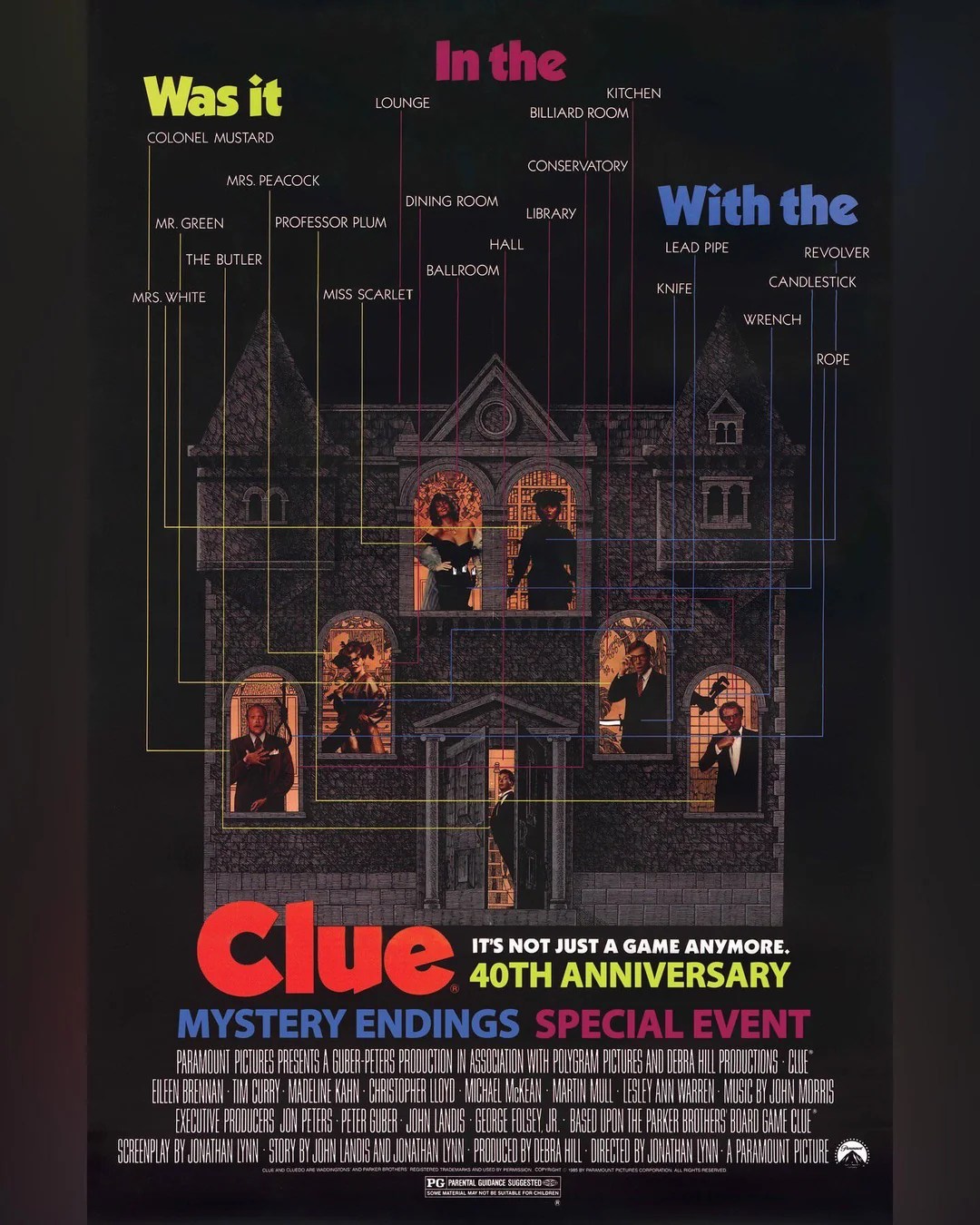
Clue (1985) somehow caught lightning in a bottle, and has held onto it for four decade; this same lightning was then shaken and thrown against the silver screen in the most delightfully chaotic ways imaginable. Forty years later, this all-star murder mystery based on the classic boardgame remains sharper, funnier, and more lovingly crafted than most prestige comedies released today. What should have been a disposable novelty became a masterpiece of comedic architecture, tonal discipline, and ensemble chemistry. I first discovered it on VHS from my local public library, and even then I knew I had stumbled onto something special. My sister loves it as much as I do. It’s a movie that works on you—and then keeps working every time you revisit it.
For my show ReelTalk on WKGC Public Media this week, I invited returning guest and friend of the show, film critic Sean Boelman to join me in our celebration of Clue‘s 40th anniversary. You can listen to the show by clicking the appropriate link below. While my article captures the highlights of what Sean and I discuss, listening to the show after reading the article, you’ll have a much more robust experience!
At its core, Clue commits fully to three things most comedic mysteries never attempt at the same time: total absurdity, airtight plotting, and theatrical precision. Most films in the genre pick one lane—either slapstick, or clever mystery, or witty farce—but Clue weaves them together with an elegance that belies how frantic the movie feels moment to moment. Unlike many modern adaptations drowning in CGI, brand synergy, or self-aware winking, Clue treats its ludicrous premise with the sincere craftsmanship of an Agatha Christie play–yet–Clue’s apparatus is actually more closely related to the boardgame play than to the typical Christie literary apparatus. The humor is character-driven, rooted in rhythm, timing, and razor-sharp verbal dexterity. That sincerity, combined with its unhinged heart, is why the film remains timeless.
Much of Clue’s durability stems from how it uses language as a weapon. This is not a movie relying on boardgame nostalgia or shallow references; it is powered by dense wordplay, screwball pacing, and overlapping exchanges that feel plucked from a stage farce running at espresso speed. Every performer is asked to treat their lines with theatrical precision. The jokes arrive in layers, often stacked on top of each other, rewarding audiences who pay attention and enhancing the comedy with every rewatch. By grounding the absurdity in craft—rather than irony—the film avoids collapsing into randomness. It feels smart, not silly; intentional, not accidental. Humor this tightly constructed simply does not age.
Another reason the film works: it respects the genre it’s parodying. Clue doesn’t mock murder mysteries from a distance. It commits to the melodrama, the red herrings, the stakes—even as it gleefully skewers them. Parody only works when sincerity lies beneath the joke. Modern adaptations often fail because they either drown in self-awareness or cling to seriousness so tightly the comedy feels bolted on. Clue threads the needle by honoring the mechanics of a whodunit while joyfully stretching them to the breaking point. It loves the sandbox it’s playing in, and the audience can feel that affection.
Of course, the film’s most unforgettable asset is its ensemble cast, which may be one of the best comedic troupes ever assembled on screen. These are character actors trained in theater, sketch, and improv—who understand timing and ensemble harmony better than any star-studded ensemble today. Tim Curry’s manic precision, Madeline Kahn’s volcanic eccentricity, Michael McKean’s brilliant awkwardness, Lesley Ann Warren’s slinky aloofness—every actor is distinct, yet completely in tune with the film’s wavelength. No one competes for the spotlight; instead, every moment becomes a relay race of comedic energy. Modern ensemble films often feel like stitched-together “bits.” Clue feels alive, reactive, and musical. It is an ensemble in the purest sense.
And then, of course, there are the multiple endings—a theatrical gamble so audacious it could have sunk the film entirely. Instead, it became an iconic part of its identity. In 1985, you never knew which ending you’d get in theaters, a cheeky nod to the board game’s replayability. Instead of feeling gimmicky, it felt organic to the world of the film—a natural extension of its playful tone and farcical structure. Today, a studio would almost certainly turn the idea into a marketing ploy or streaming bonus feature, but in Clue, the endings are crafted with sincerity and precision, not cynicism. They’re not content strategy; they’re punchlines.
The film’s simplicity is another key to its longevity. Where modern game adaptations inflate themselves into lore-heavy franchises, Clue keeps everything contained in one house with one group of increasingly frantic characters. The mansion becomes a pressure cooker where personality collisions become the main spectacle. No elaborate world-building, no digital spectacle—just smart writing, sharp performances, and a commitment to letting the humor build naturally. The film’s scale is its strength.
Would Clue still find an audience today? Absolutely—although probably through a different path. Theatrical comedy has become a rare species, and a film this verbally dense might struggle to secure screen space. But word of mouth would spread like wildfire, and social media would turn its most quotable lines into instant memes. If anything, its intelligence, compact scope, and genuine ensemble work would feel refreshingly rebellious in today’s IP-heavy landscape.
What ultimately makes Clue endlessly rewatchable—more than contemporaries like Knives Out—is that it’s a comedy first and a mystery second. The joy doesn’t hinge on solving the puzzle; it hinges on watching these characters unravel in the most glorious fashion. Puzzles fade with familiarity. Brilliant performances only deepen. The more you watch Clue, the funnier it becomes.
So what is Clue’s greatest legacy? It proved something rare: that a film can be wildly silly and intellectually sharp at the same time. It’s a miracle of tonal balance, ensemble synchronicity, and writerly discipline. A movie that treats its audience with respect even as it descends into delightful chaos. A movie that should have been forgotten…yet became unforgettable.
Forty years later, Clue remains the gold standard—not because it adapts a board game faithfully, but because it transcends one. It is lightning in a bottle. And every time we open that bottle, the spark still flies.
Ryan is the general manager for 90.7 WKGC Public Media and host of the show ReelTalk “where you can join the cinematic conversations frame by frame each week.” Additionally, he is the author of the upcoming film studies book titled Monsters, Madness, and Mayhem: Why People Love Horror. After teaching film studies for over eight years at the University of Tampa, he transitioned from the classroom to public media. He is a member of the Critics Association of Central Florida and Indie Film Critics of America. If you like this article, check out the others and FOLLOW this blog! Follow him on Twitter: RLTerry1 and LetterBoxd: RLTerry
Some movies soar on broomsticks; this one never quite gets off the ground.
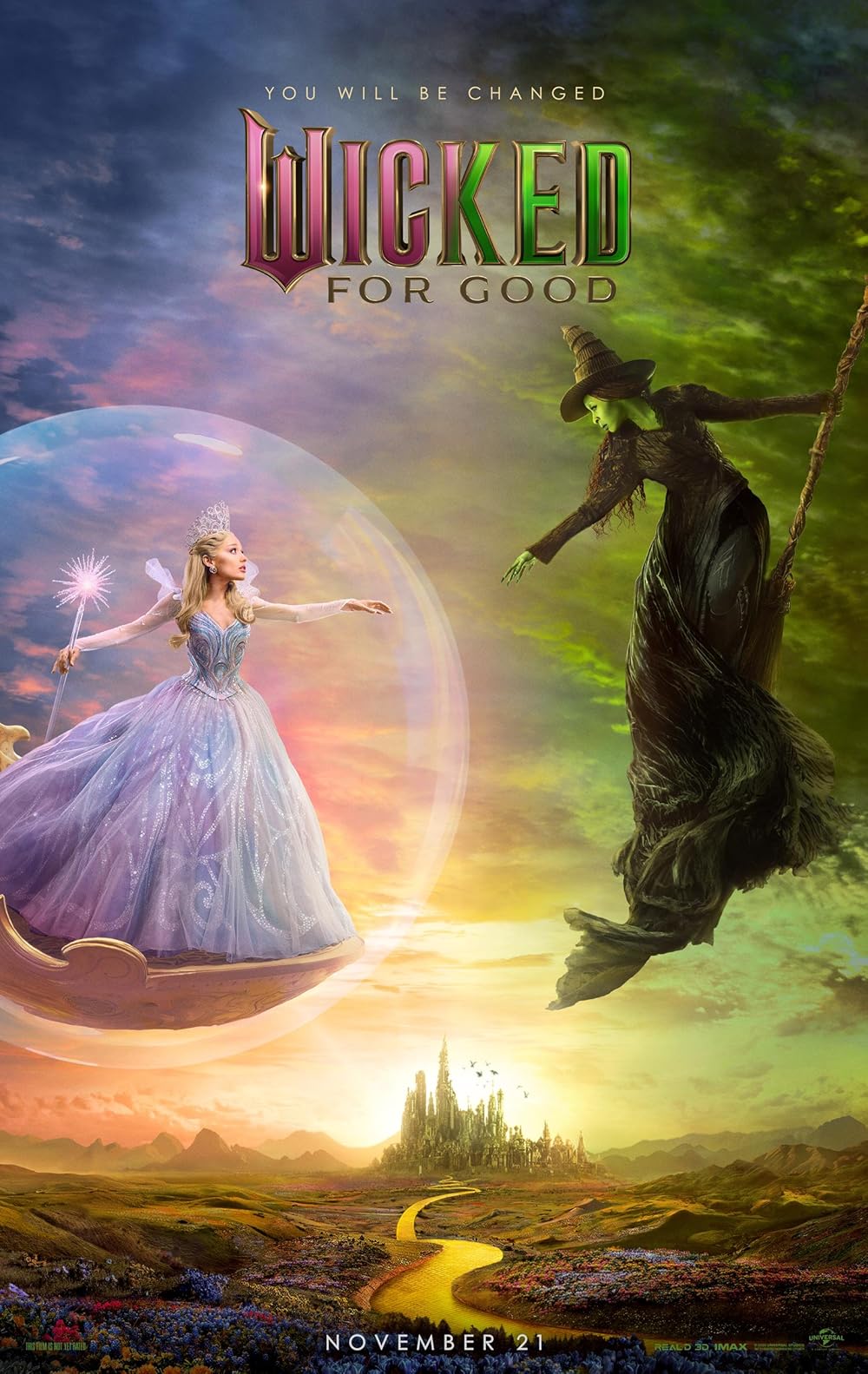
Wicked: For Good arrives with sky-high expectations, a beloved Broadway pedigree, and a cinematic world forever shaped by the 1939 Wizard of Oz. And while the heart for the material is undeniably present—director Jon M. Chu’s affection radiates through nearly every frame—the execution is fraught with problems that prevent the film from casting the spell it so eagerly attempts. It’s a movie overloaded with spectacle yet starved of narrative discipline, regrettably proving that sometimes a production can have all the right ingredients and still mix the potion incorrectly. There’s no question Jon M. Chu loves this material—his enthusiasm is evident. But passion alone isn’t enough. The film desperately needed stronger producing and organizational forces to ground the project, refine its pacing, and balance its emotional register. Instead, we get a production that feels at once over-managed and under-shaped.
Now demonized as the Wicked Witch of the West, Elphaba lives in exile in the Ozian forest, while Glinda resides at the palace in Emerald City, reveling in the perks of fame and popularity. As an angry mob rises against the Wicked Witch, she’ll need to reunite with Glinda to transform herself, and all of Oz, for good.
The most glaring issue in this movie is the pacing. This story never needed to be two movies. One Broadway show, one complete screen adaptation—simple math. Instead, Wicked and Wicked: For Good, collectively, feel like a single narrative forcibly stretched and compressed simultaneously. Scenes either end abruptly or linger with self-importance, giving the whole film a stop-and-start rhythm that betrays any emotional momentum. Moments that should breathe are suffocated, while others that should be tightened sprawl endlessly. Narratively, the film leans heavily on contrivances rather than character and plot development. Plot turns feel telegraphed or unearned, creating a sense that events are happening because the script demands it—not because the characters have earned the journey. Emotional beats are pushed rather than developed; the film tugs at heartstrings it hasn’t taken the time to weave. Many sequences feel manipulative instead of meaningful, leaving the viewer aware of the strings being pulled rather than swept up in the melody.
The film maintains the emotional equivalent of flooring the accelerator from beginning to end. Everything is heightened, everything is urgent, everything is presented at maximum volume. Without quieter resets, the story becomes exhausting rather than exhilarating. The lack of modulation leaves little room for nuance, making even potentially impactful moments blur together into one extended crescendo.
And then there’s the Oz problem itself–it was bad enough in the first movie, but this one amplifies all the flaws in this picture. From the opening Universal logo and Wicked title card, both stylized to resemble their 1930s counterparts, it’s clear the film wants to position itself adjacent to the classic Wizard of Oz. (And yes, I am aware that the Broadway show is based on books and not the 1939 classic, but this is a screen adaptation that is going to by default be connected spiritually and literally to the events, imagery, and characterizations of the original movie, but I digress). Whenever Wicked intersects with that iconic imagery, the visual and narrative disconnect is jarring. Tonally, textually, and aesthetically, nothing matches. Two of the most egregious examples are the Wicked Witch of the West’s castle, a location fundamentally misaligned with its 1939 counterpart in both history and design, and Glinda’s bubble. Hello??? She is clearly a magical being and travels by a magical bubble. To rob her of those elements is to rob her original characterization. For a film so eager to evoke some level of nostalgia, its disregard for consistency with cinema’s most beloved fantasy feels baffling.
The editing is among the film’s most distracting flaws—awkwardly timed transitions, uneven scene construction, and moments that feel spliced for convenience rather than cohesion. The cinematography dazzles with color and movement but contributes little to storytelling. It’s all flash, no narrative substance: beautiful images that ultimately amount to little more than digital confetti. And we cannot talk editing without addressing teh cringe CGI–the kind of digital spectacle that feels less like movie magic and more like a rough animatic accidentally exported at full resolution. Emerald City looks less like a tangible place and more like a high-end screensaver—everything polished to a rubbery sheen, with no texture, grit, or atmospheric depth. Characters often appear detached from their surroundings, as if composited into a digital diorama rather than inhabiting a lived-in world. Instead of mixing practical sets with digital enhancements, the film leans heavily on full-CG environments and even characters, resulting in octane-fueled and intimate moments feeling artificial. It’s like looking upon a world of fantasy that feels more like a giant animated backdrop with actors placed within versus a world that feels tangible.
Not even the presence of Michelle Yeoh is enough to elevate the film’s sense of class or gravitas. Although, it’s hard to blame her, given that she’s phoning in a performance built on scraps of narrative substance. In this second installment, her character is little more than an ornament of prestige, offering neither meaningful development nor any real impact on the story. Jeff Goldblum, likewise, delivers a surprisingly muted turn, coasting on his trademark charisma without ever fully engaging. When two performers known for commanding the screen seem this disengaged, it speaks less to their abilities and more to a film that gives them virtually nothing with which to work.
Wicked: For Good reaches for greatness but ultimately fails to stick the landing. It’s a film overflowing with heart yet undercut by structural missteps, contrived plotting, mismatched continuity, and a visual approach that prizes spectacle over substance. For a story about defying gravity, it’s ironic that this adaptation never quite lifts off the ground.
Ryan is the general manager for 90.7 WKGC Public Media and host of the show ReelTalk “where you can join the cinematic conversations frame by frame each week.” Additionally, he is the author of the upcoming film studies book titled Monsters, Madness, and Mayhem: Why People Love Horror. After teaching film studies for over eight years at the University of Tampa, he transitioned from the classroom to public media. He is a member of the Critics Association of Central Florida and Indie Film Critics of America. If you like this article, check out the others and FOLLOW this blog! Follow him on Twitter: RLTerry1 and LetterBoxd: RLTerry

 R.L. Terry ReelView