The real magic is in how this movie made it past opening night.
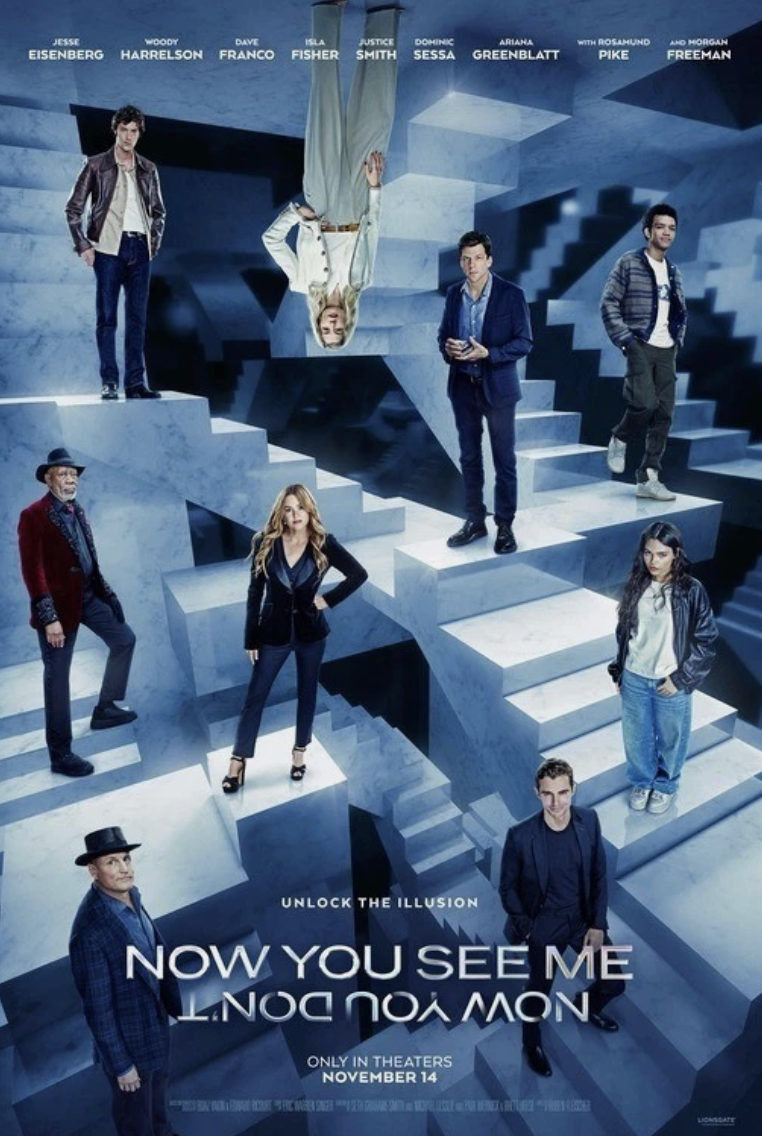
“He was an illusionist…he wasn’t a very good illusionist.” Although that comedic line is delivered by Madeline Kahn in CLUE (1985), it seems rather fitting for the tertiary installment in the Now You See Me series. Now You See Me: Now You Don’t is a cinematic magic trick without magic—an illusion performed with all the spectacle of a streaming-original and none of the wonder that made the first film such a delightful surprise. What should have been a clever caper wrapped in misdirection, sleight of hand, and showmanship instead plays like an inflated pilot episode for a franchise desperate to convince us it still has something up its sleeve.
The Four Horsemen and a new generation of illusionists try to bring down a worldwide criminal network.
Let’s begin with the one element that is genuinely spellbinding: the château sequence of scenes. The production design on display here is fantastic—one of the best production designs of the year. Every room, corridor, and shadow-drenched chamber seems crafted with the meticulous eye of an artisan. Sadly, aside from the technical achievement, this setting is little more than a backdrop to the action within its labyrinthine corridors. In another movie, this location could have been a character unto itself; here, it’s little more than an exceptionally beautiful stage for an otherwise uninspired performance. Still, credit where is due: the château alone might be the only reason this movie deserves to be seen anywhere larger than a laptop screen.
The returning cast—those legacy performers who anchored the earlier installments—slip back into their roles with charm and chemistry. Harrelson always delivers an entertaining performance–ever since his days on Cheers. The rapport between the legacy cast is believable–a once-close group of friends that hasn’t seen one another in a decade, even if the screenplay material underserves them. And yes, Morgan Freeman’s cameo is a genuine delight, a sprinkle of prestige the film desperately needed. But not even Freeman can pull a rabbit out of this hat.
Unfortunately, the three new teenage cast members derail what little fun the film attempts to muster. Obnoxious, self-righteous, and utterly allergic to accountability, they embody the worst tendencies of modern franchise youthification. The film props them up as the only ones who can “fix the world,” all while they display a profound lack of understanding of that very world’s complexities. It’s a toxic ideological cocktail—one part hubris, one part naïveté, shaken vigorously and served without nuance. Their presence doesn’t invigorate the franchise; it infantilizes it.
An overview of the plotting reveals that Now You Don’t contains more holes and narrative gaps than those the O.J. jury was willing to ignore. Motivations shift without cause, twists are telegraphed from miles away, and the screenplay is so preoccupied with its social commentary that it forgets to construct a believable story around it. The message—about the wealthy exploiting the poor—is noble in theory but executed with such superficiality that it borders on parody. It’s activism-by-template, the cinematic equivalent of most “thoughts and prayers” tweets.
Worse, the film contains no meaningful tension. It coasts on comic-book logic without embracing the fun of comic-book storytelling. Stakes evaporate. Consequences vanish. Nearly every set piece feels contrived rather than orchestrated. Magic, by its nature, requires misdirection, timing, and a suspension of disbelief; this film offers none of those. What should have been a thrilling high-wire act is instead a leisurely stroll with training wheels–or perhaps a trite-cycle of a movie.
Now You See Me: Now You Don’t is a movie that wants to dazzle but barely flickers. It lacks cinematic gravitas, emotional investment, and narrative cohesion. And much like a forgettable card trick, it should ultimately disappear from cinemas—preferably before anyone attempts to resurrect this franchise again. It’s time to vanish.
Ryan is the general manager for 90.7 WKGC Public Media and host of the show ReelTalk “where you can join the cinematic conversations frame by frame each week.” Additionally, he is the author of the upcoming film studies book titled Monsters, Madness, and Mayhem: Why People Love Horror. After teaching film studies for over eight years at the University of Tampa, he transitioned from the classroom to public media. He is a member of the Critics Association of Central Florida and Indie Film Critics of America. If you like this article, check out the others and FOLLOW this blog! Follow him on Twitter: RLTerry1 and LetterBoxd: RLTerry


 R.L. Terry ReelView