CLUE: LIVE ON STAGE play review

“I. Am. Your singing telegram (POW!)” here to tell you that you do not want to miss the hilarious hijinks of CLUE: Live on Stage! It successfully channels the film whilst crafting a new experience. And yes, all the iconic, quotable lines and slapstick moments are in the show!! It’s a laugh out loud riot that will uplift the human spirit!

Playing the Straz Center in Tampa now through June 2nd.

Designed for fans of the cult classic, complete with all the camp, but can still be appreciated by all! This stage adaptation of the beloved star-studded film owes its success to the playwriting that retained the soul and memorable moments of the film yet injected new dialogue, scenes, comedic irony, and physical comedy that together craft a familiar yet fresh experience. From the moment the play opens with the original theme music, you know that you will be in for an uplifting time at the theatre. Some stage adaptations of films neglect to include so much of what makes their respective film source beloved, such as the score, quotable lines, or slapstick humor; not true with CLUE. This is one of the best stage adaptations of a film that I have ever witnessed.

One of the subtle strengths of the playwriting is the inclusion of some meta humor such as characters carrying around the original board game detective notepads and even the game board. Other elements that elevate the meta humor of the play include musical cues and slight fourth wall breaking as if to nod to the audience that “we know you know.” The stage design is fantastic! Every inch of space is used efficiently and effectively to achieve the feeling of a vast mansion on a single stage. Furthermore, the design retains that beautifully gothic atmosphere that we associate with the iconic board game and campy film.

With such great cast/character chemistry in the film, I was curious if this adaptation would be able to capture even half of the magic. It pleases me to report that the cast’s chemistry is fantastic! And while they certainly recreate notable moments from the film, each of them puts their own spin on the expression of those moments. From “Let us out, let us out; let us in, let us in” to “Fla, fla, flames, flames on the side of my face” to “I. Am. Your singing telegram,” all those memorable moments are part of the stage production!

And if you were curious if the multiple endings from the film are included, that they are! But, the solution(s) are different than the film, so don’t think that you have it figured out. Even this faithful adaptation throws curve balls that will keep you on the edge of your seat.

I had such an incredibly enjoyable time with this play, and I know you will too. CLUE: Live on Stage is currently touring the country, so look for a showing near you! CLUE is playing the Straz Center in Tampa now through June 2nd, but checkout the CLUE website for when it will be touring in your area.

Ryan teaches Film Studies and Screenwriting at the University of Tampa and is a member of the Critics Association of Central Florida and Indie Film Critics of America. If you like this article, check out the others and FOLLOW this blog! Interested in Ryan making a guest appearance on your podcast or contributing to your website? Send him a DM on Twitter. If you’re ever in Tampa or Orlando, feel free to catch a movie with him.

Follow him on Twitter: RLTerry1 and LetterBoxd: RLTerry

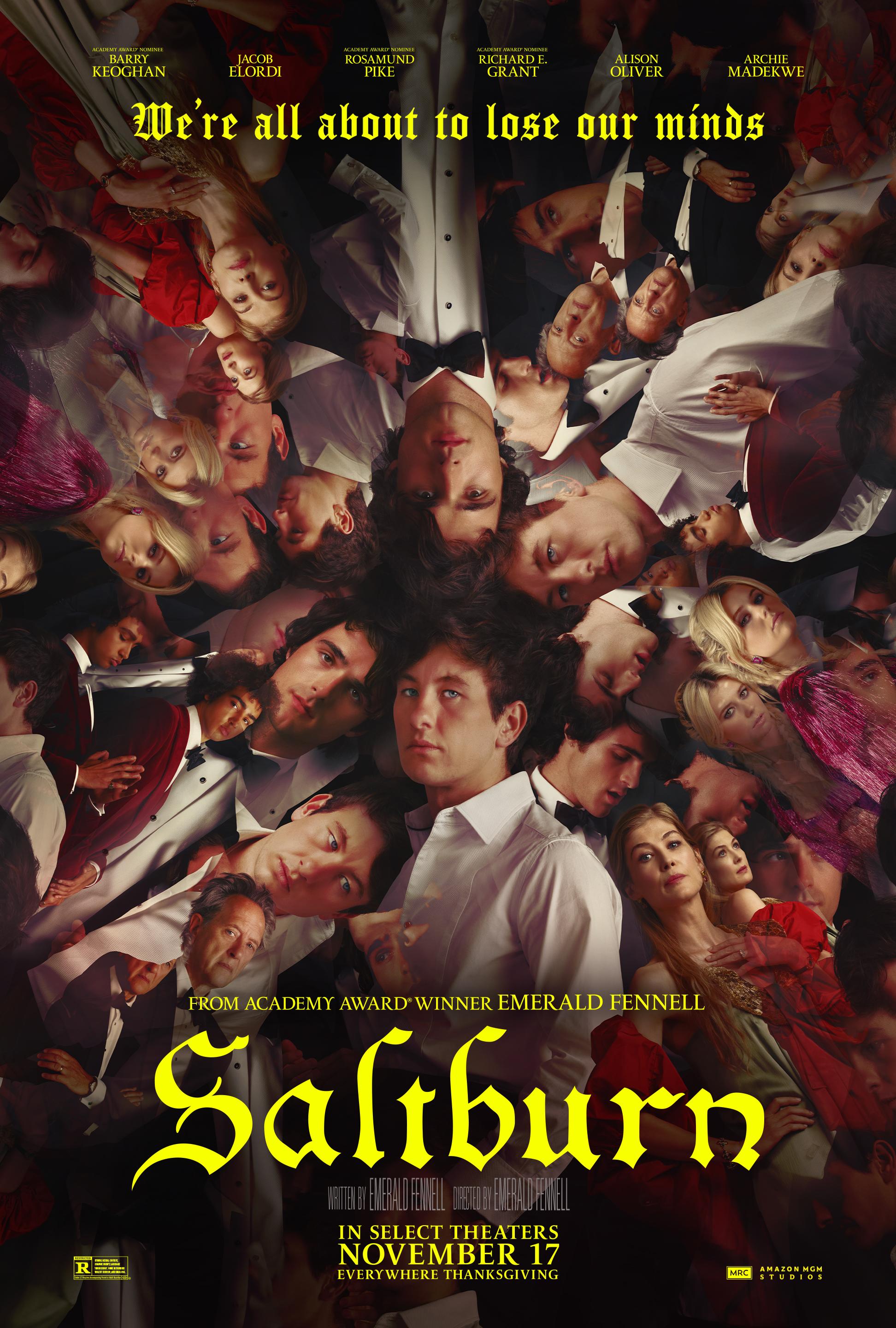
SALTBURN film review

An intoxicating and provocative neo-gothic film that is tonally all over the place. Heathers meets Cruel Intentions meets Flashdance(?) in a film that is incredibly stylistic but lacks any lasting entertainment value, except for the very end. Emerald Fennel (Promising Young Woman) delivers a sensory explosion critique on the facades we project through a story of the shifting balances of power, obsession, and deception. Is it a dark comedy? Is it a psychological thriller? Answer: it’s both and neither, and to that end, it’s potential for motion picture excellence is hampered. The tone of the film is incredibly uneven; and not one single character is likable. Saltburn presented many opportunities for effective, intentional camp, but chose to go the more serious route and play it straight.

Oliver (Barry Keoghan), a freshman at Oxford, is invited by classmate Felix’s (Jacob Elordi) family’s country estate for an exciting summer, but things are not what they seem and soon the fantastical estate falls victim to deception and manipulation.

The aforementioned movie examples in the opening paragraph each feature an aspect of this film; but each of those three examples offers a great deal more in entertainment value, not to mention lasting impact upon popular culture. Even though the central character’s external goal doesn’t become clear until the end, it is a thoughtfully plotted film that you wish you had enjoyed more in order to watch it again. However, the very last scene of the film is one that takes direct inspiration from Flashdance, and will be what is likely talked about for years to come. Too bad the rest of the film wasn’t as fun and entertaining as the final scene. Saltburn is neither an uplifting story nor is it a cautionary tale; it’s uncomfortably somewhere in the middle.

Clearly Emerald Fennell has a fantastic eye for shot composition and a demonstrable talent for crafting environments that stimulate the senses and emote. And that is to be commended. Few directors have a gift for creating and capturing settings and environments that communicate a discernible mood, tone, or emotion. We witness this in German Expressionism, which is at the root of gothic and many horror films. No surprise then that this film is incredibly neo-gothic in story and setting. Saltburn embodies uses both the technical and performative dimensions of the mise-en-scene to challenge audience perceptions; moreover, gothic films concern themselves with sexuality and audience response thereto. The collective imagery in this film generate a kind of spectacle for the audience to draw us into a heightened state of unease or fear. Fennell’s Saltburn is an exemplary motion picture for the art of drawing the audience into the world inhabited by the characters, and beckons you to join them.

Sounds great, right? If there were any characters worth caring about, then Saltburn could indeed be the masterpiece that many have claimed it to be. Fennell nailed the neo-gothic aesthetic and further stimulated our senses with the film’s intoxicating sexuality, but there isn’t a single character that you care enough about whether they live or die. These characters will both attract and repulse you, but more repulsive than attractive. No doubt that Oliver will become the stuff of erotic fan fiction and dreams, but even he isn’t likable in the end. And when delivering a melodrama about facades, pretenses, obsession, and deception, whether the film ends on a high or low note, there should always be at least one character the audience can root for, can truly care whether they live or die.

The story of Saltburn is inspired by the narratives of both Heathers and Cruel Intentions. And I don’t mention this to in any way suggest that Saltburn is derivative–it’s not–but to draw parallels to similar films. While I feel that both of these movies are much more rewatchable than Saltburn, if you like those two movies, you will likely enjoy it, even if you watch it one time. Where Heathers and Cruel Intentions succeed and Saltburn fails is in the entertainment value and tonal consistency. It’s as if Fennell was so concerned with provoking and sensually stimulating the audience that she forgot that the film should still be entertaining. Just because a film contains dark comedy or scathing social commentary doesn’t mean that it’s excused from providing entertainment for the audience.

What I will remember most is the ending of the film, which I cannot talk much about because of spoilers; however, I know that Fennell must love Flashdance because the final scene of the film is clearly inspired by the audition and triumph scene when Alex (and the dancers portraying her, haha) dance to Flashdance…What a Feeling! by the late Irene Cara. Even though we love Flashdance, we all know the plot is honestly not very good, but what saves the movie that literally defined the music, dance, and fashion of the 1980s is the uplifting, inspirational story and the high degree of entertainment value, not to mention one of the best jukebox soundtracks of all time (it won both an Oscar and Grammy for best original song).

Even though the tone may be inconsistent and characters unlikeable, the film certainly delivers on immersive atmosphere and a spider-like web of deception and manipulation with a great cast.

Ryan teaches Film Studies and Screenwriting at the University of Tampa and is a member of the Critics Association of Central Florida and Indie Film Critics of America. If you like this article, check out the others and FOLLOW this blog! Interested in Ryan making a guest appearance on your podcast or contributing to your website? Send him a DM on Twitter. If you’re ever in Tampa or Orlando, feel free to catch a movie with him.

Follow him on Twitter: RLTerry1 and LetterBoxd: RLTerry

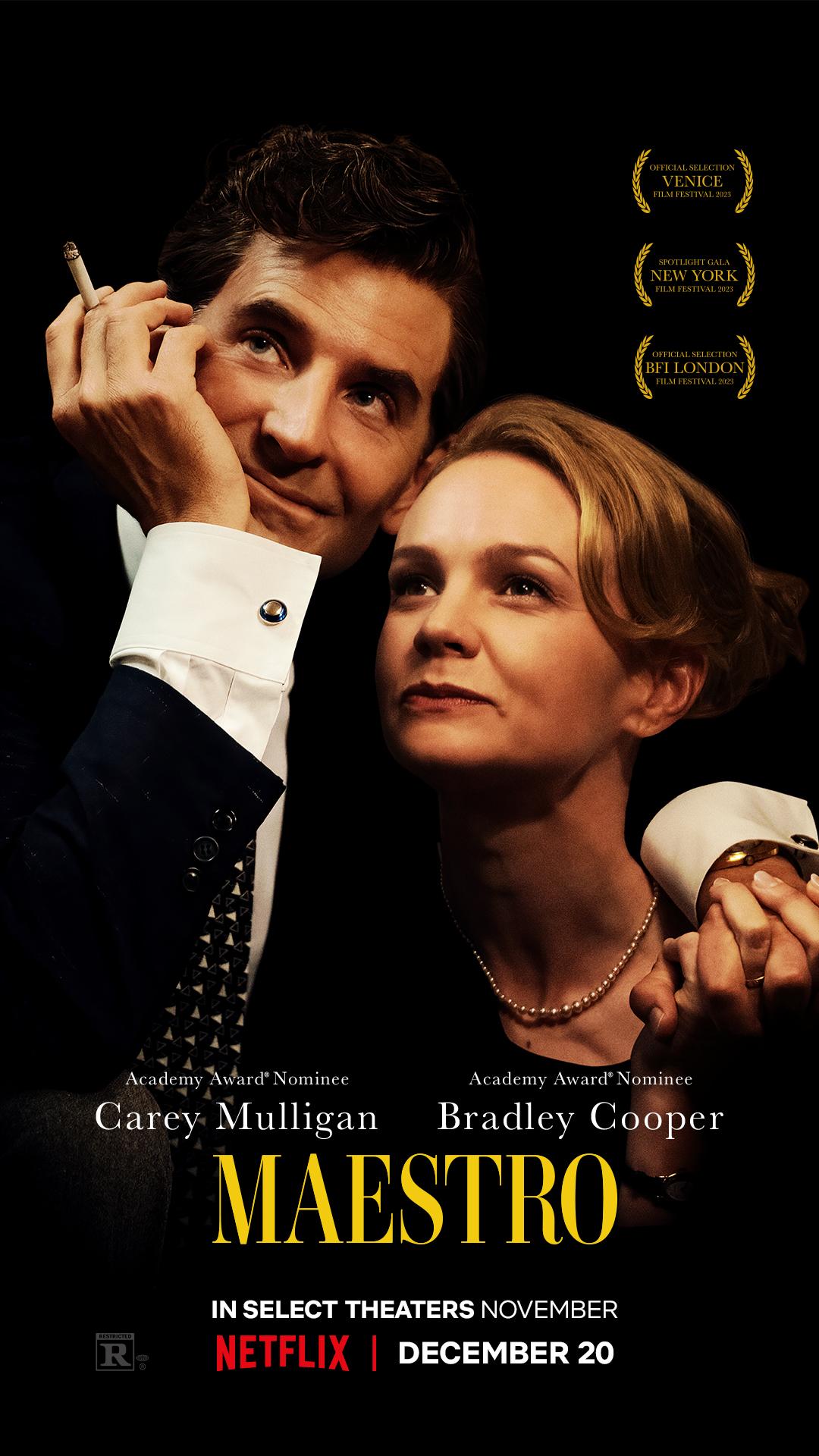
MAESTRO film review

Maestro‘s reach exceeds its grasp. Bradley Cooper’s biopic on Leonard Bernstein is an exemplary motion picture in many respects, but ultimately its potential for excellence is hampered by a disjointed screenplay. The performative dimension of the film is impressive, as is the emotive apparatus of the film itself. Furthermore, Cooper’s talent for the director’s chair is witnessed beautifully in most areas of the film except for the storytelling mechanics–not the story itself–but rather how the story is told. Another example of the dangers of being both writer and director (and in this case producer too). Most films need the checks and balances that come from having a different individual at the helm of writing, directing, and producing. If most of what you know of Bernstein’s legendary career comes from West Side Story, then you should read up on his accomplishments prior to watching the film, as it feels very inside baseball. There is a great story in this film, but the screenwriting mechanics hold it back from being truly outstanding.

Maestro tells the complex love story of Leonard and Felicia, a story that spans over 30 years-from the time they met in 1946 at a party and continuing through two engagements. It also chronicles the prolific and influential career of one of the greatest composers and conductors in American history.

The most striking dimension of the film is the apparatus of the film itself, the mechanics employed to visually craft the method of telling this story. The film starts in then-present day with an on-camera interview in color and widescreen, then as the film jumps back to the 1940s, it changes to a 4:3 ratio and is in grayscale (with a blue tint). As the story unfolds, the film transitions from 4:3 grayscale to 4:3 color to eventually 16:9 (if you will) color. To the casual observer, this was to signify time jumps alone–and to stop there would be limiting the art and affects of this tool. More than signifying chronology, it was used to spotlight the emotive dimension of the film as it evolves (or devolves, depending on how you look at it) from an old Hollywood conventional romance to post-modern subversive romance.

Bernstein goes from being in love with people to being in love with his music, but always in need of muses and people around him. He was almost never alone–he was scared of being alone. The irony in that is he simultaneously brought people together with his music but drove them away because his first love was his music. Beyond the montage of the film, this emotive apparatus incudes a complete score by Bernstein, and the inclusion of Bernstein’s music to accompany audiences along this journey was a brilliant choice to increase the intimacy of the story for audiences both familiar and unfamiliar with his library of compositions. Cooper’s use of a cinematic storytelling apparatus such as this, elevated mere storytelling montage for cause/effect chronology to that which communicates emotion and introspection.

Both Bradley Cooper and Carey Mulligan shine in their respective roles; moreover, Mulligan’s Felicia Montealegre-Bernstein is truly the heart and soul of this film. Not mere impersonations, both Cooper and Mulligan completely transform into the real-life characters they are portraying. The performances were so incredibly intimate and personal that the authenticity leaped off the screen. When they hurt, we hurt, and when they were joyous, we were joyous. While Leonard is the title role, the character with whom most in the audience will identify is Felicia. She is the conduit through which we experience most of this biopic. Furthermore, she is the character that feel the most human, because Leonard’s level of talent was so out-of-the-world that it is hard to connect with him to the same degree most in the audience connect with the unconventional romance of Felicia and Leonard.

On a more personal note, I found myself connecting with Leonard the most because there is a line from Bernstein in the movie that goes something to the effect of (and I am paraphrasing) “I am so many things, but society only wants me to be one thing. I cannot be that one thing because I am all these things, and to not be any one of them would be to deny who I am.” Despite the fact I feel that Cooper is as much a screenwriter as Sorkin is a director, this line is representative of the central theme in the film and one with which I identify greatly. For I too am so many things, but society wants me to pick (and be successful) at just one of them, but I cannot because I am all these things. I am a professor, academic writer, event planner, film critic, and public speaker. For me to not do any one of these things would be to deny who I am. On that level, this film felt incredibly personal.

With all these wonderful elements going for this motion picture, the film’s reach exceeds its grasp due to the disjointed screenwriting. I’ve said it before, and I will say it again, most directors are not screenwriters (and the inverse is also true). Very few writer-directors can do both jobs equally well. If for no other reason, a film built upon a writer-director lacks sufficient checks and balances to ensure the narrative mechanics are adequate for translating a story from the mind of a screenwriter to the screen of a director. And this is where I draw the inside baseball analogy I mentioned earlier. The full potential of this film requires audiences to be knowledgable in the career of Bernstein beyond West Side Story and Our Town.

The screenplay fails to start on common ground before its deep dive into the career and romances of Bernstein. For example, unless you are a student of music, it is doubtful that you were aware of his work outside of West Side Story and Our Town. Therefore, since that is most people, the screenplay should have established a common connection between Bernstein’s work and general audience members early on in the film. Then, once common ground was established, take audiences on the journey through his personal and professional life. His contributions to Broadway are little more than one-off mentions during the film. The pacing of the story also plagues the film as it provides few, if any, transitional scenes and simply jumps from time period to time period. The stylized editing and cinematography mentioned earlier in the review help to communicate chronology, but there is more to telling a biographical story than time and place.

Alfred Hitchcock stated to start every scene in a film as close to the end of the scene as possible and end the scene as soon as possible all while ensuring that something dramatic happens at the end of the scene (in screenwriting terms a button) that sets up the proceeding scene. Nothing should happen in scene B that wasn’t setup in scene A and every scene should in some way point to the end of the film. It is basic screenwriting conventions that are ignored in hopes that the stylistic apparatus and performative dimensions of the film will make up for the lack of care in the how the story is being told. Screenwriting is more than a narrative to be delivered on the silver screen, it’s more than dramatize don’t tell, it’s all of that plus how story is being told even before the first shot is filmed. Screenwriting mechanics (inclusive of conventions and guidelines) are important because they work.

Bradley Cooper’s Maestro is a beautiful-looking motion picture that attempts to capture the gravitas of the professional and personal life of one of the greatest composers and conductors in American history. While it’s no Amadeus or Mr. Holland’s Opus, it is a solid film that students and fans of his career will thoroughly enjoy. For those that may only know him from his contributions to Broadway, the film will still be interesting enough, but may not be as impactful without more in-depth knowledge of his career and life.

Ryan teaches Film Studies and Screenwriting at the University of Tampa and is a member of the Critics Association of Central Florida and Indie Film Critics of America. If you like this article, check out the others and FOLLOW this blog! Interested in Ryan making a guest appearance on your podcast or contributing to your website? Send him a DM on Twitter. If you’re ever in Tampa or Orlando, feel free to catch a movie with him.

Follow him on Twitter: RLTerry1 and LetterBoxd: RLTerry

AMERICA’S HEART PROBLEM

As I look over the major events in our country over the last couple of years, I am left with one question: What does it mean to be human?

And what does that have to do with the ideologically polarized time in which we find ourselves, you may ask? EVERYTHING.

Studying and teaching film has its benefits way beyond cinematic critical analysis. Since film is a reflection of life, we can learn a lot about a people by analyzing motion picture art. Granted, much of what we study in film is in retrospect, but these same approaches can be used to study current trends in storytelling media, which often parallel events in real life.

For example, my area of expertise is the American Horror Film, and as I wrote in the chapter on horror cinema of the 1970s, in my forthcoming book Why Horror?, I found the parallels between 1970s America shockingly similar to 2020s America. From the fights over abortion to inflation to civil rights to the rise of the new right and new left, much of what we are experiencing now can trace its roots back to the chaos of the 1970s.

But I digress.

What does it mean to be human? 

Everything we are facing in our tumultuous socio-political landscape has its roots in that philosophical question. One of the many reasons why I love Star Trek, in particular The Next Generation, is because of its central theme: the persistent exploration of humanity: What does it mean to be human? If we can answer that question, then so many of our other problems will solve themselves. Can logic and reasoning solve everything? No. But it’s far less chaotic and more strategic than constantly addressing symptoms of a larger generational illness through ideological positioning.

What is that illness, exactly? I believe it is the lack of a moral compass.

While there has been a distorted, warped definition of what it means to be liberal, I want to remind you that pure liberalism is a philosophical approach that considers all available empirical and anecdotal evidence to arrive at a solution that opposes fascism and authoritarianism in all their forms. It is not—and should not be—used as a synonym for either the political left (or for progressivism), any more than conservatism (or legalism) should be used as a synonym for the political right.

It takes only one generation to bring about the demise of a society. Just like the Roman Empire imploded—fell apart from within—our own American Empire is crumbling from within. About one-and-a-half to two generations ago, our public school systems began to drift away from teaching morals and ethics in formal classrooms. Combine that with the dissolution of the American family and the widespread abandonment of parental responsibility for teaching morals and ethics, and we can trace most of our societal problems back to this shift.

Why? Because we began to devalue truth in exchange for opinion, expression, and relativism. And when there is no truth, there is no means to know what is right or wrong. Think of it this way: a compass rose would be useless for navigation if it didn’t point to the true north. If a user of a compass was able to simply choose which north they wanted, then it would render navigation an exercise in futility. There can’t be more than one north anymore than there can be more than one truth. Without compasses (or GPSs) that are fixed to recognize the geographic north, no one is able to successfully navigate.

By not teaching the difference between right and wrong, fact and opinion, etc., children and young people since the mid-to-late ‘90s onward have not been reared and educated to respect parents, leaders, peers, and even one’s adversaries. Contrary to popular belief, respect doesn’t mean weakness or complacency. One can completely and vehemently disagree with someone, yet still be respectful.

I cite how Maverick responds to his leaders in Top Gun: Maverick, or how Jean-Luc Picard responds to countless admirals in Star Trek: the Next Generation when he is at philosophical or diplomatic odds with them. Even when Captain Picard is addressing his subordinates, he is always respectful, yet may fundamentally disagree with them. A great example of this is when he wanted Lt. Worf to donate his blood to save the life of a Romulan, but Worf refused. Captain Picard could have ordered him, but he chose not to out of respect for Worf’s dignity.

America has a gun heart problem.

By eliminating morals and ethics from our public school classrooms, educators no longer teach what is right and wrong (in the eyes of the law and humanity).

Growing up in and being educated by a system that values relativism over logic and reasoning gives birth to the kind of rampant disrespect for humanity that we’ve seen in the Pulse Massacre (in which I lost a friend and former coworker), Sandy Hook, Parkland, and Robb Elementary schools, the mass shooting in Buffalo, NY, Columbine, Uvalde, and more. Are gun laws perhaps a little too loose? Sure, I’ll give you that. Should there be universal background checks? Probably. Should the age to buy a firearm be increased to 21? Perhaps. Should military assault-style rifles be banned to the general public? Many think so.

The shooters in all those examples placed greater value on what they wanted, what they believed, and what they felt was the appropriate course of action than on the value of each and every human life. When one is reared in an environment devoid of consistent respect for others, then there is no reason not to behave inhumanely. It’s not mental illness that is driving these mass shooters (although I’m sure there is some correlation), but it’s the devaluing of human life that is the root cause. After all, this abominable action is justified or true to them. It all gets back to the heart.

If we look at this issue from a biological perspective, from the time male puberty sets in, through adolescence, until early to mid-20s, young men have raging hormones. And while we tend to associate these hormones solely with sex drive, we often forget that these same hormones and other chemicals predispose a young man to increased aggression. While some countries choose to require military service after high school, the U.S. doesn’t have any programs like that. Why is this important? Because in countries wherein there is required military service after high school for young men, they are better able to channel their predisposition to aggression in constructive ways. Not only does this provide seat time while the chemicals level out, but it also forces young men to deal with and manage these emotions.

I’m not stating that this is the only option the U.S. has for providing a method for young men to manage this biological and cognitive developmental stage, but it does demonstrate the need for a means for young men to have an avenue through which they can be educated as to how to behave like gentlemen and control their urges. Whether in military service or education, young men should be taught the difference between recognizing an impulse and acting upon it. Between inaction and impulse, there is a realm of good taste that is begging for attention.

Moreover, this stage in life also demonstrates why it’s important for a young man to have a father or a father figure in his life, because he needs to know how to be a man. Without a father at home or even a father figure in a boy’s life, there is an increased risk of inability to deal with the raging hormones and other chemicals as childhood transitions into adulthood.

For every action we take, there are consequences, be they good, bad, or indifferent. And contrary to postmodern belief, we ARE responsible for our actions. Does that mean our actions aren’t influenced by our environment? No, they most certainly can be, and often are. But at the end of the day, we—not the world—pull the trigger on our actions and are responsible for our decision(s)

But addressing these issues only fixes symptoms (i.e. the clear bigotry that motivates a variety of violence and hate speech). And by only treating symptoms, the root cause will continue to fester and get more septic over time. We will be better off by treating the cause, and then the symptoms correct themselves. Much more efficient. Children and teens today (and I’d venture to include young adults) have little fundamental understanding of (1) what it means to be human and (2) human dignity. When human life is devalued, then the risk of violence increases exponentially.

When does life become human?

Think of it this way: a baby can’t not be human until it is any more than it is human until it isn’t. It’s either human or not. It’s not complicated. Logically, the fetus is either a human child or a benign tumor, because it cannot simultaneously be both. Moreover, if we are in agreement that ending human life (when not in self-defense of one’s life or defense of one’s country when at war) is murder (and I’d hope we’re all in agreement on that), then ending unborn human life is also murder. But, if a human is only human when we decide it is, then it’s not murder because there is no standard for human life.

A great example of protecting sentient life (in all forms) can be found in the Star Trek: the Next Generation episode “The Offspring.” This is the episode wherein Data creates his child Lal. We witness Picard protecting the human rights of Lal when Starfleet informs Data and Picard that it will be removing Lal from the Enterprise to study her. Picard delivers this wonderfully profound line, “There comes a time when men can no longer blindly follow orders.” And he is willing to put his career on the line for a life.

Science, science, science. We hear so much about science nowadays; however, many only cite science when it supports their ideology. Science is science, regardless of what one believes. The great thing about scientific observations is that they can be either proven or disproven.

While science cannot answer questions that are a matter of philosophy or faith, such as the origins of the universe or is God real, science can help us to understand a great many things, such as the heartbeat in a sentient being indicating life.

So if we agree that intentionally ending a human life is murder, and murder is immoral, then we have to then conclude that intentionally ending the life of an unborn child is also murder. Moreover, this decision also influences whether or not the murder of a pregnant woman is—in fact—a double homicide. If the unborn child isn’t human, then there isn’t a double homicide; but if the unborn child is human, then a double homicide has been committed. Again, the unborn child can’t simultaneously be both human and non-human, as that would be illogical. If we begin to decide when a baby is or isn’t human (based upon personal opinion or choice), then we will be living by double standards and ignoring the science.

Well, what about surprise pregnancies? Okay, perhaps we need to revisit high school biology. Other than an immaculate conception, no pregnancy is a complete surprise. If you’re hetero, and you do the deed, a possible consequence is pregnancy. It’s not rocket science. It’s barely high school science. What there are, are unplanned or unintended pregnancies. Big difference between surprise and unplanned.

The only sure-fire method for preventing pregnancy for hetero couples is to not have sex. But we’re all human, and have human needs. And according to Maslow’s Hierarchy of Needs, sex is a basic need. Therefore, the reasonable solution is to offer morning-after pills, easy/free access to contraceptives, and financial assistance for mothers that have little to no means to care for a child.

Fortunately for most people in the United States, there is likely a Department of Health office or clinic in your area, and they have condoms they will gladly give you. Many offices, you just walk in and take a bunch out of a basket. There IS easy and free access to contraceptives. For those who fear this SCOTUS decision could affect alternative pregnancy procedures, such as IVF or surrogacy, there simply isn’t evidence to support that conclusion because those procedures seek to create and foster human life, not end it.

Earlier in the Next Generation episode “The Offspring,” Data informs Picard that he can deactivate Lal if her creation is problematic. Picard sharply responds, “It’s a life Data, you cannot simply activate and deactivate it.”

Protected rights and expression

We are all deserving of respect. Respect from those with whom we agree and disagree. The gross lack of human dignity and respect I observe around me, whether in real life or online, is dangerous. When young people are brought up not to value human life (including the life of those with whom they disagree), then they will interpret respect and dignity through their own eyes. Schools and other organizations that are focused on consistently highlighting the differences between people are actually fueling the problem.

From a position of logic, there is no white America, black America, hetero America, homo America, or Hispanic America, there is only America. Likewise, there aren’t white humans, black humans, Hispanic humans, hetero humans, homo humans, etc. Only humans who happen to be one or more of the above. Each with their own respective worldviews, beliefs, dreams, and fears. Once we begin to think of ourselves as one people, one nation, then we can fix so many of our problems.

On a biological level, there are two sexes: male and female. That’s it. Not opinion. Fact. It’s science, plain and simple. That said, while we are either male or female biologically, the manner in which we express ourselves is not limited by that binary; we can express our gender any way we want. You can be a feminine man or a masculine woman, or even androgynous. It doesn’t change the anatomy or chemistry; but fortunately, we are not limited to a binary means of expression.

The latitude of creative personal expression is as wide as the color spectrum! Every human is deserving of respect and dignity. Be different! It’s okay! Be proud of who you are, in whatever aesthetic form that takes! Just know that some will not accept your gender expression; but that’s unfortunate for them, because they will miss out on getting to know you.

The recent Supreme Court ruling in favor of the coach from Washington state that was disciplined by his school administration for holding prayer after football games at the 50 yard line, is another hot topic. 

Instantly, I saw countless posts on Twitter citing the separation of church and state. What many people don’t realize is that the principle has far more to do with State-sponsored or State-mandated religion than it does religious expression.

Moreover, it is not the equivalent of freedom from religion. That is a gross misinterpretation. What this separation means is that the State will not forcibly impose religious beliefs on citizens. Even though there is a movement (largely within the woke ideology) to dissociate the United States from its foundation in morality, the Constitution and our laws are influenced by Judeo-Christian principles (and for this, let’s look at George Washington’s farewell address):

Of all the dispositions and habits which lead to political prosperity, religion and morality are indispensable supports. In vain would that man claim the tribute of patriotism who should labor to subvert these great pillars of human happiness, these firmest props of the duties of men and citizens. The mere politician, equally with the pious man, ought to respect and to cherish them. A volume could not trace all their connections with private and public felicity. Let it simply be asked where is the security for property, for reputation, for life, if the sense of religious obligation desert the oaths, which are the instruments of investigation in courts of justice? And let us with caution indulge the supposition that morality can be maintained without religion. Whatever may be conceded to the influence of refined education on minds of peculiar structure, reason and experience both forbid us to expect that national morality can prevail in exclusion of religious principle.

While morality and religion are at the foundation of our great country, federal, state, and local governments are not to force matters of faith on citizens. According to The Constitution, these rights are endowed by our creator; therefore, the Constitution protects innate rights, rather than granting rights that were not present to begin with. We have human rights from our very beginning as a human. Allowing for or permitting religious expression is not the equivalent of forcing it on someone.

Make It So

Life is unfair. Shocking, I know. And no amount of legislation can ever make it fair. Utopia is an idea, not a destination. Some people will always have it harder than others. But that is why we create systems that provide tools to individuals that want to reshape their future. It takes hard work. But just like working for your first car, you will value it so much more than if it was given to you. It works against all logic and reasoning to devalue one group in order to place greater value on another. Or blame one group for the problems of another. It’s counterproductive.

From the time we are born, we are selfish. We have to learn not to be selfish. If we are not teaching our children the value of respect, logic, and selflessness, then they will grow up ignoring those foundational concepts and grow in selfishness, which can lead to destructive behaviors. That would be a far more constructive conversation than the age at which discussions of sex and gender expression should take place.

Let’s do the next generation a favor by showing them that they need a moral compass to successfully navigate life and to know what it means to be human.

One of the reasons why Star Trek’s Q is fascinated by humanity, in particularly Picard, is humanity’s moral center, which is something lacking in the Q Continuum. Let’s start instilling into our children and young people the importance of morals, ethics, and logic. Next time you are faced with a loaded sociological or political question, think about it from a logical perspective, because it will help to place you on a stable path devoid of counterintuitive, cynical theories.

Ryan teaches Film Studies and Screenwriting at the University of Tampa. If you like this article, check out the others (which are mostly film reviews and deep dives) and FOLLOW this blog!

Follow him on Twitter: RLTerry1

“The Eyes of Tammy Faye” Film Review

The Eyes of Tammy Faye will penetrate to your soul. You may think you know Tammy Faye’s story, but go beyond the tabloids in Michael Showalter’s (The Big Sick) heartfelt, hilarious, honest film that paints a humanizing portrait of the ridiculed and often parodied Tammy Faye Bakker. You will undoubtedly be blown away by Jessica Chastain’s jaw-dropping performance as the “Queen of Eyelashes” in this powerful rise, fall, and redemption story. Tammy’s eyelashes may be fake, but there is nothing fake about this candid portrait of the late television icon. Playing the mastermind of the PTL Network scandal is Andrew Garfield in a showcase performance that will have you despising Jim, but praising the uncanny portrayal. The film highlights Tammy Faye’s genuine love for God and her love for people–everyone! Even in the 1980s, when the LGBT community had little to no voice, especially amongst fundamental evangelicals, she was a loving voice for them. While it would have been so easy for the film to have been devoid of genuine levity, audiences will find there are some hilarious scenes that work as fantastic humanizing elements, especially early on when Jim and Tammy Faye engage their lustful adolescent interests as hormonally charged young adults and newlyweds. Showalter, Chastain, and Garfield deliver a fresh perspective on Jim and Tammy Faye Bakker that depicts human beings, not one-dimensional caricatures of televangelism.

In the 1970s, Tammy Faye Bakker and her husband, Jim, rise from humble beginnings to create the world’s largest religious broadcasting network and theme park. Tammy Faye becomes legendary for her indelible eyelashes, her idiosyncratic singing, and her eagerness to embrace people from all walks of life. However, financial improprieties, scheming rivals and a scandal soon threaten to topple their carefully constructed empire.

I already want to see it again! And it’s definitely becoming an addition to my physical media collection. This narrative film is based on the award-winning documentary by the same name, directed by Fenton Bailey and Randy Barbato, and I suggest watching it as a companion piece. In many respects, the storytelling structure of The Eyes of Tammy Faye parallels the approach Craig Gillespie took in I, Tonya. In addition to the awards-talk around the performances, I would look to see this film in other conversations such as makeup, screenplay, and perhaps directing and picture. Showalter’s film explores the world of Tammy Faye, as seen through her unmistakable eyes; furthermore, he treats the character (the person) of Tammy Faye with respect as a flawed but loving woman rather than the heavy-makeup-wearing satirical and parodied caricature that many remember from the tabloids. Perhaps the thousands of times she said “God loves you” may have came across as insincere; but the truth is, she wanted the world to know that God and Tammy both love them.

Showalter’s candid picture gives Tammy Faye and Jim the full treatment as he takes audiences on a journey through their story, including the scandal that rocked a nation, whilst treating them with dignity and respect as they are–as we all are–flawed humans. This biographic drama seeks to understand (mostly Tammy Faye, but a little of Jim too) the Bakkers, not mock them or their work. Tammy Faye is a breath of fresh air in an environment polluted by stale, lifeless, and downright rotten individuals. From the beginning of the film, you learn that her faith in God and love of Jesus was not going to be defined by her circumstances or what people thought of her. If you told her she couldn’t, she would prove to you that she could. That is a trait that she could continue through her entire life, even after her scandalous fall from grace. You also learn that while she lived an opulent lifestyle, she was never defined by her material possessions. Oh don’t get me wrong, she loved her signature clothing style and trademark makeup and hair, but those things did not define her or her faith. Well, except for her eyes. She said “if you remove my [fake] eyelashes, I wouldn’t be me.”

While her husband was pulling the strings, she was doing everything she could to reach people for Christ; however, it was also clear that she loved the performance, the camera, and the microphone. If she hadn’t gone into televangelism, she very well could have been a Broadway star with her larger than life showmanship and personality. We also learn that Tammy Faye was likely unaware of the dishonest and illegal dealings of her husband, even though she at times suspected he wasn’t being honest. Chalk it up to extreme naivety. Despite no reports of Jim being physically abusive to Tammy Faye or their two kids, he was shown to be psychologically and emotionally abusive to Tammy Faye. Even to the extent that he used Tammy’s minor indiscretion with a Nashville music producer against her, to humiliate her on international television in an effort to raise more money because of her testimony. Tammy’s flirtation with the an elicit affair goes to show that we are all flawed individuals that toy with or fall victim to the same temptations, in whatever form they take. But we understand how and why Tammy Faye was tempted to search for love elsewhere; she was not appreciated as a person by Jim, but only as a tool to get more money out of PTL’s “partners.” Even when the reality of Jim would peak through, she never let that detour her from spreading the love of God to everyone in her signature style.

While we ostensibly watch the events of the rise and fall of the Bakkers through Tammy Faye’s eyes, in a similar fashion we did in I, Tonya, we also get glimpses of the story through Jim’s perspective when it serves to advance the emotional journey of the characters, especially when it comes to his complicated relationship with the then and now unlikable Pat Robertson and Jerry Falwell. For example, I did not know that it was Jim and Tammy Faye that started the 700 Club. But when the innovative Christian talk show became a popular program on the fledgling CBN Network, Pat Robertson placed them on a maternity/paternity sabbatical, but was actually steeling their show in a jealous power-grab. The Bakkers then started what would become the TBN Network, but were ran off from there too. Finally, they began the PTL Club (later massive, worldwide PTL Satellite Network), and the success of that venture would eventually spawn a 24-hour network, neighborhoods, and a theme park that would become the third most visited in the country after Disneyland and Disney World.

While PTL was growing by leaps and bounds, Robertson and Falwell were seething with jealously at the success of Jim and Tammy Faye, a motive that comes into play when they discover the payment of PTL funds for the hush-money regarding Jim’s affair. Little did Tammy Faye know that Jim surrounded himself with a conniving mafia-like group of “Christians” that sought to take down the power couple after they departed from the Robertson-Falwell fundamentalist agenda. This mafia-like mentality is most apparent when Tammy Faye televises the emotional interview with a gay AIDS patient, also a Christian pastor, on her show. She ends the interview with reminding the viewers that Christians are called to love as Jesus loved. It was shortly after that, that Robertson and Falwell actively looked for ways to dethrone the king and queen of televangelism. Of all the examples of Christians in the film, amongst the lead and supporting characters, Tammy Faye is the best example of how a Christian should love and act.

Chastain has instantly shot to the front of the Best Actress in a Leading Role category, and Garfield may find himself in the Best Actor conversations as well. Chastain disappears behind the trademark Tammy Faye makeup and delivers a larger than life performance! And since Tammy Faye, herself, was the definition of camp and larger than life, it’s an incredibly authentic, sincere performance. It’s easy to see how the LBGTQ community was drawn to the person of Tammy Faye then and now, because the LGBTQ community often greatly admires women who remain strong in the face of adversity. But Chastain’s performance of the person of Tammy Faye will undoubtedly inspire and win the admiration of all kinds of people from all walks of life. While Chastain is brilliantly portraying the character of Tammy Faye, we learn in the film (and in the documentary, the interviews, and PLT flips that many will undoubtedly pour through after leaving the film) that Tammy Faye wasn’t a character at all but one of the most genuine, sincere loving people that ever walked the planet. Chastain captures every nuance of Tammy Faye with uncanny precision.

Even the indelible Cherry Jones as Tammy Faye’s love-to-hate mother that was so often Tammy Faye’s harshest critic may be in the supporting actress conversations. She’s a scene steeler herself, much like Allison Janney was as LaVona Harding in I, Tonya. All the lead and supporting performances are perfectly executed, and the hair/makeup on everyone leaves an uncanny resemblance between the actors and the real-life people that are being portrayed. If Tammy Faye was still alive, I feel strongly that she would appreciate the film. Her son Jay appears to like the film from what I’ve read of his comments.

I’d be remiss not to mention, what is perhaps the most telling scene of who Tammy Faye was. Months or perhaps years after the collapse of the PTL Empire and all her fine things were sold (and house actually burned to the ground), and she’s driving a crappy Honda Accord and living in a rundown apartment, she pulls into her parking spot one day. And she gets out, she hears a few of the neighborhood punk teens making fun or her. She walks over to them, and graciously says, “if you’re going to talk about me, since I am your neighbor, you should at least shake my hand and meet me first; hi, I’m Tammy Faye” (or something to this effect).

What we have here is a brilliantly produced biographical drama that works as trifecta comprised of a cautionary tale, a redemption story, and film that provides social commentary on topics such as politics, religion, and patriotism as our country is becoming increasingly polarized on these subjects.

This image has an empty alt attribute; its file name is profile_pic.jpg

Ryan teaches American and World Cinema at the University of Tampa. If you like this article, check out the others and FOLLOW this blog! Interested in Ryan making a guest appearance on your podcast or contributing to your website? Send him a DM on Twitter or email him at RLTerry1@gmail.com! If you’re ever in Tampa or Orlando, feel free to catch a movie with or meet him in the theme parks!

Follow him on Twitter: RLTerry1