F1 THE MOVIE film review

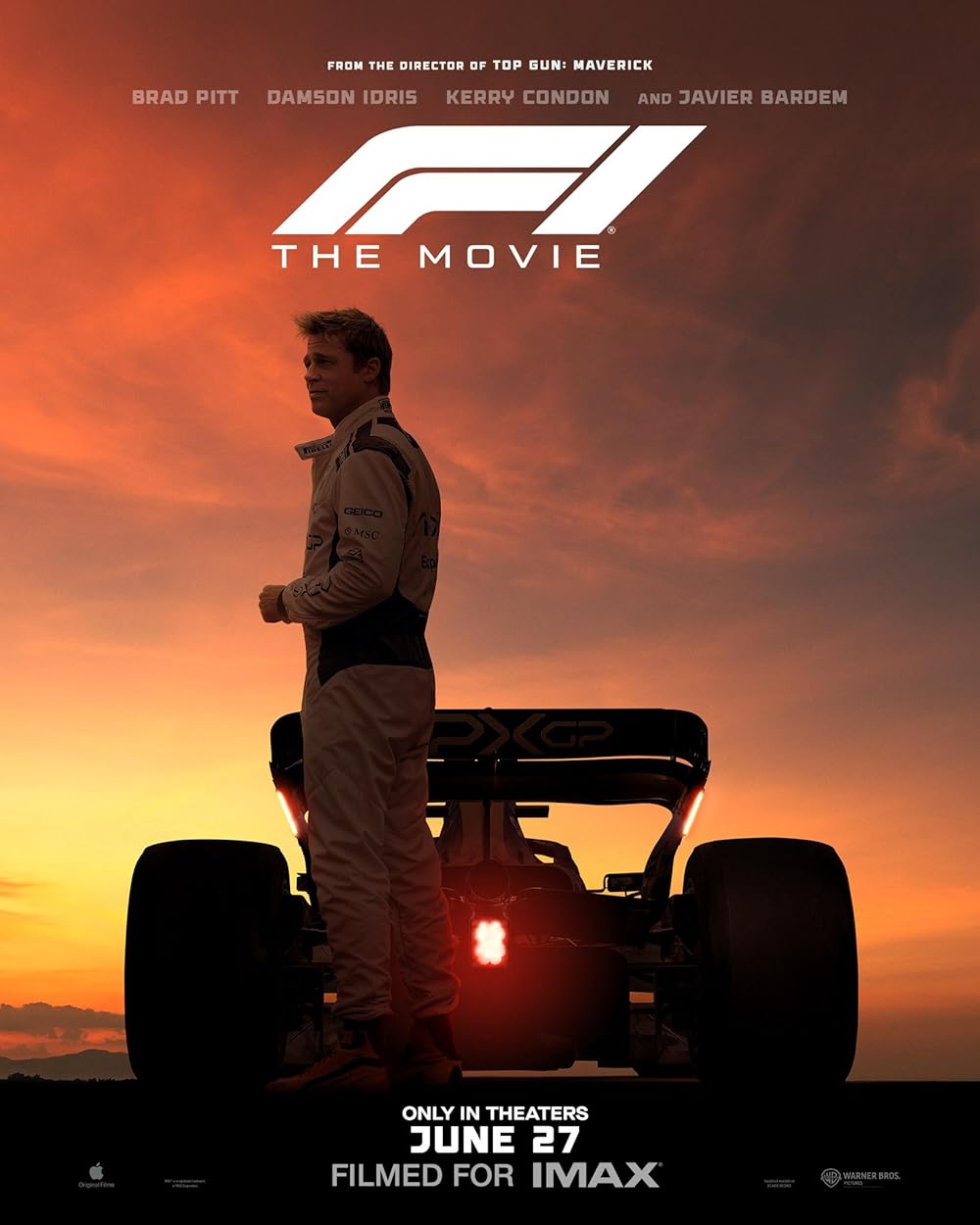
Starts on high octane, finishes on fumes. From the exhilarating technical achievement to the fantastic cast chemistry to the underdog story of redemption, it would appear that the “formula” for F1 was of sound design and execution; unfortunately, the character development is rushed and the third act simply doesn’t offer the adrenaline-pumping suspense and action as do the firsts two acts.

In the 1990s, Sonny Hayes (Brad Pitt) was Formula 1’s most promising driver until an accident on the track nearly ended his career. Thirty years later, the owner of a struggling Formula 1 team convinces Sonny to return to racing and become the best in the world. Driving alongside the team’s hotshot rookie, Sonny soon learns that the road to redemption is not something you can travel alone.

If for no other reason, see this film on the biggest screen with the highest quality sound because Joseph Kosinski’s F1 is why the BIG screen was made. From beginning to end, the cinematography and editing deserve top billing for this picture because you will feel that you are right there in the crowd or with the drivers along the Grand Prix. Even if you know little to nothing about Formula 1 racing, you will never feel lost as there are sufficient context clues and exposition to keep you along for the 200mph ride. It would have been too easy to lean into the racing sequences, but the racing punctuates the rest of the story, so each and every time you are on the track of the Grand Prix, there has been an emotional and chemical reset from the previous racing scenes. Both the sound design and cinematography are outstanding in this octane-fueled motion picture.

The score from Hans Zimmer serves as a direct extension of both action and character in F1. His energetic score blends sweeping orchestration with pulsating electronic textures that wrap audiences in the big screen story. Zimmer’s ability to craft a human story inside a mechanical world is on full display in the film. Where his brilliance as a composer is witnessed most is in the rhythmic choices scene to scene. He employs musical motifs that emulate machinery or momentum, which in a sport where every millisecond matters, Zimmer’s percussive, syncopated techniques mirror the precision and stakes of the most elite motorsport. In a film that captures a motorsport that crosses cultural boundaries–a global sport–Zimmer’s score represents a cross-section of the various regions of the world that play host to Formula 1 and seamlessly transcends cultural boundaries, creating a sort of global score that resonates with audiences from around the world.

While the plotting is sound, and serves as the foundation for a compelling story, where the film suffers is in the character development and third act. The setup in the first act informs the audience of everything needed to understand our two central characters of Sonny and Joshua (Idris) and the two vastly different worlds in which they live yet are connected by the thrill and love of racing. Of course, this thrill and love is expressed differently based upon the difference in both generation and worldview. Everything needed for a compelling character journey formula is there, but falters in the third act. Underscoring the story is social commentary on our drive (or motivation) for pursuing a passion, be that a career or by extension, a hobby. And it’s in this motivation that we witness our central characters develop over the course of the narrative conflict.

Sonny is a cynical former (generation X) Formula 1 driver, that was once heralded as the newest star on the Grand Prix circuit. In contrast, Joshua “JP” is the (generation Z) talented and charismatic driver that is obsessed with his image (with help from his press manager). Both drivers excel in talent, but are each battling their own respective demons. Sonny and JP develop over the course of the film–each man’s worldview challenged. Sonny has to grow in team spirit and JP has to grow in humility. The character arcs on which both characters are traveling begin and even develop in compelling ways, even resonating with audience members that are somewhere on the spectrum between both individuals; but, the change in both characters is too rapid when the resolution comes in the third act. JP’s scenario appears to be the perfect canvas on which to paint a portrait of what happens when we lose focus on the love of a sport and rather find ourselves lost in the celebrity of it, lost in the toxic social media swamp. Sonny’s character arc feels more complete, but even his switch from where he was to where he ended resolved itself too quickly, losing the full impact that it could have had.

Kosinski’s casting decisions result in a cast that demonstrates excellence in chemistry. There is an authenticity in the relationships and dynamics among the lead and supporting cast. Never once, did I feel that I was watching actors–rather–I felt I was watching real Formula 1 drivers, crew, and investors. I completely buy the longtime relationship between Sonny and Reuben (Bardem), even though we spend minimal time on the history of their friendship. And the clashes between Sonny and the pit crew and directors never felt rehearsed or contrived.

Even though there are shortcomings in the third act, the film remains an exhilarating experience. Movies like this is that for which the BIG screen was created–to capture larger than life stories that most audience members will never face or experience.
Ryan is the general manager for 90.7 WKGC Public Media in Panama City and host of the public radio show ReelTalk “where you can join the cinematic conversations frame by frame each week.” Additionally, he is the author of the upcoming film studies book titled Monsters, Madness, and Mayhem: Why People Love Horror. After teaching film studies for over eight years at the University of Tampa, he transitioned from the classroom to public media. He is a member of the Critics Association of Central Florida and Indie Film Critics of America. If you like this article, check out the others and FOLLOW this blog! Follow him on Twitter: RLTerry1 and LetterBoxd: RLTerry

TWISTERS movie review

Plot chasers. Despite the great chemistry between the leads of Daisy Edgar-Jones and Glen Powell, this cinematic storm is lacking the necessary elements in both thoughtful plotting and character development to form a compelling story. And while most of the special effects are excellent, it comes off feeling like one long storm chase. If it wasn’t for Edgar-Jones and Powell, I’d just as soon watch the Weather Channel instead. Twisters tries to be too many different kinds of stories, and isn’t successful at any one of them. There is an attempt at underscoring the outside-action narrative(s) with a heart-felt inside-emotional story, but even that isn’t fully developed. While there are some well-written scenes that will pique your interest, aside from the disaster porn dimension of the movie, there isn’t much here of any great interest.

Haunted by a devastating encounter with a tornado, Kate Cooper (Edgar-Jones) gets lured back to the open plains by her friend, Javi, to test a groundbreaking new tracking system. She soon crosses paths with Tyler Owens (Powell), a charming but reckless social-media superstar who thrives on posting his storm-chasing adventures. As storm season intensifies, Kate, Tyler and their competing teams find themselves in a fight for their lives as multiple systems converge over central Oklahoma.

The lack of a compelling narrative has far less to do with Lee Isaac Chung’s directing than it does Mark L. Smith’s screenwriting. No real surprise there since his other recent screenwriting credit is The Boys in the Boat, which also suffered from poor plotting and character development. While Joseph Koskinki receives a story-by credit, clearly he has demonstrated that he is a much better director (Top Gun: Maverick) than he is a writer. Both Twisters and The Boys in the Boat have a compelling story to tell, but the plotting itself (the map of how you get from beginning to end) lacks meaningful direction or focus. The movie sets up one story of overcoming trauma, then becomes a white collar vs blue collar story, then turns into a story about storm profiteering, which morphs into a melodrama about overcoming fear and guilt, just to finish as a romcom. All the while, the external goal of the story, which is setup successfully in the beginning, doesn’t get revisited and become clear until the third act. There is about as much narrative depth in Twisters as any given episode of Storm Chasers. Where is will give Smith, Kosinski, and Chung credit is that they didn’t choose to make this a “preachy” movie about ecoterrorism or climate change. Sometimes bad storm just happen. And that’s what makes them scary; there is no explanation.

Even though the themes of the movie are not very well developed, I like that Smith was trying to do with the subtext of the movie. Without getting into spoilers, there is an attempt at spotlighting how some people that appear that they are trying to help storm victims are actually more interested in profiting off the disaster. Which, I imagine does happen in real life. The movie also has something to say (and this was actually pretty well developed) about not judging the level of competence or motivation based on face-value or first impressions. The very people that look unprofessional may be even more professional and genuine than the ones that appear like they have it all together.

Other than some badly CG’d dandelion fuzz (which should’ve been done practically, c’mon). the rest of the special effects in the movie are excellent. Okay, so maybe excellent is being a bit generous, but I’m trying to give the film some credit for not putting me to sleep. I screened the film in Dolby Cinema, which is the best way to watch this movie because aside from the chemistry between the leads, the reason to watch this movie is for the storms and disaster porn thereof. Perhaps the story is on SyFy or Weather Channel levels, but the storm effects are executed very well. I was disappointed that we did not get a flying cow as a nod to one of the most memorable moments in the wildly popular original Twister. It’s well-known that the first movie literally built and destroyed houses to achieve the full effect and impact of the tornadoes, and it appears that Twisters used miniatures and models for some of the disaster scenes. Practical beats CGI nearly all the time. Also like the first movie, this one also appeared to integrate real footage of tornadoes and the disaster left in their wake.

The force that keeps this movie from falling completely apart is the chemistry between our leads of Daisy Edgar-Jones and Glen Powell. Playing Kate and Tyler, respectively, there is a throwback style (almost romcom-like) romance between the two in the vein of “will they, won’t they.” Even though Kate is our central character, it’s Tyler that receives more thoughtful development. Kate is largely the same from beginning to end, despite a great setup for overcoming trauma and guilt. Both of these characters (and their respective actor) keep this movie from falling completely flat. The playful chemistry between the two gives the film a human dimension that it is sorely lacking otherwise. Moreover, I like the fact that the budding romance between the two did not become the focus of the movie, but it certainly adds to the film in a constructive way. Both Edgar-Jones and Powell have an old-school charm that feel refreshing to see in contemporary cinema.

Whether or not you have recently rewatched the first movie, you can confidently go into this movie knowing all you need to know. There is little, if any, connection to the original 1996 blockbuster. For those that are super fans of the original, I imagine there are more nods to the first movie than that which I identified. If you’re looking for movie this summer to escape the heat with the whole family, then this is a good pick, but don’t expect much more than a mildly entertaining couple of hours.

Ryan teaches Film Studies and Screenwriting at the University of Tampa and is a member of the Critics Association of Central Florida and Indie Film Critics of America. If you like this article, check out the others and FOLLOW this blog! Interested in Ryan making a guest appearance on your podcast or contributing to your website? Send him a DM on Twitter. If you’re ever in Tampa or Orlando, feel free to catch a movie with him.

Follow him on Twitter: RLTerry1 and LetterBoxd: RLTerry