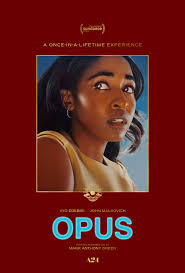
An enigmatic puzzle with missing pieces. What starts as a fascinating psychological mystery quickly devolves into a series of disjointed, cryptic sequences that offer more questions than answers. Opus is certainly a haunting experience that delivers striking visuals, but the stylistic storytelling lacks substance, resulting in a film that is ultimately hollow. Like with so many A24 and Neon films, Opus is rich in atmosphere, but lacks strategic plotting, proper pacing, and demonstrable working knowledge of screenwriting mechanics. Moreover, it falls into an all too familiar trap of prioritizing aesthetic over storytelling. Opus is yet another example of modern arthouse cinema mistaking ambiguity for depth. The film posits many otherwise thoughtful questions, but leaves you wondering why you should even care about what you just watched.
Journalist Ariel (Ayo Edebiri) works for an acclaimed music magazine but has grown tired of her arrogant boss Stan (Murray Bartlett) assigning her good pitches to more senior writers. But following the reclusive, visionary pop star Alfred Moretti (John Malkovich) emerging from hiding after more than thirty years, Ariel’s boss is invited to his secluded, remote compound where he will be releasing a new album. Ariel and her boss are invited to attend as press. But not long after arriving, Ariel deduces that the compound’s collection of ardent admirers of Alfred are actually a cult with deadly plans for the guests.
Most of the film’s problems can be traced back to its screenplay. Like with many (if not most, in my opinion) writer-directors, this story likely made much more sense in Mark Anthony Green’s head, than it did on paper. I find that writer-directors often have excellent movie ideas and eyes for shot composition, but lack a working knowledge of screenwriting mechanics. Had Green collaborated with a more established screenwriter, then the film may not have had the plotting issues that plagued it the whole time.
Adding to the film’s plotting issues is its reliance on repetition rather than escalation. Scenes blend into one another with minimal variation, creating a sense of stagnation rather than rising tension. Ariel’s, our central character’s, journey is more about cycling through eerie encounters and vague hallucinations than actually uncovering deeper truths. Without a clearly defined external goal for Ariel, Opus feels like a film more concerned with its own mystique than engaging its audience. The goal could’ve been something as simple as getting the article published, but the film never quite has a throughline on which to land the diegetic plane.
While strong, the performative dimension of the film is underscored with style over substance. Ayo Edebiri’s performance is layered and emotionally compelling. Unfortunately, the film gives her little to work with beyond surface-level tension. John Malkovich, always a commanding presence, delivers an eerie gravitas, but his role feels more like a cryptic device than a fully developed character.
One of the biggest shortcomings in character development is the lack of meaningful relationships. While Opus teases conflicts between Ariel and her boss Stan, these tensions never evolve into anything substantial. All around, the film’s characters never form real, emotional connections, leaving their interactions feeling hollow. Without compelling relationships, the film struggles make us care about any of the characters, much less the central character of Ariel.
Opus seems content to let its themes remain vague, as though interpretation itself is the art. This approach works in moderation but ultimately leaves the film feeling like an unfinished composition—beautiful in pieces but lacking a resonant core.
A24 has perfected the art of marketing “prestige horror” films that emphasize mood over traditional storytelling. While this approach has resulted in some modern masterpieces such as “The Blackcoat’s Daughter,” “Hereditary,” and “Midsommar,” it has also encouraged a wave of films that mistake ambiguity for intelligence. Opus is a prime example of this trend, prioritizing its hypnotic cinematography and eerie sound design over a screenplay that provides emotional or intellectual engagement.
This raises the question: Has arthouse cinema become so obsessed with being enigmatic that it has lost sight of storytelling? Moreover, has the proliferation of “arthouse” films become the very thing they opposed: the mainstream? Films like Opus appear to be forcing audiences to assign meaning where there may be none, and delivering a film that looks great but is ultimately forgettable. The present trajectory of many arthouse film is trending is becoming the new cinematic fast food: tasty but forgettable and lacking in nutrition. In striving for profundity, these films, risk alienating viewers who crave narrative satisfaction alongside visual artistry.
There’s no denying Opus is visually arresting and technically impressive. Mark Anthony Green’s direction is meticulous, and Ayo Edebiri delivers a gripping performance. But beneath its meticulously crafted atmosphere lies a film that lacks emotional weight or thematic clarity. For fans of slow-burn psychological horror and puzzle-box storytelling, Opus may still be a rewarding experience. For others, it’s yet another reminder that style, no matter how dazzling, can never replace substance or sheer entertainment value.
Ryan is the general manager for 90.7 WKGC Public Media in Panama City and host of the public radio show ReelTalk about all things cinema. Additionally, he is the author of the upcoming film studies book titled Monsters, Madness, and Mayhem: Why People Love Horror. After teaching film studies for over eight years at the University of Tampa, he transitioned from the classroom to public media. He is a member of the Critics Association of Central Florida and Indie Film Critics of America. If you like this article, check out the others and FOLLOW this blog! Follow him on Twitter: RLTerry1 and LetterBoxd: RLTerry
 R.L. Terry ReelView