PREDATOR: BADLANDS movie review

Predator: Let’s Play. When streaming content hits the big screen.
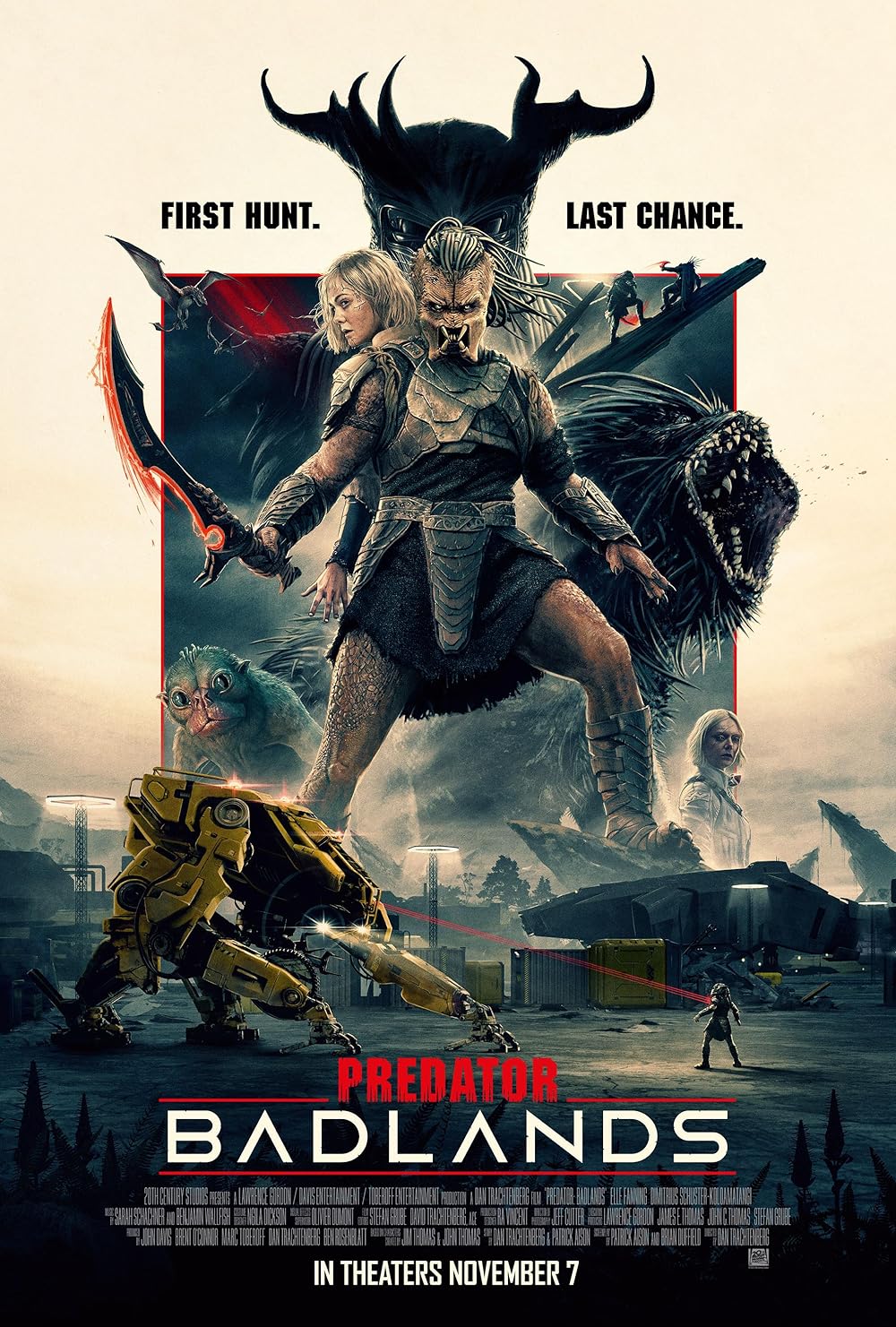
Predator: Badlands is the equivalent of a “Let’s Play,” but with bigger explosions. The nonstop action, constant motion offer little to no substantive emotional investment. You’re an observer, not a participant—which might be fine for streaming, but it’s a strange fit for cinema. The latest in the Predator franchise plays like a two-hour sizzle reel with delusions of grandeur. It’s a glossy barrage of explosions, digital dust, and quippy one-liners that evaporate before they even hit the floor. By the time the credits roll–that’s if you haven’t fallen asleep—you’ve seen everything and felt nothing. It’s not that the film is aggressively bad—it’s that it’s aggressively empty–little more than content to pander to short attention spans with shiny movement instead of meaningful momentum.

Cast out from its clan, a Predator and an unlikely synthetic ally embark on a treacherous journey in search of the ultimate adversary.

The screenplay feels like it was written by an algorithm trained on reaction videos and Reddit threads. Every line of dialogue sounds like a placeholder; it’s as if someone said, “We’ll fix it later” or “funny line here,” and neglected to return to the page in order to fix it–before principle photography. There’s no sense of escalation, tension, or rhythm; it’s a series of flashy moments loosely stitched together, like a highlight reel of a game you didn’t play. Even the humor feels synthetic–much like the characters– punching at air instead of connecting with character or tone.

As for the characters, they exist mostly as camera targets. They are little more than digital avatars running, shooting, and shouting for reasons that never feel personal or compelling. The lead could be replaced by a different actor mid-film and you might not notice. This critic isn’t even convinced that Dek (our central Predator character) wasn’t entirely CGI, though it may have only been the facial area. “What’s my motivation?” Difficult to say–there wasn’t much upon which to build. Motivations are paper-thin, arcs nonexistent. The Predator itself, once a symbol of primal fear and unseen menace, now feels like a boss-level NPC waiting to be triggered by the next quick-time event.

Visually, Badlands has all the spectacle money can buy; but its spectacle is divorced from any meaningful purpose. The explosions are massive, the sound mix thunderous, and yet it’s as emotionally engaging as watching someone else play Call of Duty. Every frame screams “look at me!” without ever inviting you to feel something. The editing, too, is manic. And it’s not even as though the narrative demanded it; rather, the dynamic editing was most likely employed because the movie was terrified that you’d look away or down at your watch, which I did several times.

And maybe that’s the point. Predator: Badlands is far less like a movie and more like a cinematic exercise in a large scale “Let’s Play.” For those that are unfamiliar with the term, it’s a type of (usually) YouTube video of someone playing a video game and often their reactions to the game play. Think of it as a passive experience of someone else’s thrill ride. The ultimate, disconnected form of living vicariously. Don’t question anything, because it won’t take long to realize that this movie is hollow. You don’t engage; you just witness. The irony is that the film could’ve been a fascinating critique of screen-mediated experiences, but it never once stops to think.

This is just the latest in a growing trend from Disney’s genre arm: a reliance on brand nostalgia and visual polish in place of storytelling. Ever since the corporate appetite turned to IP recycling, the studio has mistaken familiarity for depth. Badlands is what happens when you try to “optimize engagement” instead of crafting a narrative, resulting in the film equivalent of clickbait dressed in billion-dollar armor.

Predator: Badlands doesn’t so much hunt its audience as it does chase its own tail. A movie that is fast, flashy, and utterly pointless; and desperately wants to go viral but forgets to be cinema. You don’t leave exhilarated; you leave wondering if you accidentally spent $15 to watch a YouTube compilation in IMAX.
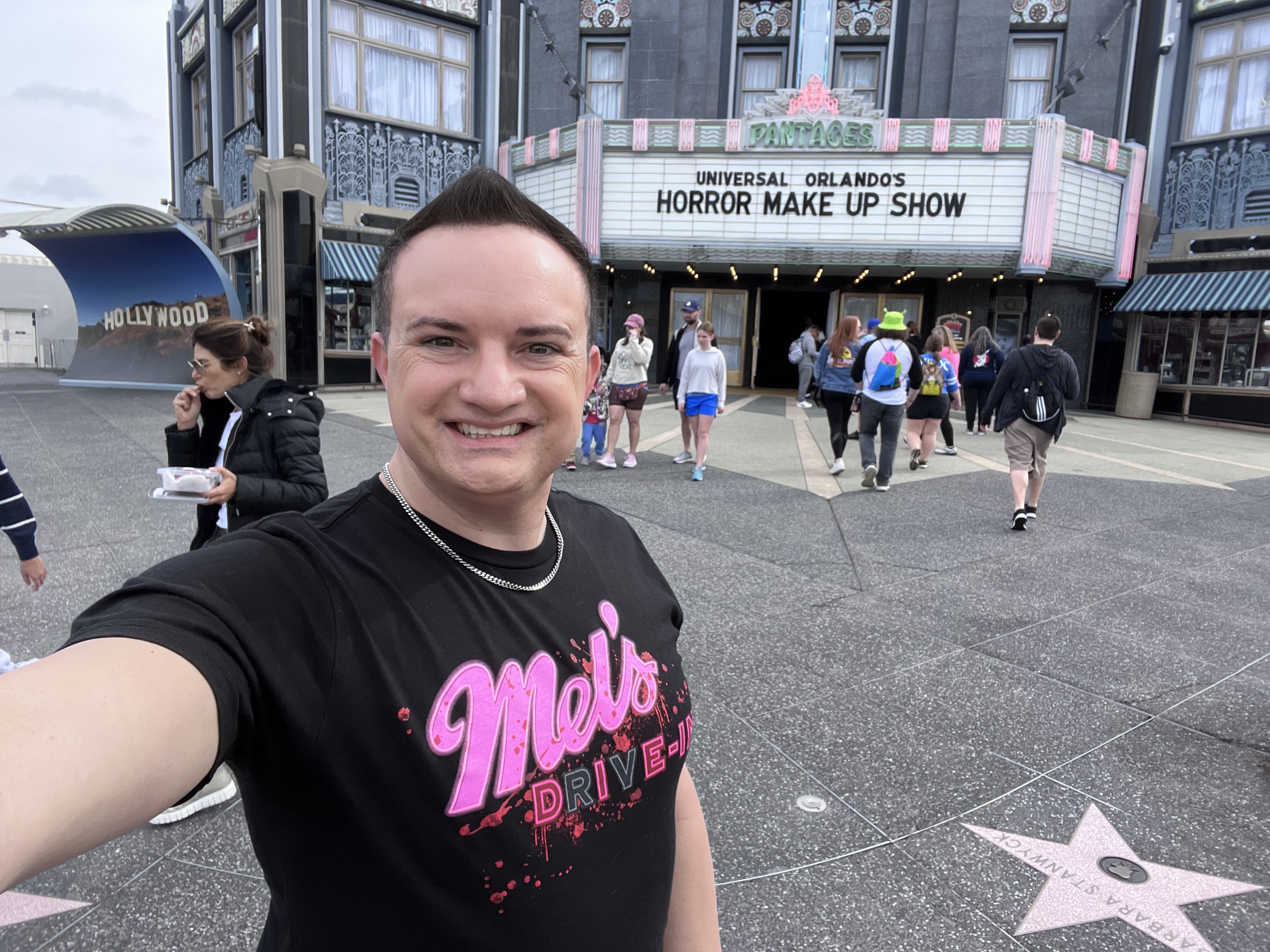
Ryan is the general manager for 90.7 WKGC Public Media and host of the show ReelTalk “where you can join the cinematic conversations frame by frame each week.” Additionally, he is the author of the upcoming film studies book titled Monsters, Madness, and Mayhem: Why People Love Horror. After teaching film studies for over eight years at the University of Tampa, he transitioned from the classroom to public media. He is a member of the Critics Association of Central Florida and Indie Film Critics of America. If you like this article, check out the others and FOLLOW this blog! Follow him on Twitter: RLTerry1 and LetterBoxd: RLTerry

“Bombshell” Film Review

Explosive! Bombshell is a brilliantly orchestrated and riveting film that takes you behind the scenes at Fox News in the months leading up to the oust of news business mogul Roger Ailes. Follow Megyn Kelly, Gretchen Carlson, and (fictionalized) Kayla as they battle the courts of public opinion and the seemingly impenetrable fortress of Fox News to take down the repulsive Roger Ailes. I went into this film prepared for a snark-filled satire, but what I was presented with was a meticulously written and directed docudrama that struck a fantastic balance between feature news story, so to speak, and motion picture. Although the film takes itself appropriately seriously, there are plenty of moments of levity that intertwine to strike the perfect tone. Where films tackling subjects as high profile and personal as this one occasionally fall victim to creating caricatures of real people and settings. Rather than limit the film to dramatizing the legal battle and cold hard facts, it uses the fictionalized character of Kayla to explore the psycho-social cost of being the victim of sexual harassment. So this film is just as much a human story as it is a recreation of an actual event. And it’s that human component that is explored through Kayla, Megyn, and Gretchen that gives this film incredible depth. There is no pretense in this film; it’s a raw, organic approach to adapting this story from the small screen to the big screen. You even get a few surprise cameos from some some familiar anchors and other personalities. Exemplary writing and direction is coupled with a highly effective stylistic cinematography and outstanding performances by the lead and supporting cast.

Bombshell is the dramatization of the downfall of Fox News mogul Roger Ailes that chronicles a group of women as they decide to take on the mastermind of the “fair and balanced” cable news network and the toxic atmosphere he presided over at Fox News.

There have been a few films in recent years that seek to dramatize and tackle the human cost of lecherous sexual harassment and abuse of power in the work place. But this is the first one to strike the perfect balance of PSA and dramatic plot. I love the irony all throughout the film, the stark contrast between “traditional values,” and “fair and balanced” approaches and the repulsive behavior behind the scenes. Yes, Ailes might look like a pioneer for women in that he was the first to truly give women the big anchor chair, but at a scaring and traumatizing cost. He was a sadistic magician of sorts with his “look at what my right hand is doing, meanwhile my left hard is truly pulling the strings.” Much like the news network that he built (and to his credit, he was a broadcast news business genius), the surface was not a reflection of the disgusting practices to craft this “family friendly” illusion. The truly scary portrait that this film paints is not limited to Fox News, but it is likely a reflection of the business of running a “visual medium” by in large. While much of what Ailes did was direct sexual abuse and harassment, he committed a lot of indirect abuse and harassment that leaves just as traumatizing a mark upon the women he abused. Much like Hustlers posited that the entire world is a strip club where a few are dancing while the majority are paying, this film also explores the dark, seedy underbelly of “sex sells” and sex appeal.

The performances are mindblowing! How Charlize Theron completely transformed into Megyn Kelly is nearly as uncanny as Rene Zellweger’s transformation into Judy Garland in Judy. You will swear that you are watching Kelly on the big screen. Theron not only nails the look of Kelly, but the tone of voice, rhythm of speech, and body language. She is truly captivating, and showcases her phenomenal acting chops. Here’s hoping for an Oscar nom for her! Although Megyn Kelly is the central character, she is supported by Gretchen Carlson brilliantly portrayed by Nicole Kidman and fictionalized Kayla, played by Margot Robbie. In the same vein of Theron’s excellent performance, Kidman also nails Carlson down to a science. When I watched Kidman on the Fox and Friends set, I swore that it was Carlson herself. Kidman brings out the strength of character and vulnerability of Carlson. It is clear that Kidman did her homework as well as her character did. Finishing out our trifecta of women at Fox is Kayla, an entry level staff member on various shows at Fox News. She is our conduit through which we experience the extend of Ailes reprehensible behaviors behind the scenes. She represents a young eager professional that can be found in many offices. She is the “everyman,” for all intents and purposes. This role gave her so much to work with, and she was able to demonstrate the wide breadth of her acting abilities. Such a versatile actor! I also appreciate the writing of her character for giving us a normal, every day, woman of faith. One whom isn’t prudish, judgmental, or pious. Her character was likable, sex positive, and NOT homophobic. However, she also highlights how many conservatives view Fox News. And you can feel her heart break as she falls victim to Ailes, that moment she realizes and experiences that the head of Fox News is a disgusting human being.

Not only do the women shine brilliantly in this film, but John Lithgow’s Roger Ailes is fantastic! It’s hard to praise such a disgusting man, but here we have to separate the actor from the character. Lithgow is one of the most charismatic and witty actors ever, and he convinces us that he IS Ailes. I can only imagine the difficulty in portraying such a villainous person. What stands out the most in the performance, aside from the image, is how much he humanized Ailes. Showed him to self-aware of his body image and how he, much like we, rationalize negative behaviors. But it’s this human side that makes Ailed even more frightening. He successfully turns Ailes from TV business diabolical genius to mob boss. Towards the end of the film, we get an appearance by Malcolm McDowell as Rupert Murdoch himself. Such a delightful surprise to see McDowell on the big screen again. His Rupert is on point! And in his brief time on screen, he commands it strongly.

The choice of cinematography was very interesting. The movie starts out as if we are at Fox News HQ on a tour of the facility and shows. Our guide is Megyn Kelly! She simultaneously walks us through the facility and provides poignant social commentary on the image and relationships of Fox News to the world. The manner that the camera moves throughout the scenes of the film is in a documentary fashion in the scenes that are real-life recreations of the actual events. When we are in a fictionalized part of the movie, then the camera moves in a more traditional manner for scripted motion pictures. This oscillation between objective and subjective makes for a dynamic experience. Instead of a clip show of headlines and what trended in social media during this time, the film goes deeper to reveal the heart of the issue: ultimate power. Tension and suspense are built effectively as the narrative unfolds in a gripping fashion. From the creative to the technical, everything about this film works flawlessly.

Ryan teaches screenwriting at the University of Tampa. If you like this article, check out the others and FOLLOW this blog! Interested in Ryan making a guest appearance on your podcast or contributing to your website? Send him a DM on Twitter or email him at RLTerry1@gmail.com! You can catch Ryan most weeks at Studio Movie Grill Tampa, so if you’re in the area, feel free to catch a movie with him!

Follow him!

Twitter: RLTerry1

Instagram: RL_Terry

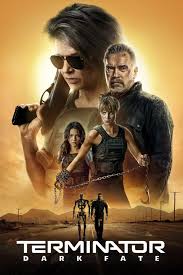
“Terminator: Dark Fate” action movie review

Linda Hamilton is back! And that’s all you really need to know about Terminator: Dark Fate. Her return highlights what was missing in the sequels that followed the critically acclaimed and immensely popular Terminator 2: Judgement Day that inspired the former attraction T2-3D at Universal Studios Florida. While this action movie clearly seeks to impress you with its phenomenal visual effects, it also goes back to the gritty character driven plot that made the first two Terminator movies works incredibly well and give them that punch that we expect out of these movies. With the return of Hamilton’s Sarah Connor and Arnold, in the role that made him a household name, this movie uses nostalgia–not as a way to live in the past and look back at the good ol’ days–but to move forward. No mistaking it, this movie is filled with adrenaline pumping action from start to finish; but the plot is very much grounded in what made the first two so successful: the characters. Despite having so many futuristic elements, Dark Fate’s storytelling is grounded in a science-fiction that never feels completely out of this world. One might even say that the plot is very much grounded in a plausible reality. When this franchise faced eternal damnation in its own judgement day after several flops, Sarah Connor returns to save the franchise from its own extinction. With Cameron providing a vision for this installment, it is the perfect blend of tentpole plot devices and progressive storytelling. Terminator: Dark Fate erases the previous three movies to fit in nicely after T2:3D.

In Mexico City, a newly modified liquid Terminator — the Rev-9 model — arrives from the future to kill a young factory worker named Dani Ramos. Also sent back in time is Grace, a hybrid cyborg human who must protect Ramos from the seemingly indestructible robotic assassin. But the two women soon find some much-needed help from a pair of unexpected allies — seasoned warrior Sarah Connor and the T-800 Terminator. (IMDb)

It should come of no surprise that the number one reason to watch this movie is for the bold, bad ass return of Linda Hamilton’s Sarah Connor! Her mantra may as well be “have bazooka, will travel.” Even though we witnessed the moment she stepped out of the SUV and onto the highway in the trailer, that moment still packs a punch when you watch it in the movie. Although it’s Davis character of Grace that is sent from the future to protect Dani, it really is Hamilton whom saves this movie and the franchise. Both Davis and Hamilton complement one another very well, each adding that special something that this franchise desperately needed. And that something is great, memorable characters. Not only do we have our two intimidating protectors, we also have a new “Sarah/John Connor” character in Natalia Reyes that will steel your heart. Even though Reyes’ Dani is our central character, it is Hamilton and Davis that have the lion’s share of the screentime. And it’s a good thing to, because it is their chemistry that holds this movie together and grounds it in that same abrasive banter that makes the first two movies so endearing. And yes, Connor has some great one-liners, including the franchise’s best-known line “I’ll be back.” Her entrance will undoubtedly evoke uncontrollable cheering throughout the audience for both her character and the actor herself.

The first two movies had extremely well-developed and executed plots, and then the plots and characters went off the rails. Thankfully, under the guidance of Cameron (whom has a co-writer credit), the plot of Dark Fate goes back to its roots of spending a sufficient amount of time setting up the story that is about to unfold. One of the magical parts of screenwriting is the ability to get away with just about anything–and it be believable–if you set it up early enough in the story. From the moment the movie opens, the central conflict in the plot is already being setup for major deliveries later on in the story. Not only do we hop in the wayback machine to a late 90s Sarah and John Connor, we witness that preventing judgment day did not completely protect the Connors from tragedy. Judgment day appears to be “starting all over” to quote the former T2-3D attraction. Although the overall goal of the plot is to stop Judgment Day from happening in the future, there is a secondary goal for both Connor and Grace. That is to protect Grace because she is the key to stopping the malevolent AI in the future. Not because she is a “Mother Mary” figure (much like Sarah was in the original) whom will give birth to the one who would save the world from the machines, but because Dani is to give birth to her own sense of agency that will cause her to become the leader of the resistance.

The strongest kind of conflict, in a plot, is derived from character relationships. Well developed and setup character conflict provides a near endless supply of drama that will carry the action and subtext of the movie. And the conflict meter reads off the charts between Connor and a particular T-800 (played by the definitive Terminator Schwarzenegger) because of a tragedy that befell Connor in the late 90s. Before you think that this T-800 is still hunting down Terminators from the future, this one can tell you any and everything you need to know about drapery. He’s gone and bought the metaphoric house with a picket fence, got married, and has a kid. Even though he’s demonstrably turned from his CyberDyne ways, Connor has a longtime grudge against this model, and she isn’t afraid to show it–and loudly. While Connor wants to kill him, Dani concludes that she cannot save the world without his help. Watching Connor and Carl (Arnold’s T-800) passionately bicker and verbally fight sounds like it may be there simply for the sake of nostalgia, but it lays the groundwork for how they will be forced to work together during the second and third acts of the movie. It may be grounded in T-1 and T-2, but this conflict moves the story forward. In a sense, these two characters provide the perfect balance between human and machine that was largely missing from the three movies that followed Terminator 2: Judgment Day.

If you’re a fan of the first two Terminators and the former attraction at Universal Studios Florida, then this movie is for you. Yes, it’s also for general audiences, but it’d specifically made for the longtime fans of the franchise that was, up to this point, doomed for extinction. Its got it all: action, a thrilling plot, endearing characters, beautiful visuals, and a memorable score (duh duh duh, duh-duh, duh duh duh, duh-duh). But more than for any other reason, you want to watch this movie to see our combat boot wearing, rock launcher carrying, no nonsense Sarah Connor as can only be played by Linda Hamilton.

Ryan teaches screenwriting at the University of Tampa. If you like this article, check out the others and FOLLOW this blog! Interested in Ryan making a guest appearance on your podcast or contributing to your website? Send him a DM on Twitter or email him at RLTerry1@gmail.com! You can catch Ryan most weeks at Studio Movie Grill Tampa, so if you’re in the area, feel free to catch a movie with him!

Follow him!

Twitter: RLTerry1

Instagram: RL_Terry

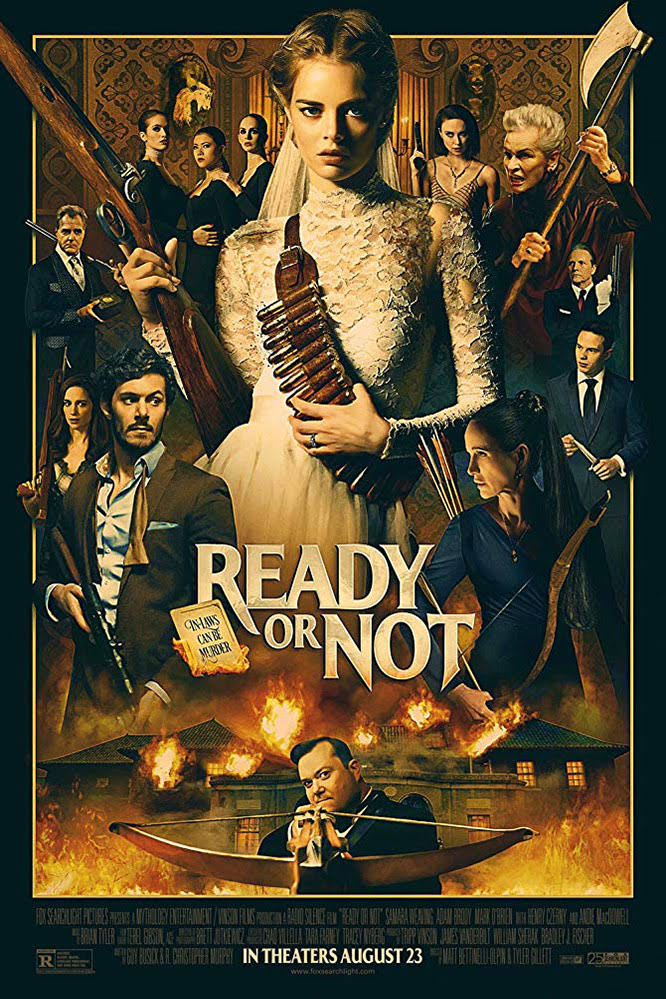
“Ready or Not” Horror Comedy Review

Outstanding! Ready or Not is a brilliant horror comedy from start to finish. Fantastic screenplay, cast, direction, effects, everything works flawlessly. Probably the most fun movie of the summer. It’s a no holds barred dark comedy full of entertaining, campy dialogue and gruesome kills. Not since the cult classic Clue, has there been such an excellent horror comedy heavily influenced by the concept of a game. Samara Weaving slays audiences as the wedding dress wearing Grace as she transforms into this movie’s answer to Kill Bill. Although most of the other characters are relatively flat, you forgive them because of the endless jokes about the insanely rich and the non-stop bloody comedy. Does the film have shortcomings? Sure does–the cinematography and lighting, for examples; however, this movie is so incredibly charismatic and it’s hilarious enough to more than makeup for the technical faults in this movie. When I state “everything works flawlessly,” I suppose it’s a bit hyperbole because it’s not a perfect film, but it knows its strengths, and those strengths support everything else to deliver a movie that will keep you highly entertained for the entire run time that is non-stop antics and action.

“Till death do us part” means so much more than you bargained for in this movie. A century ago, the Le Domas family made a faustian deal with Mr. Le Bail, quite literally the devil, to launch a board game empire. As with any deal with the devil, he will make sure you hold up your end of the bargain. For the Le Domas family, that means playing a game at midnight whenever someone new marries into the family. A blank playing card is placed into a mysterious wooden box, then a  simple turn of the crank prints the name of the game onto the card. All is fun and games, unless the game is hide and seek, which turns the Le Domas mansion into a hunting ground for newlywed Grace (Weaving) as she must now hide from the entire family until dawn, all while her new in-laws hunt her with guns, crossbows and other weapons.

You think your family is screwed up, you ain’t seen nothin’ yet! Why is this movie so good? It’s a horror comedy with a poignant point to make for audiences. It’s the combination of social commentary and non-stop excellently paced gory antics that make this one to watch. From one of Grace’s first lines “I honestly can’t wait to be a part of your moderately fucked up family,” we know we are being setup for one of the most absurdly fucked up families ever, and we are hooked. It’s just so incredibly, spectacularly ridiculous! The success of this movie is partially derived from screenwriter Guy Bustick’s (The Purge) excellent handle on a healthy and smart sense of humor and comedic timing. He has also demonstrated an ability to creatively comment on the divide between the haves and have-nots while the story not coming off as propaganda. He has a message, but the method he chooses utilizes the power of horror and comedy to deliver it in a way that provokes thoughtful discussions but highly entertains along the way.

But what is the thoughtful discussion point posited by this movie? Is it wealth? Not necessarily. But wealth certainly has a lot to do with it. Ready or Not comments on the insane actions and thoughts of people who place immense value in wealth and the proximity to it. Furthermore, the movie suggests that if you come between a family and their wealth–watch out–because you may be rubbed out. All throughout the movie, characters acknowledge, in various ways, that they associate with the family to be close to the money steeped in tradition. The love of money is a drug–not the money itself–the love of money is probably the most powerful drug with the greatest degree of addictiveness that we’ve ever seen. And that addiction to money is played out in this movie. Everyone from the blood family themselves to those whom married into the family, and the servants is addicted to the money. The family doesn’t want to lose their money and power because that IS their legacy, and the servants don’t want to not be associated with it. The fear of a curse that could end a dynasty is more important than people’s lives, even though some of the family members even state that they don’t believe in the curse. Instead of the family’s pride and joy being the decades of games that have brought laughter and smiles to billions of people, the family is more concerned with the money than its creations.

Samara’s Weaving’s Grace is such a treasure to watch! She goes from a blushing bride to a scream queen to a kick ass Uma Thurmon-like character in a matter of moments. Her transformation is so much fun to watch, and she owns every second of screen time she receives. Her level of charisma is on par with the over all tone of the film. She delivers a dynamite performance that you will love to watch every second. This movie has cemented her as a bad ass who can hold her own. Her performance is so highly entertaining that you forgive it of the rough edges and even the movie for the plot holes that are pretty visible. She strikes a balance between someone unbelievably kick ass but still vulnerable and human all at the same time; furthermore, her actions do not lend themselves to superhuman or John McClane levels of survivorship. Grace is 100% human and 100% bad ass all at the same time. Her wounds are severe, but she is determined to survive. In fact, she must’ve read the same book as Nancy Thompson in A Nightmare on Elm Street, because Grace is obviously “into survival.”

Here is a question likely on your mind: why was The Hunt cancelled and Ready or Not still hit theatres since they have a similar premise at their respective cores. Not having seen The Hunt, I can merely speculate, but from what I inferred from the trailers, The Hunt appears to take itself far more seriously than Ready or Not. The latter is a black comedy that satirizes the concept of the rich preying on the poor for comedic effect whereas the former gives off far more serious tone. This is one example of how comedy allows you to tell stories that simply don’t work in other tones; furthermore, the pairing of horror and comedy provide such a creative latitude for expressing plots that would otherwise be too dark (i.e. The Hunt).

Don’t hide from this movie, because if you do, you will miss out on an absolute blast at the cinema.

Ryan teaches screenwriting at the University of Tampa and teaches high school TV/Film production. If you like this article, check out the others and FOLLOW this blog! Interested in Ryan making a guest appearance on your podcast or contributing to your website? Send him a DM on Twitter or email him at RLTerry1@gmail.com!

Follow him!

Twitter: RLTerry1

Instagram: RL_Terry

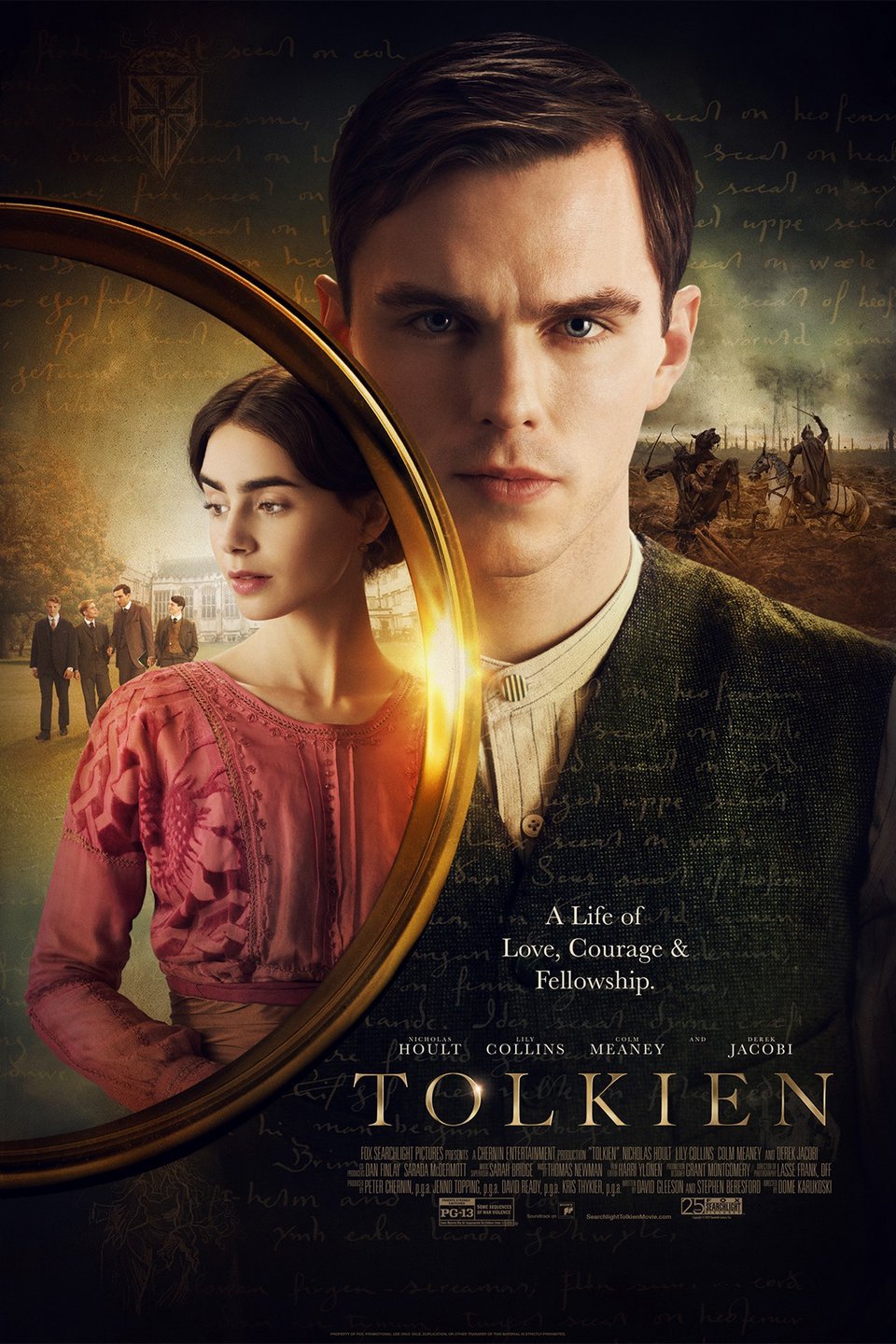
“Tolkien” BioPic Movie Review

One of the world’s most engaging authors in one of the world’s most un-engaging biopics. Go behind the prolific fantasy writing, linguistics, and mythology to discover the origins of author J.R.R. Tolkien. From his early childhood as an orphan to his studies and teaching at Oxford, follow the famed author on his own unexpected journey to eventually pen those iconic words “In a hole in the ground there lived a hobbit.” Biopics are often challenged with balancing what the audience wants to see with the reality of what was, both the attractive, inspiring moments and, if applicable, the gruesome or repulsive. And over all, Tolkien does an adequate job of highlighting the personal history of Tolkien (tol-Keen); however, where the biopic does not deliver is evoking a significant emotional response from the audience. If you’ve read that it comes off as a glorified Wikipedia article, then don’t worry, that is not true. But, it isn’t an I, TonyaTheory of Everything, or Amadeus either. As biopics go, it is pretty much middle of the road. Though the story may not be as fascinating or gripping as audiences want, it does deliver command performances by Hoult, Collins, and JRR’s three best friends. In addition to the impeccable casting, the production design is gorgeous and the score is compelling. Sometimes biopics make the mistake of treating the subject with too much reverence, thus overlooking or glossing over low points or decisions that place the subject in a less than favorable light. And, without knowing a detailed history of his life, I am left with the real possibility that this biopic did just that. Perhaps it’s the oversimplification of Tolkien’s quasi-privileged life that predisposes the screenplay to falling short of evoking strong emotion from the audience. If there is one message that is clear from this biopic, it’s that imagination served as an escape from the obstacles and trials of life, especially during WWI.

Years before he would write The Fellowship of the Ring, J.R.R. Tolkien found himself in a childhood fellowship with three other outcasts at King Edward’s School in Birmingham, England after his mom, who would regale him of stories of dragons and knights, unexpectedly passed away. This close friendship would follow him all the way through to college and even into WWI. These four friends would draw upon one another for courage and artistic expression. Taking inspiration from his own fellowship including the personal/interpersonal challenges Tolkien faced as he and his friends challenged one another and his affections for Edith Bratt, Tolkien reflected on these experiences to write The Hobbit and The Lord of the Rings.

Although the scenes from WWI serve as a framing device for this biopic, it is the formidable years spent at King Edward’s School and Oxford that truly defined Tolkien and set him up for his timeless masterpieces. Had the movie taken a more linear approach, the story may have been much more impactful. As it stands, there is so much oscillation between the “present day” moments and the flash forwards/backwards (yes, there are both in this movie) that it was difficult to focus. The majority of the movie takes place at Oxford, but the number of flashbacks and flashforwards took me out of the story periodically. Flashbacks can be a useful storytelling tool, to provide visual exposition, but they are often misused. Had this movie followed the approach that Fried Green Tomatoes took with the use of present-day and flashbacks, then I think it would have delivered more powerful story. Although as a screenwriting lecturer I recommend that my students not use flashbacks because of how tricky it can be to integrate them in such a way that they advance the plot, if a screenwriter chooses to use flashbacks, then the writer has to make sure that the flashback or flashforward works to move the plot forward–add something of value to the story. With Tolkien, the flashbacks do little more than frame the story. Other than some impressive visuals and opening a window into the world that inspired and shaped Tolkien, these moments do not significantly advance the plot in meaningful ways.

With Tolkien’s infatuation with (future wife) Edith Bratt, there was certainly opportunity to turn this into a romance, shifting focus away from the fellowship Tolkien had with his three close male friends. Thankfully, the romance between Tolkien and Edith was a nice B story to our A story. I say B story instead of subplot because it is a counterpart to the main outside action plot (story A). Furthermore, the romance between the two does heavily influence the and even inspire the romance between future characters Aragorn and Arwen in The Lord of the Rings. From romantic to close platonic relationships, that is truly what the plot of the biopic is about. Throughout the movie, you will encounter various relationships that Tolkien experienced during his life. Although we don’t spend much time with him and his younger brother, it is well-established that he has a moderately strong relationship with his brother. Furthermore, we see that Tolkien had a strong relationship with his mother, whom helped to shape his imagination in his younger years. It is widely known that Tolkien was a Catholic, but that is not highlighted in the movie (and it isn’t missed) but it’s that element that explains why the family priest is his legal guardian. Tolkien and the priest have a contentious relationship, but it is clear that the priest wants Tolkien to succeed in life. We don’t get to spend much time with his foster mom, but she seems to understand Tolkien and Edith’s relationship. Before getting to focal relationships, Tolkien has a strong relationship with his mentor and professor whom is chiefly responsible for Tolkien pursuing his scholarly studies at Oxford.

The central relationship(s) in the movie is between Tolkien and colleagues Christopher, Geoffrey, and Robert. For most of the movie, they are shown to be as close as brothers, but I appreciate the movie spending some time on the development of the relationships. What starts out as heavy conflict (that even devolves into physical altercations), soon evolves into the kind of friendships that you and I hope to have with close friends that ostensibly become our family. Despite Tolkien not coming from wealthy families like his friends, they share one very important thing in common: a desire to change the world through art. Each of the boys has a different interest, but they each inspire one another to stand up to the obstacles of life and achieve what each deeply desires. Of all his friends, Tolkien was closest to Geoffrey, whom was tragically killed during WWI along with Robert. Christopher is the only survivor out of Tolkien’s three friends. While Christopher’s scares (we are led to believe they are more emotional/psychological than physical) impacted his ability to compose music, Tolkien harnessed the atrocities of war to inspire The Hobbit and The Lord of the Rings. I absolutely love the depiction of close friendship between these young men because we seem to have very few examples of this level of male companionship in cinema, by in large. Many of the closest friendships are often shown between women. The structure of the plot keeps the movie from being as inspirational as it could have been, but there is still a lot to like here.

As biopics go, this one is middle of the road. It is not outstanding nor is it a bore. For fans of the author, I feel that you will get quite a lot out of the movie. The impeccable casting is the strength of this story. Each actor/actress delivers solid performances. Whether you are more familiar with the books or movies, you will find surrogates for notable characters throughout Tolkien’s most famous writing. Interestingly, the late author’s estate released a statement saying that Tolkien’s family members “do not endorse it or its content in any way.” In fact, the estate has yet to see the movie. Perhaps its the exclusion of nuances that the family is aware of in the author’s life, but I am unable to see why any parts of this biopic are controversial in any way. If you enjoy reading his books or watching the movies that were inspired by them, then you should see this biopic. Not because it is an outstanding motion picture, but because it does give you insight into the real world of Tolkien.

You can catch Ryan most weeks at Studio Movie Grill Tampa, so if you’re in the area, let him know and you can join him at the cinema.

Ryan teaches screenwriting at the University of Tampa. If you like this article, check out the others and FOLLOW this blog! Interested in Ryan making a guest appearance on your podcast or contributing to your website? Send him a DM on Twitter!

Follow him!

Twitter: RLTerry1

Instagram: RL_Terry