SPEAK NO EVIL horror movie review

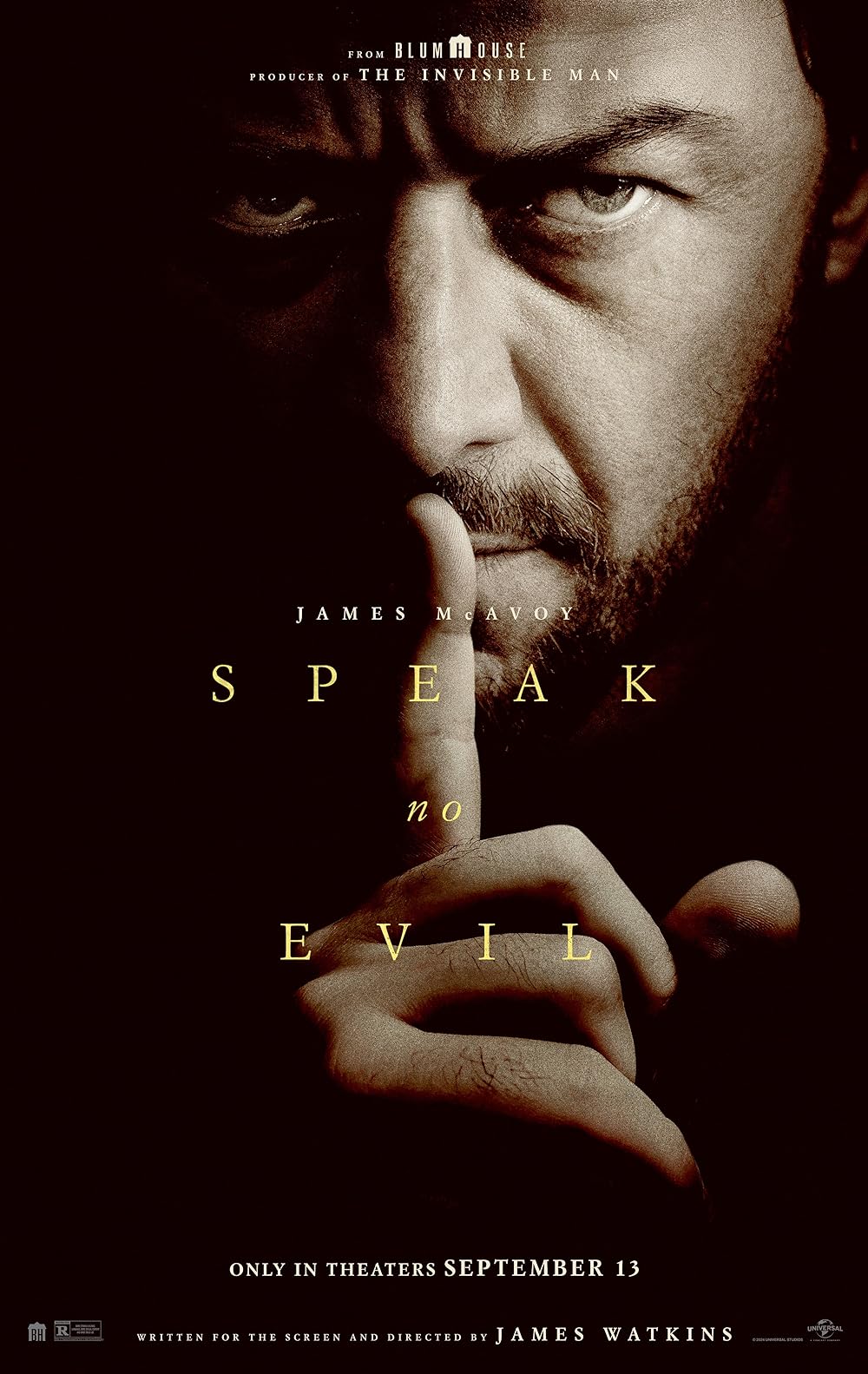
An entertaining and terrifying thrill ride. Blumhouse and Universal’s Speak No Evil, starring James McAvoy, excels in plotting and atmosphere but falters in character building and development. Based on the Danish film by the same name, director James Watkins’ version is a methodical and spellbinding descent from dream to nightmare. The highlight of the film is McAvoy’s completely manic performance that is simultaneously comedic and unsettling. Whilst Watkins attempts to bestow upon the high concept narrative thoughtful social commentary on image, isolation, and identity, the commentary is inconsistent and lacks the gravitas to truly be compelling or provocative.

A dream holiday turns into a living nightmare when an American couple and their daughter spend the weekend at a British family’s idyllic country estate.

That which is most personal is most relatable, and can be the most terrifying. And what can be more personal and relatable than the need for a relaxing vacation in the peaceful countryside? That is precisely where this decent into a nightmare begins. Speak No Evil may take its time (albeit justified) in setting up the conflict, but once that second act kicks into gear, it is a nonstop thrill ride into isolation and violation. Keep the cast small, the film is able to spend sufficient time in developing the plot and keeping with proper pacing for the tight storytelling. From the very beginning, the piping is laid for everything that audiences will encounter in the second and third acts, with every shot, scene, and sequence pointing towards the shocking conclusion.

Violence on screen is minimal; however, when it hits, it HITS. But that hit isn’t always visual; many times it is psychological in nature, which in many ways, is even more terrifying. Throughout this film, the terror on screen is transferred into the minds of the audience. Part of that is because of the degree of relatability in this story. Many of us have been on vacation in a new place or even moved to a new place unfamiliar to us–perhaps in or to another country–and we are often desperate for friendship or companionship of any kind in order to begin to feel more at home. Therefore, the setup of this film is one to which many of us can relate–and that’s what makes it particularly terrifying. The thought that we could unwittingly befriend a monster.

While the social commentary on isolation, identity, and image is inconsistent and weak, I appreciate what Watkins was trying to do; although, there is one aspect of the film that was screaming for a redemption arc that was so obviously squandered (and actually hurt the quality of the film). Speak No Evil depicts many expressions of isolation. Isolation from friends and family, isolation from the urban core, isolation within one’s family. And it’s this isolation that greatly heightens the level of suspense and terror.

Additionally, the film depicts the identities (or facades) that we project to the world when we are hiding something or feel insecure because we wield it like a sort of armor. Moreover, this identity can also harbor inconsistencies that lead to a lack of authenticity and meaningful motivation. Perhaps this identity is merely a facade that is intended to make others feel uncomfortable or to project an image that sets one apart simply out of fear of being found out as little more than keeping up with what’s trending on social media. Furthermore, the attempted commentary on image is depicted in a variety of ways throughout the film.

The weakness in the film is found in the character building and development. Not with all the characters, but enough that it mitigates the potential of the film to deliver a compelling story. Without getting into spoilers, I want to discuss where the film had an opportunity an an effective character redemption arc, but pandered to what’s presently trending in movies instead of providing a constructive character arc that would’ve benefitted the film by adding a since of compelling meaning. Strong characters are not strong because those around them are weak; to craft a strong character through that methodology makes for a weakened (and less compelling) character because ostensibly standards have been lowered.

Strong characters are at their strongest when other characters are strong, complete with dimension as well. There is a character in the movie that lost their job, and have been personally struggling with feelings of anger, inadequacy, and failure–that is completely relatable as it is very much a human response to losing ones income and livelihood. Where the film fails is setting this character up to overcome the feeling of failing their family and at life, but never doing anything with it, and merely reinforce weakness. I imagine this was done to make their counterpart appear stronger. But it amounts to lazy storytelling that reinforces negative imagery.

The character that is the most entertaining is James McAvoy’s Paddy. I cannot think of any other actor working today that could’ve brought this character to life nearly as well as McAvoy. In an otherwise par for the course performative dimension in the film, he brings a kinetic energy that draws audiences into the macabre, twisted tale. From the very beginning, we can tell that there is something a little off about his character, but never enough to know precisely where he stands. When he goes full-on manic mode, we are in for the ride because he makes us laugh and gasp in horror all at the same time.

Everything about this movie would make for a fantastic house at next year’s Halloween Horror Nights at Universal Orlando and Hollywood. The farmhouse at the center of the movie is a labyrinth and hints at a variation of the hillbilly horror aesthetic. I can see how this film’s characters and setting could adapt well to an HHN house, so I would not be surprised if we see this intellectual property featured at next year’s HHN.

Speak No Evil may lack dimension that could’ve made it a more compelling narrative than what we received; however, it’s still an entertaining thrill ride that will have you laughing and screaming. A solid popcorn horror movie that has some degree of rewatchability.

Ryan teaches Film Studies and Screenwriting at the University of Tampa and is a member of the Critics Association of Central Florida and Indie Film Critics of America. If you like this article, check out the others and FOLLOW this blog! Interested in Ryan making a guest appearance on your podcast or contributing to your website? Send him a DM on Twitter. If you’re ever in Tampa or Orlando, feel free to catch a movie with him.
Follow him on Twitter: RLTerry1 and LetterBoxd: RLTerry

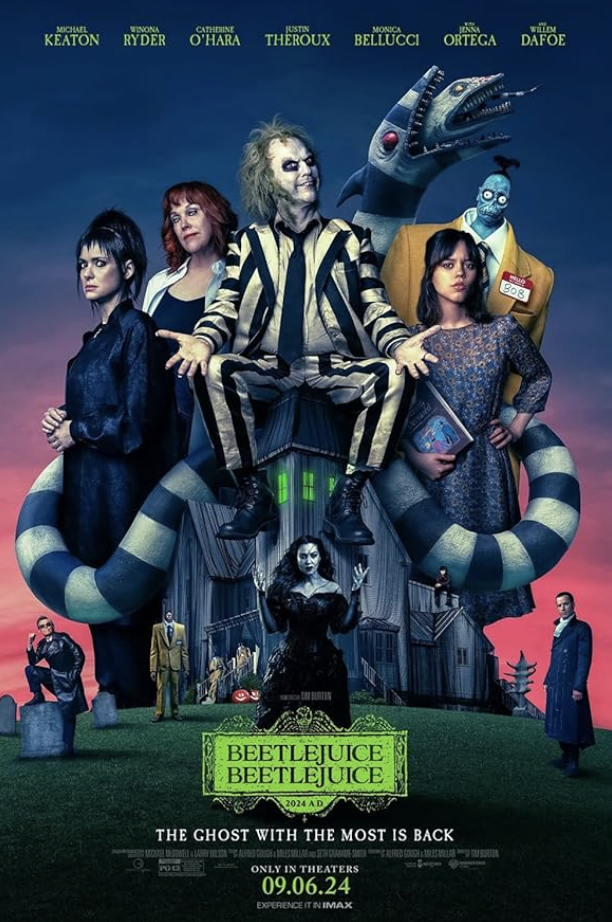
BEETLEJUICE BEETLEJUICE movie review

Forgettable and messy. The long awaited and much anticipated sequel to the campy cult classic Beetlejuice is unfortunately an underwhelming return to the fantastical, whimsical universe of colorful and dynamic characters. I’m left asking myself, this is the story for which Burton has been waiting???

Three generations of the Deetz family return home to Winter River after an unexpected family tragedy. Still haunted by Beetlejuice, Lydia’s life soon gets turned upside down when her rebellious teenage daughter discovers a mysterious portal to the afterlife. When someone says Beetlejuice’s name three times, the mischievous demon gleefully returns to unleash his very own brand of mayhem.

Beetlejuice Beetlejuice is a disjoined mess of setup after setup, with little development or meaningful resolution. Even though it successfully channels some of the charm and macabre whimsy of the original, this one is missing something vital–heart. What is most painful to witness is that there is actually a good and even compelling story in there, but its’ buried beneath a garbage heap of subplots and characters that are little more than the equivalent of an NPC (video game-speak for non player character). While the screenplay is abysmal, the bright spots in the movie are Michael Keaton’s delightful reprisal of Beetlejuice, despite his reveal appearing too early in the story. Other highlights of the movie are the quintessentially Burton special makeup and practical effects, including miniatures and puppetry. And composer Danny Elfman lends his distinctive authorship to the score. For fans of the original, this one is likely going to disappoint, but perhaps for those that may be getting introduced to the world of Beetlejuice for the first time, will seek out the original campy classic. At the end of the day, it’s not all bad, but it’s far from good. At best, it’s sufficiently entertaining.

Before getting into what didn’t work, which is substantive, I’d be remiss not to spotlight what the movie did right. The big question, did Burton and Keaton revive ol’ Beetlejuice? And the answer is, yes. The character of Beetlejuice himself is the reason the movie has enjoyable moments and will keep you moderately entertained. Keaton delivers a Beetlejuice that makes you forget that he hasn’t played this character in nearly 40 years. For the most part, he captures the energy, wit, sarcasm, and offbeat charm of his original incarnation. Unfortunately, that cannot be said for the rest of the performative dimension. But more on that later.

Over all, the design of the movie harkens back to the Burton’s golden age in the 80s and 90s, except when he lays practical effects over CGI backgrounds or oscillates between both mechanical and digital in jarring ways. From beginning to end, movie magic is witnessed everywhere. Burton was committed to capturing the imagery of the original in both the costumes and set design, and by in large, he accomplished just that. This movie is a reminder that computers cannot replace the way real light bounces off real objects into the camera lens. The magic of motion pictures is a combination of tactile, chemical, performative, and lighting elements. Despite the Afterlife lacking true camp value, it was a successful return to the imaginative world created by Burton in the original movie.

Regrettably, the movie fails to deliver a compelling or even coherent story. It’s a disjoined mess of ideas that couldn’t have possibly made sense on paper, let alone on the screen. The first act moves along sluggishly, but picks up pacing in the second and third; however, very little (if anything of meaningful value) is developed or resolved that is setup in the first and second acts. There are literally entire characters that serve little to no purpose in the story. And, without getting into spoilers, there is a compelling plot that is excellently setup, but the development and resolution is so sloppy it just hurts the narrative all the more. Even a notable cameo is completely wasted as it bears little importance to the story. It’s hard to even call it a story because it’s lacking a plot, a central character, and a character of opposition; there isn’t even a real goal to be achieved. While the character of Beetlejuice is known for his chaotic behavior, the narrative need’t exhibited the same level of randomness and chaos as exhibited by our title character.

Speaking of characters, the reason that the performative dimension is sorely lacking any modicum of substance is because the characters are given nothing to do. There is little reason for anyone to be doing anything. Furthermore, the Delia and Lydia we get in the original are not the Delia and Lydia we witness in this movie, and Lydia’s daughter Astrid is simply not believable as an angsty teenager. With a little motivation and dimension, the characters would’ve likely been highly entertaining and compelling; but, they are lacking any dimension whatsoever.

Tonally, the movie is all over the place. All over the place except for the one place it needed to be. And that is camp. For a movie that should’ve eat, slept, breathed camp, it plays it too seriously and tonally inconsistent. Yes, there are what we would usually refer to as campy costumes and characters in the movie, but the context is lacking that camp aesthetic and sensibility, for which Burton is (or used to be) known. Contributing to the tone of the movie is the Elfman score that only feels like Elfman sometimes. It’s like a composer imitating Elfman. Yes, we get the classic Beetlejuice theme music, but other than that, I’d be hard -pressed to identify any other musical moments that felt like Elfman.

The movie does deliver some entertaining moments, but sadly they are few in number. When the movie works, it works! But it simply does not work sufficiently enough. Also, the lines “…strange and unusual” and “it’s showtime” are nowhere to be found. There was also a setup for a much-needed scathing critique on influencers and influencer culture, but that setup too wasn’t developed. So many great ideas that are completely disconnected.

Watch if you simply want to enjoy some movie magic and familiar characters, but don’t expect to be quoting this sequel like you do the original. I’ll leave you with this, the fact that Lydia’s TV show is titled “Ghost House” is a nice nod to the original title of Beetlejuice.

Ryan teaches Film Studies and Screenwriting at the University of Tampa and is a member of the Critics Association of Central Florida and Indie Film Critics of America. If you like this article, check out the others and FOLLOW this blog! Interested in Ryan making a guest appearance on your podcast or contributing to your website? Send him a DM on Twitter. If you’re ever in Tampa or Orlando, feel free to catch a movie with him.

Follow him on Twitter: RLTerry1 and LetterBoxd: RLTerry

ALIEN: ROMULUS review

In space, these characters are screaming for dimension. Fede Alvarez’ Alien: Romulus is the closest in form that we have had since the masterful Alien (1979). And while the premise and plot are fairly solid, the plotting and exquisite design cannot compensate for the poorly written characters.

The most human character is a synthetic human, and he is the only character that is thoughtfully crafted. When characters struggle to connect with audiences, then the audience couldn’t care less whether they live or die–ostensibly mitigating any real stakes. The central character is mostly flawless and we never feel as though that they will be injured, much less die (I’m avoiding spoilers). The original Alien delivers incredibly well-written and developed characters that we want to survive. Alien: Romulus‘ characters–well–they should’ve all perished for lack of anything truly compelling. Additionally, this cast is way too young to be taken seriously in these roles that would be better suited for a cast that was at least 10–15 years older.

Where the film does succeed is the throwback design and feel of everything from beginning to end. Even the CG is integrated very well with the much-welcomed use of practical effects. Practical beats CG, nearly every time. Even though this movie is releasing more than forty years from the original, it feels very much connected to that iconic motion picture in form. Everything from the production design to the sounds to the music kept me from completely disengaging from the film. Alvarez has a fantastic eye for composition and atmosphere, but his screenwriting and character development are not on par with the technical achievement of the film. If you love the original Alien, then definitely see Romulus, and have fun with it. But I don’t imagine you will be rewatching this one over and over like the one that started it all. At least, it was way more meaningful than anything that released after Aliens.

Apologies for the short review of a movie that I highly anticipated. But Disney chose not to screen the film for all the critics in the CACF.

Ryan teaches Film Studies and Screenwriting at the University of Tampa and is a member of the Critics Association of Central Florida and Indie Film Critics of America. If you like this article, check out the others and FOLLOW this blog! Interested in Ryan making a guest appearance on your podcast or contributing to your website? Send him a DM on Twitter. If you’re ever in Tampa or Orlando, feel free to catch a movie with him.
Follow him on Twitter: RLTerry1 and LetterBoxd: RLTerry

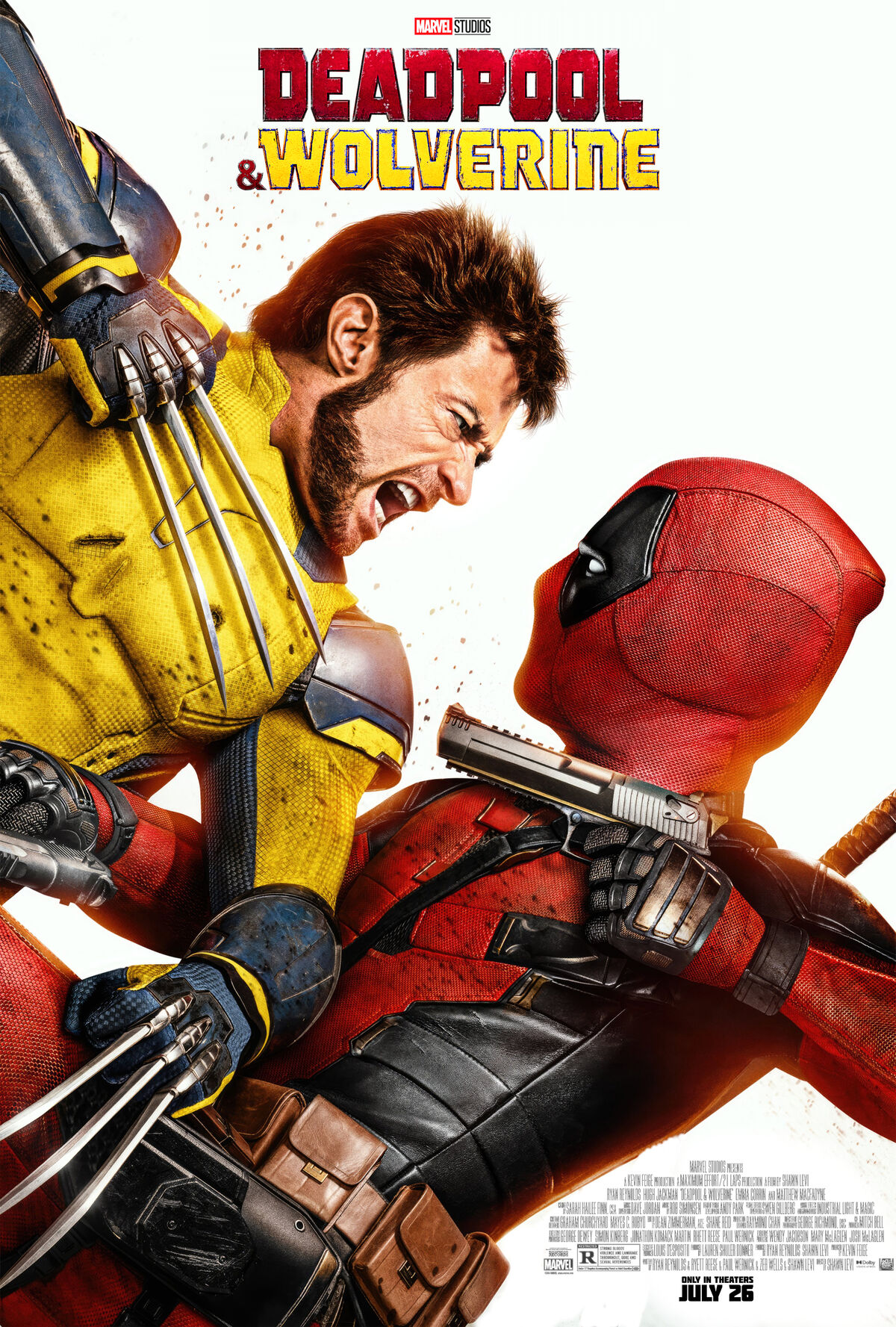
DEADPOOL & WOLVERINE movie review

Exhausting. Deadpool & Wolverine is a step down from its predecessors in terms of quality and cleverness of storytelling. While clearly intended to be a movie that reinvigorates the MCU, the screenwriting is both pandering and derivative. While effective in smaller doses, the hyper-meta humor is overplayed to the point of being obnoxious. Moreover, there are many gags that are recurring to the point of boredom. While expertly choreographed, shot, and edited, the endless barrage of fight sequences overstays its welcome. In terms of the premise, the whole multiverse idea that has been integrated into so many superhero movies (both MCU and DCEU) is overplayed. Had the movie been closer to 90-100 minutes, then perhaps the pacing would’ve been better and the Deadpool jokes, satire, and gags would not have felt overplayed, but the 2+ hours runtime works against the full potential of the narrative. If you can’t get enough of the Deadpool schtick, then you’ll undoubtedly like this movie. But if you were hoping for something as clever as the first two Deadpool movies, then you may be as disappointed as was I.

When the multiverse is threatened by a powerful Omega class mutant, Deadpool’s services are retained to protect the multiverse from complete collapse. In order to defeat this new deadly enemy, Deadpool teams up with the Wolverine, whom is recovering from psychological injuries.

Because of the movie’s setup, I had hoped that Deadpool and Wolverine’s goal would have been to eliminate all timelines except the sacred timeline (I guess that’s supposed to be the real/our world), putting an end to the multiverse, but that wasn’t the motivation or goal. So, I suppose that means the multiverse theory will continue steamrolling through this and other franchises. The whole multiverse theory needs to die. At this point, it is way past its half-life and rather limiting on the stories that can be told. Sounds counterintuitive, right? For how could a multiverse limit the stories that can be told? Simple. Everything is connected in a codependent sort of way. In a cinematic (including television counterparts) multiverse, no story, character, or plot is truly independent of the other; therefore, a filmmaker is unable to craft an original story; for any story involving the characters in a multiverse, has to fit in with the rest of the multiverse.

In a manner of speaking, a multiverse actually mitigates freedom of expression and variety of storytelling. When filmmakers return to crafting original expressions of stories and plots for comic book characters, then the quality of comic book movies may agin reach the levels of the Burton-verse. To this day, Batman 89 and Batman Returns are still the two best examples of superhero/comic book movies with X-Men the Animated Series being the best example of a superhero/CBM television series.

Fortunately, Hugh Jackman’s Wolverine’s gritty, no nonsense personality helps to balance out Ryan Reynolds’ manic Deadpool. While I have many reservations with this movie, I cannot deny the great chemistry between the two of them. Jackman’s X-Men the Animated Series inspired Wolverine was my favorite part of the whole movie. Partly because I grew up with X-Men TAS and have enjoyed the X-Men 97 series. Seeing that yellow and blue suit filled me with such happiness. Additionally, there are other nods to X-Men TAS and the Fox X-Men movies, including a particular surprise cameo that I know my friend Shawn of the Solving for X podcast will immensely enjoy! (If you’re an X-Men fan, then you should add this podcast to your lineup). What I liked most about this movie was the X-Men dynamic. Even though I have my reservations, I am curious how this newest iteration of cinematic X-Men will be adapted for the big screen. It is my hope that it will have the quality of storytelling of X-Men TAS that successfully addressed difficult topics in the real world both creatively and accessibly, all while bringing everyone to the table. Just as Professor X dreamed humans and mutants could engage in meaningful discourse one day.

Breaking the fourth wall and meta-humor can be effective tools for both humor and plot/character development; however, recurring pot shots and real-world references detract from the cleverness of the humor, and can ultimately take the viewer out of the movie. More so than the previous installments in the Deadpool franchise, this one is particularly packed with, what I am calling, hyper-meta humor. Hyper in that it’s so over the top and repetitive that it loses its charm quickly and grows stale. Most movies serve as a means of escape from the dullness, harshness, or complexities of reality; this is certainly true of superhero/comic book movies–or rather, was. I don’t know about you, but I don’t go into most movies hoping to be reminded of reality. Unless of course, for example, it’s based on a true story or a melodrama that is intended to evoke a real-world emotive response. So many of the jokes in Deadpool & Wolverine take me out of the movie, especially one recurring pot shot, that I won’t mention, that is borderline disrespectful of an historic Hollywood institution.

Despite most of the movie, in my opinion, to be lacking in genuine, clever humor, I manages to at least laugh here and there. The problem with a movie built entirely on the humor of middle school boys is that the move is ironically inappropriate for that same age group. When the first Deadpool released (by 20th Century Fox), they did the responsible thing by reminding parents that, even though this was a superhero movie, that its intended audience was 17+. I’ve yet to see an effort on Disney/Marvel’s part to remind potential audiences that this movie is rated R, and not appropriate for younger audiences due to the sexual innuendoes and language. Violence wise, other than the increased amount of blood, it’s on par with many PG-13 movies. When Deadpool hit the scene, he was different from that of most other superhero characters at that point, and his schtick was refreshingly funny; now, with the increased amount of middle school base humor in many comic book movies (mainly the MCU), it’s no longer refreshing and now borderline obnoxious. If I had to select one word that best describes Deadpool & Wolverine it would be obnoxious.

Ryan teaches Film Studies and Screenwriting at the University of Tampa and is a member of the Critics Association of Central Florida and Indie Film Critics of America. If you like this article, check out the others and FOLLOW this blog! Interested in Ryan making a guest appearance on your podcast or contributing to your website? Send him a DM on Twitter. If you’re ever in Tampa or Orlando, feel free to catch a movie with him.

Follow him on Twitter: RLTerry1 and LetterBoxd: RLTerry

TWISTERS movie review

Plot chasers. Despite the great chemistry between the leads of Daisy Edgar-Jones and Glen Powell, this cinematic storm is lacking the necessary elements in both thoughtful plotting and character development to form a compelling story. And while most of the special effects are excellent, it comes off feeling like one long storm chase. If it wasn’t for Edgar-Jones and Powell, I’d just as soon watch the Weather Channel instead. Twisters tries to be too many different kinds of stories, and isn’t successful at any one of them. There is an attempt at underscoring the outside-action narrative(s) with a heart-felt inside-emotional story, but even that isn’t fully developed. While there are some well-written scenes that will pique your interest, aside from the disaster porn dimension of the movie, there isn’t much here of any great interest.

Haunted by a devastating encounter with a tornado, Kate Cooper (Edgar-Jones) gets lured back to the open plains by her friend, Javi, to test a groundbreaking new tracking system. She soon crosses paths with Tyler Owens (Powell), a charming but reckless social-media superstar who thrives on posting his storm-chasing adventures. As storm season intensifies, Kate, Tyler and their competing teams find themselves in a fight for their lives as multiple systems converge over central Oklahoma.

The lack of a compelling narrative has far less to do with Lee Isaac Chung’s directing than it does Mark L. Smith’s screenwriting. No real surprise there since his other recent screenwriting credit is The Boys in the Boat, which also suffered from poor plotting and character development. While Joseph Koskinki receives a story-by credit, clearly he has demonstrated that he is a much better director (Top Gun: Maverick) than he is a writer. Both Twisters and The Boys in the Boat have a compelling story to tell, but the plotting itself (the map of how you get from beginning to end) lacks meaningful direction or focus. The movie sets up one story of overcoming trauma, then becomes a white collar vs blue collar story, then turns into a story about storm profiteering, which morphs into a melodrama about overcoming fear and guilt, just to finish as a romcom. All the while, the external goal of the story, which is setup successfully in the beginning, doesn’t get revisited and become clear until the third act. There is about as much narrative depth in Twisters as any given episode of Storm Chasers. Where is will give Smith, Kosinski, and Chung credit is that they didn’t choose to make this a “preachy” movie about ecoterrorism or climate change. Sometimes bad storm just happen. And that’s what makes them scary; there is no explanation.

Even though the themes of the movie are not very well developed, I like that Smith was trying to do with the subtext of the movie. Without getting into spoilers, there is an attempt at spotlighting how some people that appear that they are trying to help storm victims are actually more interested in profiting off the disaster. Which, I imagine does happen in real life. The movie also has something to say (and this was actually pretty well developed) about not judging the level of competence or motivation based on face-value or first impressions. The very people that look unprofessional may be even more professional and genuine than the ones that appear like they have it all together.

Other than some badly CG’d dandelion fuzz (which should’ve been done practically, c’mon). the rest of the special effects in the movie are excellent. Okay, so maybe excellent is being a bit generous, but I’m trying to give the film some credit for not putting me to sleep. I screened the film in Dolby Cinema, which is the best way to watch this movie because aside from the chemistry between the leads, the reason to watch this movie is for the storms and disaster porn thereof. Perhaps the story is on SyFy or Weather Channel levels, but the storm effects are executed very well. I was disappointed that we did not get a flying cow as a nod to one of the most memorable moments in the wildly popular original Twister. It’s well-known that the first movie literally built and destroyed houses to achieve the full effect and impact of the tornadoes, and it appears that Twisters used miniatures and models for some of the disaster scenes. Practical beats CGI nearly all the time. Also like the first movie, this one also appeared to integrate real footage of tornadoes and the disaster left in their wake.

The force that keeps this movie from falling completely apart is the chemistry between our leads of Daisy Edgar-Jones and Glen Powell. Playing Kate and Tyler, respectively, there is a throwback style (almost romcom-like) romance between the two in the vein of “will they, won’t they.” Even though Kate is our central character, it’s Tyler that receives more thoughtful development. Kate is largely the same from beginning to end, despite a great setup for overcoming trauma and guilt. Both of these characters (and their respective actor) keep this movie from falling completely flat. The playful chemistry between the two gives the film a human dimension that it is sorely lacking otherwise. Moreover, I like the fact that the budding romance between the two did not become the focus of the movie, but it certainly adds to the film in a constructive way. Both Edgar-Jones and Powell have an old-school charm that feel refreshing to see in contemporary cinema.

Whether or not you have recently rewatched the first movie, you can confidently go into this movie knowing all you need to know. There is little, if any, connection to the original 1996 blockbuster. For those that are super fans of the original, I imagine there are more nods to the first movie than that which I identified. If you’re looking for movie this summer to escape the heat with the whole family, then this is a good pick, but don’t expect much more than a mildly entertaining couple of hours.

Ryan teaches Film Studies and Screenwriting at the University of Tampa and is a member of the Critics Association of Central Florida and Indie Film Critics of America. If you like this article, check out the others and FOLLOW this blog! Interested in Ryan making a guest appearance on your podcast or contributing to your website? Send him a DM on Twitter. If you’re ever in Tampa or Orlando, feel free to catch a movie with him.

Follow him on Twitter: RLTerry1 and LetterBoxd: RLTerry