“Annihilation” film review

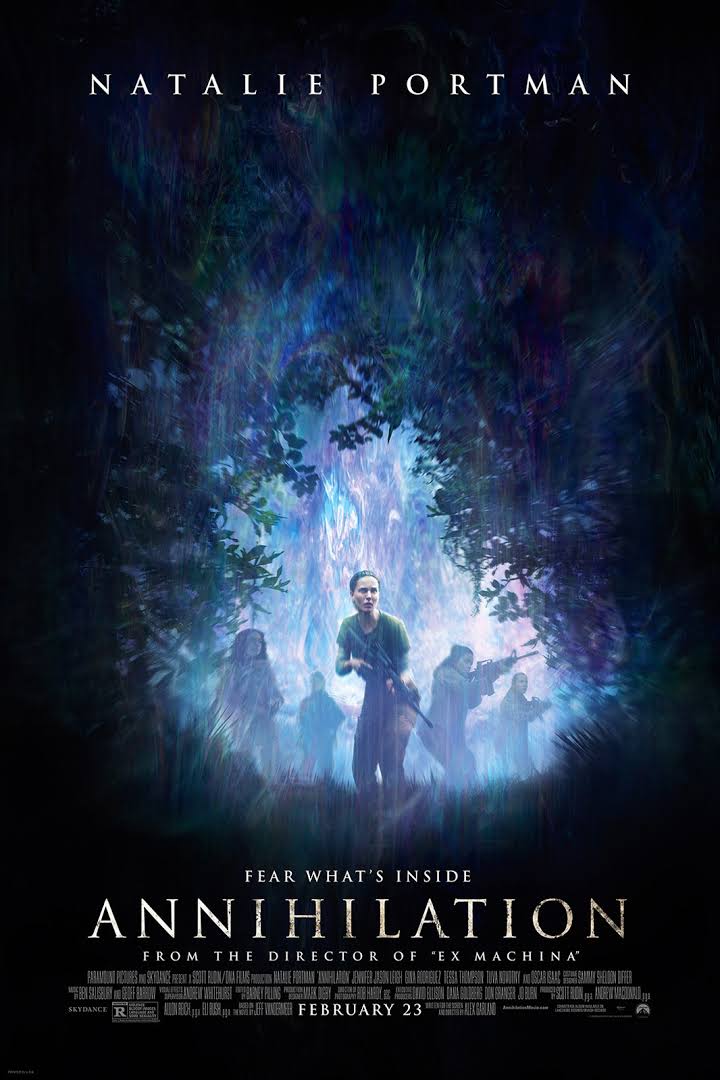
Outstanding craftsmanship that provides a trippy, surrealist experience! It’s been a long time since I’ve seen a horror science-fiction film like this one–one that harkens back to the manner in which Stanley Kubrick terrified audiences with his cinematic masterpieces. The brilliance of this film is the visually disturbing storytelling that’s built upon metaphysical and philosophical queries as well as Freud’s uncanny. Written and directed by Alex Garland (Ex Machina) and based upon the Southern Reach book series by Jeff VanderMeer, Annihilation boasts an all-female lead cast that takes the audience on a gripping, nail-biting adventure into the unknown that is frocked with wonder and tragedy. Falling in line with extraterrestrial films, this one exists somewhere between Alien and Arrival with influences from Kubrick and even Salvador Dali. Don’t wait for it to be released on Netflix internationally to avoid watching it at your local cinema; this IS a film best viewed, experienced, and enjoyed on the BIG screen–and not the 65in in your living room. For those who look for and appreciate science-fiction and/or horror films that explore psycho-social and institutional themes, then this is truly a film for you. Cognitively engaging and physiologically disturbing, Annihilation is a turbulent, horrific adventure.

After a mysterious meteor-like object strikes a lighthouse in Area X (most likely the swamplands of northwestern Florida), an increasingly growing membrane-like phenomenon is slowly swallowing up the land around it. When several paramilitary and scientific expeditions do not return from exploring the anomaly, biology professor Lena Kane (Natalie Portman) is aggressively recruited to work on the next team of scientists to track, report, analyze and potentially rescue former teams from what’s being called “the shimmer.” Professor Kane and her team have no idea that they will be facing their worst nightmares inside the shimmer as they explore this unknown world filled with dangerous opposition from the creatures that live within and the psychosis-like tension between the team members themselves.

Definitely not a film for the general masses. And you know what??? That is perfectly fine. In fact, that’s why this film works so incredibly well as an avant-garde-like science-fiction horror film. Had it directed for the masses, the film would not be nearly as stimulating psychologically and physiologically. Much like Garland did with the Oscar-winning Ex Machina, he crafts a world based on the best-selling series that takes the audience on a disturbing journey into the macabre, which juxtaposes the physical and metaphysical dimensions. Garland’s Annihilation is a masterful cinematic work that combines excellent writing with exceptional imagery and stunning practical effects. If Dali were alive today, this is the kind of film that he would have wanted to work on because there is such a heavy surrealist approach to the production design and visual effects. But this film is so much more than just the cinematic beauty of the motion picture. There are philosophical questions that one may ask oneself that create an added dimension of engagement that further immerses the audience into the world of the film.

Much like with Ex Machina, Garland shows an obsession with the need to see and see through when observing an unknown entity that may or may not be sentient. Paralleling how he set up the glass wall between Caleb and Ava (the AI) in the compound/lab designed by Nathan (Oscar Isaac, who is also in Annihilation), Garland sets up the interrogation room in which we are first introduced to Lena while she is being interviewed by the team in hazmat suits. I love the play on perspectives, vantage points if you will in both movies. That fluctuation between a filtered and unfiltered view of the phenomenon under observation offers much depth to the storytelling. In Annihilation, we are initially introduced to the shimmer, and world within, through sensors, readouts, and other “filters” but then we are thrust into the horrifying flora, fauna, and animal life without any type of protective boundary. Freud refers to the revealing of that which should remain hidden or the return of the repressed (which we literally get to witness in this film) as that which is uncanny (click for article). Just as our characters are constantly searching for clarity, you will find yourself paying close attention to the unknown to gain an unhindered understanding of what you are witnessing.

Not your average science-fiction horror film, this one will truly get under your skin–much like The Shimmer invades the bodies of those who choose to enter the dark twisted, refracted world of that which lies beyond our senses. Truly terrifying, this film is one for those who love a sci-fi horror that will prompt you to contemplate the themes and subtext of the movie. One of the quandaries that face the characters, and by extension, the audience is the idea of self-destruction versus suicide–the physiological versus the psychological components. For those who may worry that the film is “too intellectual,” the story is told in such a way that it not only appeals to film critics, academics, or horror aficionados but can be enjoyed by those who like a good, disturbing scare. The fact that there is the “intellectual” dimension to the film adds to the experience for those who appreciate that element in visual storytelling.
“Black Panther” movie review

A groundbreaking new perspective on the typical high concept superhero movie. Marvel’s Black Panther directed by Ryan Coogler is the type of movie that began with the desire to make a bold statement and then a narrative was built around the message. If you’ve heard it’s unlike any superhero movie you’ve seen before, then you’ve heard correctly. One of the things I’ve always appreciated about the Marvel universe (and DC by the same token) is the diversity of the characters. There are characters from a variety of backgrounds, creeds, cultures, ethnicities, etc that are represented in the characters. However, just because the characters were there does not mean they received reasonable screentime (or page time in comics). Up to this point, X-Men’s Storm (my favorite Marvel character) seems to be the only black character who receives comparable screen and page time to that of her white male or female counterparts. In a world that should teach us that our universe is a diverse place, filled with incredible people from a variety of backgrounds and origins, the representation of black heroes lagged behind. The beauty of Black Panther is not that is was simply created to finally give a predominantly black cast in a superhero universe the spotlight, the beauty is that the movie has something to teach everyone. There is a particularly strong message for young black boys and girls that their mythology is as fascinating as the Greeks and Romans, and that they can achieve greatness through teamwork, education, and loyalty.

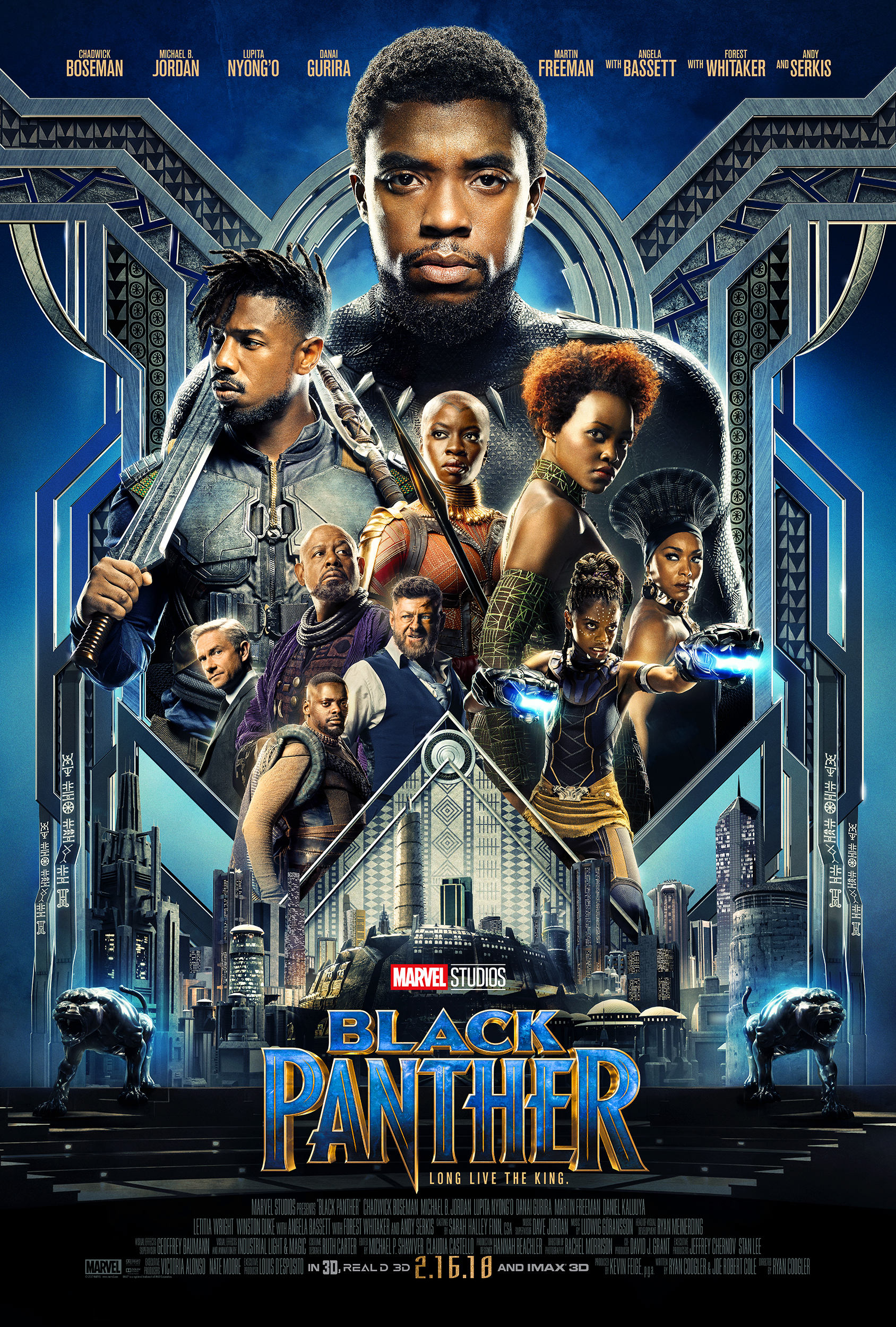
Chadwick Boseman plays King T’Challa, of Wakanda, the fictional African nation housing secret sci-fi technology, who must step up and embrace the weighty responsibility of his birthright after the assassination of his father. When T’Challa returns home Wakanda to take his rightful place as king, a powerful enemy suddenly reappears and challenges T’Challa’s claim to the throne — and as Black Panther — T’Challa gets tested when he’s drawn into a conflict that puts the fate of Wakanda and the entire world at risk. Faced with treachery and danger, the young king must rally his allies and release the full power of Black Panther to defeat his foes and secure the safety of his people. (IMDb)

Although there is a lot of technology in Wakanda (and by extension, in the film), the focus is not on gadgetry or superpowers but on how T’Challa can be a better king than his father who made a poor judgment call that ultimately cost him his life and put the land of Wakanda at risk of rape, pillage, and plunder. That is a message that resonates with everyone–we all want to strive to be better as we go through life. Perhaps we are trying to be better than we were as kids or maybe you are trying to be a better parent than yours were. Whatever the case, we can all place ourselves in T’Challe’s boots. There is also a powerful message regarding how isolation can be detrimental to society at large. Not that the film is advocating the loss of sovereignty–Wakanda is highly sovereign–but there is the message that a country with so much to offer should return some of that to the world in order to help create a better society, more opportunities for growth, and the sharing knowledge that can heal and protect.

The cast is incredible! So many talented performers who truly bring their respective characters to life. My only negative critique regarding the cast is the underused Michael B Jordan as the main opposition character. His charisma shines brightly on screen! But sadly, he does not get much screen time. He is the type of opposition character that you love to see, but unfortunately, you don’t get that much time with him. Although many may be quick to liken Black Panther to Captain America—and for good reason, both shoot straight and almost piously righteous–there is a big difference between the two–and it’s a good one. Black Panther is humanized by his endearing relationship with his brilliant sister Shuri portrayed by the delightful Letitia Wright. Honestly, she was my favorite character in the entire movie. Every moment she was on screen was outstanding. She was the only one who wasn’t bruting–always positive–and has the BEST lines. Just her character alone is enough to give the movie rewatchabiity. On the topic of dialogue, I would like to have seen a powerful monologue that embodied the message of the film and evoked strong emotion. There are emotional parts, but I think an acute moment would have done the film well.

The film opens with a beautiful long tracking shot of exquisite editing that has a mystical feel to it. The opening alone is enough to hook your attention for the remainder of the narrative. No surprise here that all the technical elements were exemplary. There were only a few times that the visual effects felt artificial. For all the action movie tropes in the film, it plays as more of a character-driven story than action-driven. And that’s the brilliance of Black Panther. Simple plot, complex characters–that’s what I tell my screenwriting students at the University of Tampa.

Intensely riveting, Black Panther is clearly a standout Marvel film distinguished from the others in the MCU. All the elements that give it the fresh take on the superhero movie genre work to its advantage. You’ll certainly be left with a lasting impression.

“I, Tonya” film review

Of skates and class. Margot Robbie stars as the first US woman to successfully land a triple axel…also the most infamous woman in the history of US Figure Skating in what is likely one of the most difficult and controversial biographical films ever produced. Tonya Harding is back in the headlines and on TV, and even on the ice if you caught last night’s 2-hour Truth and Lies special on ABC. While most Olympiad names are forgotten within a short amount of time, Harding and Nancy Kerrigan’s names will always have notoriety through the years. Nearly 25 years later, we find ourselves still talking about Tonya Harding. The biopic I, Tonya directed by Craig Gillespie and written by Steven Rogers provides audiences with an unapologetic glimpse into Harding’s early life through “the incident.” It is unlike any biographical film that I have ever seen before. Most often, biopics slant toward making the central character more likable than perhaps they were in real life. This film approaches Harding from the perspective of not shying away from her foul-mouthed, inability to take responsibility, violent temper; instead, showing us an authentic Harding who struggled through life to break the chains of classless poverty and emerge onto the scene as a professional figure skating record-setting champion. While this movie does not set out to prove what really happened, it does show what is likely to have happened. Although “the incident” is what everyone remembers, this movie shows a struggling young person attempting to change but thwarted at every angle by hearing that she cannot because she isn’t what America is looking for and has no class. But why couldn’t it have been just about the skating???

Tonya Harding (Margot Robbie) took to ice like a fish takes to water. She was an ice skating prodigy from the soft age of four when she took her first lesson from coach Diane Rawlinson (Julianne Nicholson). Growing up poor, she faced obstacle at every triple toe loop. From mental and physical abuse to sexual abuse, she weathered it all. Her mother LaVona (Allison Janney) was a monster of a woman who pushed and pushed in order to toughen “soft” Tonya. Even hot-tempered Tonya found love–albeit brief–with Jeff Gillooly (Sebastian Stan). The mental and physical abuse continued and only worsened after she set the world record for being the first US woman to successfully land a triple axel in 1991. But she would come in fourth in the 1992 Olympics. She fell into despair after that crushing defeat. When the US Figure Skating association gives Harding a second chance at the 1994 Winter Olympics, all seems like it is finally going her way, and she would finally experience the success she dreamt of her entire life, until “the incident.” Of course, as we all know, she went on to become a national punchline, material for comedians and sitcoms, and the most well-known name in the US after Bill Clinton.

Even though crime and ice skating are central elements in this film, it is truly a commentary on class and abuse. From the moment the movie opens with Harding and her mother smoking a cigarette at the ice rink in Harding’s hometown of Portland juxtaposing them against the pretty and proper coach with her students, we know that we are about to watch a story of class warfare. All Harding wanted was to excel at the sport she was naturally gifted at. Only one small problem: society and the figure skating association made it incredibly difficult–if not nearly impossible–for Tonya Harding to break free of her roots in classless poverty. But don’t allow the beginning of the film fool you into thinking she Harding is a kind soul who finds herself the underdog, she has a volatile temper and foul mouth that constantly gets her into trouble during practice and in competition. This film is an underdog story, but quite the unconventional one. Because we already know going in that she went from the first woman to land a triple axel, national champion to disgraced skater and unsuccessful boxer. For all its various plot points, the common theme throughout the movie is whether or not to allow your financial station in life to determine your behavior on and off the ice. Class has little to do with money, but rather, is a state of mind and demeanor. Perhaps we have a better idea of why Tonya behaved the way she did. The film never excuses her behavior or indirect knowledge (after the fact) of what her husband mastermind, but peels back the 24-hr 1990s news coverage in order to empathize and understand what made Tonya tick.

Is it possible for a square peg to fit into a round hole? Certainly, the life of a figure skater, especially one who represents the US on the global stage, is incredibly structured, polished, and constructed in such a way that the skater always looks his or her best to the public–a facade if you will. But, the once bright career of Harding serves as evidence that if you don’t come from the right family, have the right costume (or clothes), or speak eloquently, then the arena has no place for you. Perhaps that is why Harding still has fans despite her infamy. Although according to the film, she could have spoken up a lot sooner to help the investigation along instead of being fully consumed by having to make the 1994 Olympic team and indirectly covering for her ex-husband, she was dealt a dirty hand by judges and rivals who felt she just didn’t belong with them; and America generally liked an underdog. Unfortunately, this underdog got caught up in a scandal the followed a long history of irreverent behavior. The media coverage certainly did not help Harding’s case any. With the availability of CNN’s 24-hour news coverage, birthed out of the Gulf War now able to capture everything in order to have stories constantly grabbing audience attention, the film paints a picture that the media treated her unfairly and convicted her before the court’s decision to prohibit her from ever competing or coaching again, and the subsequent stripping of titles. Just some food for thought.

The topic of abuse is not shied away from in this film. We witness Tonya suffering from the brutal tongue of her mother, as well as constant physical abuse. Because there lacked the number of social programs for the protection of children and teenagers we have today, and schools were not as in tuned to abuse at home, she had little choice but to deal. Eventually, she would succumb to lashing out in similar ways to what which she experienced every day growing up in that house–house, not home. Her mother attempts to rationalize and excise her behavior because she tells Tonya that fear and anger will drive her to be a champion, but that doesn’t change the lasting affect the lifelong abuse had upon Tonya. It’s entirely possible that Tonya sought out Jeff because she was used ot abuse and felt that she needed it. Talk about warped.

The quality of this biopic is incredible! I absolutely loved the “interview” footage in the 4:3  format whereas the main narrative was in 16:9. Felt like we were watching actual news coverage in 1998. At first, I thought we were, but then I recognized Margot Robbie behind the exquisite makeup and costuming job. It has such an organic–no pretense–feel to the film. Robbie and her costars had me fully convinced that they were their respective characters. All around, the commitment to character was outstanding. Robbie commented in an interview that she studied footage of Harding for over a year, and it shows brilliantly! When the actual footage rolls at the end of the film, it is incredibly difficult to tell the real Tonya from her screen counterpart. Robbie’s monologue in front of the mirror is certainly one for the record books because of just how authentic and powerful it is. The production design and cinematography create a time machine; you will feel as though you have been whisked back 20-30 years throughout the film. Authenticity in spades. Director Craig Gillespie should be immensely proud of the film he crafted! Excellent writing, acting, technical elements. This biographic motion picture has it all. And will certainly get you to once again talk about Tonya Harding.

Highly recommend for those who enjoy controversial biographical films. The high profile critics are not exaggerating when referring to it as one of, if not the, best film of the year. There is so much to like, and for some, hate about this film. Whether you believe her to be criminal or not, there is no doubt that you will be blown away by the quality of this motion picture.

“Jumanji: Welcome to the Jungle” (2017) movie review

You know what, it’s actually good! I know, right??? For months now, many of us thought the sequel to the 90s classic was going to be a disaster. The truth is, this movie is incredibly well written, directed, and acted, and will ‘suck’ you right into the story. It’s been a long time since I’ve seen a movie that was this much fun to watch. In fact, Jumanji: Welcome to the Jungle has a high degree of entertainment value and rewatchability. Honestly, the only negative critique is that the stakes are not high enough because, at the end of the day, you know the characters are in a video game whereas the actual town was under attack in the original. Although this is a completely new story and fresh take on the 1995 film, there are enough nods and references to the original that keep it within the same universe. All the characters display excellent chemistry and are lovable! You have solid writing, characters that you love and love to hate, humor, and action! In short, it’s an excellent movie. I went into the movie expecting to laugh AT the movie, and my friend and I found ourselves laughing WITH the movie. Furthermore, I was worried about the movie having way too much CGI because the characters are in a video game, but I am delighted to report that there is, for all intents and purposes, little CGI compared to many other action-adventure films.   This movie goes to show that when you have well-developed characters with well-defined external goals opposed by external forces in a visually intriguing setting supported by effective direction that you have a recipe for a successful movie. I remember in the first movie the game directions “do not begin unless you intend to finish,” and those words were taken to heart because director Jake Kasdan began and finished well. Do yourself a favor, and catch Jumani: Welcome to the Jungle this holiday season with your friends or family!

“Last Flag Flying” film review

An all-star cast takes audiences on a memory journey of war, loss, friendship, and patriotism as genuine human emotions are dealt with through comedy and grief. Amazon Studios hits a homer again with the release of Last Flag Flying distributed by Lionsgate. Now in select theaters, writer-director Richard Linklater crafts an incredible motion picture that organically deals with the loss of a loved one during a time of war through the stages of grief and irreverent comedy between friends. While this film is currently flying under the radar, don’t allow that to dissuade you from watching this incredible war film. I cannot remember the last time that I saw a film that felt so genuine. Watching this film, I truly felt like a fly on the wall, watching a Vietnam vet deal with the loss of his son and reconnecting with some of the closest friends he ever had in his life. Last Flag Flying is a subgenre of war movies that places the camera at a distance from the characters and allows them to mourn and laugh on screen without interference from censors and other outsiders. While not a conventional war movie, the topic of war is found underlying many diegetic components. Dialogue driven, this film provides social commentary on patriotism, God, and friendship. Bring your listening ear to this movie because the context of the tough subject matter contains subtle yet powerful messages that highlight otherwise unstated emotions. Sometimes the best way to go through the stages of grief is to throw caution to the wind and allow humor to work its powerful remedy.

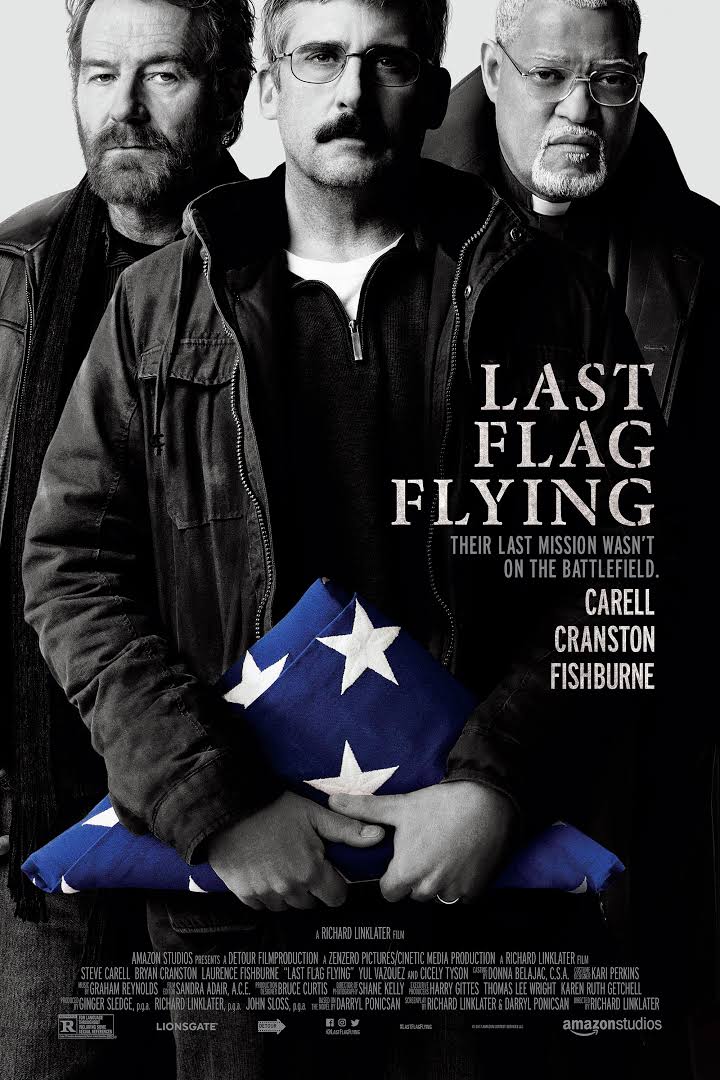
Three Vietnam war veterans reunite for a different kind of mission that forces them to deal with the present and the past. When Larry “Doc” Shepherd (Steve Carrel) arrives at the dive bar that belongs to former comrade Sal Nealson (Bryan Cranston), he asks his Marine brother to go with him without naming where. Sal drives Shepherd to a old country church now pastored by their Marine brother Richard Mueller (Laurence Fishburne). When Shepherd doesn’t touch his pale cobbler, the group realizes there is something wrong. It’s then the Shepherd reveals that his son was killed outside of Baghdad, and wants his two Marine brothers to go with him to bury his son at Arlington. Along the journey, the three former military comrades are forced to come to terms with their shared past that continues to shape their present lives by discussing tough topics such as grief, God, war, honesty, and addiction.

The sheer storytelling beauty of Last Flag Flying is found in the solid writing made evident through the excellent direction and A-list cast (and one surprising cameo that I won’t mention because it will detract from the brief but powerful screen presence). While it may appear like a somber tragedy on the surface, beneath that surface of sadness beats the heart of dark but respectful comedy that takes audiences on the memory journey right along side the characters. War movies about the loss of loved ones is not something new; but this film allows the characters to go through the stages of grief in organic ways that paints a motion picture of how human these emotions are. Human. Truly human. At times, there are no holds barred when three very different voices all converge on the same topic. You have the grieving father, a reverend, and foul-mouthed barkeep discussing everything, just as friends in real life often do. In many ways, these three former military comrades could not be any different in their present states; but at one time, they were inseparable and very much alike. While the focus of the film could have been on Shepherd’s loss or the politics of war, the focus is clearly on what makes us human and how one genuinely has to deal with loss due to war. Not that discussions of politics and religion are not found in this film–they are–but the discussions and arguments between these friends are used as tools to comment on the human condition. Because we never see combat footage, the expositional dialogue about war and politics adds incredible weight and a little mystery to the events in the film.

Before you begin to think that Linklater uses flashbacks to connect the present to the past, think again. While that would have been the easy, lazy way of accomplishing that task, he chooses to connect the present to the past through exceptional exposition between characters that prompt the audience to engage their own emotions to connect the pieces of the story together. Because we never shift between the past and present, the main story is always the main story. When constructing strong characters as we have this this film, it is the responsibility of the actors (though proper direction) to not allow the actor to get in the way of the character. Honestly, there are times that I see the individual actors eclipse the respective character, but most of the time, the audience will see the characters themselves throughout the dark comedy. The cinematography is simple, but perfect for the story within this motion picture. Linklater uses no gimmicks to tell this thought provoking story. The movie has an intimate feel to it because you can likely identify with one of the lead or supporting characters, especially when they are talking about “Disneyland” in Vietnam (you’ll just have to watch to understand why that’s in quotes). So incredibly genuine. No pretense about any of the characters in the film.

The content of this film truly reflects the tenor of the times in which we live. Topics of war, politics, and religion seem to be inundating us from all angles. It takes a special film to deal with each of those respectfully, candidly, and effectively. The trifecta of voices in this film allows the thought provoking conversations to transcend the screen and enter the minds of the audience. While working through his grief, there were times that Shepherd could have gone on an anti-military or anti-American rant, but he never speaks a negative word against anyone, though he is sometimes in immense pain. Patriotism, God, and the human condition are shown and discussed in quite unconventional and maybe even controversial ways; yet, the manner in which these topics are discussed, as it relates to Shepherd’s loss, are absolutely perfect. In a seemingly binary world where you are either a red-blooded patriot or you’re anti-American, with no room for nuance or discussion, this film provides the platform to begin to realize that we are first human before we take sides.

Although I did not care for Linklater’s Boyhood, I can honestly tell you that this film is one that you don’t want to miss. Whether you are in a military family or not, this film offers a glimpse into a world that many people have to face on a daily basis. The genuine, organic approach to the hard topics in this film allows the humanity to shine through. Not speaking for ALL veterans, but the vets that were in the screening last night had high praise for the film. And the rest of us had many positive remarks and feedback for the screener hosts.