Blumhouse’s “Upgrade” movie review

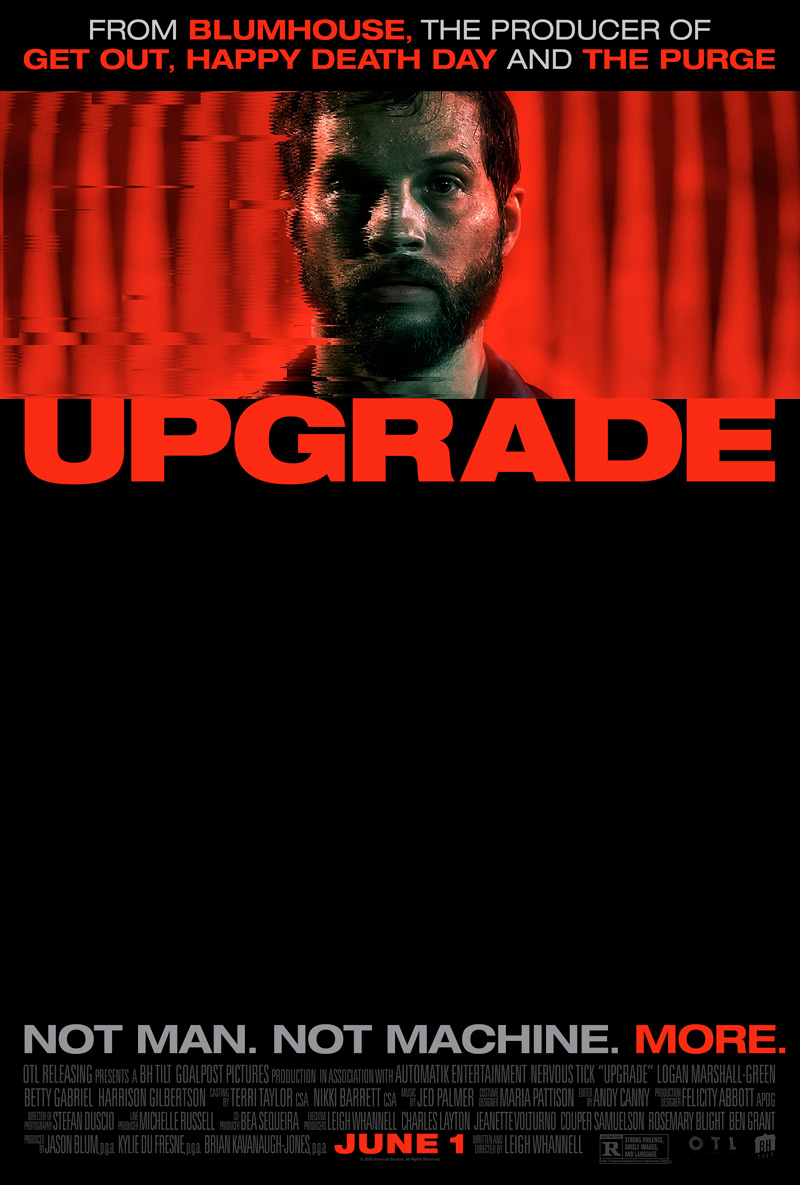
Black Mirror on crack. That is precisely what Blumhouse’s Upgrade can be likened to. Outstanding commentary on the convergence of humanity and technology that provides many thought-provoking moments. Best known for its horror, this action thriller from Blumhouse will have you on the edge of your seat the entire time. Rooted in classic science-fiction, this thriller will also deliver a healthy dose of dark comedy, heart-pounding action, and acutely shockingly violent scenes. Writer-director Leigh Whannel crafts a brilliant motion picture that is one part vigilante Robocop and another part Dr. Frankenstein’s Monster. On the surface, Whannel’s thriller comes across as a B-movie done well, but it contains prolific content that will likely inspire conversations about the relationship between humanity and technology. Perhaps it was not the intention of Whannel (co-creator of Insidious and Saw) to write a motion picture steeped with commentary on the human condition and a harbinger against allowing technology to fuse with our minds and bodies, but there is certainly material here to discuss those deeper topics. Bumhouse’s Upgrade is certainly a big screen experience, so catch it while it is there!

Set in the not-so-distant future, cars drive themselves, pizzas can be printed at home, and Alexa is built into your house. After dropping off a completely rebuilt 1980s Firebird Trans-Am at a client’s hosue, Grey Trace (Logan Marshall-Green) is left a quadriplegic following a brutal car accident and mugging that also leaves his wife dead. While recovering in the hospital, Grey is approached by a major tech company owner about an experimental surgery that is theorized to enable Grey to regain his motor skills. It worked! Only now, Grey’s realized that he has cat-like agility and reflexes as well as increased strength. With his newfound abilities, Grey seeks to assassinate those he blames for his wife’s death.

Better have an iron stomach in order to watch this thriller, because Whannel prefers shocking moments in abundance. Whereas this film is certainly not a horror–as the intent of the film is NOT to horrify audiences–it certainly contains elements borrowed from horror films in order in increase the level of threat. A director friend of mine from Germany characterized the film has having tones of a John Carpenter movie combined with Drive by Nicholas Winding Refn. Though set in a possible near-future, the cinematography, score, and lighting are quintessential 1980s. No surprise as 80s is en vogue in our movies and TV shows. Grey’s “everyman” character archetype enables audiences to identify with him quickly, thus root for him as he takes the law into his own hands to avenge the brutal death of his beloved wife. It’s the simple revenge plot that enables Whannel to build a complex character delivering dark humor and visceral violence.

Definitely an entertaining science-fiction thriller! If you enjoy TV shows like Netflix’ Black Mirror and movies like DriveHalloween, Frankenstein, and Robocop, then you’ll certainly like Blumhouse’s Upgrade.

“Life of the Party” movie review

Positively uplifting! Melissa McCarthy and Ben Falcone’s comedy Life of the Party releasing everywhere today is a quintessential Mothers Day flick that you can take your mom to and enjoy together this Sunday afternoon. McCarthy shines as the brilliant comic she is in this film. Whereas she is typically the brunt of the jokes in the film’s she and her husband often cowrite together, this film provides McCarthy with a platform to truly showcase her talents as a comedic actor who can not only play the butt of the humor but also the vixen who’s captured the eye of a hot frat guy as she sets out to complete her education. McCarthy’s brand of comedy–that authenticity, candidness, optimism–that we have come to know and love, will have laughing and empathizing throughout the movie.

Although themes such as inspiration, determination, and resilience are not uncommon for a comedy, I appreciate many tropes often associated with fish-out-of-water plots were abandoned for something more unconventional yet infectiously charming. Instead of ultimately changing herself for the world around her or changing the world to fit her, she finds her place in the world and creatively directs it to make room for her. Whatever your age, you will likely find yourself connecting with one or more of the characters in this film as it proves that you are never too old to learn something new or complete that which you chose not to earlier in life. From acoustic guitar tunes to Cyndi Lauper and even a surprise performance by Christina Aguilera, the music will have you dancing in your seat. Watch as nervous, scared girls who are afraid of unknown elements in school, grow to become incredible women who form meaningful relationships and heal from tragedy. Each of the principle cast is unique in some way, and it’s these traits that setup conflict and allow the comedy to flow from the conflict naturally. From McCarthy’s Deanna’s endearing vampire-like roommate who low key longs for a friendship to the girl who is also a non-traditional student because of being in a coma for eight years, the film is filled with a colorful cast of likable characters and of course Deanna’s ex and mistress who we love to hate.

McCarthy is joined by comedienne Maya Rudolph and the pair of them dominate any scene they are in together. It never feels overwhelming because they are both saying precisely what you and I are thinking. The two of them exhibit kind of friendship that perhaps your closest friend and you desire to have. Although there is a mild degree of suspense, the film derives most of its energy from the brilliant cast’s reactions to the varying conflicts throughout the film. As there is not much to analyze in this film, you’ll find this review far shorter than my usual ones. But, I desired to write up a piece on it because it’s been largely panned by most critics. Variety and I seem to be among the few who find so much that’s “right” with this film as opposed to what’s “wrong.” Maybe it’s not terribly deep, but it boasts a simple plot with complex characters that provides McCarthy with an opportunity to show a different side to her trademark comedy. With honors!

“Tully” film review

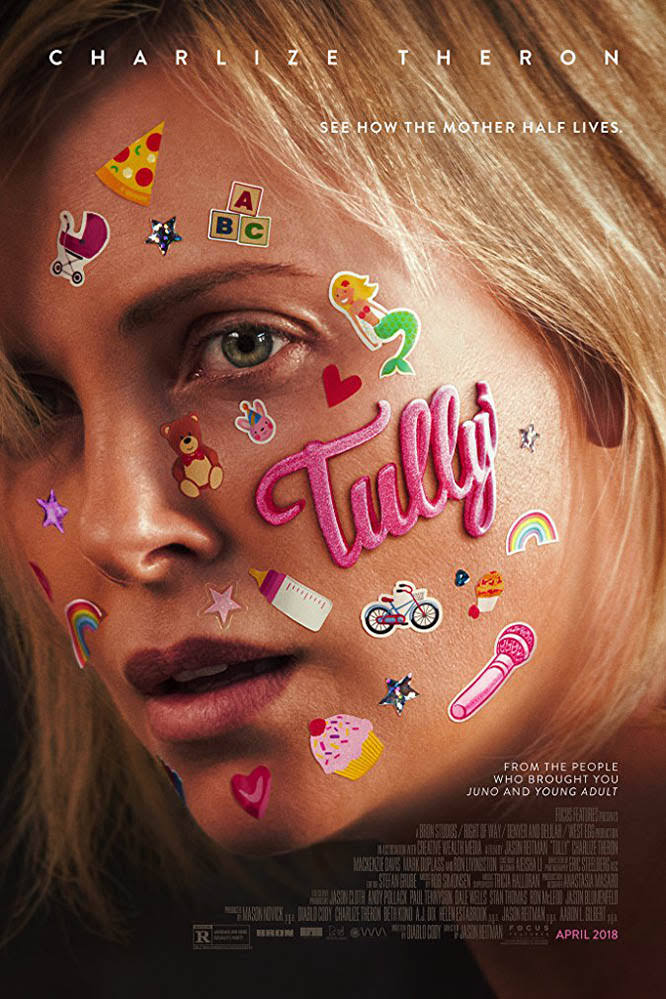
A no holds barred, unapologetic story of the realities of motherhood. Focus Features’ Tully starring Charlize Theron is a brilliant film that shies not away from what being a mom is truly about during postpartum depression, a subject seldom touched on in film or TV. Directed and written by Juno’s Jason Reitman and Diablo Cody respectively, this film represents the best work of Reitman and Cody since the groundbreaking Juno which was followed up by the outstanding Young Adult, and showcases just how incredibly diverse an actor Theron is. See her in a role unlike her typical roles as she so incredibly authentically brings to life a middle-class working mother who is faced with many obstacles as she rears her three kids, one of which is a newborn. As a male, I cannot begin to fathom just how difficult it is to be a mother (or by extension, a single father); but after watching this film, I have a whole new respect for the many hats that a mom has to wear in order to manage a household. Some might even say that this film is so incredibly effective at laying out the hardships of being a mom, that it may work better than more conventional birth control. However, the film is not only about the trials of motherhood, but it also spends time on the joys. Tully is what I characterize as a dark comedy that has some truly terrifying moments.

Already the working mother of two kids, one of which displays signs of a developmental disorder, Marlo (Charlize Theron) is not pregnant with baby number three, in what her brother identifies as an “unplanned pregnancy.” Marlo’s wealthy brother desires to help his sister by gifting her a night nanny in order to help Marlo through the rough transition of a newborn in an already chaotic house. Marlo’s husband is hardworking, makes lunches, and assists his oldest daughter with her homework, but fails to understand that Marlo needs to be taken care of as well. In order to not go completely insane during postpartum depression, Marlo reluctantly decides that she could use the night nanny that her brother offered to pay for. Hesitant to the extravagance of having a nanny at first, Marlo forms an unexpected bond with the unconventional, challenging hipster Mary Poppins named Tully.

No pretense about this story of motherhood. Cody’s brilliant penchant for self-deprecation, dry humor, and stark naked emotion is witnessed once again in Tully. I cannot think of a present screenwriter that could have created such a compelling story. Unlike her timeless modern classic Juno, Cody shies away from the comedy you may be accustomed to seeing from her, and focus on the darker side of being a mother. And it works superbly. I laughed, cringed, and cheered during the film, and so did many of the others in the audience. There is an authenticity in this story that is seldom seen in other melodramas. Possessing a raw, gritty narrative, Tully will have you empathizing quickly with the struggles Marlo continues to face throughout the film. There is so much that is praiseworthy in this story; but unfortunately the sharp, precision that supports the first two acts becomes a little dull during the realization (or resolution) on the third act–the same chutzpah that was in the DNA of the majority of the movie is not as apparent at the end. What Tully lacks is a well-defined external goal. The weak end game is uncharacteristic of Cody, as both Juno and Young Adult had solid realizations. As I tell my screenwriting students, dealing with life is not a goal (it’s incidental). Still, everything else about this film is effectively compelling.

Theron displays a genuine, uncompromising commitment to character in this motion picture. Aside from the fact she literally put on 50lbs for the role (that’s right, no fat suit), she provides audiences with a fearless portrayal that is both vulnerable and fiery. Coupled with waves of mania, anger, and complete exhaustion, Theron delivers a razor-sharp performance that will leave you breathless and bleeding from the unbridled intensity and emotional rawness. In this slice of life story, there was certainly the room to demonize Marlo’s husband, the sister-in-law, the former roommate, and school principal, but Cody includes these individuals that many moms actually have in their lives but chooses to focus on the physiological and emotional struggle of Marlo as she recovers from her unplanned pregnancy. Of course, there is a brilliantly funny scene of Marlo confronting the pretentious private school principal. It’s the kind of encounter that many of us want to have with those who refuse to shoot straight and annoyingly avoid confrontation because they are so afraid to be candid, and it just comes off as a facade. Theron’s ability to completely sell a mother on the verge of a breakdown who’s constantly facing situations in which she asks herself how-the-hell-am-I-going-to-get-through-this is unparalleled. I cannot think of another movie that has a character quite like Marlo in Tully.

The film’s title character is a Mary Poppins of sorts that comes to the aid of Marlo when she is at her wits’ end. You may be wondering why the film is named after the night nanny instead of Marlo. For the same reason Mary Poppins is the name of the story that is really about Mr. Banks. Marlo may be the central character, but Tully (Mackenzie Davis) is so incredibly instrumental in supporting Marlo through this time. Furthermore, she opens her mind to new possibilities and the joys of being a mom, even when Marlo isn’t feeling it. Tully embodies that free spirit that many of us have or had in our 20s that somehow gets lost as we get older. Tully enables Marlo to channel her younger self in an effort to be emotionally healthier for her kids. Taking care of yourself first so you can be there for your kids, is one of Tully’s many messages to Marlo. There is a whimsy about Tully that is contagious, and will put smiles on the audience’s faces amidst the majority of the film’s darker moments.

You’ll encounter all the different kinds of people that an emotionally struggling mom has to deal with on a regular basis. From an out-of-touch snobby sister-in-law to a husband who just doesn’t get you, from a pretentious and absurdly conflict aversive school principal to a former roommate, the film provides commentary on how each of these kinds of relationships affect a mom who’s trying her best to keep sane and not murder everyone. The film even touches on how having a kid with a developmental disability is physiologically and psychologically draining, even though you love your kid unconditionally. It’s important to note that Marlo’s husband is shown to be an active participant in his family by way of, not only his financial support, but being there for his kids in the evening and helping to make lunches. However, he does withdraw to playing video games after the kids have gone to bed; but that’s because he is like many fathers that are unaware that their spouses need to be comforted, cared for, and shown appreciation during this rough transitional time. Hopefully, after watching this movie, fathers will have a better idea of what their spouse may be going through. One of the strongest themes one can write into a film is a commentary on what it means to be human–the human condition–but seldom has a film been so specific to comment on what it means to be a mother. In this respect, Tully is provocatively groundbreaking.

Such a perfect film for the upcoming Mothers Day weekend. Even if you are not a mom or (let’s not forget) single father, there is something to learn from this film because you may have a mom or single father in your circle of friends or family. Never before has a film stripped away all the magic of motherhood at the time when your kids are little. No frivolous, ostentatious gender reveal parties, gym moms-to-be, or ridiculously lavish baby showers for this mom. Why? Because those are events and experiences typically found on Pinterest, in the movies, or reserved for upperclass society that is hasn’t a clue what it’s like to be a struggling mother balancing her full-time career and being a full-time mom. Tully tells it like it is for so many, and why it is such an outstanding motion picture.

Ryan is a screenwriting professor at the University of Tampa. If you like this article, check out the others and FOLLOW this blog!

Follow him!

Twitter: RLTerry1

Instagram: RL_Terry

Thrillz (theme parks): Thrillz.co

“A Quiet Place” horror film review

Heart-pounding. Spine-chilling. A creepy creature-feature that will leave you speechless. The demonstrable excellence in terrifying visual storytelling can effectively be summed up by the queen of silent film herself Norma Desmond, “we didn’t need dialogue, we had faces” (Sunset Boulevard). A Quiet Place truly earns its place among “certified fresh” horror films. Not since Don’t Breath and 10 Cloverfield Lane have I encountered such a thrillingly intelligent motion picture. Writer-director John Krasinski’s post-apocalyptic horror masterpiece showcases the power of visual storytelling within the horror genre. Furthermore Krasinski brilliantly channeled the soul of the iconic (mostly Universal Pictures) silent and early horror films for his modern interpretation of the creature-feature. No gimmicks here. Only a solid plot that builds an incredible, immersive cinematic experience upon the foundation of a simple plot with simple limitations. Simple plot, complex characters. That basic screenwriting principle is where so many filmmakers and writers go astray. Film is a visual medium, often supported by well-crafted, lean dialogue, and this film has visual storytelling in spades. This film represents one of the best examples of embracing the concept of “show don’t tell.”

Shhhh. Don’t make a sound. One family finds themselves surviving a post-apocalyptic world now inhabited by an alien species that hunts by sound.

There has certainly been a resurgence of exceptional horror films over the last few years. I mentioned Don’t Breath and 10 Cloverfield Lane earlier, we also have the Academy Award nominated Get Out from last year and many others. While many may shrug their shoulders at horror because it is a proliferated genre with many cheep, tawdry horror flicks, this same genre can be incredibly intelligent in how it makes an observation of society and offers commentary, a new perspective, or provides a means to a discussion. Some of the most critically acclaimed films over the decades have been horror. Being among the first films commercially released, horror has also stood the test of time and provides audiences with a experience that challenges worldviews, provokes physiological responses, and fuels nightmares and imaginations.

One of the most brilliant aspects to A Quiet Place is the film’s innate ability to instantly hook the audience with loud silence. Going into the movie, audiences know that the arachnid-like creatures kill anything within an earshot. Therefore, the audiences hang onto every bump, snap, or thud as the tension rises and suspense is drawn out to terrifying levels. Impeccable audience engagement. It takes a special kind of movie to completely immerse the audience into the world of the film in a multidimensional way. In terms of viability of the film and cross-promotion, this movie certainly has what it takes to be a popular and successful adaptation for a house at Universal’s Halloween Horror Nights or Busch Gardens’ Howl-O-Scream. Definitely has a place among the best horror film experiences to date.

The successful suspense and tension building can be attributed to seldom getting a good look at the alien-arachnid-like creatures. Had the audience seen the creature repeatedly throughout the film, it would lose fright value. As Hitchcock stated, “there is nothing scarier than an unopened door.” Meaning, the filmmaker’s ability to transfer the terror on screen to the minds of the audience is far more powerful and impressive than relying upon on-the-nose scares and jump-scare gimmicks. Well-crafted suspense and rising tension carries far more weight, and has the ability to support a narrative so much more effectively than a cheap scare. Although the atmosphere in this film may remind you of Don’t Breath, and rightly so, Krasinski’s film does not quite measure up to the macabre, terrifying atmosphere that Fede Alvarez provided audiences; however, Krasinski’s A Quiet Place is extremely close to the aforementioned and deserves the accolades that it has received.

In terms of how to closely read A Quiet Place, the film provides exceptional social commentary on the perils parenting and, by extension, protecting one’s offspring. In fact, I imagine that the experience for parents watching this film exceeds the levels of terror felt by those of us who do not have kids. There is also plenty of material on how far a parent is willing to go in order to protect their children. I also appreciate the film’s commentary on expected mothers, and how they stop at nothing to protect their unborn child from that which seeks to do it harm. Responding to and working through grave tragedy is another heavy and shocking subject matter in the film. We all respond to death differently; many of us grieve differently than one another. Some bottle up all the negative feelings for fear of how to deal with them, and others blame themselves because they feel that there is something that could’ve been done differently to protect a lost loved one. On a lighter note, the film also provides metaphor on how to work with and handle your older kids when they seek to push the boundaries–boundaries that may be dangerous and place them in harm’s way. There is so much here to talk about, and I have just touched on the surface. That is why horror is the best genre for creatively exploring psycho-social constructs and other observations about humanity and the world in which we live.

Quietly make your way to your seat in the auditorium. A Quiet Place is definitely a film to be experienced on the big screen with a theatre full of others who seek to be frightened. Enjoy the refreshing originality of a film that could have so easily went by way of so many other creatures features that lack anything memorable, and just blend into the background with countless others in this subgenre of horror. It may not have the well-defined external goal and end game of Don’t Breath, but it is certainly exciting and fun! You’ll certainly be absorbed into this terrifying post-apocalyptic world, where YOU are afraid to go bump in the night.

“Ready Player One” movie review

A spectacular journey that will have you on the edge of your seat. Ready Player One is a throwback to the classic Spielberg blockbuster films from the 70s, 80s, and 90s that many of us know, quote, and love. You’ll do far more than wax nostalgic in this film, because the focus is on the conflict at hand and not the pop culture references. Spielberg’s adaptation of the best-selling novel, written by Ernest Cline, takes on the challenge of crafting a visually compelling narrative that shows the benefits of virtual reality (VR) and gaming, juxtaposing it against the harshness of a reality following socio-economic and natural disasters in the near future. Although the story highlights the benefits of VR and shows the wonders of the imagination through the exquisitely designed scenes, there is one element seen throughout the story that transcends the illusion of Oasis (the virtual world); and that is humanity. Generosity of spirit and integrity are showcased brilliantly through the various central characters. I found myself, at the end of the movie, thinking about how much it reminds me of the magic of Willy Wonka and the Chocolate Factory. Never once, will you find an opportunity for boredom to set in. And you’ll find yourself rooting for this open source of entertainment and information to remain available to all those who want to participate, and not regulate content based upon how much someone is willing to pay.

From filmmaker Steven Spielberg comes the science fiction action adventure “Ready Player One,” based on Ernest Cline’s bestseller of the same name, which has become a worldwide phenomenon. The film is set in 2045, with the world on the brink of chaos and collapse. But the people have found salvation in the OASIS, an expansive virtual reality universe created by the brilliant and eccentric James Halliday (Mark Rylance). When Halliday dies, he leaves his immense fortune to the first person to find a digital Easter egg he has hidden somewhere in the OASIS, sparking a contest that grips the entire world. When an unlikely young hero named Wade Watts (Tye Sheridan) decides to join the contest, he is hurled into a breakneck, reality-bending treasure hunt through a fantastical universe of mystery, discovery and danger. (IMDb)

Pop culture, geek-dom, and nerd-dom for everyone! Whereas the book primarily contains 1980s references, the movie adaptation spans pop culture from the 80s to today. This was an important and strategically solid move in order to appeal to a wide age-range of movie-goers. Not being a gamer myself, I am unable to comment on the various references in the film and how they are placed perfectly in the narrative; however, I LOVE movies and TV, so I can definitely comment on those references, and they were spot on! Loved every one of them. And not just because these references were in the movie–anyone can just shove references and product placements into a movie without thought of the meaning or contribution to the plot–each and every movie or TV reference was selected specifically to fulfill a larger purpose and placed precisely where it needs to be. It would have been far too easy for the pop culture references to steel attention away from the plot, but the structure and pacing of the movie is such that the references enhance the experience without becoming sheer spectacle that could have been interpreted and pandering to audiences.

Of all the references, my favorite is Stanley Kubrick’s The Shining. That’s right. Return to the infamous Overlook Hotel during one of the quests to search for the Jade Key. The Overlook Hotel from Kubrick’s horror masterpiece (that was, interestingly enough, disliked strongly by Stephen King) was incredible. I felt that I was legitimately transported to the macabre setting in which we encounter unimaginable terror. This referenced worked particularly well because I cannot imagine another setting that could have been used in such an instrumental fashion. There are times in films that a location could be swapped out for another similar setting and achieve the same result because the plot is not predicated on it–essentially, the plot would play out just as well and effectively through another comparable location. The Overlook Hotel and specific events from The Shining (that I won’t go into because of spoiling the experience) were nearly as integral to the advancement of the plot as the characters themselves. No sooner could you replace The Shining sequence than you could the main turning points between Acts I/II and II/III. Although there are many excellent sequences to choose from in the movie, the series of scenes during the time spent at The Overlook are definitely my favorite.

It’s not often that an action-adventure or fantasy movie is deep enough to provide social commentary on real issues facing us in the real world or what it means to be human; but Ready Player One contains fantastic material for philosophical discussions regarding the current trends and challenges facing present-day society. The subtext of this movie contains material on human values, equitable access to content online, and the dangers of falling victim to only “existing” in a virtual world. Man vs technology, greed vs generosity are ways to look at the story, not to oversimplify the subtext. Because of the present crisis of the ending of net neutrality facing the United States, there is clearly a message that everyone has the right to equitable access to the universe of entertainment and information online. When a greedy capitalist attempts to disrupt that access and determine someone’s access based upon how much someone is willing to pay, we see that the system runs the risk of breaking down and not allowing for the joy that was once ran through the very framework of the virtual world. The film also provides audiences with commentary on the importance of actively participating in the real world to form tangible, physical relationships with others in order to find love and forge friendships. Furthermore, if a society becomes so fixated on avoiding the problems of the real world by transporting to a virtual world, then the problems of the real world grow worse, bigger, and more devastating than if society takes the time and effort to combat that which seeks to destroy our world.

Such an excellent movie! If you are a fan of the Black Mirror series on Netflix for its Twilight Zone approach to tackling tough subject matter involving the degree to which technology permeates our lives, then you’ll enjoy Ready Player One. I find that many elements of this movie feel like the San Junipero episode, and the successful show at large, because of the terrifying visions of the near future distorted by the abuse of technology. Thoroughly enjoyed every moment on the more than two-hour runtime. I was initially afraid that the movie would feel too much like a video game, but that is not the case. The design is such that the virtual world and real world feel just as tangible. Being that I am not a gamer, I don’t want to attend the cinema and feel that I am watching cut scenes from a video game, so this was handed extremely well. You’ll easily find characters that you can identify with and root for, and the opposition forces are well-developed too.