MICKEY 17 film review

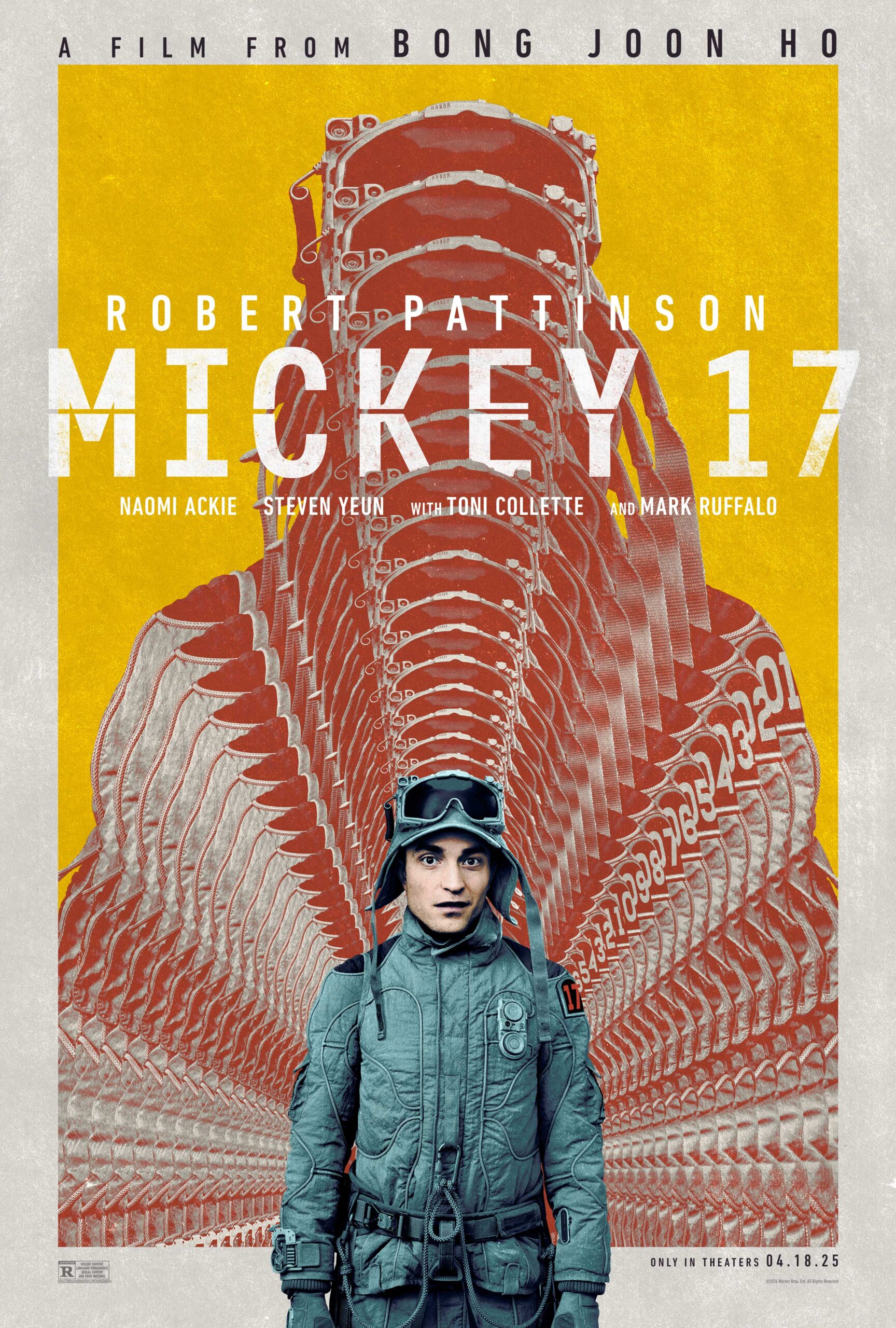
Ambitious but disjointed. Bong Joon-ho’s newest film Mickey 17 excels in technical achievement but the full impact of the story demonstrates greater concern for its satire, message, and world building than it does its plotting and structure. Blending multiple genre conventions, Joon-ho’s science-fiction, dark comedy begins with an intriguing premise underscores with existential questions, but ultimately doesn’t feel cohesive from beginning to end. Despite the exhaustive satire–which is entertaining at first–the film works excellently as a critique of the prolific mediation of society, obsession with the idea of self-made celebrity, and the camera fame. Additionally, it presents an exploration of humanity’s fixation on replication and surveillance. Perhaps the film doesn’t call out any particular app or platform, it certainly drives home the point that a monster can be created through obsession with one’s image, control, and manipulation of others.

Mickey Barnes (Robert Pattinson), a disposable employee, is sent on a human expedition to colonize the ice world Niflheim. After one iteration dies, a new body is regenerated with most of his memories intact.

Despite an intriguing premise, the narrative often succumbs to prolonged scenes and sequences, subplots that lack meaningful purpose, and over-explanation in come places whilst lack of purpose exists elsewhere. While the third act is strong and completely engaging, the first act is protracted and the second act is plagued by poor pacing brought on by a wandering direction. The protracted first act delays audience immersion into the core narrative. What would’ve served the plot better as a brief prologue, turns into most of the first act. Even though the film maintains a modicum of innovation and freshness, it struggles to sustain momentum, resulting in a clunky and disposable experience.

The film delivers a relatively strong performative dimension, which helps to keep the audience engaged–however weak the engagement–in the story. And, Robert Pattinson performance strikes a nice balance between nuanced and manic, which mimics the film’s darkly comedic tone. Between his and the other leading actors performances, collectively they add a rolling punchline to the monotony of many scenes and sequences in the film. Mark Ruffalo’s depiction of the authoritarian leader, Kenneth Marshall, is audacious and campy, but doesn’t take long for this performance to become exhaustive–a little goes a long way with Marshall. Playing Marshall’s wife is horror-fan favorite Toni Collette, and even her character overstays her welcome in most of the scenes in which she appears.

Both the plotting and character issues can be connected to the screenwriting, which lacks direction, purpose, and refinement. Mickey 17 is another example of a director with a great, even innovative movie idea, but should work with a screenwriter with a command of proper screenwriting conventions and mechanics to craft the story for the page, and eventually the screen. This issue is not unique to Joon-ho, but a recurring problem I find with many (if not most) writer-directors. Few directors can write as well as they direct; and the inverse is also true–few screenwriters can direct as well as they can write.

Mickey 17 serves as a critique of the mediation of society, wherein informative, entertaining, and surveilling media technologies devalue the individual resulting in individuality with dimension being reduced to a character or commodity to be traded and exploited for the sake of ratings and celebrity. Mickey’s existential crisis of repeatedly dying and being reprinted underscores the alienation experienced in a society that commodifies human existence. Furthermore, Keneth Marshall’s obsession with control and his self-made celebrity mirrors the obsession many have, in the real world, with their “celluloid” self–or more accurately today–their digital self.

Everything Marshall said or did was ran through an image consultant and production crew on how it would look on camera. Looking at the real world, each of those squared images on Instagram or vertical video on SnapChat or Tik Tok, only show an edited version of the subject–the framing and editing is specifically manipulated and articulated to shape the audience’s perception. While this is to be expected in motion pictures and television shows, many of these self-made celebrities and influencers on social media want the audience believe they are being authentic, when it’s all a facade. In this obsession with the camera and “framed” image, society is exchanging that which is real with a projected authenticity; furthermore, the lines between what which is real and that which is fictionalized (or augmented) are becoming increasingly blurred.

Bong Joon-ho’s Mickey 17 blends satire with science fiction but the film’s underdeveloped plot and uneven character portrayals prevent it from reaching the potential this film demonstrably had with the talent behind it.

Ryan is the general manager for 90.7 WKGC Public Media in Panama City and host of the public radio show ReelTalk about all things cinema. Additionally, he is the author of the upcoming film studies book titled Monsters, Madness, and Mayhem: Why People Love Horror. After teaching film studies for over eight years at the University of Tampa, he transitioned from the classroom to public media. He is a member of the Critics Association of Central Florida and Indie Film Critics of America. If you like this article, check out the others and FOLLOW this blog! Follow him on Twitter: RLTerry1 and LetterBoxd: RLTerry

BASIC INSTINCT (1992) a Throwback Thursday review

Still suspenseful and seductive! The Paul Verhoeven hypnotic neo-noir thriller continues to entertain and fascinate us more than three decades later. Exemplary direction, writing, and acting. Every storytelling element works flawlessly together to craft a film that was a cultural phenomenon and made Sharon Stone a household name. The heavily Hitchcockian-inspired film also contains characteristics of giallo that assault the senses and add a cloak and dagger quality to the string of mysterious, gruesome crimes. The effective use of red herrings and misdirection adds to the tension, keeping audiences guessing until the final reveal. Recently, I used this film in class, and my students, none of whom had seen it before, found it to be captivating, thoughtful, and provocative.

The mysterious Catherine Tramell (Sharon Stone), a beautiful crime novelist, becomes a suspect when she is linked to the brutal death of a rock star. Investigated by homicide detective Nick Curran (Michael Douglas), Catherine seduces him into an intense relationship. Meanwhile, the murder case becomes increasingly complicated when more seemingly connected deaths occur and Nick’s psychologist and lover, Beth Garner (Jeanne Tripplehorn), appears to be another suspect.

Basic Instinct both pays homage to and yet subverts expectations and tropes we have of film noir. This psychosexual suspense thriller draws inspiration from the works of Alfred Hitchcock and Dario Argento, particularly Vertigo, Psycho, and Suspiria in its exploration of manipulation, sexuality, and obsession. The use of shadowy lighting, ominous music, and morally ambiguous characters all contribute to the film’s rich noir aesthetic. That, coupled with unraveling the alluring mystery of the ice pic wielding killer, makes this a gripping sensory explosion motion picture tour de force.

Jerry Goldsmith’s phenomenal score plays a vital role in shaping the film’s atmosphere, mood, and emotional impact. Through its seductive melodies, tense rhythms, and character motifs, the music enhances the storytelling and helps to create a compelling and immersive cinematic experience. Whether accompanying intimate moments or intense suspense and violence, the music enhances the audience’s experience and adds an immersion to the storytelling. Goldsmith is an underrated composer because, not only did he deliver this seductive score, but he also wrote themes and music for Gremlins, Alien, Star Trek: the Next Generation, The Omen, and more. In addition to a prolific library of work in cinema and television, his compositions also demonstrate a wide rage of styles, unlike most other composers. When discussing great composers of the music of cinema, he should definitely be in the conversation.

At its core, this seductive film explores themes of obsession, desire, power, and manipulation. The film delves into the darker aspects of human psychology, particularly the blurred lines between love, lust, and violence. It also examines the idea of control, both in personal relationships and within the criminal justice system. In an analysis of the film, one of my students described it as a chess game, with Tramell being the white pieces and Nick being black. After all these years, I never thought to read the film as a chess match, each character attempting to out maneuver the other. While the film has long sense been thought of as an elaborate cat and mouse game, I feel my student offers a much more precise reading of the film as a chess game.

Sharon Stone’s iconic career-defining role as Catherine Tramell is characterized by her magnetic presence and undeniable charisma. From the moment we meet her lounging at her beach house by the waterside, she exudes confidence and allure, drawing others into her orbit with ease. Her character subverts stereotypes, presenting a complex and empowered female character of opposition whom is both alluring and dangerous. In every scene in which she appears, she delivers her performance with incredible gravitas. And it’s this performance by which the film owes so much of its enduring legacy. That interrogation scene alone, wherein she is simultaneously in complete control of the interview whilst embracing her sexuality is still one of the best single scenes of all time, especially when exploring feminist cinema.

She isn’t a strong female character because the men around her are weak or incompetent at their jobs, she is a strong character–period–because those that surround her are smart and driven. Yet, Catherine Tramell continually proves herself throughout the film to be cunning, calm, confident, and in control of any situation in which she finds herself. Suffice it to say, Stone’s Tramell is a complex and enigmatic character who embodies the archetype of the femme fatale, a seductive and dangerous woman who manipulates those around her for her own gain. The femme fatale represents a beautiful symphony of duality that continually draws us into the story.

Tramell’s sexuality is a central aspect of her character, and Stone portrays her with a sense of agency and empowerment. She is unabashedly sexual, embracing her desires without apology or shame. Stone’s performance balances Tramell’s overt sexuality with a sense of control and autonomy, challenging traditional gender norms and expectations. Tramell is a complex character that defies social norms and mores, wielding her sexuality as a means of empowerment in a male-dominated world.

In the film’s exploration of the darker aspects of the human psyche, both Nick and Catherine become completely consumed by their mutual attraction and psychological gamesmanship, blurring the lines between lust and danger. In many ways, they are mirror images of one another, which may explain the instant fascination each has with the other. The film explores the consequences of unchecked desire and the destructive nature of obsession. Moreover, the film explores heteronormative gender norms and that liminal space between personal and professional boundaries.

Tramell’s overt sexuality challenges Nick’s masculinity and authority, leading to a complex dynamic characterized by dominance and submission. This exploration of heteronormative gender dynamics adds dimension to their relationship and underscores the film’s themes of control and manipulation. One can even take this further to read the ice pic itself as a phallic weapon that Tramell has commandeered. She exerts control over the penetrative ice pic just as she has exerted control over Nick, or at least Nick’s perception of her. Concerning the manipulation of perception, this aspect to the plot and characters is a fantastic homage to Vertigo.

Michael Douglas’ performance of the deeply flawed detective Nick Curran may not get the attention that Stone’s Catherine Tramell does, but he delivers an incredibly strong performance of the recovering alcoholic and struggling sex-addict. Nick, a man whose moral and ethical compass is constantly being tested, struggles with his past and his predisposition to impulsive behavior. His vulnerabilities and inner demons make him a compelling character, as he navigates a dangerous world while battling his personal demons.

His attraction to Tramell blurs the lines between his personal desires and professional duties, compromising his judgment and objectivity. This vulnerability adds depth to his character, showcasing his susceptibility to manipulation. Throughout the film, Nick seeks redemption for his past mistakes, making his character journey one of self-discovery and catharsis. Nick’s experiences in the roller-coaster of an investigation provide him with the tools to confront his inner turmoil and ultimately finds closure. This character arc adds emotional depth to the narrative and allows the audience to empathize with his struggles.

Basic Instinct simultaneously checks all the boxes for neo-noir, and still manages to break ground! It’s a mind-bending, mesmerizing thrill ride from start to finish that continues to age beautifully like a fine wine. It’s a bold and controversial thriller that continues to captivate audiences with its exploration of sexuality, heteronormative roles, power, and psychological intrigue.

Ryan teaches Film Studies and Screenwriting at the University of Tampa and is a member of the Critics Association of Central Florida and Indie Film Critics of America. If you like this article, check out the others and FOLLOW this blog! Interested in Ryan making a guest appearance on your podcast or contributing to your website? Send him a DM on Twitter. If you’re ever in Tampa or Orlando, feel free to catch a movie with him.

Follow him on Twitter: RLTerry1 and LetterBoxd: RLTerry

TOP 10 FILMS of 2023

While this has largely been a 3.5 kind of year, there are a handful of standout films that left a lasting impression upon me in all the right ways. And here are my picks for the Top 10 films of 2023.

For a list of the Critics Association of Central Florida award winners and runners-up, click HERE.

10. COBWEB

Terrifying! Completely unnerving from beginning to end. The best horror film of the year! Everything works incredibly well from the atmosphere to characters to kills and even the jump scares. Go in as blind as possible because any information hinting at the plot may spoil the fantastic surprises.

9. CREED III

Heart pounding! Michael B. Jordan’s CREED III is an excellent, gripping motion picture! Quite possibly the best in the now-trilogy. Moreover, it is the first Best Picture contender in 2023. Reminds us that movies that focus on simple plots with complex characters are often times make for the best stories. The tertiary installment in the Creed series is a a revenge story on the backdrop of the power the past can have over us if we fail to face it in the ring. This moving story is certain to stir up the feels! 

8. JESUS REVOLUTION

Healing and uplifting. Jesus Revolution is a biographical drama that simultaneously depicts the past whilst critiquing the present. Based on a true story about the radical search for truth, comes a motion picture that is simultaneously concerned with critiquing our present world as much as it is depicting historical events. Through exploring the past, the journey’s true value is not merely a better understanding of the past, but the impact on our present world. The real power of this motion picture is the ability for it to use a story from the past as a provocative lens through which to understand the current state of affairs in both popular culture and the Church.

7. MISSION: IMPOSSIBLE–DEAD RECKONING part 1

Truly exhilarating cinema! Tom Cruise and the whole Mission Impossible team deliver what is likely the most epic movie of the year!! It’s thrilling, funny, and suspenseful from beginning to explosive ending! Part 1 is both a complete story and sets up Part 2 exceptionally well. If I am to be objective, Mission: Impossible III delivers the best story; however, audiences are still going to love this movie because feels like cinema in every measurable way. Move over James Cameron, Christopher Nolan, and yes even Martin Scorsese, for it is Tom Cruise whom knows how to deliver cinema to audiences.

6. AIR

Nothin’ but net! “AIR” is an outstanding biographical drama that will inspire anyone with a gut feeling, that they’re onto something great, to ”Just Do It!” The allstar cast shines brilliantly, and the screenwriting is excellent! Definitely look for this high stakes, high energy underdog story next awards season. Who would have ever thought that the origins of the single best known athletic shoe would have this much ‘sole.’ It’s funny, emotionally moving, and educational. More than the risky financial move that would either launch the struggling NIKE company to success or shutter the athletic division, this story is one of resilience. Resilience in business and in character. In many ways, this movie is “Mrs. Harris Goes to Paris” meets “The Social Network,” two films to which this one will undoubtedly be compared. Every scene in this film exemplifies exceptional screenwriting and directing. The story snaps, crackles, and pops.

5. MAY DECEMBER

Unnerving and spectacular! From start to finish, you’ll never know where the film will lead you, but you are in for one phenomenal ride! not sure. The moral decay underlying the relationships depicted in the film is both repulsive and intriguing at the same time. On one hand, you want to run away; on the other, you are sucked into the nexus of a relationship you want to be real and healthy, but you already know that it is not. Todd Haynes direction is exemplary and Sammy Burch’s screenplay is fantastic. This dark comedy is one that will deliver both laugh out loud moments and that which is dark and disturbing.

4. OPPENHEIMER

Sensational! Christopher Nolan’s highly anticipated cinematic spectacular Oppenheimer is an extraordinary motion picture that delivers a story as explosive as the subject matter. Not since Nolan’s earlier work on pictures such as Memento and The Prestige have I enjoyed both the form and function of his stylistic brand of filmmaking. Although the film chronicles the development, use of, and subsequent scientific and sociological affects of the A-Bomb, the story it really about the rise and fall of J. Robert Oppenheimer. Moreover, the subtext of the story is one that carries with it such commentary as the true cost of notoriety and serving one’s country and the destructive nature of unsubstantiated witch hunts. It’s a character-driven story more than it is a plot-driven story about the creation of the A-Bomb.

3. THANKSGIVING

I know what you did last Thanksgiving! Eli Roth’s Thanksgiving is IKWYDLS meets Jaws with a dash of Scream in a scathing critique of toxic, insatiable consumerism that is destined to be an instant holiday horror fave! Complete with great kills and stuffed with laughs, it’s a highly entertaining slasher! Eli Roth challenges audiences to ask themselves to what extent will they devolve in order to get 50% off a waffle iron. The slasher has a formula, and Eli Roth is serving it up in heaping helpings that simultaneously check all the boxes for the horror stable yet find ways of seasoning it with style and flare. While some non-slasher fans may get hung up on all the nods to classic slashers, it’s how Roth uses the homages and references that express his original recipe for this future holiday horror classic. Beyond the cleverness of the screenplay, Eli Roth has crafted a horror movie that is entertaining from the first course to dessert. Thanksgiving is a well-written and directed holiday slasher that delivers a clever story, thoughtful plotting, and fun characters. I can totally see the John Carver mask becoming one that you may very well see on Halloween along with Ghostface, Jason, Michael and the rest.

2. BLACKBERRY

Positively kinetic! This wildly entertaining biographical drama just clicks on so many levels! From beginning to end, the film commands your attention as it delivers razor sharp dialogue and outstanding performances. Whether you are a former CrackBerry addict like myself (2007–2011) or are fascinated by how the world’s first smartphone came to be, there is something for everyone in this film. There is a Greek tragic or mythological quality about this film as it reminds me of the story of how Icarus flew too close to the sun and had his wings clipped. BlackBerry was king of the smartphone world for however brief a time, but its impact upon the industry will be felt in perpetuity. But this movie isn’t about the history of smartphones per se or even the company Research in Motion itself, but rather three human stories of the men whom founded, developed, and (two of which) eventually crashed the company. So, it’s a very human story. BlackBerry simultaneously created a new communications device and completely re-imagined how cell service works on principle, even though the company went down in flames. The characters are fascinating and the story mesmerizing. Easily one of the year’s best films!

1. GODZILLA MINUS ONE

Pure cinema!! Not since the original Godzilla (and King Kong) has there been a better kaiju film. It has epic action, heartfelt character moments, and a story of redemption. Definitely my favorite film of the year!! Don’t miss seeing this one on the big screen. The movie is just as much (if not more so) a human interest piece as it is a monster movie. There is kaiju-sized heart at the center of this film. From both technical achievement and narrative perspectives, Godzilla Minus One is a truly outstanding motion picture, the likes of which we haven’t witnessed on the big screen in a long time. This is a surprisingly emotional story, delving deep into relatable themes focusing on the human spirit and survival in times of uncertainty and chaos. Furthermore, it’s a story of redemption that will tug at your heart strings as you become fully invested in the story and characters.

Ryan teaches Film Studies and Screenwriting at the University of Tampa and is a member of the Critics Association of Central Florida and Indie Film Critics of America. If you like this article, check out the others and FOLLOW this blog! Interested in Ryan making a guest appearance on your podcast or contributing to your website? Send him a DM on Twitter. If you’re ever in Tampa or Orlando, feel free to catch a movie with him.

Follow him on Twitter: RLTerry1 and LetterBoxd: RLTerry
MISSION: IMPOSSIBLE–DEAD RECKONING PART 1 movie review

Exhilarating! Pure, unadulterated cinema! Tom Cruise and the whole Mission Impossible team deliver what is likely the most epic movie of the year!! It’s thrilling, funny, and suspenseful from beginning to explosive ending! Part 1 is both a complete story and sets up Part 2 exceptionally well. If I am to be objective, Mission: Impossible III delivers the best story; however, audiences are still going to love this movie because feels like cinema in every measurable way. Move over James Cameron, Christopher Nolan, and yes even Martin Scorsese, for it is Tom Cruise whom knows how to deliver cinema to audiences.

Ethan Hunt (Cruise) and the IMF team must track down a terrifying new weapon that threatens all of humanity if it falls into the wrong hands. With control of the future and the fate of the world at stake, a deadly race around the globe begins. Confronted by a mysterious, all-powerful enemy, Ethan is forced to consider that nothing can matter more than the mission — not even the lives of those he cares about most.

After the massive success, both critically and financially, of Top Gun: Maverick I was curious to witness whether or not Cruise would pull off another cinematic hit. Suffice it to say, he did just that! The last remaining movie star, in the classical sense, Tom Cruise continues to deliver entertaining and thoughtful cinema. In an era overridden by form over function motion pictures (though, there is certainly a place for those stylistic films), Mission Impossible: Dead Reckoning Part 1 (MI7) proves that cinema is should generally concern itself with both the form and function equally. By sticking to foundational screenwriting conventions, pairing it with sequences that make the most of every square inch of that big silver screen, the entire MI team demonstrate why cinema is not only about the art of the narrative but also in a larger-than-life experience.

The entire auditorium was electric at the screening I attended. I don’t think I felt the level of kinetic energy at the cinema since Top Gun: Maverick. It even surpassed the high-energy of the more recent The Flash. Perhaps it is the combination of classical espionage/action plotting and epic-sized set pieces and locations. While MI7 feels very much contemporary, it also never forgets its roots in both the previous MI movies or in the original TV show. Of course there are those that will overly critique the dialogue, more specifically its lack of subtext, but I argue that it is on brand with and perfectly appropriate for this genre movie. Does that mean writers and directors should simply aim for status quo? No, MI3 proved that MI movies can be exciting and full of heart, complete with characters rich with dimension. But the dialogue should not significantly impact the overall experience of this movie.

Without getting into spoilers, the mission, should you choose to accept it, is to stop the character of opposition from unleashing a destructive artificial intelligence (AI) on the world. Talk about timely social and tech commentary. The film broaches topics such as truth (subjective/interpretive truth) and truth (as in universal truth). By extension, this same idea is carried over into fact vs opinion and predictive decisions (in the vein of Minority Report). In short, the crisis that Ethan is attempting to prevent is one that would completely disrupt, retcon, and violate the very informational fabric of life. Think Skynet. While I wouldn’t characterize MI7 as being inordinately deep or thoughtful, concerning truth and AI, it does posit these questions and subjects, which provides opportunities for more discerning audiences to discuss the advantages and disadvantages of AI. More specifically, the dangers of AI falling into the wrong hands.

The set pieces and locations are cinematic in both scale and scope. From the beginning of the movie on a submarine in the Bearing Sea to the Alpine vistas of Austria, the best way to experience this motion picture is in a premium format at your local cinema. Moreover, the biggest screen with best sound possible will make the car chases and Tom Cruise’s stunts all the more outstanding! Even though we’ve all seen that stunt in which Cruise launches himself off the mountain on a motorcycle in various promotional content for this movie, watching it in the third act of the film was still so incredibly impressive!

While Cruise performing most of his own death-defying stunts is unparalleled and impressive enough, what makes these car chases and stunts even more adrenaline-pumping is the fact so little CGI is used. Tom Cruise is literally launching himself off a mountain, and he (and others) are literally driving cars through the streets of Rome. The lack of overt CGI or relying upon it to take the real danger out of the stunt sequences removes just that–the danger. These stunt sequences are all the more exciting because they are real–there is little to no simulation employed. Not to over simplify, but the dimension of real beats the flat, lifeless CGI sequences every time. Real>artificial.

And that’s precisely what we have here real cinema! On a personal note, I am so incredibly grateful for Tom Cruise keeping cinema alive! He has demonstrated through Maverick and now with MI7 that he understands what it means to craft cinematic stories for the silver screen! Before you @ me, I am fully aware that cinema takes various forms, form intimate character studies to the avant-garde, but the power of a genre movie that follows screenwriting conventions should never be devalued. Genre movies are what helped build cinema, and folkslike Tom Cruise keep them coming to entertain and thrill us.

Ryan teaches Film Studies and Screenwriting at the University of Tampa and is a member of the Critics Association of Central Florida and Indie Film Critics of America. If you like this article, check out the others and FOLLOW this blog! Interested in Ryan making a guest appearance on your podcast or contributing to your website? Send him a DM on Twitter. If you’re ever in Tampa or Orlando, feel free to catch a movie with him.

Follow him on Twitter: RLTerry1 and LetterBoxd: RLTerry
MRS. HARRIS GOES TO PARIS motion picture review

A peerless delight! A throwback motion picture as exquisite as the House of Dior itself! Refreshing, uplifts the human spirit. A film to inspire dreamers and doers. Easily one of the best pictures of the year. Slip into Director Anthony Fabian’s meticulously crafted film that is sure to make a beautiful statement in any cinema! Lesley Manville delivers a command performance as the title character that will tug at your heartstrings. While the setting may be in the pretentious world of haute couture, this adaptation of Paul Gallico’s timeless novel takes audiences on a journey that is just as relatable and relevant as it is whimsical! When so many films depict the fate of the world at stake, preach a woke-filled sermon, or rely on showmanship over substance, Mrs. Harris Goes to Paris is an endearing fairy tale that feels very close to story in which we could find ourselves. Realistic enough wherein we effortlessly buy into the story with just the right about of fantasy that it serves as a much needed cinematic respite from the deluge of larger-than-life movies overcrowding cinemas across the country. Simple, yet complex. It’s a perfect drama that provides audiences with hope and hutzpah.

In 1950s London, a widowed cleaning lady falls madly in love with a couture Dior dress, deciding she must have one of her own. After working to raise the funds to pursue her dream, she embarks on an adventure to Paris that will change not only her own outlook — but the very future of the House of Dior.

Whimsical, yet relatable. Pretentious, yet authentic. That is the magic of Mrs. Harris Goes to Paris. Films depicting central characters setting out to realize a dream are in no short supply; the examples over the nearly 125 year of cinema are seemingly endless. But what makes this film so special is just how within arm’s reach it feels. Our central character of Ada Harris (Manville) is an everyman–one of us–fears, dreams, and all. She comes from a world not unlike the one in which you and I may find ourselves. Grated, we’re not all housekeepers, but we’re either presently or have been the invisible, under-appreciated worker within our respective vocational fields. We know what it’s like to have a dream, and work to make it happen. That’s the key here–work.

From the moment Mrs. Harris lair eyes on the Christian Dior dress in one of her employer’s wardrobes, she knew right then and there that she needed to own a Dior original! Not to impress others, but because it was so beautiful! For some, it’s a designer dress, for others it may be a particular automobile or work of art. We all dream of owning something that has special meaning to us–it makes us feel happy! But the real accomplishment is when it is the result of hard and smart work. Mrs. Harris is a hard, dedicated worker who values the blood, sweat, and tears it takes to provide for oneself or craft something beautiful for the world to see and appreciate. Mrs. Harris also reminds us that it’s okay to want something exquisite or beautiful because of how it makes (or we believe it will make us) feel. Treat yourself! Moreover, Fabian’s film also provides commentary on the dangers of placing one’s identity into material possessions or status symbols. There is a healthy balance, and Mrs. Harris lives that out! She is as beautiful on the inside as she is on the outside.

Lesley Manville’s Mrs. Harris is loved by nearly all whom meet her, because of her genuine spirit of kindness, graciousness, and generosity. Those whom have trouble with Mrs. Harris find her authentic spirit unfitting, disruptive, or something to be taken advantage of. When those with the best of intentions, come to disappoint Mrs. Harris. What I love about Mrs. Harris’ internal and external journeys is that they don’t simply fall into place through some deus ex machina methodology. She’s met with some serious setbacks and heartbreaks along the way. Even when you’re sure it’s gonna work out like it does in the movies, it’s more like one step forward and two steps back. But she doesn’t let that defeat her. Even her great apprehension about leaving her comfort zone, does not stop her. Still, she demonstrates inner-struggles when faced with the comfort of the status quo, or taking a chance on something wonderful!

Even though this movie harkens back to Hollywood’s feel-good movies in a post-WWII world, the characters are not one-dimensional caricatures from a bygone era. Our lead Mrs. Harris, her best friend, and Dior staff all have multiple layers about them…each goes on a journey of self-discovery paired with tangible goals. In others words, in screenwriting terms, each has a well-defined external goal and internal need driving the character. Is every character that well defined? No, but importantly the central and chief supporting ones are. Perhaps you’re a Mrs. Harris, maybe you’re a Natasha (the model), Mrs. Colbert (the legacy employee), or Mr. Fauvel (the accountant), You will likely find yourself as one of the prominent characters in the movie. It’s possible that you may be one of Mrs. Harris’ various employers (which will give you some pause to evaluate how you treat your employees).

Underpinning the A Story, is a story of worker exploitation. Even though the film could have spent a great deal of time on employer-employee relations, the backdrop of workers;’ rights serves as a conduit through which the film is able to comment on how employers should treat employees and even adapt with the changing times. It’s not a heady-handed message, and does come off a little hokey, but it works tonally in this film. There is a documentary by the title Dior and I, and I recommend watching it as a companion piece to this film as it will give you a greater appreciation for Mrs. Harris Goes to Paris. Furthermore, you may want to search for the 1992 adaptation starring Dame Angela Lansbury. Manville’s expression (and Fabian’s expression) of the character and story are not the same as the 1992 film, so you can appreciate both for all they respectively bring to this timeless story.

Between Top Gun: Maverick and Mrs. Harris Goes to Paris, we are seeing the power of timeless stories brought back to the big screen! That’s why these two films work as well as they do: some stories are just that–timeless. Each has a simple plot and complex characters, entertains and inspires. Both of these films uplift the human spirit in ways that seek to bring people together instead of dividing them apart.

Ryan teaches Film Studies and Screenwriting at the University of Tampa. If you like this article, check out the others and FOLLOW this blog! Interested in Ryan making a guest appearance on your podcast or contributing to your website? Send him a DM on Twitter or email him at RLTerry1@gmail.com! If you’re ever in Tampa or Orlando, feel free to catch a movie with him.

Follow him on Twitter: RLTerry1