
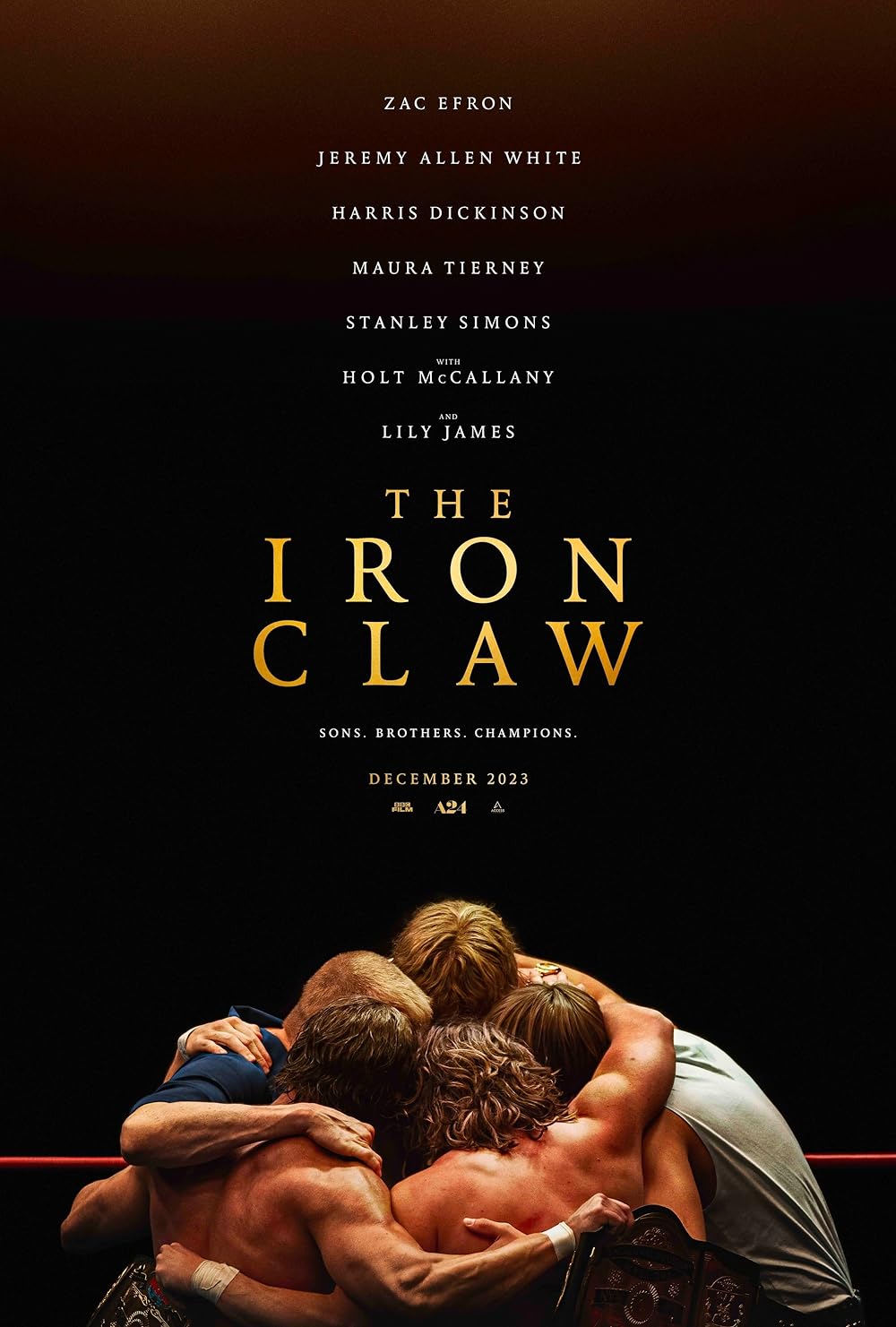
THE IRON CLAW film review

A compelling story with one-dimensional characters. The Iron Claw has all the ingredients for a masterpiece, but still misses the punch. My initial reaction to this film was an eagerness to like it much more than I did, for it was missing something. At the time, I was unsure what was missing, but the most likely culprit is the lack of character dimension and development. However, the film is saved from falling completely flat by the outstanding performance by Zac Efron. He has the weight of this film on his shoulders and it shows clearly throughout the story. Like with other sports-related biopics or sports movies, it’s not really about the wrestling; but rather, it is about the life of wrestling legend Kevin Von Erich and his relationship with his family and the tragedies that haunted them. It’s a film to watch for the excellent performance by Efron and to learn about the biggest competitor to the WWE from the 1960s-80s. Clearly the real-life story is incredibly tragic, but as it was expressed in the film, it leaves me with a feeling that there was a great film in there somewhere, but it unfortunately fell victim to lackluster screenwriting.

The true story of the inseparable Von Erich brothers, who make history in the intensely competitive world of professional wrestling in the early 1980s. Through tragedy and triumph, under the shadow of their domineering father and coach, the brothers seek larger-than-life immortality on the biggest stage in sports.

When I say I wanted to like this film more, I am certainly not alone. Most of the other critic in my screening had the same or similar reaction. We were in agreement that this film was missing something, but at the time, we did not know what that was. After much thought, I am left with the fault being in the screenwriting, specifically, the lack of character development. This is most noticeable during the three deaths (this isn’t a spoiler as this is based on real family). None of the deaths feel particularly impactful because we failed to spend a sufficient amount of time with any of the characters prior to the tragedy.

Most of our time is spent with Kevin Von Erich (Efron) and the patriarch of the family Fritz, They are the only two characters that are ever given anything substantive to do during the film. This is especially true for Kevin’s girlfriend/wife Pam Adkinsson (Lily James) and the Von Erich matriarch Doris (Maura TIerney). Neither character is given much to do; therefore, in most scenes, both ladies are unfortunately treated like little more than furniture. Yes, this is a story about the Von Erich bothers; however, your central cast is often only as interesting and dynamic as the supporting cast around them. You can remove either Pam or Doris from this movie, and it plays out nearly the same, until the very end.

While in real life, death can come at any moment, therefore there lacks a measurable buildup to the tragic passing, in a film, there is the creative latitude to both pace and structure the story in such a way that characters are developed sufficiently and there is adequate breathing room between deaths. When deaths occur occur in the film, it feels like a matter of fact. Yes, it is a factual event, but the deaths do not exactly emote much. Combine this with the lack of connection between the audience and most of the characters in the film, and it’s nearly impossible for the deaths to truly impact–suffice it to say–the deaths in this film are felt more or less cerebrally. You will find yourself thinking about them, but you won’t feel them to any great extent.

Saving the film from completely falling flat is the outstanding performance by Efron as Kevin Von Erich. We’ve seen Efron flex his acting chops in the past, but this role is certainly the most dramatic of his career. Not knowing anything about the real Kevin Von Erich, aside from what I learned in the film, it appears that Efron completely transforms into the wrestling legend. And I am not just talking physique, but mentally and physically he became Von Erich. In every scene, he delivers a nuanced performance that communicates in spades to the audience the weight of the world on his shoulders. Never once did I feel that I was watching Efron portray Von Erich, I felt I was watching Kevin Von Erich on screen. His performance and characterization of Kevin Von Erich will captivate you, and almost make you forget the film is lacking in the writing department.

Lastly, a theme that the film touches on, but fails to lean into more heavily is legacy; moreover, a cautionary story of what can happen when a parent attempts to live out his or her career or professional accomplishments through their chid even when the child is not necessarily gifted in the same way nor has the same goals and ambitions. Fritz Von Erich represents a toxic parenting trait of forcing kids to fit his mold and to accomplish what he couldn’t, thus allowing him to vicariously live out the dreams he never realized. The emotional and psychological (and sometimes physical) effects upon the child often end in negative growth because the child is rarely ever able to live up to the expectations of the parent demanding the child achieve for the family what the parents was unable to do.

If you’re a wrestling fan, I highly encourage you to watch The Iron Claw in cinemas, but if you are not particularly a wrestling fan, then it’s one that is still a good watch, but watching it at home will be sufficient enough. It’s an intimate film, but the family is larger than life.
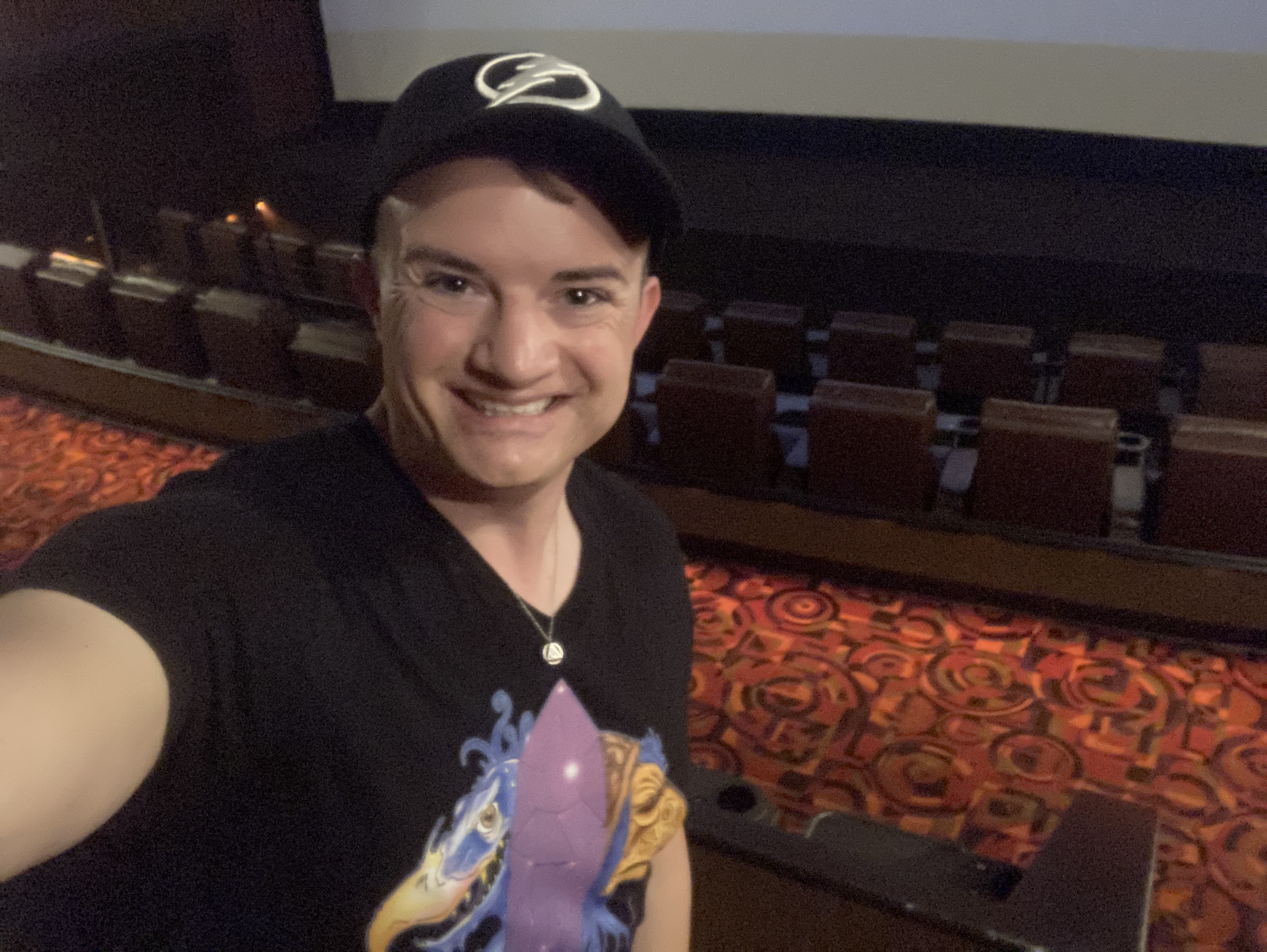
Ryan teaches Film Studies and Screenwriting at the University of Tampa and is a member of the Critics Association of Central Florida and Indie Film Critics of America. If you like this article, check out the others and FOLLOW this blog! Interested in Ryan making a guest appearance on your podcast or contributing to your website? Send him a DM on Twitter. If you’re ever in Tampa or Orlando, feel free to catch a movie with him.
Follow him on Twitter: RLTerry1 and LetterBoxd: RLTerry

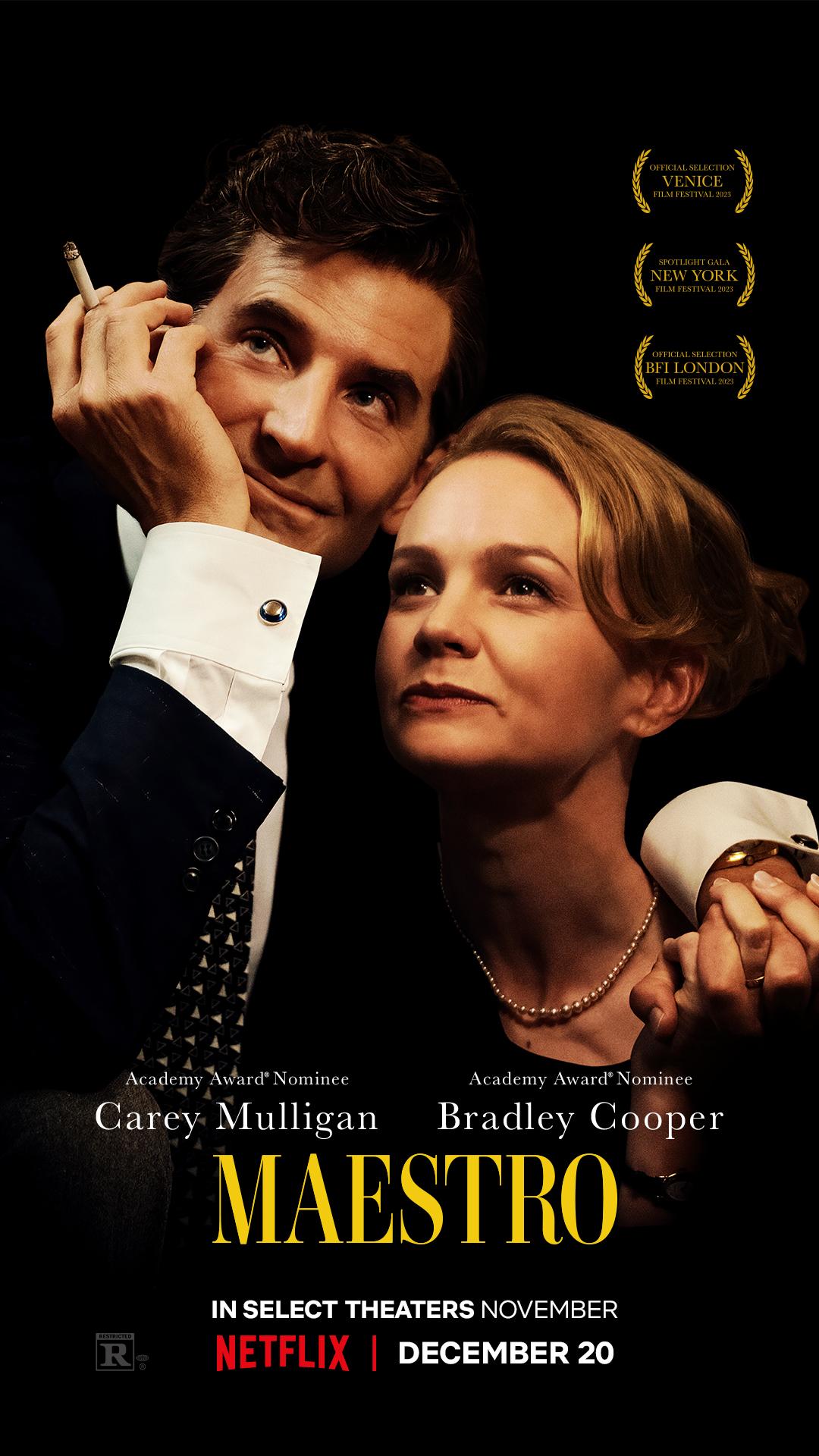
MAESTRO film review

Maestro‘s reach exceeds its grasp. Bradley Cooper’s biopic on Leonard Bernstein is an exemplary motion picture in many respects, but ultimately its potential for excellence is hampered by a disjointed screenplay. The performative dimension of the film is impressive, as is the emotive apparatus of the film itself. Furthermore, Cooper’s talent for the director’s chair is witnessed beautifully in most areas of the film except for the storytelling mechanics–not the story itself–but rather how the story is told. Another example of the dangers of being both writer and director (and in this case producer too). Most films need the checks and balances that come from having a different individual at the helm of writing, directing, and producing. If most of what you know of Bernstein’s legendary career comes from West Side Story, then you should read up on his accomplishments prior to watching the film, as it feels very inside baseball. There is a great story in this film, but the screenwriting mechanics hold it back from being truly outstanding.

Maestro tells the complex love story of Leonard and Felicia, a story that spans over 30 years-from the time they met in 1946 at a party and continuing through two engagements. It also chronicles the prolific and influential career of one of the greatest composers and conductors in American history.

The most striking dimension of the film is the apparatus of the film itself, the mechanics employed to visually craft the method of telling this story. The film starts in then-present day with an on-camera interview in color and widescreen, then as the film jumps back to the 1940s, it changes to a 4:3 ratio and is in grayscale (with a blue tint). As the story unfolds, the film transitions from 4:3 grayscale to 4:3 color to eventually 16:9 (if you will) color. To the casual observer, this was to signify time jumps alone–and to stop there would be limiting the art and affects of this tool. More than signifying chronology, it was used to spotlight the emotive dimension of the film as it evolves (or devolves, depending on how you look at it) from an old Hollywood conventional romance to post-modern subversive romance.

Bernstein goes from being in love with people to being in love with his music, but always in need of muses and people around him. He was almost never alone–he was scared of being alone. The irony in that is he simultaneously brought people together with his music but drove them away because his first love was his music. Beyond the montage of the film, this emotive apparatus incudes a complete score by Bernstein, and the inclusion of Bernstein’s music to accompany audiences along this journey was a brilliant choice to increase the intimacy of the story for audiences both familiar and unfamiliar with his library of compositions. Cooper’s use of a cinematic storytelling apparatus such as this, elevated mere storytelling montage for cause/effect chronology to that which communicates emotion and introspection.

Both Bradley Cooper and Carey Mulligan shine in their respective roles; moreover, Mulligan’s Felicia Montealegre-Bernstein is truly the heart and soul of this film. Not mere impersonations, both Cooper and Mulligan completely transform into the real-life characters they are portraying. The performances were so incredibly intimate and personal that the authenticity leaped off the screen. When they hurt, we hurt, and when they were joyous, we were joyous. While Leonard is the title role, the character with whom most in the audience will identify is Felicia. She is the conduit through which we experience most of this biopic. Furthermore, she is the character that feel the most human, because Leonard’s level of talent was so out-of-the-world that it is hard to connect with him to the same degree most in the audience connect with the unconventional romance of Felicia and Leonard.

On a more personal note, I found myself connecting with Leonard the most because there is a line from Bernstein in the movie that goes something to the effect of (and I am paraphrasing) “I am so many things, but society only wants me to be one thing. I cannot be that one thing because I am all these things, and to not be any one of them would be to deny who I am.” Despite the fact I feel that Cooper is as much a screenwriter as Sorkin is a director, this line is representative of the central theme in the film and one with which I identify greatly. For I too am so many things, but society wants me to pick (and be successful) at just one of them, but I cannot because I am all these things. I am a professor, academic writer, event planner, film critic, and public speaker. For me to not do any one of these things would be to deny who I am. On that level, this film felt incredibly personal.

With all these wonderful elements going for this motion picture, the film’s reach exceeds its grasp due to the disjointed screenwriting. I’ve said it before, and I will say it again, most directors are not screenwriters (and the inverse is also true). Very few writer-directors can do both jobs equally well. If for no other reason, a film built upon a writer-director lacks sufficient checks and balances to ensure the narrative mechanics are adequate for translating a story from the mind of a screenwriter to the screen of a director. And this is where I draw the inside baseball analogy I mentioned earlier. The full potential of this film requires audiences to be knowledgable in the career of Bernstein beyond West Side Story and Our Town.

The screenplay fails to start on common ground before its deep dive into the career and romances of Bernstein. For example, unless you are a student of music, it is doubtful that you were aware of his work outside of West Side Story and Our Town. Therefore, since that is most people, the screenplay should have established a common connection between Bernstein’s work and general audience members early on in the film. Then, once common ground was established, take audiences on the journey through his personal and professional life. His contributions to Broadway are little more than one-off mentions during the film. The pacing of the story also plagues the film as it provides few, if any, transitional scenes and simply jumps from time period to time period. The stylized editing and cinematography mentioned earlier in the review help to communicate chronology, but there is more to telling a biographical story than time and place.

Alfred Hitchcock stated to start every scene in a film as close to the end of the scene as possible and end the scene as soon as possible all while ensuring that something dramatic happens at the end of the scene (in screenwriting terms a button) that sets up the proceeding scene. Nothing should happen in scene B that wasn’t setup in scene A and every scene should in some way point to the end of the film. It is basic screenwriting conventions that are ignored in hopes that the stylistic apparatus and performative dimensions of the film will make up for the lack of care in the how the story is being told. Screenwriting is more than a narrative to be delivered on the silver screen, it’s more than dramatize don’t tell, it’s all of that plus how story is being told even before the first shot is filmed. Screenwriting mechanics (inclusive of conventions and guidelines) are important because they work.

Bradley Cooper’s Maestro is a beautiful-looking motion picture that attempts to capture the gravitas of the professional and personal life of one of the greatest composers and conductors in American history. While it’s no Amadeus or Mr. Holland’s Opus, it is a solid film that students and fans of his career will thoroughly enjoy. For those that may only know him from his contributions to Broadway, the film will still be interesting enough, but may not be as impactful without more in-depth knowledge of his career and life.

Ryan teaches Film Studies and Screenwriting at the University of Tampa and is a member of the Critics Association of Central Florida and Indie Film Critics of America. If you like this article, check out the others and FOLLOW this blog! Interested in Ryan making a guest appearance on your podcast or contributing to your website? Send him a DM on Twitter. If you’re ever in Tampa or Orlando, feel free to catch a movie with him.
Follow him on Twitter: RLTerry1 and LetterBoxd: RLTerry

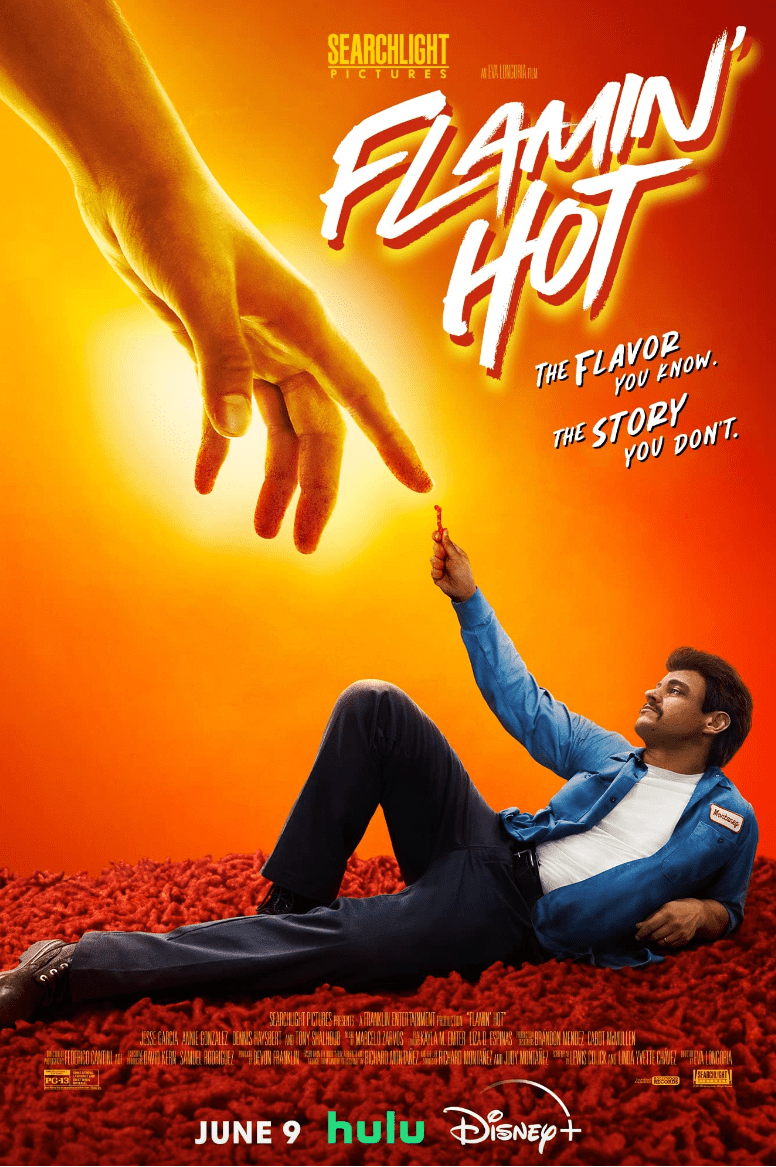
FLAMIN’ HOT movie mini review

Uplifting! Flamin’ Hot is a thoroughly enjoyable, motivational biopic that captivates audiences with the compelling story of Richard Montañez, the man who invented Flamin’ Hot Cheetos (and other Flamin’ Hot line items) and ostensibly saved his Southern California FritoLay plant from closure in the 90s. Directed by Eva Longoria and written by Lewis Colick and Linda Yvette Chávez, this movie delivers a more compelling story than AIR; however, Flamin Hot does not deliver as highly in the performative dimension. This is a movie for anyone that has ever felt like an underdog. Richard’s inspirational story serves as evidence that prayer, determination, resiliency, and refusal to allow one’s origin to determine one’s personal and professional destination, truly do work! Although the movie is tonally upbeat and even funny, it still affords intimate character moments. Structurally, the movie is well-paced and never hangs out in any scene longer than it needs. And it’s incredibly interesting! Just like AIR so successfully made the origin of a shoe captivating, the same can be said for Flamin’ Hot Cheetos.

If you’re seeking a picture that is inspirational, lean, and funny, then checkout Flamin’ Hot on Hulu and Disney+ starting June 9th.

Ryan teaches Film Studies and Screenwriting at the University of Tampa and is a member of the Critics Association of Central Florida and Indie Film Critics of America. If you like this article, check out the others and FOLLOW this blog! Interested in Ryan making a guest appearance on your podcast or contributing to your website? Send him a DM on Twitter. If you’re ever in Tampa or Orlando, feel free to catch a movie with him.
Follow him on Twitter: RLTerry1 and LetterBoxd: RLTerry

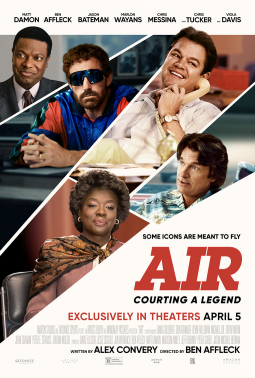
AIR movie review

Nothin’ but net! “AIR” is an outstanding biographical drama that will inspire anyone with a gut feeling, that they’re onto something great, to ”Just Do It!” The allstar cast shines brilliantly, and the screenwriting is excellent! Definitely look for this high stakes, high energy underdog story next awards season.

Sonny Vaccaro and Nike pursue basketball rookie Michael Jordan, creating a partnership that revolutionizes the world of sports and contemporary culture.

Who would have ever thought that the origins of the single best known athletic shoe would have this much ‘sole.’ It’s funny, emotionally moving, and educational. More than the risky financial move that would either launch the struggling NIKE company to success or shutter the athletic division, this story is one of resilience. Resilience in business and in character. In many ways, this movie is “Mrs. Harris Goes to Paris” meets “The Social Network,” two films to which this one will undoubtedly be compared.

Every scene in this film exemplifies exceptional screenwriting and directing. The story snaps, crackles, and pops, and the vision for direction is consistently building to the end of the story, with every scene delivering a well-defined setup–>development–>resolution.

Highly recommend watching this heartfelt motion picture!

Ryan teaches Film Studies and Screenwriting at the University of Tampa and is a member of the Critics Association of Central Florida and Indie Film Critics of America. If you like this article, check out the others and FOLLOW this blog! Interested in Ryan making a guest appearance on your podcast or contributing to your website? Send him a DM on Twitter. If you’re ever in Tampa or Orlando, feel free to catch a movie with him.

Follow him on Twitter: RLTerry1 and LetterBoxd: RLTerry

“The Eyes of Tammy Faye” Film Review

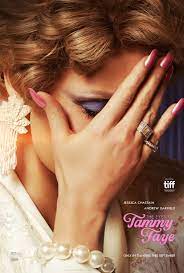
The Eyes of Tammy Faye will penetrate to your soul. You may think you know Tammy Faye’s story, but go beyond the tabloids in Michael Showalter’s (The Big Sick) heartfelt, hilarious, honest film that paints a humanizing portrait of the ridiculed and often parodied Tammy Faye Bakker. You will undoubtedly be blown away by Jessica Chastain’s jaw-dropping performance as the “Queen of Eyelashes” in this powerful rise, fall, and redemption story. Tammy’s eyelashes may be fake, but there is nothing fake about this candid portrait of the late television icon. Playing the mastermind of the PTL Network scandal is Andrew Garfield in a showcase performance that will have you despising Jim, but praising the uncanny portrayal. The film highlights Tammy Faye’s genuine love for God and her love for people–everyone! Even in the 1980s, when the LGBT community had little to no voice, especially amongst fundamental evangelicals, she was a loving voice for them. While it would have been so easy for the film to have been devoid of genuine levity, audiences will find there are some hilarious scenes that work as fantastic humanizing elements, especially early on when Jim and Tammy Faye engage their lustful adolescent interests as hormonally charged young adults and newlyweds. Showalter, Chastain, and Garfield deliver a fresh perspective on Jim and Tammy Faye Bakker that depicts human beings, not one-dimensional caricatures of televangelism.

In the 1970s, Tammy Faye Bakker and her husband, Jim, rise from humble beginnings to create the world’s largest religious broadcasting network and theme park. Tammy Faye becomes legendary for her indelible eyelashes, her idiosyncratic singing, and her eagerness to embrace people from all walks of life. However, financial improprieties, scheming rivals and a scandal soon threaten to topple their carefully constructed empire.

I already want to see it again! And it’s definitely becoming an addition to my physical media collection. This narrative film is based on the award-winning documentary by the same name, directed by Fenton Bailey and Randy Barbato, and I suggest watching it as a companion piece. In many respects, the storytelling structure of The Eyes of Tammy Faye parallels the approach Craig Gillespie took in I, Tonya. In addition to the awards-talk around the performances, I would look to see this film in other conversations such as makeup, screenplay, and perhaps directing and picture. Showalter’s film explores the world of Tammy Faye, as seen through her unmistakable eyes; furthermore, he treats the character (the person) of Tammy Faye with respect as a flawed but loving woman rather than the heavy-makeup-wearing satirical and parodied caricature that many remember from the tabloids. Perhaps the thousands of times she said “God loves you” may have came across as insincere; but the truth is, she wanted the world to know that God and Tammy both love them.

Showalter’s candid picture gives Tammy Faye and Jim the full treatment as he takes audiences on a journey through their story, including the scandal that rocked a nation, whilst treating them with dignity and respect as they are–as we all are–flawed humans. This biographic drama seeks to understand (mostly Tammy Faye, but a little of Jim too) the Bakkers, not mock them or their work. Tammy Faye is a breath of fresh air in an environment polluted by stale, lifeless, and downright rotten individuals. From the beginning of the film, you learn that her faith in God and love of Jesus was not going to be defined by her circumstances or what people thought of her. If you told her she couldn’t, she would prove to you that she could. That is a trait that she could continue through her entire life, even after her scandalous fall from grace. You also learn that while she lived an opulent lifestyle, she was never defined by her material possessions. Oh don’t get me wrong, she loved her signature clothing style and trademark makeup and hair, but those things did not define her or her faith. Well, except for her eyes. She said “if you remove my [fake] eyelashes, I wouldn’t be me.”

While her husband was pulling the strings, she was doing everything she could to reach people for Christ; however, it was also clear that she loved the performance, the camera, and the microphone. If she hadn’t gone into televangelism, she very well could have been a Broadway star with her larger than life showmanship and personality. We also learn that Tammy Faye was likely unaware of the dishonest and illegal dealings of her husband, even though she at times suspected he wasn’t being honest. Chalk it up to extreme naivety. Despite no reports of Jim being physically abusive to Tammy Faye or their two kids, he was shown to be psychologically and emotionally abusive to Tammy Faye. Even to the extent that he used Tammy’s minor indiscretion with a Nashville music producer against her, to humiliate her on international television in an effort to raise more money because of her testimony. Tammy’s flirtation with the an elicit affair goes to show that we are all flawed individuals that toy with or fall victim to the same temptations, in whatever form they take. But we understand how and why Tammy Faye was tempted to search for love elsewhere; she was not appreciated as a person by Jim, but only as a tool to get more money out of PTL’s “partners.” Even when the reality of Jim would peak through, she never let that detour her from spreading the love of God to everyone in her signature style.

While we ostensibly watch the events of the rise and fall of the Bakkers through Tammy Faye’s eyes, in a similar fashion we did in I, Tonya, we also get glimpses of the story through Jim’s perspective when it serves to advance the emotional journey of the characters, especially when it comes to his complicated relationship with the then and now unlikable Pat Robertson and Jerry Falwell. For example, I did not know that it was Jim and Tammy Faye that started the 700 Club. But when the innovative Christian talk show became a popular program on the fledgling CBN Network, Pat Robertson placed them on a maternity/paternity sabbatical, but was actually steeling their show in a jealous power-grab. The Bakkers then started what would become the TBN Network, but were ran off from there too. Finally, they began the PTL Club (later massive, worldwide PTL Satellite Network), and the success of that venture would eventually spawn a 24-hour network, neighborhoods, and a theme park that would become the third most visited in the country after Disneyland and Disney World.

While PTL was growing by leaps and bounds, Robertson and Falwell were seething with jealously at the success of Jim and Tammy Faye, a motive that comes into play when they discover the payment of PTL funds for the hush-money regarding Jim’s affair. Little did Tammy Faye know that Jim surrounded himself with a conniving mafia-like group of “Christians” that sought to take down the power couple after they departed from the Robertson-Falwell fundamentalist agenda. This mafia-like mentality is most apparent when Tammy Faye televises the emotional interview with a gay AIDS patient, also a Christian pastor, on her show. She ends the interview with reminding the viewers that Christians are called to love as Jesus loved. It was shortly after that, that Robertson and Falwell actively looked for ways to dethrone the king and queen of televangelism. Of all the examples of Christians in the film, amongst the lead and supporting characters, Tammy Faye is the best example of how a Christian should love and act.

Chastain has instantly shot to the front of the Best Actress in a Leading Role category, and Garfield may find himself in the Best Actor conversations as well. Chastain disappears behind the trademark Tammy Faye makeup and delivers a larger than life performance! And since Tammy Faye, herself, was the definition of camp and larger than life, it’s an incredibly authentic, sincere performance. It’s easy to see how the LBGTQ community was drawn to the person of Tammy Faye then and now, because the LGBTQ community often greatly admires women who remain strong in the face of adversity. But Chastain’s performance of the person of Tammy Faye will undoubtedly inspire and win the admiration of all kinds of people from all walks of life. While Chastain is brilliantly portraying the character of Tammy Faye, we learn in the film (and in the documentary, the interviews, and PLT flips that many will undoubtedly pour through after leaving the film) that Tammy Faye wasn’t a character at all but one of the most genuine, sincere loving people that ever walked the planet. Chastain captures every nuance of Tammy Faye with uncanny precision.

Even the indelible Cherry Jones as Tammy Faye’s love-to-hate mother that was so often Tammy Faye’s harshest critic may be in the supporting actress conversations. She’s a scene steeler herself, much like Allison Janney was as LaVona Harding in I, Tonya. All the lead and supporting performances are perfectly executed, and the hair/makeup on everyone leaves an uncanny resemblance between the actors and the real-life people that are being portrayed. If Tammy Faye was still alive, I feel strongly that she would appreciate the film. Her son Jay appears to like the film from what I’ve read of his comments.

I’d be remiss not to mention, what is perhaps the most telling scene of who Tammy Faye was. Months or perhaps years after the collapse of the PTL Empire and all her fine things were sold (and house actually burned to the ground), and she’s driving a crappy Honda Accord and living in a rundown apartment, she pulls into her parking spot one day. And she gets out, she hears a few of the neighborhood punk teens making fun or her. She walks over to them, and graciously says, “if you’re going to talk about me, since I am your neighbor, you should at least shake my hand and meet me first; hi, I’m Tammy Faye” (or something to this effect).

What we have here is a brilliantly produced biographical drama that works as trifecta comprised of a cautionary tale, a redemption story, and film that provides social commentary on topics such as politics, religion, and patriotism as our country is becoming increasingly polarized on these subjects.

This image has an empty alt attribute; its file name is profile_pic.jpg

Ryan teaches American and World Cinema at the University of Tampa. If you like this article, check out the others and FOLLOW this blog! Interested in Ryan making a guest appearance on your podcast or contributing to your website? Send him a DM on Twitter or email him at RLTerry1@gmail.com! If you’re ever in Tampa or Orlando, feel free to catch a movie with or meet him in the theme parks!

Follow him on Twitter: RLTerry1