TEENAGE MUTANT NINJA TURTLES (2023) movie review

Cowabunga, you’ll have fun! Whether or not you grew up with the Teenage Mutant Ninja Turtles (TMNT) 1980s animated television show, the comic books, or even the other movies, there is so much to be enjoyed in the new TMNT movie. At just over 1.5 hours, you’ll be invested in this Mutant Mayhem that functions as a standalone origin story, plus a foundation from which to launch subsequent sequels. While Shredder is not the villain, stick around for his subtle debut in a mid-credits scene.

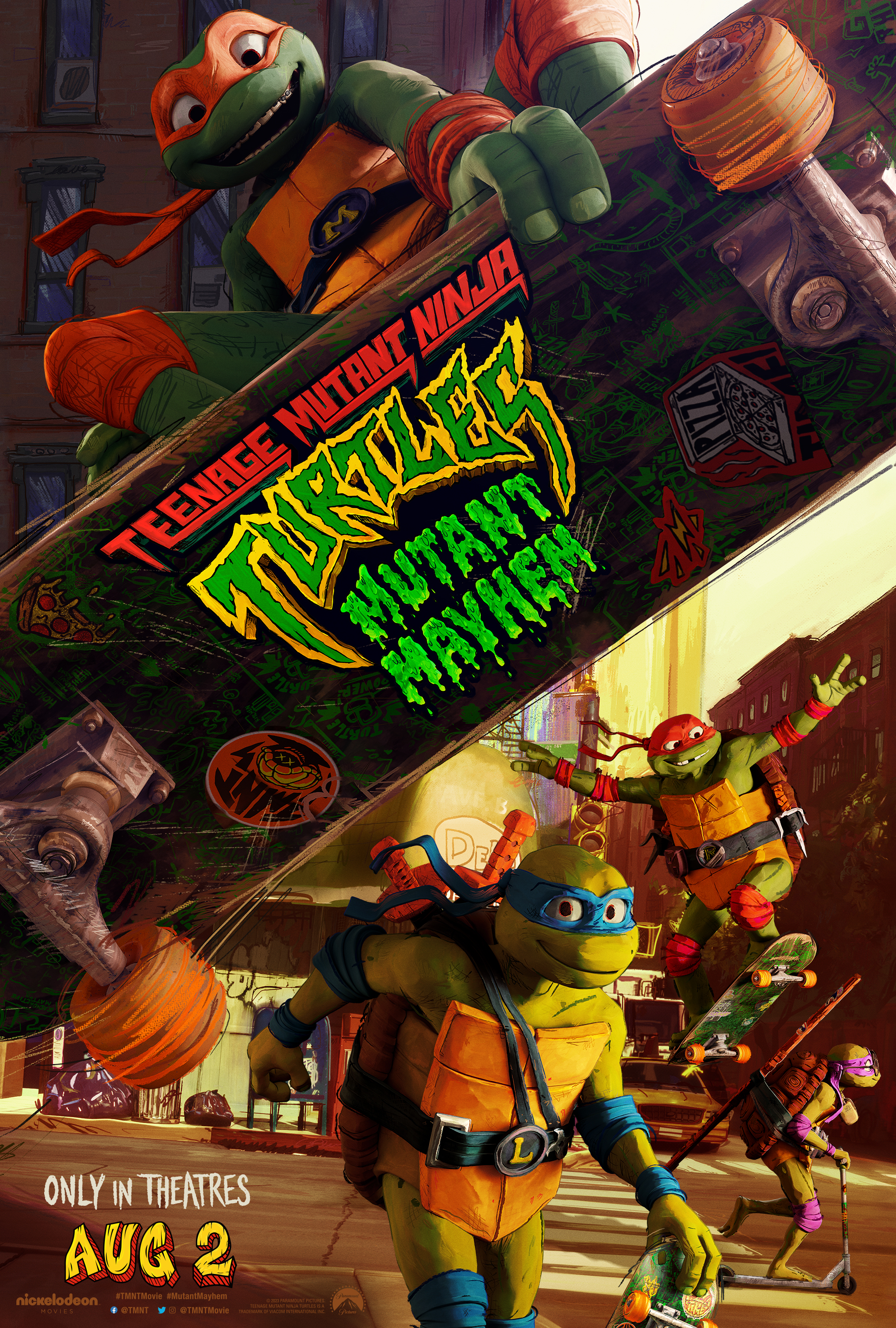
After years of being sheltered from the human world, the Turtle brothers set out to win the hearts of New Yorkers and be accepted as normal teenagers. Their new friend, April O’Neil, helps them take on a mysterious crime syndicate, but they soon get in over their heads when an army of mutants is unleashed upon them.

Since I have not watched any TMNT shows or movies since the animated series in the 1980s, I can’t comment on what is or isn’t canon or what would or would not be, but I can say that from what I remember about the old show, this feels like a reimagination that is simultaneously fresh yet familiar. Perhaps some characters are interpreted differently for this movie than they have been in the past, but the character dynamics, conflict, and relationships make sense within this world. Nicely plotted and paced TMNT moves quickly and leanly–sometimes a little too leanly, but I digress. Most of the humor in the movie works well, but there is one recurring joke that does grow tiring to the point that the punch is less funny than it would have been had the joke been setup and developed more sleekly.

The movie is incredibly postmodern in the sense that the characters reference real life celebrities, TV shows, movies, etc. And while it was cute for a short while, the constant pop-cultural references grew a little tiresome. It’s like salt: fantastic in small amounts; unhealthy in large amounts.

I’ve said it before, and I will say it again, I cannot figure out why studios and writers insist on sprinkling in adult language in a movie that is undeniably geared towards kids (if for no other reason, it is released by Nickelodeon). Reminder: you do not need to include foul language (in however small amounts) in order for adults to watch…they are going to watch anyway, and maybe even be more inclined to introduce their kid(s) to the TMNT.

Suffice it to say, TMNT is a lot of fun, and if you’re looking for a throwback superhero movie with some heart, then I’ve no doubt that you’ll enjoy this movie.

Ryan teaches Film Studies and Screenwriting at the University of Tampa and is a member of the Critics Association of Central Florida and Indie Film Critics of America. If you like this article, check out the others and FOLLOW this blog! Interested in Ryan making a guest appearance on your podcast or contributing to your website? Send him a DM on Twitter. If you’re ever in Tampa or Orlando, feel free to catch a movie with him.

Follow him on Twitter: RLTerry1 and LetterBoxd: RLTerry

SPIDER-MAN: ACROSS THE SPIDER-VERSE movie review

Oh, what a tangled web [they] weave…with this cacophony of story threads. The highly anticipated sequel to the Best Animated Feature Oscar-winning Into the Spider-verse opens this week, but unfortunately, it suffers from a bad case of sequelitis brought on by a gluttonous consumption of excess. Spider-man: Across the Spider-verse works in title only–and all too well, as it were. The title says it all, and that is precisely what audiences get in this comic philhar-tragic symphony in the key of overindulgence.

After reuniting with Gwen Stacy, Brooklyn’s full-time, friendly neighborhood Spider-Man is catapulted across the Multiverse, where he encounters a team of Spider-People charged with protecting its very existence. However, when the heroes clash on how to handle a new threat, Miles finds himself pitted against the other Spiders. He must soon redefine what it means to be a hero so he can save the people he loves most.

Across the Spider-verse is what happens when a story idea doesn’t pass the elevator pitch litmus test (wherein an idea can be explained sufficiently enough in three-minutes or less). Quite simply, there is such a proliferation of story webs that there is virtually no plot–there is certainly no resolution before the (and this isn’t a spoiler) cliffhanger ending. Story webs lead into story webs that leads into even more story webs. Suffice it to say, it’s as if writers and producers took every incarnation of Spider-man comic series, threw them into a blender, and served the concoction o audiences. Unless you are read up on decades of Spider-man comics, you will be hard-pressed to follow any storyline. Perhaps the better expression of a collision of Spider-verses would have been in a television series that could have explored a different thread of comics each season.

Clearly, Sony took the extremely positive reception of the first one, focussed on recurring praises, and amplified those to the nth degree. Never mind that more than the visual expression of the story, plotting is crucial to structure, pacing, and coherency. The animators and artists are showcasing brilliance in animated filmmaking, but the clear evidence of screenwriting is nowhere to be found. Without a well-defined central character, a well-defined external goal, and a well-defined character of opposition between the central character and the goal, there is no plot–merely a sequence of loosely connected scenes or fragments of ideas. A fever dream, if you will.

While Across the Spider-verse suffers narratively, it certainly excels in the art of animation. The stylistic animation and editing is outstanding! Much like with the first movie, this one takes the emotive detail found in a single frame of a comic book (or graphic novel) and combines that approach with hand-drawn inspired motion picture animation. There are certainly problems with the story (or stories, as it were), but Sony Pictures Animation has demonstrably shown commitment to the boundless imagination and capabilities of animation. Across the Spider-verse, in how it is expressed in this movie, can only happen within the world of animation. In no way could this movie be expressed in a live-action way. Perhaps the writers were asleep at the wheel, but the animators gave each universe of Spider-man characters its own color palate and animation style.

Make sure to watch Across the Spider-verse in a premium format at your cinema, because the strength in this animated movie has little to do with the story as much as it does the stylistic animation. When a film, animated or live action, strikes a balance between style and substance, it can be enjoyed on the big or small screen without detracting from the storytelling; but when the movie struggles narratively but excels in form, then experiencing it on the big screen is the best approach.

Ryan teaches Film Studies and Screenwriting at the University of Tampa and is a member of the Critics Association of Central Florida and Indie Film Critics of America. If you like this article, check out the others and FOLLOW this blog! Interested in Ryan making a guest appearance on your podcast or contributing to your website? Send him a DM on Twitter. If you’re ever in Tampa or Orlando, feel free to catch a movie with him.

Follow him on Twitter: RLTerry1 and LetterBoxd: RLTerry
THE SUPER MARIO BROS. MOVIE review

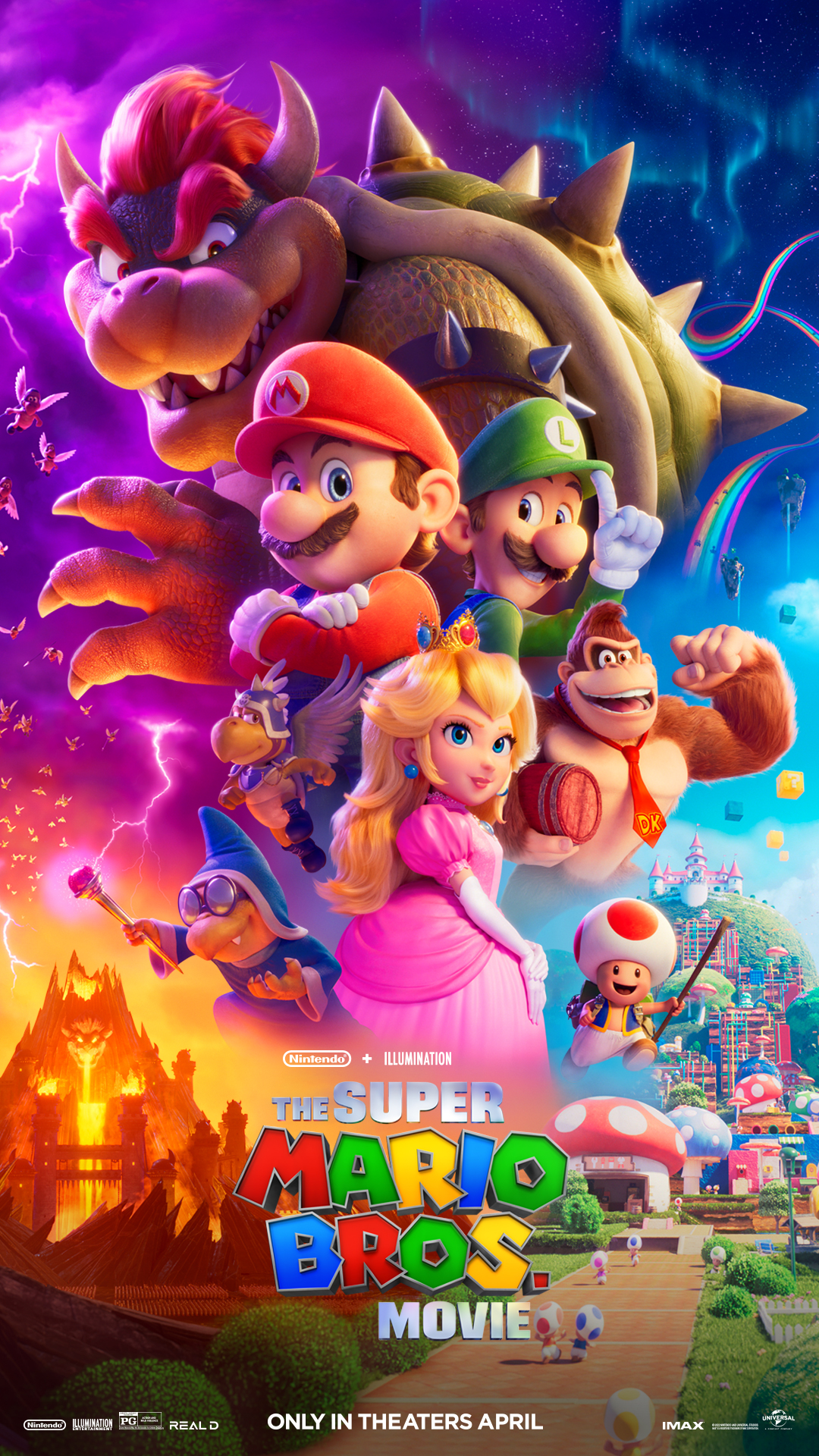
Game Fin. The highly anticipated animated adaptation of the timeless game series is more accurately titled The Super Princess Peach Movie, because you will spend significantly more screen time with the superhero-like Princess Peach than you will the title characters. Mario and Luigi take a backseat (and Luigi, a WAY back seat) to the flawless Princess Peach on an adventure to save the Mushroom Kingdom.

While some have characterized this movie as a love letter to the Mario universe of games, the irony is that the screenwriters were demonstrably more concerned with easter eggs and cameos than they were telling a good, meaningful story with the beloved interactive media characters and worlds.

A feature film adaptation of a video game is on shaky narrative ground when the original video game has greater stakes than the movie version. Never once are you second-guessing Princess Peach’s–uhh, I mean–Mario’s ability to defeat King Kupa and save the legacy Nintendo realm.

Most of the humor is either short-lived or falls flat. While we don’t look to these types of movies to deliver deeply moving character development, movies like this should at least seek to deliver clever plotting to engage the audience beyond a superficial level. There are no twists nor are there any real turns after the movie sets up the story (a term which is giving the movie way too much credit) that is about to unfold.

The best scenes in the movie are the ones with Donkey Kong, because there is better executed setup and delivery in the conflict. Furthermore, Donkey Kong is the only character that has any kind of measurable agency in the movie.

Movies that feature a character(s) that is either exceptional at everything or continually fails in order to make another character(s) look more superior offer very little to be desired, much less craft a movie that is rewatchable. The movie works as a fun nostalgic trip through the legacy of the Mario universe of games, but the one-dimensional characters and vapid plot greatly hold this movie back from the quality it very well could have been.

I’ll give the movie this: I did make me want to download an N64 emulator and buy an N64 bluetooth or USB controller for my computer so I could relive my childhood playing Mario 64. So if it prompts others to get together with friends or their kids to play these timeless games, then the movie does have a positive affect upon the audience.

Ryan teaches Film Studies and Screenwriting at the University of Tampa and is a member of the Critics Association of Central Florida and Indie Film Critics of America. If you like this article, check out the others and FOLLOW this blog! Interested in Ryan making a guest appearance on your podcast or contributing to your website? Send him a DM on Twitter. If you’re ever in Tampa or Orlando, feel free to catch a movie with him.

Follow him on Twitter: RLTerry1 and LetterBoxd: RLTerry
GUILLERMO DEL TORO’S PINOCCHIO motion picture review

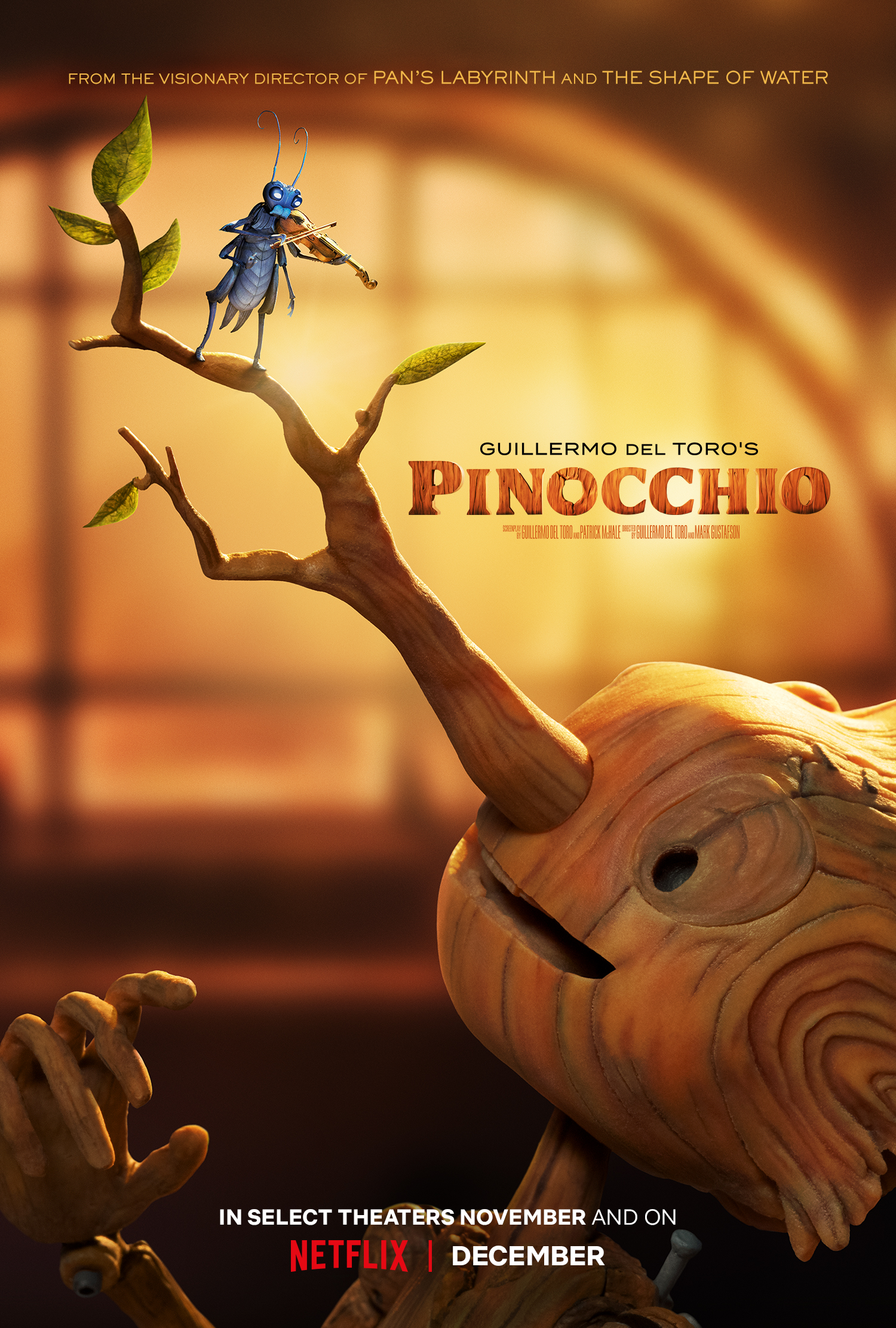
Positively avant-garde! Easily among the best pictures of the year, period. Guillermo del Toro’s Pinocchio is a brilliant stop-motion picture that will stir the hearts and minds of any audience! In many ways it’s reminiscent of 80s dark fantasies such as The NeverEnding Story and The Dark Crystal. Which should come as no surprise that del Toro worked in collaboration with the Jim Henson Company. Audience will be completely transported to the post-World War I Italian world that del Toto meticulously recreates, complete with the fascist movement, which underscores much of the film. Not since Kubo and the Two Strings have we had such a gorgeous, imaginative animated feature film–a film that was robbed of its deserved and earned Beast Animated Film Oscar (no, Zootopia is in no universe a superior film). Let’s hope that the Mouse doesn’t rob Pinocchio of it’s well-deserved Academy Award for Best Animated Feature.

The story may seem familiar: A father’s wish magically brings a wooden boy to life in Italy, giving him a chance to care for the child. But you’ve never seen Pinocchio like this before!

Before you dismiss Del Toro’s Pinocchio as another soulless, cash-grab remake, this much more macabre version of the titular puppet’s story delivers immense depth and dimension. Not only of technical achievement, but of theme, plot, and character development. This animated film proves that animation isn’t only for kids, because this film is far more thoughtfully crafted than most live action films this ear. And yes, I agree with recent comments from Quintin Tarrantino that we are experiencing one of the worst eras of cinema in history. No doubt this is true. However, this year has seen some real winners such as Top Gun: Maverick and now Pinocchio. Suffice it to say, this is not your kid’s Pinocchio. And, although there are important life lessons in the film, it goes to places, both figuratively and literally, that may not be appropriate for kinds under 12 years of age. While Pinocchio is in its limited theatrical run, see it on the BIG screen!

While there are certainly plot beats which are shared by the original 19th century story, the 1940 Disney adaptation, the wretched Robert Zemeckis’ remake earlier this year, and countless stage adaptations (funnily enough, I saw the operetta Pinocchio this week as well), Guillermo del Toro’s Pinocchio takes on a life of its own. It isn’t often that the filmmaker added a possessive to the film title. Whereas it’s commonplace for Disney to add Disney’s… to literally everything, it’s uncommon for director’s or producers to add a possessive to the film’s title. Notable exceptions include Tim Burton’s Nightmare Before Christmas (directed by Henry Selick), Bram Stoker’s Dracula (directed by Francis Ford Coppola), and now Guillermo del Toro’s Pinocchio. This possessive form of title is often employed to signify (1) the filmmaker’s confidence in his or her work of motion picture art and (2) to separate it from all other versions of the same story (and/or title). Moreover, this often indicates to audiences that they are about to witness the work of a true auteur (not the case when we see Disney’s…–that’s just plain branding).

Is it del Toro’s arrogance or an ego trip that prompts such chutzpah in this film’s title? Not at all. Del Toro has been working on this passion project for over 15 years. Before you feel that’s an exaggeration, let the finished motion picture be the demonstrable evidence of meticulous work frame-by-frame in this nearly two-hour film. Images are most often captured at 25-frames-per-second, so to achieve the fluid motion del Toro has, you just do that math. Del Toro crafted intricate animation captured by a camera that is repeatedly started and stopped over the course of day, weeks, years. Each mouth, arm ear, eye, literally any object that has movement, is moves a little at a time, frame-by-frame. Not only does del Toro’s craftsmanship translate to beautiful, seamless movement by the characters and environment in the film, he successfully captures the visual and emotional miracles that can only be accomplished through stop motion animation. There’s a reason why we go back to the Rankin & Bass Christmas classics every year; there is immense simplicity and beauty in stop-motion animation. Why? Same reason why practical effects will always be superior to (overt) CGI effects–depth, dimension, the way real light bounces off objects and into the camera lens.

Even though the film is quite dark from the moment the atrocities of war are witnessed, it is not without its levity and uplifting scenes. To get into a central theme of the film involving stages of grief (which makes it unique compared to other iterations), would mean venturing too far into spoilers, which I would like to avoid, and with that theme, there are many scenes that force the audience to confront what many fear most. Because of this theme, one might think the film is somber most of of the time, and fortunately, this is not true. There are plenty of moments that break up the sadness to inject a healthy dose of laughter. And more often than not, we have Sebastian J. Cricket to thank for that! (I’m sure the “J” is a playful jab at Disney). DelToro’s sardonic, raconteur cricket always has the perfect witty remark or anecdote to provide insight into a given plot point or emotional beat. Because of Sebastian J. Cricket’s running commentary and moral/ethical guidance, the audience is willing to go on this emotional roller coaster. The moment of levity allow for an emotional and psychological reset to face the darker moments.

Outside of the imagery of the stages of grief, there are other fascinating areas of social commentary in the film as well. I love how del Toro moves the real boy imagery, how it’s traditionally interpreted: wood vs. flesh, to one that posits ideas of what it means to be a real man. These arguments are mostly seen in the Mussolini’s youth armies scenes. In the world of fascist Italy, to be a real man meant taking up the arms and creeds of Mussolini’s Italy to fight the allied forces. Pinocchio must decide what it means to be a real man. Another area that is interesting is the relationship between Geppetto and the village (Catholic) Church. While there may be various ways of interpreting this imagery and these scenes, which are bookends for the film, I feel it is best interpreted as Geppetto never compromising on his faith in God even though the Catholic Church, at that time in Italy, was being infiltrated by Mussolini’s fascist ideals (cleverly disguised to sway some in the faith community).

Lastly, we cannot talk about this film without highlighting the moving score and outstanding original songs. While Pinocchio is not a musical, it has several original songs that will move audiences! Not only does this film boast exquisite animation, but it delivers outstanding original music and lyrics as well. Audiences will find both diegetic and non-diegetic musical numbers in the film. This combination works incredibly well to wrap audiences in the mesmerizing story!

Even though Guillermo del Toro’s Pinocchio is coming to Netflix in December, look to see if it’s playing at theatre near you for the full experience!

Ryan teaches Film Studies and Screenwriting at the University of Tampa and is a member of the Critics Association of Central Florida. If you like this article, check out the others and FOLLOW this blog! Interested in Ryan making a guest appearance on your podcast or contributing to your website? Send him a DM on Twitter. If you’re ever in Tampa or Orlando, feel free to catch a movie with him.

Follow him on Twitter: RLTerry1

THE BAD GUYS animated film review

Highly entertaining with heart! Disney-Pixar, eat your heart out! Whether you’re typically interested in animated films or not, you don’t want to miss Universal-DreamWorks’ The Bad Guys opening this week only in cinemas. Prepare yourself for a refreshing, high octane Oceans 11 meets Zootopia heist comedy for the whole family. Honestly, this is the best animated film that I have seen in a long time. The Bad Guys delivers audiences a simple, lean plot with complex central characters that will completely delight you from beginning to end with its innate ability to find the humor in the smallest details. While the film borrows from Oceans 11 and Zootopia, it is crafted in an almost Tarantino for kids storytelling method. This atypical approach to animated film storytelling (popularized by Into the SpiderVerse), has opened the floodgates for subverting our expectations for styles we have long -since associated with animated films. Furthermore, films such as the remake of The Lion King have inspired CGI artists to go for more of a photorealistic aesthetic. What The Bad Guys does is paint a 2D world with some 3D enhancements, which demonstrates more of an affinity for stylization over realism–great! Too many animated motion pictures lean into realism therefore negating the magic of animation. In my opinion, if the animation is going to be so incredibly realistic-looking, then just make a live action picture. The advantage of the stylized approach is that there is very clearly a design to each and every frame. Perhaps it lacks the cinema stylo of hand-drawn frames, but it certainly delivers more style than anything released by Disney-Pixar in recent years. On a scale of Kubo and the Two Strings (the best animated film in the last decade) to The Lion King, I’d say The Bad Guys is much closer to a Kubo. With witty comedy and adrenaline-pumping action, you don’t want to miss seeing this film on the BIG SCREEN.

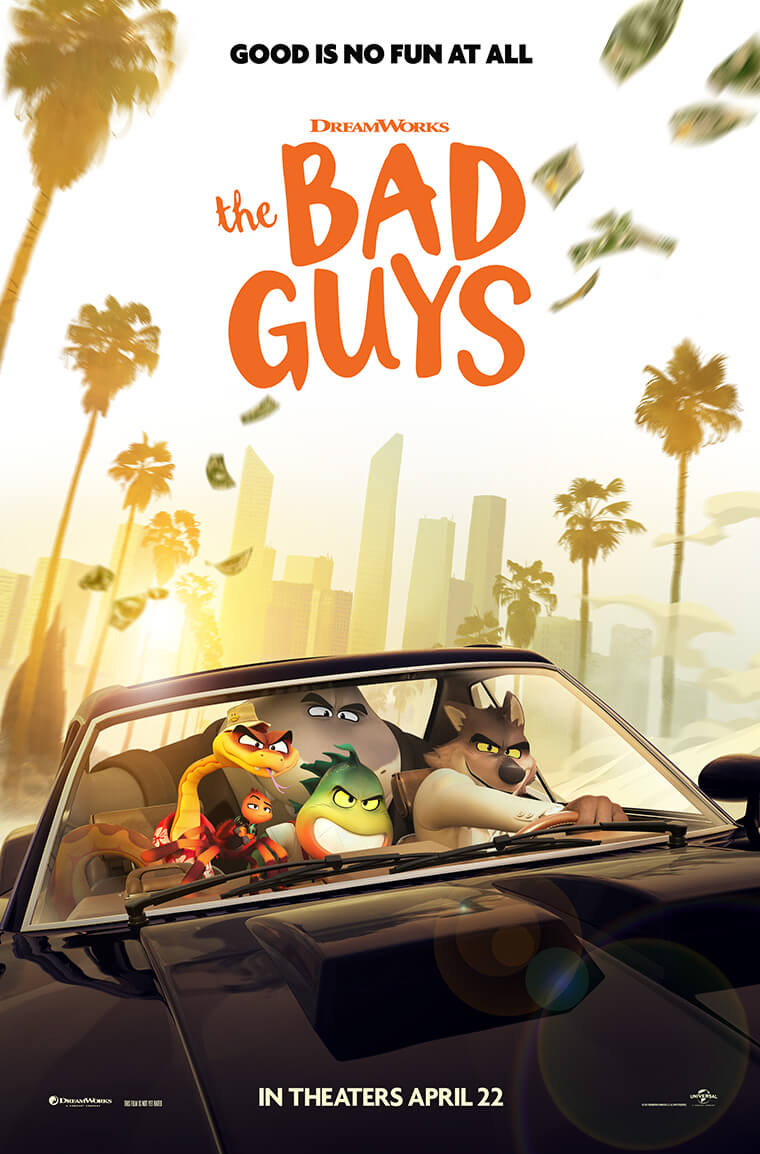
After a lifetime of legendary heists, notorious criminals Mr. Wolf, Mr. Snake, Mr. Piranha, Mr. Shark and Ms. Tarantula are finally caught. To avoid a prison sentence, the animal outlaws must pull off their most challenging con yet — becoming model citizens. Under the tutelage of their mentor, Professor Marmalade, the dubious gang sets out to fool the world that they’re turning good.

What a(n animated) picture. Seriously. It’s been a long time since I enjoyed an animated motion picture this much. Over the last decade, only Kubo, How to Train Your Dragon 2, and Onward stand out to me. As I was exiting the auditorium following the screening, I talked with the general audience members that were in attendance, and nearly every one with whom I spoke said variations of the same things: entertaining, fun, and thrilling. During the screening, I heard many kids (and their families) laughing along with the characters. Although it is clearly aimed at kids, there are comedic moments for adults too. What we have here is a good story! Remembering my Sunset Boulevard

Joe Gillis: “-Ah…one of those message kids. Just a story won’t do…”

Betty Schaefer: “I just think a picture should say a little something.”

I reference this exchange between the struggling screenwriter and the aspiring reader turned screenwriter because too many animated films (mostly from Disney/Pixar) suffocate their stories under oppressive, cynical social commentary; so much so, that the story suffers because the focus is on the sermon instead of the characters. You will find the absence of overt social commentary in The Bad Guys refreshing! Does that mean there is no depth or thoughtful elements? No. But the message of the film is that we are all capable of a redemption arc. Granted, it’s not as strong a redemption message as we have in A Christmas Carol, but for a kid’s movie, they will undoubtedly pickup on it.

The screenplay is well structured and paced. While the bones of the screenplay are rather paint by numbers, the the superstructure is creative and stylish! Furthermore, in a film that looks to be one that will throw a joke a minute at you, it holds back the cards, delivering the humorous dialogue and site gags in a method that allows them room to breath. The laughs are setup, reinforced, then twisted thoughtfully.

All around, this is a solid animated feature that should be on your watch list while it’s in cinemas.

Ryan teaches Film Studies and Digital Citizenship at the University of Tampa. If you like this article, check out the others and FOLLOW this blog! Interested in Ryan making a guest appearance on your podcast or contributing to your website? Send him a DM on Twitter or email him at RLTerry1@gmail.com! If you’re ever in Tampa or Orlando, feel free to catch a movie with him.

Follow him on Twitter: RLTerry1