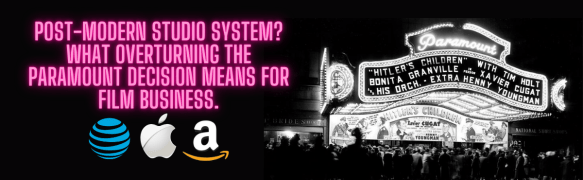
While the official announcement was unaccompanied with fanfare, the overturning of the landmark ruling in “U.S. v Paramount Pictures, Inc., et al” (1948) on Friday, August 7, 2020 marks a turning point in the business of modern cinema. Also known as The Paramount Decision and The Hollywood Antitrust Case, this ruling marked the end of Hollywood’s Golden Age and the decline of the Studio System that upheld it. What exactly does this mean for the business moving forward? Short answer: nobody knows, and anyone claiming to know what IS going to happen is incredibly presumptuous. However, by looking at the history of the 1948 ruling and the current events surrounding the August 7th ruling, we can explore this watershed moment in the film business, both past and present. Furthermore, we can extrapolate from past precedent what may happen or even could happen today. One thing is certain, we are in rapidly ranging and even uncertain times due to the direct and indirect impacts of the response to COVID-19. Although the federal court began reevaluating this case in late 2019, it is undeniable that the impact of the response to the effects of the virus may have played a latent role in the final decision. From a massive increase in streaming content options to premium paid video-on-demand (PVOD) to continued (at the time of this writing) delays in returning “big ticket” first-run movies to theatrical exhibition, there are many factors at play here. Not to mention questions such as “if I am an indie filmmaker, will I be able to get my movies in theatrical chains,” “does this mean that Amazon or Apple will buy up struggling chains like AMC,” or “if I am a screenwriter, will I still be able to submit my screenplays to studios if they are completely vertically integrated?” Perhaps this exploration of the past, present, and future of the film business in light of the overturn of the Paramount Decision won’t be able to provide definitive answers, but it will provide historical, empirical, and observational evidences to suggest what may or could happen moving forward.
In short, the Paramount Decision (1948) was a landmark case in which the US Government forced the eight major/minor studio players to end the practice of block booking, divest themselves of their respective theatre chains (sell them off), and modify the practice of long-term employee contracts (although, this practice would continue until the 1960s). This marked the beginning of the end of the Studio System, AKA Hollywood’s decentralization. But before we can even begin to understand the significance of the August 7, 2020 decision that overturned the landmark ruling, we have to jump in the wayback machine and head to Hollywood’s Golden Age (recently seen on Ryan Murphy’s Hollywood, a 2020 limited-run series on Netflix).
What was the studio system anyway? It was the arrangement of film production and distribution dominated by a small number of studios in Hollywood. Historically, the term refers to the practice of large motion picture studios, between the 1920s-60s, of producing movies primarily on their own backlots with creative personnel often under long-term contracts, and which dominated exhibition through the vertical integration of company-owned movie theatres. Block booking was also a common practice at this time. This process forced theatres to accept a block of movies from a studio. If an independent theatre wanted to show Movie A, then the studio would require the theatre to also accept and show Movies B, C, D, and E too.
Years before the U.S. Supreme Court ruled against the once powerful Paramount Pictures, the biggest studio in Hollywood at the time, there were constant legal and ethical issues plaguing the storied studio system that produced some of the most foundational films in cinema history. Back during the height of the studio system, there were eight principle players: the Big Five and the Little Three. The Big Five was comprised of: Paramount, MGM, Warner Bros., 20th Century Fox, and RKO; the Little Three included Universal, Columbia, and United Artists. You may (1) recognize some of those names today and (2) notice that there is a famous studio conspicuously missing. The latter is due to Walt Disney Studios being in its infancy during this time. Ironically, it would become nearly completely vertically integrated in the 20th and 21st centuries, minus owning a chain of movie theatres. In a manner of speaking the Walt Disney Company operates in a very similar fashion to that of its older brothers and sisters.
When I took a tour of Paramount Pictures back in 2015, I asked how many full-time staff worked on the lot. And the tour guide responded with 30-40 people. That’s right, only 30-40 people at the time. While that number may have fluctuated in the last five years, it leads me into one of the practices that came to a close when the Studio System fell. Prior to the Paramount Decision and the development of professional unions, studios held movie stars, directors, writers, and others to longterm contracts (with few, if any, options). Contracts were so tightly managed, that studios would loan stars to other studios, for example Paramount may choose to loan out Mae West to M-G-M in exchange for Judy Garland. The on screen talent wasn’t the only area treated as a commodity, virtually every role in front or or behind the camera was under contract to a studio, including directors and writers.
While this looks like an infringement upon civil liberties through our 2020 eyes, and there are many reasons it should, there was something positive regarding employment during the Studio System: job security. When you worked for the studio, you worked for the studio and made all its pictures. Meaning, you knew you had regular employment until your contract was satisfied, you quit, or were fired. Employees didn’t have to worry about when and where the next gig was; employees went to work, Monday through Friday if you will, just like other working professionals. Furthermore, this centralized human resources system also made it possible to apply for vacant positions as a director, writer, craftsman, or any other position. There were also a great number of formal apprenticeships for those who were trying to break into the system. Sounds great, right? Well, yes and no. Yes, for reasons of streamlining the hiring process and providing stable employment in the field; and no, because the studio (that also likely controlled movie theatres) would not produce or distribute your picture unless you worked for the studio. It was a closed corporate system, so independents were largely kept out of it. From submitting screenplays to theatrical distribution, aspiring filmmakers either had to join the corporate ranks of the studio system or exhibit their pictures in small independent movie houses, IF they could even get the film developed and edited.
Even before the 1948 decision, the studio system and studio-theatre relationships were under attack, but the studios were able to find loop-holes and political alliances in order to avoid the breakup of the vertical integration that was expensive to maintain but highly lucrative. As the movie studios regrouped for continued legal battles in the court system and Justice Department, media mogul Howard Hughes of storied RKO Pictures made the decision to sell off his movie theatres. When The Justice Department made it clear that there were to be no more deals between the government and the movie studios, Paramount sold its movies theaters in an attempt to buy into television. However, after the legacy studio’s continued involvement in all the antitrust cases leading to the final decision in 1948, the government did not permit Paramount to maintain any semblance of a monopoly in the frontier of television.The battle to keep the studio system was finally over. In the end, the Paramount case influenced the growth of television because, among other reasons, RKO and other studios sold their film libraries to television stations to offset the losses from the Paramount Decision. The studios also released actors from those longterm contracts, and many became television stars.
Although there are many side-effects and tangential reasons why the studio system (1) was lucrative and (2) hard to dismantle, there is one root reason from which everything else radiated: control. Everything gets back to control. Control of movie stars, control of writers and directors, control of the distribution and exhibition process. With all this control, the Studio System was able to craft its own narrative and success story. While the system was lucrative, it also racked up a lot of debt. Debt that came from borrowing from banks, exorbitant movie star salaries, and fighting legal battles. Even though the system had a lot of problems, it still gave us some of the best movies of all time, motion pictures that are larger than life, and those that typified the Golden Age of Hollywood. However, this system also protected its own when scrutiny or accusations arose, which is reprehensible. The Hollywood Studio System was truly its own self-contained world that outsiders were only let into through the movies and publicity.
The film business landscape looks much different than it was during and just after the Golden Age of Hollywood. But over time, we have seen a migration back towards the ol’ system of doing things. The most recent examples of borderline antitrust infringement are Disney’s acquisition of 20th Century Fox, AT&T’s acquisition of Warner Bros. Pictures, and Comcast’s acquisition of NBC-Universal. What makes the latter two particularly interesting cases is the simple fact that both AT&T and Comcast own and operate the literal hardware in the ground and air that brings you your connection to the internet. One could read this as a form of distribution. The Disney example is more or less one of reducing the ability to equitably compete for audience dollars and the ability to create jobs. You can read more on the Disney-Fox deal in my article Out-Foxed. While block booking and price-fixing are still illegal, the overturn of the Paramount Decision does create a greater pathway to acquiring movie theatres and the ability to be more greatly vertically integrated than was possible since 1948. Interestingly, movie studios have been legally able to buy movie theatres since 1948, but because of the scrutiny and bureaucratic red tape that would come with it, it was not a practice except in the case of Disney purchasing the historic El Capitan theatre and Netflix purchasing the iconic Grauman’s Egyptian Theatre (sister theatre to the world-famous Grauman’s Chinese Theatre). Disney uses the El Capitan for most of its own premieres, but the movie theatre also shows a variety of other programming. But with this overturning, Disney could choose to only show its movies in the El Capitan, likewise with Netflix and the Egyptian Theatre.
But, so what if Netflix and Disney want to exclusively exhibit their own films in their movie palaces? And you’re right, those two locations do not significantly make a difference in the grand scheme of things; but, what this represents is a microcosm of what could happen more nationally. And that’s why many of us are fascinated by this ruling; we are both anxious and eager to see what happens in this new frontier. Maybe nothing, maybe something. But film academics have a duty to analyze the situation to inform the public of the possible outcomes.
At the time of writing this article, Disney has made no claim regarding any real interest in purchasing the struggling AMC movie theatre chain nor Regal (owned by CineWorld). That said, there is more to explore that isn’t quite as in the face of the public as purchasing theatre chains. While control is the root cause for the machine that was the studio system, the reason the government went after the big studios was in-part because the studios made it nearly impossible for independent filmmakers to get their films into theatres or land distribution deals. If the studio did not produce your film, then it would not distribute it. The inequitable competition field led the US Government to bring about the landmark antitrust case. Lack of competition or lack of an opportunity to compete is what many independent producers, directors, and other creative and technical personnel fear most moving forward. It is highly unlikely that anything major is going to happen overnight; however, the studios now have the latitude, or horizontal if you will, to test the boundaries of their vertical integration and ability to strong-arm the marketplace. Suffice it to say, the studios will be “testing the fences for weaknesses, systematically…they remember” (Robert Muldoon, Jurassic Park).
While Disney may not be presently interested in purchasing a movie theatre chain (according to the August earnings call), the three companies to watch out for are: AT&T, Amazon, and Apple. The AAA threat. Interestingly, AT&T is no stranger to monopolies or even oligopolies (like a monopoly, but when a market is controlled by a few big companies instead of one). Without going into too much detail on the U.S. v American Telephone and Telegraph (AT&T) case, the antitrust case was brought against the telecom giant, owner and operator of Bell Systems. Bell Systems held a monopoly over American and Canadian phone systems, a monopoly that was held since the dawn of the telephone. The end result of the 1982 ruling brought about the breakup of the Bell Systems company into seven regional “Bell” markets. From this breakup we got seven telecom companies, each operating a particular geographic region. Interestingly, four out of the seven companies are now back under the control of AT&T. The remaining three former Bell markets are owned by Verizon and CenturyLink.
If we use the AT&T case study as a parallel model for understanding studios and the film business, we can posit ideas of what may happen in light of the recent overturn. The AT&T model bares many similarities to the Studio System model. We have a monopoly (or oligopoly) that was broken up by the US Government. Then there was a time of division; but slowly those once divested companies were bought up by the big company again, and in AT&T’s case, the original company. Full circle. What’s funny is that this parallel case study involves one of the likely players in this post-Paramount Decision world. By using the AT&T model, reason stands that a big company or two (maybe three) can and will buy up smaller companies to have a larger footprint, thus reducing competition. It happened the telephone world, it can happen in the film world. After being broken up, AT&T made many smart, seemingly benign moves in order to essentially become a phoenix that is greater than it was before its empire was broken up.
What does this mean for studios and movie theatres? It simply means that it is very likely that a major company with deep pockets will purchase movie theatre chains. Simple as that. We have seen this before in the AT&T case study. But it won’t be Disney, Universal, or even Netflix buying the theatres, it will be AT&T, Amazon, Apple, or and/or Sony. Inarguably, the first three are some of the largest, wealthiest, and most influential companies in the world, with the latter having an incredibly diversified portfolio that includes technology and more; what better way to showcase your audiovisual technology than in movie theatres??? Each of these companies has the assets necessary to acquire AMC, CineWorld (Regal), Cobb, and even Cinemark. Interestingly, AT&T, Amazon, Apple, and Sony all have investments in film and tv production. AT&T owns WarnerMedia et al., Amazon operates Amazon Studios, Apple creates original content for Apple TV+, and Sony operates Sony Entertainment et al. It is unlikely that the US Government would permit any of these companies to buy up more than one of the major movie theatre chains, but we could easily see each of the four major movie theatre players getting bought up by corporate conglomerates. While there isn’t evidence to suggest that these four corporate giants would force audiences to go to one of their theatres to see one of their movies, it is entirely possible that those corporate giants would offer additional programming (maybe certain movies primarily released on streaming services) at their company owned movie theatres. Between original and licensed/distributed content, these movie theates, tied to media conglomerates that have major studio investments, may pack the theatres with so many movies that independent filmmakers will have to see alternate means of securing distribution, be that through streaming services, independent movie theatres, or or smaller specialized chains like Studio Movie Grill and Alamo Draft House, both of which are known for catering to cinephiles, including horror fans.
In a manner of speaking, what we are looking at here is a post-modern Studio System. You’d once again have the BIG FIVE (AT&T, Apple, Amazon, Disney, and Comcast) and the LITTLE THREE (Sony, Viacom/Paramount, and Netflix). These eight companies would control the media landscape. And there will be just enough competition that it avoids any antitrust lawsuits (until it doesn’t; that’s how this goes, if you haven’t figured it out), until history repeats itself again. This new studio system will flourish for decades, but then something will happen and the government will step in and break up the companies again, most likely resulting in selling of movie theatre chains or even more sobering, movie theatres become a shadow of their former selves. It is unlikely that movie theatres will completely go away, but their purpose and role in show business may be relegated to little more than a novelty. These studios may reimagine the movie star star system, film/tv/production related unions could lose their power because of the increasing number of employees (not contractors) at movie studios, and/or there could even be more theme parks as a means to generate quick revenue to funnel back into the studio model, much like Disney and Universal Parks and Resorts do for their parent companies. Lots of job creation may happen, but these will lack in the creative latitude that many filmmakers crave.
For many independent filmmakers, the fear of the fallout from the overturn of the Paramount Decision is reduced opportunities to secure distribution deals. But it’s not only the production talent that is concerned. Writers could be greatly impacted; because, in a more heavily vertically integrated system, writers will have far fewer outlets for purchasing or licensure of their screenplays. Disney is a good example of this. Disney rarely purchases screenplays from screenwriters; their common practice is to use in-house screenwriters or commission a writer to pen a screenplay. So, if you are not IN the Disney studio system, then your chances of selling or optioning your screenplay are minimal. Since Disney owns 20th Century Fox, then this same practice carries over into that branch as well. That said, Searchlight Pictures is still a production and distribution company to which independent filmmakers and screenwriters can submit work for purchase, licensing, etc. While Disney is the easy example here, this same practice could be said of any major studio.
More vertical integration means larger companies in a world that is shrinking. This shrinking world could mean trouble for the aspiring filmmaker or screenwriter because of the lack of opportunities to make the transition from page to set to distribution. While this new world may make it more difficult for a screenwriter to sell a screenplay to a studio that is vertically integrated, the director will also face new challenges. Independent filmmakers will have to get their films bought or licensed by a major company in order to get the exposure needed to be able to develop a substantive career. Netflix has a history of being friendly to independent filmmakers (although it has more and more original programming), so an advantage to getting Netflix to buy or option your movie is that you may just be able to screen it at the Egyptian Theatre, which would greatly aid in qualifying for the Oscars or Golden Globes.
While independent filmmakers may face increasing odds against them for theatrical distribution, this post-modern Studio System could create thousands of jobs in the industry. But you will create what the studio wants you to create, which may not necessarily be the stories that you want to tell. And amidst this possible creation of jobs may be a world with far less opportunity for equitable competition for that golden statue and audience eyes.

Ryan teaches film studies and screenwriting at the University of Tampa. If you like this article, check out the others and FOLLOW this blog! Interested in Ryan making a guest appearance on your podcast or contributing to your website? Send him a DM on Twitter or email him at RLTerry1@gmail.com! If you’re ever in Tampa or Orlando, feel free to catch a movie with or meet him in the theme parks!
Follow him on Twitter: RLTerry1