Last Night in Soho horror film review

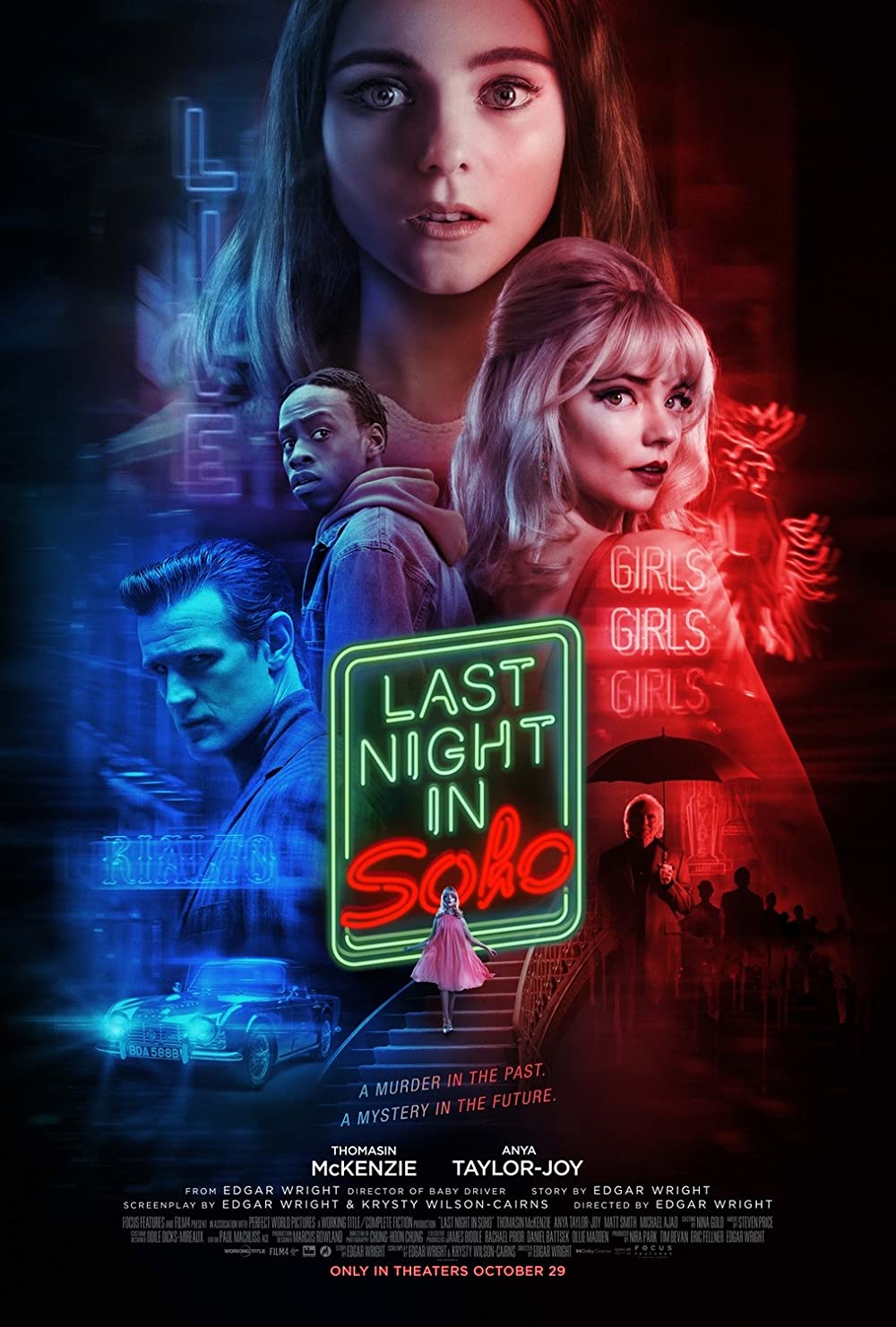
Mesmerizing! Dressed to Kill meets Mulholland Drive meets Suspiria! It’s like Wright channeled the best of Lynch, de Palma, and Argento to craft his spellbinding thriller! One of the best films of the year, and one that commands a rewatch. Other than seeing the trailer a few times in the cinema, I did not spend any time reading up on this film–and I’m glad I didn’t. Just speculating here, but I could definitely see this film as one that cultivates a cult following and is talked about in classrooms much like Mulholland Drive. Quite different from the other films in Wright’s cinematic library, if you’re going into it for a Shaun of the Dead, Hot Fuzz, or World’s End, then you may be disappointed. Although they are dissimilar in most respects, the film that this one shares commonality with is Baby Driver. As I am writing this, I’ve only seen it once, but I need to see it again. Not because I didn’t understand it–quite the opposite–the storytelling is top shelf! But I want to pay closer attention to details to gain a greater appreciation for how this kaleidoscope delivered such an immersive cinematic experience. The vibrant 1960s in London some alive in this dream-like psychological horror punctuated with giallo-esque mystery and slasher elements and nostalgic fashion. Told though a Lynchian cinematic framework, the surrealist experience of this film will capture your imagination and beckon you into the seedy underbelly of the iconic Soho district of London. Much like in Suspiria, the idyllic atmosphere and setting descend into madness in a beautiful symphony of terror! Clearly, Last Night in Soho is Wright’s most personal film; we can not only see this passion but feel it in every frame.

An aspiring fashion designer is mysteriously able to enter the 1960s, where she encounters a dazzling wannabe singer. However, the glamour is not all it appears to be, and the dreams of the past start to crack and splinter into something far darker.

Edgar Wright’s Last Night in Soho reminded me of so many great films! And, in all the best ways possible. Now, I don’t state that to suggest that Wright’s latest offering is derivative. Quite the contrary. It’s a testament to the scope of his career and talent. But when you watch this, and can think of Dressed to Kill, Mulholland Drive, Battleship Potemkin, and Suspiria, then the degree of thoughtfulness is evidence that the filmmaker seeks to channel some of the best cinema of all time whilst delivering a fresh interpretation. Fashion from Dressed to Kill, story structure from Mulholland Drive, cinematography and editing from Suspiria and Battleship Potemkin, and score/soundtrack from Baby Driver.

Often times when a filmmaker attempts to integrate too much from a variety of sources of inspiration, the end result is a cluster that has no identity other than in that which its emulating. But Wright’s Last Night in Soho, delivers an experience that completely envelopes the audience in a fantastical story while audiences vicariously dance through the streets of Soho; streets that, on the surface are paved with an idyllic portrait of Soho in the 1960s, but beneath the pavement, beats the sinister heart of a gritty world of pleasure, pain, and violence. For the non cinephile members of the audience, they may feel an unusual dichotomy of simultaneously being overwhelmed by the technical elements yet underwhelmed by the dizzying narrative of emotional themes, references to past films, and motifs all playing together in a perfect orchestra of cinema.

Phenomenal cast! Thomasin McKenzie’s Ellie will capture your heart with her candid portrayal of the small town girl in the big city for the first time. But if you think you’ve seen this character before, think again. Yes, we’ve all seen this trope before, but she delivers an incredibly raw, unfiltered approach to this character-type. In fact, it’s probably one of the most authentic portrayals of the small town girl in the big city that I’ve seen in a long time. Never feels like a facade or contrived, but rather feels relatable. Playing opposite (or parallel) to McKenzie is Ana Taylor-Joy as Sandy. I’ve been hit or miss with Ana Taylor-Joy in the past, so I wasn’t entirely sure what to make of her casting in this film prior to seeing it. But I’m pleased to describe her performance as outstanding! She is perfectly cast in this role. I love how she communicates both strength and vulnerability in the promising young star character-type. When life deals her a raw deck, she plays a different game in order to survive the metaphoric prison in which she finds herself.

Comprised ostensibly of two parallel stories that emotionally share the same DNA, the montage (French for assembly) of this film will blow your mind! What Wright and his team have created here is a Battleship Potemkin and Man with a Movie Camera approach to the editing. I reference these tow films because of Soviet Montage. Without going into lots of details best left to a classroom, Soviet Montage (or editing/assembly) occurs when two separate images are assembled together (traditionally by cross-cutting), in which the relationship between the images gives the meaning (not the action OF or IN the images themselves). The audience views these two separate images, and subconsciously give them a collective context. Wright’s utilization of Soviet montage theory allowed him to explore how time and space can be presented and manipulated in Last Night in Soho. Furthermore, this stylistic approach (1) engages the sympathy of the audience and (2) advances the narrative. Where Wright takes the work of Eisenstein and Kuleshov to the next level is by going beyond cross and contrast-cutting to delivering these image juxtapositions within a single frame (or series of frames) by way of non-linear editing. We see both the past and present in the same image, usually by way of a mirror (or other reflection). It’s a technique that isn’t merely stylistic for the sake of being stylized, but allows for the tension to consistently rise without any break in the mode of storytelling. Brilliant!

I highly recommend this film for anyone that enjoys any of the films that I have referenced in this review. It’s been a while since we’ve had a motion picture that is truly inspired by the greats, and this is certainly one that will find itself to be considered a classic in the future.

Ryan teaches American and World Cinema at the University of Tampa. If you like this article, check out the others and FOLLOW this blog! Interested in Ryan making a guest appearance on your podcast or contributing to your website? Send him a DM on Twitter or email him at RLTerry1@gmail.com! If you’re ever in Tampa or Orlando, feel free to catch a movie with him.

Follow him on Twitter: RLTerry1
ANTLERS horror film review

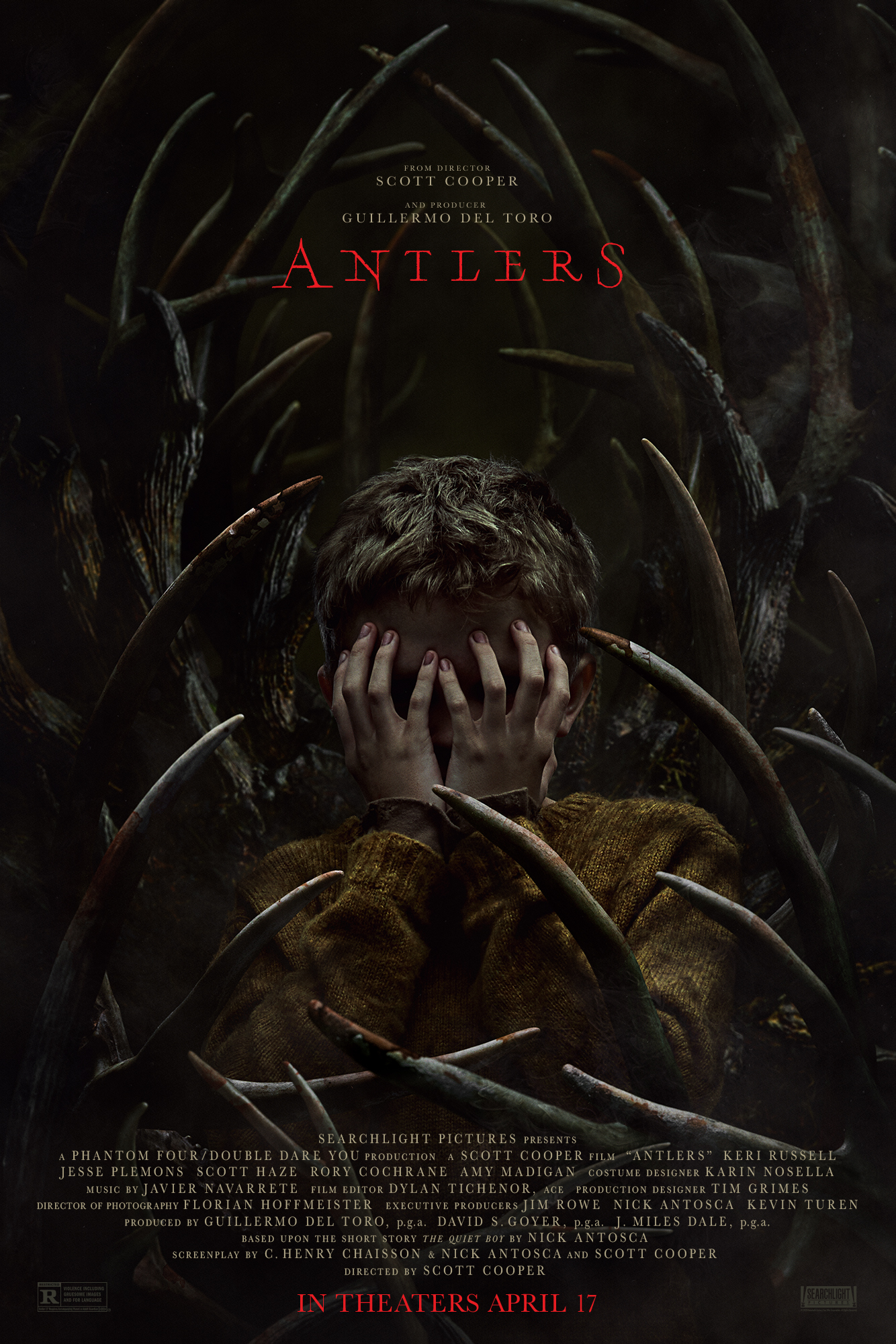
Intense! Antlers is a terrifying film that will truly absorb you! See is on the BIGGEST screen with the BEST sound possible. From stunning, terrifying creature effects to thoughtful, provocative commentary on the trauma of grief and loss, this is one of the best films of the year, period. Directed by Scott Cooper and produced by Guillermo del Toro, this highly atmospheric film is based on the novel The Quiet Boy by Nick Antosca. Every element of the mise-en-scene works flawlessly to capture your imagination and take it to some incredibly dark places where you will confront the stuff of nightmares. Del Toro’s eye for the visual storytelling of a darkly fantastic world is witnessed in every frame of this outstanding motion picture. Cooper has clearly worked closely with del Toro in order to combine their various cinematic storytelling methods to craft a modern story steeped in mythology. Keri Russell and Jeremy T Thomas deliver frightening performances; especially Thomas–he is incredibly creepy! Antlers is the type of horror film that is surely gong to find a place amongst the classics in the future. While so many horror films in recent years have included overt sermon-like ideological messages that feel more like a weapon, this film integrates the heavy subject matter exploring the trauma experienced following abuse, grief, and loss into the background, which allows the foreground to remain focussed on the action plot and characters. Furthermore, this film illustrates the power of horror to be able to simultaneously entertain the masses while providing thought-provoking content that manifests ideas that are difficult to talk about or show directly. But through nightmarish imagery, audiences allow themselves to be taken into liminal spaces to overcome the effects of trauma.

A small-town Oregon teacher and her brother, the local sheriff, discover that a young student is harbouring a dangerous secret with frightening consequences.

Prepare for an immersive, haunting world that is both whimsical and ominous, as can only be conceived by the mind of del Toro. While del Toro is not credited as director, clearly Cooper worked closely with del Toro to craft the visual and soundscape design of the film. And as a director that is still early in his career, you couldn’t ask for a better coach along the way. I anticipate that we will see great films from Cooper in the future, especially if he leans into horror and fantasy. From the moment the film opens, the breathtaking cinematography is like an oil on canvas that paints an overwhelming sense of dread that serves as the backdrop for the terror that is about to beset the small Oregon town. Lately, there is a trend to use spectacular cinematography and production design to compensate for weak storytelling (i.e. The Night House), but thankfully the atmosphere in Antlers is just that–the atmosphere–not the sole reason to watch the film. Establishing the tone up front is so very important in order to set the bar for what the audience is going to experience. Everything feels incredibly tangible; there is a dimension that cannot be replicated by CGI. Yes, there is some CGI in the film, but it’s used to supplement what cannot be practically created. And when the world on screen has visual depth, it heightens the level of tension because there is a sense of vulnerability that is evoked within the audience.

Need a creepy kid in your next horror film, then Jeremy T Thomas should be on your casting list! I loved everything about the performative dimension he brought to the screen in his character of Lucas. You believe that he is truly disturbed from the moment you meet him following the traumatic event he experiences in the prologue of the film. He perfectly communicates both vulnerability and defensiveness simultaneously. Keri Russell plays Julia Meadows, Lucas’ teacher. And early on we learn that she is clearly dealing with her own demons, both distant past and more recent present. There is such a significant degree of authenticity in her performance! Much like Thomas strikes that perfect balance in vulnerability and defensiveness, Russell delivers those same traits, but adds in a strength of character that refuses to be sidelined by school officials or her brother, the sheriff. Speaking of whom, Jesse Plemons’ Sheriff is another character that is dealing with the trauma of his childhood, and in a world in which filmmakers seem to actively finding ways to disparage law enforcement, this film delivers a character that, albeit imperfect as we all are, does truly care about his community, but does find the supernatural to be unbelievable until he sees it with his own eyes.

The central theme in Antlers is an exploration of childhood trauma, grief, and loss. Both the characters of Julia and Lucas parallel one another in terms of their respective journeys. Without getting into spoiler territory, both character suffer from childhood trauma. Of course, Lucas is in the midst of his childhood trauma while Julia’s stems from her chronological childhood; however, Julia is dealing with a more recent demon that likely is connected to alcoholism, which is what prompted her relocation from California to Oregon to live with her brother in their childhood home. Lucas appears to have had a hard time since his mother died, which is perhaps what drove his father to cooking and moving meth. And if the death of one’s mother at such an early age isn’t traumatic enough, he continues to experience traumatic grief and loss. We learn early on that Julia also lost her mother at about Lucas’ age, and we get flashbacks to the childhood trauma that eventually caused Julie to leave her brother, and move to California. In order to get into the details, that would require going into spoiler territory, which I don’t want to do in order to preserve the experience of the film.

It’s no spoiler that there is a malevolent entity at the center of this film, and I won’t go into details as to what it is. But what I want to talk about is the outstanding combination of CGI and practical effects that brings the entity to life. It’s unlike anything you’ve seen in recent years. It’s both gruesome and beautiful, all at the same time! And the best part is the reveal! Won’t go into details, but you will be completely in shock and awe at the ALIEN level tension, suspense, and surprise. Like what Spielberg did with JAWS and Ridley Scott did with ALIEN, Cooper and del Toro keep the creature cards close to their chest, so as you get glimpses of the creature, the tension will rise to incredible levels. And this anticipation of getting to see the creature will pay off in spades! Less is more, that is the approach in this film. When the violence and gore hit, they HIT! But because this film is not about the creature, we are able to focus on the characters. Symbolically, the creature is a manifestation of all that we cannot see with the naked eye, but is very much present nevertheless.

You don’t want to miss seeing this masterful horror film on the big screen! If you only vaguely remember the trailer, DON’T rewatch it. Go into this film with just a little knowledge, and you’ll be glad you did. If your experience is anything like mine, then you will undoubtedly be carrying on internal monologues in response to the nightmarish journey through the effects trauma has on the mind and body.

Ryan teaches American and World Cinema at the University of Tampa. If you like this article, check out the others and FOLLOW this blog! Interested in Ryan making a guest appearance on your podcast or contributing to your website? Send him a DM on Twitter or email him at RLTerry1@gmail.com! If you’re ever in Tampa or Orlando, feel free to catch a movie with him.

Follow him on Twitter: RLTerry1
Halloween Kills horror movie review

Halloween Kills the momentum of H40 (aka, Halloween 2018), leaving audiences wondering why they should care about anything that happens. While the brutality is amped up to an 11 with a comedic touch, the plotting is a complete cluster that ultimately has little to no purpose. Twitter was all a’buzz with the news that the virtual screeners for press were delayed until Thursday evening; and after I saw Halloween Kills in the cinema Tuesday night, I can see why Universal made that strategic decision. It’s simply not good. Is that to say it’s a bad movie? No, it’s not bad; but the storytelling is a significant disappointment compared just how fantastic Halloween (2018) was. This sequel merely functions as filler material between Halloween and Halloween Ends. In a manner of speaking, Halloween could’ve ended with this one had the tertiary installment not already been shot. This movie doesn’t even try to justify its existence; it’s as if it knows that it’s bad, but did what it could to thrill audiences with the return of Michael Myers as much as possible. And he certainly delivers creative kills, some of which, have a hint of dark comedy. So if nothing else, you will be entertained by the brutality of The Shape, and even laugh at his twisted sense of humor. He’s no Freddy Krueger, but I like the touch of comedy in some of the kills.

The nightmare isn’t over as unstoppable killer Michael Myers escapes from Laurie Strode’s trap to continue his ritual bloodbath. Injured and taken to the hospital, Laurie fights through the pain as she inspires residents of Haddonfield, Ill., to rise up against Myers. Taking matters into their own hands, the Strode women and other survivors form a vigilante mob to hunt down Michael and end his reign of terror once and for all.

While this sequel is incredibly brutal, I appreciate how none of the kills are gratuitous nor does the camera linger on the violent acts or results thereof. However, the camera does linger on a subplot that is bonkers bad and pointless, except to provide social commentary on the negative impact of mob mentality. The idea of commenting on mob mentality shows that there was some attempt at thoughtfulness in the story; unfortunately, it was a slapdash attempt to provide substance in this otherwise forgettable sequel.

What makes a good sequel? That is perhaps the question that the writers, producers, and director David Gordon Green should’ve thought about when outlining this followup to the smash hit Halloween 2018. If there is already a predetemined trilogy, then the middle movie should deliver develop key characters and the plot should leave us with a feeling of all hope is lost. Now, this movie certainly leaves audiences hanging precariously at the end, and there is a very significant kill, but there is no substantive character development or meaningful plotting anywhere to be found. It’s simply a Michael on a rampage movie, with some moderately interesting exposition and backstory. What this movie did in 1.5hrs, it could’ve easily done in 20–30mins. While I may be exaggerating a little, it’s hyperbole to illustrate the fact there is so little substance to this movie. The plot is a real cluster.

What does work in the film? The kills. You will be highly entertained by the brute force in Michael’s kills. Massive carnage awaits audiences. No one is safe, and Michael proves that he truly is the unstoppable killing machine that is filled with evil. I appreciate how much care was put into the kills and how to show them. Wish that same level of care was found in the writing. You will also enjoy seeing familiar characters from the original film! And there is a particular character that I was absolutely delighted to see, because their appearance was completely unexpected–that I would actually see them! Those couple of moments made me smile.

After watching this movie, I still feel that Halloween H20 and Halloween 2018 are the stronger Halloween sequels. Between the two, I actually like H20 just a little more. Speaking of which, H20 has a much better story and more substantive character development than Halloween Kills. Furthermore, H20 is far more entertaining and fun to watch, not to mention the plot is significantly more structurally sound. There aren’t any real standout moments in Halloween Kills, and from what I can remember, no emotional nods to the original or Halloween II.

Perhaps the tertiary installment Halloween Ends will be the A Nightmare on Elm Street 3: Dream Warriors of the Halloween franchise. Even though Freddy’s Revenge is a better film than Halloween Kills, it’s still seen as a point at which ANOES may have died, but thankfully Dream Warriors swooped in to save the day with its outstanding characters, plot, and story. Many prefer Dream Warriors to the OG (not me, but I do place Dream Warriors as a close second behind the OG). Here’s hoping that the final film in this trilogy will have the soul of the original film but take us to new places.

This image has an empty alt attribute; its file name is profile_pic.jpg

Ryan teaches American and World Cinema at the University of Tampa. If you like this article, check out the others and FOLLOW this blog! Interested in Ryan making a guest appearance on your podcast or contributing to your website? Send him a DM on Twitter or email him at RLTerry1@gmail.com! If you’re ever in Tampa or Orlando, feel free to catch a movie with him.

Follow him on Twitter: RLTerry1

TITANE French Extremity Horror Review

Zero to sixty in three seconds, but loses traction toward the end. When I first read David Ehrlich describe Julia Ducournau’s Titane as “the sweetest movie ever made about a serial killer who has sex with a car,” I as instantly intrigued.  And for the first half of the movie, that is exactly what I got.  It was a brutal, thrilling, and raw (pun intended!) ride.  The main character, Alexia, is an erotic dancer at a car venue with a sadistic side – hinted at in her interactions with a fellow dancer in the showers and made even more obvious with her murder of a fanboy later in the evening.  While it may seem like a one-off act of self-defense, the mechanical precision and heartless manner in which she swiftly kills and stows her victim suggest otherwise.  We later learn she is a wanted serial killer terrorizing the south of France. 

Her heartless nature can be reflected in her relationship with cars.  After surviving an automotive accident as a child, a titanium plate is inserted into her head with the scars of the procedure following her onward into adulthood.  She physically has become more machinelike form this operation, and when discharged, she does not take solace with her parents, but rather begins to passionately kiss their car.  As an adult, this “auto” eroticism will manifest into her literally having sex with cars and later, even conceiving.

Alexia continues on with her killing spree, until one night she miscalculates – what she thinks is a quiet secluded night in to kill her colleague turns out to be a small gathering, with several guests in the home.  It becomes a massacre, as she stresses over making sure each new witness meets their demise in order to keep the situation under control.  But it all goes wrong when one girl escapes.  From this moment on, she will no longer be a mysterious killer able to move freely in plain sight, she will be a wanted criminal with her police sketch plastered everywhere.

At this point, around midway, the movie takes an odd pivot and never recovers the thrill of the first half.  What started as a violent adventure with a sensual huntress becomes a drawn-out family melodrama as the film slams on the brakes in tone and pacing.

Alexia is on the run and sees a sign for missing children that have been digitally aged.  She decides she can pose as one of them and goes into a bathroom to undergo a brutal transformation involving a haircut, binding her breasts, and several excruciating attempts – one finally being successful – to break her own nose.  She turns herself in at a police station and is now “Adrien” the long-lost son of an unknown man who instantly “recognises” her and takes her home – even refusing a DNA test to confirm.

Whilst Alexia was an alluring figure –leading men and women to their deaths through seduction, once she makes the transformation to Adrien, she loses that spark.  Even her attempt to murder her foster father comes across as half-hearted.  She, like this film, has lost her gusto.

Adrien hardly mutters a word – a presumptive attempt to prevent outing herself as a female – and takes on a shy, timid nature.  Maybe it is deeper- a commentary on the silencing of women in a “man’s world” and her change in demeanour and “worth” due to the loss of her alluring sexuality.  In any event, Alexia as Adrien must work hard to keep her secret, which becomes especially harder as she realises she is pregnant and beginning to show.  She binds her stomach and breasts at all times unless showering or sleeping.  Still, there are many close-call instances where she must quickly grab a blanket or a towel to prevent her foster father from seeing her naked body as he busts into the room unannounced.  The challenge is greater still when whatever is growing inside her starts causing motor oil to secrete from her mammary glands and groin.  

Her new father is a fire chief and gets his “son” to start working at the station.  Fitting in is difficult, with Adrien coming across as awkward and weak.  One fellow firefighter even starts to catch on to the ruse and poses yet another challenge to keeping the secret intact.  However, it soon becomes clear that the task will not be so difficult, as the father simply does not care if this person is truly his son.  Even when confronted about it, he refuses to discuss it.  And when his estranged ex-wife arrives to see their newly found son, she tells Alexia she knows she is a con (even seeing her naked to remove all doubt), but that she does not care because it is helping her ex-husband to cope with his trauma.  The father’s apathy to the truth and is finally made blatantly clear when the he ultimately does see Adrien’s breasts in the shower and is completely unphased, and then later when he helps her as she goes into labour.  She dies during childbirth, with the final scene showing the father embracing the new-born, who like its mother is a hybrid of human and titanium with a metal spine protruding on its back.

This film certainly has a lot to say – although it is not always clear what that is.  It touches on gender roles and androgyny, misogyny and the objectification of women, and delusion as a coping mechanism – willful ignorance, or even denial, can be bliss.  There are Biblical references, with a perverse protocol son scenario and even mention of Adrien being Jesus-like figure.  The line is blurred between the “human” and the “mechanical.”  And it certainly has its fair share of brutal bodily pain – from an older man shooting up steroids and overdosing to a woman scratching, taping, and even secreting motor oil from her pregnant body.  Whatever she has conceived with the car is causing her immense physical pain, with metal cutting through her flesh.  

Fire plays an important role, even Alexia’s car – yes, the one she has intercourse with – is covered in flame motives.  She later decides to entrap her family in a burning house as she makes her great escape from the law.  Her newfound father is a firefighter and finds himself surrounded by fire in both simulations and real-life scenarios.  The destructive power of fire acts to both destroy and provide opportunity – Alexia can leave her old family behind without a trace and later the fellow firefighter, who suspects Adrien is not what he/she seems, succumbs to a forest fire, his inquisitive distrust dying with him.  The father even sets himself on fire when a match falls on his alcohol drenched shirt from a drink he has coughed up on his chest.

The second half of Titane is almost unrecognizable from the first half – it feels like an entirely different film.  Had the movie unfolded in the reverse – the slow, crawling pace of the Adrien portion leading up to a motorized, satisfying payoff, perhaps as a flashback– then I probably would have left with a different view.  But starting with a bang and then faltering towards the conclusion, the film left me unsatisfied.  I found myself wishing that the movie that it started as was the movie it finished as; namely “the sweetest movie ever made about a serial killer who has sex with a car,” which, in the absence of any competition, I suppose it still technically is.

This review was written by Justin Schubert.

You might also like to read the review on another French horror film Knife+Heart.

“The Night House” Sheds ‘Light’ on Spectacle Over Narrative

Plot and story take a backseat to the technical and performative elements of the mise-en-scene. The Night House represents a trend in horror that began as an emerging art house cinematic form championed by studios like A24 in the mid 2010s, continuing today. Many of the films that fall into this category are highly stylized through overtly artistic approach (artistic in that the hand of the auteur is clearly visible) or a minimalist approaches. While many of these films DO have a strong story told though established narrative conventions, some of them (and an increasing number) place so much emphasis on the look and feel of the film, that the filmmakers forget that they also need to tell a good story with a beginning, middle, and end that makes sense within the world that has been established on screen.

This house looks gorgeous, but the bones are weak. The Night House certainly delivers a haunting and unnerving atmosphere, excellent production design, fantastic editing, and a tour de force performance by Rebecca Hall, but its labyrinth-like plot and meandering story ultimately lead to “nothing.” If nothing else, this film works as a showcase for Hall in her one-woman show! And no mistaking it, her performance is outstanding–nearly Toni Collette Hereditary levels. Further notable elements in the film are the exquisite editing and cinematography that help to generate the ominous feeling of dread that you will feel the entire time. All of the aforementioned sounds like an incredibly effective mise-en-scene, doesn’t it? The problem with The Night House isn’t in the mise-en-scene as much as it is in the bones of the house itself, or the screenwriting.

My problem with films like The Night House, The Lighthouse, (am I sensing a trend here?) and others is the trend to ostensibly convince audiences, through the thoughtful craftsmanship of the mise-en-scene, that the film is more important than it is, that it has something substantive to deliver, or that the filmmaker is elevating horror (a term I despise because horror has always been the most truthful and progressive of all the genres). When this happens, the plotting suffers greatly. Why? Because the filmmaker considers themselves an artist that is above established conventions because there is a clear attempt to be unconventional, to be be a nonconformist, to rage against the system, if you will. So because they do not feel that they should abide by the guidelines or conventions of screenwriting or image montage (montage is French for assembly), they expect audiences to be so impressed by the gorgeous imagery on screen that the story or plot is of little consequence. Or there is the idea that these films aren’t for everyone or they are used as fuel for the pretentious you just don’t get it conversations on #FilmTwitter. Oh, many cinephiles just love that one, because they can elevate themselves.

Now, you are probably wondering if I think all films need to follow conventional filmmaking approaches. And the answer is NO. What?!? Did I just contradict everything I just wrote? Again, no. It’s when the filmmaker crafts a motion picture that they’ve clearly positioned to give the pretense that it’s more important than it actually is and fail to deliver the story that is so clearly attempting to be told. That is where I find fault with the filmmaker or screenwriter. Does that mean narrative/fictional films can’t be poetic in their form? Certainly not. One of my favorite horror films is Dario Argento’s Suspiria. And, even though I include this masterful work of cinema in my World Cinema class, I will also be the first to tell you that the plot is not very good. But, the beauty of Suspiria isn’t in the story, but in the euphoric experience of watching Argento create cinematic art with this violent, technicolor world accompanied by the mesmerizing score. The difference between Suspiria and The Night House is the simple fact that Argento did not create Suspiria to tell an important story. It’s a film that has grown in importance through the decades because we can find meaningful expression in the mise-en-scene. But that film didn’t hit cinemas to tell an important or thoughtful story. It hit cinemas to provide an experience!

What we have here is spectacle vs narrative. A subject I covered in my academic book On the Convergence of Cinema and Theme Parks. In the book, I look at the storytelling approached in themed entertainment when it intersects cinema. Without going too deep into that subject, I explore the idea of cinema of attractions. And films that do not tell a plot-driven story, are more about the attraction or experiential factors, not unlike a theme park attractions. With the increase in IP (intellectual property) based attractions (think: attractions based on movies), attractions have integrated story elements that aim to take the physiological experience and add the dynamic of story to it. A good example of this is found in Universal Orlando’s Hagrid’s Magical Creature Motorbike Adventure in the Wizarding World of Harry Potter: Hogsmeade at Islands of Adventure. Universal coined the term story-coaster. But I digress. When I evaluate a film, I often look at the implied attempt by the director (and marketing agency or distribution company), and I ask myself questions like: does the film give the impression that it is more important than it actually is? Is there an attempt to have a thoughtful message or some social commentary on dominant or emerging ideologies, and the film form takes precedence over the actual story? Are the films technical elements and acting so impressive that it hopes you don’t notice that the plot or story are weak?

While I have established that there is rightly a place amongst the greats for films that are visually stunning that don’t necessarily follow a traditional story structure (ie. Suspiria), the best films are often those that have a simple plot and complex characters. A simple plot forms the solid foundation and structure of the house (the bones, if you will), while the film form is everything that you see with the naked eye. It starts with the firm foundation and strong structural elements. Everything else is window dressing–important–but ultimately meaningless if the narrative is’t sound. What good is the building material of the walls, the paint, the type of windows, or kitchen cabinetry if the foundation or structure are weak??? I appreciate the intimate feel of the trend to release films that look artful so we can witness the cinema stylo of the auteur, but the filmmakers also need to remember the importance of plotting, pacing, and structure.

This image has an empty alt attribute; its file name is profile_pic.jpg

Ryan teaches American and World Cinema at the University of Tampa. If you like this article, check out the others and FOLLOW this blog! Interested in Ryan making a guest appearance on your podcast or contributing to your website? Send him a DM on Twitter or email him at RLTerry1@gmail.com! If you’re ever in Tampa or Orlando, feel free to catch a movie with or meet him in the theme parks!

Follow him on Twitter: RLTerry1