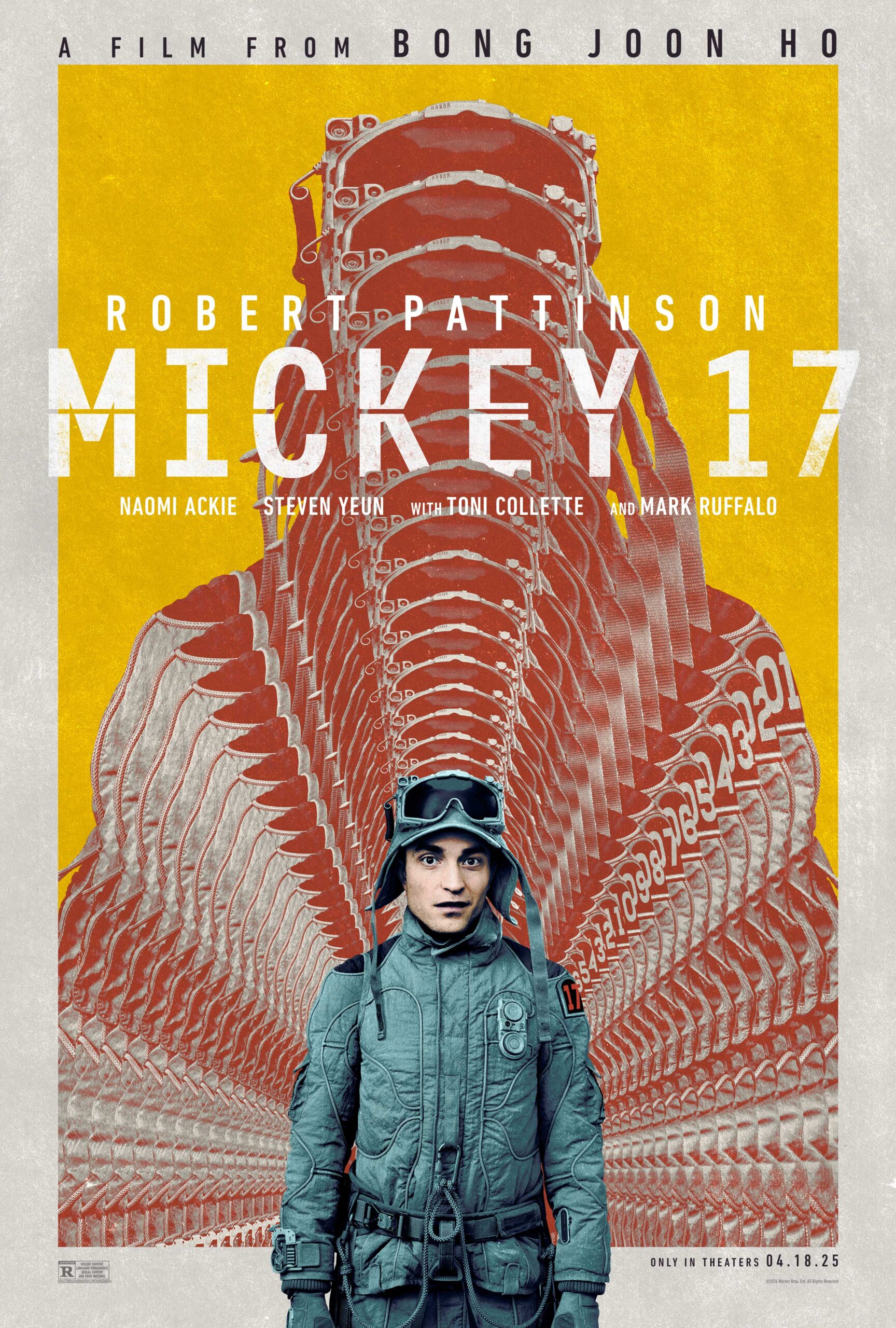
MICKEY 17 film review

Ambitious but disjointed. Bong Joon-ho’s newest film Mickey 17 excels in technical achievement but the full impact of the story demonstrates greater concern for its satire, message, and world building than it does its plotting and structure. Blending multiple genre conventions, Joon-ho’s science-fiction, dark comedy begins with an intriguing premise underscores with existential questions, but ultimately doesn’t feel cohesive from beginning to end. Despite the exhaustive satire–which is entertaining at first–the film works excellently as a critique of the prolific mediation of society, obsession with the idea of self-made celebrity, and the camera fame. Additionally, it presents an exploration of humanity’s fixation on replication and surveillance. Perhaps the film doesn’t call out any particular app or platform, it certainly drives home the point that a monster can be created through obsession with one’s image, control, and manipulation of others.

Mickey Barnes (Robert Pattinson), a disposable employee, is sent on a human expedition to colonize the ice world Niflheim. After one iteration dies, a new body is regenerated with most of his memories intact.

Despite an intriguing premise, the narrative often succumbs to prolonged scenes and sequences, subplots that lack meaningful purpose, and over-explanation in come places whilst lack of purpose exists elsewhere. While the third act is strong and completely engaging, the first act is protracted and the second act is plagued by poor pacing brought on by a wandering direction. The protracted first act delays audience immersion into the core narrative. What would’ve served the plot better as a brief prologue, turns into most of the first act. Even though the film maintains a modicum of innovation and freshness, it struggles to sustain momentum, resulting in a clunky and disposable experience.

The film delivers a relatively strong performative dimension, which helps to keep the audience engaged–however weak the engagement–in the story. And, Robert Pattinson performance strikes a nice balance between nuanced and manic, which mimics the film’s darkly comedic tone. Between his and the other leading actors performances, collectively they add a rolling punchline to the monotony of many scenes and sequences in the film. Mark Ruffalo’s depiction of the authoritarian leader, Kenneth Marshall, is audacious and campy, but doesn’t take long for this performance to become exhaustive–a little goes a long way with Marshall. Playing Marshall’s wife is horror-fan favorite Toni Collette, and even her character overstays her welcome in most of the scenes in which she appears.

Both the plotting and character issues can be connected to the screenwriting, which lacks direction, purpose, and refinement. Mickey 17 is another example of a director with a great, even innovative movie idea, but should work with a screenwriter with a command of proper screenwriting conventions and mechanics to craft the story for the page, and eventually the screen. This issue is not unique to Joon-ho, but a recurring problem I find with many (if not most) writer-directors. Few directors can write as well as they direct; and the inverse is also true–few screenwriters can direct as well as they can write.

Mickey 17 serves as a critique of the mediation of society, wherein informative, entertaining, and surveilling media technologies devalue the individual resulting in individuality with dimension being reduced to a character or commodity to be traded and exploited for the sake of ratings and celebrity. Mickey’s existential crisis of repeatedly dying and being reprinted underscores the alienation experienced in a society that commodifies human existence. Furthermore, Keneth Marshall’s obsession with control and his self-made celebrity mirrors the obsession many have, in the real world, with their “celluloid” self–or more accurately today–their digital self.

Everything Marshall said or did was ran through an image consultant and production crew on how it would look on camera. Looking at the real world, each of those squared images on Instagram or vertical video on SnapChat or Tik Tok, only show an edited version of the subject–the framing and editing is specifically manipulated and articulated to shape the audience’s perception. While this is to be expected in motion pictures and television shows, many of these self-made celebrities and influencers on social media want the audience believe they are being authentic, when it’s all a facade. In this obsession with the camera and “framed” image, society is exchanging that which is real with a projected authenticity; furthermore, the lines between what which is real and that which is fictionalized (or augmented) are becoming increasingly blurred.

Bong Joon-ho’s Mickey 17 blends satire with science fiction but the film’s underdeveloped plot and uneven character portrayals prevent it from reaching the potential this film demonstrably had with the talent behind it.

Ryan is the general manager for 90.7 WKGC Public Media in Panama City and host of the public radio show ReelTalk about all things cinema. Additionally, he is the author of the upcoming film studies book titled Monsters, Madness, and Mayhem: Why People Love Horror. After teaching film studies for over eight years at the University of Tampa, he transitioned from the classroom to public media. He is a member of the Critics Association of Central Florida and Indie Film Critics of America. If you like this article, check out the others and FOLLOW this blog! Follow him on Twitter: RLTerry1 and LetterBoxd: RLTerry
HEART EYES horror movie review

Slashtastic! Heart Eyes is the don’t miss holiday horror movie this Valentine’s season. Whether you’re a romantic or a cynic, there is something in here for everyone. The blend of romance and horror will, like Cupid’s arrow, find its way to the heart of slasher fans. Move over Coal Miner to make room for a new killer on the Valentine’s scene. Directed by CollegeHumor’s Josh Ruben and written by Christopher Landon (Happy Death Day), Michael Kennedy (Freaky), and Phillip Murphy (Hitman’s Wife’s Bodyguard), Heart Eyes seamlessly blends cliches from both romcoms and slashers, resulting in a movie that is sure to find its way onto rewatch lists every Valentine’s Day.

A masked maniac with glowing, red heart-shaped eyes returns every Valentine’s Day to terrorize unsuspecting couples.

The screenwriting is efficient and effective, and wastes no time in drawing audiences into this properly paced story. The kills are over-the-top–almost campy–and the romanic comedy bits are cheesy–in all the best ways possible. But this movie isn’t just about thrills and kills, because the central characters are surprisingly well-developed, and you’ll be rooting for their survival. So sure, some of the plot beats are formulaic, but this is a formula that has worked for over four decades, and demonstrates that genre movies have a timeless quality–a charm–about them that keeps us coming back for more screams.

Much like we saw with 2023’s Thanksgiving, Heart Eyes does the slasher right. Not only does it check off all the boxes for a classically written slasher, it also checks off boxes for a romantic comedy. Perhaps the movie leans more into its horror genes than it does its romcom genes, but it still strikes a well balanced genetic sequence for your entertainment pleasure. Starting with a classic romantic comedy opening, but as soon as it steeps for just the right amount of time, then upending it with a campy and gruesome slasher sequence, informs audiences precisely that for which they are in store for the rest of the movie. It sets the tone right up front, so you’re willing to buy everything else the movie throws at you.

The plotting is both sound as does the slasher reveal right. Yes, in hind sight you can make the observations that Heart Eyes took from this or that slasher, but that’s the beauty–it follows the formula but still keeps it engaging. Never once did I feel that it failed to keep my interest–even when I called the identity of HEK. I liked that this movie felt like classic slasher. We get it all: a big event that kicks everything into gear, a central character with a well-defined external goal driven by an internal need, and a character of opposition. This movie benefits from solid screenwriting and a director that seeks to entertain first and underscores the superstructure with thoughtful material for conversations about romance and relationships in the subtext. The stakes are high: survival! And throughout the movie, the stakes are raised, reminding us that no one is safe and even our final girl can be injured or killed.

Both of our central characters are well-developed. Olivia Holt’s Ally and Mason Gooding’s Jay are relatable and compelling. Are the characters particularly deep? No. But are they sufficiently developed to give these slasher characters human dimension? Yes. Both are strong and vulnerable. Furthermore, Ally feels like an “everyman” that is thrown into a situation in way over her head, but the setup is quite believable. I also like comedic irony in that she works for a jewelry company but has grown disillusioned by romance after being dumped by her boyfriend. Perhaps you work for a company that advocates for or sells something of which you are now cynical. Alternatively, Jay may come off overly optimistic and idealistic, but through that, we also learn that he as fears and vulnerabilities too. My point is, the principle players in this slasher are written with dimension, so you are rooting for their survival.

The most memorable slashers have a trademark mask, weapon, or sometimes both, which is the case with the Heart Eyes Killer (HEK). I’ve no doubt that HEK will find a place amongst the pantheon of slasher icons. After a long time of no new entries into that circle, we had John Carver added in 2023 and now HEK. Heart Eyes is a horror movie made by slasher fans for slasher fans, and its refreshing to see that the horror staple is still alive and well. Through movies like Thanksgiving and Heart Eyes, modern audiences are reminded that genre movies can be just as entertaining or thoughtful as the arthouse movies that are slowly becoming the mainstream. Funny–the movies that used to be the mainstream (i.e. slashers) are slowly finding their way into the arthouse cinemas, while the prestige pictures that used to be confined to the arthouse cinemas are slowly becoming the new mainstream.

Thematically, the movie explores disillusionment in and with romance. From an opening scene that underscores the realization that images captured by a camera are not always reflexive of reality to the cynicism that can grow out of broken relationships to accepting that an idyllic romance may just be possible, it’s all in this movie. Through the apparatus of the slasher, the writers and director are able to explore love and romance in a variety of ways that are rather poignant.

If your idea of a Valentine’s date is dinner followed by a scary movie, then this movie fits the bill! It works as both. Happy Valentine’s Day!

Ryan is the general manager for 90.7 WKGC Public Media in Panama City and host of the public radio show ReelTalk about all things cinema. Additionally, he is the author of the upcoming film studies book titled Monsters, Madness, and Mayhem: Why People Love Horror. After teaching film studies for over eight years at the University of Tampa, he transitioned from the classroom to public media. He is a member of the Critics Association of Central Florida and Indie Film Critics of America. If you like this article, check out the others and FOLLOW this blog! Follow him on Twitter: RLTerry1 and LetterBoxd: RLTerry
COMPANION horror movie review

A wild, albeit predictable ride. New Line Cinema’s Companion, written and directed by Drew Hancock, is an entertaining cautionary tale on how ultimate control, ultimately corrupts. Moreover, the film provides a thoughtful critique on the (in this case) deadly consequences of attempting to exert that desire for ultimate control over an individual, thus rendering mute their unique individuality. The film also paints a provocative portrait of the relationship between humanity and artificial intelligence (and androids) by establishing a seemingly controlled environment that then devolves into one of chaos. This progression reflects the overarching theme of attempts at ultimate control by underscoring the illusion of the ability to exert ultimate control over the human spirit, even if that “humanity” is housed within an artificial intelligence. Hancock’s screenplay is lean and mean, and nicely balances the horror elements with both lighthearted and dark comedy. Even though many of the plot beats were predictable, the movie still succeeded in remaining engaging and fun–just goes to show that there is a beauty to genre movies.

A weekend getaway turns bloody and violent when a subservient android that’s built for human companionship goes haywire.

Hancock’s film effectively blends elements of horror and comedy to explore contemporary anxieties surrounding individualism, artificial intelligence, and the ethical implications of control for the purposes of subjugation. Audiences are challenged by the plot and characters to reflect on the moral responsibilities involved in the creation and control of artificial-sentient beings. By prompting the audience to consider the consequences, the film is positing questions concerning the very nature of humanity and the desire and limits of control. Furthermore, the film demonstrates that when given seemingly ultimate control, that primal desires for ultimate control surface, thus reminding us that we have to learn to be generous, kindly, and altruistic because we are naturally born rather selfish and self-centered. Ultimate control, ultimately corrupts. Without reasonable checks and balances, the results of absolute control can be negative and quite possibly even deadly to the human spirit.

As artificial intelligence increases in human-like problem solving and expression, we have to ask ourselves how far will be go to both create and control artificial intelligence as it slowly approaches android-like technology. Will androids be controlled like a typical robot or mindless automaton or will they be granted sentient status like Data on Star Trek: the Next Generation‘s critically acclaimed episode “The Measure of a Man”? Without derailing from my review of Companion too much, I am reminded of this outstanding Trek episode that actually does a much better job of addressing topics of autonomy and control than Hancock’s film. The episode critiques the idea that beings created for a (even at one time, pre-determined) purpose (especially artificial ones) can be controlled or owned. Data’s ability to choose his own destiny is at stake. Captain Picard argues, in the trial that is convened to determine Data’s humanity, that intelligence, self-awareness, and consciousness make someone a sentient individual, not merely their biological nature.

Where I feel that Hancock’s film falls short is in its social commentary is the limitations it places on itself in its expression of the themes with which it underscores the plotting and characters. For the greatest impact, it should have been more consistent in the exploration of ultimate control over a seemingly sentient individual. Instead of crafting a film that could be more broadly applied, Hancock’s story falls into the trap of being too focuses on a overly generalized stereotype of particular individuals versus crafting a narrative that was more broadly concerning itself with depicting robbing sentient beings of their individualistic humanity–their free will. The sharpest criticism is clearly aimed at one particular character (and the demographic they represent). But eventually the idea of control over an individual snares another group. And for a moment, there was hope that Hancock was extending his critique to be more inclusive, but it returns to being focused on the original demographic group. This extension would have been a reminder that anyone can find themselves drawn to how far one can push the limits of control over a lover, friend, or other platonic, professional, or romantic relationship. It’s a trait that runs through everyone, and we have to learn to control our innate selfish and self-centered behaviors with which we are born.

While I have some reservations in the consistency and accuracy of theming in the film, Companion remains a solid horror films that serves as a reminder of the consequences of exerting ultimate control over an individual. The pacing, plotting, character development, and technical elements work together very well to keep the audience entertained on this wild ride.

Ryan is the general manager for 90.7 WKGC Public Media in Panama City and host of the public radio show ReelTalk about all things cinema. Additionally, he is the author of the upcoming film studies book titled Monsters, Madness, and Mayhem: Why People Love Horror. After teaching film studies for over eight years at the University of Tampa, he transitioned from the classroom to public media. He is a member of the Critics Association of Central Florida and Indie Film Critics of America. If you like this article, check out the others and FOLLOW this blog! Follow him on Twitter: RLTerry1 and LetterBoxd: RLTerry
PRESENCE horror film review

It’s, well, interesting. As soon as I saw that David Koepp was the screenwriter, I was instantly intrigued. While I’m hit or miss with Soderbergh, I’m generally hit with Koepp. But, I find this film’s apparatus to be more interesting than the story itself. While Presence is ostensibly a ghost story, it derives much of its intrigue–not from its narrative–but from its formal and technological apparatus. Soderbergh, known for his experimental approach to filmmaking, employs an innovative first-person perspective; however, this stylistic choice, coupled with Soderbergh’s meticulous control over framing, lighting, and movement and Koepp’s minimalist screenplay, resulted in elevating the film’s formal qualities above its forgettable plot and one-dimensional characters.

In short, the film is about a family that moves into a suburban house and becomes convinced they’re not alone.

The film unfolds through the perspective of an unseen spectral presence, effectively turning the camera into an active participant rather than a passive observer. This shift from traditional storytelling to experiential cinema foregrounds the act of seeing and being seen, inviting viewers to consider their own complicity in the voyeuristic aspects of horror. The film’s reliance on long takes and fluid camerawork creates an unsettling sense of omnipresence, emphasizing the medium’s ability to manipulate space and perception.

While Koepp’s screenplay is serviceable in its exploration of haunted house tropes, it often feels secondary to the film’s preoccupation with its own form. Koepp’s screenwriting is characterized by minimalistic dialogue and a structure devoid of conventional plotting. Rather than relying on his penchant for exposition-heavy scripts, Koepp wrote a screenplay that relied primarily on subtext and visual cues, thus inviting the audience to experience the story through mood versus visually-driven stimuli. The film’s thees such as literal and metaphoric isolation, family dysfunction, and the effects of trauma, feel much more like scaffolding for Soderbergh’s technical experimentation than an actual story. Koepp’s unconventional screenplay paired with Soderbergh’s experimental filmmaking results in a film wherein the mechanics of cinema take precedence over traditional storytelling.

Ultimately, Presence is most compelling when considered as an exercise in film form rather than a compelling story itself. The filmmaking apparatus generates a more profound engagement than its plot and characters, which hurts the potential this film had given its pedigree of talent. Soderbergh and Koepp crafted a film that is less about a haunted house and more about reimagining the voyeuristic capabilities of cinema itself. By leveraging cutting-edge camera systems and post-production techniques, Soderbergh set out to blur the line between observer and observed, in an attempt to create an uncanny sense of intimacy and detachment, but it failed to stick with this critic long after the credits rolled.

Ryan is the general manager for 90.7 WKGC Public Media in Panama City and host of the public radio show ReelTalk about all things cinema. Additionally, he is the author of the upcoming film studies book titled Monsters, Madness, and Mayhem: Why People Love Horror. After teaching film studies for over eight years at the University of Tampa, he transitioned from the classroom to public media. He is a member of the Critics Association of Central Florida and Indie Film Critics of America. If you like this article, check out the others and FOLLOW this blog! Follow him on Twitter: RLTerry1 and LetterBoxd: RLTerry
THE LAST SHOWGIRL film review

Anderson dazzles in spite of lackluster screenplay. Pamela Anderson’s captivating performance in The Last Showgirl is truly compelling. Gia Coppola’s film may lack strong, cohesive plotting, but serves as a fantastic character study that remains with you long after you leave the theatre. This is particularly true for anyone that has ever worked in live entertainment or felt left behind due to being perceived as irrelevant or outdated due to changing times and shifting audience taste. This film unapologetically explores universal fears and anxieties associated with change, relevance, and identity. It’s only flaw, which is a biggie, is that I wish the screenplay had been a better vessel for the performative dimension to showcase the talent and passion on screen.

Written by Kate Gersten, the film follows iconic Vegas showgirl Shelly (Pamela Anderson) after her legendary Las Vegas showgirl spectacular is coming to an abrupt end after more than thirty years. Now, she much grapple with the uncertainty of her future because of the extinction of the Vegas showgirl shows.

The Vegas showgirl used to be an institution, but unfortunately shifts in audience taste have all but made the iconic showgirl an obsolete fixture of live entertainment. The idea of the Vegas showgirl in all her sequined and feathered glory is still alive, but that’s all it is anymore–an idea that exists only in our collective memories of a bygone era. Anderson’s performance is particularly compelling because of her effortless ability to oscillate between vulnerability and strength without the end result ever feeling fabricated or unrelatable. In retrospect, I cannot think of a better actor to have brought this character to life than Pamela Anderson, because a signifiant portion of the gravitas she is able to bring to the character is inspired by channeling the energy of her own past glory days, which she infuses into each step and gesture. Anderson’s charisma shines in the scenes where the character performs, even if only in the solitude of her own living room. Delivering a gritty, raw honesty to the role, the former Baywatch megastar relinquishes glamor in exchange for authenticity in a role that feels achingly real and profoundly human.

Shelly represents all those that have worked on stage in live entertainment, whether that is in a theatre or at a theme park. While the focus is on the stage talent, many of the ideas that the film posits can be connected to work backstage as well, as entertainment changes. Shelly is not only haunted by the loss of relevance, but also by the deeper, existential terror of becoming invisible–something we all fear. As such, Anderson’s character connects to us on both a personal level and to society at large. Whether on the Vegas stage, at the cinema, on the television, or even at the theme park (looking at you, Universal Orlando), this film comments on the broader idea of how cultural shifts in audience tastes can be destructive to dreams, experiences, and careers.

Coppola’s film delves provides audiences a candid portrait of a former starlet from the golden age of Vegas entertainment, now struggling to find her way in an unfamiliar world that is all but alien to her. What Shelly is going through is not unlike what some (if not many) of us go through–or fear we will go through during the course of our professional careers or interests. While the film takes place in Vegas, many parallels can be drawn to changes in cinema, theme parks, and television. As shown in the film, the Vegas audience of today has drifted away from the opulent, theatrical traditions that were a staple of Las Vegas toward minimalism, concerts, and new media. And while there is nothing innately damaging about any of those, collectively they rendered the classic Vegas experience obsolete. The audience Shelly once captivated, no longer values or finds enjoyment in that which she represents.

I recently learned this when I found that I will be attending the NAB convention in Las Vegas. And the first thing I did was look to find a classic Vegas showgirl show–like from Show Girls. Didn’t take long to learn that those shows do not exist anymore. So, this film was all the more relevant and even poignant because Shelly represents something that I had hoped to experience, but can only find in, as I gather, Vegas: the Show and films and television from decades past. I was saddened, really. To think that something that was a Vegas mainstay for decades, inspiring movies, songs, and playing a signifiant role in the whole Rat Pack aesthetic, was just a faded memory. Originality was exchanged for an extension of what you could find on Broadway or a concert venue near you.

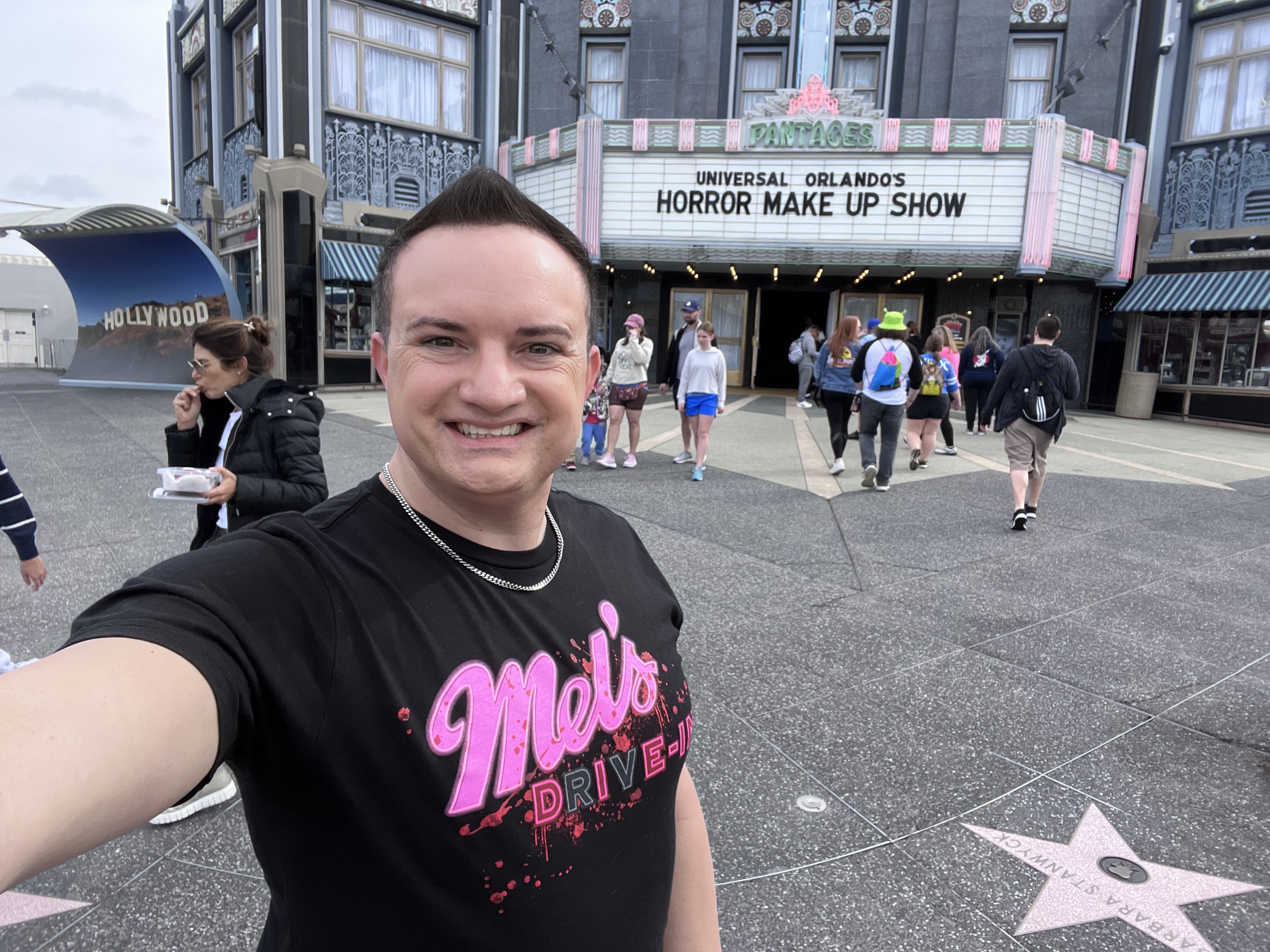
Something else that hit me was how Shelly and events of the film prompted me to think about my own career and professional aspirations, because the Hollywood that I fell in love with as a kid is nearly a distant memory. Just like the Universal Studios Florida that I fell in love with as a kid no longer exists except for the Horror Makeup Show and the E.T. Adventure. Sitcoms and non-serialized drama and horror programs are nearly an entertainment medium of television past and the slasher film has largely fallen out of favor with mainstream audiences. Even film criticism–it’s no longer about applying a critical lens to motion picture arts and sciences; rather, it’s now about your means of garnering attention on YouTube or Instagram matters more than what you have to say. Even blogging has nearly become a thing of the past. Scary to think that you can become obsolete in the very field in which you’ve worked do diligently, smartly, and hard.

Through this character study film, we learn that there is a quiet, enduring value in the traditions and artistry Shelly represents, even in an age of social media influencer, superficial trends, and fleeting attention spans. Perhaps we are drawn to films like this because, for example, the Vegas showgirl is truly timeless. Maybe she isn’t on the stage any longer, and the last remnants of French Lido culture are extinct except for Moulin Rouge in Paris and (in a manner of speaking) the Rockettes at Radio City Music Hall, but her legacy will live on, if only in our memories.

I highly recommend watching this film if you enjoy compelling character studies. I wish it was more than a character study, but that’s no fault of the actors or director. The weakness in the storytelling of this film is found in the vapid screenwriting and lack of following proper screenwriting mechanics that require, at minimum, a well-defined central character with a well-defined external goal opposed by a well-defined character of opposition.

Ryan is the general manager for 90.7 WKGC Public Media in Panama City and host of the public radio show ReelTalk about all things cinema. Additionally, he is the author of the upcoming film studies book titled Monsters, Madness, and Mayhem: Why People Love Horror. After teaching film studies for over eight years at the University of Tampa, he transitioned from the classroom to public media. He is a member of the Critics Association of Central Florida and Indie Film Critics of America. If you like this article, check out the others and FOLLOW this blog! Follow him on Twitter: RLTerry1 and LetterBoxd: RLTerry