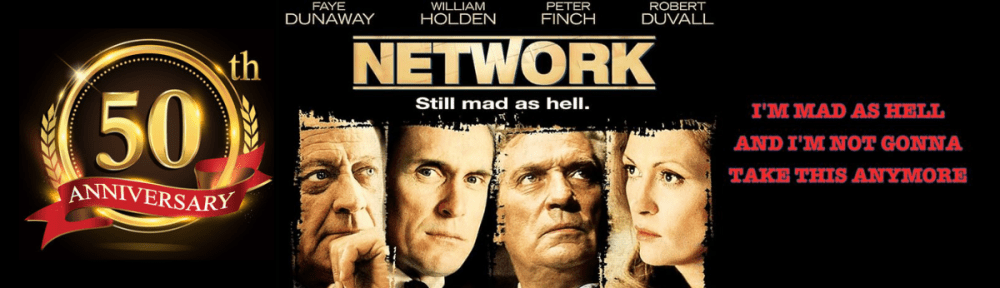
When satire ceases being satire–we’re living inside it.
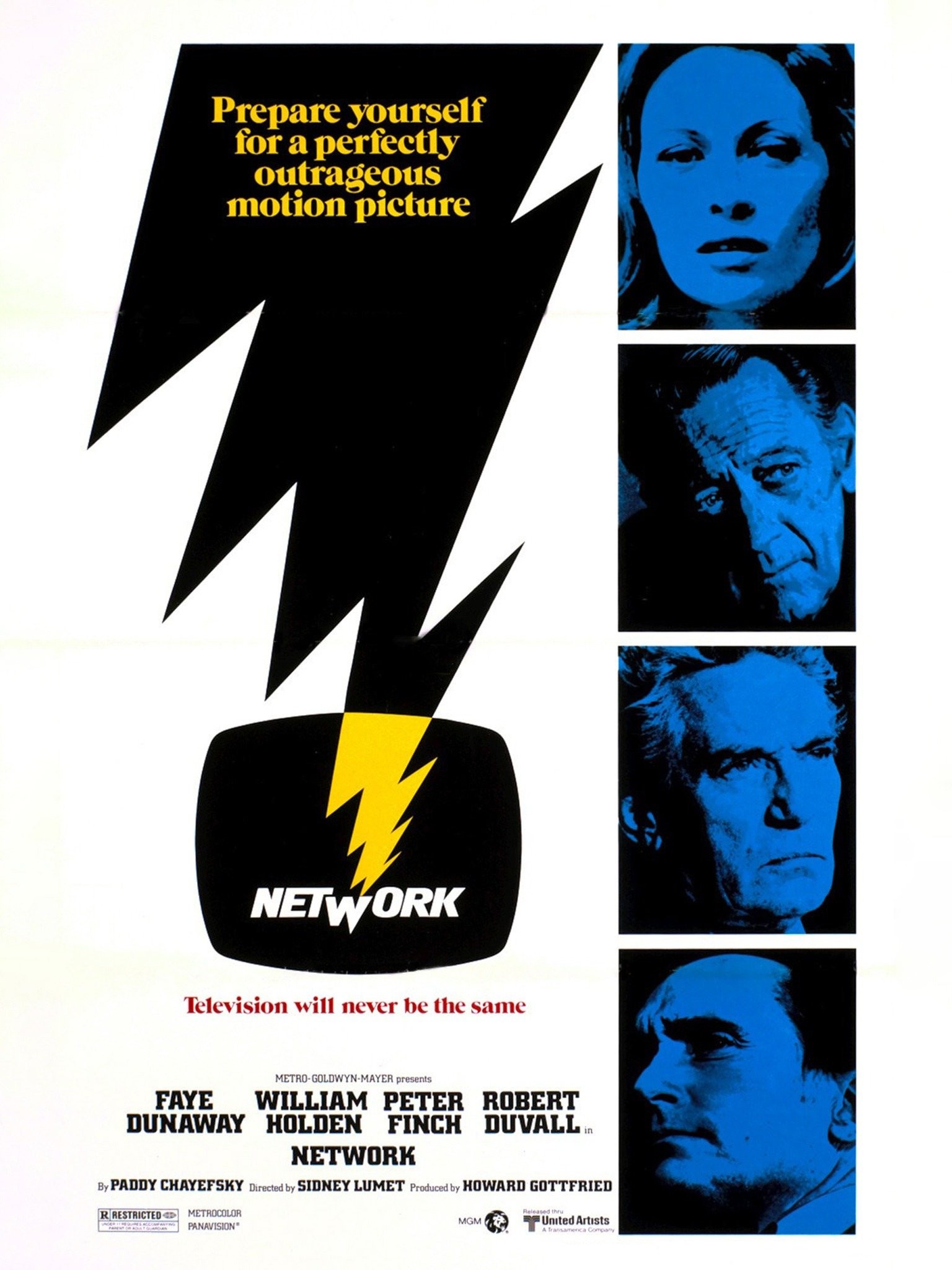
There are films that feel timely, films that feel dated, and then there is Network—a work so disturbingly elastic that it seems to recalibrate its relevance with each passing decade. What Sidney Lumet’s incendiary masterpiece offered in 1976 as provocation now functions as diagnosis. Network ceased being satire the moment we began living inside it. And at fifty years on, it is no longer prophetic so much as instructional—a grim field manual for the media ecosystem we willingly built.
On its surface, Network is a scathing critique of television news and the corrosive marriage between journalism and entertainment. But that reading now feels almost quaint. Today, the film operates as a far more expansive lens—one through which we can examine social media’s performative outrage, the collapse of editorial integrity, the rise of influencers over actors, and “content” replacing cinema as both commodity and aspiration. The film’s possibilities for interpretation are not merely endless; they are inescapable.
You can listen to the NETWORK episode of ReelTalk, which serves as a great companion piece to this article through your favorite podcast service. For your convenience, I’ve included some links that may work for you.
When I survey the contemporary media landscape—where outrage is currency, truth is malleable, and spectacle supplants substance—I often find myself echoing Howard Beale’s immortal lament: “I’m as mad as hell, and I’m not going to take this anymore.” The tragedy, of course, is that Beale’s righteous fury is swiftly commodified, packaged, and sold back to the public. In Network, that process is the warning. In 2026, it is the business model.
What Network ultimately offers is not just a critique of television news, but an elegy for every so-called Golden Age of legacy media—journalism, cinema, and serialized television alike. Watching it now, I am reminded of Norma Desmond’s aching declaration in Sunset Boulevard: “I am big. It’s the pictures that got small.” Substitute “pictures” for platforms, algorithms, and engagement metrics, and the lament lands with devastating clarity. In my view, social media and streaming have not merely disrupted cinema and television; they have delivered a mortal wound—one from which craft, patience, and collective cultural experience may never fully recover.
Network endures first and foremost because it is built on one of the most ferocious screenplays ever put to film. Paddy Chayefsky’s Oscar-winning script is not merely well-written; it is weaponized language—monologues that cut like scalpels, dialogue that oscillates between blistering satire and operatic tragedy, and ideas so densely packed they continue to unfold decades later. This is writing that trusts intelligence, that dares to be verbose, ideological, and confrontational in a way modern studio cinema rarely permits. Chayefsky understood that words—spoken with conviction—could be more explosive than spectacle, and he built Network accordingly.
What makes the screenplay extraordinary is its refusal to choose a single target. It indicts television news, corporate capitalism, religious fervor, political apathy, and audience complicity with equal venom. The famous “mad as hell” speech is not a populist rallying cry so much as a trap—an emotional release engineered to be monetized, emptied of meaning, and repackaged as programming. Chayefsky was not predicting outrage culture; he was anatomizing it. In an era where dialogue is often sanded down to algorithm-friendly soundbites, Network feels almost alien in its literary ambition—proof that cinema once trusted language to carry weight, risk, and consequence.
Sidney Lumet’s direction is the perfect counterbalance: disciplined, precise, and deliberately unflashy. Lumet stages the film like a moral courtroom drama, allowing performances and ideas to occupy the foreground while the camera observes with quiet authority. His restraint is crucial. Rather than amplifying the satire through stylistic excess, Lumet grounds the absurdity in realism—office spaces feel oppressive, boardrooms feel sterile, and television studios feel eerily sacred. The effect is chilling: the madness is not heightened by cinematic flourish; it emerges organically from systems that feel frighteningly familiar.
Together, Chayefsky and Lumet create a film that feels less like a movie and more like a controlled detonation. There is no indulgence, no wasted motion, no attempt to soften the blow. In contrast to today’s cinema—often drowned in visual noise, diluted themes, and studio-mandated ambiguity—Network stands as a reminder of what happens when writing and direction operate with absolute clarity of purpose. It is fearless, articulate, and devastatingly focused. And perhaps most damning of all: it proves that cinema once had the courage to tell audiences the truth, even when that truth was deeply uncomfortable.
Yet if Network endures as forcefully as it does, it is not solely because of its prescience. It endures because it is performed with astonishing precision and gravitas by one of the greatest ensembles ever assembled. Peter Finch’s Howard Beale remains one of cinema’s most unforgettable figures—a man whose breakdown is mistaken for authenticity, whose humanity is exploited until nothing remains. Finch’s posthumous Academy Award win feels less like recognition than inevitability.
William Holden, meanwhile, brings a weary, world-worn melancholy to Max Schumacher that resonates deeply with his earlier turn as Joe Gillis in Sunset Boulevard. Both characters are men who recognize the rot of the system even as they remain complicit within it—observers with just enough moral clarity to feel shame, but not enough power to stop the machine. Holden’s quiet resignation here serves as the film’s conscience, a reminder of what professionalism and restraint once meant.
And then there is Faye Dunaway, delivering a tour de force for the ages—one of those rare performances that does not merely dominate a film, but defines an era of acting. Her Diana Christensen is ambition incarnate: ice-cold, ferociously intelligent, and utterly unencumbered by empathy. Dunaway doesn’t soften the character or seek audience approval; she weaponizes Diana’s ruthlessness, allowing her to move through the film with the predatory calm of someone who understands power not as responsibility, but as leverage. The performance is so precise and so unflinching that it almost feels inhuman, as though Diana has already evolved into the algorithmic logic the film warns us about—ratings as morality, attention as currency, and human cost as an acceptable casualty.
It is no accident that Dunaway earned the Academy Award for Best Actress for this role. The Oscar was not simply recognition of a great performance; it was an acknowledgment of something rarer—a character so vividly realized that she became a cultural archetype. Diana Christensen is not just a television executive; she is the prototype for the modern media operator, the spiritual ancestor of today’s content strategists, brand architects, and engagement-obsessed executives. Dunaway plays her with surgical control, her clipped delivery and laser-focused gaze conveying a woman who has replaced conscience with metrics long before such thinking became normalized.
In the broader context of film history, Dunaway’s work in Network cements her status as one of the greatest actresses of all time—very much in the lineage of Bette Davis and Joan Crawford, yet operating outside the classical Golden Age of Hollywood. Like them, Dunaway possessed an unapologetic intensity, a willingness to embrace unlikable women, and a commanding screen presence that bent films around her gravitational pull. But unlike Davis or Crawford, her era offered fewer guardrails and less mythmaking; Dunaway emerged during a transitional moment in American cinema, when performances could be raw, confrontational, and morally untidy.
That makes her Diana Christensen all the more extraordinary. It is not a performance cushioned by studio glamour or softened by melodrama—it is sharp, modern, and terrifyingly plausible. Decades later, Dunaway’s Oscar-winning turn feels less like a relic of 1970s cinema and more like a warning label we ignored.
The supporting cast—Beatrice Straight, Ned Beatty, Robert Duvall—forms a devastating chorus, each representing a different facet of institutional decay. Straight’s Oscar-winning performance, in particular, remains one of the most remarkable achievements in Academy history. The fact that Straight’s Academy Award for Best Supporting Actress was won with comparatively limited screen time only underscores the magnitude of her presence. Every line, every glance carries weight. Gravitas is not measured in minutes.
It is impossible to discuss Network without reckoning with its unprecedented—and now unthinkable—Oscar performance. The film received ten Academy Award nominations, including Best Picture, Best Director, and an astonishing four acting nominations across all performance categories. Even more remarkable: Network won three of the four acting awards—Peter Finch (Best Actor), Faye Dunaway (Best Actress), and Beatrice Straight (Best Supporting Actress)—with Finch’s win occurring posthumously. That trifecta remains a singular achievement in Oscar history.
What makes this feat so haunting in retrospect is not merely its rarity, but what it represents: a time when the Academy rewarded performance-driven cinema rooted in language, ideas, and moral urgency. These were not roles engineered for “Oscar moments” clipped for social media circulation. They were fully realized characters inhabiting a screenplay that demanded intelligence, restraint, and theatrical rigor. Even Beatrice Straight’s win—earned with fewer than six minutes of screen time—speaks to an era when gravitas mattered more than exposure, and emotional truth outweighed narrative gymnastics.
Contrast that with the modern awards landscape, where performances are often subsumed by brand visibility, platform allegiance, and campaign machinery. Today’s Oscars frequently feel less like a celebration of cinema than a referendum on cultural relevance as defined by streaming metrics and algorithmic reach. In that context, Network’s acting sweep feels not merely impressive, but elegiac—another artifact from a period when cinema trusted adults to speak, listen, and think.
This is where Network dovetails uncomfortably with my broader reflections on the erosion of cinematic prestige and journalistic integrity. The film arrived at a moment when studios still believed movies could challenge audiences, when networks still pretended journalism was a public service, and when awards bodies still recognized craft over content. That ecosystem no longer exists.
Today, companies like Netflix and Disney—titans of scale and convenience—have played outsized roles in flattening the cultural landscape. Netflix’s content-first philosophy has blurred the line between cinema and disposable product, prioritizing volume over vision and treating storytelling as a data problem to be optimized rather than an art form to be refined. Disney, meanwhile, has transformed legacy filmmaking into brand maintenance, where risk is minimized, mythmaking is franchised, and even news-adjacent programming is filtered through spectacle and marketability.
In that environment, Network feels almost confrontational. It reminds us that journalism once aspired to truth rather than virality, that cinema once valued language over noise, and that performances once carried weight beyond their runtime. The film’s Oscar dominance is not simply a historical footnote—it is a marker of how far the industry has drifted from rewarding seriousness, substance, and moral clarity.
Ultimately, Network foresaw where we were headed with terrifying clarity. But perhaps its greatest sorrow is that it did not imagine how eagerly we would embrace that future. Our media landscape has not merely changed; it has lost its soul. Journalism has become performance. Cinema has become content. And authenticity—once a virtue—has been repurposed as branding. Half a century later, Network stands as both benchmark and indictment. It is proof that cinema once mattered enough to scare the powerful—and a reminder that somewhere along the way, we stopped demanding that it do so.
Ryan is the general manager for 90.7 WKGC Public Media and host of the show ReelTalk “where you can join the cinematic conversations frame by frame each week.” Additionally, he is the author of the upcoming film studies book titled Monsters, Madness, and Mayhem: Why People Love Horror. After teaching film studies for over eight years at the University of Tampa, he transitioned from the classroom to public media. He is a member of the Critics Association of Central Florida and Indie Film Critics of America. If you like this article, check out the others and FOLLOW this blog! Follow him on Twitter: RLTerry1 and LetterBoxd: RLTerry
 R.L. Terry ReelView