
ORDINARY ANGELS movie review

Warms the most cynical of hearts. Two-time Academy Award-winning Hilary Swank makes a triumphant return to the silver screen in Ordinary Angels. Her outstanding performance in this remarkable true story will stir your soul, and remind us that with all the conflict and self-centeredness in the world, that there are still those that strive to make it a better place, even if it’s just helping one person. Despite some pacing issues, most notably in the second act, and some forced dialogue here and there, Ordinary Angels genuinely surprised me by how well it was written and directed. Moreover, there is a discernible emotive dimension to the editing and cinematography as well. Many movies based on true stories can feel like an extension of a Wikipedia article, but not so with this film. From beginning to end, it is a moving story that provides hope for humanity even when we feel broken.

Sharon (Swank), a struggling hairdresser, finds a renewed sense of purpose when she meets Ed (Alan Ritchson), a widowed father, working hard to care for his two daughters. With his youngest critically ill and waiting for a liver transplant, the fierce woman single-handedly rallies an entire community to help.

Okay, let’s address the white elephant (for many) in the room, and get it out of the way. Yes, Ordinary Angels is a motion picture from a faith-based production company. And even I have written how those types of movies are often poorly written and acted. Generally, the technical aspects of production are on par with more mainstream studios; but the writing and acting usually suffer. Suffice it to say, that is not the case here. I was shocked by how much I enjoyed the story and how the story was crafted.

The conflict is real, relatable, and raw. The characters feel like real people, flaws and all, especially Sharon and Ed. Whether it’s a true or fictional story, I always strive to find a character(s) with whom I can identify with his or her struggles and goals, because it’s our flaws and dreams that bring us together.

Why? Relatability. Characters in motion pictures need to feel relatable. Sometimes that relatability is identified in paralleling struggles or conflicts in our own lives to that which we observe on the screen. That which is most personal is most relatable. Furthermore, often times the best heroes are those that are just as broken as those around them, but it’s the overcoming of emotional or psychological baggage that greatly resonates with us.

It’s been a while since we’ve seen Hilary Swank on the silver screen, and it was so refreshing to see her once again. She brings such gravitas to every scene in which she is featured in Ordinary Angels. Throughout this performance, there are hints of the indelible quality she brought to us in Boys Don’t Cry and Million Dollar Baby. Sharon feels like your hairdresser or your friend or neighbor. She’s the perfect every man because there is neither pretense nor anything particularly special about her, save her infectious, brassy energy. And as much fun as she’s having on the outside, she is broken on the inside. That is, until she reads of the story of the little girl who needs a liver transplant and lost her mother the year prior.

And before you begin thinking this otherwise self-centered alcoholic mother with a son from whom she is estranged does everything without care for herself, you learn that she is using her philanthropic skills to help fill a void in her own life. Yes, she cares deeply for the little girl and her family; however, deep down, Sharon is also hoping to makeup for her failures as a mother. But through her journey helping this little girl, Sharon learns how to acknowledge the demons in her own life, and to grow from them instead of always compensating for or excusing them. True healing begins in the heart.

The character of Ed is also incredibly relatable. He represents an every man whom is angry at the world, angry at God, angry with himself, and full of stubborn pride. After losing his wife, five years after she gave birth to our dying little girl, he feels abandoned by the faith he once held dear. And how many of us wouldn’t feel exactly the same after losing a loved one, and on the verge of losing another, all while trying to manage a household on a shoestring budget with medical bills mounting? His response is a very human response. I particularly like his behavior after there is a light at the end of the tunnel–he is still wrestling with all those same anger issues, but demonstrates the beginning of recapturing his faith in God and humanity.

While the subject matter is rather dark–the dire straights in which the little girl’s family finds themselves–and the fact without a liver, the little girl will most certainly die, there are moments of levity that serve as emotional resets. My biggest problem with the writing is the second act in which pacing is rather sluggish. There is about 10-15mins that could’ve easily been carved out of the second act in order to maintain proper pacing throughout the entirety of the movie. Furthermore, there are moments in which the dialogue feels more plot-driven than character-driven. Not to the point it turns into a melodrama, but some lines feel a trifle artificial.

If you’re looking for a motion picture that shows that there is still hope for humanity, hope that we can–despite differences–help one another, help our neighbor, then this is a picture to check out while it is still in cinemas.
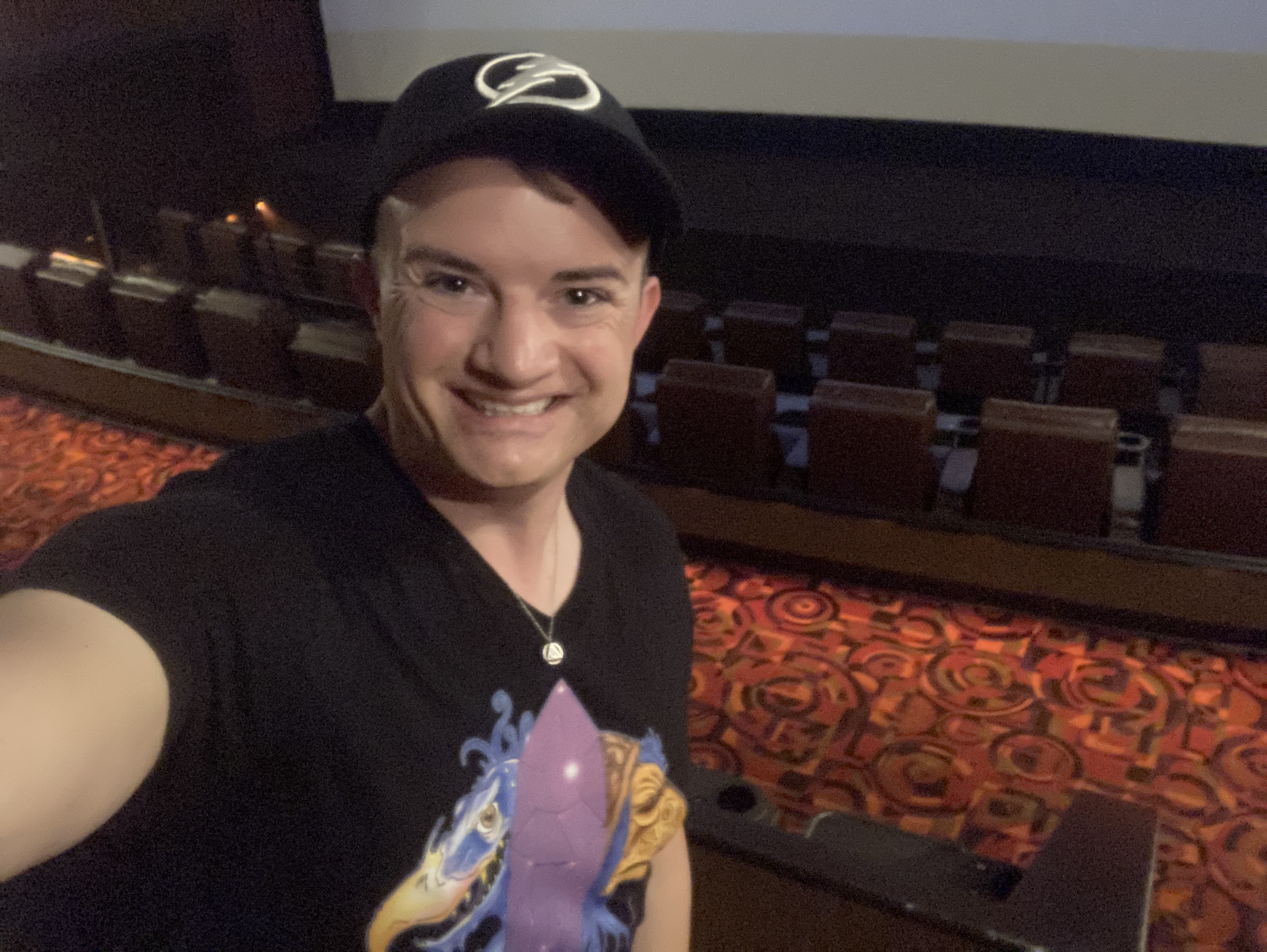
Ryan teaches Film Studies and Screenwriting at the University of Tampa and is a member of the Critics Association of Central Florida and Indie Film Critics of America. If you like this article, check out the others and FOLLOW this blog! Interested in Ryan making a guest appearance on your podcast or contributing to your website? Send him a DM on Twitter. If you’re ever in Tampa or Orlando, feel free to catch a movie with him.

Follow him on Twitter: RLTerry1 and LetterBoxd: RLTerry

SOUND OF FREEDOM movie review

Aleatoric. (Music theory folks will get it). Sound of Freedom is like Taken meets Argo, but the compelling true story ultimately falls slightly flat because of poor pacing. However, the film delivers on both technical merit and casting. While some outlets have described Sound of Freedom as a faith-based film from the same studio that produces the successful television series The Chosen, that is an inaccurate reading at best and an attempt to disparage the film’s quality at worst. Because this movie most definitely delivers on high production value and casting; but unfortunately, the performative dimension and screenplay are underwhelming. Feeling more like a visualization of the Wikipedia entry or Congressional testimony, Sound of Freedom‘s ambition is tapered by screenplay mechanics.

After rescuing a boy from ruthless child traffickers, Tim Ballard (Jim Caviezel), a federal agent, sets out on a dangerous mission to locate and free the boy’s sister, along with other children caught up in the nightmare of sex trafficking. With time running out, he quits his job and journeys deep into the Colombian jungle, putting his life on the line to free her from a fate worse than death.

There is certainly a compelling, gripping, gritty screenplay based on the true story of Tim Ballard’s mission to free children caught up in sex trafficking, but the plotting and pacing of the screenplay hold the film back from achieving the potential is so clearly demonstrates. While the screenwriting lacks finesse, there is no doubt that this film forces the world to face the nightmarish and closeness of the reality of human (specifically, child in this film) slavery and sex trafficking. Most acknowledge the importance of fighting human trafficking, but few realize how close to our own country this subject matter hits.

We often think of human trafficking as something that happens in foreign lands, but most of those that pay for such reprehensible services are operating out of the United States. Sound of Freedom is a grim reminder of the real war that is being waged in which innocent people are bought, sold, and traded as disposable commodities.

Visually, the film looks fantastic! Clearly, there was immense thought placed into the quality of image. Moreover, this same level of thought is witnessed in the settings and even in the casting. This film reminds me of the type of motion picture that we often see from Annapurna productions. In terms of the visual tone, it falls between arthouse and mainstream, which is to the film’s detriment, because had it stuck to either the look/feel of Taken or Argo, then the film would have been more surefooted. On the plus side, though, clearly Angel Studios has show the world that they are capable of releasing high quality motion pictures that can compete with the larger Hollywood studios.

Clocking in at around 2.25 hours, the film’s second act feels incredibly drawn out. I’ve written before about the litmus test I give myself, which evaluates pacing, and to that end, I did look at my watch about 1.5 hours into the film. Structurally, the first and third acts work sufficiently well, but the second act is augmented to needlessly extend the runtime. As this interpretation of the true story has it, there is enough plot for about 1.5-1.75 hours, meaning there is about 30-minutes that could have been cut out to streamline the motion picture.

I mentioned my observation that many outlets and other critics are referring to Sound of Freedom as a faith-based film, and there is little evidence to support that reading since there lacks any type of salvation or proselytizing message in the film. Because I’m sure we can all agree that God’s children are not for sale. If there is a message in the film, that is it. A universal truth that is applicable to and relatable by all.

Ryan teaches Film Studies and Screenwriting at the University of Tampa and is a member of the Critics Association of Central Florida and Indie Film Critics of America. If you like this article, check out the others and FOLLOW this blog! Interested in Ryan making a guest appearance on your podcast or contributing to your website? Send him a DM on Twitter. If you’re ever in Tampa or Orlando, feel free to catch a movie with him.
Follow him on Twitter: RLTerry1 and LetterBoxd: RLTerry

COCAINE BEAR horror movie review

Bonkers fun! Cocaine Bear is just what you imagine it to be: no holds barred carnage meets slapstick campy comedy. Inspired by the true story of a drug run gone wrong, this movie will keep you laughing from beginning to end. When it comes to the bear carnage, it’s delivers in spades; but, suffice it to say, the human characters are mostly annoyingly flat and uninteresting, save discount Officer Winslow. That’s not to say that you’ll be underwhelmed–quite the contrary–I’ve little doubt that you won’t laugh as much as I did! If you’re a fan of horror comedies, you’ll likely find Cocaine Bear to be in the vein of the brilliant Tucker and Dale vs Evil, but ultimately less cleverly written.

After a 500-pound black bear consumes a significant amount of cocaine and embarks on a drug-fueled rampage, an eccentric gathering of cops, criminals, tourists, and teenagers assemble in a Georgia forest.

Directed by Elizabeth Banks and written by Jimmy Warden, audiences will encounter a movie wherein the bear scenes were written first, and received the most care, while the human characters and stories mostly received demonstrably less care and attention. Fortunately, there are a couple of human characters that were crafted with more care, but most of them are flat and lifeless. Moreover, few of the characters will prompt you to care enough about their survival, and you’ll mostly be rooting for the bear.

If you’re interested in the true story upon which this movie is based, in real life, the bear OD’d after consuming the massive amounts of cocaine. That’s it. In fact, you can see the bear, wearing a hat, on display in a Kentucky mall. This presents the best possible setup for this movie, because the inciting incident is true, while everything else is completely fictionalized. This vast creative latitude is the perfect canvas on which to paint this wild and crazy movie! Cocaine Bear may not be one that earn the rewatchability that Tucker and Dale does, but it’s certainly one to watch on the BIG SCREEN with a group of friends, and just turn you brains off to enjoy the highly entertaining spectacle.

Come for the ridiculous setup and stay for the hilarious kills! From the moment the movie opens, you are queued into the story and antics you are about to encounter in the wild. But this movie would not be nearly as entertaining if it wasn’t for the heavy dose of comedy to act as an emotional reset between the kills. Everything about this movie’s plot is utterly ludicrous. And the character mix is equally bonkers. Wherein the movie could’ve be stronger is in the various character subplots and dialogue, and the human characters could have been more interesting.

But all in all, it’s a fun movie that will make you laugh and even jump!

Ryan teaches Film Studies and Screenwriting at the University of Tampa and is a member of the Critics Association of Central Florida and Indie Film Critics of America. If you like this article, check out the others and FOLLOW this blog! Interested in Ryan making a guest appearance on your podcast or contributing to your website? Send him a DM on Twitter. If you’re ever in Tampa or Orlando, feel free to catch a movie with him.

Follow him on Twitter: RLTerry1 and LetterBoxd: RLTerry

AMSTERDAM movie mini-review

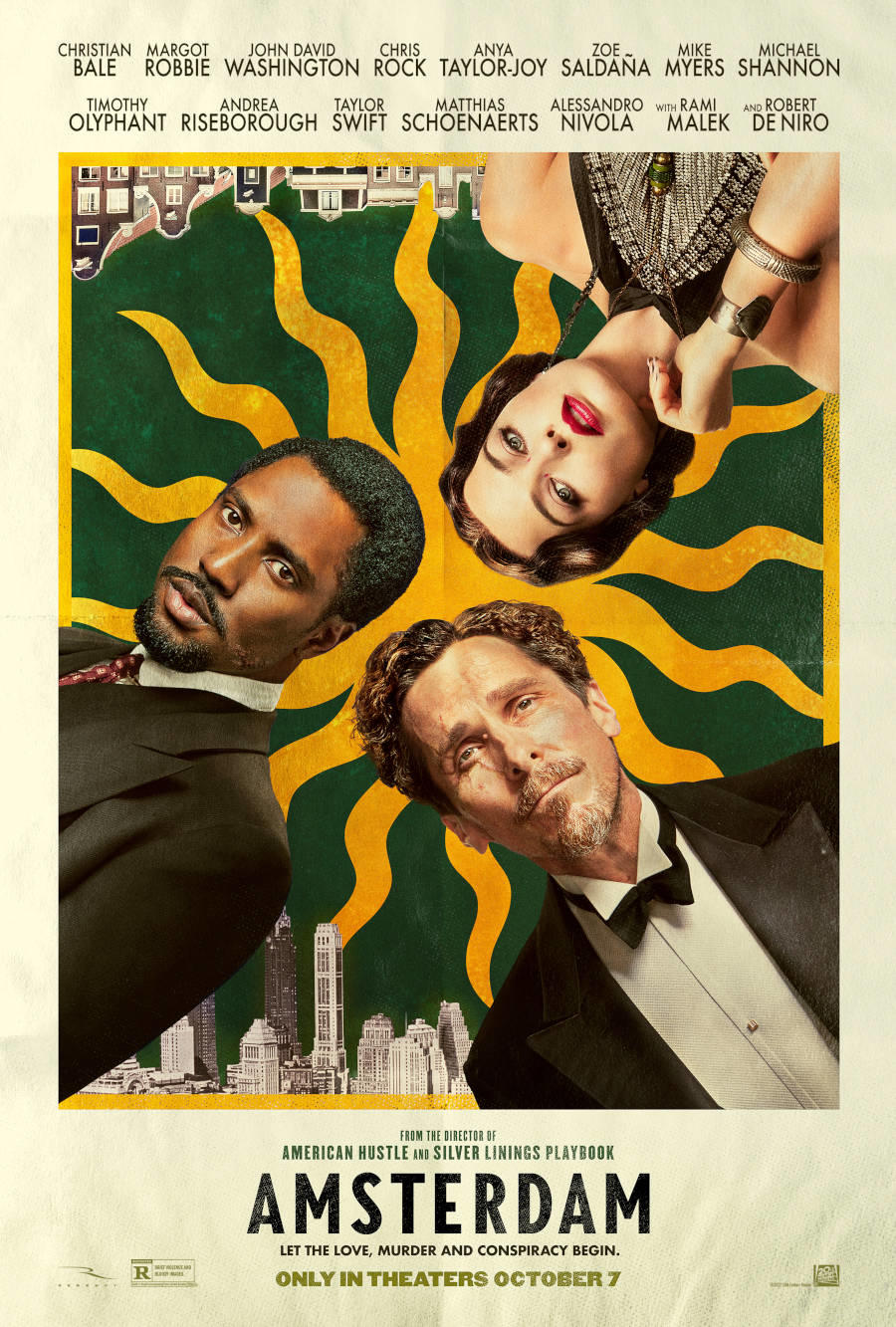
There is a fascinating true story and great movie…in there…somewhere. David O. Russell’s star-studded Amsterdam is a bloated, poorly paced movie that places far more emphasis on repetitive, pedantic social commentary than it does on lean storytelling and strategic plotting. If not for the powerhouse cast, the movie would be nearly unwatchable. A litmus test I give a movie is (1) if I look at my watch and (2) if so, how often. If I am looking at the time, then I am not engrossed in the story. And I looked at my watch many times during this lengthy quasi-historical drama. Amsterdam demonstrably has little idea or security in what it wants to be. Is it a dark comedy? Is it a drama? Is it satire? All valid questions for which there is no clear answer, because it struggles to find the proper tone that best expresses its story. Although the social commentary on race relations quickly becomes redundant, it does highlight some areas of wartime history of which many, including myself, are likely unaware. Such as soldiers of color being forced to wear French uniforms–had no idea! So I am glad that this disrespectful chapter in history was highlighted for modern audiences. Clearly this movie should have been an Oscar vehicle for Russell, his cast, and crew, From beginning to end, it’s easy to read this film as a desperate attempt to win over general audiences and critics by convincing them that there is something to see here; unfortunately, what should have been an incredibly interesting mystery and untold true story suffocates under the poorly written and structured screenplay.

Ryan teaches Film Studies and Screenwriting at the University of Tampa and is a member of the Critics Association of Central Florida. If you like this article, check out the others and FOLLOW this blog! Interested in Ryan making a guest appearance on your podcast or contributing to your website? Send him a DM on Twitter. If you’re ever in Tampa or Orlando, feel free to catch a movie with him.
Follow him on Twitter: RLTerry1

THIRTEEN LIVES docudrama mini review

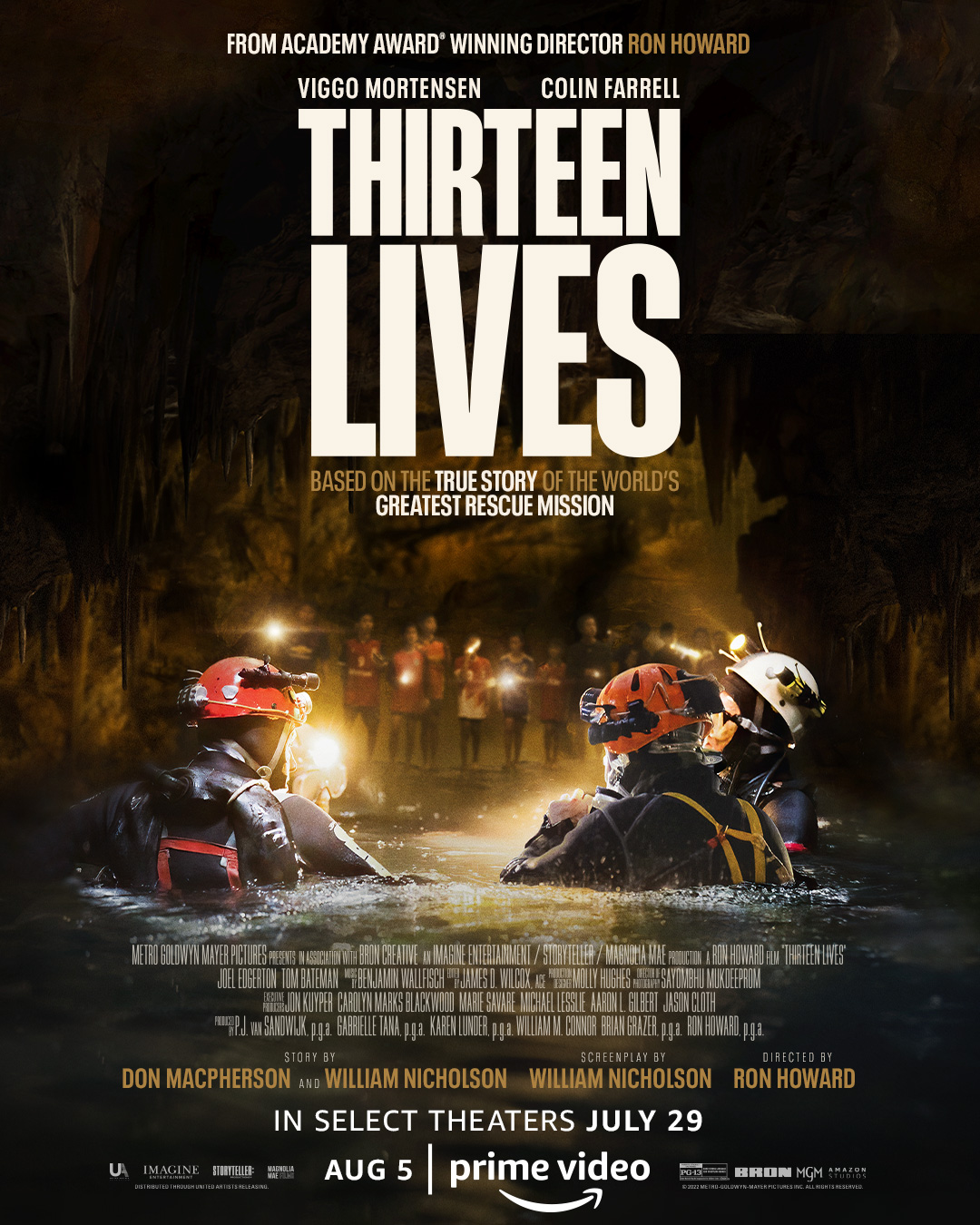
Interesting. Ron Howard’s big screen adaptation of the true story of the daring rescue of the Thai youth football (soccer) team from the flooded cave is faithful to the wikipedia page, but with an impressive addition of underwater cinematography. Thirteen Lives chronicles the seemingly impossible rescue that captured the attention of the entire world in summer 2018. While Howard’s docudrama is well-made all the way around, what audiences will find most fascinating is the mechanics of the rescue. It took thousands of volunteers in the labyrinth of caves, mountain peaks, and basecamps to bring all the boys and their coach to safety. Although none of the performances particularly stand out, the film delivers solid casting. Thirteen Lives is a different kind of “based on the true story” film, because it does not have particularly strong plotting to map-out the narrative. On one hand, it is a simple plot rescue the boys, but the film ultimately plays as a blow by blow description of what happened. Upon viewing the film, I thought to myself, why not just make a documentary instead; and then it occurred to me, that there would have been little to no footage of the inside of the caves. Therefore, docudrama was the way to go. There really isn’t much in the way of connective tissue between plot points; events just happen. That’s not to say that what we are watching isn’t terrifying in places–it certainly is–especially if you have kids; but at the same time, it doesn’t feel like a cinematic story in the conventional sense. Even though we all know how the true story ends, the film focuses on the steps that were taken in order to rescue the youth soccer team. Is it good? Well, it’s not bad. It just kind of is. Often we see based on a true story films that take so much dramatic license that it’s no longer a faithful big or small screen adaptation; sometimes, character or situational nuances or motivations are lost in translation. Thirteen Lives is so incredibly focuses on a dutiful adaptation, that it sometimes forgets that it’s also supposed to be finding the narrative amongst the facts. I wouldn’t wait to see this on the small screen, catch it during its limited theatrical run because the visuals are impressive.

Ryan teaches Film Studies and Screenwriting at the University of Tampa. If you like this article, check out the others and FOLLOW this blog! Interested in Ryan making a guest appearance on your podcast or contributing to your website? Send him a DM on Twitter or email him at RLTerry1@gmail.com! If you’re ever in Tampa or Orlando, feel free to catch a movie with him.

Follow him on Twitter: RLTerry1