
I KNOW WHAT YOU DID LAST SUMMER (2025) horror movie review

“What are you waiting for, huh, what are you waiting for?” the hook-handed slicker-wearing slasher is back and knows what you did last summer in the reboot/sequel (or rebootquel) of the 1997 all-star classic slasher I Know What You Did Last Summer. While this throwback slasher is certainly entertaining, with just the right amount of nostalgic charm, the Jennifer Kaytlin Robinson written-directed addition to the series falters in making the bold choices needed to truly respect and adhere to the slasher formula, resulting in lower stakes and missed opportunities for horror excellence. No mistaking it, there is a lot to enjoy in 2025’s IKWYDLS, but what could’ve been perhaps as rewatchable as the original, fell victim to playing it too safe. However, this movie does offer a glimmer of hope, much like 2023’s Thanksgiving, that the slasher can be just as entertaining in the 2020s as it was in the 1980s and 90s.

When five friends inadvertently cause a deadly car accident, they cover up their involvement and make a pact to keep it a secret rather than face the consequences. One year later, the past comes back to haunt them as they learn someone knows what they did last summer. Stalked by a mysterious killer, they soon seek help from two survivors of the legendary Southport massacre of 1997.

Despite my negative criticism of two aspects to the storytelling and plotting thereof, which I cannot effectively analyze without going into spoilers, Robinson’s IKWYDLS succeeds where many (if not most) rebootquels fail when revisiting a classic movie (or franchise)–this is particularly true of horror movies. 2025’s IKWYDLS leans into the original (and even 1998 sequel) just enough to establish meaningful narrative and setting connections but still expresses a new story. Other than a glaring missed checkbox and another more nuanced narrative element perpetuating a toxicity found in modern media, this movie checks most of the boxes for a classic slasher and throwback-style horror movie without it feeling lazy or uninspired. Instead of repeatedly hitting us over the head with “hey remember this from the original,” it strategically places these homages and references in places that drive the main story forward.

Even the most memorable line from the original (which was actually a fan-suggested change that was initially met with opposition yet became THE line and moment most remembered from the original movie), “what are you waiting for, huh, what are you waiting for?,” was used incredibly well in this movie. For those that, like me, may watch the original IKWYDLS every Fourth of July, there are other nods to the original that are lurking in the background or shadows, but will add a little extra enjoyment in watching 2025’s IKWYDLS.

Three of the central characters from the original movie and one from the 1998 sequel do make appearances in this entry into the series. Two are rather signifiant, whilst the two others are little more than cameos. Still, getting to see them reprise their roles to varying degrees was huge in connecting the events of this film to the events of 1997. The connection is somewhat meta in that, among other dynamics, there is an obnoxious true crime podcaster that is traveling to Southport to cover the 1997 killing spree by the hook-handed slicker-wearing slasher in the quaint fishing village near Wilmington, NC (in reality, much of the original movie was filmed in Wilmington). But it’d be inaccurate to characterize this movie’s connection to the original being completely meta. It’s a nice balance between staying true to the movie world but connecting it to our real world. 2025’s IKWYDLS parallels characters to the original, but in ways that work for this story and not merely as throwbacks to the original.

Avoiding spoilers, I want to touch on the three negative criticisms I have of this movie, as best as possible. Firstly, there is a bold choice made by past slashers that is ultimately non-existent in this movie. The whole time, I am waiting for that moment–to truly drive up the stakes and ratchet up the suspense–and just when I think Robinson is going to play it too safe, she delivers it–or so I think. Then, she undoes the bold choice that I felt she made in order to more closely follow the tried and true slasher formula THAT WORKS (if the formula works, don’t change it). This move is necessary for a variety of reasons that I cannot get into without giving too much away, and Robinson fails to deliver. Consequently, this movie also devalues and even ignores a key character type that is (again) a crucial component of the slasher formula. Secondly, Robinson’s screenplay perpetuates a dangerous stereotype in contemporary media that not only works against crafting a realistic portrait of a collection of characters but also lowers the stakes because there lacks reasonable emotive and social connections. Even slashers have both redeeming and unredeeming characters.

Lastly, Robinson clearly panders to GenZ. One thing Kevin Williamson’s Scream, I Know What You Did Last Summer, and The Faculty taught us is that you can write a movie that appeals to young people without pandering to them. Taking notes from that, screenwriters can write something aimed at 17–24 year-olds that, those of us that are older, can still enjoy watching as well.

If you are a slasher fan, then I still recommend watching 2025’s I Know What You Did Last Summer, because it feels like a summer movie and reminds us of why the slasher is such a tentpole in the history of horror movies.
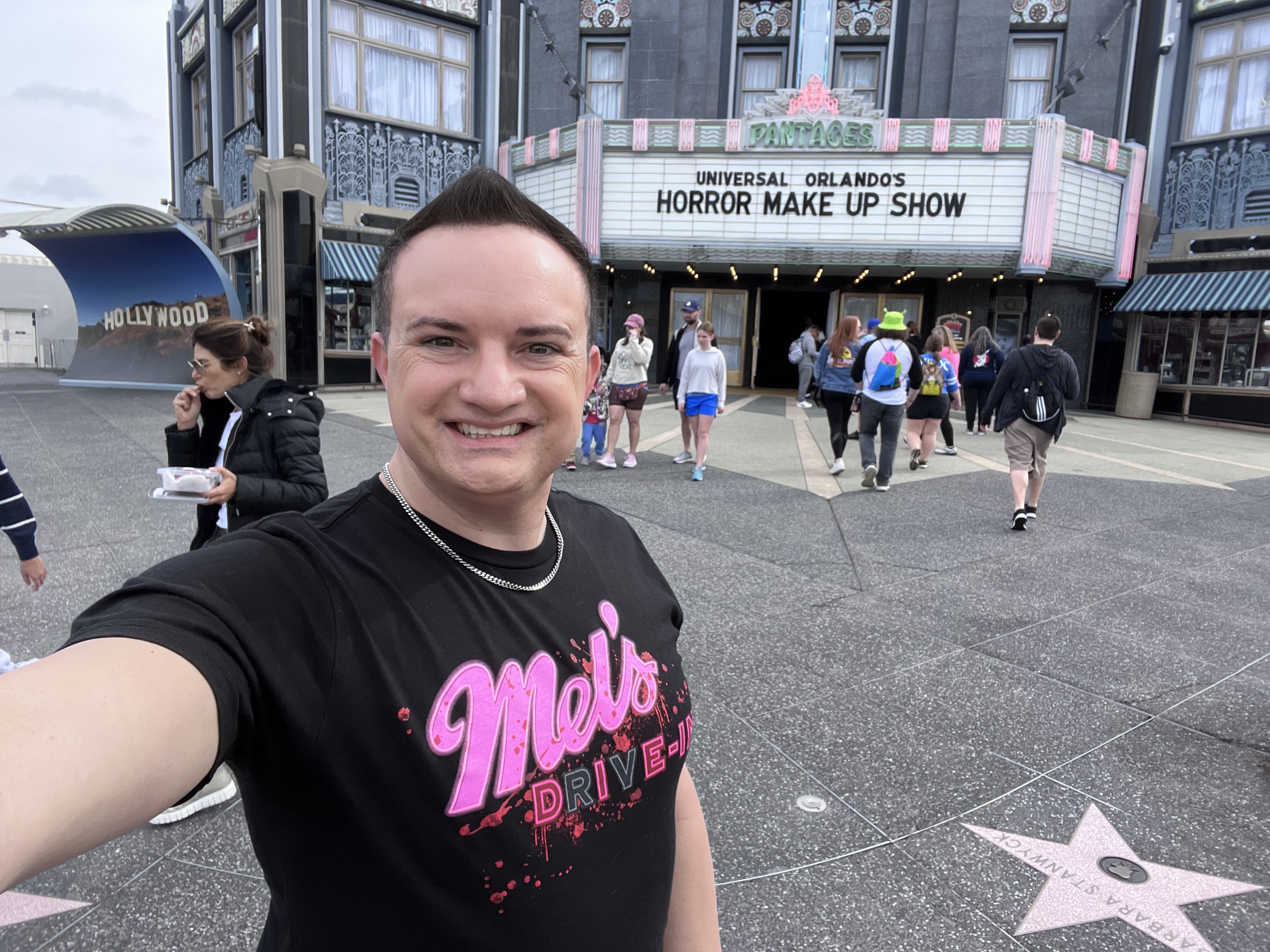
Ryan is the general manager for 90.7 WKGC Public Media in Panama City and host of the public radio show ReelTalk “where you can join the cinematic conversations frame by frame each week.” Additionally, he is the author of the upcoming film studies book titled Monsters, Madness, and Mayhem: Why People Love Horror. After teaching film studies for over eight years at the University of Tampa, he transitioned from the classroom to public media. He is a member of the Critics Association of Central Florida and Indie Film Critics of America. If you like this article, check out the others and FOLLOW this blog! Follow him on Twitter: RLTerry1 and LetterBoxd: RLTerry
HEART EYES horror movie review

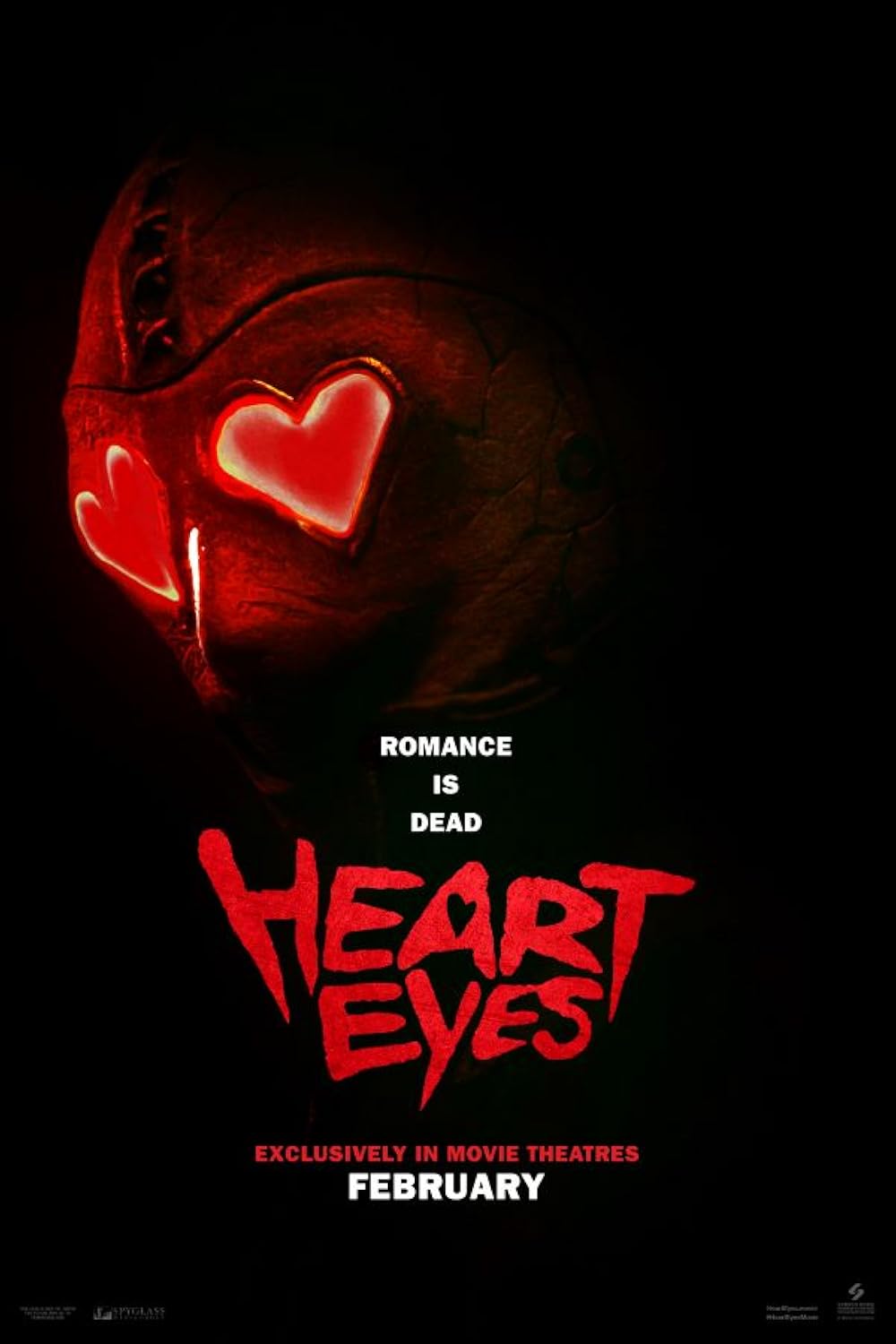
Slashtastic! Heart Eyes is the don’t miss holiday horror movie this Valentine’s season. Whether you’re a romantic or a cynic, there is something in here for everyone. The blend of romance and horror will, like Cupid’s arrow, find its way to the heart of slasher fans. Move over Coal Miner to make room for a new killer on the Valentine’s scene. Directed by CollegeHumor’s Josh Ruben and written by Christopher Landon (Happy Death Day), Michael Kennedy (Freaky), and Phillip Murphy (Hitman’s Wife’s Bodyguard), Heart Eyes seamlessly blends cliches from both romcoms and slashers, resulting in a movie that is sure to find its way onto rewatch lists every Valentine’s Day.

A masked maniac with glowing, red heart-shaped eyes returns every Valentine’s Day to terrorize unsuspecting couples.

The screenwriting is efficient and effective, and wastes no time in drawing audiences into this properly paced story. The kills are over-the-top–almost campy–and the romanic comedy bits are cheesy–in all the best ways possible. But this movie isn’t just about thrills and kills, because the central characters are surprisingly well-developed, and you’ll be rooting for their survival. So sure, some of the plot beats are formulaic, but this is a formula that has worked for over four decades, and demonstrates that genre movies have a timeless quality–a charm–about them that keeps us coming back for more screams.

Much like we saw with 2023’s Thanksgiving, Heart Eyes does the slasher right. Not only does it check off all the boxes for a classically written slasher, it also checks off boxes for a romantic comedy. Perhaps the movie leans more into its horror genes than it does its romcom genes, but it still strikes a well balanced genetic sequence for your entertainment pleasure. Starting with a classic romantic comedy opening, but as soon as it steeps for just the right amount of time, then upending it with a campy and gruesome slasher sequence, informs audiences precisely that for which they are in store for the rest of the movie. It sets the tone right up front, so you’re willing to buy everything else the movie throws at you.

The plotting is both sound as does the slasher reveal right. Yes, in hind sight you can make the observations that Heart Eyes took from this or that slasher, but that’s the beauty–it follows the formula but still keeps it engaging. Never once did I feel that it failed to keep my interest–even when I called the identity of HEK. I liked that this movie felt like classic slasher. We get it all: a big event that kicks everything into gear, a central character with a well-defined external goal driven by an internal need, and a character of opposition. This movie benefits from solid screenwriting and a director that seeks to entertain first and underscores the superstructure with thoughtful material for conversations about romance and relationships in the subtext. The stakes are high: survival! And throughout the movie, the stakes are raised, reminding us that no one is safe and even our final girl can be injured or killed.

Both of our central characters are well-developed. Olivia Holt’s Ally and Mason Gooding’s Jay are relatable and compelling. Are the characters particularly deep? No. But are they sufficiently developed to give these slasher characters human dimension? Yes. Both are strong and vulnerable. Furthermore, Ally feels like an “everyman” that is thrown into a situation in way over her head, but the setup is quite believable. I also like comedic irony in that she works for a jewelry company but has grown disillusioned by romance after being dumped by her boyfriend. Perhaps you work for a company that advocates for or sells something of which you are now cynical. Alternatively, Jay may come off overly optimistic and idealistic, but through that, we also learn that he as fears and vulnerabilities too. My point is, the principle players in this slasher are written with dimension, so you are rooting for their survival.

The most memorable slashers have a trademark mask, weapon, or sometimes both, which is the case with the Heart Eyes Killer (HEK). I’ve no doubt that HEK will find a place amongst the pantheon of slasher icons. After a long time of no new entries into that circle, we had John Carver added in 2023 and now HEK. Heart Eyes is a horror movie made by slasher fans for slasher fans, and its refreshing to see that the horror staple is still alive and well. Through movies like Thanksgiving and Heart Eyes, modern audiences are reminded that genre movies can be just as entertaining or thoughtful as the arthouse movies that are slowly becoming the mainstream. Funny–the movies that used to be the mainstream (i.e. slashers) are slowly finding their way into the arthouse cinemas, while the prestige pictures that used to be confined to the arthouse cinemas are slowly becoming the new mainstream.

Thematically, the movie explores disillusionment in and with romance. From an opening scene that underscores the realization that images captured by a camera are not always reflexive of reality to the cynicism that can grow out of broken relationships to accepting that an idyllic romance may just be possible, it’s all in this movie. Through the apparatus of the slasher, the writers and director are able to explore love and romance in a variety of ways that are rather poignant.

If your idea of a Valentine’s date is dinner followed by a scary movie, then this movie fits the bill! It works as both. Happy Valentine’s Day!

Ryan is the general manager for 90.7 WKGC Public Media in Panama City and host of the public radio show ReelTalk about all things cinema. Additionally, he is the author of the upcoming film studies book titled Monsters, Madness, and Mayhem: Why People Love Horror. After teaching film studies for over eight years at the University of Tampa, he transitioned from the classroom to public media. He is a member of the Critics Association of Central Florida and Indie Film Critics of America. If you like this article, check out the others and FOLLOW this blog! Follow him on Twitter: RLTerry1 and LetterBoxd: RLTerry

NO HARD FEELINGS movie review

A clever inversion of The Taming of the Shrew that delivers some laughs and heart, but is ultimately a mediocre comedy. If you were to take 10 Things I Hate About You, Never Been Kissed, and Shakespeare’s Taming of the Shrew, invert the plot, then you’d have No Hard Feelings.

On the brink of losing her childhood home, a desperate woman (Lawrence) agrees to date a wealthy couple’s introverted and awkward 19-year-old son (Feldman) before he leaves for college.

The outside/action story is well-written, but the subplots are left to aimless wander throughout the movie. The central plot is well-structured, and the audience will be hooked, but the screenplay introduces ancillary characters and subplots that do nothing to advance the story in substance or form. Disappointingly, there is one particular subplot in the life of Maddie that is introduced but never truly revisited or resolved. Moreover, this event afforded the movie to provide thoughtful social commentary on how harboring unforgiveness is like drinking poison hoping that it hurts the other person, but fails to explore this timeless life lesson and theme. Likewise, there is a subplot introduced in the life of Percy that is expressed through an ancillary character, but it feels incredibly out of place and forced.

Another prominent theme and subplot in the movie is the idea of gentrification or being metaphorically and literally pushed out of your home because it’s been deemed highly desirable by the elite. We revisit this subplot throughout the movie, but it’s never truly explored. Such a fantastic opportunity to comment on resilience and serve as a cautionary tale of what happens when neighborhoods are wiped off the map, but it only serves as a shallow plot device.

What the movie lacks in thoughtful social commentary in the subplots and themes, it makes up for in the excellent chemistry between Jennifer Lawrence (Maddie) and Andrew Feldman (Percy). The strength of this subversive romcom can be found in the vulnerability and rawness of the central characters of Maddie and Percy; moreover, both Lawrence and Feldman bring an infectious, entertaining energy to their respective characters caught up in one of Shakespeare’s more endearing and thought-provoking plots. While the movie won’t likely find itself one that will be revisited for years to come, it is sufficiently funny and heartfelt for a weekend afternoon at the cinema or for an evening at home.

If you want to laugh, this movie will do the trick! Clearly the lead characters are having fun with their respective roles, and that enthusiasm is felt by the audience.

Ryan teaches Film Studies and Screenwriting at the University of Tampa and is a member of the Critics Association of Central Florida and Indie Film Critics of America. If you like this article, check out the others and FOLLOW this blog! Interested in Ryan making a guest appearance on your podcast or contributing to your website? Send him a DM on Twitter. If you’re ever in Tampa or Orlando, feel free to catch a movie with him.

Follow him on Twitter: RLTerry1 and LetterBoxd: RLTerry
SPIDER-MAN: ACROSS THE SPIDER-VERSE movie review

Oh, what a tangled web [they] weave…with this cacophony of story threads. The highly anticipated sequel to the Best Animated Feature Oscar-winning Into the Spider-verse opens this week, but unfortunately, it suffers from a bad case of sequelitis brought on by a gluttonous consumption of excess. Spider-man: Across the Spider-verse works in title only–and all too well, as it were. The title says it all, and that is precisely what audiences get in this comic philhar-tragic symphony in the key of overindulgence.

After reuniting with Gwen Stacy, Brooklyn’s full-time, friendly neighborhood Spider-Man is catapulted across the Multiverse, where he encounters a team of Spider-People charged with protecting its very existence. However, when the heroes clash on how to handle a new threat, Miles finds himself pitted against the other Spiders. He must soon redefine what it means to be a hero so he can save the people he loves most.

Across the Spider-verse is what happens when a story idea doesn’t pass the elevator pitch litmus test (wherein an idea can be explained sufficiently enough in three-minutes or less). Quite simply, there is such a proliferation of story webs that there is virtually no plot–there is certainly no resolution before the (and this isn’t a spoiler) cliffhanger ending. Story webs lead into story webs that leads into even more story webs. Suffice it to say, it’s as if writers and producers took every incarnation of Spider-man comic series, threw them into a blender, and served the concoction o audiences. Unless you are read up on decades of Spider-man comics, you will be hard-pressed to follow any storyline. Perhaps the better expression of a collision of Spider-verses would have been in a television series that could have explored a different thread of comics each season.

Clearly, Sony took the extremely positive reception of the first one, focussed on recurring praises, and amplified those to the nth degree. Never mind that more than the visual expression of the story, plotting is crucial to structure, pacing, and coherency. The animators and artists are showcasing brilliance in animated filmmaking, but the clear evidence of screenwriting is nowhere to be found. Without a well-defined central character, a well-defined external goal, and a well-defined character of opposition between the central character and the goal, there is no plot–merely a sequence of loosely connected scenes or fragments of ideas. A fever dream, if you will.

While Across the Spider-verse suffers narratively, it certainly excels in the art of animation. The stylistic animation and editing is outstanding! Much like with the first movie, this one takes the emotive detail found in a single frame of a comic book (or graphic novel) and combines that approach with hand-drawn inspired motion picture animation. There are certainly problems with the story (or stories, as it were), but Sony Pictures Animation has demonstrably shown commitment to the boundless imagination and capabilities of animation. Across the Spider-verse, in how it is expressed in this movie, can only happen within the world of animation. In no way could this movie be expressed in a live-action way. Perhaps the writers were asleep at the wheel, but the animators gave each universe of Spider-man characters its own color palate and animation style.

Make sure to watch Across the Spider-verse in a premium format at your cinema, because the strength in this animated movie has little to do with the story as much as it does the stylistic animation. When a film, animated or live action, strikes a balance between style and substance, it can be enjoyed on the big or small screen without detracting from the storytelling; but when the movie struggles narratively but excels in form, then experiencing it on the big screen is the best approach.

Ryan teaches Film Studies and Screenwriting at the University of Tampa and is a member of the Critics Association of Central Florida and Indie Film Critics of America. If you like this article, check out the others and FOLLOW this blog! Interested in Ryan making a guest appearance on your podcast or contributing to your website? Send him a DM on Twitter. If you’re ever in Tampa or Orlando, feel free to catch a movie with him.

Follow him on Twitter: RLTerry1 and LetterBoxd: RLTerry

Review of “French Exit”

A purrrrrfect vessel to showcase the incomparable Michelle Pfeiffer’s acting chops–complete with a–you guessed it–black cat! French Exit gets its wide exclusively theatrical release this Friday, and if you are a fan of Pfeiffer, then you don’t want to miss this whimsical, existential motion picture that’s as quirky and aimless as Frances (Pfeiffer) and Malcolm (Lucas Hedges), yet possesses an incredible charm that will hook you from the very beginning when Michelle Pfeiffer waltzes into her son’s prep school in a mink fur-lined trench coat that ostensibly gives her a larger-the-life power and protection from judgmental eyes of Manhattan high society.

Aging New York socialite Frances’ (Pfeiffer’s) is in dire straits, beset by scandal and impending bankruptcy. Her accountant tells her that she has burnt through her inheritance, and is now broke. Frances isn’t alone, she has her aimless son Malcolm, but he is of no help due to his perpetual mire in a permanent state of arrested development. Frances is forced to sell everything. Putting penury and pariahdom behind them, along with their car, the two quirky social outcasts decide to cut their losses and take the French exit. One ocean voyage later, the curious trio land in their beloved Paris, which will serve as a backdrop not for love or romance, but self-destruction and economic ruin—to riotous effect. Frances takes the last of her money and spends frivolously as she has accepted the fact that she is a cliche, but in that, she is timeless.

French Exit is based upon the novel by the same name written by the screenwriter Patrick deWitt and directed by Azazel Jacobs. While the film does not follow a typical plot structure, it does deliver a story stressing the emotional and psychological journeys of our central characters and supporting cast, which often stress individualism. Furthermore, the film delivers darkly comedic moments that explore the human condition and even human existence in and of itself. The screenwriting is filled with hilarious irony and sarcasm that often says exactly what we are thinking within a similar conflict, as the audience, but rarely have the chutzpah to state aloud. Jacobs’ and deWitt’s combination of surrealism, subjectivity, and running commentary by Frances and Malcolm create a sort of narrative ambiguity in the sense that you will undoubtedly ask questions of the film that are only ever partly answered, if answered at all. Usually this could run the risk of frustrating the audience, but it’s the off-beat comedy and Pfeiffer’s command of the screen that truly anchor this avant-garde motion picture.

Before discussing the film’s biggest selling point and sole reason to watch–Michelle Pfeiffer–I want to spend some time on the title itself, but more specifically what it represents. While on the surface the title may seem to be an extension of the slang French leave, “a departure from a location or event without informing others or without seeking approval,” which does describe the manner in which Frances and Malcolm leave New York and how Frances dramatically exits the film, it’s actually a creative nod to the style of filmmaking that is at the soul of this picture–French New Wave. In both its cinematic and literary (extrapolating from the evidence at hand) forms, French Exit is a product of the French New Wave movement in cinema, which was popularized following World War II and the massive influx of American films (most famously noir). Jacob’s vision for this existential exploration brings a fresh, auteur approach to deWitt’s screenplay using his camera-stylo to craft stylistic scenes through montage (French for assembly). Moreover, many of these shots and scenes and mesmerize the audience with excellent use of dramatic imagery that plays with audience expectation.

Throughout the film, it’s clear that Jacobs’ takes inspiration from the films of the French New Wave era evidence in everything from the blocking of the characters, the emotionally-driven scene sequences, intentionally awkward pacing. Further evidence of the inspiration taken from French New Wave includes a sort of cinematic defiance–a film that refuses to live by conventional diegetic rules. Much like Jacobs’ flagrantly defies cinematic expectations placed upon the artistic medium by scholars like yours truly, the character of Frances also doesn’t give a damn what anyone thinks about her, her son, or her cat. She doesn’t care that she isn’t relatable. You will take her or leave her. But we all know that we are going to take her, because of the outstanding, nuanced performance by Pfeiffer.

I love this line: “My plan was to die before the money ran out, but I kept and keep not dying, so here I am.” It’s but merely the tip of the iceberg of delicious character study! Jacobs’ provides a role for Pfeiffer that she’s not quite had the opportunity to play before. What I love about the character of Frances (hmm, could this be nod to French New Wave filmmaker Francois Truffaut?) is that she isn’t quite a diva, but a sophisticated, entitled, and savagely articulate socialite, with a hint of camp. While we have seen Pfeiffer in roles that have given us a glimpse into this type of character, her role in Murder on the Orient Express for example, and had the pleasure of enjoying her bewitching role in the fantasty-comedy Stardust, and the showcase of larger-then-life camp in her definitive role as Catwoman in Batman Returns, Pfeiffer channels all these memorable characters yet finds a way of grounding Frances in reality.

It’s not only the words she says, but it’s how she says them. Everything line is delivered with razor-sharp precision accompanied by an unmistakable nuance. Not limited to Frances’ dialogue, but her entire body is completely engaged in every single frame. And the manner in which she sprays perfume or wields her cigarette like a rapier, she commands your attention. In the same way that Jacobs’ film itself is a bit like controlled chaos, Pfeiffer’s portrayal of Frances is very much the same. Whether she’s drunkenly slinging kitchen knives or lighting floral arrangements on fire when the server neglects to provide timely service, Pfeiffer ensures that we not soon forget Frances.

French New Wave meets screwball comedy in this adaptation that was tricky to execute. Fortunately for audiences, Jacobs succeeds brilliantly! Even though the story’s weird pacing and tonal shifts marches to the beat of its own drum, this nearly one-room play delivers laughs, thoughtful moments, and the kind of absolutely ridiculousness we sometimes need! For all this film does uniquely well, it’s that unique comedic tone that wont’ likely resonate with everyone. However the ensemble cast of off-beat characters craving human connection will resonate with audiences, and prompt them to enthusiastically embrace the film. And it’s that desire for human connection, which universally appeals to us all. connection lends it a universal appeal that deserves to be enthusiastically embraced. If for no other reason, this film provides an excuse to enjoy 110 minutes of the glorious Oscar-deserved Michelle Pfeiffer.

Ryan teaches screenwriting and film studies at the University of Tampa. If you like this article, check out the others and FOLLOW this blog! Interested in Ryan making a guest appearance on your podcast or contributing to your website? Send him a DM on Twitter or email him at RLTerry1@gmail.com! If you’re ever in Tampa or Orlando, feel free to catch a movie with or meet him in the theme parks!

Follow him on Twitter: RLTerry1