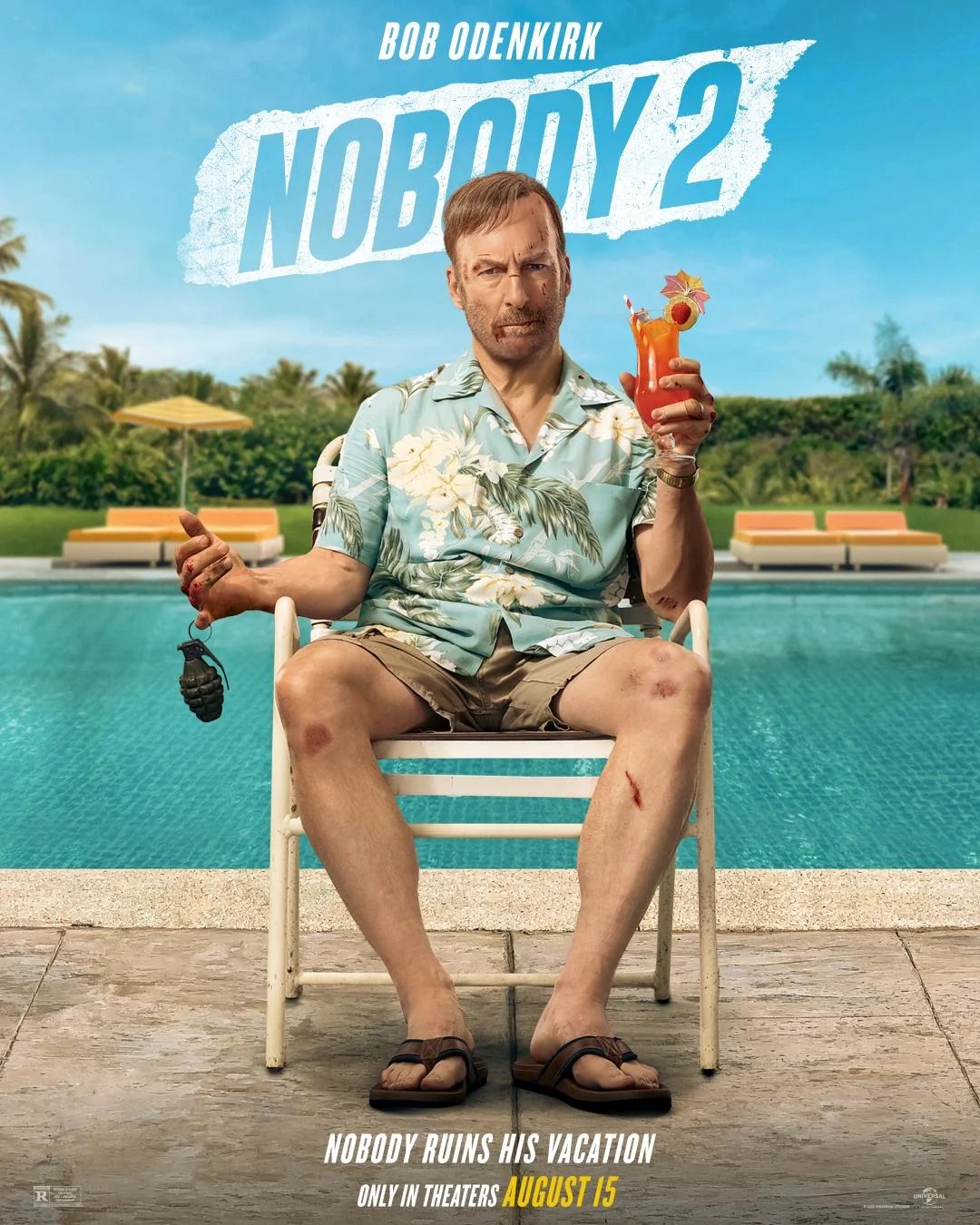
Lowbrow thrills, high-budget spectacle. Proof that sometimes all a B-movie needs is an A-list wallet to unleash maximum mayhem. At at one-and-a-half hours, its a fast-paced wild ride. Nobody 2 is precisely what you expect, plus you get treated to a rare appearance by big screen icon Sharon Stone.
Workaholic assassin Hutch Mansell takes his family on a much-needed vacation to the small tourist town of Plummerville. However, he soon finds himself in the crosshairs of a corrupt theme-park operator, a shady sheriff, and a bloodthirsty crime boss.
It’s as if the followup to 2021’s Nobody stumbled out of a neon-lit drive-in and somehow found itself with a blockbuster budget to burn. Where the first film offered a sly, bruised take on the “ordinary man goes berserk” formula, this sequel leans into the gleefully exaggerated: bigger fights, louder explosions, and a grin-worthy parade of bad guys to pummel. It’s still got that B-movie backbone—lean plotting, brisk runtime, and the sense that logic is secondary to spectacle—but it all works like a well-oiled machine.
While Bob Odenkirk’s Hutch delivers his outlandishly entertaining, no holds barred, logic-defying fight sequences, there’s the ace up the sleeve of Nobody 2: Sharon Stone. In a world where her film appearances have become a rare pleasure, her turn here as a campy, hyper-stylized villain is worth the ticket price alone. With every razor-edged line reading and wardrobe flourish, she seems to be savoring the role, delivering the kind of larger-than-life menace that feels ripped from the pages of a pulp novel. Stone doesn’t just play the villain—she plays with the villain, reveling in the absurdity without ever letting the stakes slip.
If the original Nobody was a gritty surprise, Nobody 2 is an unapologetic mash-up of grindhouse spirit and Hollywood muscle. It’s loud, it’s ludicrous, and it’s a fantastic time at the movies.
Ryan is the general manager for 90.7 WKGC Public Media in Panama City and host of the public radio show ReelTalk “where you can join the cinematic conversations frame by frame each week.” Additionally, he is the author of the upcoming film studies book titled Monsters, Madness, and Mayhem: Why People Love Horror. After teaching film studies for over eight years at the University of Tampa, he transitioned from the classroom to public media. He is a member of the Critics Association of Central Florida and Indie Film Critics of America. If you like this article, check out the others and FOLLOW this blog! Follow him on Twitter: RLTerry1 and LetterBoxd: RLTerry
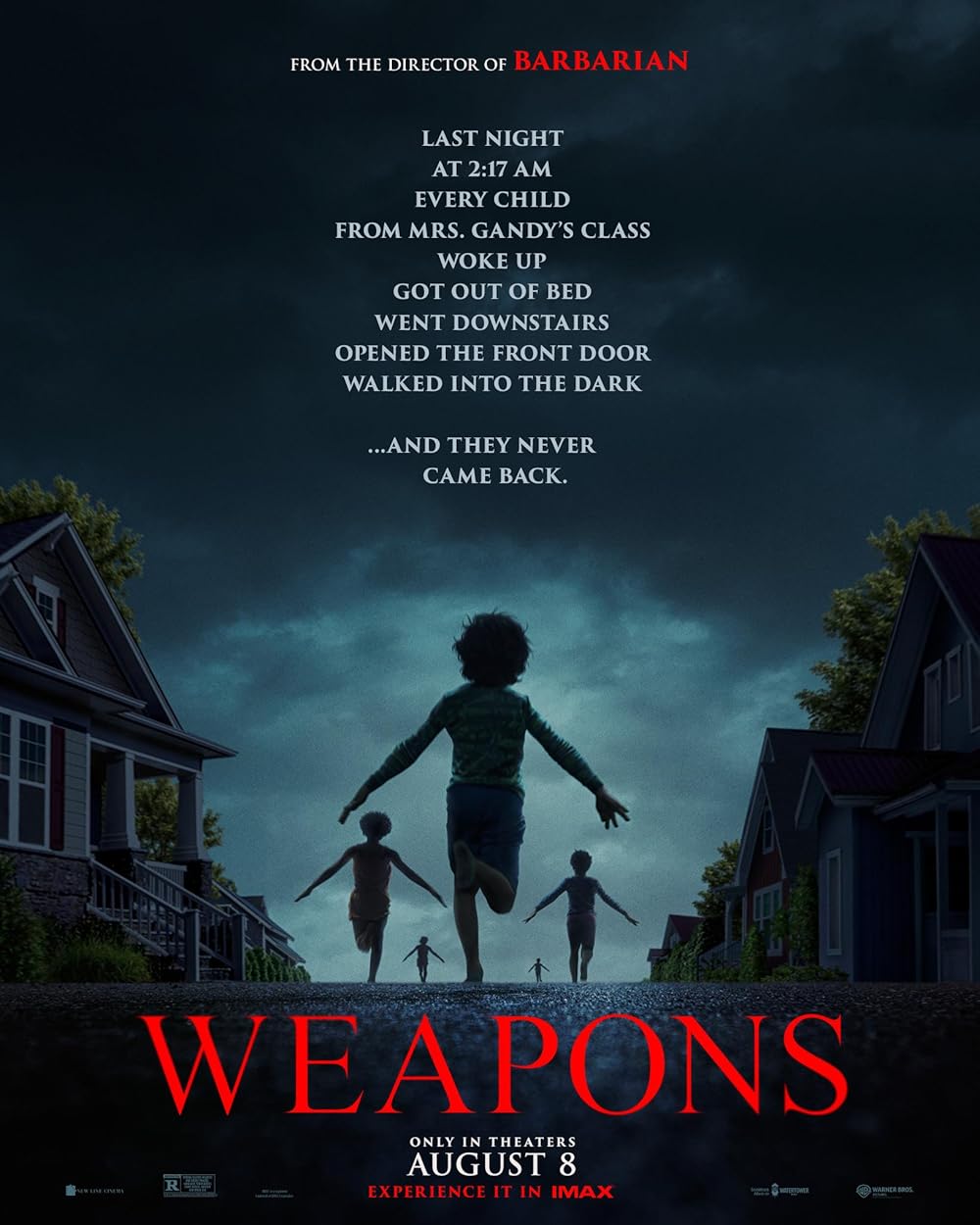
Sleek, stylish, and appears razor-honed, but needs a little sharpening. Zach Cregger’s Weapons takes audiences on a visually arresting and emotionally charged journey that blends suspense, terror, and moments of surrealism. While the film excels in crafting atmosphere through its immersive sound design, haunting imagery, and striking cinematography, its story ultimately collapses under the weight of overwriting and structural ambition. Despite moments of genuine tension and intrigue, the story struggles to cohere into something emotionally resonant or thematically satisfying. In the end, Weapons proves to be more refined in aesthetic than in substance—an experience-driven work that favors tone over storytelling.
When all but one child from the same classroom mysteriously vanish on the same night at exactly the same time, a community is left questioning who or what is behind their disappearance.
Weapons positions itself as a psychological horror anthology-adjacent film that aspires to echo the structural ambition of Trick ‘r Treat and the dread-soaked atmosphere of Hereditary. Each composition is meticulously crafted, echoing the influences of Ari Aster, David Lynch, and Paul Thomas Anderson. The film’s immersive sound design, scored with unnerving precision, deepens the psychological tension, ensuring that audiences feel trapped within the same spiraling unease as its characters. Cregger, best known for the unexpected 2022 breakout Barbarian, attempts something far more sprawling here: a multi-threaded, nonlinear horror tapestry that spans time, location, and character perspectives. On paper, the structure is bold and ambitious. But unlike Barbarian, which grounded its twists in a tightly wound narrative, Weapons ultimately feels thematically scattered and emotionally distant. Characters arrive with weight, but rarely evolve; connections are drawn, but their meaning feels underdeveloped.
What Weapons does exceptionally well is craft an experience. Cregger’s talent for generating sustained suspense, is elevated here to a more mature and stylized level. The tonal consistency, even across multiple timelines and narrative threads, is admirable. Individual sequences build atmosphere masterfully, utilizing silence and suggestion as effectively as sudden, jarring visuals. The sound design alone is enough to make your skin crawl—unsettling, precise, and deeply immersive. The cinematography delivers an unnerving blend of realism and the uncanny, grounding even the most supernatural or surreal moments in believable textures and light.
Weapons boasts an outstanding performative dimension. Each of the lead and key supporting actors deliver performances that are uniformly committed, standing out for their subtle, tortured portrayals of people unraveling in the wake of the trauma of the kids vanishing. After the mostly disappointing Wolf Man earlier this year, I was curious to see if this film would be the vehicle needed for Julia Garner (until the Madonna bio pic that’s calling her name) to showcase her acting chops. The performative quality we witnessed of her in Ozark is what we have in Weapons. Josh Brolin offers stoic gravitas, while Austin Abrams adds a jittery, unpredictable energy. And then there’s Cary Christopher’s unsettling Alex, complete with enough creepy kid energy to fill a whole classroom. Collectively, their efforts lend some gravitas and humanity to a film that often prioritizes vision over narrative.
Without getting in to spoilers, the film takes a turn midway through the second act that completely shifts the experience and even the tone of the picture. One might say that the movie sets up one mystery and eventual payoff, but then deviates onto a different (and ultimately more predictable) path. Once that (unfortunately too obvious) reveal is made midway through the investigation into the disappearance of the classroom of kids–save one (Alex)–then it becomes quite the twisted fairytale. But therein likes one of the most significant problems I have with the film–because of this twist, there are questions that emerge for which we will not be provided answers. We can certainly draw conclusions, that are most likely correct, but this isn’t the type of picture that should require that level of guesswork. When that twist is revealed, explanations of reasons for the motivation and consequences, should the plan fair, are not sufficiently clear.
Horror thrives in that liminal space between order and chaos, but Weapons leans too heavily into the latter. Instead of meticulously peeling back layers to reveal a deeper truth, it obscures character arcs and emotional payoffs beneath narrative experimentation. In striving to be a psychological puzzle-box, the film forgets to provide the audience with enough meaningful pieces to solve it. As a result, Weapons leaves audiences with questions that the film should have answered because it clearly desires to be a genre horror film–it’s not Memento. However, the climax of the picture, while somewhat predictable, is none-the-less satisfyingly bold.
In the end, Weapons is a film that demands attention but struggles to justify its complexities. It will certainly appeal to fans of the prestige horror aesthetic, but despite the converging narratives it never quite hits the mark of a film that invites multiple viewings in order to fully appreciate the story and the apparatus thereof. But for general audiences, or those seeking a tightly woven narrative, the film’s impact may feel more like a glancing blow than a direct hit. Visually stunning and rich in atmosphere, Weapons captivates the senses but lacks the narrative clarity and cohesion to land its thematic strikes. A bold motion picture outing, it’s a film that’s more experience than story—one that feels sharpened in presentation but blunted in meaning.
Ryan is the general manager for 90.7 WKGC Public Media in Panama City and host of the public radio show ReelTalk “where you can join the cinematic conversations frame by frame each week.” Additionally, he is the author of the upcoming film studies book titled Monsters, Madness, and Mayhem: Why People Love Horror. After teaching film studies for over eight years at the University of Tampa, he transitioned from the classroom to public media. He is a member of the Critics Association of Central Florida and Indie Film Critics of America. If you like this article, check out the others and FOLLOW this blog! Follow him on Twitter: RLTerry1 and LetterBoxd: RLTerry
“What are you waiting for, huh, what are you waiting for?” the hook-handed slicker-wearing slasher is back and knows what you did last summer in the reboot/sequel (or rebootquel) of the 1997 all-star classic slasher I Know What You Did Last Summer. While this throwback slasher is certainly entertaining, with just the right amount of nostalgic charm, the Jennifer Kaytlin Robinson written-directed addition to the series falters in making the bold choices needed to truly respect and adhere to the slasher formula, resulting in lower stakes and missed opportunities for horror excellence. No mistaking it, there is a lot to enjoy in 2025’s IKWYDLS, but what could’ve been perhaps as rewatchable as the original, fell victim to playing it too safe. However, this movie does offer a glimmer of hope, much like 2023’s Thanksgiving, that the slasher can be just as entertaining in the 2020s as it was in the 1980s and 90s.
When five friends inadvertently cause a deadly car accident, they cover up their involvement and make a pact to keep it a secret rather than face the consequences. One year later, the past comes back to haunt them as they learn someone knows what they did last summer. Stalked by a mysterious killer, they soon seek help from two survivors of the legendary Southport massacre of 1997.
Despite my negative criticism of two aspects to the storytelling and plotting thereof, which I cannot effectively analyze without going into spoilers, Robinson’s IKWYDLS succeeds where many (if not most) rebootquels fail when revisiting a classic movie (or franchise)–this is particularly true of horror movies. 2025’s IKWYDLS leans into the original (and even 1998 sequel) just enough to establish meaningful narrative and setting connections but still expresses a new story. Other than a glaring missed checkbox and another more nuanced narrative element perpetuating a toxicity found in modern media, this movie checks most of the boxes for a classic slasher and throwback-style horror movie without it feeling lazy or uninspired. Instead of repeatedly hitting us over the head with “hey remember this from the original,” it strategically places these homages and references in places that drive the main story forward.
Even the most memorable line from the original (which was actually a fan-suggested change that was initially met with opposition yet became THE line and moment most remembered from the original movie), “what are you waiting for, huh, what are you waiting for?,” was used incredibly well in this movie. For those that, like me, may watch the original IKWYDLS every Fourth of July, there are other nods to the original that are lurking in the background or shadows, but will add a little extra enjoyment in watching 2025’s IKWYDLS.
Three of the central characters from the original movie and one from the 1998 sequel do make appearances in this entry into the series. Two are rather signifiant, whilst the two others are little more than cameos. Still, getting to see them reprise their roles to varying degrees was huge in connecting the events of this film to the events of 1997. The connection is somewhat meta in that, among other dynamics, there is an obnoxious true crime podcaster that is traveling to Southport to cover the 1997 killing spree by the hook-handed slicker-wearing slasher in the quaint fishing village near Wilmington, NC (in reality, much of the original movie was filmed in Wilmington). But it’d be inaccurate to characterize this movie’s connection to the original being completely meta. It’s a nice balance between staying true to the movie world but connecting it to our real world. 2025’s IKWYDLS parallels characters to the original, but in ways that work for this story and not merely as throwbacks to the original.
Avoiding spoilers, I want to touch on the three negative criticisms I have of this movie, as best as possible. Firstly, there is a bold choice made by past slashers that is ultimately non-existent in this movie. The whole time, I am waiting for that moment–to truly drive up the stakes and ratchet up the suspense–and just when I think Robinson is going to play it too safe, she delivers it–or so I think. Then, she undoes the bold choice that I felt she made in order to more closely follow the tried and true slasher formula THAT WORKS (if the formula works, don’t change it). This move is necessary for a variety of reasons that I cannot get into without giving too much away, and Robinson fails to deliver. Consequently, this movie also devalues and even ignores a key character type that is (again) a crucial component of the slasher formula. Secondly, Robinson’s screenplay perpetuates a dangerous stereotype in contemporary media that not only works against crafting a realistic portrait of a collection of characters but also lowers the stakes because there lacks reasonable emotive and social connections. Even slashers have both redeeming and unredeeming characters.
Lastly, Robinson clearly panders to GenZ. One thing Kevin Williamson’s Scream, I Know What You Did Last Summer, and The Faculty taught us is that you can write a movie that appeals to young people without pandering to them. Taking notes from that, screenwriters can write something aimed at 17–24 year-olds that, those of us that are older, can still enjoy watching as well.
If you are a slasher fan, then I still recommend watching 2025’s I Know What You Did Last Summer, because it feels like a summer movie and reminds us of why the slasher is such a tentpole in the history of horror movies.
Ryan is the general manager for 90.7 WKGC Public Media in Panama City and host of the public radio show ReelTalk “where you can join the cinematic conversations frame by frame each week.” Additionally, he is the author of the upcoming film studies book titled Monsters, Madness, and Mayhem: Why People Love Horror. After teaching film studies for over eight years at the University of Tampa, he transitioned from the classroom to public media. He is a member of the Critics Association of Central Florida and Indie Film Critics of America. If you like this article, check out the others and FOLLOW this blog! Follow him on Twitter: RLTerry1 and LetterBoxd: RLTerry
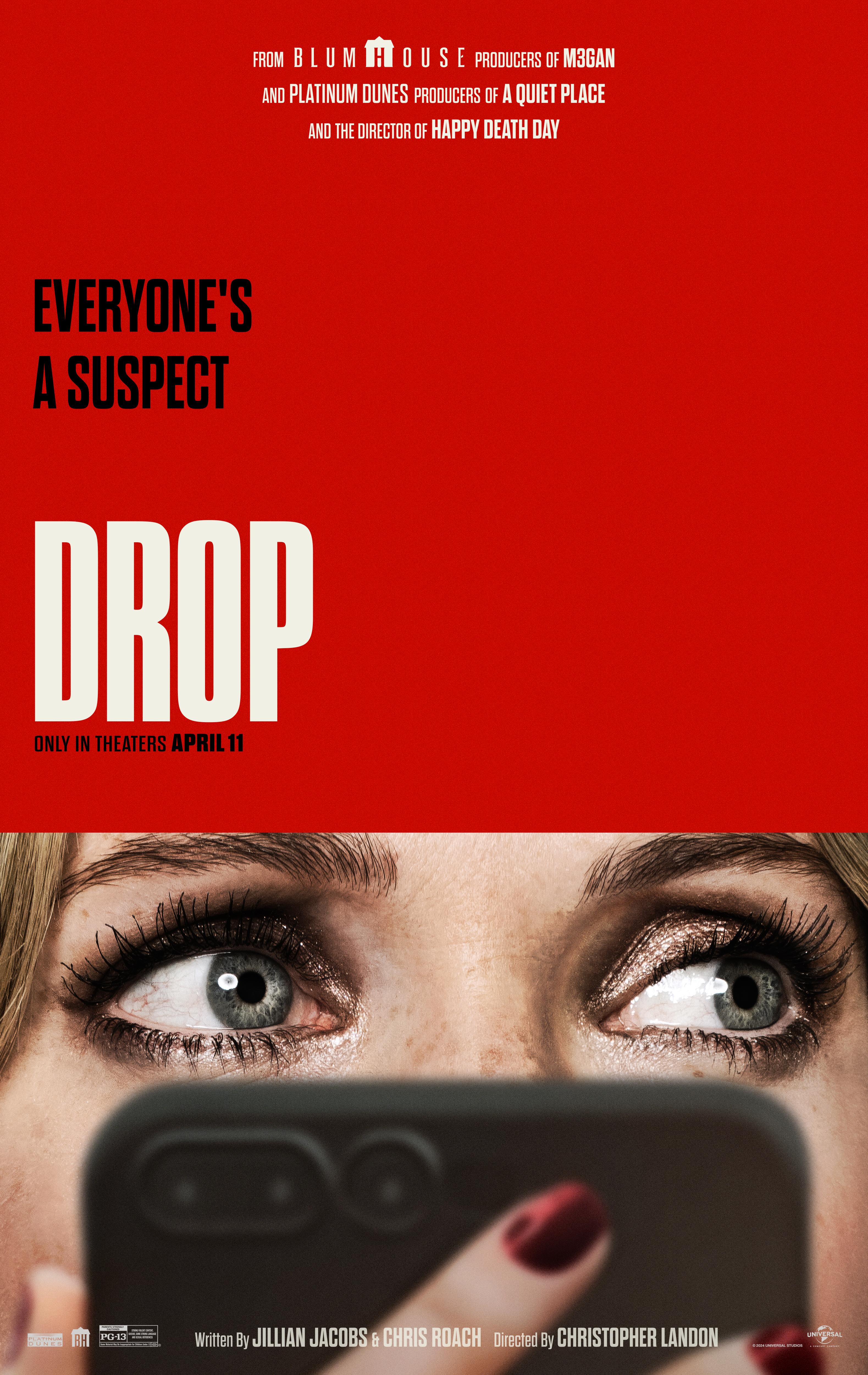
“Drop” in on a lot of fun at the cinema. Universal and Blumhouse’s Drop is a highly entertaining Lifetime-esque thriller that requires a prescription-strength dosage of suspension of disbelief. With a charming cast and adrenaline pumping suspense and tension, Christopher Landon’s latest movie delivers an engaging time at the cinema.
Violet is a widowed mother who goes to an upscale restaurant to meet Henry, her charming and handsome date. However, her pleasant evening soon turns into a living nightmare when she receives phone messages from a mysterious, hooded figure who threatens to kill her young son and sister unless she kills Henry.
If you enjoy the Lifetime movies of the 2000s, then this is right up your alley. The stakes are high and you’ll empathize with our central character of Violet, and root for her and her family’s survival. Because the lead cast quickly makes a meaningful connection with the audience, the plot holes (and there are many) almost feel irrelevant because the movie’s strength isn’t so much in the realism of the plot as much as it is in the naturalism of the plot. The movie is disconnected sufficiently enough from reality that it functions as an escapist picture, therefore the fact that there is little to no way this plot could ever happen due to the ridiculous nature. Between the high camp, high stakes, and charming cast, Drop blends the aesthetics of a high-budget thriller with the emotional pitch of a Lifetime movie—often to hilarious and unexpectedly entertaining results.
From writer-director Christopher Landon, Drop is directed with the kind of slick, over-serious tone that almost dares you not to laugh, Drop thrives in that uncanny cinematic space where implausibility meets irresistible entertainment (a.k.a. the Lifetime movie formula). The film is not so much interested in realism as it is in emotional immediacy—and it serves it with gusto. What makes Drop work is the sheet Oscar-level commitment. In an era wherein movies that typically fall in the vein of this one, wink at the audience to cue them in on the joke, this movie never acknowledges the absurdity of the premise. Which proves to be the winning hand, because the audience’s experience is surprisingly immersive. The stakes may be inflated, but the emotions feel real in the moment, and that’s what keeps viewers engaged. it to be consumed by its tornado of drama.
Even though the movie never becomes self-aware of its absurdity, that isn’t to say that the campy levels of plot devices and drama don’t play a role–on the contrary–the movie’s absurdity is its strength. Whether you’re watching in genuine suspense or howling with friends at the sheer audacity of it all, Drop delivers. And it’s way more fun than it has any right to be. Solid as the plot is from a storytelling mechanics perspective, it definitely defies conventional logic. But the movie completely surpasses any expectations I had going into the movie. Drop is a deliciously unhinged suspense thriller that feels like a Lifetime movie on a Red Bull bender—highly recommended for fans of unintentional camp and cathartic chaos.
Ryan is the general manager for 90.7 WKGC Public Media in Panama City and host of the public radio show ReelTalk about all things cinema. Additionally, he is the author of the upcoming film studies book titled Monsters, Madness, and Mayhem: Why People Love Horror. After teaching film studies for over eight years at the University of Tampa, he transitioned from the classroom to public media. He is a member of the Critics Association of Central Florida and Indie Film Critics of America. If you like this article, check out the others and FOLLOW this blog! Follow him on Twitter: RLTerry1 and LetterBoxd: RLTerry
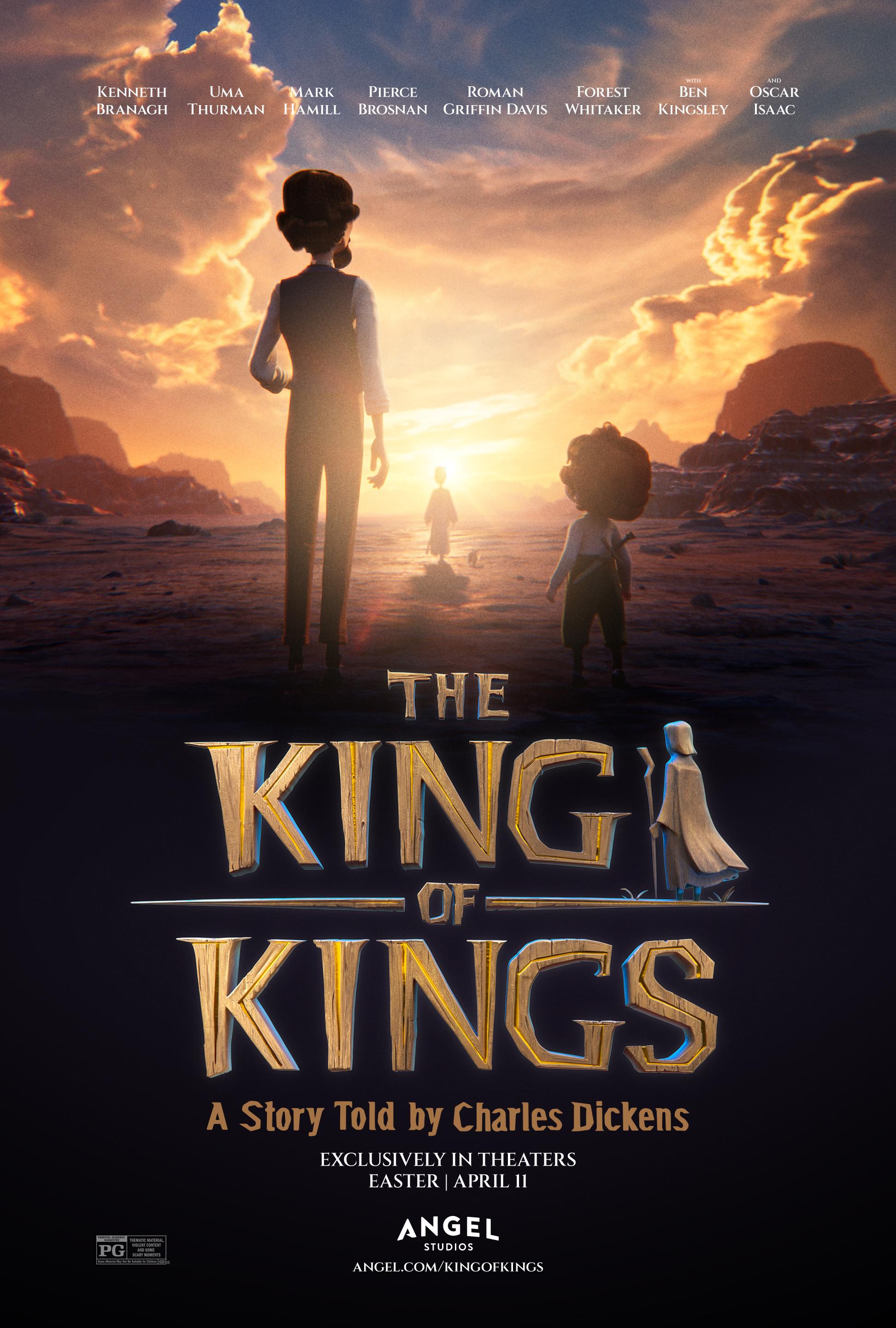
Surprisingly good! Masterful storytelling, stunning hand-drawn sequences, and emotional depth are at the heart of King of Kings. Delivering a rich tapestry of contemporary CGI-derived imagery fused with hand-drawn animation, the visual storytelling creates a distinctive style that feels both modern and timeless. King of Kings is a star-studded animated feature that follows Charles Dickens as he regales his son with the “greatest story ever told.” The scale and scope of this story is not typically one that can effectively fit into a runtime of just over an hour and a half; but in the vein of the critically acclaimed Prince of Egypt, the film’s narrative is lean yet never sacrifices diegetic nuance or quality. The impact of the film is aided by a stellar voice cast and characters that are relatable, vulnerable, and ultimately human. This compelling feature film brings history to life for audiences in one of the strongest and most engaging cinematic adaptations of the gospel.
Renowned writer Charles Dickens shares the story of Jesus Christ with his son, Walter. As his father narrates the stirring tale, Walter becomes captivated with the events of Jesus’ life.
King of Kings strikes a tone and pacing that defied any expectations I had for this film. From beginning to end, the film remains engaging. The film’s opening sequences establish the setting and stakes with efficiency, drawing viewers into its world without overwhelming exposition. The narrative unfolds at a steady rhythm, alternating between introspective character moments and energetic action sequences. The excellence in screenwriting and direction is witnessed in the effective oscillation between the serious or reverent and brief moments of levity or comedy. By punctuating scenes and sequences with humorous emotional resets allows for emotional beats to resonate whilst keeping the momentum alive. Despite the film’s epic scope, the story never lingers too long in one place. Key moments in the gospel story are given the space they need to land with full impact, without feeling rushed or drawn out. The climax builds with a gripping intensity even though the story and history are well-known. The film’s showdown culminated in a resolution that is both satisfying and emotionally powerful.
Among the cinematic elements that surprised me the most when I watched this film was the star-studded cast that includes Kenneth Branagh, Uma Thurman, Oscar Isaac, Ben Kingsley, Mark Hamill, and James Bond himself Pierce Brosnan. Additionally, the film’s original song is recorded by Broadway royalty Kristen Chenoweth. The compelling performative dimension elevates the film beyond its breathtaking animation. Each actor brings a distinct energy to their respective role, seamlessly blending emotion, gravitas, and authenticity to create a truly immersive cinematic experience. Whether delivered by a leading or supporting actor, each line of dialogue is delivered with conviction, making even the quietest moments resonate with emotional power. The collective efforts by the cast and director breathe a discernible heart and soul into the film.
There are many layers to the visual storytelling in King of Kings. Ostensibly, we have a story within a story because the film opens with Charles Dickens delivering a dramatic reading of his titular novella A Christmas Carol, later he tells his son the story of Jesus from birth to resurrection. Within this story, there are sequences that dramatically depict the exodus and Adam and Eve’s expulsion from the Garden of Eden. Each layer of the film as a whole are delivered with their own distinctive aesthetic. And within this aesthetic, the characters feel like an extension of their respective worlds rather than merely an extension of the artists drawing and programming the movie. The character animations are fluid and expressive, capturing subtle facial movements and gestures that bring an incredible level of realism to the performances. Battle sequences explode with kinetic energy, yet remain clear and visually stunning, avoiding the chaotic clutter that plagues many action-heavy animated films. The combination of motion-capture technology with traditional animation techniques results in characters that move with breathtaking realism while retaining an artistic, almost mythic quality.
Just in time for Easter, King of Kings reminds us that we, in the words of Chenoweth’s song, want to “live like that.” In a world that often feels so cynical and self-centered, comes an adaptation that challenges us to examine our lives and grow in how we impact the community and world around us. Jesus challenged the pious, bureaucratic leaders that built religious empires and He also made a difference in the lives of the discarded and ignored individuals in His community. Whether you go into this film a Believer or not or whether you emerge a Believer or not, there is little doubt that the actions of Jesus will challenge you to be a better person to friends, neighbors, colleagues, and members of your community.
Ryan is the general manager for 90.7 WKGC Public Media in Panama City and host of the public radio show ReelTalk about all things cinema. Additionally, he is the author of the upcoming film studies book titled Monsters, Madness, and Mayhem: Why People Love Horror. After teaching film studies for over eight years at the University of Tampa, he transitioned from the classroom to public media. He is a member of the Critics Association of Central Florida and Indie Film Critics of America. If you like this article, check out the others and FOLLOW this blog! Follow him on Twitter: RLTerry1 and LetterBoxd: RLTerry


 R.L. Terry ReelView