
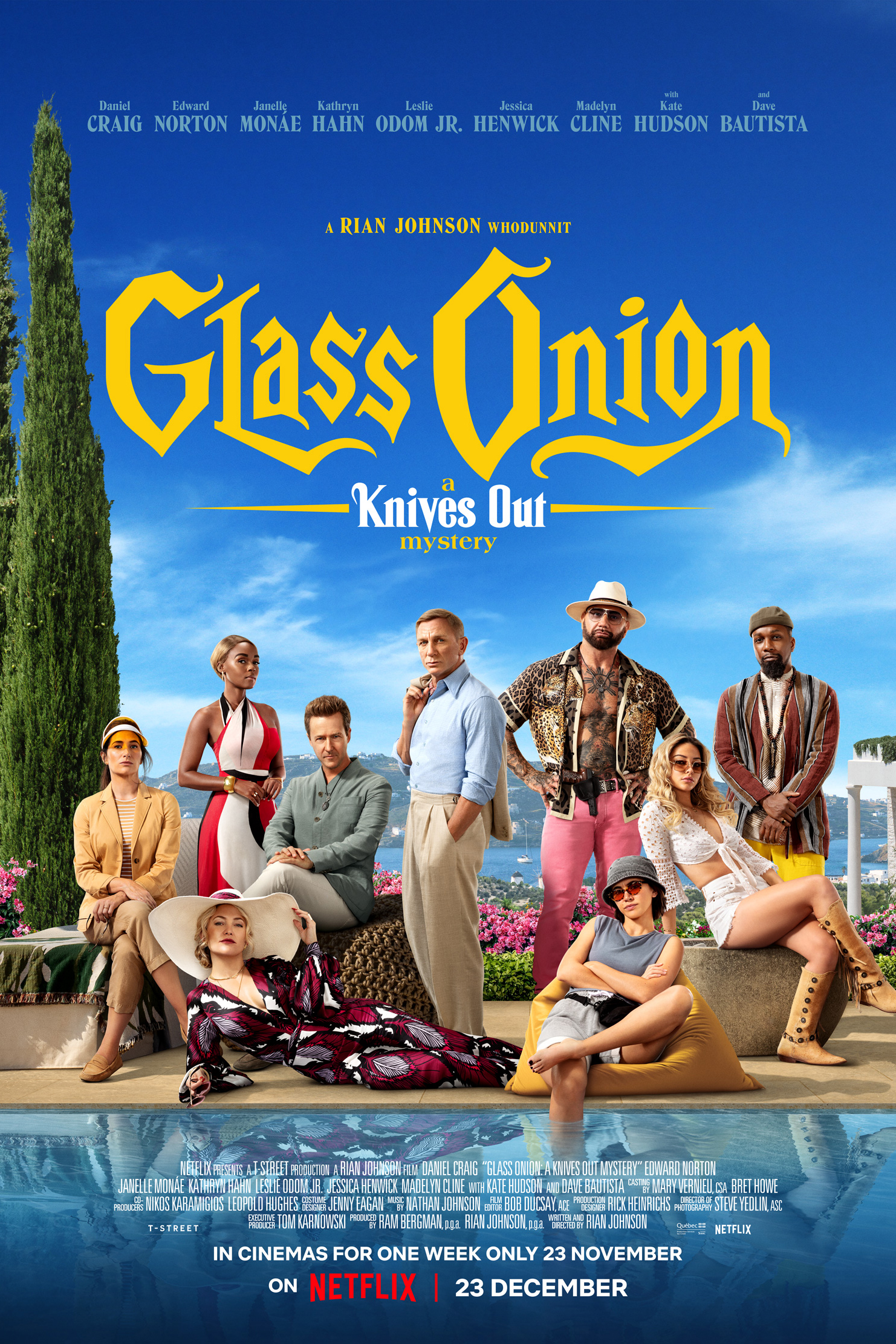
GLASS ONION: A KNIVES OUT MYSTERY whodunit movie review

Cloth Mask: a COVID Mystery. The real mystery is why Johnson didn’t turnover his idea for this chapter in the fledgling franchise to a different screenwriter. World famous detective Benoit Blanc is back, but this mystery suffocates under constant reminders of the varying degrees of response to COVID-19. At the core of this Knives Out installment is an intriguing mystery; however, throughout the whole movie, the audience is reminded of about two years of recent history that most people would rather forget. The best part of the movie is a cameo, near the beginning, of a truly legendary TV detective. Even if you don’t want to watch the whole movie, watch the first few minutes, because you will undoubtedly love the cameo as much as I did.

Tech billionaire Miles Bron invites his friends for a getaway on his private Greek island. When someone turns up dead, Detective Benoit Blanc is put on the case.

Before I break down my thoughts on the movie, just who is that legendary TV detective that surprises us with a heartwarming cameo? None other than Dame Angela Lansbury, aka Murder, She Wrote‘s Jessica Fletcher! Knowing she makes her final film appearance in a murder mystery is incredibly poetic, and will absolutely thrill audiences.

While there is certainly a time and place for films that depict or are an abstract representation of events and people from real life, for purposes of inspiring conversations, most fictional films should transport us, be a momentary break from the negative stressors of life. From beginning to end, Glass Onion is a manifestation of COVID Theatre–and not for purposes of parody or satire–because it’s neither funny enough to be parody nor clever or thoughtful enough to be satire. Even though Rian Johnson is reprising his role as the writer-director of this one, the loss in quality from the brilliant Knives Out to this installment is rather conspicuous. Perhaps this is yet another example of why some directors need to stick to directing, and turn their ideas over to a screenwriter. Evidence of the poor pacing and structure is demonstrably witnessed in the simple fact that nothing big happens for an hour and fifteen minutes into the movie.

Another troubling aspect of this movie is the showdown. And no, I am not about to get into spoilers. But it’s a subject matter that certainly requires critiquing. Keeping in mind that when Glass Onion was written, Johnson could not have possibly known about now-recent headline-grabbing events (in Europe presently) about a group that feels by being a (to quote the movie) a disruptor that they can get their way. And in the film, something rather disturbing happens that could very well serve as inspiration for the continued despicable actions of this group. When these events began happening a few months ago, Johnson (or Netflix) should have rewritten and shot the ending because as it stands, the ending is tasteless.

The set and production design of the movie is nothing short of impressive. While the constant reminders of COVID do nothing to transport us to another world, the setting of this movie certainly does! I absolutely love witnessing the hand of the artist in the design of the palatial house and manicured gardens of the location where the murder mystery takes place. Much like the house in the original Knives Out felt like the Game of Clue, this one delivers a similar feel, which causes the house to feel like a character in and of itself.

While the story execution and writing leave much to be desired, the casting is great! Daniel Craig’s Benoit Blanc is just as entertaining as he was in the first movie. Outside of the foghorn leghorn detective, Jannelle Monáe delivers a fantastic performance as the ex-wife of our murder mystery weekend host Miles Bron, enthusiastically played by Edward Norton. You’ll recognize many to the other cast members and there are a few cameos that will garner a laugh or two. Some of the characters aren’t given much to do, so they become filler. But for the characters that have something of substance to do, they are mostly entertaining.

Unlike the previous movie, this one feels very “Netflixy,” so it’s not one that benefits from a theatrical viewing. Watching it at home will be sufficient enough. However, an advantage to watching it during its limited theatrical run is avoiding spoilers on social media.

For more on the movie, visit Netflix.com/GlassOnion.

Ryan teaches Film Studies and Screenwriting at the University of Tampa and is a member of the Critics Association of Central Florida. If you like this article, check out the others and FOLLOW this blog! Interested in Ryan making a guest appearance on your podcast or contributing to your website? Send him a DM on Twitter. If you’re ever in Tampa or Orlando, feel free to catch a movie with him.

Follow him on Twitter: RLTerry1
BONES AND ALL horror adjacent movie review

Intriguing concept, poorly written. The highly anticipated film from director Luca Guadagnino (Call Me By Your Name) leaves a mediocre taste on the palate. Moreover, Bones and All represents another example of the result of concentrating more on atmosphere and technical elements than on strategic storytelling and proper plotting. “A day in the life of…” or simply “dealing with life” is not a goal; therefore, a plot it does not make. Vapid dialogue and lack of diegetic purpose plague this rather gothic romance. However, the gore is handled tastefully. The most pleasant surprise in the film is the cameo by veteran horror actress Jessica Harper of Suspiria fame! She may only be on screen for a few minutes, but her performance will captivate audiences! Unfortunately, the rest of the film is largely forgettable. In contrast to many other films this year that greatly exceed the two hour runtime, this one clocks in at a sluggishly paced two hours and ten minutes.

Love blossoms between Maren (Taylor Russell), a young woman on the margins of society, and Lee (Timotée Chalamet), a disenfranchised drifter as they embark on a 3,000-mile odyssey through the backroads of America. However, despite their best efforts, all roads lead back to their terrifying pasts and a final stand that will determine whether their love can survive their differences.

While the concept is interesting (although Warm Bodies did it better), the execution is sloppy. And I am not talking about the dining habits of our central characters. I’m talking about the disregard for screenwriting conventions. There are many refreshing ideas in the film, but the ideas are not fleshed out sufficiently. I applaud the film for delivering an original expression of an extension of the zombie genre, but I wish the story had been better paced and structured–oh yeah–an external goal for the central characters would’ve been nice too.

Although the film boasts solid casting choices (especially the Harper cameo), the visual aesthetic the central characters bring to the screen is not supported by compelling talent or character arcs. There simply wasn’t much to these characters; they are borderline one-dimensional. Lots of potential for depth, but the characters are largely the same at the end as they are at the beginning.

For all the potential for the film to serve as a social commentary on feeling alone in the world, the film never thematically lands on any particular ideology or observation of society. Extrapolating from the thematic evidence the audience is given, the film is most likely attempting to craft a story depicting when someone feels alone in the world, but surprised to find out that they are not. When relationships with your fellow man (be it platonic or romantic) are actually possible.

Despite the film taking place in the late 1980s (an era that is growing blasé as a setting for film and TV), it shares a lot in common with gothic romances because of the subject matter. Seems like every other movie releasing takes place in the 1980s, which is beginning to become tiresome and unimaginative. But, I suppose we have Stranger Things to thank for that. On the topic of visual aesthetics and production design, the film’s various midwest settings feel like a character in and of themselves. I appreciate design most when you can see the hand of the artist.

Perhaps Bones and All works better as a novel because it is overwhelmingly internally driven. Not having read the novel, I can merely infer what may have been lost in the novel to screen adaptation. Most likely what is lost is that which cannot be shown on screen, so I cannot fault the screenwriters for that. Where I do find fault is neglecting a proper outside/action story driven by a plot that points and builds to a climactic showdown and resolution. We have plenty of internal need (aka inside/emotional story), but simply dealing with life or finding love is not sufficient for purposes of compelling cinematic storytelling.

Ryan teaches Film Studies and Screenwriting at the University of Tampa and is a member of the Critics Association of Central Florida. If you like this article, check out the others and FOLLOW this blog! Interested in Ryan making a guest appearance on your podcast or contributing to your website? Send him a DM on Twitter. If you’re ever in Tampa or Orlando, feel free to catch a movie with him.

Follow him on Twitter: RLTerry1

DEVOTION film review

DEVOTION delivers an endearing story with heart, but the unevenly paced screenplay lacks the gravitas to be truly impactful or memorable. Unfortunately, this Naval Air Force biographical drama arrives on the tailwinds of Top Gun: Maverick, to which it will undoubtedly get compared (though they are different). It’s a decent film with an important, historical story to tell, but the film is held back by the lack of strategic focus and the competing story threads.

Elite fighter pilots Jesse Brown (Jonathan Majors) and Tom Hudner (Glen Powell) become the U.S. Navy’s most celebrated wingmen during the Korean War.

We cannot discuss this film without addressing the white elephant in the room, the wildly popular, critical and box office smash hit Top Gun: Maverick. Both films feature character-driven stories in the Air Force, one fictional, while the other is biographical. Funnily, both feature Glen Powell in a central role. Speaking of casting, Devotion has a solid cast, but often times, neither the lead nor supporting characters are given much to do.

Even though I was unfamiliar with this true story prior to watching the film, it certainly seems to have hit all the factual points (which–don’t get me wrong–is important in a biographical drama), but the facts of the account never fully manifest into a cinematic story. Furthermore, there are three competing story threads, each vying to be the main outside/action story (1) the Korean War mission (2) the friendship between Tom and Jesse and (3) the relationship between Jesse and his family. Underscoring each of these is the inside/emotional story of Jesse’s professional and psychological struggles being the first person of color in the Naval Air Force.

The screenplay lacks focus, lacks direction. None of the outside/actions stories ever emerges as the main (or A-story). In an effort to dramatize everything that was going on in Jesse’s life professionally and personally, the screenplay never completely landed on any one of them. Because of this lack of focus, audiences will likely experience difficulty in connecting with any one of the characters; empathize? Yes. Truly connect? Therein lies the struggle.

Compared to the cinematography and editing of Maverick, Devotion noticeably struggles. Regrettably, this struggle would have been less noticeable had both films not been released in the same year (and yes I am aware Maverick experienced delays due to shuttered theatres and mitigated operations from 2020–2021). As much as I tried to separate the two films, Maverick was such an incredible film that it’s nearly impossible to evaluate them independent of one another.

Devotion is a middle of the road film, from technical achievement and screenwriting perspectives. It’s neither bad nor great; because it has an important story to tell, and it’s clear that everyone’s hearts were in the right place, it does make for a good film, but one that won’t likely stick with you as long as Maverick did.

Ryan teaches Film Studies and Screenwriting at the University of Tampa and is a member of the Critics Association of Central Florida. If you like this article, check out the others and FOLLOW this blog! Interested in Ryan making a guest appearance on your podcast or contributing to your website? Send him a DM on Twitter. If you’re ever in Tampa or Orlando, feel free to catch a movie with him.

Follow him on Twitter: RLTerry1
TICKET TO PARADISE romcom movie review

Refreshing and utterly delightful! George Clooney and Julia Roberts shine in Ticket to Paradise! Not only does this outstanding romantic comedy deliver a highly entertaining and heartfelt performative dimension, the script is solid! Excellent plotting for the familiar yet fresh story paired with dialogue that snaps, crackles, and pops! It’s an honest romcom featuring authentic true-to-life characters (albeit slightly exaggerated for dramatic purposes) that will resonate with audiences across the relationship spectrum. Whether you are a in new love, still in the honeymoon phase, or a cynic, you will find characters and predicaments that are inspired by real life. It’s been a long time since the romcom dominated cinemas, but Ticket to Ride is a great example of the classic romcom being reimagined for today’s audiences. And you know what? It’s fun for the whole family! Just goes to show that a comedy can be good, clean fun and still deliver laughs and heart. With a lean, mean script and brilliant casting in the lead and supporting roles, let this be your ticket to cinemas on your next date night!

A divorced couple teams up and travels to Bali to stop their daughter from making the same mistake they think they made 25 years ago.

Ticket to Paradise manages to seemingly do the impossible with an genre that sees few well-written directed, and acted examples nowadays, it simultaneously checks off the conventions and expectations audiences have of a romcom–yet–it delivers a story that will surprise you! Furthermore, this movie entertains audiences with a subject matter so seldom touched by romcoms–new love versus cynical love. Oh, there have been moves that have tried such as Love Actually, but this one strikes all the right tones. Over the last few years, we’ve seen some excellently written romcoms such as Last Christmas and I Want you Back. And if you enjoyed those two as much as I did, then you are sure to enjoy this one!

What’s better than a smartly written romcom with excellent casting? Well, one that takes place in an exotic landscape, of course! You may find yourself booking your next vacation to Bali after watching this movie, and for good reason, it looks like paradise. While there is nothing particularly remarkable about the cinematography, the setting serves as its own star. From sunrises to sunsets and all the crystal clear water in between, you will wish you had ordered a maitai to enjoy along with the movie. It’s easy to see why anyone would be tempted to fly to Bali on vacation and desire to stay. What I appreciate about the cinematography is that it could have so easily been distracting by increasing stylistic approaches to capturing the action and setting, but it never overshadows the story, which is why we go to the cinema, “the greatest art in the world is the art of storytelling” (C.B. DeMille).

Clooney and Roberts’ chemistry is uncanny! They’ve always played off each other so incredibly well. Such a natural couple, whether in love or fighting. And their relationship (or lack thereof) in this movie is completely believable. Of course it’s exaggerated for dramatic purposes, but this IS a romcom. Think of their relationship as real life, but edited. I’ve read some critics that have claimed the story is weak and the only redeeming dimension of this movie is the chemistry between Clooney and Roberts. Suffice it to say, that is an unfair evaluation, because the script gives them everything they need to deliver the laughs and a great story. Moreover, their respective characters have depth and dimension. Yes, there is an element of whimsy in their delivery and in the character mix, but again, this is a romantic comedy. We want to see a romanticized version of real life, but these characters and story work because they also exhibit human dimension, feelings, reactions, and flaws.

I highly recommend Ticket to Paradise! In a year that has had few stand-out movies, this is definitely one of them. Perhaps we will see more smartly written and cast romcoms return to the cinema, because as important as heavy films are, lighthearted ones are just as important because they provide an emotional balance.

Ryan teaches Film Studies and Screenwriting at the University of Tampa and is a member of the Critics Association of Central Florida. If you like this article, check out the others and FOLLOW this blog! Interested in Ryan making a guest appearance on your podcast or contributing to your website? Send him a DM on Twitter. If you’re ever in Tampa or Orlando, feel free to catch a movie with him.

Follow him on Twitter: RLTerry1
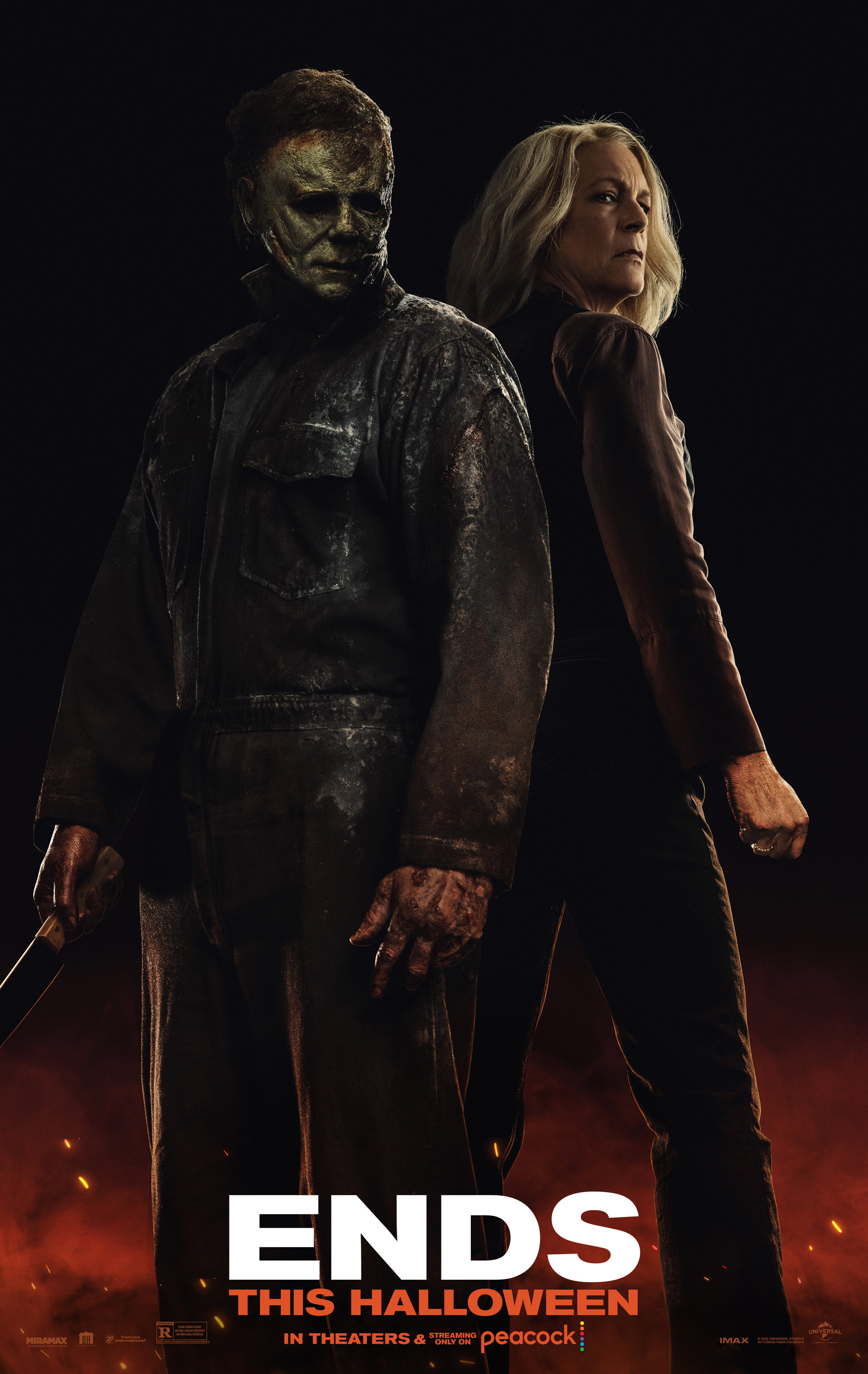
HALLOWEEN ENDS horror movie review

Well, it’s better than Kills. While Halloween Ends still struggles narratively, I appreciate what David Gordon Green attempted to do in order to add a thoughtfulness to the action plot and diegetic subtext. What we have here is a melodrama maskerading around as a slasher that delivers an insufficient amount of fun and genuine suspense. After the hugely disappointing and largely forgettable (except for how bad it was) Halloween Kills, expectations were set incredibly low for the final installment in Green’s take on the Laurie Strode/Michael story. Thankfully, the final chapter isn’t bad–that’s not to say it’s good–it’s more accurately described as watchable. As an added bonus, there is prolific exposition at the beginning that negates the need to watch Kills, so audiences can go from H40 to Ends and not miss anything, really. Even though there is one distinct kill inspired by, and some other shot compositions and camera movements that pay homage to the 1978 original, none of these moments feel like gross attempts at winning audiences over with pure nostalgia. Halloween Ends continues the trend for horror films, particularly the (what I like to call the) neo-slasher to focus so hard on atmosphere, social commentary, and melodrama that both the fun and suspense layers are so thin that they may as well be non-existent. From Halloween (1978) to SCREAM, the slasher delivered creative kills and icons but it also delivered highly entertaining movies in which we have found thoughtful subtext and social commentary in hindsight. Aside from the wandering narrative direction of Halloween Ends, it suffers from a lack of a demonstrable ability to generate a fun atmosphere for the audience.

Four years after her last encounter with masked killer Michael Myers, Laurie Strode is living with her granddaughter and trying to finish her memoir. Myers hasn’t been seen since, and Laurie finally decides to liberate herself from rage and fear and embrace life. However, when a young man stands accused of murdering a boy that he was babysitting, it ignites a cascade of violence and terror that forces Laurie to confront the evil she can’t control.

No spoilers.

The boogeyman, no more. “Was that the boogeyman?” –Laurie, “Yes, I believe it was.”–Dr. Loomis. Sorry, Sam, apparently not. In addition to sucking the fun out of the neo-slasher, filmmakers are also removing the boogeyman or monster factor from the killers. Instead of accepting that our killers are monsters that have evil running through their veins, filmmakers feel the need to explain why a monster isn’t a monster; rather, the killer is created by society. Up to Halloween Kills and Ends, you may have asked yourself “what makes Michael tick?” The short answer: we do not know enough–or at least we used to have an insufficient amount of knowledge about–his psychology, sociology, or physiology to know for sure. And that was a good thing! No longer is that the case.

Why? There no longer exists a mystery. Because now we do know too much about his mind and body; therefore, he ceases to be the boogeyman. Being the boogeyman (or a monster) was so important to, not only this franchise, but horror in general. That little bit of mystery and fantasy allowed him (and icons like Michael) to remain monsters that were to be feared and never truly understood or explained. That’s what made them scary–there was no explanation, which mitigates any control may feel we could achieve.

But since we are voyeurs who are obsessed with knowing, David Gordon Green decided that we needed to know why Michael (and those like him) was the way he was. What’s funny, is that in the original 1978 Halloween, the best sequel Halloween H20, and in H40, we can gather enough evidence to hint at what may make him tick, but at the end of the day, it’s fun speculation. Even before we had to have Michael’s behavior (directly or indirectly) explained to us, Michael likely suffered from and displayed signs of a combination of antisocial personality disorder, schizophrenia, and obsessive compulsive disorder. But none of that truly matters any longer because we now know that Michael and those that admire him are created by society’s negative impacts on their young, impressionable lives. True evil is does not exist.

Many fans of the Halloween franchise have a fondness or even love of the (seemingly) one-off Halloween III: Season of the Witch. And while I do not share a particular fondness for this installment, I can appreciate the creativity behind the expression of this tale of Halloween. And maybe if it wasn’t indirectly connected to Halloween, I may like it more. Anyway, I digress. I bring up Season of the Witch, because there are some shared elements between this Halloween movie and Jason Goes to Hell: the Final Friday and Halloween Ends, And I will leave it at that, as to avoid spoilers. If you’ve seen both of these movies I’ve referenced, then you may be able to make connections.

David Gordon Green and his team of writers inject a heaping helping of melodrama into Halloween Ends. Right up there with melodrama perfectly suited for–you fill in the blank–show on The CW or Freeform. Clearly, this was an attempt at adding some gravitas to this poor excuse for a slasher by spending time on dysfunctional family dynamics. After this trilogy, I am convinced that no family unit is healthy in Haddonfield. Bullies, manic and demanding moms, overbearing and weak fathers, nobody feels real in this town–all caricatures of what we don’t like about some people in society. There is no normal ever established. Establishing a sense of normalcy is important because it’s only then that the slasher can upset the order.

Even though this is the final chapter in the Michael/Laurie story, the movie does tip its hat to future Halloween movies. This is one of those movies that isn’t bad enough to warn people to spend their money and time elsewhere, but it’s also not good enough to where it needs to be seen at the cinema. While I firmly believe that horror movies are best experienced at the cinema in a crowded auditorium, the experience of this one will be good enough at home with some friends.

Ryan teaches Film Studies and Screenwriting at the University of Tampa and is a member of the Critics Association of Central Florida. If you like this article, check out the others and FOLLOW this blog! Interested in Ryan making a guest appearance on your podcast or contributing to your website? Send him a DM on Twitter. If you’re ever in Tampa or Orlando, feel free to catch a movie with him.

Follow him on Twitter: RLTerry1