BLACKBERRY film review

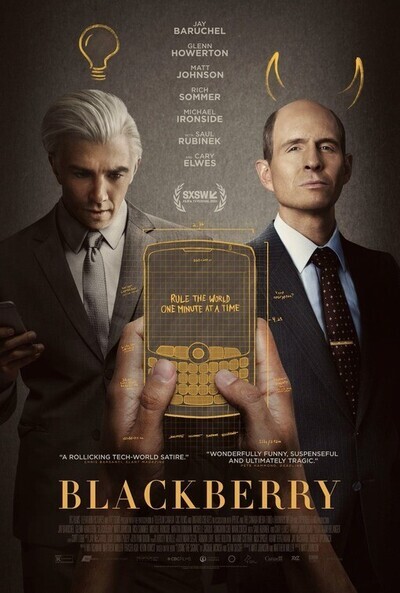
Positively kinetic! This wildly entertaining biographical drama just clicks on so many levels! From beginning to end, the film commands your attention as it delivers razor sharp dialogue and outstanding performances. Whether you are a former CrackBerry addict like myself (2007–2011) or are fascinated by how the world’s first smartphone came to be, there is something for everyone in this film.

BlackBerry explores the incredible growth and tragic collapse of the world’s first smartphone and how it smashed huge enterprises before surrendering to Silicon Valley’s fiercely competitive companies.

Destined to be a film shown in business and technology classes, this cautionary tale is a brilliant depiction of what happens when you give into the system you so desperately tried to avoid or the dangers of extreme naivety and stubbornness. Moreover, the characters are both repulsive and sympathetic. You will both empathize with their plight and shake your had at the obvious missteps that would eventually lead Research In Motion, which rocketed to the top of the tech food chain, to its cataclysmic downfall. It’s in the vein of Wolf of Wall Street and The Big Short.

There is a Greek tragic or mythological quality about this film as it reminds me of the story of how Icarus flew too close to the sun and had his wings clipped. BlackBerry was king of the smartphone world for however brief a time, but its impact upon the industry will be felt in perpetuity. But this movie isn’t about the history of smartphones per se or even the company Research in Motion itself, but rather three human stories of the men whom founded, developed, and (two of which) eventually crashed the company. So, it’s a very human story.

There are three different personalities at play in the film, each represented by one of the key figures int he meteoric rise and cataclysmic fall of BlackBerry/Research in Motion. Jim Balsillie (played by Glenn Howerton) represents insatiable greed and control, Mike Lazaridis (played by Jay Baruchel represents insecurity and naivety, and Doug Fregin (played by Matthew Johnson) represents childlike pride and blind belief. Each one of these men, especially the former two, played significant roles in the rise and fall of Research in Motion. Each one demonstrated a tragic flaw that was instrumental in the eventual demise of the tech giant. Greed, naivety, and pride greatly limit resiliency, adaptability, and teachability. And it’s the refusal to apply common sense and adapt that sent BlackBerry to the exit for Defunctland.

Everything works so demonstrably well in this film! The directing, screenwriting, and performative elements are all working at peak efficiency and at incredible precision. However, even efficiency can have a downside; and in this film, the third act’s pacing isn’t quite on par with the first two. Often times in films, it’s the first or second acts that suffer from poor pacing, setup, or development; but in BlackBerry, it’s the third act. That said, it’s still mostly written and directed well, but the third act is wherein we do find flaws in the story delivery.

From the three central characters to the chief supporting players, the performances are outstanding! Supported with razor sharp dialogue that snaps, crackles, and pops, all the actors will entertain you from beginning to end! It’s one of few films this year that feels quotable and earns multiple rewatches. Perhaps the performances border on caricatures or exaggerated versions of the real people, but they are appropriate for the over-the-top nature of the film. BlackBerry was, at a time, a larger than life company, ran by larger-than-life people, so the performative dimension should be just as over-the-top, which it was, and in all the best ways possible.

One might be tempted to refer to this movie as a depiction of the word’s most famous losers that quite literally paved the way for iPhone, Galaxy, Pixel, and more. Believe it or not, if it wasn’t for Research In Motion/BlackBerry chartering new territories and pioneering new communications technologies and formulas for data/voice coverage, we may not have iPhone or Galaxy today. BlackBerry simultaneously created a new communications device and completely re-imagined how cell service works on principle. The characters are fascinating and the story mesmerizing. Easily one of the year’s best films!

Ryan teaches Film Studies and Screenwriting at the University of Tampa and is a member of the Critics Association of Central Florida and Indie Film Critics of America. If you like this article, check out the others and FOLLOW this blog! Interested in Ryan making a guest appearance on your podcast or contributing to your website? Send him a DM on Twitter. If you’re ever in Tampa or Orlando, feel free to catch a movie with him.
Follow him on Twitter: RLTerry1 and LetterBoxd: RLTerry

POOR THINGS film review

Imaginative and provocative! Yorgos Lanthimos’ adaptation of POOR THINGS is a fascinating motion picture that takes audiences on a whimsical, otherworldly exploration, but unfortunately suffers from sluggish pacing midway through the adventure. This interpretation of Frankenstein, in both substance and form, delivers a labyrinth of social commentary on expectation versus reality, pretense versus disillusionment and the consequences of metaphoric prisons.

Brought back to life by an unorthodox scientist, a young woman runs off with a lawyer on a whirlwind adventure across the continents. Free from the prejudices of her times, she grows steadfast in her purpose to stand for equality and liberation.

The most striking element of the film is stunning production design! It’s whimsical and dark, gothic and post-modern all at the same time. Audiences will be completely transported to a highly stylized variation of the real world that is clearly inspired by the gothic imagination of Tim Burton filled with quirky characters that feel lifted right out of a Wes Anderson film. If it sounds like a Frankenstein’d film, you’d be correct because the very apparatus of the film is a bunch of pieces sewn together to create a new whole that arrives on screens by way of The Isle of Dr. Moreau. There is even a nod to a famous sene and shot in Metropolis!

From what I could tell, the entirety of the film was shot on a sound stage with highly theatrical, emotive sets and costuming. Lanthimos combined the best of German Expressionism and French Surrealism to craft a 19th century world that both felt part of our own, yet, not of our world. I liken the highly stylized designs to the motion pictures of Tim Burton in the 1980s-90s with exaggerated shapes, harsh shadows, and a substantial helping of dark whimsy. This intentional move to create a world that resides in this liminal space between that which we know to be real(istic) and fantasy works to the film’s advantage because we are prompted at the very beginning that we are about to embark on a bizarre adventure. Lanthimos’ story needed this stylized version of our 19th century world to be the playground for his quirky characters so that we believe and become vested in the journey. 

Without getting into plot points that spoil the film, it’s difficult to go into the degree of detail that I would like in order to analyze the very apparatus of the film itself, as it is in many ways self-reflexive of the narrative itself. But, I’d be remiss to not spend some time on spotlighting the Frankenstein’s creation-like form the film takes in telling this reimagined interpretation of Frankenstein. It is not simply by chance that this Lanthimos film looks different that his previous works such as The Lobster, The Killing of a Sacred Deer, and The Favourite, he intentionally took discernible tropes and elements of his own cinematic authorship and combined it with the gothic-inspired stylized worlds of Burton with the quirky characters and dry humor of Anderson to create a new experience for audiences. In essence, he Frankenstein’d his film, which is populated by Frankenstein and Isle of Dr. Moreau characters and animals. There are animals that are right out of the latter and characters that are expressions of the former. 

Poor Things captures the imagination and whisks audiences away to this whimsical world, but this adventure is not without its rich subtext and theming. Honestly, this is going to be one of those films wherein each member of the audience may read it differently. In my screening alone, I overheard conversations ranging from #MeToo to modernity versus postmodernism to capitalism versus socialism and even a critique of the affects of Victorian culture on society. 

My reading of the film consists of arguments around the ideas of the expectation versus reality, the expectations placed upon us by the world and society in which we live (which can feel like a prison) and the reality of when the world and society do not meet our expectations placed upon it. Moreover, we can expand upon this idea by including what happens to us when we become disillusioned by the pretenses and facades that are projected by various individuals in our lives—we learn who and how they really are. And lastly, the film depicts many different images of prisons. These prisons can be our family of origin, our occupation(s), or the norms and mores of society—we feel trapped and long for adventure; we long to stimulate our senses with new experiences that challenge the status quo.

Tony McNamara and Alasdair Gray’s screenplay is mostly well-crafted; however, after a solid first act, the second act drags on and on to the point there are many redundant scenes and repeated sexual exploits that cross the line from being able to justify them dramatically to self-indulgent and gratuitous. As a film professor, my philosophy for sex, drugs, and violence in screenplays (and in motion pictures)  is that as long as it can be justified dramatically and adds to character or world-building, then it is appropriate. However, it’s when these elements are used for shock value or to indulge warped fantasies that they become inappropriate. And I must say that the sexual content of the film borders on gratuitousness.

I don’t bring this up as some sort of moral judgment on the film as much as I bring it up because it’s due to this borderline gratuitousness that the second act gets bogged down, which it could have easily been written much more leanly. Beyond the repeated sexual exploits of the second act, there are other sequences and scenes that simply drag. Sufficient time developing the story is one thing, but some of the sequences and scenes become superfluous and excessive, revisiting the same conflicts or relationships over and over to the point that it feel pedantic. 

Fortunately, after the protracted second act, the third act returns to proper pacing and delivers a satisfying resolution. However, there is a coda (of sorts) that I could take or leave. It is definitely setup, but was it necessary? I’ll leave that up to you. 

For everything in the film that works so incredibly well, it needed another editing pass to mitigate the self-indulgent second act that continues to the improper pacing. Fortunately, the cast is superb and the candid, brutal honest of the film is intoxicatingly funny. Because of the phenomenal production design, it is a film that will be best experienced on the BIG screen, so I advise not waiting until it’s available to rent on-demand to watch at home. 

Ryan teaches Film Studies and Screenwriting at the University of Tampa and is a member of the Critics Association of Central Florida and Indie Film Critics of America. If you like this article, check out the others and FOLLOW this blog! Interested in Ryan making a guest appearance on your podcast or contributing to your website? Send him a DM on Twitter. If you’re ever in Tampa or Orlando, feel free to catch a movie with him.

Follow him on Twitter: RLTerry1 and LetterBoxd: RLTerry

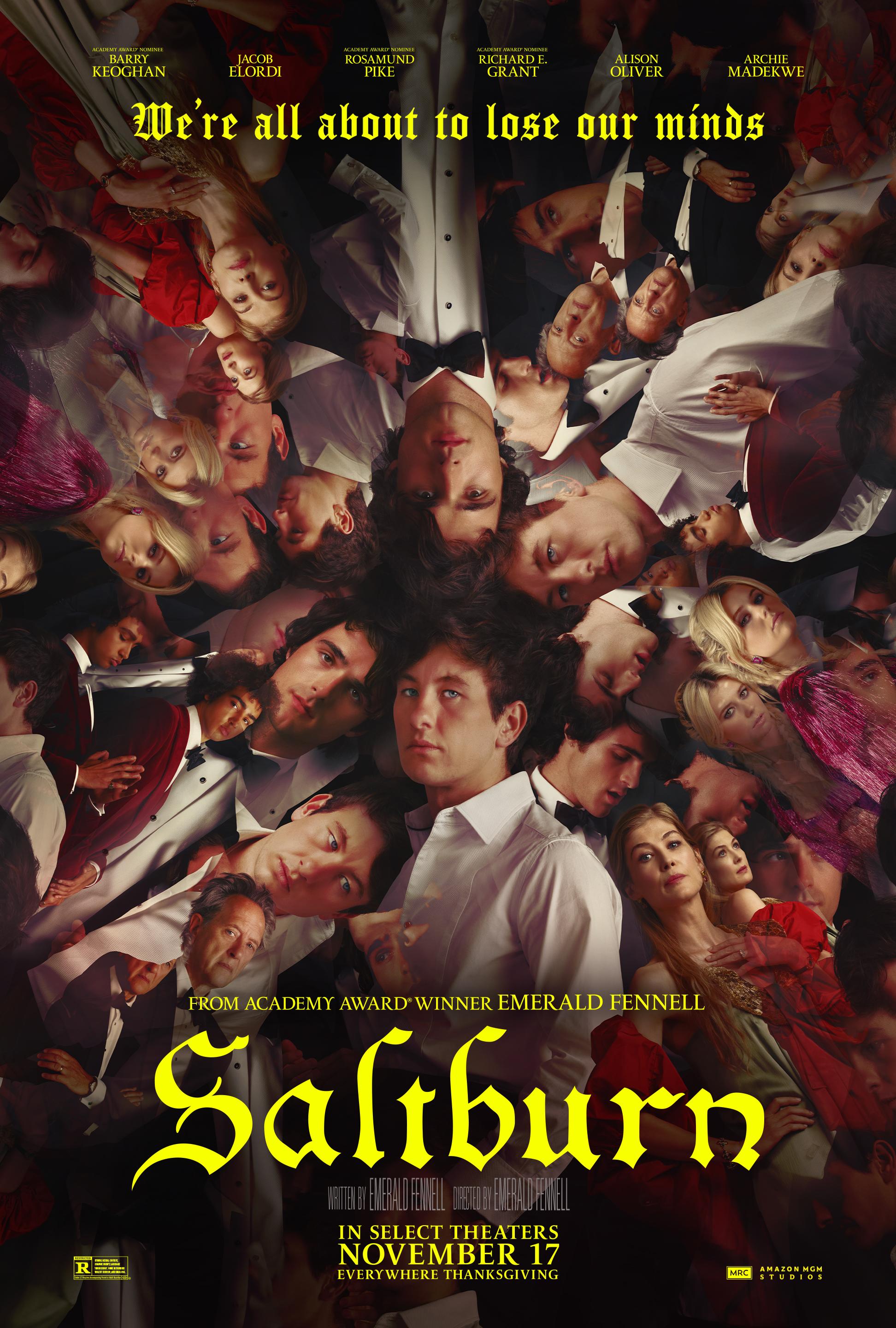
SALTBURN film review

An intoxicating and provocative neo-gothic film that is tonally all over the place. Heathers meets Cruel Intentions meets Flashdance(?) in a film that is incredibly stylistic but lacks any lasting entertainment value, except for the very end. Emerald Fennel (Promising Young Woman) delivers a sensory explosion critique on the facades we project through a story of the shifting balances of power, obsession, and deception. Is it a dark comedy? Is it a psychological thriller? Answer: it’s both and neither, and to that end, it’s potential for motion picture excellence is hampered. The tone of the film is incredibly uneven; and not one single character is likable. Saltburn presented many opportunities for effective, intentional camp, but chose to go the more serious route and play it straight.

Oliver (Barry Keoghan), a freshman at Oxford, is invited by classmate Felix’s (Jacob Elordi) family’s country estate for an exciting summer, but things are not what they seem and soon the fantastical estate falls victim to deception and manipulation.

The aforementioned movie examples in the opening paragraph each feature an aspect of this film; but each of those three examples offers a great deal more in entertainment value, not to mention lasting impact upon popular culture. Even though the central character’s external goal doesn’t become clear until the end, it is a thoughtfully plotted film that you wish you had enjoyed more in order to watch it again. However, the very last scene of the film is one that takes direct inspiration from Flashdance, and will be what is likely talked about for years to come. Too bad the rest of the film wasn’t as fun and entertaining as the final scene. Saltburn is neither an uplifting story nor is it a cautionary tale; it’s uncomfortably somewhere in the middle.

Clearly Emerald Fennell has a fantastic eye for shot composition and a demonstrable talent for crafting environments that stimulate the senses and emote. And that is to be commended. Few directors have a gift for creating and capturing settings and environments that communicate a discernible mood, tone, or emotion. We witness this in German Expressionism, which is at the root of gothic and many horror films. No surprise then that this film is incredibly neo-gothic in story and setting. Saltburn embodies uses both the technical and performative dimensions of the mise-en-scene to challenge audience perceptions; moreover, gothic films concern themselves with sexuality and audience response thereto. The collective imagery in this film generate a kind of spectacle for the audience to draw us into a heightened state of unease or fear. Fennell’s Saltburn is an exemplary motion picture for the art of drawing the audience into the world inhabited by the characters, and beckons you to join them.

Sounds great, right? If there were any characters worth caring about, then Saltburn could indeed be the masterpiece that many have claimed it to be. Fennell nailed the neo-gothic aesthetic and further stimulated our senses with the film’s intoxicating sexuality, but there isn’t a single character that you care enough about whether they live or die. These characters will both attract and repulse you, but more repulsive than attractive. No doubt that Oliver will become the stuff of erotic fan fiction and dreams, but even he isn’t likable in the end. And when delivering a melodrama about facades, pretenses, obsession, and deception, whether the film ends on a high or low note, there should always be at least one character the audience can root for, can truly care whether they live or die.

The story of Saltburn is inspired by the narratives of both Heathers and Cruel Intentions. And I don’t mention this to in any way suggest that Saltburn is derivative–it’s not–but to draw parallels to similar films. While I feel that both of these movies are much more rewatchable than Saltburn, if you like those two movies, you will likely enjoy it, even if you watch it one time. Where Heathers and Cruel Intentions succeed and Saltburn fails is in the entertainment value and tonal consistency. It’s as if Fennell was so concerned with provoking and sensually stimulating the audience that she forgot that the film should still be entertaining. Just because a film contains dark comedy or scathing social commentary doesn’t mean that it’s excused from providing entertainment for the audience.

What I will remember most is the ending of the film, which I cannot talk much about because of spoilers; however, I know that Fennell must love Flashdance because the final scene of the film is clearly inspired by the audition and triumph scene when Alex (and the dancers portraying her, haha) dance to Flashdance…What a Feeling! by the late Irene Cara. Even though we love Flashdance, we all know the plot is honestly not very good, but what saves the movie that literally defined the music, dance, and fashion of the 1980s is the uplifting, inspirational story and the high degree of entertainment value, not to mention one of the best jukebox soundtracks of all time (it won both an Oscar and Grammy for best original song).

Even though the tone may be inconsistent and characters unlikeable, the film certainly delivers on immersive atmosphere and a spider-like web of deception and manipulation with a great cast.

Ryan teaches Film Studies and Screenwriting at the University of Tampa and is a member of the Critics Association of Central Florida and Indie Film Critics of America. If you like this article, check out the others and FOLLOW this blog! Interested in Ryan making a guest appearance on your podcast or contributing to your website? Send him a DM on Twitter. If you’re ever in Tampa or Orlando, feel free to catch a movie with him.
Follow him on Twitter: RLTerry1 and LetterBoxd: RLTerry

MAESTRO film review

Maestro‘s reach exceeds its grasp. Bradley Cooper’s biopic on Leonard Bernstein is an exemplary motion picture in many respects, but ultimately its potential for excellence is hampered by a disjointed screenplay. The performative dimension of the film is impressive, as is the emotive apparatus of the film itself. Furthermore, Cooper’s talent for the director’s chair is witnessed beautifully in most areas of the film except for the storytelling mechanics–not the story itself–but rather how the story is told. Another example of the dangers of being both writer and director (and in this case producer too). Most films need the checks and balances that come from having a different individual at the helm of writing, directing, and producing. If most of what you know of Bernstein’s legendary career comes from West Side Story, then you should read up on his accomplishments prior to watching the film, as it feels very inside baseball. There is a great story in this film, but the screenwriting mechanics hold it back from being truly outstanding.

Maestro tells the complex love story of Leonard and Felicia, a story that spans over 30 years-from the time they met in 1946 at a party and continuing through two engagements. It also chronicles the prolific and influential career of one of the greatest composers and conductors in American history.

The most striking dimension of the film is the apparatus of the film itself, the mechanics employed to visually craft the method of telling this story. The film starts in then-present day with an on-camera interview in color and widescreen, then as the film jumps back to the 1940s, it changes to a 4:3 ratio and is in grayscale (with a blue tint). As the story unfolds, the film transitions from 4:3 grayscale to 4:3 color to eventually 16:9 (if you will) color. To the casual observer, this was to signify time jumps alone–and to stop there would be limiting the art and affects of this tool. More than signifying chronology, it was used to spotlight the emotive dimension of the film as it evolves (or devolves, depending on how you look at it) from an old Hollywood conventional romance to post-modern subversive romance.

Bernstein goes from being in love with people to being in love with his music, but always in need of muses and people around him. He was almost never alone–he was scared of being alone. The irony in that is he simultaneously brought people together with his music but drove them away because his first love was his music. Beyond the montage of the film, this emotive apparatus incudes a complete score by Bernstein, and the inclusion of Bernstein’s music to accompany audiences along this journey was a brilliant choice to increase the intimacy of the story for audiences both familiar and unfamiliar with his library of compositions. Cooper’s use of a cinematic storytelling apparatus such as this, elevated mere storytelling montage for cause/effect chronology to that which communicates emotion and introspection.

Both Bradley Cooper and Carey Mulligan shine in their respective roles; moreover, Mulligan’s Felicia Montealegre-Bernstein is truly the heart and soul of this film. Not mere impersonations, both Cooper and Mulligan completely transform into the real-life characters they are portraying. The performances were so incredibly intimate and personal that the authenticity leaped off the screen. When they hurt, we hurt, and when they were joyous, we were joyous. While Leonard is the title role, the character with whom most in the audience will identify is Felicia. She is the conduit through which we experience most of this biopic. Furthermore, she is the character that feel the most human, because Leonard’s level of talent was so out-of-the-world that it is hard to connect with him to the same degree most in the audience connect with the unconventional romance of Felicia and Leonard.

On a more personal note, I found myself connecting with Leonard the most because there is a line from Bernstein in the movie that goes something to the effect of (and I am paraphrasing) “I am so many things, but society only wants me to be one thing. I cannot be that one thing because I am all these things, and to not be any one of them would be to deny who I am.” Despite the fact I feel that Cooper is as much a screenwriter as Sorkin is a director, this line is representative of the central theme in the film and one with which I identify greatly. For I too am so many things, but society wants me to pick (and be successful) at just one of them, but I cannot because I am all these things. I am a professor, academic writer, event planner, film critic, and public speaker. For me to not do any one of these things would be to deny who I am. On that level, this film felt incredibly personal.

With all these wonderful elements going for this motion picture, the film’s reach exceeds its grasp due to the disjointed screenwriting. I’ve said it before, and I will say it again, most directors are not screenwriters (and the inverse is also true). Very few writer-directors can do both jobs equally well. If for no other reason, a film built upon a writer-director lacks sufficient checks and balances to ensure the narrative mechanics are adequate for translating a story from the mind of a screenwriter to the screen of a director. And this is where I draw the inside baseball analogy I mentioned earlier. The full potential of this film requires audiences to be knowledgable in the career of Bernstein beyond West Side Story and Our Town.

The screenplay fails to start on common ground before its deep dive into the career and romances of Bernstein. For example, unless you are a student of music, it is doubtful that you were aware of his work outside of West Side Story and Our Town. Therefore, since that is most people, the screenplay should have established a common connection between Bernstein’s work and general audience members early on in the film. Then, once common ground was established, take audiences on the journey through his personal and professional life. His contributions to Broadway are little more than one-off mentions during the film. The pacing of the story also plagues the film as it provides few, if any, transitional scenes and simply jumps from time period to time period. The stylized editing and cinematography mentioned earlier in the review help to communicate chronology, but there is more to telling a biographical story than time and place.

Alfred Hitchcock stated to start every scene in a film as close to the end of the scene as possible and end the scene as soon as possible all while ensuring that something dramatic happens at the end of the scene (in screenwriting terms a button) that sets up the proceeding scene. Nothing should happen in scene B that wasn’t setup in scene A and every scene should in some way point to the end of the film. It is basic screenwriting conventions that are ignored in hopes that the stylistic apparatus and performative dimensions of the film will make up for the lack of care in the how the story is being told. Screenwriting is more than a narrative to be delivered on the silver screen, it’s more than dramatize don’t tell, it’s all of that plus how story is being told even before the first shot is filmed. Screenwriting mechanics (inclusive of conventions and guidelines) are important because they work.

Bradley Cooper’s Maestro is a beautiful-looking motion picture that attempts to capture the gravitas of the professional and personal life of one of the greatest composers and conductors in American history. While it’s no Amadeus or Mr. Holland’s Opus, it is a solid film that students and fans of his career will thoroughly enjoy. For those that may only know him from his contributions to Broadway, the film will still be interesting enough, but may not be as impactful without more in-depth knowledge of his career and life.

Ryan teaches Film Studies and Screenwriting at the University of Tampa and is a member of the Critics Association of Central Florida and Indie Film Critics of America. If you like this article, check out the others and FOLLOW this blog! Interested in Ryan making a guest appearance on your podcast or contributing to your website? Send him a DM on Twitter. If you’re ever in Tampa or Orlando, feel free to catch a movie with him.

Follow him on Twitter: RLTerry1 and LetterBoxd: RLTerry

Disney’s WISH movie review

Disney should’ve wished upon a star for a better screenplay. But hey, at least we have an actual villain again! Wish attempts to be a return to the classic Disney animated feature form, but it fails to recapture the magic. Still, there are glimpses of that former Disney magic that are encouraging, and perhaps it’s a sign of what is to come in the next few years. And I am talking about the hand-drawn inspired matte-like backgrounds. Unfortunately, the CG cast and foreground elements detract from the magic of that classic Disney animation. Suffice it to say, the dichotomy of animation styles is distracting. Wish doesn’t have so much a story idea problem as it does a plotting and story execution problem, which plagues this movie. Moreover, what the movie lacks in thoughtful plotting, it strives to make up for in the musical numbers–forgettable as they may be. Most likely, the movie won’t be remembered for its story per se, but rather for the setups for future animated classic remakes as Wish is the origin story for the Disney wishing star. To that end, there are a couple of hidden Mickeys and moderately subtle nods to other Disney characters; and these nods are tastefully handled until they are not–and incredibly overt to the point of being obnoxious.

Young Asha makes a wish so powerful that it’s answered by a cosmic force, a little ball of boundless energy called Star. With Star’s help, Asha must save her kingdom from King Magnifico and prove that when the will of one courageous human connects with the magic of the stars, wondrous things can happen.

Even though I have many reservations in the execution of this movie, I admire it for the originality in creating an origin story for THE Disney wishing star, which we first witness in Disney’s Pinocchio. And the rest is history. This same star guides Peter Pan to Never Never Land, Cinderella wishes upon it, and so many more characters. To the screenwriters’ credit, the idea for Wish is a refreshing turn from the direction Disney movies (live action and animated) have been going for years now. All the building blocks for a great story and plot are there, but it’s as if the builders of the story didn’t follow the architect’s plans as closely as they should have. Suffice it to say: great idea, poorly executed. The result is rushed character and plot development.

Something that Wish does mostly well: it represents the return of the classically-inspired Disney villain. And while Magnifico can’t hold a candle to Ursula, Maleficent, the Horned King, or even Yzma (my personal favorite Disney villain), he does fill the vacancy that has been present since after The Princess and the Frog (2009) and Tangled (2010). For thirteen years, we’ve needed a villain, and Magnifico has shown us why. Nevermind that he isn’t nearly as memorable as the aforementioned villains, but he demonstrates why it’s important for a movie to have a villain. Yes, I am aware that (1) it’s more accurately described as a character of opposition and (2) the villain needn’t be the bad guy. But, I digress.

We love villains that we love to hate, or villains that are the flip side of the coin to our central character. In fact the best villains have many of the same attributes as our hero, and maybe even some of the same goals, but their methods of achieving these warped goals are twisted. At its most basic level, a well-written movie has a central character, that central character has an external goal motivated by an internal need, and there is a character standing between the central character and his or her goal.

The plotting may be weak, but the subtext and theming are quite strong! The movie provides commentary on ideas such as socialism, censorship, and authoritarianism. Unfortunately, I cannot get into all the supporting material without venturing into spoiler territory, but I want to spotlight the commentary, because it works well. The movie clearly demonstrates that the censorship of ideas can lead to a loss of uniqueness and individuality. And even the ability to learn and grow as unique individuals. This parallels the tyrannical banning of books in our public schools being experienced by some states in our country, including the one from which I write this review. One thing that the history of the world has taught us is that anytime mass censorship (often government or other large institution-based) is exerted upon a people, the society becomes a prison for those that live in it. They, in essence, become entrapped in Plato’s Cave allegory.

It’s difficult to get into all the details of how the movie provides a negative critique on socialism, but this theme can be read in the dark side of lofty promises of government-provided housing, occupational, food, and other resources. For there is a cost–and a great one at that. In the movie, this cost is expressed through wishes and Magnifico’s reign over the Kingdom of Rosas. Even though all the characters were enjoying the freely available resources of Rosas, in the end, they realize that nanny-like state took away individualism and freedom of choice. In a movie landscape that is ever-so-more-regularly advocating the advantages of socialism, this movie is a testament to “be care what you wish for” because everything in life does come at a cost. For the Kingdom of Rosas, it was wishes, for you, it maybe something entirely different but no less important to your individuality and freedom of choice.

Lastly, I want to touch on the magic of those hand-drawn-inspired backgrounds. There are so many scenes in which the background looks straight-up like a matte painting, and I love it! I wish the entire movie looked hand-drawn; it wouldn’t fix the story execution or screenwriting issues, but it would have given the movie a more magical, almost tangible quality. Hand-drawn animation (and I will include stop-motion animation in this critique) has real dimension. With stop-motion animation, the dimension is in the objects and the lighting thereof; with hand-drawn animation, the magic is in the imperfections and motion.

Specifically looking at Golden Age through The Black Cauldron, the hand-drawn animation had literal depth because of Walt’s patented multiplane camera. Artists would draw onto glass panes, layer and space them, and the camera would shoot the linear image, giving the two-dimensional image depth of field. The hand-drawn-inspired backgrounds of Wish are encouraging because this may be a sign of what is to come for Disney animation. Unfortunately, the magic gets lost in this movie because of the distracting dichotomy of animation styles. It’s removes the characters from the background, from the world in which they live, and you never quite buy these characters are part of the setting.

Perhaps Wish suffers from story execution problems, but there is hope that Disney animation may be making a turn for the better.

Ryan teaches Film Studies and Screenwriting at the University of Tampa and is a member of the Critics Association of Central Florida and Indie Film Critics of America. If you like this article, check out the others and FOLLOW this blog! Interested in Ryan making a guest appearance on your podcast or contributing to your website? Send him a DM on Twitter. If you’re ever in Tampa or Orlando, feel free to catch a movie with him.

Follow him on Twitter: RLTerry1 and LetterBoxd: RLTerry