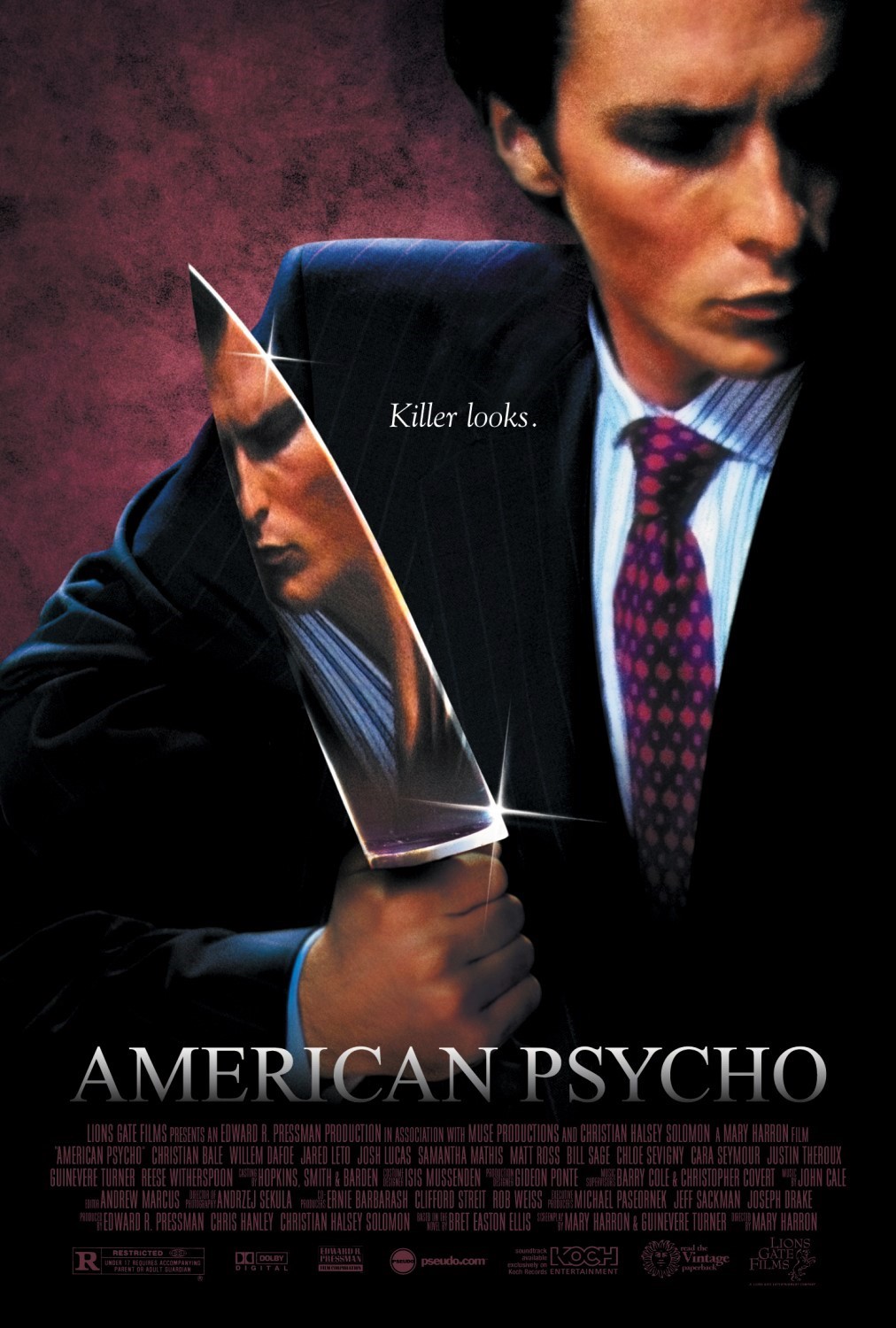
We all go a little mad sometimes. Once nearly banned on bookshelves, American Psycho (2000) is the film adaptation of a book about materialism, narcissism, yuppie culture, and the inter-personal empty feeling that comes along with it. Interestingly, despite this film commenting on and taking place in the 1980s, it also holds strong relevance for the 2020s. Except, if this movie were made in the 2020s, its social commentary would be on toxic consumerism, social media influencer culture, and political polarization.
Even though the central character of Patrick Bateman (Christian Bale) reeks of snobbery and pretension, Mary Herron’s brilliant horror-meets-dark comedy motion picture is raw, gritty, and unapologetic. The movie that was once protested by women was, in fact, directed by a woman. It’s a candid, fantastical exploration of the state of humanity when it loses its identity in exchange for the facades of prestige, money, and power. Herron externalizes all the emotions and thought processes she is exploring through the actions of Bateman. It’s a visual representation of what happens when we become so consumed with the image we project to others that we lose ourselves and are left feeling empty.
Not only is this a great horror film, but a great film period. Equal parts horror and comedy, this film can be characterized as a motion picture that forces us to reconcile our aspirations for wealth, power, and what happens when we fail to make genuine emotional connections with other individuals because we are completely consumed by image and status. Furthermore, there is a fascinating character study here on trying to fit into a society that you really don’t want to fit into, but don’t know what the other options are. Therefore you act on impulses instead of recognizing them in order to critically analyze if they indeed are the right things to do.
One of the qualities of the experience of watching a horror film compared to other genres is the power it has to force us to face our fears, look in the mirror (pun intended), and question the world around us. Moreover, it allows us to explore hard-to-talk-about subjects because it approaches them in creative, visual ways. that force us to think about some societal observation or construct in new and different ways.
In many ways, Patrick Bateman is us; the us we are when no one is looking. Perhaps most of us are not serial killers, but we certainly have a running commentary on the world around us. Also like Bateman, if we are not careful, we can fall prey to our own animalistic, self-centered instincts. I also love how this movie parallels the vicious nature of Wall Street with the murder sprees of Bateman. In this movie, it’s Wall Street, but it could very well be any number of work places. Perhaps there is little relatability to the characters on the surface, but dig a little deeper and this film is quite the microcosm of the world we live in.
American Psycho provides audiences a complex central character whose existence is more indebted to the dire strife of his reality than to the antagonism or conflicts posed by others. It’s an internal conflict that manifests itself in the elaborate, personal murders as well as the masturbatory discussions of dinner reservations and business cards. Through all of this, Bateman tries to feel something because society’s expectations have made him numb to humanity.
Although the topics of materialism, narcissism, and yuppie culture are explored in the film, the core of the film is actually about one’s self-identity. And much like Bateman’s iconic character, society in the 2000s (and by extension, the 2020s), was and is also concerned with issues of identity and where to find it after the transitional 1990s. The world of Bateman is hermetically sealed, yet there is a yearning to be set apart as an individual within this otherwise homogenous world of high rises, offices, business cards, and physical fitness. Efforts to be recognized as an individual are not limited to Bateman, but can be found in his colleagues. Moreover, any effort made by our officious, pretentious characters to be individuals within the confines of the depicted toxic culture, are shunned, ridiculed, and even ostracized.
These trivial assets are used as a means to form something resembling a personality, but so benign and meaningless that they can’t be anything other than a shallow, soulless facade, lacking any substance. There is an arbitrary box that everyone must fit into, but it’s merely a device to validate one’s existence. Validation through some arbitrary societal contract that somehow defines what one is supposed to be and how one is suppose to act WHEN people are looking. Sounds a lot like social media in the 2010s and 20s.
Many horror films began to incorporate more overt socio-political arguments and conflicts that paralleled during and emerged after the terrorism events of 9/11. The source of the terror in the real world was transported into the fictional diegesis of the horror film. This era of horror was much darker and more disturbing than its 80s and 90s counterparts. More than merely an increase in the viciousness on screen, additionally, this era of horror was socially aware of the cultural context that gave birth to it. By 2004, the news was filled with stories of enhanced-interrogation techniques that came under scrutiny from some anti-war and human rights groups. And this idea found its way from the news media into horror media.
One of the great mysteries of American Psycho is whether or not Bateman has actually committed any of the murders and violent acts in the movie. There are hypotheses that suggest that it’s all in his head, that we as the audience have witnessed the imagery of his mind and not his actions in real life. While the book American Psycho doesn’t leave anything to the imagination, Harron chose to withhold dramatic information from the audience in order to afford the audience the opportunity to form images in the mind, which can sometimes (and often are) more potent and powerful.
Ryan teaches Film Studies and Screenwriting at the University of Tampa and is a member of the Critics Association of Central Florida and Indie Film Critics of America. If you like this article, check out the others and FOLLOW this blog! Interested in Ryan making a guest appearance on your podcast or contributing to your website? Send him a DM on Twitter. If you’re ever in Tampa or Orlando, feel free to catch a movie with him.
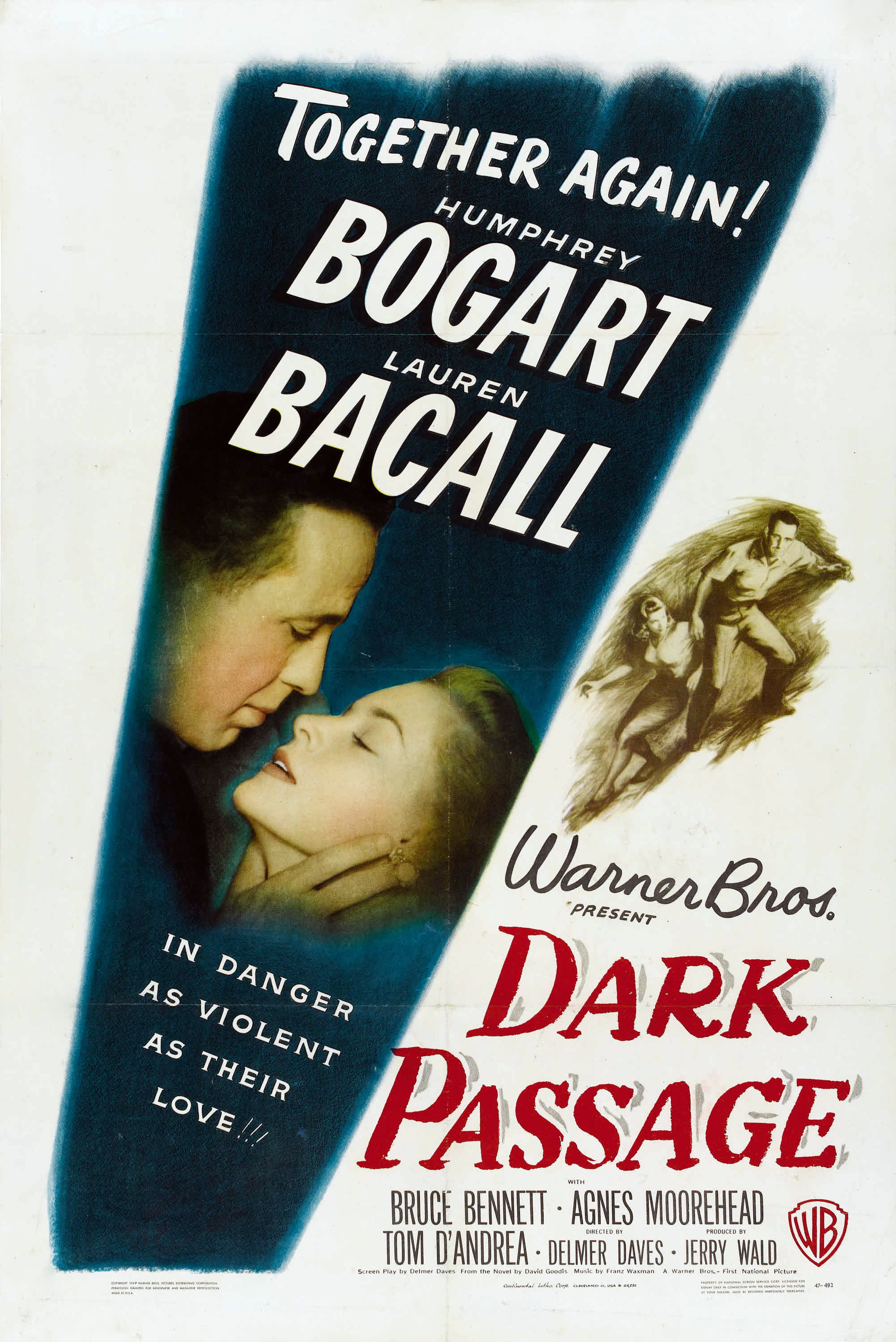
Spectacular and immersive! Dark Passage is the outstanding Bogie-Bacall film noir that you’ve likely never seen or even heard of, but you’ll want to change that. From beginning to end, this motion picture never ceases to draw you into its mysterious, seductive atmosphere. Bogie delivers a noteworthy performance through his dynamic facial expressions and body language, but it’s Bacall that steals the show through her sultry, smart, and sensational screen presence and performance. Dark Passage simultaneously checks all the film noir boxes whilst delivering something fresh and exciting.
Vincent Parry (Bogart) has just escaped from prison after being locked up for a crime he did not commit–murdering his wife. Vincent finds that his face is betraying him, literally, so he finds a plastic surgeon to give him new features. After getting a ride out of town from a stranger, Vincent crosses paths with Irene Jansen (Lauren Bacall), who believes in his innocence and helps him unravel the mystery surrounding his wife’s murder.
The most striking production element of Dark Passage is its innovative use of motivated camera framing and movement, which provides a unique and immersive perspective for the audience. By presenting the action from Vincent’s point of view (POV), the audience is drawn into his experiences and emotions, creating a sense of empathy and connection with the character. This technique adds a layer of suspense and tension to the film, as the audience is kept in the dark about Vincent’s true identity until later in the story. While POV camera is commonplace today, in the 1940s it was almost unheard of, which may have contributed to the reception of the film. But, if you’re searching for an excellent example of emotive POV camera, then definitely add this movie to your watch list.
Thematically, the film concerns itself with exploring concepts such as identity, justice, and redemption. Vincent’s transformation through plastic surgery raises questions about the nature of identity and whether changing one’s appearance can truly alter who they are on psychological, physiological, and emotional levels. As Vincent searches for his late wife’s real killer in order to clear his name, he grapples with issues of morality and the quest for justice in a corrupt world.
Underscoring the aforementioned themes is the compelling and complex relationship between Vincent and Irene. Irene’s unwavering belief in Vincent’s innocence provides him with hope and motivation to continue his search for the truth. Their growing bond adds depth to the story and serves as a contrast to the darker elements of the plot, because of the humor generated by their conflicting personalities. Film noir isn’t characterized merely by grayscale images (commonly referred to as black and white), but specifically the high contrast between light and dark. The high contrast isn’t only communicated visually, but is communicated thematically as well. In Dark Passage, the humor in Vincent and Irene’s relationship is the light to the film’s dark elements.
Lauren Bacall delivers a captivating performance as the determined Irene Jansen, Bacall’s portrayal of Irene is both alluring and sympathetic, adding depth to the character and serving as a crucial counterpart to Humphrey Bogart’s Vincent. Bacall’s performance exudes confidence and intelligence, traits that are essential for Irene as she navigates the morally ambiguous world of the film noir genre.
Perhaps the very definition and embodiment of femme fatale, Bacall communicates strength and cunning whilst never at the expense of sensuality and seduction. Moreover, she simultaneously conveys both fortitude and vulnerability beneath her character’s poised exterior. Bacall authentically portrays a relatable human dimension, allowing the audience to empathize with Irene’s plight and unwavering support for Vincent.
Furthermore, Bacall brings a sense of sophistication and glamour to the role, seamlessly fitting into the noir aesthetic. Her distinctive voice and sultry demeanor add to Irene’s allure, making her a memorable presence in every scene in which she appears. Humphrey Bogart delivers a compelling and nuanced performance in the film, even when we do not see him. Even his voice work is outstanding. His portrayal of Vincent is a masterclass in film noir acting, showcasing his ability to convey complex emotions and inner conflict.
Bogart’s performance is particularly noteworthy for his use of facial expressions and body language to convey Vincent’s emotions. Even when his face is hidden from view during the first part of the film, Bogart manages to convey a wide range of emotions through his voice and physical presence alone. His expressive eyes, in particular, become a focal point for conveying Vincent’s inner turmoil and determination.
Bogie’s performance is a truly an underrated performance in his illustrious career. With his skillful portrayal of Vincent Parry, Bogart elevates the film beyond its genre trappings, creating a compelling and unforgettable character that lingers in the minds of audiences long after the credits roll.
On an aesthetic level, one of film noir’s most striking elements is the high contrast grayscale imagery. The moody grayscale cinematography brilliantly captures the shadowy streets of San Francisco, thus crafting an atmosphere of dread. Beyond mere aesthetics, however, the lighting and camera movement communicate a sense of unease and mystery, mirroring Vincent’s (and by extension film noir’s) emotional journey through this murky world of crime and deception.
Why isn’t this brilliant picture more well-known? Most likely the reasons are three fold (1) competition from other better-known Bogie-Bacall collaborations like The Big Sleep (2) overt subjective camera framing and movement and (3) availability on broadcast/cable TV and home video.
Points one and three are somewhat interlinked because other Bogie-Bacall pictures like A Gentleman’s Agreement and The Big Sleep are much better known because they received higher praise from critics and audiences (even though Dark Passage received mostly positive reviews at the time of its release). And because of this, other Bogie-Bacall pictures received more airtime on broadcast and cable TV and were more widely available to own on home video and DVD. The second point, which may have led to the mixed-positive reception, concerns the (what would’ve been interpreted at the time as experimental) subjective camera techniques. In retrospect, the POV shots are an outstanding use of motivated camera movement that simultaneously conveys the film’s theme of identity and advances the plot.
While not as well-known as it should be, Dark Passage holds significance within the film noir genre and remains appreciated by cinephiles for its innovative cinematography, compelling performances from Bogie and Bacall, and atmospheric storytelling. And underscoring the technical and performative achievement is the film’s exploration of identity and injustice. It remains a captivating and influential motion picture.
Ryan teaches Film Studies and Screenwriting at the University of Tampa and is a member of the Critics Association of Central Florida and Indie Film Critics of America. If you like this article, check out the others and FOLLOW this blog! Interested in Ryan making a guest appearance on your podcast or contributing to your website? Send him a DM on Twitter. If you’re ever in Tampa or Orlando, feel free to catch a movie with him.
“Welcome to prime time” in the final article of my 2021 Sinister Summer series. This month’s article is covering the much lauded tertiary installment in the A Nightmare on Elm Street (ANOES) franchise Dream Warriors written by Wes Craven & Bruce Wagner (Maps to the Stars) and directed by Chuck Russell (The Blob, 1988), with returning ANOES stars Heather Langenkamp reprising her iconic role as the (in my opinion) definitive final girl Nancy Thompson, John Saxon as her father and the now disgraced former police Detective Thompson, Patricia Arquette in her breakout role, Laurence (credited as Larry) Fishburne, and of course Robert Englund as the terrifying and hilarious nightmare-inducing Freddy Krueger! Talk about a powerhouse cast! It’s not often that a sequel can rival the original installment in a horror franchise, much less the third installment. But A Nightmare on Elm Street 3: Dream Warriors (from hereon out Dream Warriors), is a heavy hitter that some even argue is better than the first one (a sentiment that I don’t share); however, it is certainly on par with the original, and that is largely due to the outstanding writing of Wes Craven. Dream Warriors is not simply a great horror film, it’s a great film period! And it’s Craven screenplays like the original, Dream Warriors, and New Nightmare that cement him as one of the great horror screenwriters of all time, not to mention his brilliant direction in the SCREAMfranchise (particularly the original and SCRE4M). While cinema academics and critics can argue all day long which is better (I or III), what both camps of subject matter experts can agree on is that THIS is the film that transformed Freddy from great horror villain to the revered, timeless icon of the horror genre that he is!
For those of you who haven’t seen this excellent work of horror cinema (what are you waiting for?!?). Expanding the story universe, the action takes place outside of the titular address 1428 Elm Street this time around; and instead focuses on a bunch of Springfield teens who occupy the local psychiatric institute. These teens are the last of the Elm Street children, and all suffer from various sleep disorders. The clinic’s answer: keep them doped up on dream blocking drugs (hypnocil). Nancy Thompson is now a graduate student at the institution whom specializes in sleep disorders. Through a series of accidents, she realizes that the patients are being hunted by Freddy Krueger in their dreams. Over the years, the stories of Freddy and the kills from seven years prior are all but the stuff of legend, and so Freddy has lost much of his power because no one remembers (or fears) him. That is all about to change when he figures out how to gain his former strength. Nancy becomes a de facto general as she leads her Dream Warriors into battle against the malevolent Freddy IN the dream realm.
The Dream Master is back, and with all the one-liners and signature kills that are on brand for him! Having seen his beloved character completely misinterpreted in the first sequel (Freddy’s Revenge, which was panned by critics but has sense seen a cult following within the gay community because of the homoeroticism in it), it was completely understandable that he wanted to return as the Godfather of Freddy this time around. He took on both co-writer and executive producer duties. Sharing story by and screenwriting credits with Bruce Wagner. The film’s director Chuck Russell also contributed to the script but only officially holds the director credit–not a bad deal. Before the first draft of Dream Warriors was written by Wes Craven, he conceived of an idea that the film’s characters be self-aware and the plot would play around with the idea of knowing what the horror tropes are and play it to both dark comedy and tragedy. New Line did not go for the idea, and said it wouldn’t work. Gee, a Craven-helmed self-aware horror movie that plays around with horror tropes to create a meta horror movie? Nah, that’ll never work. It would be another seven years before we would get meta horror in Wes Craven’s New Nightmare and nine years before SCREAM.
The final product of Dream Warriors differs greatly from Craven’s original ideas and screenplay for the film, which was much darker in tone (even darker than Freddy’s Revenge). In fact, the characters themselves were quite different in Craven’s original script. For example, Freddy does not have his trademark one-liners, so yes that means no “welcome to prime time, bitch!” (arguably his most Freddy line out of the whole series). Instead, he was much more brutal and violent, and even more graphic in how he taunted and terrorized the teens. The two elements that all, involved in the writing of this film, agreed on was that the teens would have special powers when in the Dream World with Freddy and the plot should include Nancy Thompson. When it was conceived to bring the teens into Freddy’s dream world, Craven questioned “why would Freddy be the only one to have powers here?” So the Dream Warriors were born. New Line eventually ordered a rewrite of the script to increase Freddy’s memorable, twisted sense of humor and witty one-liners and to transform the screenplay from an action-driven plot to a character-driven one. And it’s that character-driven nature of Dream Warriors that gives it the high level of quality that it has. It’s not just about Freddy or his kills, but it’s about the emotional hero journey of these vulnerable teens.
Responsible for the rewrites were Russell and Wagner. Analyzing the screenplay itself, it is clear that both Russell and Wagner were knowledgable in not only the previous two ANOES movies, but the nuance of the horror genre itself. Much more than in the original film, the rewrites also show a penchant for integrating pop culture influences into the dream-state personalities of the characters; and it’s the obsession with pop culture that ultimately contributes to their demise. Among other narrative elements, Russell and Wagner are particularly responsible for the demographic makeup of the teens that we get in the final product by changing many of the ages, sexes, and ethnicities of them. And talk about diversity in ethnicity, physical ability, intelligence, and gender! Jennifer, the young girl obsessed with TV and becoming an actress in Hollywood. Will, the young man confined to a wheelchair who is a huge nerd Dungeons and Dragons geek. Phillip, a young man who loves to create marionette puppets. Taryn, a former heroin addict looking to stay clean and sober. Joey, the quieter one in the group but incredibly horny for the ladies. Kristen (Arquette), who dreams of being an olympic gymnast and has a special kind of ESP that connects her with others. And Kincaid, a tough, short-tempered, and at times violent teen with a sarcastic sense of humor. Outside of Nancy, the other important adults include the often misinterpreted Nurse Ratched-like Dr. Simms, whom really is doing what she thinks is medically best for the teens to help them recover. And Max (Fishburne), the brave orderly.
Dream Warriors‘ screenplay is incredibly lean, and wastes no time in establishing the world of the disturbed teens before launching the audience, full-throttle, into the action plot. For starters, the opening scene of Dream Warriors is fantastic! I would put it up there with the opening to SCREAM, although SCREAM is at the top of my list of best openings–not just in horror-but in all of cinema. The opening to Dream Warriors is perfect because it re-introduces us to Freddy, including his grisly past and insight into the epic, terrifying dream world he creates for his victims. Furthermore, we get an elaboration on his backstory, including more insight into his fiery earthly death and his origin as “the bastard son of a hundred maniacs.” Adding to his intriguing, horrific origin is the idea that his mother was a nun, which is a terrifying idea that this horrific figure could have been spawned by any number of madmen raping a nun. All this adds to Freddy’s mythos and is perfectly accompanied by the iconic ANOES score. All these storytelling elements work together to set the tone for a masterful work of horror cinema. One that is more concerned with the characters, themes, and social commentary than merely the elaborate, entertaining, showman-like kills and memorable one-liners.
Showing the depth and complexity of the American horror film, this film tackles the tough, taboo subject of teen suicide. While teen suicide remains an issue today, it was more pronounce in the 1980s. Beyond after-school-specials and PSAs, this was a difficult subject for films (certainly at that time) to tackle. But when there is a tough subject to tackle, leave it to the American horror film to provide insight into and comment on it in unique ways. Much like Nancy and the Dream Warriors face their worst nightmares, the horror battles tough subjects face on! Not only does Dream Warriors tackle teen suicide, it also tackles drug addiction, broken families, self-esteem, and identity issues. A close reading of the imagery associated with the trauma experienced by the teens can be read as a metaphor of adolescence, transitioning from childhood into adulthood. Whether experiencing direct or implied trauma from Freddy, their family, friends, or the hospital staff, the teens endure gaslighting, imprisonment, mental rape, and attempted murder (and times, murder itself) all within the confines and intimacy of the mind. One can easily make the argument that Dream Warriors is a clever PSA on these subjects masquerading around as a horror movie.
Langenkamp’s Nancy’s return to the series showed us more mature side of Nancy. Gone was the shy girl turned bad ass from the original; now she truly was a survivor! And in Dream Warriors, she is the only adult authority figure that actually takes the time to listen to the teens, which is what ultimately points her in the direction of Freddy. Interestingly, her care for these teens evolves into a sort of maternal role in this film. Throughout this film (and franchise) there are images of mothers (and parental figures) that are explored through the conflicts, kills, and dreams. We know that Nancy had an absent mother before she got fired, so Nancy is striving to be the mother to these teens that she never had. While Detective Thompson is washed up at the beginning of this film, and took him a while to come around to Nancy’s plight in the original, he is actually one of the better parents (and fathers) we have in horror. And this film gives him a sort of redemption arc that I greatly appreciate.
Nancy also demonstrates the ability to be in a constant state of learning, even though she is a subject matter expert graduate student in this film. But Nancy is not without her own vulnerabilities. She may have exchanged her pink rose pajamas for 80s power suits, but she is still the same Nancy. Despite her more mature, calm, collected exterior, she is still haunted by her former Freddy nightmares and the ordeal from seven years prior. This makes her character incredibly relatable because she isn’t (and neither is anyone else in the movie) a superhero, she isn’t morally/ethically perfect, she is a flawed person like you and me. But she is harnessing the energy of these fears and flaws, and channeling them into making a difference in the lives (and dreams) of these teens.
The film is called Dream Warriors for a reason, and that reason is because each of the tormented teens gains supernatural power in Freddy’s dream world. And it’s not some arbitrary super power–no–it’s a power that is an answer to their vices and weaknesses. One of the common themes of horror is perceived powerlessness. And there is no better franchise for exploring powerlessness than ANOES because Freddy attacks you when you are your most vulnerable–when you’re sleeping. And we must all sleep at some point–it is unavoidable. Except in this film, his victims band together to battle Freddy on his own turf. While most of them wind up dead–after all, we are usually left with the final girl in slashers–they do not go down without a valiant fight! Through their nightmares, they show that they can overcome that which torments them. On the surface, they are fighting Freddy, but really, they are fighting their own personal demons that have traumatized them.
Now, it wouldn’t be ANOES movie without Freddy’s magnificently creative kills and catchy one-liners. And Dream Warriors has some of the best kills in the entire franchise! I do not have time to go through each of them, but I just have to highlight my absolute favorite Freddy kill and one-liner of all time. Not only is it mine, but this kill and accompanying one-liners are often in the Top 5 and even Top 3 from fans, critics, and scholars alike. And it’s Jennifer’s Welcome to Primetime kill!
The beauty of this particular kill lies not only in its simplicity, but in this scenes’s energy and showmanship that is 100% trademark Freddy from beginning to end! Jennifer is trying to stay awake by watching television in the TV room. Max comes in to escort her to bed because it’s late, but she begs him to let her stay up a little while longer. Reluctantly, he agrees to let her stay up and watch TV but he warns her that if she’s caught that he won’t help her out. She agrees and Max leaves. Thinking that the TV alone may not be enough to keep her awake, she burns herself with a cigarette. While much of this film could very well happen today, we get a totally 80s moment here with Jennifer watching the Dick Cavett Show featuring an interview with (and cameo by) the legendary Zsa Zsa Gabor! During the interview, Dick turns into Freddy and slashes at Ms. Gabor! Then the TV turns to that static screen that we don’t get anymore. Confused by what is happening and at the sounds of those all-too-familiar Freddy victim screams, Jennifer gets up and turns the channel knob, but it does seem to fix the problem. Angry at the TV, Jennifer smacks it and suddenly two razor-clawed mechanical arms burst out of the side and pick up Jennifer. Then Freddy’s TV antennae-wearing head emerges from the top of the TV and makes cinema history by saying, “this is it Jennifer, your big break…welcome to primetime, bitch!” Then smashes Jennifer’s head into the TV. And it is likely due to that kill and line that Freddy continued to develop more of a twisted sense of humor throughout the series. Of course, too much of a good thing is a bad thing, which we also see in the subsequent installments.
If Welcome to Primetime is the film’s (and possibly series’) best kill, this next kill is the most shocking out of the series. And it’s the death of final girl Nancy Thompson. Even though Nancy goes out as a ballsy warrior, it was completely unexpected that she would die. But that death made her return in New Nightmare all the better! In dying, Nancy successfully passes on the torch of the Elm Street protector to Kristen. While Freddy’s motivation for killing the other Elm Street teens in this movie is an extension of what drove him to murder the teens in the previous installments, his motivation for killing Nancy was more than revenge brought on by his death at the hands of the Elm Street parents; it was revenge for doing the impossible–defeating him by taking away the source of his strength: her fear. While it was “nothing personal” in the other murders, his desire to kill Nancy was very personal.
Dream Warriors was a hit with both critics and fans! How often do you hear that with horror movies, much less sequels. In fact, in my opinion as a film professor specializing in the American horror film, I argue that the best films in the ANOES franchise are: A Nightmare on Elm Street, Dream Warriors, New Nightmare, and Freddy vs Jason. The final script was praised highly for its pacing, thoughtful commentary, character development, and imagery. With a higher budget thanks to the successes of the original and Freddy’s Revenge, the special effects and set design were cutting edge! This is especially true of the scenes in Freddy’s Hell. Is the film flawless? No. However the few flaws the film does have in no way detract from the cinematic experience of the story. More than 30 years old, this film is widely considered to be among the best horror films of all time, and will continue to be the stuff of nightmares for decades to come.
Ryan teaches American and World Cinema at the University of Tampa. If you like this article, check out the others and FOLLOW this blog! Interested in Ryan making a guest appearance on your podcast or contributing to your website? Send him a DM on Twitter or email him at RLTerry1@gmail.com! If you’re ever in Tampa or Orlando, feel free to catch a movie with or meet him in the theme parks!
A haunting, dreamlike supernatural horror film about a truly hangry house that was ahead of its time. This month’s retrospective review is on Dan Curtis’ only theatrical film,: 1976’s Burnt Offerings. While I have certainly heard and read good things about this film, I had not really made it a priority to watch. A priority in that I would spend the $4 on Amazon to rent it. But the night before writing this, I saw it show up as a featured Shudder offering. With a mediocre IMDb score, I wasn’t convinced to spend my evening watching the two-hour film; however, upon a Google search, I saw that Golden Age screen icon (“fasten your seatbelts, it’s going to be a bumpy night”) Bette Davis was in a supporting role, as well as Burgess Meredith. Throw in leads Karen Black and Oliver Reed, and you have one stacked cast. But an opportunity to see those Bette Davis Eyes was what swung the pendulum in favor of selecting this more-or-less obscure 70s horror film.
Ben Rolf (Reed), his wife Marian (Black), and their son Davey (Lee Montgomery) visit a country manor up for rent for the summer. They are welcomed by weird siblings Roz Allardyce and Arnold Allardyce (Meredith) who offer the mansion for $900 for the whole summer. Ben is concerned with the upkeep of such a stately place, and the Allardyces state that the house will take care of itself as long as they show it love. The only condition to the siblings’ generous offer is that the Rolfs feed their mother that lives in a plush, cozy attic apartment three times a day by leaving a tray outside of her room. The Rolf family accepts the too-good-to-be-true offer, and move in right away with Ben’s vivacious, eccentric Aunt Elizabeth (Davis). Not long after moving in, Marian begins to become more and more obsessed with Ms. Allardyce and the house. Meanwhile, unsettling things begin happen to the Rolf family, including violent outbursts, and even an untimely death. Ben feels that something sinister is going on with the house, and urges his family to leave. But leaving the estate is not as easy as it seems.
It’s all too easy to see hues of The Shining, Poltergeist, and even The Haunting and TheSkeleton Key in this film, but remember that Burnt Offerings came out four years before The Shining and six years before Poltergeist. So if the plot feels a little predictable at times, it’s not because William F Nolan’s screenplay borrowed heavily from those tentpole heavy-hitters, but because those two iconic films perhaps took a little inspiration from it. Where Curtis may have taken inspiration was from Carnival of Souls because it feels like there is a nod or two to that film. Curtis has pacing down to a science! He demonstrates command of the emotional and psychological journeys of the characters and audience. Those who watch this film without reading up on it will scarcely have the leisure to ask why the Rolf family isn’t more observant and curious about their grand dwelling. At the time this film was released, horror was increasingly concerned and even obsessed with supernatural villains and primal fears take that place in otherwise innocent settings, such as an innocent little girl in The Exorcist or an innocent palatial estate in Burnt Offerings. In the case of the latter, the supernatural monster/entity is the house itself, which manifests its sinister desires in very much the same way a vampire does. It’s romantic, alluring, feeding on and sustaining itself with violence and death. This monster is capable of menace, vengeance, outrage, and even murder.
Instead of a shaky handheld camera, promiscuous teens/college students, and poor pacing that lacks a true windup or never pays off at all, comes a film that was ahead of its time in haunted house storytelling. This film feels far more polished and meticulously executed than most present-day haunted house movies. You won’t find jump scares or haphazard pacing here; this film comes from a time when the slow burn was both the norm and it was strategically utilized to setup a brilliant, shocking payoff that is ultimately among the most effective and memorable horror film endings of all time. In terms of its alluring aesthetic, Burnt Offerings harkens back to the days of Gothic horror in the vein of Edgar Allen Poe and the first and second generation of Universal Pictures Horror. Particularly Poe’s Fall of the House of Usher feels heavily channeled in this otherworldly, unsettling horror film. The film location itself comes completely with a sordid past. The estate in the film is the Dunsmuir Estate in Oakland, CA, which was used in every scene according to Curtis (so sound stages). It was built by coal fortune heir Alexander Dunsmuir in 1899. Dunsmuir intended the house to be a wedding gift for his new bride; but in horror movie fashion, he didn’t get to live in it with her because he fell ill and died while on his honeymoon in New York City. His new bride returned to live in the house but died soon after in 1901. What better haunted house location than a location, which may be truly haunted?!?
Burnt Offerings was one of many horror films in the 1970s and early 1980s that commented on the rising negative societal effects of middle-class life, including viral consumerism and obsession with single-family-house ownership, the family is destroyed by a house they otherwise dreamed of. Furthermore, it also provides an exploration of the perceived breakdown of the nuclear family, following the civil rights and sexual revolution movements. Closely reading the major themes in Burnt Offerings leads me to posit the idea that perhaps the most effective way to critically analyze this film is to interpret it as asupernatural parable on the risks of being controlled by one’s possessions. That said, contrary to how the Biblical proverb is so often misquoted; money is NOT the root of all evil; it’s the LOVE OF money that is at the root of all evil. And here, we can replace money with possessions (more specifically, the obsessionwith possessions). This is shown through Marian’s obsession with the Allardyces estate and possessions therein, Ben’s sexual obsession with his wife (as an object to possess), and the house’s evil energy possessing and draining the family. Anyone who’s ever owned a car, a house, or any kind of property can relate to what this family is going through. We know it as viral consumerism, or the toxic desire to acquire material objects (in today’s language, we can include experiences), whichcan begin to dominate one’s life. Furthermore, we’ve all been there, experiencing that feeling that repairs to, taxes on, and upkeep of property (be it cars, houses, or anything really) can become a burden that is figuratively unbearable. Ostensibly, the property and experiences we sought to possess, in an ironic twist of fate, now possess us.
The horror of Burnt Offerings is portrayed as a manifestation of the family’s inner turmoil. We aren’t given much to go on, as far as the family’s backstory, but clearly the facade of a happy couple is merely a thin veneer covering a very unhappy marriage–one that is using this summer get-away as a means to rectify. Although not specified, Ben is likely a teacher or non-tenure track college professor because his family is there for the summer (I infer this because Marian encourages Ben to work on his doctorate, something I intend to do as soon as I land a full-time staff/faculty position at the university where I’ve taught part-time for over five years). The manifestation of the internal conflict is expressed through the atmosphere and external behavior of the characters, much in the same way we witness this in The Shining, but more effectively witnessed in Rosemary’s Baby. The screenplay by Nolan (and Curtis) grafts this familial dysfunction onto the haunted house conventions to create an eerie sense of tension, both supernaturally and psychologically. As we observe how the Rolf family interacts in public (in front of the Allardyces) and in private (in their vehicle in a Shining-like motif), it’s easy to imagine that perhaps the “right people,” the Allardyces seek for the house, are ones living under a pressure cooker of repressed animosity and barely controlled hostilities.
Lastly, but certainly not least are the overall performances! Everyone in Burnt Offerings delivers a stellar performance. Talk about an award-winning, powerhouse ensemble! From the leads to our supporting cast, you will be delighted at the top shelf quality of the actors and their respective characters. What I appreciate most about each performance is just how authentic they were, no matter if the actor was playing a lead or supporting character. Both Reed and Black completely sell audiences on the stages of the relationship between their two characters as they go from happy to toxic couple, and it all feels so incredibly genuine. Montgomery’s performance as their son is par for the course, but effective and believable enough in this story (albeit he sometimes acts a little older than a 12-year-old would act). Burgess Meredith and Eileen Heckart simultaneously convince audiences their characters are jolly, eccentric siblings–yet there is a nuance of something creepy underneath. But the performance you really want to know about is the incomparable Bette Davis as Aunt Elizabeth. You get it all: Davis’ trademark sassy personality, witty quips, independence, and her eyes! Yes, those Bette Davis eyes that are a hallmark of cinema. One of the most beautiful faces the silver screen has ever seen, and yet she was adamant that she look like her character should look. Therefore, you eventually get a haggard, makeup-less, decrepit old woman that is the complete 180º from how we commonly see Davis. She delivers a fantastic performance, and you will be left wondering why she didn’t do more horror films to rescue herself from TV movie hell in the latter part of her career, from the golden age until she passed away in 1989.
If you are a fan of 1970s horror, The Shining, Poltergeist, Rosemary’s Baby, or Amityville Horror, I feel confident that you will enjoy this film. While it’s not a great horror film, it is a solidly good one that fans of the genre will likely appreciate. In retrospect, there is so much to unpack in this dreamlike, haunting gothic horror motion picture. Perhaps audiences at the time it was originally released weren’t ready for this methodical haunted house film.
Ryan teaches American and World Cinema at the University of Tampa. If you like this article, check out the others and FOLLOW this blog! Interested in Ryan making a guest appearance on your podcast or contributing to your website? Send him a DM on Twitter or email him at RLTerry1@gmail.com! If you’re ever in Tampa or Orlando, feel free to catch a movie with or meet him in the theme parks!
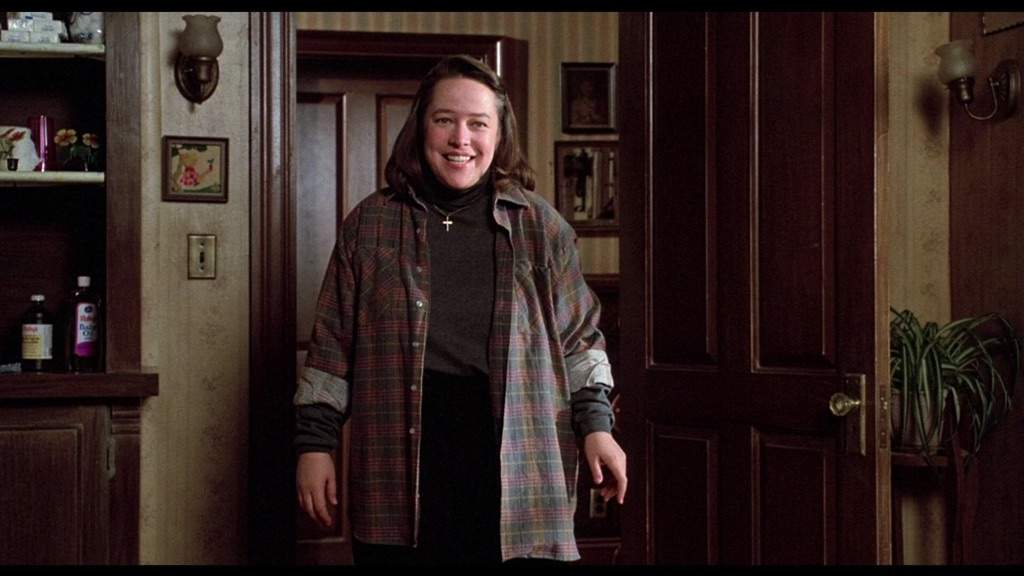
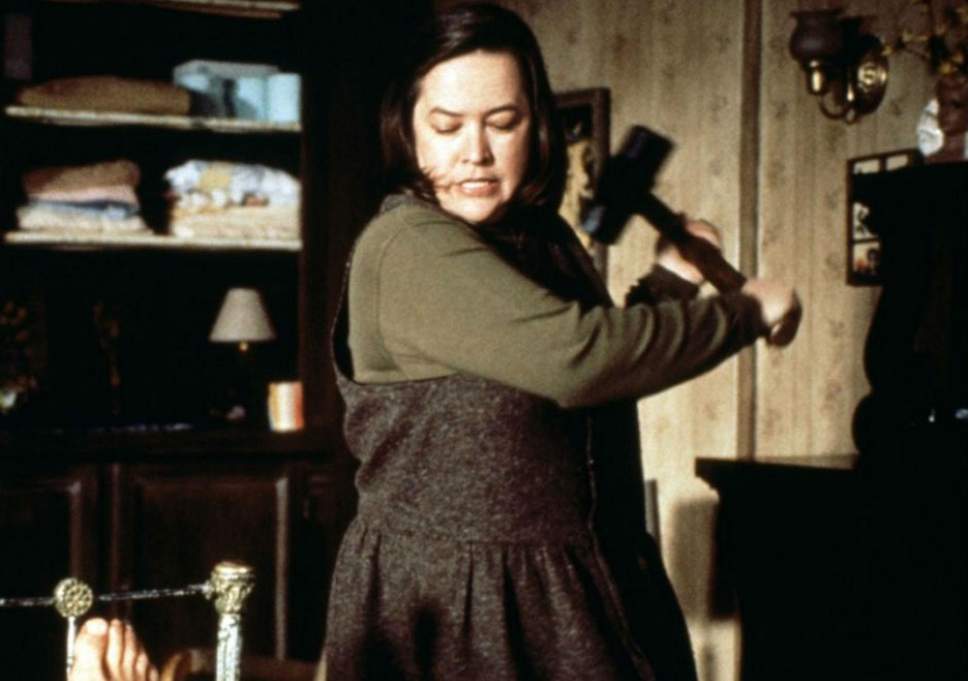
Do your ankles hurt just at the thought of this film??? Well, they should because this is one of the most unnerving horror movies of all time. In fact, each semester when I show my students the hobbling scene, they visibly cringe at that moment, and often remark that it was one of the most nightmarish scenes they’ve ever witnessed in a film. Based on the best-selling novel by Stephen King, Misery is widely regarded as one of the most terrifying psychological horror films ever. Directed by Rob Reiner, it stars then-newcomer Kathy Bates as Annie Wilkes, and playing opposite Kathy is James Caan as celebrity author Paul Sheldon. Just a quick note, the sultry Lauren Bacall also makes an appearance in this horror film as Sheldon’s agent. While this role is little more than a cameo, very few icons of the screen could’ve commanded it as beautifully as she did for those few scenes. Not only is this a brilliantly written and directed horror film, but Bates captivated us with her outstanding performance as the terrifying Annie Wilkes. In a quintessential Hitchcockian fashion, Rob Reiner crafts a phenomenal adaptation of the King novel that turns us into the prisoner of a disturbed and frightening fangirl. Annie convinced us that anyone who claims to be your No.1 fan may actually be your No.1 worst nightmare. Next time a nondescript motherly figure invites you to her picturesque cabin in Colorado, you may want to consider staying at the local Holiday Inn instead.
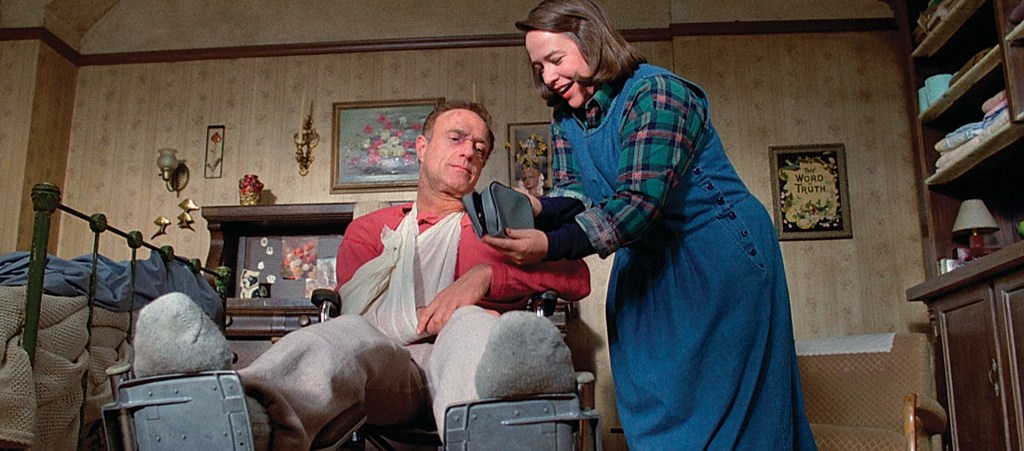
Clearly, Reiner studied Alfred Hitchcock’s methods for shooting a thriller. Evidence of this tone is witnessed in the framing, character blocking, and lingering shots. In fact, I argue that if you were to replace Reiner’s name with Hitchcock’s, it would be easy to convince (non cinephile’s) that it was in fact directed by the Master of Suspense. Reiner provides audiences with one of the most iconic horror films from the 90s that holds up incredibly well. Even with the typewriter, the sheer terror that Caan’s character of Paul Sheldon felt as he was kept prisoner by his sadistic No.1 fan Annie Wilkes (Bates). One of the biggest differences between the book and movie is the famous and painful hobbling scene. The book depicts Annie chopping off one of Paul’s feet versus the crippling of the ankles in the movie. I feel this was a good choice because the sledgehammer scene is far more painful than the former. I mean, every time I see a sledgehammer, I am reminded of this scene even to this day. Misery takes a minimalistic approach to the American horror film at a time that it was about being bigger and better. This approach was contrary to the trends of the day in that it felt far more intimate than other horror film contemporaries. As such, Reiner’s Misery is also largely takes place in one location (only flanked by quick moments in others). The combination of truly appalling, gut wrenching, darkly humorous, and sadistically amusing nature of this film enables it to hold up incredibly well and boasts one of the single most horrific scenes in horror cinema history.
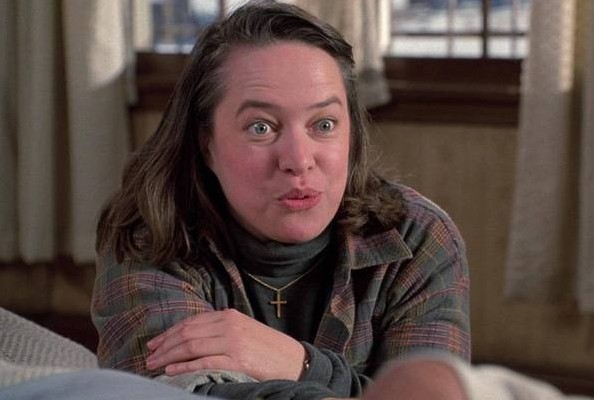
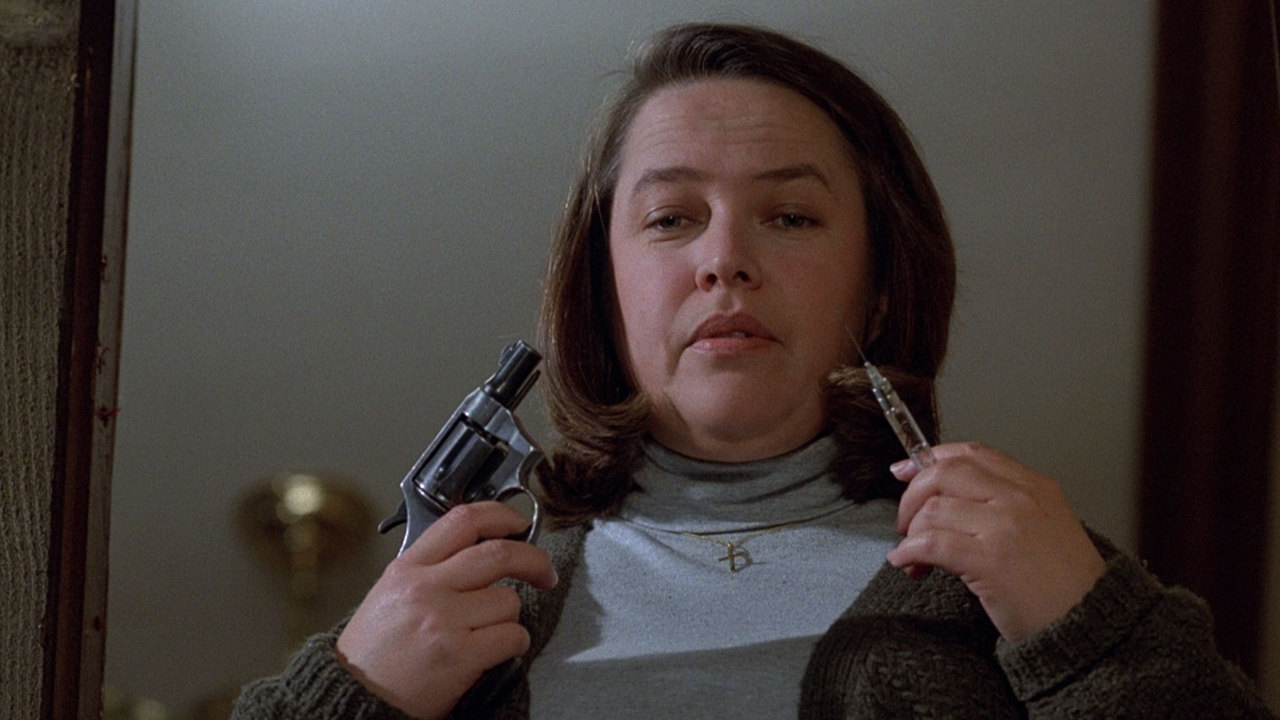
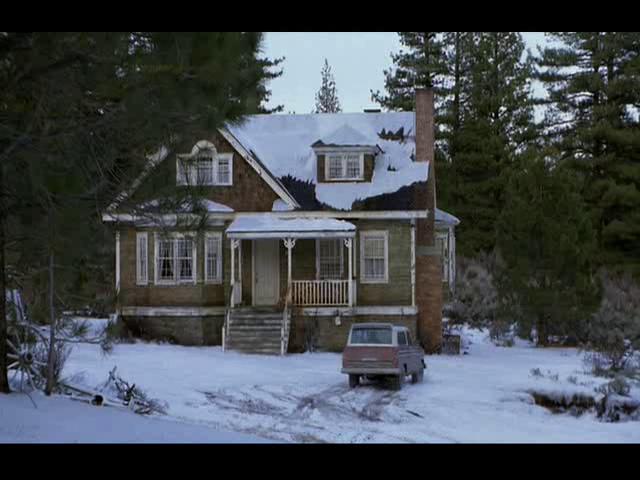
Talk about a character with incredible depth! Annie Wilkes is one of those exemplary characters in horror that provides ample opportunity to apply critical lenses to analyze her psychology and sociology. Clearly she displays signs of psychopathy, but there is so much more to her character. And those layers are what makes her one of the most terrifying characters in horror film history. On the surface, she is a monster-like human; but beneath that sociopathic behavior, she is clearly suffering from severe mental disorders brought on by past trauma. Collectively, we can surmise that Annie’s past traumas left her feeling that everyone and everything is out to get her. Therefore, she runs a countryside farm in mountainous Colorado away from everyone. Her only interaction with outsiders is when she has to run to town to pickup food and supplies. In addition to her mental disorders, she also displays signs of agoraphobia. Although some of her mental disorders have direct impact on her violent nature, other disorders are largely indirectly responsible, such as her likely obsessive compulsive disorder (OCD). Evidence supporting this can be seen in her immaculately clean and organized house. Her OCD contributes significantly to her obsession with Paul Sheldon. The only joy in her life comes from the romance novels that she reads–a vicarious way to experience a full life–namely the Misery series by Paul Sheldon. Essentially, she is the perfect storm of psychological and emotional disorders all wrapped up in a an unassuming citizen of a small Colorado town. She could very well be your neighbor or one of your social media followers. Perhaps she is YOUR No.1 fan.
Although screenwriter William Goldman adds in a subplot of the town’s sheriff investigating the disappearance of Paul Sheldon, which works very well for the film even though it was not in the novel, the story is about two characters (representing two sides of the same coin) trapped in a room together, locked in a psycho-social battle of wills. Ostensibly, this story features two characters whom represent the creative mind of Stephen King during his real addiction to alcohol. I mention this real-life time of darkness in King’s life, not to glorify it because it helped inspire one of his greatest novels turned film, but it helps us to understand the depth and power of the story and characters. Both Sheldon and Wilkes have incredible chemistry because they represent real life villains in the life of King. King’s real battle between his healthy mind and drug-induced state parallels Paul Sheldon’s battle for freedom with Annie Wilkes standing in his way. In a most brilliant fashion, the sadistic former nurse Annie is the manifestation of how controlling a drug addiction can be–how it makes the user a prisoner of one’s own mind and body. This subplot is strategically woven into the main action plot then delivered through the character development and character-driven scenes in the story.
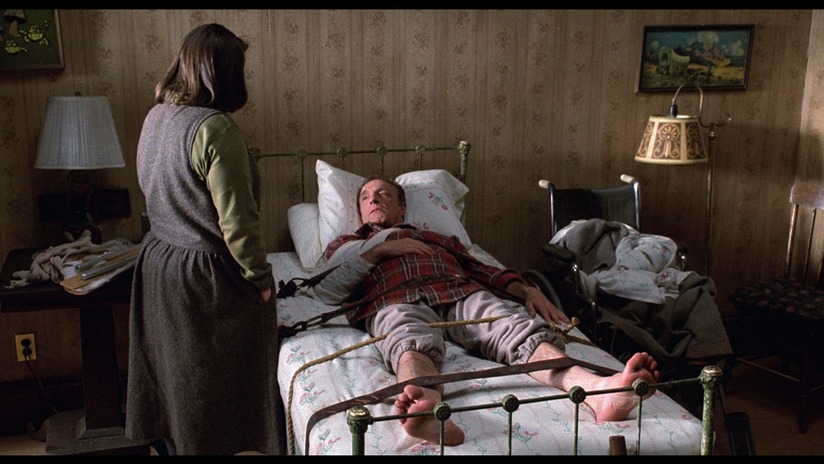
Annie is not completely evil. Early on, she shows us that she cares about victims as she could not have known that it was Paul Sheldon that she was rescuing from the car crash. Being his No.1 fan, as soon as she saw him, she knew precisely who he was and therefore her obsessive nature takes over. There is a moment that encapsulates one of the film’s themes that is often overlooked. Prior to caring for Paul, Annie takes his attache full of manuscripts and tucks it under her arm thus symbolizing that Paul’s work is more important than Paul’s life. But that doesn’t confirm her psychopathic nature. Even upon the more formal introduction of Annie, she shows us that she cares about Paul’s recovery as she crudely splints his broken legs. Why not take him to the hospital? Well, because she is his No.1 fan and no one can take care of him the way she can. She goes on to shower Paul with accolades. Claims to have read his Misery novels several times, even committing them to memory. Furthermore, she closely identifies with Misery Chastain (the series’ central character), so cares deeply what happens to her. Albeit being hospitalized in a stranger’s private residence is a little disconcerting, Paul grows to trust and even like Annie. He trusts her so much that he allows her to read the unpublished manuscript for the final Misery novel. And this is where things take a turn for the worse, Paul’s hospital is about to turn into a prison ran by the sinister warden from hell.
The plot of Misery works on multiple levels to generate the fear that it elicits from audiences. It’s a combination of exploring the effects of isolation on the mind and body, depicting various interpretations of captivity, and the overwhelming sense of dread that cruel intentions are lurking in the background of everything. And it’s not abstract feelings of isolation that Paul experiences, but he is literally isolated from the world due to being snowed in and downed phone lines. Despite being just outside of town, he may as well be on the moon. Without phone lines, Paul is cut off from anyone that is not Annie. Not only is Paul a prisoner of Annie’s house and his room (and eventually the bed specifically), but he is a psychological prisoner as well. He only has Annie to talk to, and he has to play her game or risk her violent mania. Failing to play her game, the role she would have him play, has grave consequences. And those grave consequences give way to the ominous sense of impending cruelty. Even before Annie completely loses it, Paul sees through the cracks in her homespun veneer, and what he sees terrifies him. I absolutely love Annie’s long drawn out monologue about the Kimberly Mines before she hobbles Paul. Paired with the creepy rendition of Moonlight Serenade, this scene plays out with methodic brilliance. The suspense of what is to come will make even the bravest crumble under the fear.
During Annie’s rage over the offensive swearing in the unpublished manuscript, she spills the hot soup on Paul and we begin to see the signs of her mania, twisted morals, paranoia, and negative effects of OCD. Obviously, we learn more about her psychopathy as the scenes unfold, but in retrospect, we witness the signs in big bold letters from this moment on. But she doesn’t continually behave in such a neurotic manner. She oscillates back and forth. This oscillation is an important aspect to her character because it drives up the tension and suspense because we don’t know when or where to expect her dangerous behavior. There are moments that we anticipate a violent outburst, but then she fools us by not delivering. By the same token, there are moments that we don’t expect it, and she terrifies us. The character trait of Annie’s that makes her one of the most terrifying in the Blockbuster of horror is her lack of feeling. Everything she does, she rationalizes without regard for quality of life or humankind. The very definition of sociopath.
The psycho-social disorders affecting the behavior and psychology of Annie are never confirmed, and don’t need to be. We don’t need to know precisely why or what causes Annie to behave the way she does. Because if we fully understood her, she would cease to be as nightmare-inducing as she is. It’s important that Annie Wilkes remain a type of Boogeyman. However, we can gather from the film that she suffers from a form schizotypal personality disorder, OCD (which I’ve mentioned), and meets most of the criteria of borderline personality disorder. A trifecta of disorders that creates the monster that we encounter in the film. She copes with these disorders by executing numerous defensive mechanisms including denial, projection, rationalization, regression, fantasy, and more. Whereas we often talk about her psychopathy and sociopathy, we often neglect to recognize her highly intelligent mind. Too bad her intelligence isn’t matched by empathy and and human kindness. Her intellect is observed through how she anticipates Paul’s movements and knowing when he’s been out of his room. And an intelligent villain is the most dangerous and unpredictable of all.
Aside from her disorders, unpredictable behavior, and lack of empathy, attributes that can be found in other horror villains, she stands out because she is a women. It’s her feminism that enables her to stand out against similar villains such as Norman Bates, Jack Torrance, Buffalo Bill and others. When we typically think of female characters or women in general (and I realize I am over-generalizing), we think of someone whom is kind, hospitable, nurturing, passive, and empathetic. Annie subverts those notions in so many ways, many of which have been outlined in this analysis. She makes Joan Crawford from Mommy Dearest look like Mrs. Brady. As out of control as Annie behaves, she is very much in control. She IS the one holding all the cards and calling the shots in this prison. While other characters (male or female) with similar disorders or backgrounds that parallel Annie’s have lost their minds, Annie knows precisely what she is doing, and is supremely strategic when she does it. We may be cheering when Paul finally kills her with the typewriter, in brilliant ironic fashion, but she is an incredibly strong female character who can hold her own, backs down to no one.
Not only is Misery one of the top psychological horror films ever made, but Annie is a noteworthy female character in the horror genre. While the final girls get most of the attention when we talk Women in Horror, it’s important to not forget that horror has given us terrifying women as well. Whereas so often the most interesting villains (or characters of opposition) get to be played by men, this film would not be as powerful is the roles were gender swapped. The fact that this psychopath is a women makes her all the more disturbing. She crafts such overwhelming sense of dread that is more frightening because we aren’t used to female characters as the main villains. Kathy Bates was a perfect choice for this role, and she has gone on to play all kinds of roles but the horror community gets extra excited when she plays a horror role. While horror doesn’t often win awards at the Oscars, Kathy Bates won the Academy Award for an actress in a leading role for her work in Misery.
Ryan teaches Film Studies and Screenwriting at the University of Tampa. If you like this article, check out the others and FOLLOW this blog! Interested in Ryan making a guest appearance on your podcast or contributing to your website? Send him a DM on Twitter or email him at RLTerry1@gmail.com! If you’re ever in Tampa or Orlando, feel free to catch a movie with him.






 R.L. Terry ReelView