“Nocturnal Animals” movie review

nocturnalanimalsA meta-thriller that is equally shocking, seductive, bizarre, and beautiful all at the same time. Tom Ford’s adaptation of the best-selling novel Tony and Susan (1993) will either repulse or intrigue you from the opening credit sequence. There is definitely a pronounced shock value in this cinematic erotic mystery that includes an incredible amount of symbolism and theming just eager to be interpreted and dissected. Not typically found in mainstream cinema, the avant-garde seems to be the inspiration for many films this year. Nocturnal Animals is one of those films that is destined for discussion in a film or media studies graduate class. With solid acting, writing, and cinematography, you will be sucked into this twisted mystery within the world that the wealthy live in and the real world that most of us live in. You will likely find yourself thinking about what everything means, how it might apply to you, or simply appreciate non-linear storytelling. Although the film certainly rests upon the flashback as a chief storytelling method, Ford plays his cards right and creates a film in which all three stories are equally interesting. You may have heard it said–even by me–that some good movies are poor films; but, this is a case of a good film but a poor movie. That is usually the case with films that fall into the artistic or avant-garde stylistic way of conducting a visual story that contains a strong emotional impact.

Susan Morrow (Amy Adams) is an incredibly successful art gallery owner in Los Angeles. However, the marriage to her second husband is not nearly as successful. He’s often away on business trips to New York. One evening, Susan receives a manuscript written by her first husband (Jake Gyllenhaal)–a once struggling writer and graduate student turned college professor and now professional author. She finds the novel gripping and disturbing. As she continues to pour over the pages dripping with intrigue, she is impacted on a personal level as she uses the world of the novel as a mirror on her own life. Taking her to dark places in her past, Susan finds herself on a path of self-evaluation as she is presently going through emotional and financially hard times.

Cognitive cinema. Focus Features’ Nocturnal Animals is one of those films that requires higher thinking in order to truly appreciate the symbolism and theming. Not that it cannot be enjoyed as a beautifully dark and disturbing story, but there is so much that can be analyzed in this film. From the sequence of obese nude females dancing with sparklers, ringmaster hats, and cheerleader regalia to the reoccurring imagery of crosses and death–both in terms of emotional and physical–director Tom Ford provides audiences with a film that can only be characterized as a mystery that is meta-thriller meets hints of erotica. Even now, I am analyzing the symbolism and theming as I write this review. There are so many elements to talk about. And I think that is the best part about a movie like this. Don’t watch it alone. Not because it is too intense or scary but because you will want to talk to someone about the theming or emotional commentary. I find myself with a deep desire to analyze the film with someone, but none of my friends or colleagues have seen it yet. Visually driven. Even without the dialog, Ford’s Nocturnal Animals can be understood through the imagery in and of itself. Trace amounts of Tom Ford’s legacy as a high fashion designer can easily be seen in the design of this film. And I am not just talking about Adams’ stunning wardrobe and hair/makeup. In many ways, this film–as a whole–is symbolic of high fashion clothing. It can be read in some of the same ways fashion is read and appreciated. Because this is only the second feature length film from Ford, there are elements of the story that give the impression that his talent for visual storytelling is still in the development process as there are times that his method of directing is that of an observant student or scholar of cinema.

There are three distinct narrative threads in this film. (1) is the main story that we open up to at the interpretive and conceptual art exhibit establishing Susan, her gallery, her husband, and lavish lifestyle (2) is the narrative of her first husband Edward Sheffield (Gyllenhaal)’s novel Nocturnal Animals and (3) is the story of the rise and fall of the relationship between Susan and Edward. Juggling three plots is no easy task. Contrary to how it may appear, the narratives are not confusing or incoherent. Each plays an important role in the overarching theme and story of the film. The incoherency is found in the interpretation and analysis of what everything means. It’s as if the film is providing the audience with puzzle pieces that can be arranged to depict something different for everyone. Perhaps you want to read the film as commentary on the relationship between Susan and Edward. Maybe you view it as symbolic of the estranged relationship between Susan and her current husband. Or maybe the novel is self-reflexive of the life Susan has created for herself.

Each story is stylized in such a way that they complement one another–do not necessarily correlate or match each other, but the narratives are complementary. Although the audience is asked to draw their own respective conclusions to the story, presumably Susan’s once lavish and charmed life will continue to rot and crumble as her husband is likely cheating on her just like she cheated on Edward. Still, there is a lot left up to interpretation in the best possible way. The Roger Ebert website review of this film commented that there are parallels between this film and Alice Through the Looking Glass. Fascinating take on this film. That is probably the best analogical interpretation of Nocturnal AnimalsLooking at the film in such a way that Susan is Alice and the two other narrative threads are her adventures in Wonderland opens a whole new window through which to view the events as they unfold. On the surface level, there is a clear theme of revenge woven throughout the plot. This is indicated by a painting that catches Susan’s attention on her way to a board meeting. The metaphysical thrilling aspect to the subplot of revenge is the revenge the past has on the present and the present on the past. In a manner of speaking, Susan is listed by ghosts of her past, present, and future. Okay, perhaps not in the same way Scrooge was visited, but there are certainly some commonalities.

If you enjoy films that make you think, then this is definitely one to watch! As it was on a limited release until this weekend, you may not have heard of it but look for it at your local movie theatre. Fans of Blue Velvet will likely enjoy this film as well. Intriguing writing, solid acting, and beautiful cinematography make this a fascinating movie to prompt deep discussions afterwards.

 

Disney’s “A Christmas Carol” (2009) movie review

d_a_christmas_carolAn exhilarating visual array of breathtaking motion-capture animation with a touch of the macabre! Disney’s A Christmas Carol directed by Robert Zemeckis is an outstanding adaptation of the literary classic. Instead of attending the cinema this week, with the box office offerings on the anemic side as we gear up for the bulk of Oscar season heavy hitters, I decided to rewatch Disney’s A Christmas Carol. Charles Dickens’ masterpieces have long sense been a source of inspiration for film adaptations of literature. Specifically, A Christmas Carol was actually one of the earliest films period–let alone adaptations. The first adaptation of A Christmas Carol was a British film in 1901 titled Marley’s Ghost. This classic work has been adapted for film, theatre, radio, and television more than 100 original/separate times, collectively. But why??? Why this novel? Quite possibly, this single work of literature has been brought to life for the stage, speaker, or screen more than any other with only a few possible exceptions. Perhaps, because it is simply timeless–transcends all generations. Writer-director Robert Zemeckis showcases his ability to put his spin on the timeless tale by perfecting the motion-capture animation techniques that made his adaptation of The Polar Express so visually stunning. Although Patrick Stewart’s Scrooge in the TNT original movie from 1999 is my favorite Scrooge, I feel strongly that Zemeckis’ film is closest adaptation to the spirit of the novel and brings it to life in the way Dickens himself may have imagined.

London may be anxiously awaiting the arrival of Christmas Day, but the old miser Ebenezer Scrooge (Jim Carrey) could not care any less. He much prefers the company of his money and micro-managing his humble clerk Bob Cratchit (Gary Oldman) at his counting house. After begrudgingly allowing Cratchit to have Christmas Day off, Scrooge heads home. Upon arrival to his stately but lonely townhouse, Scrooge encounters the ghost of his dead–and there is no doubt about that–business partner Jacob Marley (Oldman). In an effort to spare Scrooge his horrifying fate, Marley informs Scrooge that he will be listed by three spirits (Carrey). The ghosts of Christmas past, present, and yet to come respectively take Scrooge on a terrifying journey through his his life in hopes of transforming his selfish bitterness and embrace the selfless love and joy of Christmas.

Prior to analyzing this adaptation, as it is a story most of us know and cherish, I’d like to look at why. Why has this work of literature been adapted for nearly every storytelling medium? The short answer is that it is a story that is as relevant today as it was in the 1800s. Much like with his other masterpieces, Dickens captures so much about the human condition, in what amounts to a short story. The novel is not terribly long. With many in the U.S. feeling as though, much like in Dickens’ world, that we are being divided up into the rich and poor, this novel rings especially true. In fact, there are definitely high profile people in our economy echoing Scrooge’s words “have we no prisons; have we no work houses???” Not that we have a physical debters’ prison or work houses (in the old fashioned sense), but there are certainly elements of our society which parallel them. The story hits close to home for many. Furthermore, the novel, and subsequent adaptations, are regarded so highly because Dickens encapsulated every aspect by which mankind judges one another: past, present, and future. This is the foundation of a single person or people as a unit. Through Scrooge, Dickens shows us that if we look at our past, present, and future, then we can see the impact we have on those around us and even ourselves. By seeing how we really are, we can make the decisions to develop an approach to change ourselves to be about the business of mankind.

Interestingly, the ghosts show Scrooge how Christmas past was a time of magic (although it ended in heartbreak for Scrooge), Christmas present depicts how commercialism and greed have all but wiped out the magic with a glimmer of hope as shown by Cratchit and Fred, and Christmas yet to come shows Scrooge–and us–a world without the magic of Christmas: a world that we created. Another reason why this story is so powerful is because Dickens wrote the character of Scrooge to be a complex, multi-layered human who acts very much like a mirror to many of us. On the surface, he looks like a stereotypical old miser, but after looking into his past, we are given a glimpse of how he evolved–not unlike many of us. This story is also powerful for those who recognize the religious origins of Christmas or not. The focus of the story is on generosity, hospitality, love, compassion, as well as selfishness, greed, and sociopathy; but, it very much includes and makes reference to the religious underpinnings of this special time of year. Simply stated, this is a dynamic story of redemption that transcends generations of people.

Zemeckis’ adaptation is a beautiful usage of 3D storytelling technology. Ordinarily, I am not a fan of 3D movies, but this one is an exception for sure. I did not watch it in 3D last night, but I remember watching it in 3D when it came out in 2009 at the [then] Downtown Disney AMC. Zemeckis is one of few directors who knows how to use 3D effectively without it seeming like a gimmick. His use of 3D in A Christmas Carol greatly enhances the visceral appeal of the movie. One of the principle differences between this and other adaptations is just how supercharged it is with visual effects, intense chase scenes, and flying through the street of London. But, as Scrooge himself acknowledged, spirits can do anything–they’re spirits. Zemeckis does not hold back on the dark elements of the story. If you have read the novel, you will recognize that there are very dark parts. In many respects, A Christmas Carol is a supernatural horror film. After all, how else was Scrooge going be so scared that he would make a 180 and change his miserly ways???

It’s no surprise that Jim Carrey can be seen in the character of Scrooge; however, it is not as apparent that he is the infrastructure of the look of the characters he voiced, as was the case with Tom Hanks’ characters in Zemeckis’ The Polar Express. And this trend is even less apparent with Firth’s, Oldman’s, and Wright’s, respective characters. I love Zemeckis’ embrace of the macabre mood of the story. So often, adaptations of this story lose the very horrifying elements that absolutely terrify Scrooge. Although I remember hearing parents comment that this version was too scary for their kids, I think that having a version that is skewed towards teens and adults was important. Another great element in this film: the score! Alan Silvestri’s score sneaks in some traditional Christmas carols, but you have to listen for such as “God Rest Ye Merry, Gentlemen” when its distinctive cadences turn sinister during a perilous flight through London.

There are few Christmas movies that capture the spirit of the season better than A Christmas Carol. Zemeckis’ adaptation is my pick for best translation of page to screen. The cinematic excellence of Disney storytelling is woven throughout this film and makes for a thrilling journey. If you are planning to watch some Christmas movies this holiday season, I highly recommend this version of A Christmas Carol. But if you have very young children, it may be a little too scary for them. Whether you are young or young at heart, the magic of Christmas rings all too loudly in this timeless story brought to screen once again.

“Where are You Christmas?” A Review of “Jingle Bell, Jingle BAM” at Disney’s Hollywood Studios

img_7604One of my favorite times of the year at the Disney Parks is the holiday season. And not just November through December but September through October too. The autumn and winter holidays offer so much opportunity for seasonal offerings that make the Holidays a special time of year for friends, family, and lovers. Of all the holidays, Christmastime is the generally the highest attended and most looked forward to at the Disney Parks. Whereas Universal Studios Florida is the king with Busch Gardens Tampa Bay as Queen during Halloween, the big D is arguably king at Christmas–perhaps the Jingle King? Putting a Christmas spin on Pumpkin King. For years, hundreds of thousands of park guests flood the Disney Parks to enjoy everything from Cinderella’s Castle draped in icicle lights to Mickey’s Very Merry Christmas Party to the late Osborne Family Spectacle of Dancing Lights and even Holidays Around the World at Epcot’s World Showcase and Jingle Cruise (the holiday overlay at Jungle Cruise). Not to even mention the elaborate gingerbread houses and other creations at the Disney Resorts. Over the last few years, we have witnessed a slow mitigation of Holiday offerings. Most notably the Osborne Family Spectacle of Dancing Lights at Hollywood Studios (DHS) and Animal Kingdom’s Jingle Jungle Parade. Along with so many anxious park guests and Cast Members, I too was curious how DHS was going to adjust its Christmas offerings with the conspicuous absence of the Osborne Lights. Sunday night, I was finally able to watch the new Jingle Bell, Jingle BAM show at DHS, and if I had to sum up the experience in one word, it’d be a lukewarm “meh.” But as you know, I will provide you with many more words, haha…….

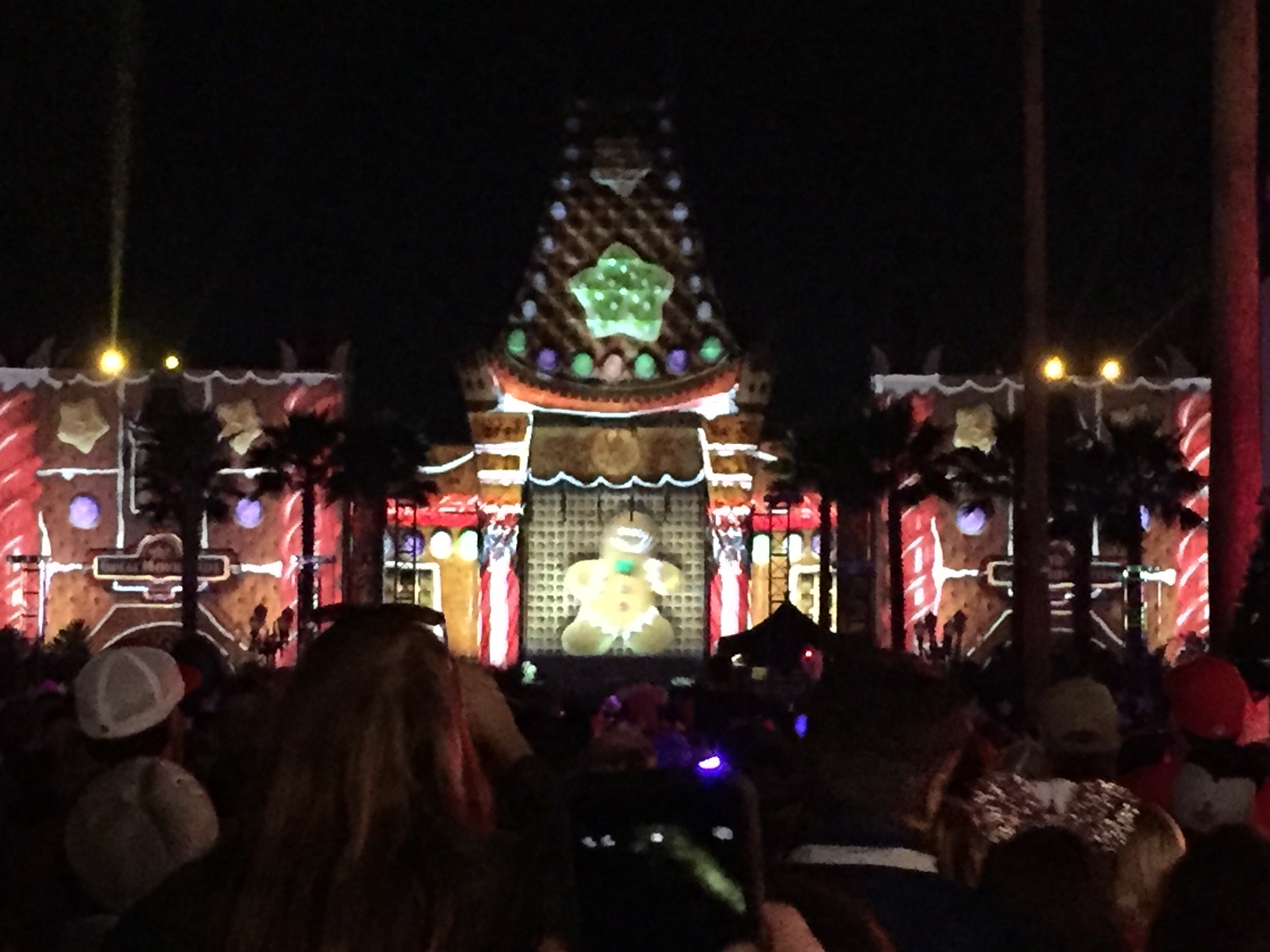
After the announcement of Jingle Bell, Jingle BAM as the special seasonal nighttime spectacular offering at DHS, I was still sad that there were no more dancing lights but I was looking forward to the new show and how it was going to play out. Taking place in the center of the park at the replica of the timeless Grauman’s Chinese Theatre serving as the show building for the opening day attraction The Great Movie Ride and icon of the park, Jingle Bell, Jingle BAM (Jingle BAM from hereon) is a colorful display of map projections, lasers, and pyrotechnics. Many of your favorite Disney and Pixar animated films are included as well as a sequence from Tim Burton’s The Nightmare Before Christmas. In addition to the familiar film clips, there is a loosely integrated narrative with Santa’s elves and then a message from the big man himself. Accompanying the outstanding map projections of gingerbread men, presents, snow, and other holiday iconic images are a vast array of lasers crisscrossing the sky adding an immersive effect to the courtyard and Hollywood Blvd. No nighttime spectacular at the Disney parks would be complete without pyrotechnics. Jingle BAM boasts a fantastic finale of fireworks that dazzle the sky.

For all the wonderful potential the show has, it unfortunately fails to leave even half the lasting impression that the Osborne Lights left in the hearts and minds of park guests for 20 years. There are a few key elements that contribute to the mediocre reception of Jingle BAM: (1) DHS is not designed/laid out for a nighttime hub show (2) narrative is weak (3) plays out very flat–lacks depth (4) the fireworks are nowhere close to being centered behind the Chinese Theatre (5) fails to elicit a positive emotional response from the park guests (6) Santa’s message is generic and forgettable and (7) there is very little “Christmas” to be found in the show, period. However, it’s not all bad. The show is an outstanding combination of programming, projection technology, and brilliant lasers. The lasers greatly enhance the experience when the snow falls along Hollywood Blvd. From a technical perspective, the show is an incredible spectacle of what happens when art and science are combined.

Unless you arrive one or more hours before showtime or purchase the special dinner/dessert package viewing area, you will quickly notice that your view is most likely obstructed by anything from palm trees, to tech booths, to light poles, shoppes, or even children on the shoulders of parents. Let’s face it, the latter is unavoidable. If you’ve ever been to DHS, you’ll remember that the courtyard in from of the stage in front of Great Movie Ride (GMR) is quite small. Possibly a 1/3 of the size of the one in front of the Tree of Life at Disney’s Animal Kingdom (DAK). So, there isn’t much physical space to work with when accommodating thousands of guests in the same location for a 15min show. Although Osborne Lights moved over the years, it was a staple to the local holiday celebrations, for sure, as well as those who would travel hundreds of miles. Very quickly, for those of you who do not know the history of Osborne Lights, the show was originally on Residential Street (a street of TV houses) until it was moved to its former location on Streets of America (production standing set). Families and friends could casually stroll through the millions of lights that danced every few minutes–synced to classic and contemporary holiday hits! No showtimes. Just continual twinkling and dancing from sunset to one hour after the park closed.

Much like the hub area, the backlot area was also unable to support the majority of the park guests at any one (1) time. So, the continual dancing was important because guests could attend at their leisure. Compounding the physical space dilemma, there are also new palm trees that were installed after the hat was removed, two giant towers that are tech/electrical/equipment booths for the “temporary” stage that sits where the hat was, and several light poles. Once you back up toward Hollywood Blvd, your view is also blocked by the other trees and shoppes. Unlike Magic Kingdom, which has a low grade incline from the train station to the castle, there is no incline from the entrance of DHS to GMR; therefore, the possibility of an obstructed view is greatly increased. Never mind that GMR is less than half the height of Cinderella’s Castle. Between the level surface from the entrance to GMR, the palm trees directly in front of GMR, and the tech booths blocking the view from Hollywood Blvd, it is clear that this park is not designed for a hub show. At least a hub show that runs only once. And you know what? There is little that can be done about the layout of the park. So. The Imagineers and entertainment leadership should recognize those shortcomings and develop a way that a decent view of the show is possible from the central area of the park.

I love the concept of storytelling–in all forms. So, naturally I was curious as to how a story was woven into Jingle BAM. Even now, I am attempting to piece together what the story was. Essentially, the elves are looking for Santa because he is missing. Turns out that he has been captured by Oogie Boogie from The Nightmare Before Christmas. After Boogie’s song number, Santa is rescued. Following Santa’s rescue, he has a message about friends and family. More specifically, he directs the message to the City of Orlando. But, it just doesn’t strike an emotional tone. It plays off as canned and generic. Tiny Tim’s closing remarks “God bless us, everyone” from Charles Dickens’ masterpiece A Christmas Carol packs much more meaning and impact. Interestingly, it is the other bookend and answer to the novel’s opening line “Marley was dead to begin with, there’s no doubt about that.” I think a holiday message about friends and family is very important, but this one just plays off as forced–like other elements of this show. There is definitely a story and message there, but it is weak. Perhaps it would have been more effective to include some holiday spirit or nostalgia in his closing remarks. I think the show would play out just as well–if not better–if the plot of rescuing Santa wasn’t present. Not that I think the show should be without a story, but the story should be more coherent. Stories, such as this one, should also attempt to elicit an emotional response from the audience but it does not extend its reach beyond the surface level.

The over all experience of the show lacked depth. It felt very flat–like a projected image, ironically enough. All surface level and spectacle but no substance. One of the major attractions to and benefits from Osborne Lights was the total immersion into a winter wonderland. Immersion is so incredibly important in themed entertainment. The Osborne Lights provided more than a show–an experience! Even more importantly than immersion is the concept of experiential attractions. And this was an experience like no other. Jingle BAM lacks these all too important elements of immersion and experience. Instead of experiencing the seasonal holiday offering, park guests watch as third party spectators. The only time it becomes mildly experiential is when the Florida snow begins to fall. One of the most important elements to the experience of the Osborne Lights was the park guests’ ability to go from spectator to participant. The transition from spectator to participant is a popular trend in themed entertainment attractions because it offers a much more visceral experience. But what about the other nighttime Disney shows??? Aren’t they more of a spectacle than experience? Short answer: yes. Wishes, Illuminations, Fantasmic, and the Tree of Life are all about the sheer spectacle of it all. And there’s nothing wrong with that…provided that is how it’s always been. However, Wishes is set apart because of the strong emotions the music and pyro evokes from the park guests. It truly is a magical experience. But the problem occurs when the park offers a participatory experience and replaces it with something more along the lines of a glorified short film.

Most Disney nighttime spectaculars offer a phenomenal dazzling array of pyrotechnics and fireworks. Keeping in line with the tradition of magical Disney fireworks, Jingle BAM also offers an impressive choreographed firework display and dynamic finale. Unfortunately, those fireworks are not behind the Chinese Theatre–not even close. The majority of the pyro and entire firework finale is way off stage left (house right). illuminating the sky above the Animation Courtyard, the fireworks cause the park guests to turn their heads 90-degrees (away from the center of the show). Although DHS would have to close the Pixar area during the Galactic Spectacular (Star Wars nighttime show) in order to keep guests safe from the falling debris, the fireworks shot off above the Chinese Theatre making for a phenomenal nighttime show that was truly spectacular whether you are a Star Wars fan or not. The show was incredibly impressive. With the fireworks way off to the side at Jingle BAM, it feels more like a distraction than the finale.

Lastly, the show simply does not have that holiday spirit. Other than Santa and a couple Christmas songs, the show has a very generic feel. So much so that, take away Santa and replace a few other elements and the show could silly be modified to run as part of daily operations. That certainly displays efficiency, but this is a seasonal offering during Christmastime and should feel special. Guests should have the impression that they cannot get this experience anywhere else. As it stands, this map projection show is not unlike the one at Magic Kingdom. Since Disney has two popular versions of A Christmas Carol as part of its IP, I was shocked that neither make appearances in the show. What is more Christmassy than the timeless classic??? The lack of Christmas music is compounded by the absence of Jack Skellington’s lyrics in the song What’s This? from The Nightmare Before Christmas. As part of the score for Jingle BAM, the accompaniment from What’s This? can be heard, but no lyrics. Although many people celebrate the holiday season differently and various elements are held more dearly than others, there should have been a mixture of classic and contemporary holiday hits to create a festive atmosphere. The magic of Christmas is very much lacking in this seasonal show. Where are you Christmas?

Over all, Jingle BAM is a cute show. Is it a replacement for the late Osborne Lights? No. Is it filled with holiday cheer? Not particularly. But perhaps this is the start of something that will grow to become nostalgic for guests that are just now experiencing the Disney parks for the first time. With map projection shows taking the place of more practical effect shows, we could simply we witnessing the next evolution of nighttime spectaculars at Walt Disney World. As I recognize the need to evolve and develop new ideas in order to keep the parks relevant to current generations, perhaps Disney Imagineers can find a way to combine both the Osborne Lights and the map projection concept in a new dynamic show–a new experience. In the short term, if Disney Imagineers could find a way to modify the current Jingle BAM to go from a one (1) showtime to something more continuous like the Tree of Life at Animal Kingdom, then that would quickly solve the physical space and adequate viewing dilemma.


“Allied” movie review

alliedQuite the duplicitous plot! Robert Zemeckis’ Allied released by Paramount Pictures is a thrilling tale of espionage and love. We have certainly seen a few different “spy” movies over the last couple of years; some more about espionage and others more about the drama that ensues afterwards. Fortunately, Allied feels like a genuine spy movie that actually contains espionage. The production design and costumes are a beautiful throwback to the fabulous 40s. You’ll find yourself reaching for a glass of champagne and swing dancing to Benny Goodman’s timeless big band jazz hit Sing, Sing, Sing. There is one city synonymous with WWII, espionage, and romance and you will appropriately return to that iconic city of Casablanca in Allied. This is definitely not a reimagined Casablanca but there are indirect references to that movie sprinkled throughout this new story. Films like this one require top notch talent, and both Brad Pitt and Marion Cotillard deliver outstanding performances to accompany this staple in film genres. Not limited to the love story between Pitt’s and Cotillard’s respective characters, the movie also includes some deadly shootout scenes and dangerously close encounters with the Nazis behind enemy lines.

Commander and intelligence officer Max Vatan (Pitt) is stationed in the famous city of Casablanca in French Morocco where he teams up with French resistance movement leader Marianne Beausejour (Cotillard). Impressed by her ability to so effectively blend in and create her authentic cover, Vatan soon finds himself falling in love with his partner. Following the assassination of a Nazi ambassador, Beausejour and Vatan flee to London to start their life together. Everything is going beautifully for the happy couple in their second year of marriage with a child when Vatan’s superiors confront him with the suspicion that Marianne is in fact a Nazi spy. Refusing to believe it to be true, Max must now conduct his own investigation into his wife’s history to protect the ones he loves so dearly.

I absolutely adored the look and feel of the film as it echoes the era of the Golden Age of Hollywood. Although this movie plays off a tad listless as a result of failing to elicit a strong emotional response from the audience, it is not without it outstanding elements. It benefits from solid acting and beautiful cinematography as well as some fantastic symbolism. Robert Zemeckis’ talent for visual storytelling is clearly visible in this period film. The weakness in the ability to successfully leave a lasting emotional impact on the audience is in the writing and executive producership of Steven Knight (Eastern Promises). For films that are not as much about the spectacle as they are the drama between characters and the challenges faced therein, it is vitally important that the personal/interpersonal relationships transcend the screen and directly impact the audience. All the makings were there for a deeply moving cinematic story, but it just doesn’t quite make that transition from the mostly superficial and distant.

Mirror, mirror, on the wall…(interesting fun fact: this misquoted line from Snow White is actually “magic mirror on the wall”). But, I digress. The strategic use of mirrors is an  incredible use of visual storytelling and symbolism. For those who have studied film or literary rhetoric, the mirror is a classic means of conveying duplicity (two sides, faces, etc of a character). Even without knowing that this was a spy movie, I would have been able to infer that from how the mirrors are shot and placed within the composition of the 24 frames a second. When using powerful symbolism as part of the visual story, it conveys so much more meaning in a scene than words could actually describe. Mirrors have long sense been a powerful metaphor even before moving pictures. But motion pictures allow for a greater use of the importance it plays in a cinematic story. Not limited to duplicity, mirrors can also be used as a metaphor for self-reflection. Whether talking duplicity or reflection, the mirror aids in conveying so much to the audience in this movie.

Ordinarily, I am not a fan of classic films getting remakes; however, there are always exceptions when the core or essence of the film is held in tact but the production design, direction, and cinematography are brought up to speed with contemporary cinema. If you’re a fan of WWII era films or the timelsss spy movie, then you will definitely enjoy Allied. After witnessing the significance of Casablanca in this movie, I am actually looking forward to a remake if there ever is one. Provided. That the overall look and feel of the movie is in line with classical motion picture storytelling. I could definitely see Robert Zemeckis directing a remake of Casablanca. Occasionally there are directors who can strike the balance between a classic tale told through contemporary technology, and Zemeckis definitely struck that balance in Allied.

Don’t allow the weak writing to dissuade you from watching it; there is actually a lot to enjoy in this film. After the slow burn during the first act, acts II and III are full of intrigue and suspense.

Cinecittà World & Movie Park Germany: Placing Guests in the Magic of Movie Making

cinecittaworld1The overall theme of movie-based theme parks has gone from exposure and education to simulation and immersion—much more experiential. Instead of seeing how Harry Pottermovies are made, guests at Universal Studios (FL and CA) and other studio-parks want to feel like they are Harry and his friends. And, this is not something that could be achieved by the former models of the original concepts for Universal Studios Parks or Disney’s Hollywood Studios. So, the parks have to change in order to remain relevant and viable tourist destinations. Concurrently, movie and television studios are going through their own evolutionary process. In many ways, a careful examination of modern cinema compared to its predecessors reveals that storytelling has been removed from its pedestal to play second fiddle to salesmanship.

Spectacle and visceral thrills are the principal drive for the modern (1990s-present) cinema-based theme park attractions; and, for some, they confirm the worst tendencies identified within the Hollywood blockbuster: the epitome of apparently vacuous rollercoaster experiences. According to researcher Geoff King, “the label ‘thrill ride’ is a term often used approvingly in Hollywood publicity and by some film reviewers in the press, presumably because a thrill ride is precisely what many viewers want from modern cinema.” The late 1980s and the 1990s saw the arrival of theme park attractions that claim to allow the park guest to ride the movies; movies became theme park attractions. But now, theme park attractions are inspiring films. Beyond being the inspiration for films, the idea of being able to market a horror, action, or epic film or film franchise or the ability to create themed attractions from the narrative is at the forefront of studio executives’ minds, as cross-promotion is an important financial strategy.

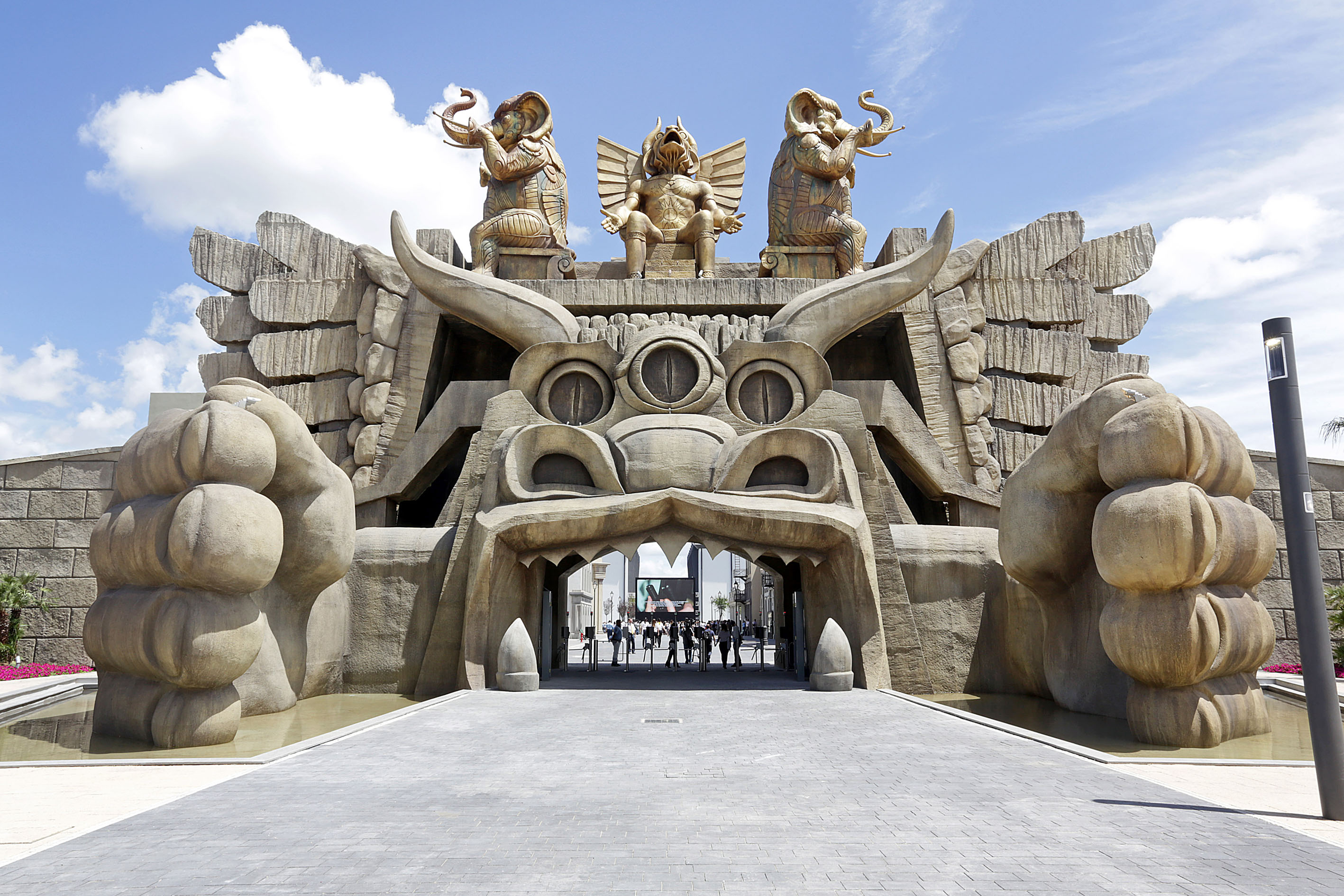
Creating attractions from cinema is not unique to the United States. The former Italian cinema powerhouse, from the early to mid twentieth century, Cinecittá Studios, known as the “Hollywood on the Tiber” is following suit with its American counterparts and converting the production lot(s) into a movie-based theme park. Located outside Rome, Cinecittá Studios, Italian for “Cinema City,” opened its gates in 2014 to the public to experience the magic of movies on this side of the screen. President of Cinecitta World Emmanuel Gout states, “Here, the idea is that people will also enter not only sets, but the confusion of a place where we are shooting movie. Everything will be illusion…the visitor will become a protagonist of the day, becoming a star, becoming involved in some fake movie.”

The model of this theme park appears to be more reminiscent of how the classic American movie-based theme parks were setup; however, there is one big difference. At the new Cinecitta Studios (theme park), park guests will actually don costumes and take hold of props to act in scenes from movies. So, in many ways, this park differs from its American counterparts because it is not defaulting to digital simulations and special visual effects; instead, it’s using practical technologies to create the illusion that the guest is actually on the set in the movie as a character in a given scene. Still, three-time Academy Award® winning production designer Dante Ferretti knows that audiences and guests want more than an immersive experience into movies, but want thrills as well. So, there are rollercoasters and water slides, amidst Roman and Egyptian ruins, to accommodate those guests seeking more conventional amusement park attractions.

Away from hustle and bustle and bright lights of Hollywood, past the palm treelined streets and white sand beaches of Florida, and beyond the Roman ruins on a century-old Italian studio lot is another example of the convergence of cinema and theme parks. Movie Park Germany is a cinema-based theme park in Bottrop-Kirchhellen. It “is a unique theme park, which is devoted entirely to movies. The former Warner Bros Movie World has six theme areas and more than 40 attractions and shows. It will not take long before you feel like a movie star or cartoon hero!.”

Much in the vein of Universal Studios Florida, Movie Park Germany blends both the benefits of an amusement park with movie-based themes throughout the whole park. Its motto is “Wow! I’m in the Movies.” According to the website, “Our visitors will not only have the opportunity to meet well-known series Heroes but also get to enjoy first class entertainment like an action-packed stunt show as well as two song and dance shows. For those guests who like it a bit more spooky, the park transforms itself at sunset into an extraordinaire chamber of horrors. In short: There’s a personal highlight for everyone!.” Unlike Universal Studios parks which have a Halloween theme for two months a year, Movie Park Germany holds on to the very cinema theory that birthed out of Germany and found its way to Hollywood—German Expressionism. Some of the first movies were horror movies, and it is refreshing to see that this park is holding on to its horror heritage throughout the year.

Although many theme park enthusiasts first think of Florida and California, it is clear that there are many beautifully conceived and designed parks all around the world that are just beckoning for adventure to be had.