
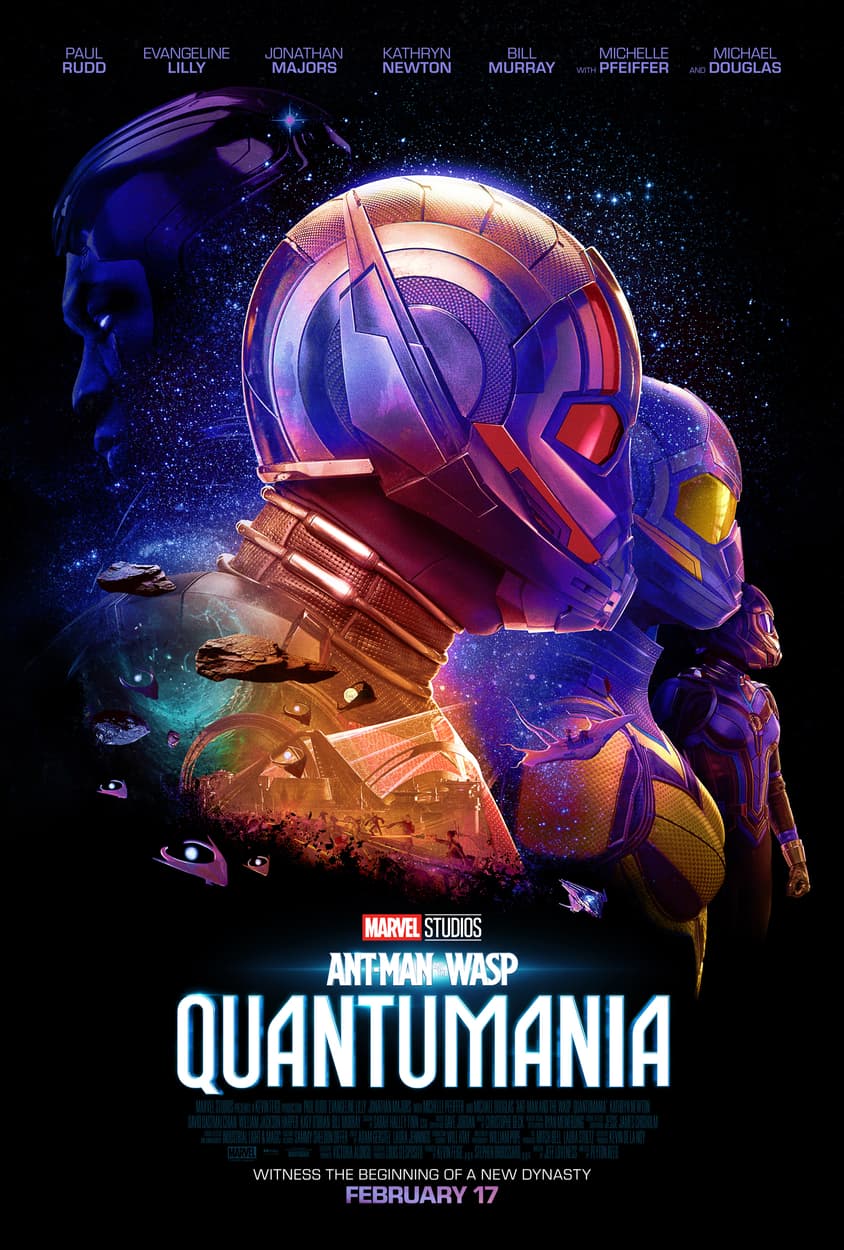
ANT-MAN AND THE WASP: QUANTUMANIA movie review

Entertaining and world-building. Phase 5 of the Marvel Cinematic Universe launches with Disney-Marvel’s Ant-Man and the Wasp: Quantumania (AWQ). This (paint-by-numbers) adventure of epic proportions benefits from a small central cast, which allows for effective character arcs and development. Furthermore, the central cast is elevated to near purrrrrrfection with the incomparable Michelle Pfeiffer’s significant screen presence as the original Wasp Janet Van Dyne. For someone that can take or leave the MCU, simply knowing that Michelle Pfeiffer is in a pivotal role, is enough to get me to watch. Perhaps that is also like you. While this is not her first time returning to the superhero genre (first did it in Ant-Man and the Wasp), this is the first time that she is front and center, giving hope that we may yet still see Pfeiffer return to her career-defining role as the definitive Catwoman.

Ant-Man and the Wasp find themselves exploring the Quantum Realm, interacting with strange new creatures and embarking on an adventure that pushes them beyond the limits of what they thought was possible.

The latest installment in the MCU mostly functions as a standalone movie, but there is clearly world building to lay the piping for Phase 5. Now, I do not follow the comics nor have seen any of the TV shows, and I was able to follow sufficiently enough, which means that anyone that has seen the MCU theatrical movies will have sufficient knowledge to follow the journey. Yes, the visual effects are expertly generated by graphics engineers, but I am seldom impressed by entire worlds that exist within the confines of a computer. There is very little real set design, which mitigates the ability to become immersed in the Quantum realm. AWQ represents what happens when a single media conglomerate owns both Marvel and Star Wars because this movie feel like the combination of Star Wars and Avengers. There is even a scene right out of the cantina on Tatooine. To the superhero movie’s credit, the plot is simple and the characters complex, so it receives high marks for screenwriting mechanics.

Par for the Disney course these days, there cannot possibly be a movie released without a dose of the cynical worldview of applied postmodernism. For AWQ, this dose comes in the first sequence of scenes following the prologue. Cassie is in jail for antagonizing law enforcement that (we are told) launched tear gas into a (we are told) peaceful protest. This serves little to no purpose, and most certainly has no bearing on the plot; therefore, it was in there simply to check off a virtue signaling box. I can see what they were trying to do–trying to show that Cassie has the early signs of going down her father’s path of delinquent behavior. If Disney-Marvel wanted this to be more poetic and elicit greater empathy from the audience, then Cassie should have been shown engaging in petty crime not activism. This would have demonstrated that Scott’s lack of engagement as a parents (due to his personal brand and professional pursuits) has had a negative impact on Cassie’s development. Furthermore, this would have provided for a greater character arc when she in instrumental in saving the universe.

What a fantastic cast!! Cast highlights include (as mentioned earlier) Michelle Pfeiffer, Michael Douglas, and a surprise cameo from Bill Murray! This otherwise paint-by-numbers superhero movie is elevated by the contributions of these exemplary actors. Even if you don’t see all the MCU movies, I highly recommend the Ant-Man movies because they are far more character-driven than the others, and the small central cast benefits from time and attention paid to their respective interpersonal journeys that provide depth to the high concept plot. For the most part, the running theme of the Ant-Man movies generally revolves around the idea of fatherhood and (by extension) parenting.

If MCU fans were looking for their next big bad, then they will find the new archenemy bent on the destruction of the known universe, without going into spoilerific details, I can say that this new villain makes Thanos look like Bowser from the Mario games, with King Koopa being our newest main villain. Be sure to stay for both the mid and post-credit scenes as they raise the stakes to exponential levels.

If you’re looking for a fun movie that you can just kick back and enjoy, then this may be your ticket. I highly recommend watching it in a premium format (such as IMAX, Dolby, or XD) because the CGI sets will shine best with the best sound and screen at your local movie theatre.
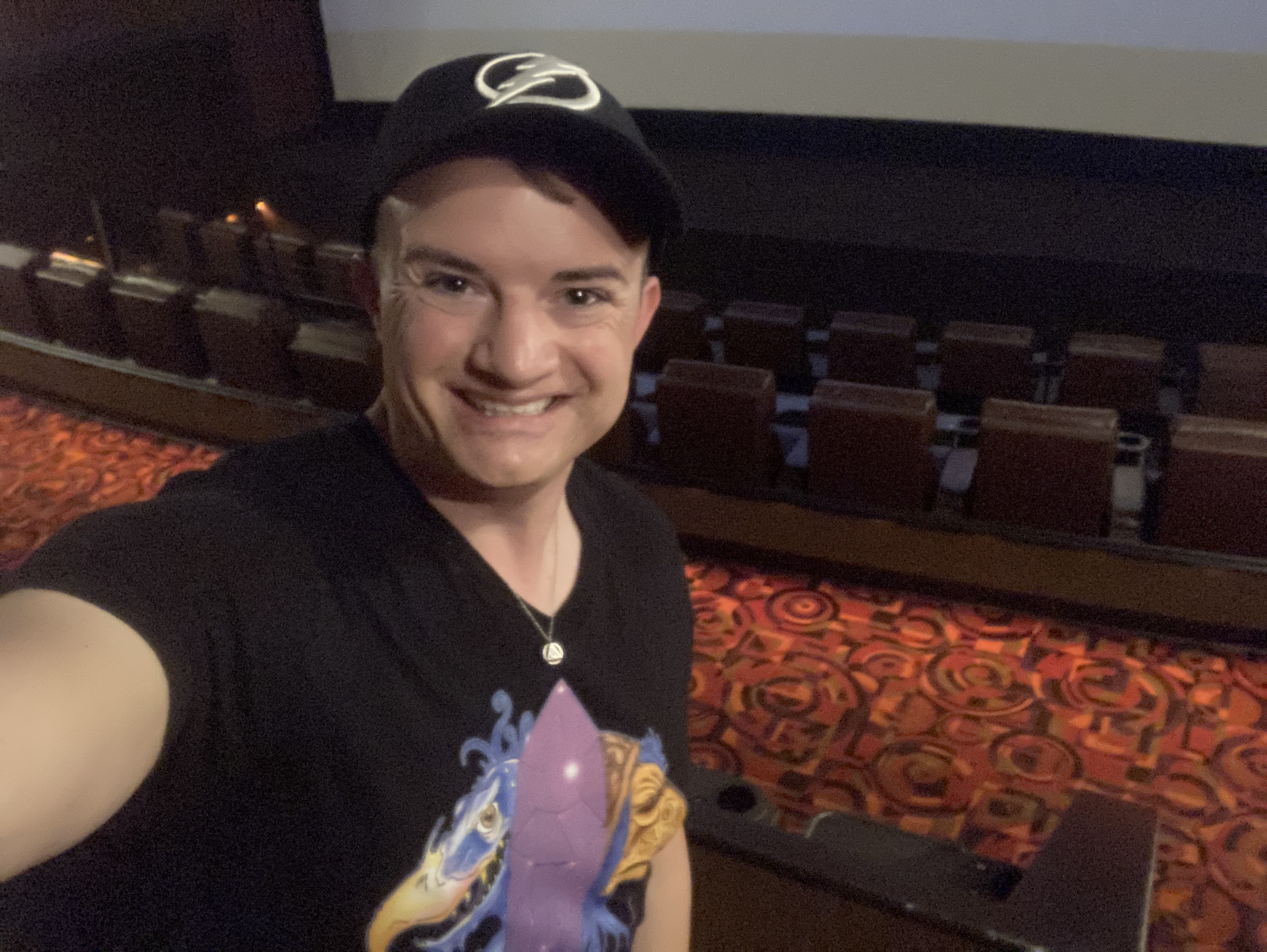
Ryan teaches Film Studies and Screenwriting at the University of Tampa and is a member of the Critics Association of Central Florida and Indie Film Critics of America. If you like this article, check out the others and FOLLOW this blog! Interested in Ryan making a guest appearance on your podcast or contributing to your website? Send him a DM on Twitter. If you’re ever in Tampa or Orlando, feel free to catch a movie with him.
Follow him on Twitter: RLTerry1 and LetterBoxd: RLTerry

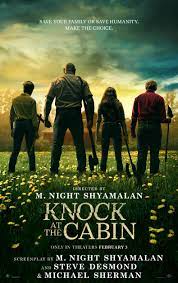
KNOCK AT THE CABIN movie review

Knock on a different cabin. M.Night Shyamalan’s latest horror film Knock at the Cabin attempts to explore thoughtful themes but the storytelling is clunky due to the poor plotting and contrived character development. Moreover, this is a case wherein film form is employed as a tool to compensate for underdeveloped meaning and story structure. Where the film excels is in the characters and casting. Yes, the character development is contrived, but I appreciate Shyamalan’s character mix. In particular, it’s a refreshing mix because the fact the parents are a same-sex couple doesn’t factor heavily into the plot nor become a sermon, like it so often does. It simply is and that’s it. Furthermore, the casting of not only the central parental couple, but all of the characters shines because of the realistic representation of everyman. Bautista is provided a platform to portray a much different character than he has in the past, which is fantastic to witness! He is given an conduit through which he can more freely exercise his acting chops. Visually, the film is striking; there is an emotive dimension to the montage of the motion picture and the cinematography. Again, the film form is outstanding! Unfortunately, the screenplay is lacking the same degree of thought that was found in the technical approach to crafting this film.

While vacationing at a remote cabin in the woods, a young girl and her parents are taken hostage by four armed strangers who demand they make an unthinkable choice to avert the apocalypse. Confused, scared and with limited access to the outside world, the family must decide what they believe before all is lost.

Knock at the Cabin excels in montage and cinematography because of how the eye of the camera oscillates between subjective and objective placement, much in the same way our own eye (and mind’s eye) operates in real life. Treating the camera as our own eyes allows Shyamalan a brilliant opportunity to bring the audience into the narrative. Unfortunately, this is hampered by the clunky storytelling. However, because of the stylistic choices for camera placement and scene framing, the film is successful in delivering an unsettling mood and suspense with the camera (in a Hitchcockian manner). Furthermore, the film proves to be exemplary in the area of montage (or dramatic film assembly) demonstrated by the stylistic choices that provide the film with steady pacing and guiding our focus from character to character or scene to scene. While the story may be lacking refinement, the editing crafts a visual narrative that is lean and mean.

Struggling narratively, the film fails to sufficiently provide thoughtful critique (or commentary) on any area on which it concerns itself. I don’t mean to sound vague, but to discuss the themes, symbolism, or commentary would require me to divulge spoilers. What I can say, without getting into spoilers, is that there is an attempt to critique: preconceived opinions or judgments of people, willful disbelief in the face of evidence, and toxic ideologies. I appreciate what Shyamalan set out to accomplish; it’s clear that this film was supposed to be a vessel to foster conversations about the themes and subtext, but no single area of theme or subtext was setup or developed adequately. We receive glimpses in the dots Shyamalan attempted to connect, but they are glimpses at best. Flashbacks are used as a tool to provide clarity on present conflicts, but that (often abused) storytelling tool is wielded ineffectively and wastefully.

Ryan teaches Film Studies and Screenwriting at the University of Tampa and is a member of the Critics Association of Central Florida and Indie Film Critics of America. If you like this article, check out the others and FOLLOW this blog! Interested in Ryan making a guest appearance on your podcast or contributing to your website? Send him a DM on Twitter. If you’re ever in Tampa or Orlando, feel free to catch a movie with him.
Follow him on Twitter: RLTerry1 and LetterBoxd: RLTerry

80 FOR BRADY movie review

Surprisingly gr80! (Okay, I’ll see myself out now, haha). No, seriously, 80 for Brady is way better than it had any right to be. That’s not to say I expected it to be bad–quite the contrary–I expected it to be cute and mildly entertaining. But in a twist (much like the showdown in the movie), it delivered a terrific, highly entertaining story with heart in the vein of 9 to 5 and Barb and Star Go to Vista Del Mar. One could even liken it to a feature length episode of The Golden Girls. And you know what? It’s inspired by a true story!

Four best friends live life to the fullest when they embark on a wild trip to see their hero, Tom Brady, play in the 2017 Super Bowl.

In a cinematic landscape of bloated, poorly paced, or intentionally pretentious films, 80 for Brady is a refreshing respite from the proliferation of 2.5+ hour pictures that so often forget simple plot, complex characters. The plot for 80 for Brady is simple, but the cast makes this one that will earn rewatches for years to come. While there is much to praise, the movie is not without its diegetic shortcomings. Where the movie could have been stronger is in the stakes and crises. The stakes and never quite high enough, despite some heavy material or consequences being hinted at, and the crises are never hopeless enough. There should always be that moment or two in which it looks as if the central characters are going to lose or the movie depicts them going to extraordinary or painstaking lengths to achieve the goal. In other words, the fabulous ensemble cast of characters needed greater opposition between them and their goal.

At the screening I attended, there was an audience member that was over 100 years old and she and her friends from the retirement home just had to see this movie! In fact, they are Tom Brady and Rob Gronkowski fangirls. Many of them has not been to a movie theatre in decades. But this movie inspired them to enjoy the cinematic experience once again.

Ryan teaches Film Studies and Screenwriting at the University of Tampa and is a member of the Critics Association of Central Florida and Indie Film Critics of America. If you like this article, check out the others and FOLLOW this blog! Interested in Ryan making a guest appearance on your podcast or contributing to your website? Send him a DM on Twitter. If you’re ever in Tampa or Orlando, feel free to catch a movie with him.

Follow him on Twitter: RLTerry1 and LetterBoxd: RLTerry

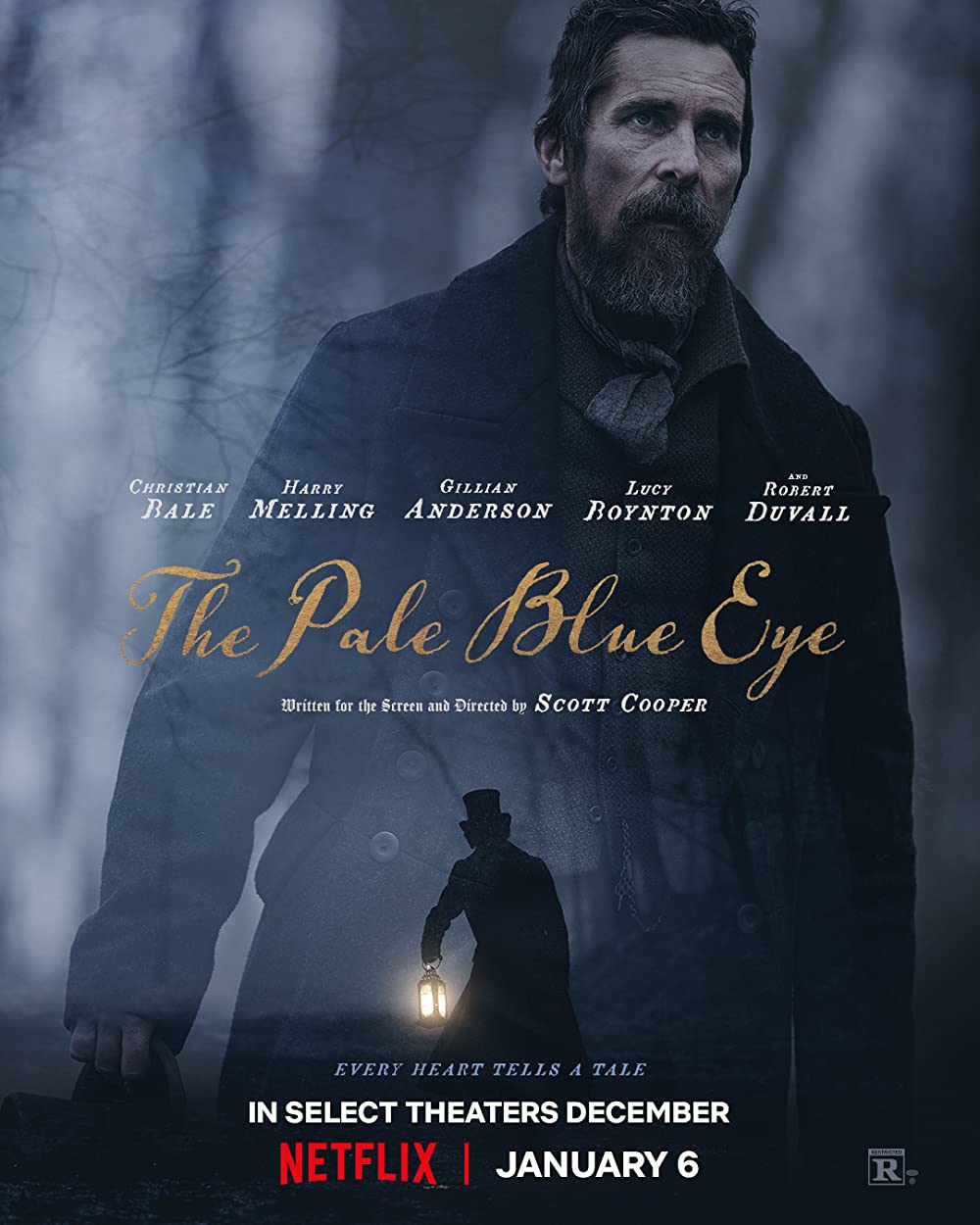
THE PALE BLUE EYE period mystery review

The unsettling atmosphere will transport, while the macabre mystery intrigues. Scott Cooper’s The Pale Blue Eye is both a period murder-mystery drama and serves as an imaginative origin story for Edgar Allan Poe. With skeletons in every character’s closet, the enigma of a mystery will beckon audiences to solve the mystery along with Christian Bale’s character. Based on the novel by the same name, the film adaptation is in the same vein as The Cursed from earlier this year and Antlers from last year. Both of which are among my favorites of the last two years. So, if you liked either of those films, you will mostly likely enjoy this one as well. In addition to the aforementioned, the film also reminds me a little of Tim Burton’s Sleepy Hollow (1999). Unlike the film’s to which I have likened this one, The Pale Blue Eye is heavier on mystery than it is horror. While Edgar Allan Poe’s short stories and poems have been the inspiration for hundreds of films, and his writing itself, foundational in the development of the American Horror Film (expressionism+surrealism+Freud+Poe), this is one of few films that feature Poe himself–or rather–a fictionalized version of the towering literary figure. What I appreciate about this imaginative origin story is showing a different side to Poe–a side that is actually funny and quirky. Because this is a mystery, I am unable to discuss details as that could spoil important plot points. But it’s important to note that this film’s mise-en-scene strikes a balance between one that is concerned with atmosphere and proper plotting. So often, films that are heavy on atmosphere are lacking in the story-structure department, but not this one. Despite the runtime of 2-hours, no scene ever lingers too long. If you enjoy period murder-mysteries, then you’ll undoubtedly enjoy this film. The Pale Blue Eye hits cinemas on December 23rd and Netflix on January 6th.

Ryan teaches Film Studies and Screenwriting at the University of Tampa and is a member of the Critics Association of Central Florida. If you like this article, check out the others and FOLLOW this blog! Interested in Ryan making a guest appearance on your podcast or contributing to your website? Send him a DM on Twitter. If you’re ever in Tampa or Orlando, feel free to catch a movie with him.

Follow him on Twitter: RLTerry1

BABYLON (2022) film review

Whoa, that’s a lot of movie. Damien Chazelle’s decadent film of bombastic proportions is simultaneously mesmerizing and repulsive, coherent and incoherent, thoughtful and thoughtless. Suffice it to say, it’s interesting to behold. This overstuffed fever dream collage of 1920s and 1930s Hollywood is trying to tell so many stories, that it winds up not telling any of them effectively enough. There are competing A-stories (outside/action plots), each vying for to be the story about which the audience empathizes with the most. To dramatize these ideas, Chazelle assembles a mise-en-scene that’s ostensibly a combination of Singin’ in the Rain, Boogie Nights, Sunset Boulevard, and Once Upon a Time in Hollywood, with a little Caligula and Wolf of Wall Street thrown in to provocative proportions. Ultimately, what we have here is more of an exercise in montage–the assembly of a motion picture–more so than we have a clearly defined narrative. Undoubtedly, this will become a film that is shown in film studies classes in the future, and will be used for close reading discussions, much like I show Boogie Nights in my American Cinema class. There is a prolific amount of imagery to analyze, as the film follows four different Hollywood stories that all intersect one another. Just for whom was the film created? Certainly not general audiences. It is likely going to be most appreciated by Chazelle himself and with some critics and scholars (tho, not this scholar nor the majority of the critics with whom I screened this film).

Decadence, depravity, and outrageous excess lead to the rise and fall of several ambitious dreamers in 1920s Hollywood.

One thing is clear, Chazelle’s intention was to craft a boisterous love letter to the allure and power of cinema whilst negatively critiquing the Hollywood system that creates and destroys careers on a whim. Furthermore, the film seeks to provide thoughtful commentary (just how thoughtful? that is for you to decide) on the superficial, fleeting nature of fame and celebrity. Where the film excels is in the both the performative dimension and Chazelle’s direction. Unfortunately, Chazelle’s screenplay is all over the place.

While audiences may not remember the four individual story threads that make up the outside/action plot, audiences will definitely remember the prologue and final scene. Chazelle certainly captures the unbridled decadence that is probably not unlike the level of debauchery that ran rampant after the great movie people migration from Europe (mostly Germany and France) and eastern U.S. (avoiding Edison’s motion picture patent policing) after the first World War. It was certainly the wild west with a seemingly unending source of money (coupled with massive debt). To borrow from Outback’s former slogan no rules, just right, that describes the atmosphere of the greater Los Angeles area. No order, only chaos. Which is not unlike this film–lots of chaotic images and plot points.

The prologue to Babylon is truly a spectacle that words simply cannot capture accurately. That’s not to say that all of the creative decisions were plot or character-driven–I’ve said it before–that even provocative imagery can be used to further the plot or character; and therefore, that which would otherwise be evaluated as gratuitous, is actually purposeful. However, much of what goes on in the opening scenes is simply gratuitous for the sake of shocking the audience–for an extended period of runtime. I am reminded of the opening to Boogie Nights, and how at first glance it may seem gratuitous, but actually the opening scene is needed for plot and character development. It’s not so much shocking as it is crafted for a strategic purpose.

While elements of the prologue are justifiable, in the relationship to plot and character, there are many moments that are no more than prolific debauchery simply because Chazelle could. Now, what I did find most interesting–and to the point that I greatly appreciate the prologue–is that much of the deplorable chaos is underscored by the score from Fritz Lang’s masterpiece Metropolis in the Babylon scene with MechaMaria. Something Chazelle wove into the scene for the film scholars in the crowd.

Jumping to the end of the film, there is a–what amounts to a–clip show featuring iconic films from the 100+ years of cinema history we have. I get it, Chazelle is communicating to audiences that being part of filmmaking means that you’re part of something bigger than yourself, something that will live on decades and (by extension) centuries after you pass away. It’s this artform that will continually be rediscovered and influence people and cultures (good, bad, or indifferent). While it’s clearly designed to be an emotionally moving moment in the film, as indicated by the tears in the character in that scene, it comes off as lazy, derivative montage that does little more than remind the audience of better films for the rather long sequence of imagery. Instead of being a deeply, moving scene, it’s rather vapid.

The four competing A-stories depict four different (but not too dissimilar in substance) Hollywood stories. (1) an A-list star that feels the pain as he watches his star fade with changing times (2) An up and comer that is thrust into the spotlight for a brief time, just to continue to fall due to tragic flaws and a talent that simply didn’t transition to talkies (3) an immensely talented individual subject to the prejudices of the general public and Hollywood executives and (4) and an animal wrangler turned studio executive by being in the right place at the right time, but even that level of fame and success is not invincible to human error and poor judgment. Any one of these stories would have made for a great A-story, with others falling in line thereafter. But each one of them feels like it’s vying for the main outside/action story. This is where Chazelle should have worked with a screenwriter that could have taken his concepts and ideas, and fashioned them into a much better structured and plotted narrative.

Perhaps it’s a film ahead of its time, or perhaps, it truly is the Heavens Gate of 2022. Maybe it will see success on down the road like Boogie Nights and Showgirls has, but only time will tell. Presently, it’s a wild, bloated film that lacks basic storytelling.

Ryan teaches Film Studies and Screenwriting at the University of Tampa and is a member of the Critics Association of Central Florida. If you like this article, check out the others and FOLLOW this blog! Interested in Ryan making a guest appearance on your podcast or contributing to your website? Send him a DM on Twitter. If you’re ever in Tampa or Orlando, feel free to catch a movie with him.

Follow him on Twitter: RLTerry1