
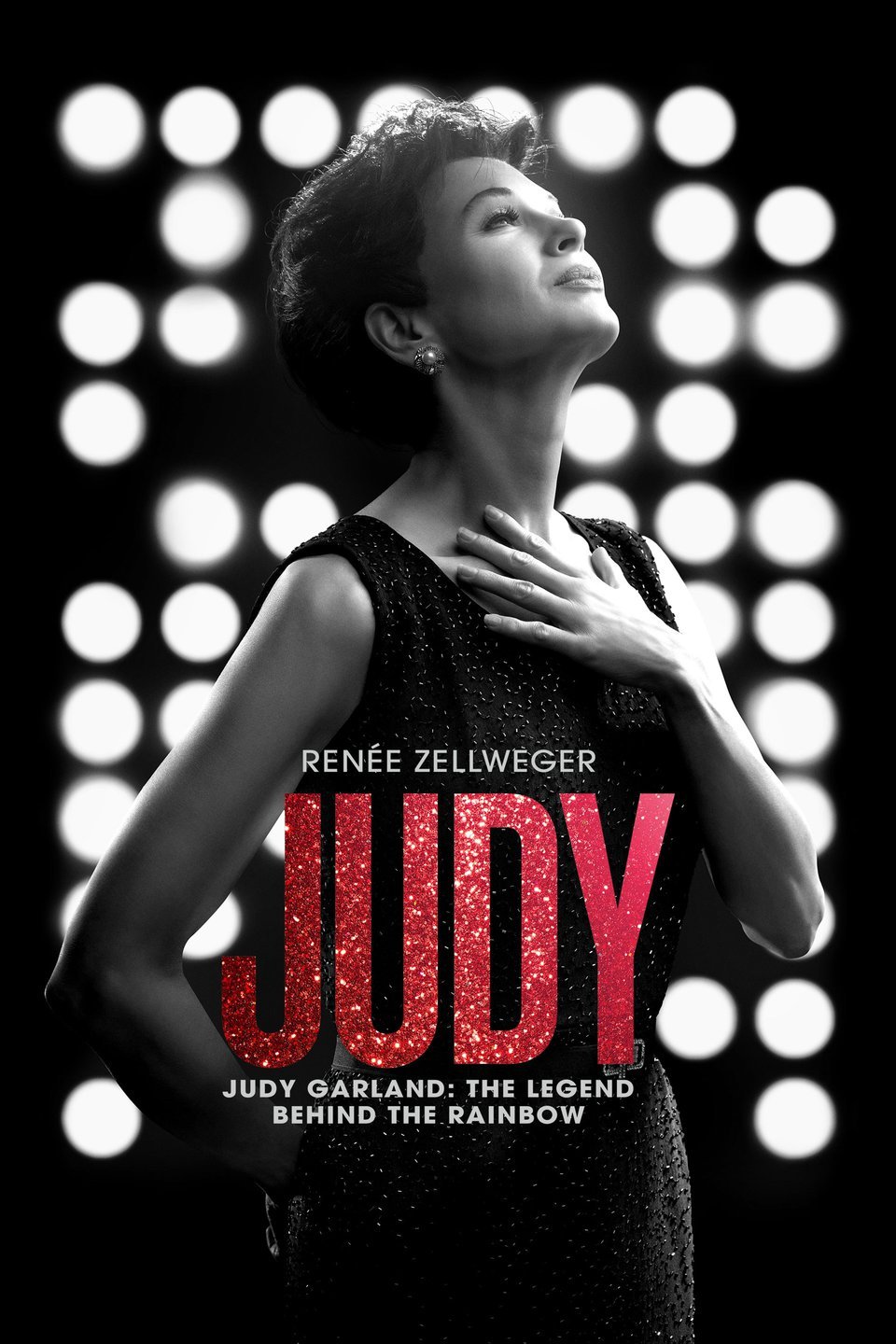
“JUDY” Biopic Film Review

A truly gripping motion picture that will bring you to tears during this somewhere over the rainbow redemption story. Bring tissues. Renee Zellweger is captivating as Judy Garland, and you’ll swear that you’re watching Garland on the big screen. Although we may be familiar with the broad strokes career of the legendary entertainer, this film goes beyond the headlines and tabloids to deliver a true life story that could ironically be titled A Star is Born, or perhaps reborn. Ironic in that this film shows the life of a movie star after the lights have faded and the offers stop coming in, much like the movie she starred in. It’s a rise and fall story, of sorts, but is more precisely a fall and rise story as the movie focusses in on the last year of Judy Garland’s life. If you are worried that the film ends on her death, you can be relived that the film chooses to stop the story prior to the end of the iconic star’s life. And it works so incredibly well! While there are many movies (not unlike A Star is Born) that focus on the rise and fall of a talent in showbusiness, this movie skips all the glitz and glamor to paint a realistic portrait of what it is like for those whom grow up in front of the camera, controlled by those around them, just to wind up in front of booing crowds, empty bank accounts, homelessness, and a tumultuous custody battle. Not to mention her addiction to pills that was caused by abusive treatment at the hands of the old studio system because of being force fed pills from an early age. Whether you are a fan of the iconic diva or not, if you love command performances, then you do not want to miss the uncanny performance of Zellweger as Judy. All the way down to the mannerisms, vocal inflections, and over all behavior, she IS Judy. Although we all know of the tragic ending, no mistaking it, this film is an inspirational story of redemption.

The money is gone, career on the rocks, and risking the loss of custody of her two youngest children, that is the last year’s of Judy Garland’s life. Unfortunately the other side of the rainbow for Judy was anything but magical. Three decades after starring in one of the greatest film musicals of all time The Wizard of Oz, the beloved actress and singer is in dire straights. She is left with virtually nothing except her name and what remains of her timeless voice that charmed millions throughout her early illustrious career. In order to prove that she can provide for her two youngest children, she accepts a gig in London playing to sold-out shows at the Talk of the Town night club. While there, she reminisces with friends and fans, fights her depression and anxiety over performing, and begins a whirlwind romance with her soon-to-be fifth husband.

“For one hour, I am Judy Garland, and the rest of the time I am just like everyone else…I want what everyone wants, I just seem to have a harder time getting it” is a paraphrased quote from the movie, but it illustrates how the actress and singer felt about her relationship with the world. The movie chronicles her inability to stay afloat financially in Los Angeles and must accept a gig in London where her personal troubles continue to follow and haunt her. Her character is so incredibly relatable because many of us have found ourselves in traps that we have stepped in and are at a loss as to how to get out. If you thought this was going to be another cliche musical biopic, then you would be mistaken. No pretense about it, this is an unapologetic look at the dark side of Hollywood in perhaps one of the greatest stories that is right up there with Norma Desmond. Now, I am not equating Judy with what is, in my opinion, the greatest film of all time Sunset Boulevard, but her story is not unlike the one experienced by Norma. The movie also comments on the far reaching effects of childhood trauma on the adult psyche. No one understood the extent that she was abused by the studio system except for Judy herself. If her present-day handlers knew what she went through during the years that American fell in love with The Wizard of OzMeet Me in St. Louis, and more, then they would not-so-casually write her off as a wrecked hasbeen who mismanaged her money and relationships. The film deals with perception versus reality. Strategically placed in the film are flashbacks to her childhood at MGM that provide context for moving the present story forward as each moment reveals a new layer to the legendary entertainer.

Zellweger delivers a performance for the ages in this film. More than a spot-on impression, she transforms into Judy Garland to the extent that you will almost believe that you are watching the iconic actress and singer on the big screen. It is clear that Zellweger studied Judy Garland for months in order to get into character. Her movement, speech pattern, posture, and other behaviors completely sell the audience on this audacious portrayal of such an icon. Never once does she break character and allow the actor to shine through, she remains committed to this phenomenally genuine portrayal of Judy Garland. We all know Zellweger can sing, after all, she wow’d us in Chicago (a rare example of when the movie adaptation IS better than the live show); but nothing will prepare you for the power of her singing in this movie. Other than Have Yourself a Merry Little Christmas, you will hear Zellweger sing other famous songs by Garland such as Get HappyThe Trolly SongCome Rain or Come Shine, and of course the encore of Over the Rainbow during the movie’s climactic, emotionally charged, showdown. Even when singing, Zellweger is determined to deliver the songs just as a late-40s Garland did, complete with all the stubbornness, anxiety, and even anger. I truly hope that Zellweger is nominated for this role.

Perhaps the reason why Liza Minelli was quite objectionably vocal about her mother’s portrayal in this movie is because there are creative liberties taken by the writers in order to further dramatize Judy’s story. As I’ve told my screenwriting class, dramatize don’t tell. If a “based on a true story” or biographical film was simply concerned with the timeline of events, the cold hard facts, and cause and effect, then it might feel more like a police procedural or college lecture. Hence why it is imperative that writers DO get a little creative in the dramatization of events for cinematic purposes. For instance, the facts are largely correct in this story as I have compared them to Wikipedia and other newspaper articles, but where I can see the difference is Judy’s reaction to the timeline of events. Articles and tabloids may be able to show what happened, but it is up to the screenwriters to dramatize the reaction to the conflict. So perhaps that is what Liza is upset with, she doesn’t agree with the story details between what we know from Hollywood history. One of the tangential components in the movie is Judy meeting up with “Friends of Judy” at the end of one of her shows. Judy joins them, rather than be by herself for a night of poorly made omelets and casual singing around a piano. It’s an emotionally moving tribute to all the gays who’ve loved her over the years. In all likelihood, this was written for the movie as there is no way of verifying if this night ever happened. This is the scene where I feel that she should’ve sang Have Yourself a Merry Little Christmas because tonally it was similar to that scene in Meet Me in St. Louis. Instead, she sings Get Happy.

Maybe this is an unconventional redemption story, but that quality is clearly communicated through the film. Rising up against the internal and external monsters in your life that have dragged you down so far that there is no end in sight. Whereas Judy may not have changed as dramatically as Scrooge did in  A Christmas Carol, she does change during the climax of the movie. If you want to know just how, then you need to go out and watch it!

Ryan teaches screenwriting at the University of Tampa. If you like this article, check out the others and FOLLOW this blog! Interested in Ryan making a guest appearance on your podcast or contributing to your website? Send him a DM on Twitter or email him at RLTerry1@gmail.com!

Follow him!

Twitter: RLTerry1

Instagram: RL_Terry

“Ad Astra” Film Review

A thought-provoking science-fiction exploration of the depths of self and space. Fox Searchlight’s Ad Astra starring Brad Pitt and Tommy Lee Jones is a visually stunning tour de force that will stick with you long after the credits roll. Not since Stanley Kubrick’s masterpiece 2001: A Space Odyssey have I experienced such a pure science-fiction motion picture. The plot is so simple, yet the characters highly complex. And the questions posited by the film provide an opportunity to not only engage your senses but also your mind. On the surface, it’s a search and rescue; but beneath that premise, the conflict is built around the idea of man vs himself and father-son relationships. What happens to our minds and relationships when we devote ourselves so intensely to our academic or vocational pursuits that life is flying past us? More specifically, this film’s thesis can be summed up in one impactful, memorable quote from the movie, “he could only ever see what wasn’t there and missed what was right in front of his face.” Perhaps I do not have it quoted precisely correct, but that line spoke volumes to me. Because I will admit to you that I often become so consumed by my studies, social media presence, and what I do not yet have that I sometimes neglect to value what I have right in front of me. In many ways, this film serves as a mirror to not only me, but to all those who allow work or other ancillary elements of our lives to consume our every thought instead of appreciating the relationships we have and the needs/wants that have been met. Powerful stuff. Not only does this film deliver an outstanding original story, but the cinematography, score, editing, and production design are stellar. It’s a testament to the ability motion pictures have to evoke us emotionally and physiologically. We may spend most of the movie with one character, but it never feels boring (maybe a little slow in places, but definitely not boring). Certainly one to watch while it is in theaters for the full cinematic experience.

Astronaut Roy McBride (Brad Pitt) travels to the outer edges of the solar system to find his missing father (Tommy Lee Jones) and unravel a mystery that threatens the survival of our planet. His journey will uncover secrets that challenge the nature of human existence and our place in the cosmos. (IMDb)

While I compare this movie to 2001: A Space Odyssey, their respective plots are different, so it does not feel like a movie that secretly seeks to remake the science-fiction classic. The strength of Ad Astra lies in the exemplary screenwriting. We have a clearly defined central character, an external goal, and the subplot driven by the need that supports the motivation to achieve the goal. Every scene meticulously peals back layers that reveal to us the depths of Pitt’s character of Roy and consistently point us to his journey to locate his father on Neptune. Although Roy is not an extremely dynamic character, and there may not be a hero’s journey, we do witness a positive growth arc. In a manner of speaking, he experiences an existential redemption that corrects the course of his psychological trajectory. If you’re seeking a contemporary film that boasts an excellent opportunity for a character study, then the two principle characters in Ad Astra will be brilliant subjects. Jones’ character of Clifford McBride may not have nearly the screen time that his son has; however, his presence is felt throughout the film. We see the father in the son, and by extension we can extrapolate that Roy was on the path to become his father. Not unlike the path that Scrooge was on before his encounter with Marley and the three ghosts. Only when faced with the reality of what his future looks like, and the effects on friends and family thereof, does Roy see the need to change. Man is often his worst enemy, an enemy that we are eternally cursed to battle in perpetuity.

Not only does this film deliver outstanding writing, but it equally delivers mesmerizing visuals that earn the film high marks in technical achievement. Never do the effects detract away from the narrative, but they are incredibly impressive. Everything feels real. Like this is a story that could believably take place in say 2100 (maybe it could have been called 2100: A Space Odyssey). When speaking on science-fiction movies with my screenwriting students, I mention that many sci-fi screenwriters spend so much time on the technology and world building that the characters suffer. Needless to say, I will be able to use this movie as a prime example of how to write a character-driven science-fiction motion picture. The technology that is used in the film feels just a few decades ahead of what we presently have, so we can connect with the people and the technology that is used much better than in more fantasy-like science-fiction movies. The cinematography shines brightly in the dark of space. If I didn’t know better, I’d say this film was shot in space because of just how real the movement of the characters was and the technique through which each and every scene was lit and shot. So smooth are the movements of the camera and the editing that brings the story together that, as the audience, you forget that you aren’t a fly on the wall of this spectacular film.

Preparing for my own review, I often like to peruse what others have said. So I sometimes read reviews or listen to podcasts to get a feel for other opinions that are out there in order to expose myself to a wide variety of opinions as a way of collecting evidence to support my own opinion on a film. And upon doing that for this review, it didn’t take long before I came across a few options that fixated on the lack of screen time for Roy’s estranged wife  played by Liv Tyler. Furthermore, opinions along these lines suggested that there needed to be a more significant female presence in the film. I disagree with these opinions because this is a film about a father-son relationship and the idea of a man battling his own internal demons, so to speak. Liv Tyler plays an important role in representing that which Roy lost as a result of his self-centered career-driven behaviors. However, she also serves as a totem for him because it is the thought of a life without her entirely that brings Roy back to earth. She is an important character in this story despite not having much to say. Her presence is a powerful reminder to Pitt that he does not want to wind up like his father. Even if Tyler was not in the movie, at the end of the day, this IS a movie about the relationship between a father and son. While mother-daughter, mother-son, or father-daughter movies are much more common, there is a need in our cinematic library for father-son movies to explore those relationships.

Do yourself a father and go see Ad Astra in theaters! Experience it in Dolby Cinema or IMAX if you can because the visual spectacle elements of this film deserve that crystal clear, larger than life treatment. At little more than two hours, the film’s pacing is pretty good for most of the story; that being said, there are a few places that my attention did drift. But it wasn’t for long, and was always hooked again. Perhaps this movie could have been shortened to 1:45-50 instead of the just over 2hr run time. I am already thinking of seeing this film again, because I know there are elements that I may have missed the first time through.

Ryan teaches screenwriting at the University of Tampa. If you like this article, check out the others and FOLLOW this blog! Interested in Ryan making a guest appearance on your podcast or contributing to your website? Send him a DM on Twitter or email him at RLTerry1@gmail.com!

Follow him!

Twitter: RLTerry1

Instagram: RL_Terry

“Where’d You Go, Bernadette?” movie review

If you loved Blanchette in her award winning role in Blue Jasmine, then you will love her in Richard Linklater’s Where’d You Go, Bernadette? Once again, Blanchette takes on the demanding role of someone struggling with an inner turmoil brought on by losing one’s identity. By no means is Bernadette the same character as Jasmine, but there are many similarities; however, these similarities are expressed in vastly different ways, which makes the story relatable and thought-provoking. Whereas this film has not been critically received nearly as well as Woody Allen’s Blue Jasmine, after watching it for myself, I absolutely loved it. Is it as strong a picture as Blue Jasmine? No. But it is still a film that I feel creative and academic persons will connect with because often the most creative or intelligent people can experience bouts of identity crisis, mania, and depression when he or she is not in the process of creating something for the world to see. Whether that world is as small as your hometown, your network on social media, or the global stage, there is a catharsis that is experienced when crafting something new. Take away that creative outlet and you may as well remove an arm or leg. Furthermore, destroy that which one has poured his or her soul into, then you metaphorically kill that creative person. The creation is an extension of the soul of the creator. I imagine that my fellow creatives and academics will also be able to identify with Bernadette much in the same manner as did I. Linklater’s film is an existential exploration of the creative genius when the very foundation of that genius is rocked off its foundation. There are many metaphorical visualizations of this concept in the film, including the catalyst that launches Bernadette into her acute downward spiral–the removal of that which was holding everything together. Perhaps the story execution lacked the precision that this plot truly required to be exemplary, but there is a strong message therein coupled with Blanchette’s excellent performance that makes Where’d You Go Bernadette? a thought-provoking movie to watch.

Former architect Bernadette Fox seems to have it all — a beautiful home in Seattle, a successful and loving husband, and a brilliant teenage daughter who’s about to attend boarding school. When Bernadette suddenly disappears without a trace, her concerned family sets off on an exciting adventure to solve the mystery of where she might have gone.

If you’re searching for a human movie, then you you have found the right one. The experience of watching this movie sticks with you long after the credits role. Not being familiar with the book, I cannot comment on the similarities and differences; fortunately, this allows me to evaluate this as a movie without influence from knowledge of the book. While most of the characters are mostly flat, the character of Bernadette is complex, vulnerable, and quite human. Despite being an architectural genius of on the level of Frank Lloyd Wright–something that most of us cannot identify with–we identify with her because of the struggle to manage personal and professional life when we’ve lost our way. The title Where’d You Go, Bernadette? works in two ways. (1) during the second and third acts of the movie, Bernadette’s family is literally searching for her and (2) after learning the news that her masterpiece house was bought simply to be destroyed, she ceased to be herself and became a new, even more eccentric and reclusive person. Essentially she took on a new identity, which posits the question, “where did she go?” The movie is a journey for Bernadette to find herself, and of course for her family to find her. Further evidence of the successful visualization of internal conflict, is when Bernadette removes the blackberry bushes in full knowledge that they will make way for a landslide, even though her neighbor wants the bushes gone. Just as the blackberry bushes were the only thing keeping the hillside together, the 20-Mile House was the primary component that kept Bernadette together. When it was destroyed, so was she.

Where this movie fails is in the adaptation from novel to screen. And I am not talking about commitment to details and such. Novels are internally driven whereas movies are visually driven. Sometimes there are novels that explore inner turmoil to such a degree that it makes visualizing it for the screen difficult to achieve. Without having read the novel, I cannot comment fully on why most of the characters are flat and the much of the dialogue is vapid, but my educated guess is that the novel explores the psychology of each character to a greater extent than a movie allows for. Where this movie excels is the performance delivered by Blanchette as the title character Bernadette. Whether quiet or a raving lunatic, she maintains a powerful screen presence that draws the audience in to the heart of the story. There is an unapologetic authenticity in Blanchette’s performance that feels fresh and powerful. It’s a command performance that should not be overlooked. Through her character of Bernadette, we witness just how complex depression, mania, and anxiety are. And not just how complex they are for the individual burdened with them, but for those around the individual.

I’m not naive to the movie’s shortcomings, but there is so much that I find was delivered with excellence that it helps to make up for the mostly weak screenwriting. I believe that the character of Bernadette offers us a fascinating character to explore as she offers great opportunities for relatability. Perhaps we aren’t genius architects, but many of us know what it’s like to see our creations destroyed or being prohibited by internal or external forces from creating.

Ryan teaches screenwriting at the University of Tampa and teaches high school TV/Film production. If you like this article, check out the others and FOLLOW this blog! Interested in Ryan making a guest appearance on your podcast or contributing to your website? Send him a DM on Twitter!

Follow him!

Twitter: RLTerry1

Instagram: RL_Terry

“Scary Stories to Tell in the Dark” horror movie review

Everyone loves a good ghost story, and Scary Stories to Tell in the Dark has several ones that remind me of Nickelodeon’s Are You Afraid of the Dark? on steroids! Don’t let the August release date fool you, this is a surpassingly frightening horror movie! It takes the very practice of passing along scary stories generation to generation, and explores the far reaching effects that the power of story has in a manner that it as insightful as it is visually terrifying. Directed by Andre Ovredal with a superlative screenwriting and story team including Guillermo del Toro, Scary Stories to Tell in the Dark relies upon a more classical approach to a horror movie by building upon old fashioned ghost stories. You know, the kind that you sit around the camp fire or on the floor of your childhood sleepover and tell one another. These are stories that have been shared and passed down so prolifically that they feel alive. Ghost stories are such a part of our childhood and teenage years, and this film explores the idea of these stories coming to life. A terrifying prospect. Despite the one-dimensional characters, this movie keeps the audience engaged because of the incredibly fun plot and nightmarish visuals. And no, the end of the movie is not tied up with a nice little bow. Traditional narratives follow: order–>disorder–>order again, but horror often takes on an order–>disorder–>order–>disorder path. While there are elements in this movie that may predispose you to thinking that it’s an anthology like Michael Dougherty’s Trick ‘r Treat, it is one linear narrative. Scary Stories is  thoughtful horror movie that is a throwback to the tales of old, when hauntingly spooky was more important than grisly gore.

Pennsylvania 1968 on Halloween, and change is blowing in the wind…but seemingly far removed from the unrest in the cities is the small town of Mill Valley, where for generations, the shadow of the Bellows family has loomed large. It is in their mansion, on the edge of town, that Sarah, a young girl with horrible secrets, turned her tortured life into a series of scary stories she passed along to children whom would talk to her through the wall of her foreboding mansion. In addition to passing down the stories orally, she wrote them down in book that truly immerses the reader into the terrifying plot. When a group of teenagers accidentally stumbles onto Sarah’s book of scary stories to tell in the dark, they realize that these stories are become all too real, and they find themselves strapped in the pages of these stories that transcend time and reality.

On one hand, this movie may appear overly generic to the casual observer, given the chief elements that make up the story. You have a group of misfit teens in small town middle America, lots of period nostalgia (that is thankfully not even more of the already proliferated 80s), a cursed object that torments its readers, and a haunted house. Everything that a writer needs to create a forgettable horror movie that goes directly to streaming services is here. But that is where you would be wrong to presume it is just another generic haunted house movie. The premise may not be exuding originality but the expression of the premise is. Combine the original expression of a plot template with the stunning visuals that we’ve come to expect from the del Toro brand, and you have one fantastic horror movie. Clearly exhibited in each and every scene, there are many signs that this movie was built by writers and a director who cares about the story and the audience experience. The degree to which this haunted house movie works for audiences may one day be seen in Universal’s Halloween Horror Nights. So many visual elements in this movie lend it to a haunted house (definitely more than the upcoming Us haunted house). Even if you did not grow up reading the Scary Stories books, you probably read Goosebumps or watch the TV version of the former or Are You Afraid of the Dark? and that is all you need to know or be familiar with. Go in with a love of good old-fashioned ghost stories, and you will have a fun time.

This is the second gateway horror movie that we have seen in the last couple years. Last year, we had The House with a Clock in its Walls, which worked as a gateway horror movie (albeit less so than this one). Ever since the TV shows referenced earlier went off the air, there has been a need for PG and PG-13 horror for younger audiences that also appeals to adults. Most of the horror movies over the last couple of decades have large been aimed at older teens and adults. The trick is to write a story that is appropriate enough for general 12-17 viewers, but still contain the macabre elements that 18+ viewers want to see. And that doesn’t mean gore, it means a thoughtful approach to crafting a fun horror movie that genuinely frightens you. Spooky atmospheres, ghostly apparitions, and tormented characters have been a staple of the American horror film from the days of Nosferatu and The Phantom of the Opera. But in recent years, haunting production design and memorable monsters have taken backseat to schlock fests. This movie seeks to bring back the old fashioned haunted house ghost movie to foster an appetite in young audiences for the fantastic world of horror.

The central character and our character of opposition are two opposite sides of the same coin. Driving their decisions is a love of storytelling and family issues. Of course the familial issues differ greatly, but they complement one another nicely. When developing central and opposition characters, it’s important for the screenwriter to remember that often both characters need to share some common traits, and even common goals, but the difference is in how that desire to achieve the goal is expressed through action. There appears to be ab attempts by the movie to provide opportunities for the characters and plot to comment on the society and politics, but it’s never fully developed. Underscoring many of the scenes in the film is the 1968 presidential election and the controversial Vietnam War. I feel that the socio=political elements were not used as effectively as they could have been, so it would have been better just to leave them out as those moments don’t add anything to the overall story.

The power of story. It was Cecil B. DeMille who stated that the “greatest art in the world is the art of storytelling,” and Scary Stories takes its cue from the timeless words from a  Hollywood great. Films were always about breaking ground in visual technical marvel, the almost oxymoronic photorealistic animation, or grisly violence; they were about telling stories. Not unlike the ones that got orally passed down. And these stories helped to shape generations of current and future storytellers. When you tell a story enough, it begins to have a life of its own, there is a place for some evil to be contained as we creatively explore the human condition, sexuality, gender roles, faith, psychology, and sociology through the American horror film. We already have a movie about what happens when the stories die (see my article on Wes Craven’s New Nightmare), so this one takes the approach of what happens when you steel someone’s storybook but pairs that with the healing power of storytelling. To get into how and why would reveal too much about the showdown of the movie, and I don’t want to spoil it for you. At the end of the movie, you are left with wondering about the stories that you have passed down, and power to terrify or to heal that comes along with them. You may even find yourself wanting to get a group of friends together to tell ghost stories.

If you love a good ghost story, then you definitely want to catch this while in theatres to truly appreciate and experience the nightmarish visuals of the monsters and the beauty of the production design. Get into the Halloween spirit a little early with Scary Stories to Tell in the Dark as you enjoy a throwback to a more classical approach to the American horror film.

You can catch Ryan most weeks at Studio Movie Grill Tampa, so if you’re in the area, let him know and you can join him at the cinema.

Ryan teaches screenwriting at the University of Tampa and teaches high school TV/Film production. If you like this article, check out the others and FOLLOW this blog! Interested in Ryan making a guest appearance on your podcast or contributing to your website? Send him a DM on Twitter!

Follow him!

Twitter: RLTerry1

Instagram: RL_Terry

Sinister Summer: Wes Craven’s “New Nightmare”

Before “meta horror” became commonplace, to the point that the once innovative concept has become all too cliche, Wes Craven wrote and directed his triumphant return to the Nightmare on Elm Street franchise (although, he did co-write Dream Warriors). Made, not only for horror fans but also for general horror audiences, New Nightmare is a horror film within a horror film that successfully dances the line between reality and fantasy. One can easily liken that to the very character of Freddy Krueger who exists in our dreams but can inflect real pain. A fascinating parallel! Craven’s revolutionary approach to one of the most iconic franchises in horror history begs the question asked of horror filmmakers whether the effects of the diegesis on screen cross over into the real world, affecting the actions and thoughts of people who love to watch horror films. Beyond the meta nature of the plot of New Nightmare, there is also a self-reflexive element to the plot because the story, lore, and movies of Freddy loops back on itself by confronting the creators of A Nightmare on Elm Street. Wes, Robert “Bob” Shaye, Robert Englund, Heather Langenkamp, and even future horror star Lin Shaye (Robert Shaye’s sister) are all playing themselves, and even referencing the Nightmare movies in the same way we do. Heather even references all the movies in the franchise, not just the one’s she’s in.

While other franchises force a reboot or revival in order to bring back an iconic horror icon–by way of just chalking the return up to being a superhuman, resurrected, or supernatural with little to no reasoning–New Nightmare provides evidence (albeit supernatural) for why more Freddy films need to be made. Therefore, Freddy will appear in one more movie (two more, if you count this one). One more, because we do not count the 2010 remake (it does not exist). While few will dispute that the original A Nightmare on Elm Street is the best, it is quite possible that this self-reflexive entry is the second best. During graduate school, when studying horror films, I used Carol Clover’s pleasurable unpleasure and Freud’s uncanny often when exploring the subtext and themes of horror. Both of these theoretical approaches to reading and understanding horror films are clearly visible in this brilliant story. We get pleasure out of and attracted to that which should repulse us. Therefore, we do not want Freddy to be dead. In many ways, we need Freddy to live, and New Nightmare brings Freddy back for an encore in the present story and Freddy vs Jason. Of course, we’ve had the first appearance of Robert Englund as Freddy in last year’s Halloween episode of The Goldbergs and there is massive social media support for Englund to play Freddy one last time.

It had been ten years since Freddy made his debut in cinemas worldwide! The once near-bankrupt New Line Cinema rose up from the ashes to become a powerhouse of films and distribution. While the first three Nightmare on Elm Street movies are solidly horror, the franchise took a different route than Halloween or Friday the 13th by relying upon comedy to the point that the franchise became a parody of itself. The worst offender being Freddy’s Dead. We watch them because we love Englund as the iconic horror villain, but the movie’s plot and other characters were complete garbage. Fun garbage, but garbage nevertheless. With the downward trajectory of the franchise heading to “direct to TV or DVD” territory, why make another Freddy movie? Simply stated, Bob Shaye said “because the public wants it.” This line is from a Shaye cameo in New Nightmare, referencing the Nightmare movie that is being produced within the film we are watching, but is also very much why New Nightmare was made. Although I have no empirical data to back up this statement, I imagine that Freddy has more fans than Jason or Michael. From his self-deprecating humor, memorable one-liners, and creative kills (despite a low body count), he has found his way into our cinemas, homes, and dreams.

New Nightmare represents a return to true horror for the franchise. Not that Freddy doesn’t have some funny lines, but the focus of the film is on the horror of Freddy manifesting in the real world. Under the direction and writing of the brilliant Wes Craven, the Nightmare franchise was about to get a heaping helping of genuine horror infused back into the series. The strength of this movie is in the script and direction that was about to take horror to new frontiers by pioneering the largely untapped sub-genre of meta-horror. Whereas Craven’s Scream is the definitive meta-horror, he used New Nightmare as the training ground. Therefore, we can consider New Nightmare as the proto-meta-horror film. Upon a close reading of New Nightmare, the groundwork can be witnessed that would support what would become Scream. In addition to exploring a new sub-genre, this film delivers the horrifying, murderous, Freddy that we were first introduced to in 1984 instead of the sinister clown that he became in Freddy’s Dead. Once again, he becomes the centerpiece, only this time his claws are sharper and he’s been given a more sinister makeover. None of this could come together if Englund wasn’t reprising his iconic role. But instead of more blood, Freddy and Craven deliver quality scares, kills, and drama versus shallow kill after kill gore fests.

The central question in this film is: where does the line between fantasy and reality lie? Moreover, is it a dark, bold line or it is one that is blurred or delineated? The first movie was inspired by the series of real articles in the Los Angeles Times that chronicled people who claimed to have been nearly scared to death in their nightmares, but then they actually died. This film takes the idea of a dream-like killer to the next level by using the past Freddy movies as a springboard, as a source of energy for the idea of Freddy to cross over into our reality. What’s crazy is that we have witnessed this IN real life. Here’s a great example: in Se7en, the film never actually shows Gwyneth Paltrow’s head in the famous box; however, countless people report to have seen her head in the box. It is an idea that is so largely collectively shared that it becomes part of our reality. So, Craven is taking that same idea and applying it to A Nightmare on Elm Street. The fascination I have with this particular installment in the franchise is just how brilliantly Craven dances that line between fantasy and reality; he does it in such a way that it comments on our fascination with horror movies. Much like Craven’s line I referenced earlier is both about the movie within the movie and about us (the audience), Heather Langenkamp questions “don’t you people ever think about the effect your movies have on the people who watch them? A question for (1) Craven and (2) Shaye in the film and (3) by extension, a question to us (the audience). Deep, right?

The concept of Freddy crossing over from the screen to our world is a fascinating approach to take in this film that laid the groundwork for Craven to forever change the landscape of the American horror film just two years later in Scream. Craven’s masterful grasp of horror storytelling is highlighted in his speeches within the film. Furthermore, his years as a humanities professor certainly provided a critical lens through which he analyzed what makes horror special. There are few other writers/directors who understand the genre as well as Craven did. I absolutely love the idea Craven posits in the film that when a horror story dies that an evil force is released upon the world because it needs to live somewhere. And if not in its story, in our world. A terrifying prospect. Furthermore, once can extrapolate from Craven’s monologues in the film that we need horror films to contain as much of the evil in the world as possible. These films keep nightmares from consuming us in real life. He urges us to keep these stories alive because they are how we work through so many of life’s perils, traumas, and conflicts that tap into our most primal fears.

You can catch Ryan most weeks at Studio Movie Grill Tampa, so if you’re in the area, let him know and you can join him at the cinema.

Ryan teaches screenwriting at the University of Tampa. If you like this article, check out the others and FOLLOW this blog! Interested in Ryan making a guest appearance on your podcast or contributing to your website? Send him a DM on Twitter!

Follow him!

Twitter: RLTerry1

Instagram: RL_Terry