THE MARVELS movie review

by Amanda Firestone, Guest Contributor and Film Professor

I don’t know about you, but I’m burned out on superhero movies. By the time we got to Infinity War (2018) and Endgame (2019), I wasn’t sure I could sit through another CGI-explosion, epic battle fight fest. And I didn’t – until Wakanda Forever hit the screen (2022). While I loved seeing Shuri become Black Panther, that same drained feeling returned after two hours and forty-one minutes in the theater seat. Leaving the cinema, I complained to my spouse that superhero filmmakers squeeze in fight after fight, sacrificing tight storytelling. For what? I’m not sure.

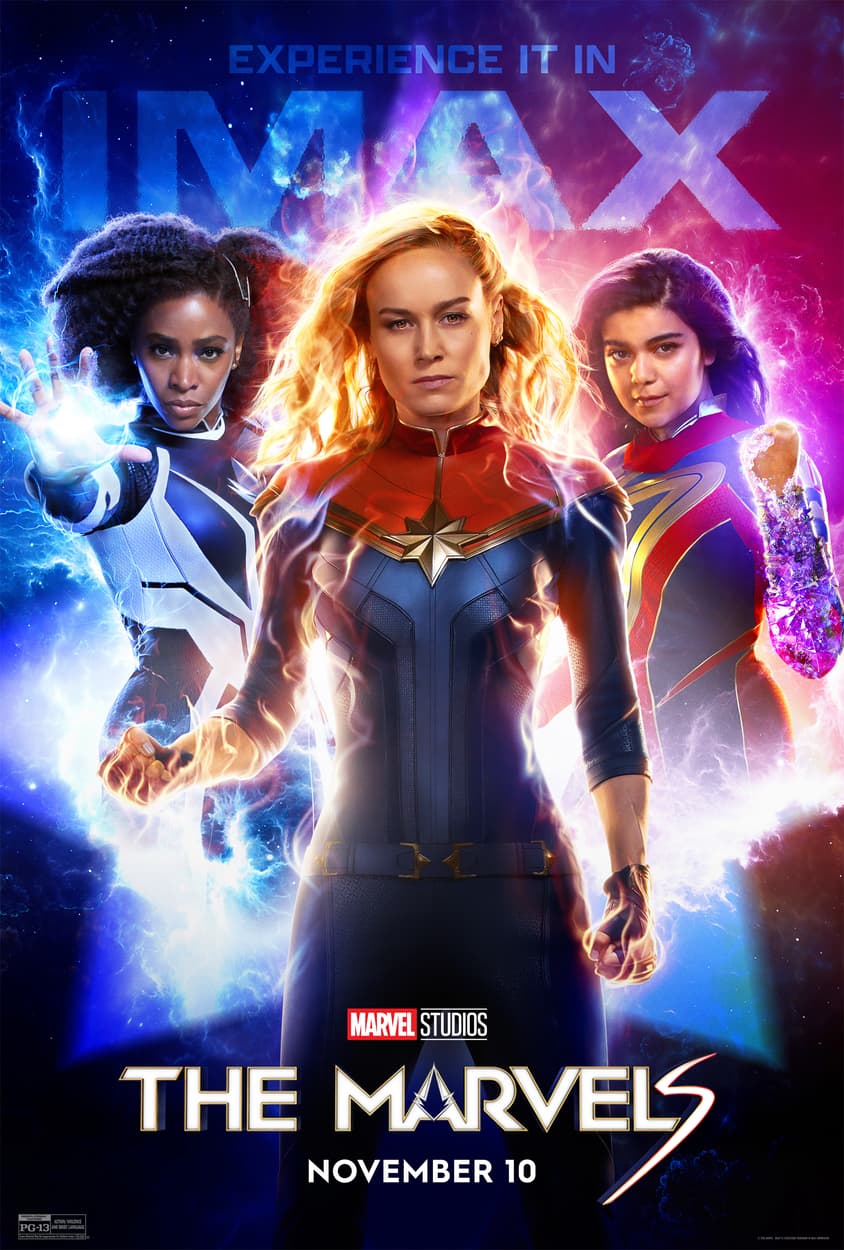
Like Wakanda Forever, the draw for me to see The Marvels is the woman-led cast. When I look at the MCU lineup, I can’t help but notice that men’s stories are prioritized, particularly in Phases One and Two. While women characters are important to the teams or the general narratives, they frequently are outnumbered by their men counterparts. The Marvels unfailingly centers audiences on Carol Danvers, Monica Rambeau, and Kamala Khan. While the ever-present Nick Fury provides support, the three heroes strategize together to defeat their common enemy, Dar-Benn, who is also a woman.

In many ways, the joy of the film is the simplicity. It brings together three characters who initially have some friction. They build trust and confidence in their team, and then they fight the baddie. For my taste, Nia DaCosta understood the assignment; the movie is one hour and forty-five minutes long, and that means the pacing is solid without so many of those masturbatory fight scenes that bog down other Marvel films.

Another way that The Marvels avoids bloat is by bypassing frequent rehashing of MCU information. When I was leaving the theater, the critic behind me complained that he didn’t know what was going on because the film didn’t take the time to explain all of the backstories for the Marvels. He hadn’t seen their respective origin stories. We all know the MCU is sprawling, and very few fans are die-hard completists. The film spent the first 15-20 minutes introducing each character and situating her in her world. It was sufficient to say, “hey, this one’s a loner superhero; this one’s a teenaged superhero with a fangirl crush on the loner; this one’s a scientist superhero who has family drama with the loner.” For people who see The Marvels as their intro to the MCU, they have Captain Marvel, Ms. Marvel, and WandaVision to seek out if they want to add more layers to their knowledge. But, those other sources are not necessary to understand the heart of the movie – build a team and fight the baddie.

Speaking of villains, another success for this movie is Dar-Benn, a Kree Accuser who becomes emperor after the destruction of the Supreme Intelligence. The sun that her planet orbits is dying and as a result, so is the planet. Dar-Benn is a ruler on a mission to save her people – at any cost. While her methods are brutal, there’s a lot of empathy to be had for her, which makes her conflicts with The Marvels more interesting on an emotional level, particularly as we head to the final showdown.

I felt so much joy watching this film. Yes, there was some fanservice in the picture (one of the most dangerous creatures in the universe features prominently), and as a Marvel fan it’s nice to see those call backs. More than that, it was just an all-around great popcorn flick. There was a great balance of levity, seriousness, and intensity. I cared about the characters, and that’s especially true for the newcomers like Dar-Benn. It’s well-worth the cost of the ticket and the time.

Assessment 4.5/5 stars

Dr. Amanda Firestone is an Associate Teaching Professor at the University of Tampa where she teaches film and media studies classes including Women in Film. She is the co-editor of Resist and Persist: Essays on Social Revolution in 21st Century Narratives, Harry Potter and Convergence Culture: Essays on Fandom and the Expanding Potterverse, and The Last Midnight: Essays on Apocalyptic Narratives in Millennial Media

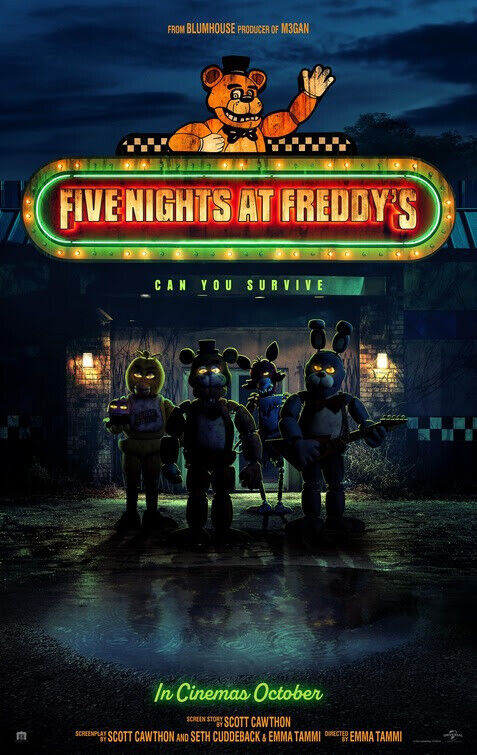
FIVE NIGHTS AT FREDDY’S horror movie review

Fun-filled and creepy! Blumhouse’s Five Nights at Freddy’s is surprisingly good! From the unnerving atmosphere to the practical effects, it’s entertaining and even thoughtful with its exploration of childhood trauma. However, for everything I liked about the movie, I do feel that it should have leaned a little more heavily into Gremlins or Chopping Mall territory because it is a little too serious at times. All in all, the movie is smartly written, with just the right amount of suspension of disbelief. There are even influences of Nightmare on Elm Street and Freddy Krueger’s MO in this movie. If you’re looking for a entertaining time to spend at the cinema on this weekend before Halloween, then you can’t go wrong with Five Nights. After watching the movie, I will now be anticipating Universal Orlando & Hollywood to feature this house at next year’s Halloween Horror Nights.

A troubled security guard begins working at Freddy Fazbear’s Pizzeria. While spending his first night on the job, he realizes the late shift at Freddy’s won’t be so easy to make it through.

I had no idea what to expect since I knew very little about the game. In fact, when I first heard of the game many years ago, I thought it was about the Freddy–Freddy Krueger. Nope. The game is about surviving an abandoned not Chuck-E-Cheese. It’s been probably twenty or more years since I’ve been to a Chuck-E-Cheese–come to think of it–I think the last time I went was when it was known as Showbiz Pizza. When I think of environments and settings that would be naturally creepy whether abandoned or not, Chuck-E-Cheese is one of them. I would imagine that on any given Tuesday night, a Chuck-E-Cheese is unnerving, let alone if it was haunted.

Since I’ve never played the game, I will not be commenting on the translation from interactive media to cinema, but from what I have learned, there is a lot of lore in the game, so I hope that lore is what was brought into the movie version.

Five Nights at Freddy’s benefits from a small cast and few locations. Furthermore, what the movie lacks in the screenwriting department, it makes up for in Emma Tammi’s directing. That’s not to suggest that it is poorly written–quite the contrary–I like how well it was written, given that it’s adapted from a video game and written for (primarily) teens that played the game as kids. Reminds me of a more mature version of Are You Afraid of the Dark? or Goosebumps. As much fun as I had with the movie, I feel that it could’ve used a little more camp in the storytelling–the movie would have benefitted from channeling Gremlins or Chopping Mall to bump up the dark humor and playfulness. The plot is simple and our central character is complex–the recipe for solid cinematic storytelling!

Our central character of Mike (Josh Hutcherson) is relatable, and his behavior feels natural considering the trauma of his younger brother being kidnapped when they were kids. The devastation of the loss of his brother, and later mother and father, has gravely impacted his ability to manage his own life and younger sister (and this is where the movie should’ve made her his daughter because a 20+ year age difference is a little hard to buy). Facing the loss of custody of his little sister to his overbearing, condescending aunt (played by Fried Green Tomatoes‘ Mary Stuart-Masterson), he must survive nights as a security guard at Freddy’s to prove he can care for his little sister. Within the first few minutes of the movie, we have our central character, their external goal, and opposition to the goal. I love when I witness established screenwriting conventions followed–because they work!

While the movie depicts very little on-screen violence and little to no gore, it successfully transfers that fear from the screen into the mind of the audience. That which is suggested in image association or shadow is more terrifying than witnessing it plainly on screen. By keeping most of the violence, death, and gore off-screen, and the adult language to a minimum, this movie works as a gateway horror for older kids and teens that are considering diving into the genre.

The setting is fantastic! I don’t know whether this was an abandoned Showbiz Pizza or Chuck-E-Cheese in real life or not–hope it was–but the setting is ominous and creepy! And because it’s representative of places in real life, it’s easy to imagine ourselves in the same environment. Perhaps it’s not as unnerving as being stalked in your own home like in Halloween or When a Stranger Calls, but there is definitely something naturally scary about being trapped with kids’ toys and animatronic characters at night in a setting haunted by ghosts of its glory days.

I also appreciate the practical effects, puppetry, and character performer costuming in the movie. While I imagine that it’s a combination of CGI and practical, I kept studying the animatronic characters to determine whether it was character performers in costume or of it was exceptionally good CGI–so much so I feel that I could reach out and touch the fur. Had the CGI been overt, then the scares would’ve been far less terrifying as CGI rarely packs the same punch as actors reacting to real props, costuming, and effects.

You’ll not be disappointed if you chose to watch Five Nights at Freddy’s this weekend. Go in with an open mind, and just enjoy a fun horror movie! Don’t overthink it, just be entertained by it!

Ryan teaches Film Studies and Screenwriting at the University of Tampa and is a member of the Critics Association of Central Florida and Indie Film Critics of America. If you like this article, check out the others and FOLLOW this blog! Interested in Ryan making a guest appearance on your podcast or contributing to your website? Send him a DM on Twitter. If you’re ever in Tampa or Orlando, feel free to catch a movie with him.
Follow him on Twitter: RLTerry1 and LetterBoxd: RLTerry

THE KILLER (2023) movie mini-review

The sleeper. David Fincher’s The Killer is lethargic and uninteresting. It’s an uninspired and predictable deconstruction of a hitman that is self-indulgent, lacking any concern for the audience experience.

After a fateful near-miss, an assassin battles his employers, and himself, on an international manhunt he insists isn’t personal.

From the opening credits that are reminiscent of a 1990s movie-of-the-week (MOW) to the exhaustive voiceover narration from beginning to end, this is one movie that you neither want to see in cinemas nor allocate time for at home to watch on Netflix. I am reminded of Fox and FX’s Deliberate Intent (2000), which was a MOW about a first amendment scholar whom is recruited by an attorney to sue Paladin Press after a hit man commits a triple murder by allegedly following a its how-to manual titles Hitman. The deconstruction of the book and hitman contained therein was far more engaging than this sleep-inducing character study by Fincher. Seems hard to believe that a movie about a hitman could lack less dimension and interesting qualities than sheet of cardboard. I kept waiting for the first act to transition into the second, but it’s nearly two hours of a first act and a very rushed third. Anticlimactic best describes the conclusion to this sleep-inducing character study.

Ryan teaches Film Studies and Screenwriting at the University of Tampa and is a member of the Critics Association of Central Florida and Indie Film Critics of America. If you like this article, check out the others and FOLLOW this blog! Interested in Ryan making a guest appearance on your podcast or contributing to your website? Send him a DM on Twitter. If you’re ever in Tampa or Orlando, feel free to catch a movie with him.

Follow him on Twitter: RLTerry1 and LetterBoxd: RLTerry

BEETLEJUICE THE MUSICAL review

Stick to the movie. While I seldom review stage productions, whenever there is an adaptation from screen to stage, I am interested in reviewing it! Touring the country this year are Broadway versions of Beetlejuice, Moulin Rouge, Mrs. Doubtfire, and Clue. Quite the season for screen to stage adaptations. The film professor and critic in me is curious as to the narrative and experiential success of the stage version of a beloved classic movie. Some movies lend themselves to stage versions such as Moulin Rouge and Clue, but others require a bit more imagination such as Beetlejuice and Mrs. Doubtfire. I went into Beetlejuice with an open mind, as I had not read any of the reviews prior to watching it. Since I rarely watch trailers before I screen a film, I wanted to be as fair as possible to a Broadway show based on a movie. Suffice it to say, Beetlejuice the Musical failed to live up to the experience, reputation, and storytelling of the Tim Burton classic Beetlejuice.

Unfortunately, my impression of the musical was off to a negative start as the performance was delayed by 30-minutes–then compound that with two additional technical problem totaling about 30 more minutes of delays, and the musical was going to have to really work some magic to overcome the hobbling out the gate.

Since I am an expert in cinema (not Broadway), I am going to stick to my opinion of the translation from screen to stage, including narrative, design, and music.

The two areas wherein the show suffers most greatly is in narrative and music. But before I talk about the story and music, I want to focus on what the musical did well. And that is the set desigg, lighting, and effects.

Even though the set design, lighting, and effects may not be directly lifted from the stylized versions created by Tim Burton, there is a distinct style to the designs employed by the musical. All the sets feel like extensions of the movie, but still an original enough expression thereof. We even get the sandworm!! The appearance of the sandworm puppet was incredibly uplifting and brought the biggest smile to my face! Classic Burton designs are steeped in German expressionism, and that doesn’t entirely come through in the set designs; however, there are plenty of exaggerated shapes, harsh shadows, and emotive expressions in the design that remind us that this is a work inspired by the creative mind of Tim Burton. The technical theatre dimension of the show was outstanding! I adored the lighting and other effects that set the atmosphere and ambiance on stage.

The Broadway musical is a near complete departure from the movie version, and in the opening number Beetlejuice acknowledges that this is not the movie–however, it would have benefitted from being closer to the movie. When the musical is aligned with the movie, it works very well! Regrettably, when it departs from the movie, the plotting, characters, and music suffer. The best scenes in the show are the dinner party, the Netherworld, and the finale, all very much inspired by the movie. Throughout the show, there are movie moments recreated, but far too few. At least we got the memorable “I, myself, am strange and unusual” line. The stage Beetlejuice feels like a different character than Michael Keaton’s in the movie.

The dialogue and performative dimension of each character was forgettable. No one feels like they are an extension of the movie version, but a different character altogether. Even the dialogue was awful. I get it: Beetlejuice’s schtick is his crass, crude humor. But in the movie, it was always balanced out by more grounded characters and a tone of whimsy. This Beetlejuice is crass and crude simply to be crass and crude–with little paying off dramatically. While I appreciate some of the additional jokes, most were simply better suited for a standup routine than for a narrative work. The characters were speaking with the voices of the musical’s writers and not the voices of the characters as written for the movie. Each character is trying to be more over-the-top than the previous character, and what we wind up with is a cacophony of loud, boisterous, annoying characters.

The story is dramatically changed from the movie. To call it an adaptation is being generous, because there is little that is the same in both the plots from the movie and stage versions. Perhaps this is what happens when you take a 1.5hr movie and try to write a 2.5hr musical. There is simply an insufficient amount of plot to fill that additional hour. I suppose the foundation is the same, but the narrative is expressed very different in the stage version compared to the movie. When moments from the movie were included in the stage version, I literally clapped–that was about the only times I clapped during the performance. This musical should have stuck more closely to the plotting and characters of the movie instead of trying to improve upon it. Even though I will admit that some of the narrative connective tissue in the movie is a bit weak and some story elements feel disjointed, it’s in far more stable shape than the story from the musical.

Lastly, conspicuously absent from the stage version is the iconic Danny Elfman score. While there are moments in the musical’s songs and score that are somewhat reminiscent of the Elfman score, its absence was sorely felt. Not once did I hear the Beetlejuice theme music, not even in the overture or prologue. Elfman’s music is as stylistic as Burton’s cinematic visions, and this musical could have benefitted greatly from the music of Elfman. I had hoped that the musical numbers would have been like the musical numbers from The Nightmare Before Christmas, but they were not. They felt like generic AI-generated Broadway songs from another non-Burton-inspired intellectual property. Elfman’s music for films such as Beetlejuice, Batman and Batman Returns, and Nightmare Before Christmas cannot be lifted for and used for any other movie or stage production. His music is a tangible extension of the characters, plot, and atmosphere of the story. What we got was generic modern Broadway music and songs.

All in all, I was unimpressed with the musical, but I appear to be in the minority on my opinion of the show. My advice to anyone thinking of seeing this show is to go into it not wanting a stage adaptation of the movie, but rather a reimagination of the characters and concept from the movie.

Ryan teaches Film Studies and Screenwriting at the University of Tampa and is a member of the Critics Association of Central Florida and Indie Film Critics of America. If you like this article, check out the others and FOLLOW this blog! Interested in Ryan making a guest appearance on your podcast or contributing to your website? Send him a DM on Twitter. If you’re ever in Tampa or Orlando, feel free to catch a movie with him.
Follow him on Twitter: RLTerry1 and LetterBoxd: RLTerry

KILLERS OF THE FLOWER MOOON film review

Killers of the tension: an important story in desperate need of a better screenplay and editor. It’s a 3.5hr film that feels every bit of 3.5hrs. I’ve nothing against long run times per se; however, the run time needs to be justified dramatically. But unfortunately, the screenplay mechanics and editing (or lack thereof) hold this otherwise compelling story back from the great potential it demonstrably had. Lacking in any significant tension, this film had me looking at my watch after the first hour and a half. I kept waiting for it to kick into gear, but it never truly managed to amp up the tension. Furthermore, all the individual narrative elements never develop strong connective tissue. Even the performative dimension is good, but there lacks any singular performance that truly stands out. While cinema knows no run time, some stories are best told in 90 or 120mins, and this is definitely one of them.

In the 1920s, members of the Osage Native American tribe of Osage County, Oklahoma, are murdered after oil is found on their land, and the FBI decides to investigate.

One of the most highly anticipated films of the year over-promises and under-delivers. Which is a real shame because it depicts such an important story. While many will fixate on the run time alone, that would be unfair as it’s not the run time that is to blame for the lackluster narrative nature of this film. Rather, it is the screenplay mechanics and lack of precision editing.

As I have written many times previously, most directors are not writers. Are some? Well, sure. But most are not equally gifted in both areas. However, many writer-directors allow their ego to get in the way of excellence in writing because they feel it’s the only way to be a true auteur. Scorsese has nothing to prove to solidify him as an auteur, He is inarguably one of the greatest directors of all time. Scorsese’s Taxi Driver is one of the greatest films of all time and it’s under 120mins (2hrs). However, between The Irishman and now Killers of the Flower Moon, it’s as if he feels compelled to intentionally create films with prodigious run times to separate them from streaming content. Cinema knows no run time. Cinema is an experience, and that experience can be had in 90mins as well as 180mins. Like Nicole Kidman says, cinema is where we come together to experience the same film at the same time on a giant screen. Stories that have both plots and characters that are larger than life or incredibly intimate encounters. But I digress.

When a director is writing the screenplay, or has a significant role in the screenplay, then there lacks adequate checks and balances for screenwriting structure and mechanics. The long and short of it is that the story, ethos and all, may make sense in the director’s mind, but that doesn’t mean that it makes sense for the audience. Whereas when the screenwriter and directors are separate individuals, the screenwriter is able to focus solely on the pages in front of him or her without interference from a director. Killers of the Flower Moon strikes me as the type of story that would’ve benefitted from the director not being involved in the actual process. Because of all the nuance of the story and relationships between characters, perhaps this is a situation in which author David Grann writes the first draft and another more established screenwirter comes in from behind and shapes it into its film form (on page, anyway). We saw this with Jurassic Park, in which Crichton’s original screenplay was too novely and David Koepp was responsible for the final screen version.

Even though the screenplay is partly responsible for the improper pacing and lack of dramatic tension in the film, it shares the blame with the film editing (or dramatic montage). Alfred Hitchcock stated that writers and directors should “start each scene as close to the end of the scene as possible” What this means is that each and every scene should be lean and mean, only leaving room for that which advances either plot or character in a dramatic direction. The editing issue that plagues Killers of the Flower Moon is that scenes were either started too early or weren’t cut off in dramatic time. There is almost too much information in each scene that the lack of meaningful, precise editing acts as an anchor, dragging the film’s pacing. Contrary to popular belief, there is no too fast or too slow when it comes to the cadence of a film; but, there is such a thing as proper pacing. It’s the ideal pacing for the dramatic elements in the story.

Killers of the Flower Moon will make you want to read the book or simply look up information on the murders and investigation thereof. The film looks gorgeous and the performative dimension is solid, but as a total package, the film is underwhelming.

Ryan teaches Film Studies and Screenwriting at the University of Tampa and is a member of the Critics Association of Central Florida and Indie Film Critics of America. If you like this article, check out the others and FOLLOW this blog! Interested in Ryan making a guest appearance on your podcast or contributing to your website? Send him a DM on Twitter. If you’re ever in Tampa or Orlando, feel free to catch a movie with him.

Follow him on Twitter: RLTerry1 and LetterBoxd: RLTerry